Quotulatiousness

May 4, 2025

One Fine Day in the British Empire 100 years ago

Filed under: Books, Britain, History — Tags: , , , , — Nicholas @ 03:00

Nigel Biggar discusses One Fine Day by Matthew Parker, which looks at the state of the British Empire in the mid-1920s with a moderately jaundiced eye (as you’d expect for a modern popular history about the empire):

The approach is imaginative: to present a snapshot of the British Empire a century ago, five years after its victory in the First World War, when its territory was most extensive and at what must have seemed its zenith. The result is a display of the Empire in all its ad hoc variety, from the white-majority settler “dominion” of Australia to the non-settler “protectorate” of Uganda. The reader meets colonial officials who were sympathetic and conscientious in their dealings with those they ruled, as well as some who were brutally arrogant and dismissive. He also hears from native people who appreciated the benefits of imperial rule, as well as those who felt humiliated by Western dominance. And he learns that, if the British were late in introducing democracy to India, they were the very first to do so, for its like had never been seen before. To its great credit, no one can read this book and conclude that the British Empire was a morally simple thing.

However, it seems that our snap-shooter was fascinated mainly by the Empire in the east and grew tired as he travelled westward. Of the thirty-seven chapters, he devotes twenty-two to Australasia, the Pacific, South-East Asia, and India. There is very little mention of the Empire in South Africa, almost nothing on the Middle East (Egypt, Palestine, and Iraq) and hardly a reference to Canada. In addition, the publisher appears to have become alarmed at the length, since readers wanting to consult the notes or bibliography are directed to the author’s website.

What is more, the synchronic approach suffers from myopia, relegating major imperial achievements to walk-on parts. We do hear about the Empire’s humanitarian suppression of slavery, but only incidentally. The reader is not told that Britain (along with France and Denmark) was among the first states in the history of the world to repudiate slave-trading and slavery in the early 1800s and that it used its imperial power throughout the second half of its life to abolish slavery from Brazil across Africa to India and New Zealand. And in ending his book by reporting the 1923 cession of Rwanda to Belgium and Jubaland to Italy as tokens of imminent imperial dissolution — “Very soon, of course, the trickle became a flood” is the very last sentence — the author allows the reader to overlook the extraordinary, heroic contribution that the British Empire went on to make in the Second World War, when, between the Fall of France in May 1940 and the German invasion of Russia in June 1941, it offered the only military resistance to the massively murderous, racist regime in Nazi Berlin, with the sole exception of Greece.

While our imperial tourist is a generally an honest reporter, presenting the good as well as the bad elements of the Empire, his account is not innocent of unfairly negative bias.

The problem first manifests itself in the decision to open his account with the story of the mining ruination of a tiny Pacific territory by the British Phosphate Company. He then returns to this in the book’s closing pages, where describes it as a tale of “extractive colonialism at its most literal”. While an attentive reader of the pages in between will notice that the Empire sometimes brought native people economic opportunities and benefits, the lasting impression given by this bookending is that it was — as neo-Marxists have always claimed — basically exploitative. And yet Rudolf von Albertini, whose work was based “on exhaustive examination of the literature on most parts of the colonial world to 1940” (according to the eminent imperial economic historian, David Fieldhouse) judged “that colonial economics cannot be understood through concepts such as plunder economics and exploitation”.1

Parker’s negative bias appears most strongly in his crude, unreflective understanding of the racial attitudes of the imperial British. While he does bring onto the stage colonial Britons who express a range of views of other peoples, including sympathy and benevolence (albeit usually “paternalistic”), he nevertheless tells us that “ideas of white supremacy remained a guiding structural principle of the empire. This racist ideology was a coping stone of empire” (p. 8). What he has in mind is specifically the idea of a fixed “hierarchy of races”, with whites permanently established at the top — “what we would now call white supremacism” (p. 65). Such a view could claim the authority of natural science, since at the turn of the twentieth century “European scientists all still agreed that human beings were naturally unequal … and that there was a hierarchy of races” (p. 138).


    1. D.K. Fieldhouse, The West and the Third World (Oxford: Blackwell, 1999), p. 168; R. von Albertini with Albert Wirz, European Colonial Rule, 1880–1940: The Impact of the West on India, Southeast Asia, and Africa, trans. John G. Williamson (Oxford: Clio, 1982), p. 507.

Everyday Life in the Roman Empire – Culture and Literacy in the Roman Empire

Filed under: Europe, History — Tags: , , , , , , — Nicholas @ 02:00

seangabb
Published 28 Dec 2024

This is the eighth video in my series on Everyday Life in the Roman Empire. In this, I wander about at the beginning, with talk of poetry and philosophy, before realising that the real theme is the extent of ancient literacy. The whole of the remainder is given over to this, and how it enabled a literary civilisation wholly different from our own.

Introduction – 00:00:00
Our perceptions of culture in the Ancient world – 00:01:40
Virgil – 00:03:45
Catullus – 00:05:17
Philosophy in Rome – 00:06:23
The Romans and Stoicism – 00:08:40
The Romans and Epicureanism – 00:10:27
Pretty silver things from Roman Britain – 00:16:25
Broad-based cultural participation in the Ancient World? – 00:19:26
The Ancient World: a largely illiterate civilisation (no spectacles) – 00:28:27
The Ancient World: a largely illiterate civilisation (expensive education, expensive books) – 00:35:40
The Ancient World: a largely illiterate civilisation (economic imperatives) – 00:42:35
The Ancient World: a largely illiterate civilisation (expensive writing materials) – 00:44:44
The Ancient World: a largely illiterate civilisation (difficulties of reading) – 00:49:16
The Ancient memory – 00:53:14
The primacy of oral communication – 00:55:23
The Ancient World: a largely illiterate civilisation (the Second Sophistic and linguistic change) – 00:59:53
Bibliography – 01:08:10
(more…)

QotD: Women and depression

Filed under: Health, Quotations — Tags: , , , , — Nicholas @ 01:00

    Why wouldn’t powerlessness cause depression in women too?

Well, in a backwards sort of way it actually does.

The difference is this: women feel powerful when they are loved, and powerless when they are not, because their instinct wiring tells them that safety lies in being able to form social coalitions and attract a strong mate.

Women, in general (there are always outlier exceptions) don’t get major antidepressive help from just going outside and chopping up a cord of firewood, the way men do. Because the woman’s game is to give a man a good reason to chop firewood for her.

It’s when she can’t do *that* that she feels powerless.

ESR, Twitter, 2024-05-06.

May 3, 2025

Carney sets his agenda

Filed under: Cancon, Government — Tags: , , , — Nicholas @ 05:00

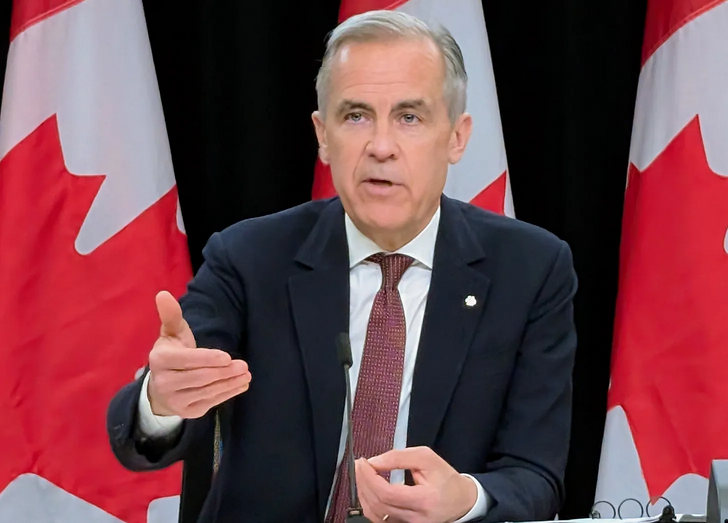
On his Substack, Paul Wells says that newly elected Prime Minister Mark Carney had a good opening press conference on Friday morning:

Mark Carney at the National Press Theatre, 2 May, 2025.
Photo By Paul Wells via his Substack

The first news conference is the easiest, because armies of public servants have been working on deliverables for weeks, and because little has had time to go wrong yet. Even by that congenial standard, Mark Carney had a good morning.

He began by noting something few of us had: that there was no serious organized attempt to reject Monday’s election result. “The leader of every party quickly and graciously accepted the results. At a time when democracies around the world are under threat, Canadians can be proud that ours remains strong.”

Canadians want “big changes quickly”. He promised to work “relentlessly” to deliver. He is “committed to working with others, governing as a team in cabinet and caucus … working in real partnership with provinces, territories, and Indigenous people and bringing together labour, business, and civil society”. Everyone always promises to work with the provinces, at first. He seemed to have something specific in mind. “In the coming weeks, I will unveil more of our plans to engage with Canadians as we embark on the biggest transformation of our economy since the end of the Second World War.”

There’ll be a new cabinet in 10 days. A return to Parliament on May 27. The King will read the Throne Speech. Before any of that, Carney will meet Donald Trump in Washington next Tuesday. He’ll remove “federal barriers to internal trade” by July 1. He’ll “identify projects that are in the national interest, projects that will connect Canada, deepen our ties with the world, and grow our economy for generations”. He’ll build a lot of houses. He’ll hire more border-services agents and muster “dog teams, drones and scanners to fight the traffic in guns and drugs”. He’ll “make bail harder to get for those charged with stealing cars, home invasion, human trafficking, and smuggling”.

There was more but you get the gist. Time for questions! What’s he expecting from his Washington trip? “Quite a comprehensive set of meetings,” mostly on tariffs. Does he expect a better reception than Volodomyr Zelensky got? “Look, I go there with the expectation of constructive — difficult but constructive — discussions.”

How’s he going to make Parliament work, with less than a majority? He offered no details at first, except to point out that the Liberals won more votes on Monday than any party ever has, and that it won seats in every province and a majority of the seats in seven provinces. He said he’s already spoken to Yves-François Blanchet and Pierre Poilievre. Speaking of Poilievre, there’ll be a by-election for the currently discomfited Conservative leader “as soon as possible … No games. Nothing. Straight.” Is the prime minister a subscriber? I don’t divulge such things.

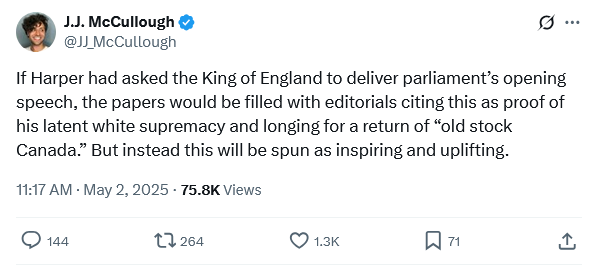
I was pleasantly surprised to find that the PM found a way to include the King in his agenda, but JJ is quite right here:

German democracy under threat from extremely extreme extreme right AfD

Filed under: Germany, Media, Politics — Tags: , , , , — Nicholas @ 04:00

That, at least is the judgement of the German domestic intelligence agency assigned responsibility for sniffing out threats to German democracy:

This morning, the Federal Office for the Protection of the Constitution (BfV) officially reclassified Alternative für Deutschland as a “confirmed right-wing extremist” organisation. The BfV is Germany’s primary domestic intelligence agency; it is subject to the Ministry of the Interior and tasked, among other things, with policing the democratic respectability of ordinary Germans and their political parties. The upgraded AfD classification is supported by an extensive and totally secret 1,100-page assessment of AfD activities and beliefs, which BfV analysts have been preparing since last year.

Everybody expected the BfV to do this. Leading Social Democrats in particular have been urging the BfV to release their new assessment for months. They see it as a political justification for initiating ban proceedings against the party. As I wrote last week, it is now likely that the new CDU/SPD government, or the new Bundestag, or both, will ask the Federal Constitutional Court in Karlsruhe to weigh an AfD prohibition. This new assessment matters mostly because it is the first concrete move in that direction.

The only thing that is really surprising about this news, is the timing: I and everybody else expected the BfV to wait until the CDU and the SPD form a new government and appoint a new Interior Minister. Instead, the sitting Interior Minister Nancy Faeser appears to have forced this assessment through in the final four days of her tenure. This, and not AfD poll numbers (as some have speculated), is the reason this is happening now.

[…]

Among other things, the assessment allegedly cites these extremely right-wing remarks from an 11 August 2024 speech by Hannes Gnauck, who sits on the AfD federal executive committee:

    We must also be allowed to decide once again who belongs to this nation and who does not. There is more to being German than simply holding citizenship papers. All of us here in this market square are connected by much more than just a common language. We are connected by an invisible and simply inexplicable bond. Each and every one of you has more in common with me than any Syrian or Afghan, and I don’t have to explain that – it’s simply a law of nature.

The assessment also includes this absolutely extremist 25 August 2024 statement by Dennis Hohloch, an AfD staffer in the Brandenburg state parliament:

    Diversity means multiculturalism. And what does multiculturalism mean? Multiculturalism means a loss of tradition, a loss of identity, a loss of homeland, murder, manslaughter, robbery and gang rape.

Finally, the BfV would like us to know that their assessment includes this insanely extreme (and since-deleted) tweet from Martin Reichardt, a Bundestag staffer:

    Failed migration policy and asylum abuse have led to the importation of 100,000 people from deeply backward and misogynistic cultures.

Obviously the BfV are leaking their choicest, least arguable, and juiciest bits of evidence – the stuff they think will really turn ordinary Germans against those evil AfD Nazis. I invite you re-read these three passages with that in mind, and then try to imagine for yourself what an absurd cultural and ideological bubble these people must inhabit, to find these remarks scandalous.

Poilievre to run in Alberta riding when the byelection is set

Filed under: Cancon, Media, Politics — Tags: , , , — Nicholas @ 03:00

After losing the seat he’d held for more than 20 years in this week’s federal election, Pierre Poilievre’s political future was clouded. An Alberta MP-elect, Damien Kurek has volunteered to resign so that Poilievre can run in his riding.

Seatless Conservative leader Pierre Poilievre will run in an Alberta byelection as Conservative MP Damien Kurek “temporarily” steps aside.

In a press release, Kurek, the Battle River—Crowfoot MP-elect, said he was relinquishing his seat for Poilievre because it’s “what’s best for Canada” and the riding. Kurek was first elected in the Alberta riding in 2019.

Poilievre lost his Ottawa-area seat to a Liberal challenger by more than 4,000 votes in Monday’s election.

“The people of Battle River—Crowfoot will be represented well by Pierre for the remainder of this Parliamentary session, and I will keep working with our incredible local team to do everything I can to remain the strong voice for you as I support him in the process, and then run again here in Battle River—Crowfoot in the next general election,” Kurek said in a statement.

At a press conference in Ottawa on Friday, Prime Minister Mark Carney said he would call a byelection as soon as possible and that the government would play “no games” with Poilievre’s quest to win a seat.

Apparently, Carney is going with the less-unfriendly path rather than delaying the call for a byelection for the full allowable period (as Justin Trudeau certainly would have done).

Development of the Uzi Family: Standard, Mini, and Micro

Forgotten Weapons
Published 4 Jan 2025

The Uzi was originally designed in the 1950s, and it was on the technological cutting edge at the time. The stamped receiver, telescoping bolt, and compact magazine-in-grip layout made it an inexpensive and effective weapon. Its sedate 600 round/minute rate of fire helped as well, making it easy to shoot effectively. Uziel Gal experimented with a compact version at that time, but dropped the idea when he proved unable to make a smaller version with the same low rate of fire as the standard pattern.

Fast forward to the late 1970s, and the designers at IMI revisited the idea of a compact Uzi. They were willing to accept the increased rate of fire of a shorter receiver and lighter bolt, and their first prototypes were ready in 1978. full export sales began in 1980. The gun was advertised as having a 900 rpm rate of fire, but the reality was much higher.

The final step of classic Uzi development was the Micro Uzi, introduced in 1986. This was actually developed form the semiautomatic, closed-bolt Uzi Pistol made for American commercial sales. That pistol was given a select-fire trigger group and a folding stock, and it became a micro-compact submachine gun for only the most tactical of operators. It was advertised as having a 1200 rpm rate of fire, but this was again underestimated to improve sales.

In reality, the standard Uzi does fire at about 600 rpm. The Mini (in closed-bolt form) ran at 1300+ in my testing at S&B, and the Micro was over 1400 rpm. Where the original Uzi is best kept in fully automatic mode and can easily fire single shots when desired, the Mini and Micro Uzis are definitely best suited to semiautomatic use. Firing them in fully automatic is a much more difficult proposition if one wants to maintain any level of accuracy and situational awareness.

Thanks to Sellier & Bellot for giving me access to this set of Uzis to film for you!
(more…)

QotD: When the Cursus Honorum failed, so did the Roman Republic

Public men in the Roman Republic had always been ambitious — it went with the territory; they built large parts of their culture around it — but by Caesar’s day the vetting process had been completely inverted.

The Old Republic was full of men like Caesar, because people are what they are; there are always potential Caesars running around. But the names of the Old Republic’s Caesars don’t appear in the history books, because back then they still maintained the distinction between process and outcome. If there’s a conflict between them, process must yield, and so even though a potential Caesar did a competent job as quaestor and was ready to stand for curule aedile, he’d be taken aside by an old man (“senate” comes from senex, “old man”) for a stern talking-to … or more than a stern talking-to, if it came to that.

By Julius Caesar‘s day, though, process had completely eclipsed outcome. Again, the “real” Caesar is much debated by historians, but what’s not in dispute is his naked ambition. Everybody knew what Caesar was about, right from the get-go. But since there was no way to stop his climb up the cursus honorum spelled out in the Policies and Procedures Manual, nobody did.

Indeed, by Caesar’s time, the rot was so deep that most (I’d argue all, but I’m not a Classicist) of the offices on the CH were eyewash, just lines on a CV. The curule aediles weren’t managing the grain supply; they had battalions of freedmen running that. They were still putting on games, of course, but they weren’t personally putting them on; again, battalions of clever freedmen did that. The only thing the aedile did for “his” games was pay for them … on credit, and only in order to take the next step up the ladder.

And the rot was, of course, recursive. Caesar at least had clarity: He wanted to be quaestor so he could be aedile; to be aedile so he could be praetor; to be praetor so he could be governor; to be governor so he could be general; to be general so he could be … well, whatever, that’s part of the great debate surrounding Caesar, but it doesn’t matter for our purposes. For us, what matters is that everyone else was doing the same thing, and because all the real work was being done by those battalions of clever freedmen, the quality of Republican leadership dropped off dramatically. How can a praetor-in-name-only accurately judge the competence of an aedile-in-name-only? Yeah, he technically held the office for a year, but he left it as ignorant of its duties as when he entered.

Severian, “Cursus Honorum”, Founding Questions, 2021-12-27.

[NR: Links to the Roman Glossary added.]

May 2, 2025

Trump’s victory lap after getting his preferred PM elected in Canada

In the National Post, Tristin Hopper rounds up American reactions to the Liberal victory in the Monday election, as many Americans seem to agree that Carney’s win was at least partly their doing:

As the U.S. awoke to a renewed Liberal government on their northern border, Americans of all political persuasions embraced the view that they — for better or worse — had caused it.

“Carney owes his job to President Donald Trump,” was the Tuesday view of the Washington Post editorial board, declaring that the U.S. president had singlehandedly thwarted the election of a populist Conservative government in Canada.

The Centre for American Progress Action Fund — a left-wing Washington, D.C.-based think tank — framed Carney’s win as a model for how anti-Trump rhetoric can win elections.

“Prime Minister Carney’s success demonstrates that resistance to President Trump’s bullying has mass popular appeal,” read a statement.

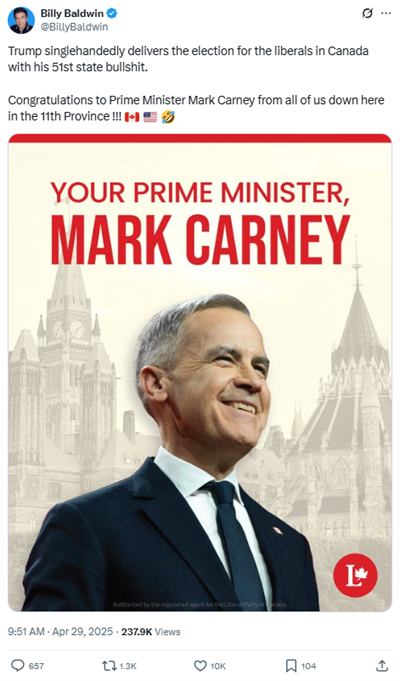
Actor Billy Baldwin, a perennial backer of progressive causes, cheered Carney’s victory with a viral social media post declaring “Trump singlehandedly delivers the election for the liberals in Canada with his 51st state bullsh-t.”

Even Rolling Stone, which put Justin Trudeau on the magazine’s cover in 2017, opined that Canada’s newest Liberal government was effectively a Trump creation. “Donald Trump single-handedly elected a new Canadian Liberal Government that was down 25 points in January with his endless ’51st State’ bloviation,” wrote the publication.

Conservative podcaster Ben Shapiro broke down the Canadian election in an extended segment on his Tuesday show, framing it as a direct failure of Trump’s foreign policy.

“Let’s be real about this; the rhetorical attacks on Canada have not actually resulted in a net good for the United States,” said Shapiro. A perennial critic of Trump’s tariff policy, Shapiro said that the White House’s habit of “yelling at Canada” had helped install a “far left-leaning internationalist” hostile to U.S. interests.

“All of this started off as a joke, and I think President Trump is so committed to the bit at this point that he couldn’t get off the train,” said Shapiro, in reference to Trump’s repeated pledges to turn Canada into the “51st state”.

A Republican consultant quoted anonymously by Politico on Tuesday was of a similar view, saying the outcome in Canada was a “pretty specific result based on the tariffs and 51st state trolling.”

On his Substack, Paul Wells offers some advice to Mark Carney about his dealings with Pierre Poilievre at this awkward time for the Conservative leader:

Stornoway in the Rockcliffe Park area of Ottawa, Ontario. It has been the official residence of the leader of the Official Opposition in Parliament since 1950.

One danger for Mark Carney is that he will be taught how to be a terrible politician by terrible politicians. A low-stakes test case is at hand. In this as in all things, a decent guiding principle should be: Don’t be like your opponent, and don’t be like your predecessor.

The test at hand is the uncomfortable predicament of Pierre Poilievre, who used to be a Member of Parliament and may want to be one again. In the meantime he is still the leader of the Conservative Party of Canada.

Poilievre lost his seat in Carleton on Monday night. This is not entirely his fault. Liberal campaign teams from neighbouring ridings were invited to spend part of their time door-knocking in Poilievre’s riding. But candidates should try to win even when their opponents work hard to defeat them. I bet this thought has occurred to Poilievre since Monday.

The usual route to the Commons, for a leader who is not yet an MP, is to run in a by-election. Often new leaders find a sitting MP somewhere to vacate their seat and enable a by-election. Brian Mulroney ran in Central Nova in 1983, Jean Chrétien in Beauséjour in New Brunswick in 1990, Stephen Harper in Calgary Southwest in 2002.

Assume Poilievre can find some Conservative MP-elect willing to abandon a seat they just won so Poilievre can try his chance (again). How should Carney react?

It’s really a question in three parts. Should a by-election be held quickly or much later? Should the Liberals run a candidate? Should the Poilievre family keep living at Stornoway, the Opposition leader’s official residence, in the meantime?

I’m hearing from a lot of people who say Carney should wait as long as the law permits — up to a half year after a seat opens — before calling the by-election; that the Liberals should definitely run a candidate; and that Poilievre and his family should be evicted from their current fancy abode.

I spent part of Wednesday debating these questions with readers on Substack Notes. Most of the people offering this advice — let him twist, then hit him hard — pointed out that if Poilievre had a say about an adversary’s career plans, he would do everything in his power to make that adversary hurt.

I think it’s bad advice. It manages to be bad tactics and bad for the soul. The two considerations don’t always line up, but here they do.

Carney should call a by-election as soon as possible after a sitting MP resigns — 11 days after the notice of vacancy is received, the minimum permitted in law. If asked, he should prefer that the Poilievre family stay at Stornoway in the meantime. And while the third question is less clear, I’d argue that the Liberals should refrain from running a candidate in the by-election.

This plan would have Poilievre back in the Commons as soon as possible, with minimal risk and discomfort. He’ll be lucky to receive such generous treatment and, while I’m less confident than ever that I know how he thinks, what he should feel is gratitude. I suspect the feeling would confuse him.

Monkey Rockets, beavers with Parachutes, and the Fall of Empires – 1948 Newscast – W2W 26

Filed under: Europe, History, USA — Tags: , , , , , , , , — Nicholas @ 04:00

TimeGhost History
Published 1 May 2025

In 1948, the Cold War intensifies as Stalin blockades Berlin, triggering a dramatic US-led Airlift to save West Berlin. Meanwhile, the British Empire continues to crumble as Burma, Ceylon, and Palestine gain independence — with Israel’s declaration igniting immediate war. America launches the Marshall Plan, the Soviets tighten their grip in Eastern Europe, and televised anticommunist hearings captivate the US public. The year ends with humanity pushing new frontiers — from launching monkeys into space to relocating beavers by parachute — showing just how rapidly the world is changing.
(more…)

The New York Times still values “the narrative” more than the truth

Filed under: Media, Military, Politics, USA — Tags: , , , , , — Nicholas @ 03:00

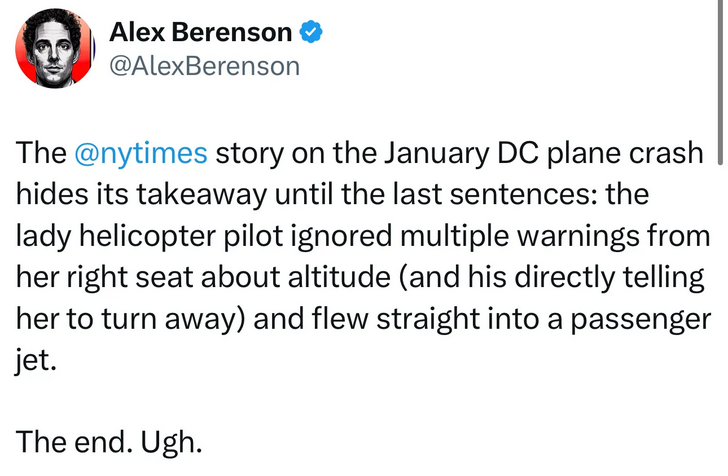
Alex Berenson on the way the New York Times chose to present the summary of the crash investigation on the fatal collision between a US Army Black Hawk helicopter and a commercial passenger aircraft over Washington DC:

The New York Times cannot stop mangling the truth to serve its political goals.

On Sunday, the paper exhaustively examined the collision between an Army Black Hawk and an American Airlines jet that killed 67 people over the Potomac in January.

The massive 4,000-word article claimed the crash had many causes, including an overworked air traffic controller. “Missteps, Equipment Problems and a Common but Risky Practice Led to a Fatal Crash“, the Times proclaimed.

Except that’s not really what happened. Or what the Times found.

Yes, the controller was busy. Yes, the Black Hawk pilots wore night-vision goggles that can, ironically, complicate seeing in cities with lots of ambient light.

Those choices and problems raised the risks of an accident.

But despite all the words the Times devoted to explaining the crash, its root cause was simple. The Black Hawk was flying too high. It flew directly into the CRJ700 regional jet. The plane’s pilots and passengers had no chance.

That’s the reality. The second reality is that an inexperienced female Army pilot, Capt. Rebecca Lobach, 28, (CORRECTION: original article said 36) was at the controls of the Black Hawk when it hit the CRJ700, on a training and evaluation mission.

What the Times actually found, the news in the article, is that the Lobach’s copilot repeatedly warned her the helicopter needed to descend in the minutes before the accident. Just seconds before the crash, he suggested she tack left, a path that would likely have avoided the jet.

She didn’t respond.

In other words, the story here is that Lobach — who had never deployed overseas but had volunteered in the Biden White House and whose obituary prominently called her a certified advocate for “sexual harassment” victims — flew her helicopter into a passenger jet and killed 67 people, including herself.

HBO’s Rome – Ep 6 “Egeria” – History and Story

Adrian Goldsworthy. Historian and Novelist
Published 30 Oct 2024

This time we come to Episode 6 of Season 1 of ROME. This one is very much based around the City of Rome itself and places Antony centre stage. In the video we look at the actual history and how well the show reflects this. For more detail on the history, have a look at the videos in the Conquered and the Proud playlist.

QotD: The Victorian attitude toward illegitimacy

Filed under: Britain, History, Quotations — Tags: , , , — Nicholas @ 01:00

Perhaps nothing divides us more profoundly from the Victorians than our attitude towards the illegitimate child (even the word illegitimate has almost disappeared from use in this context, as being unfairly stigmatising). That the sins of the parents should be visited upon children, by regarding those children themselves as tainted, seems morally monstrous to us, self-evidently cruel and unjust. We cannot even imagine — and I include myself — how anyone could be so morally primitive as to disdain a child merely because its parents were unmarried: and this is so however much we may believe in the virtues of marriage as an institution. The idea of fallen women also seems to us now to be horribly censorious, and hypocritical into the bargain: for no one ever spoke of fallen men, though they were essential to, the sine qua non of, the existence of fallen women.

I am still shocked by the recollection that, as late as the early 1990s, there were still a few women in psychiatric hospitals in Britain who were there principally because they had been admitted seventy years earlier after having given birth to an illegitimate child. No doubt they had quickly become institutionalised and could scarcely have coped with life outside; but to think of a long human life passed in this impoverished way (the wards for “chronics” had beds so close together that they allowed for no privacy whatever) as a kind of punishment for what is now no longer regarded even as an indiscretion, reminds one of La Rochefoucauld’s dictum that neither the sun nor death can be stared at for long. One cannot fix one’s mind on such a horrible injustice for long.

Of course, it was stigma like this that gave stigma itself a bad name — stigmatised so to speak, in fact, to such a degree or effect that the very name of stigma has a completely negative valency. No one has a good word to say for it, though whether there ever was, or could be, a society completely without it, I am unsure.

Theodore Dalrymple, “The Situational Nature of Scorn and Stigma”, New English Review, 2020-04-28.

May 1, 2025

Canada’s Conservative Party – every silver lining has a cloud

Filed under: Cancon, Media, Politics — Tags: , , , , , — Nicholas @ 05:00

In the National Post, Colby Cosh considers the state of the party for the federal Conservatives after an election campaign that looked radically different than the one they had prepared to fight for more than a year:

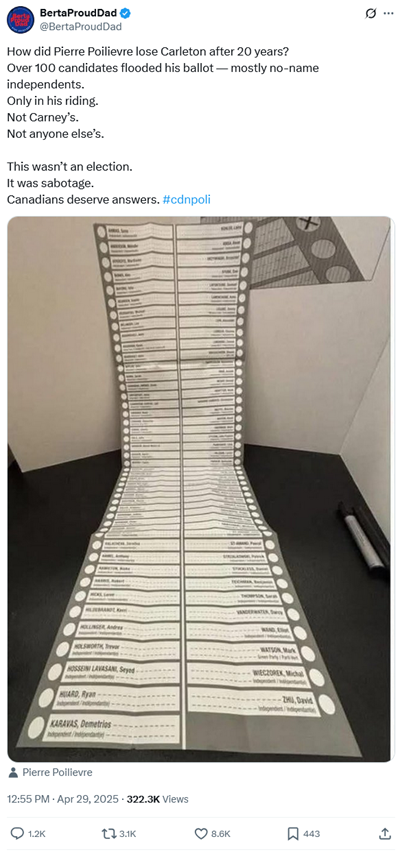
Pierre Poilievre’s riding had an insane number of protest candidates registered for the election. Oddly, the same wasn’t true in any other riding in the country. This was an organized protest for electoral reform, supposedly.

The Conservative opposition is now bound to have a difficult year, with their leader inexplicably, inexcusably ejected from the Commons. Dedicated haters of Pierre Poilievre won’t find anything at all inexplicable about the Carleton disaster, but there will need to be a proper autopsy. Especially since Poilievre’s party gathered more vote share nationally than any right-wing party — or combination thereof! — has achieved since the days of Mulroney.

Even in Ontario, Poilievre’s Conservatives got over a million more votes than the hyper-critical Ford PCs did in a provincial election 60 days earlier, and they are headed toward a higher vote share within the province. So is Poilievre a generational leader potentially on the brink of a dynasty, or an unloved boob who got caught flat-footed by a change in public mood? I promise you that the quarrelling over that question is well underway.

I assume the CPC will keep its unlucky leader, which leaves only the question, “So then what?” The Liberals don’t have to call a by-election until six months after someone decides to resign to make way for Poilievre. And maybe I ought to say “if someone decides”. It’s not essential for a party leader to have a Commons seat, but it would certainly be ideal, especially with the Commons hung.

The Conservatives are bound to find themselves adopting more of a team approach to the Opposition job by default, and maybe this ought to have been considered while it was still optional. Even by Canadian standards, the CPC campaign was very leader-focused, and was obviously predicated on the idea that the people really wanted Poilievre and would like him more as they saw more of him. (And, again, this may actually have happened!) Now there’s a chance the CPC’s House leadership performs well over the next year or so — and then has to fade into the wallpaper behind the guy who already lost.

When “looming dystopia” is the preferable scenario

Filed under: Bureaucracy, Economics, Government, USA — Tags: , , , — Nicholas @ 04:00

Elizabeth Nickson on just how badly the great and the powerful have managed to screw up so badly that instead of opening for Anthrax at the Hollywood Bowl, “Looming Dystopia” might actually be one of the better possible futures we face:

I asked Grok to show me Looming Dystopia opening for Anthrax. This is the “in Gothic style” version.

I am a person of faith, of Christ, not a very good one, but one who has been devoted for a long time. I’m not saying I didn’t spend twenty years in the great big glittering world, where I indulged every whim, lived among the powerful, beautiful, God- hostiles, adopted their habits of speech and dress, went to every small exquisite museum, the play of the moment, the art openings, the restaurants and parties, became a sophisticate able to live within that world as handmaiden or companion. I mean, for almost ten of those years, I had a husband who never, not once, came home without a present. But even that came of prayer, of a desire fulfilled a wish granted, of prayer, as in “You want this? Ok then, you will sicken, but here it is”.

That world – the enrichment of culture that came out of the 80’s and 90’s – determines today. That life is the model and goal for many and in fact, now the design, the plan laid out by those who plan the future of the world. Humans shunted deliberately into city life, then enhanced via surgery and chip. Indulgence, consumption, fighting for preference, ambition. Cultural creatives, unmarried, oddly-sexed, politically left would determine the future, their gifts the siren call of the arts, fashion, grand bohemia, Hollywood, eat, drink and travel merrily. The end goal of life: your individuality, your woundedness, your self care, the full expression of your specific gifts. If you are lucky you too can be Lady GaGa or BlackPink and have stadiums roar when you appear. Other humans? The state will take care of them, do not worry. Maybe they will die off. Like dinosaurs.

The central banks have gamed this going forward, making the insane assumption that this social movement was permanent. Did they depend on feminism and drugs to stop the next step, ie, young people leaving the city to build families? Even if they did, they thought they could stop it. Why? Because fascist greens like John Kerry, told them that rural regions must be left to “recover”.

Therefore they gutted the suburbs of financing, because “poor land use”, and “too much car required”, which is preposterous in the Americas with all this land. What else does a young family want but trees and parks, and lawns and a neighborhood of friends, not riven with whores, crackheads and murderous migrants?

The ‘08 crash was predicated on Thatcher’s fiscal success in selling people their council houses in the 80’s. Wonderful! thought Bill Clinton’s team, let’s lead marginal Americans into housing, and lo, we still haven’t paid the freight for that insane idea. I had a paralegal friend in Florida who was foreclosing on $500,000 loans to actual crackhead whores. Clinton’s people, lost in their greed and benevolence, forgot that the British council estate dweller was homogenous, placed, as in deep roots in the area, and stable. In the U.S and Canada, idiot banks lent to just about any joker who turned up with a plausible story. Then the speculators invaded, everyone cashed out merrily, then ka-boom. And pioneering walking away with $100 million from government “service” was Jimmy Johnson, Head of Fannie Mae.

I mean, it’s stupid. The western world’s current bankruptcy (and it’s severe) was caused by Central Bank clowns. Those ridiculous, repellent, hideously expensive COP #8,789 conferences had two outcomes: banks would be compelled to lend to green, require green, require climate mitigation, and jump through DEI, ESG hoops, and governments would chunk up green regs. And prosperity would bloom! Not only that, they surreptitiously, across the world, funded actual companies that poisoned the air, water and land. And when I say “they funded”, I mean the taxpayer did. A lot of our money went into insane outfits like this:

And just like Malcom Gladwell’s tipping point – it took ten years – boom, economic activity came to a screeching halt, except for the wreckage of green energy enterprises everywhere, government debt and re-financing. For instance, the Obama-created outfit, the Ivanpah Solar Power Facility, that consists of three solar concentrating thermal power plants in California burned through $1 billion before it collapsed in February. It is one of thousands across the west, all subsidized by the taxpayer. Unwittingly. The press is so embarrassed, they don’t report the trillions lost to green energy projects.

Again, the central bankers own this.

Central bankers have become a metastatic cancer on the economy. By definition, they are late adopters on the marketing curve. By the time they notice something and make their plans upon it, it’s over and something new is growing. Today, the mega-cities everywhere are emptying of everyone over 30 with an income, even or rather especially in China, where the young have just said … nope, a pox on your Commie plans. Chinese, European, British, American, everyone is trickling back to the towns of which their ancestral memories sing, where they can root, where they can live smaller, without environmental toxicity, the rank depravity of the super-culture, the ruinous stupidity of green. The great cities are now super-dangerous for women, and that is spreading as the autocrats in power force violent young men into towns. Last week a young woman in Vancouver fought off a migrant who tried to kill her three times in Stanley Park. My modest, Christian, pioneer family who built the early city along with their community of 10,000 and neglible government, made that park in the early 1900’s; my great grandmother was the first woman to ride a bike in bloomers through that park. It was so safe for 100 years you could let kids play in it after dark, calling them home with a whistle. It is one of the world’s great urban parks, more astonishing than Central Park. This is an outright tragedy. And it is unnoticed, unreported, except on TikTok.

« Newer PostsOlder Posts »

Powered by WordPress