
The Korean War by Indy Neidell
Published 6 May 2025The Senate Hearings digging into Douglas MacArthur’s dismissal as UN forces commander begin this week, though they’ll likely continue for some time. Meanwhile in the field, the Chinese Spring Offensive that raged all last week continues, although it cannot reach Seoul, and by the end of the week the enemy seems to be withdrawing on all fronts.
(more…)
May 7, 2025
The Korean War Week 46 – The MacArthur Senate Hearings Begin – May 6, 1951
Comments Off on The Korean War Week 46 – The MacArthur Senate Hearings Begin – May 6, 1951
Ontario versus the courts
In general terms, you would expect the government — in this case the Ontario provincial government — to pass the laws and the courts — when called upon — to rule on their legality. We don’t expect courts to act as if they can overrule legislation passed by the government unless it clearly contravenes the Charter or goes beyond the powers assigned to that level of government. But Canadian courts seem to be choosing to expand their powers to curtail the actions of elected government more and more these days:

Bike lanes on Yonge Street north of Bloor Street in downtown Toronto.
Image from Google Street View
In the weeks of the election period, Canadian courts were busy preventing any legislation of controversy from taking effect — and they went relatively unnoticed. On March 28, the Ontario Superior Court of Justice blocked the Ontario government from banning supervised consumption sites near schools and daycares. It struck again on April 22, halting the Ontario government from removing Toronto’s bike lanes.
Days later, on April 24, the Quebec Superior Court cancelled the province’s planned mega-tuition hike for out-of-province students.
In the case of Toronto’s major bike lanes — on Bloor Street, Yonge Street and University Avenue — Ontario Premier Doug Ford had, in theory, all the power he needed to remove them. Municipalities are creatures of the province, and traffic regulation is also a provincial domain; thus, provincial legislatures can override just about anything that a city council does, especially if related to roads. So, in November, Ford legislated the removal of the lanes, which were previously constructed by city authorities (he was later re-elected premier, so clearly bike lane preservation wasn’t a priority for voters).
In December, cycling advocates launched a court challenge that, really, should have been laughed out of the room. They argued that the removal of bike lanes amounted to a violation of their Charter rights, specifically the Section 7 catch-all right to life, liberty and security.
It remains to be seen whether there is a Charter right that guarantees two per cent of the population the right to have specialty lanes built for their commuting pleasure — the trial process is still underway. In the meantime, Ontario’s Judge Paul Schabas, a Liberal appointee, has granted the cycling advocates an injunction to keep the lanes in place, because allowing their dismantling to go forward would impose an injunction-worthy risk of “irreparable harm” to Toronto’s cyclists.
“There is no evidence that the government has engaged in any planning as to how the bike lanes will be removed or what will replace them,” Schabas wrote in the decision. “The demolition and reconstruction will create its own impacts on traffic — both for cyclists and motor vehicles — and will likely result in considerable disturbance and congestion while that is taking place. Cyclists who continue to use these routes will be at risk of irreparable physical harm for which … the government will not provide any compensation in damages.”
And, just like that, a judge overruled a decision of the elected legislature, opting instead to take, temporarily, the zero-risk-tolerance advice of unelected government consultants. It’s at least good that Ford is appealing Schabas’ decision.
Comments Off on Ontario versus the courts
Boldly Bombing Bugger All – The Bomber War Episode 1
HardThrasher
Published 13 Oct 2023To see more on the Fairey Battle go here – The Fairey Battle – Light Bomber, Hea… also subscribe to Rex’s channel, he’s ace
Selected Online Resources
https://en.m.wikipedia.org/wiki/Point…
https://en.m.wikipedia.org/wiki/Butt_…
https://en.m.wikipedia.org/wiki/Area_…
https://en.m.wikipedia.org/wiki/Casab…
https://discovery.nationalarchives.go… – Western War Plan W5a and W6Selected Bibliography
America’s Pursuit of Precision Bombing 1910-1945 – McFarland et al.
Dresden – Sinclair McKay
Dresden; Tuesday … – Fredrick Taylor
Absolute War – The Firebombing of Tokyo – Chris Bellamy
Black Snow –
Bomber Command – Max Hastings
Bomber Command’s War Against Germany, An Official History – Nobel Franklin et al.
The Bomber Mafia – Malcolm Gladwell
Undaunted and Through Adversity (Vol 1 &2) – Ben Kite
United States Strategic Bombing Survey (European War) (USSBS) Sept 1945 – Var. – https://collections.nlm.nih.gov/catal…
America’s Pursuit of Precision Bombing 1910-1945, McFarland
Big Week – James Holland
Comments Off on Boldly Bombing Bugger All – The Bomber War Episode 1
QotD: China’s millennia-long struggles between farmers and nomads
Two centuries of émigré rule had changed the South forever, but the North had also changed, which brings me to the second great theme of Chinese history to emerge in this period: the polarity between settled farmer and nomadic barbarian. This has always been viewed as a sharp dichotomy in official imperial historiography, but as I discuss at length in my review of The Art of Not Being Governed, the reality was that it was always more of a spectrum. When times got tough, or when state capacity waned, formerly loyal peasants had a tendency to migrate to the peripheries and start lynching nosy census-takers. In fact, this probably accounts for many of the seemingly vast swings in population that China has had over the centuries.1
But this time it wasn’t just Chinese peasants moving around and changing the way they lived. For the first time in recorded history, the Chinese civilizational heartland of the Yellow River valley was invaded and occupied by a massive number of non-Chinese people. It’s an extremely sensitive and difficult to discuss topic in China, but there is genetic evidence of substantial steppe admixture in Northern Chinese lineages, and it seems likely that this is around when it kicked off. Meanwhile, remember that huge numbers of Northern Chinese were migrating to the South at around this time. Our best guess from both ancient DNA and linguistic2 evidence is that the modern Southern Chinese are pretty close to what the Northern Chinese were a couple thousand years ago, while the modern Northern Chinese have a good amount of Turkic and Mongolic ancestry.
The thing is you don’t even need to look at the genetics, it’s also quite apparent from the literary, artistic, and military record that over time a hybrid aristocracy emerged in the North with influences from both the old Chinese nobility and the invaders. The change is visible in everything from fighting style (suddenly Chinese armies are using cavalry), to fashion (pants!), to preferred hobbies (suddenly a lot more archery and falconry). It was this mixed-blood elite that finally reunified North and South China, and eventually gave rise to the glorious Tang dynasty.
This may have been the most shocking fact I learned from this book. I’d always thought of the Tang as the most quintessentially Chinese of all Chinese rulers (and moreover the real beginning of “modern” Chinese history). Chinese people tend to think that way too — “Tang” is a still-used archaic ethnonym for the Chinese ethnicity (the same way that it’s recently gotten trendy in the West to use a different archaic ethnonym, also the name of an ancient dynasty, “Han”).3 The idea that the Tang actually represented an intrusion of alien Turkic influences into Chinese society is not at all the mainstream view within China, but it’s pretty much the Western scholarly consensus, and Graff lays it out convincingly.
There’s a lot more to say about the great Tang, and this book has a lot of details on their expeditions past the Tarim Basin into Central Asia and their battles with Arab armies. But all of that is getting back into the well-covered part of Chinese history, the part that you can read about anywhere else. And I’ve gotten all the way to the end of this review while neglecting the most important part: were there preppers in the Jin dynasty, and if so how did they deal with the total breakdown of society followed by two centuries of anarchy?
Were there ever. While most of the country fell prey to bands of marauders and tribesmen who roamed the land committing unspeakable crimes, there were a few village headmen and petty aristocrats who constructed fortifications, stockpiled food and weaponry, and carved order out of chaos. There, in their redoubts, they kept the flame of civilization alive and sheltered their people against the long night. If you ever run into me at a party, there’s even odds I’ll quote this passage at you:
When his home was threatened by troops of one of the princely armies in 301, [Yu Gun, a minor official] led his kinsmen and other members of the community into the high country to the northwest. “In this high and dangerous defile, he blocked the footpaths, erected fortifications, planted [defensive] hedges, examined merit, made measurements, equalized labor and rest, shared possessions, repaired implements, measured strength and employed the able, making all things correspond to what they should.” On several occasions when bandits threatened his hilltop sanctuary, he was able to deter them simply by deploying his armed followers in orderly ranks.
There’s so much that’s beautiful in this passage, I feel like I could write an entire book about it. One thing I love is the way it embodies Joseph de Maistre’s aphorism that “contre-révolution ne sera point une révolution contraire, mais le contraire de la révolution.” Yu doesn’t just oppose strength with strength, he battles the insanity and entropic forces raging outside his walls by creating hierarchy, tranquility, and harmony within. His “armed followers in orderly ranks” are a military manifestation of the “making all things correspond to what they should” that preceded them. And there’s something very profound and very true in the image of the forces of disorder recoiling from his little island of civilization like a vampire faced with a crucifix.
John Psmith, “REVIEW: Medieval Chinese Warfare, 300-900 by David A. Graff”, Mr. and Mrs. Psmith’s Bookshelf, 2023-06-05.
1. Yes, alas, this means some of the death tolls parodied in the “Chinese history be like” meme are almost certainly exaggerations. When the census says 160 million one year and 120 million the next, it’s possible that a ton of people died, but it’s also possible that it just got a lot harder to take a census.
2. All the high mountains and sheltered valleys in Southern China mean it has massively greater linguistic diversity than the North, but many of those languages actually turn out on closer inspection to be snapshots of Northern Chinese languages at some much earlier point in history. It’s more evidence, consistent with the genetic evidence, that repeated waves of migrants have entered Southern China from the North, and then stayed fairly isolated.
3. The word in Chinese for overseas Chinatowns literally translates as something like “Tang people street”.
Comments Off on QotD: China’s millennia-long struggles between farmers and nomads
May 6, 2025
If “a trade imbalance constitutes an American ‘subsidy’ justifying annexation of that country, then the US is going to have to annex most of the planet”
Despite getting his preferred choice elected as Canadian Prime Minister, US President Donald Trump still seems determined to troll Canadians about becoming the “51st state”. Among his shifting set of justifications for this is the trade imbalance between the US and Canada, which Trump chooses to interpet as a “huge” subsidy the US is providing to Canada. On that basis, there are going to have to be a lot more US states in the future:
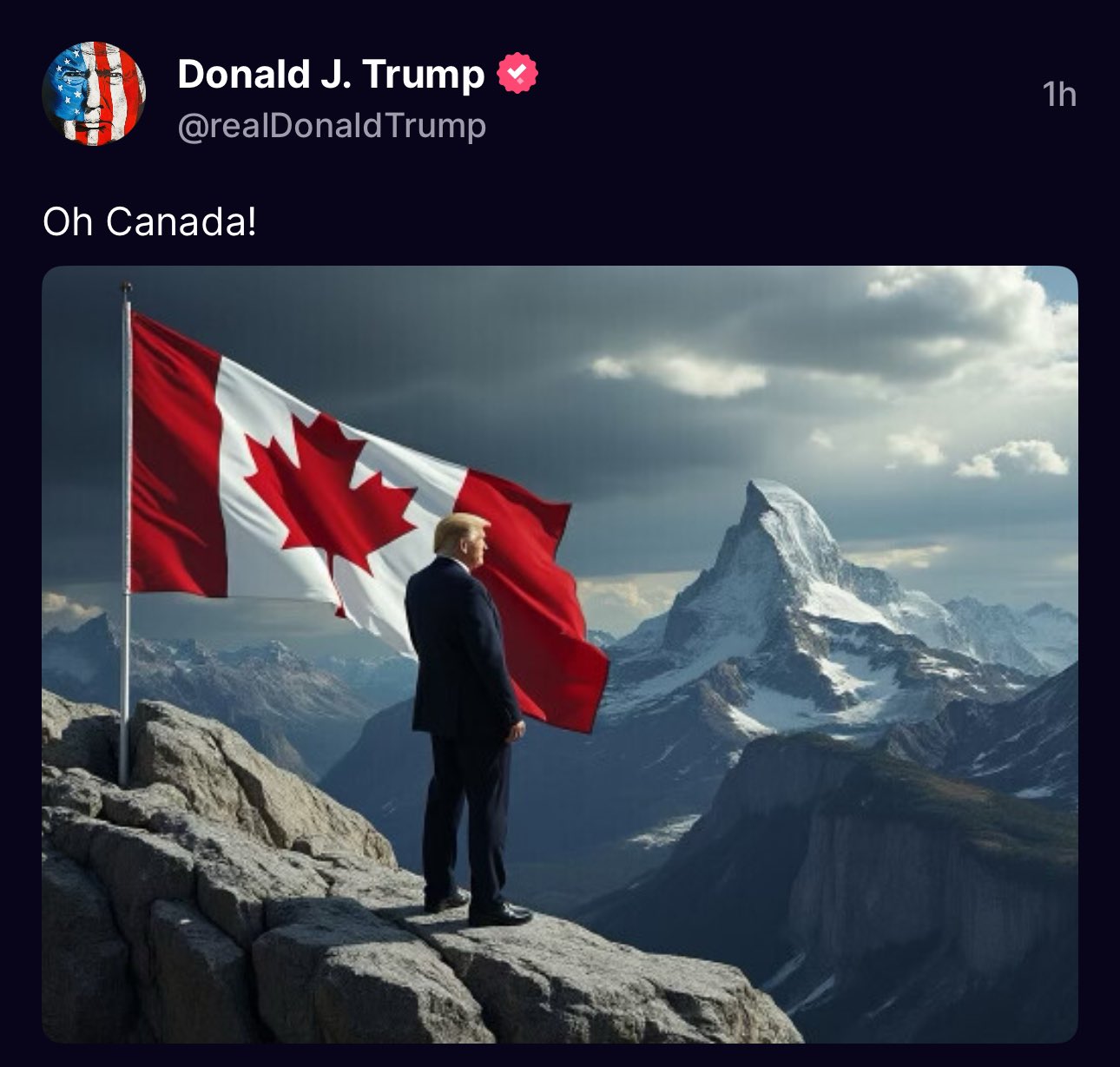
So now we have serious commentators gaming out the pros and cons of war with Canada. What started out as a mildly amusing bit of presidential “trolling” is now being discussed as next year’s Donbass.
If, for the purposes of argument, one accepts the President’s line that a trade imbalance constitutes an American “subsidy” justifying annexation of that country, then the US is going to have to annex most of the planet: last year Washington had a one-and-a-quarter trillion-dollar imbalance with the world. It’s not hard to figure out why: over recent decades the uniparty turned a country that used to make things into a crappy low-wage service economy. […] The US now has trade imbalances with — or “subsidies” of — not only the countries that you’d expect (China, Mexico, Germany, Japan, India) but a lot of ones you wouldn’t (Finland, Algeria).
True, Canada is closer than Algeria, so there are national-security implications for Washington: the country and its politicians (Trudeau, Carney) have been entirely hollowed out by Peking, but then so it goes south of the border (Biden, McConnell). And Trump’s plan for a “fifty-first state” will not solve that problem.
The “fifty-first state” shtick can’t ever have been serious, can it? Geographically, the fifty-first state would be bigger than the other fifty combined, and with a bigger population than California’s. Last time they added stars to the flag, both parties got something out of it: the GOP Alaska and the Dems Hawaii. So wouldn’t it make more sense to make Canada’s ten provinces and three territories a baker’s dozen of new American states with a couple of senators apiece? Yeah, sure – if you want Republicans never to win a national election again.
So, aside from last week’s vote, how is the other side reacting? Last Thursday’s print edition of The Spectator contained a curiously phrased squib from my old editor, Charles Moore:
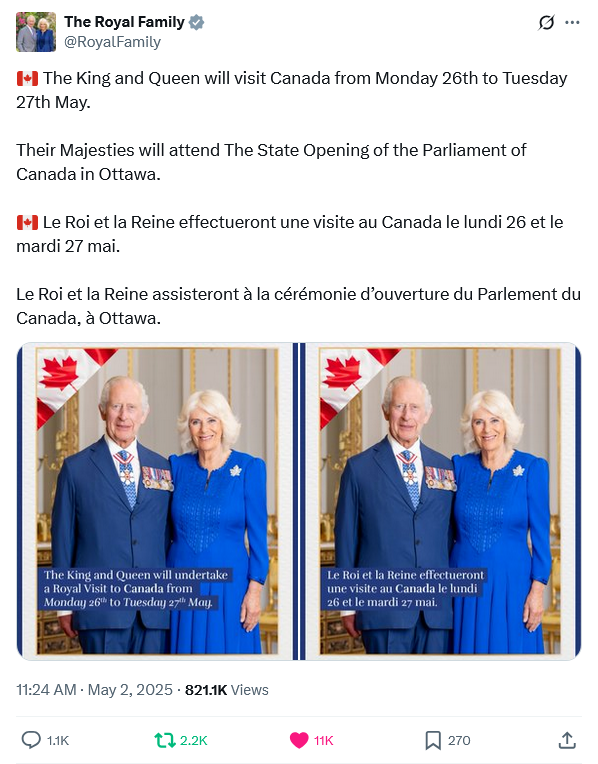
The President may be only hazily aware that the King, of whom, he says, he has the “honour to be a friend”, is also King of Canada. If, as seems likely, the King follows his mother’s twice-used precedent and opens the new Canadian parliament in person, Trump may come to see that his next-door neighbour is part of a long-standing, legitimate order which Canadian voters are happy to endorse.
Let’s just run that again:
If, as seems likely, the King follows his mother’s twice-used precedent and opens the new Canadian parliament in person …
The last time his mother opened Parliament in Ottawa was in 1977 — her Silver Jubilee year. Trudeau-wise, Justin’s father Pierre was not keen on it, but didn’t feel he could pick and win a fight with the Palace over it. A quarter-century later, Trudeau’s successor Jean Chrétien, a towering colossus of micro-pettiness, was annoyed at being given a crappy seat at the Queen Mum’s funeral and so scuttled Her Majesty’s Golden Jubilee throne speech.
So why would Charles Moore think it “likely” that the King would be opening Parliament in Ottawa later this month? If, as it was in my day, Speccie columns for Thursday’s magazine have to be filed on Tuesday, that would make Moore the first guy in either the Canadian or UK media to know what was not revealed to the world until Friday […]
The King has travelled far less in the first three years of his reign than his mother did: shortly after her Coronation, the Queen set off on a tour of parts of the Commonwealth that kept her away from London for six months. Her son can’t do that because he’s very sick with cancer. So it’s quite something that he’ll land in Ottawa on Monday May 26th, deliver the throne speech the following day, and then fly out again. Carney wouldn’t be doing this if he weren’t going to take the opportunity to put his view of Canadian sovereignty into the Sovereign’s mouth.
So, if Trump really has the “honour to be a friend” of the King, the only point of this 24-hour flying visit is so His Majesty can send the message that friends don’t let friends threaten to steal each other’s countries. In fact, he has made a point of referring to himself as “King of Canada” quite a bit of late. […] The “King of Canada” bit was done at the instigation of Carney. Which is odd. Especially from a party that has spent half-a-century diminishing and degrading the Crown, and for a monarch who is, unlike his mother, largely unloved and unloveable. Yet Carney seems belatedly to have come around to the old-school monarchist view that, without the Sovereign, there is insufficient to distinguish Canada from its domineering southern neighbour — especially when that neighbour keeps talking about taking it. On the other hand, both the King and his Canadian prime minister are bigtime players at the World Economic Forum, so they’re not the most obvious choice for defenders of national sovereignty. On the other other hand, it’s one thing to surrender it to fellow globalists, quite another to surrender it to Donald Trump.
I have no idea where this is headed, and if anyone can enlighten me I’d be happy to hear it. But Trump has doubled down on it, and Carney is playing the King card to oppose it. As longtime readers know, I have a general preference for smaller nations as happier homes for their people. If Alberta or Quebec voted to secede, why would you take the trouble to do that just to become a minor and inconsequential part of another big country?
But, that aside, why would it be in America’s interest to absorb a hostile population of mostly lefties over a vast and unpoliceable landmass? The history of the last thirty years is that China has shown there are subtler ways of taking over the world without firing a shot, while America has persisted in doing it the old-fashioned way and, in Iraq, Afghanistan, Ukraine and elsewhere, has gotten nowhere. Why add Canada to the list?
Comments Off on If “a trade imbalance constitutes an American ‘subsidy’ justifying annexation of that country, then the US is going to have to annex most of the planet”
1949: How the Arab-Israeli War Ended – W2W 27
TimeGhost History
Published 5 May 2025In early 1949, the Arab-Israeli War finally comes to an uneasy end. After brutal fighting, armistice talks in Rhodes redraw borders with a green pencil line, displacing hundreds of thousands and reshaping the Middle East. Egypt, Jordan, Syria, and Lebanon reluctantly sign ceasefires, leaving core issues — Jerusalem, refugees, and recognition — unresolved. But can forced armistices really bring lasting peace, or is Palestine fated to endless conflict?
(more…)
Comments Off on 1949: How the Arab-Israeli War Ended – W2W 27
Online tools for the curious autodidact
Like many people, I was generally not a good student and in primary and middle school, I was notorious for reading the “wrong” parts of books because they were closer to my interests than the assigned readings, but I generally was able to scrape together enough marks to pass the tests on the stuff I skimmed or ignored. This is hardly the way to make an academic career — not that I would ever have done so, unless they just let me study what I wanted to learn about. A useful Substack for my fellow autodidacts [Wiki] is a side project of military historian Bruce Ivar Gudmundsson called Extra Muros, and his latest post provides some information on tools for online research that you may find helpful:
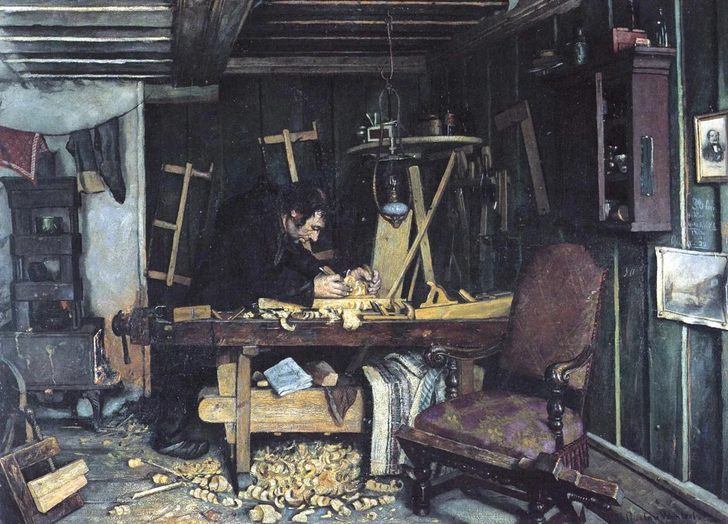
Gustav Wenzel – “A Carpenter’s Workshop” (1881)
The “advanced search” page of the Internet Archive allows you to …
- download copies, in various electronic formats, of
– books and magazines published before 1929
– works (such as those created by the US Federal Government) that have always belonged to the public domain
– relatively recent works uploaded by people in countries (such as India) with less restrictive copyright laws
- examine books that you might want to acquire for enjoyment the old-fashioned way
- find higher-quality copies of items that you found on Google Books
- obtain an overview of the works (to include foreign language translations)
– of a particular author
– on a particular subject
The “advanced search” page on the website of the Hathi Trust allows you to do many of the things you might otherwise do on the Internet Archive. Alas (and, indeed, alack), the interface restricts the direct download of complete volumes to “participating institutions”. As a result, mere mortals must either seek the PDF in question on Google Books (to which Hathi provides a direct link) or use a bit of freeware called Hathi Download Helper.
The Hathi Trust search engine also makes it easy for you to search within books for specific words and phrases, as well as the mention of particular places and personalities. Doing the former turns the Hathi Trust database into a kind of dictionary, a way of discovering ways that people in various climes and times have used the expression. Doing the latter converts that cornucopia into an encyclopedia.
The NGram Viewer performs a similar service. However, as it sits atop a smaller collection and suffers from a number of irritating defects, it has proved less useful to me than the website of the Hathi Trust.
Comments Off on Online tools for the curious autodidact
Gilboa Snake: Is the Double-AR Really so Dumb? (Re-Cut for YouTube)
Forgotten Weapons
Published 7 Jan 2025YouTube removed this video, so I re-cut it to meet their requirements (I think … for now). If you want to get off YouTube and support historical & education gun channels, please consider subscribing to History of Weapons & War: weaponsandwar.tv
The Gilboa Snake is an Israeli rifle (from the same designer behind the Cornershot) that essentially combines two standard ARs into a single unit. In its civilian configuration it has two of every part — barrels, bolts (mirrored, so one ejects left and the other right), triggers, buffers, etc. In its military setup, the triggers and recoil system are combined into single units, and this makes the gun arguably practical. With a single trigger, a person fires two rounds simultaneously, resulting in either two simultaneous hits at close range, or the potential for one hit at longer range instead of what might be a miss with a regular rifle. This is a concept that has been experimented with by pretty much all major militaries over the past decades; the Russians, French, and Americans all had rifles like this. Other approaches to the end result included duplex and triplex ammunition (multiple bullets in one case) and hyper-burst firing mechanisms (like the Russian AN-94 and German G11). Ultimately all of the different systems were deemed poor compromises compared to normal rifles, but it’s not as bizarre of an idea as it might first appear.
Unfortunately, the civilian Snake has to have two separate triggers to avoid machine gun classification in the US. It’s difficult to fire both triggers simultaneously, and this limits the practical military applications of the gun.
Oh, and don’t miss the unique elements in the Snake to allow for the barrels to be zeroed before mounting sights!
(more…)
Comments Off on Gilboa Snake: Is the Double-AR Really so Dumb? (Re-Cut for YouTube)
QotD: World War I shattered the European notion of what “war” actually was
We’ve actually talked before about just how profoundly our modern view of war and battle (and battlefields) is conditioned by the experience of the first world war and the vast literary production of the generation that went through those trenches. Certainly for English (and German and French, etc.) literature, World War I seems to almost snap the tradition in half, making everything before it feel trite and washing the whole of war literature in grim tones of field grey.
And, of course, that is the point. World War I was a new kind of war that shattered the old certainties born out of the old kinds of war. It is often a mistake to assume those old certainties had been born out of some eternal peace, but while the 1800s had not seen a general European war, they had seen many wars, in the many imperial possessions of European countries, on the edges of what the British or French considered “Europe” and also in the heart of Europe itself (not to mention a few dust–ups in the Americas). These were not peaceful societies confronting their first war and shocked by the experience, but very bellicose societies encountering for the first time a new sort of war and being stunned at how different it was from what they had expected, from the wars of their (recent!) past.
All of which is to say war, war really does change. And warriors with it.
Bret Devereaux, “Collections: The Universal Warrior, Part IIb: A Soldier’s Lot”, A Collection of Unmitigated Pedantry, 2021-02-05.
Comments Off on QotD: World War I shattered the European notion of what “war” actually was
May 5, 2025
Post-election Bullshit Bulletin from The Line
Last week’s federal election has left us in the weird, unresolved situation of being not significantly different than the situation before the writ dropped. We still have a Liberal minority government, probably supported by the rump of the NDP caucus (minus Jagmeet Singh) and a reliable vote from the Green MP, which is enough to pass at least an initial confidence vote in the Commons. Before The Line‘s editors put the Bullshit Bulletin back into mothballs, we get a useful wrap-up post:
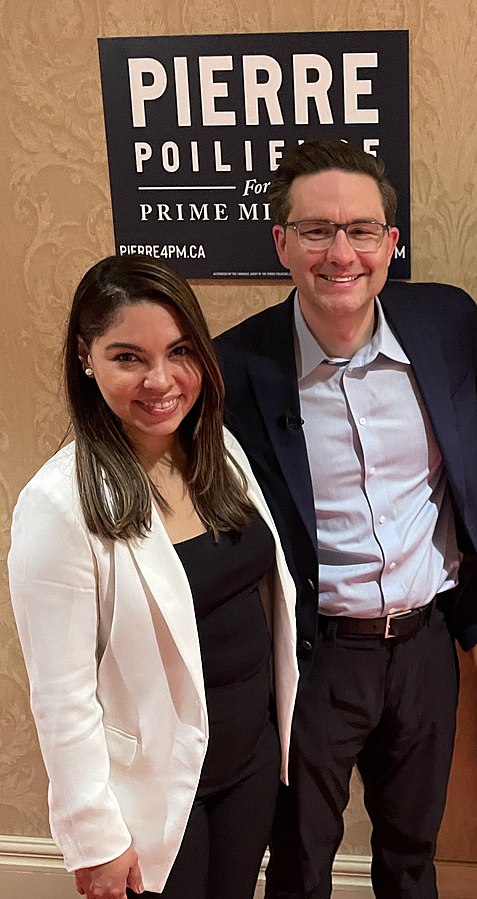
Pierre and Ana Poilievre at a Conservative leadership rally, 21 April, 2022.
Photo by Wikipageedittor099 via Wikimedia Commons.
We want to now offer some advice to Pierre Poilievre: grow up.
Seriously. Because not calling your opponent to congratulate him is bullshit.
We don’t mean Mark Carney! We do think Poilievre should call Carney and offer congratulations and also test the waters to see what extent, if any, there is room for cooperation. We aren’t naive idealists. We know neither man is going to want to hop into the sack — politically speaking — with the other. But there are still norms in a democracy, and they should be observed. Poilievre did congratulate Carney in his remarks on election night, and did so with professionalism and grace, and that’s good.
But we’re actually talking about Bruce Fanjoy, the newly elected Liberal MP for Carleton, the riding that had been held for many years by … Pierre Poilievre. Fanjoy defeated Poilievre on Monday, and by a decisive margin. In an interview with NewsTalk 1010 in Toronto, Fanjoy said that he hadn’t received a call from Poilievre to congratulate him. Calls to the winners of a riding race by the opponents in that riding are routine. Fanjoy doesn’t seem much fazed by the lack of a call, but still. It’s not a great look.
Indeed, we might go so far as to say that not making a call will be seen as confirmation in the eyes of some voters of what they already thought about Poilievre. We aren’t the first to note that the Conservative leader is polarizing and has high “negatives” — Canadians tell pollsters that they dislike him. We understand that congratulating the guy that beat you must be like pulling your own teeth out. We also think we have a good enough read on Poilievre’s personality to know why this is particularly difficult for him.
Too bad. A would-be national leader is expected to sometimes do unpleasant things. And we’re calling about a two-minute phone call here, not making a decision to send troops into battle (some of whom will die) or a decision that will alter the trajectory of our national history.
Make the call, offer congratulations, wish him well, offer any cooperation you can, and get it over with. And if you don’t, Canadians will be right to call bullshit on that.
In the latest SHuSH newsletter, Ken Whyte notes the oddly incurious attitude of the Canadian mainstream media toward the man who became Trudeau’s successor as PM and leader of the Liberal Party:

Then-Governor of the Bank of Canada Mark Carney at the 2012 Annual Meeting of the World Economic Forum in Davos, Switzerland.
WEF photo via Wikimedia Commons.
Mark Carney became prime minister of Canada in March without our media delivering a single meaningful profile of him.
There was a time, only recently ended, when every party leader and most prospective party leaders (and most senior cabinet ministers and chiefs of staff) were subjected to scrutiny the moment they were deemed serious players. A reporter, usually a high-ranking feature artist, would be assigned by Maclean’s, Saturday Night, Report on Business, The Walrus, The Globe & Mail, The National Post, a CBC documentary desk, or any number of other outlets, to dig into the person’s past, read everything on the record, speak to friends and enemies and knowledgeable observers, weigh all the evidence and craft a narrative to give readers (or audiences) a sense of what made the person tick, and some idea of how to think about him or her in relation to public office. At their best, these profiles would provide a welcome counterpoint to how political actors chose to define themselves and how they were defined by their opponents. They were an arbiter of sorts, a first draft of history depended upon by participants in the political process, other media, and the informed public.
No one bothered to profile Carney, even though his advent in our politics had been rumoured for years. It was as though the press gallery in Ottawa assumed he was a known quantity because he’d shown up at the Politics & The Pen Gala for several years in his capacity as governor of the Bank of Canada.
Carney was not only sworn in as prime minister without sustained scrutiny, he made it all the way to the last week of a national campaign before the Globe landed what read like a well-intentioned but hastily assembled and not terribly revealing profile of him. Also in the last week, The Logic, a very good upstart business news site, produced a better one, but for a relatively tiny audience behind an expensive paywall.
Thinking and reporting in depth about the careers and characters of our leaders is perhaps the most important thing that journalists do. Yet Carney’s experience is not unique. If you want to know anything about our last two prime ministers, Stephen Harper and Justin Trudeau, you won’t find much in newspapers, magazines, or documentaries. You’ll need to read the books about them: Stephen Harper by John Ibbitson, Right Side Up and The Longer I’m Prime Minister by Paul Wells, Party of One by Michael Harris; Trudeau by John Ivison, Promise and Peril by Aaron Wherry, The Prince by Stephen Maher, Justin Trudeau on the Ropes by Paul Wells. There is a whole other shelf of aggressively critical takes on the two leaders which offer valuable insights amid their axe-grinding: Tom McMillan’s Not My Party (Harper), Mel Hurtig’s The Arrogant Autocrat (Harper), Brooke Jeffrey’s Dismantling Canada (Harper), Mark Bourrie’s Kill The Messengers (Harper), Yves Engler’s The Ugly Canadian (Harper), Ezra Levant’s Libranos (Trudeau), Candice Malcolm’s Losing True North (Trudeau). Additionally, there are books by the leaders themselves, Harper’s Right Here, Right Now, and Trudeau’s Common Ground, and a range of others written about particular issues or by other participants in their governments.
The past year has brought a wealth of books on our political leadership. Justin Trudeau on the Ropes (Sutherland House) and The Prince (Simon & Schuster) chronicled the last days of Trudeau’s prime ministership. Catherine Tsalikis’s Chrystia (House of Anansi) profiled the woman who ultimately brought him down. Andrew Lawton’s Pierre Poilievre (Sutherland House) and Mark Bourrie’s Ripper (Biblioasis) treated the Conservative leader who sought to replace him. Carney, seemingly intent on dominating the conversation about himself, was ready with another book this spring. The election delayed it until summer.
Comments Off on Post-election Bullshit Bulletin from The Line
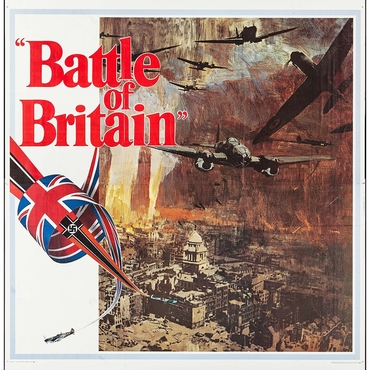
Remembering The Battle of Britain (1969)
At SteynOnline, Rick McGinnis discusses the 1969 film The Battle of Britain, which was considered a financial flop at the time it was released and only turned a profit once home VCR sales provided a new revenue stream — it was how I first watched the movie, although I do remember seeing posters for it at the cinema while it was in theatrical release.
The best recent depictions of the war – my subjective list includes Band of Brothers, The Pacific, Saving Private Ryan, Dunkirk, Das Boot, Greyhound and Letters from Iwo Jima – were mostly made with veterans advising on historical accuracy and mostly being heard. This wasn’t always the case: for at least two decades following the war, when veterans were still thick on the ground, historical accuracy was frequently sacrificed in the interest of adventure, drama, comedy or romance.
(My subjective list includes Kelly’s Heroes, The Dirty Dozen, The Guns of Navarone, D-Day The Sixth of June, Where Eagles Dare, Operation Petticoat, From Here to Eternity and Von Ryan’s Express. Not that these aren’t entertaining, enjoyable films; they just shouldn’t be considered history.)
If there was a turning point – a film that struggled and mostly succeeded in telling a plausibly accurate story about the war to audiences likely to contain not just veterans but civilians with lived memories – it was probably Guy Hamilton’s Battle of Britain, released in 1969, barely thirty years after the event it commemorates.
While in pre-production for the film, 007 producer Harry Saltzman and his co-producer (and veteran RAF pilot) Benjamin Fisz realized that their American backers at MGM were nervous about making a film about something Americans knew little about. This led to The Battle for the Battle of Britain, a short TV documentary about the film and the event that it was based on, hosted and narrated by one of the film’s stars, Michael Caine.
Included with the 2005 collector’s edition DVD of Hamilton’s film, The Battle for the Battle of Britain begins with a series of “man on the street” interviews conducted outside the American embassy in London. Older interview subjects talk vaguely about how they’d admired the British for standing alone against Nazi Germany at the time; younger ones almost unanimously admit that they don’t’ know anything about it. One woman states that she doesn’t wish to give an opinion since she works for the embassy. At the time these interviews were made the average age of a British pilot who fought in the battle and survived would have been around fifty, as the vast majority of the young men who flew to defend England in the summer of 1940 were on either side or twenty.
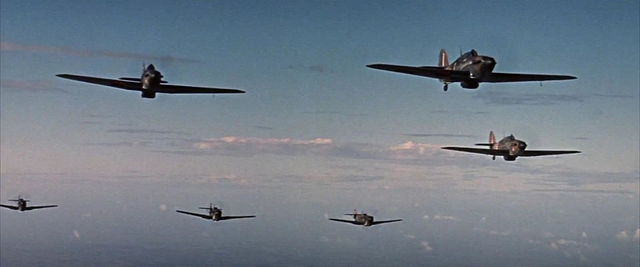
Making Battle of Britain felt like a duty in 1969; it attracted a cast of big stars who were willing to work for scale just to be involved, but that didn’t stop the film from going massively over schedule and over budget. Historical accuracy was so important that Saltzman and Lisz ended up collecting what became the world’s 35th largest air force, rebuilding wrecked airframes and making planes that had sat on concrete plinths outside museums and airfields flyable again.
Still from The Battle of Britain
The film begins with the fall of France in the spring of 1940, and British pilots and air crew struggling to get back in the air ahead of the rapidly approaching German army. We meet the three RAF squadron leaders who will be at the centre of the action: Caine’s Canfield, Robert Shaw as the curt, intense “Skipper”, and Colin Harvey (Christopher Plummer), a Canadian married to Maggie (Susannah York), an officer in the Women’s Auxiliary Air Force.
Back across the channel we meet Sir Laurence Olivier as Air Chief Marshal Sir Hugh Dowding, the head of Fighter Command and the man who will lead the English in the air battle to come. Blunt and charmless, Dowding had the unenviable task of telling Sir Winston Churchill, only just appointed Prime Minister, that he doesn’t support his promise to send more fighter squadrons across the Channel to aid the French as they would be squandered in a lost cause and, in any case, he needs every plane and pilot he has to fight the German invasion that’s doubtless coming.
Comments Off on Remembering The Battle of Britain (1969)
Make America Austere Again?
The first 100 days of the BOM haven’t been quite what anyone expected. Close allies and trading partners were shocked at the new administration’s devotion to 1920s tariff “diplomacy”, supporters were dismayed to not get lots and lots of perceived wrongdoers of the Biden administration getting perp-walked for the cameras, and ordinary Americans were presented with a much worse domestic economy than they were promised:
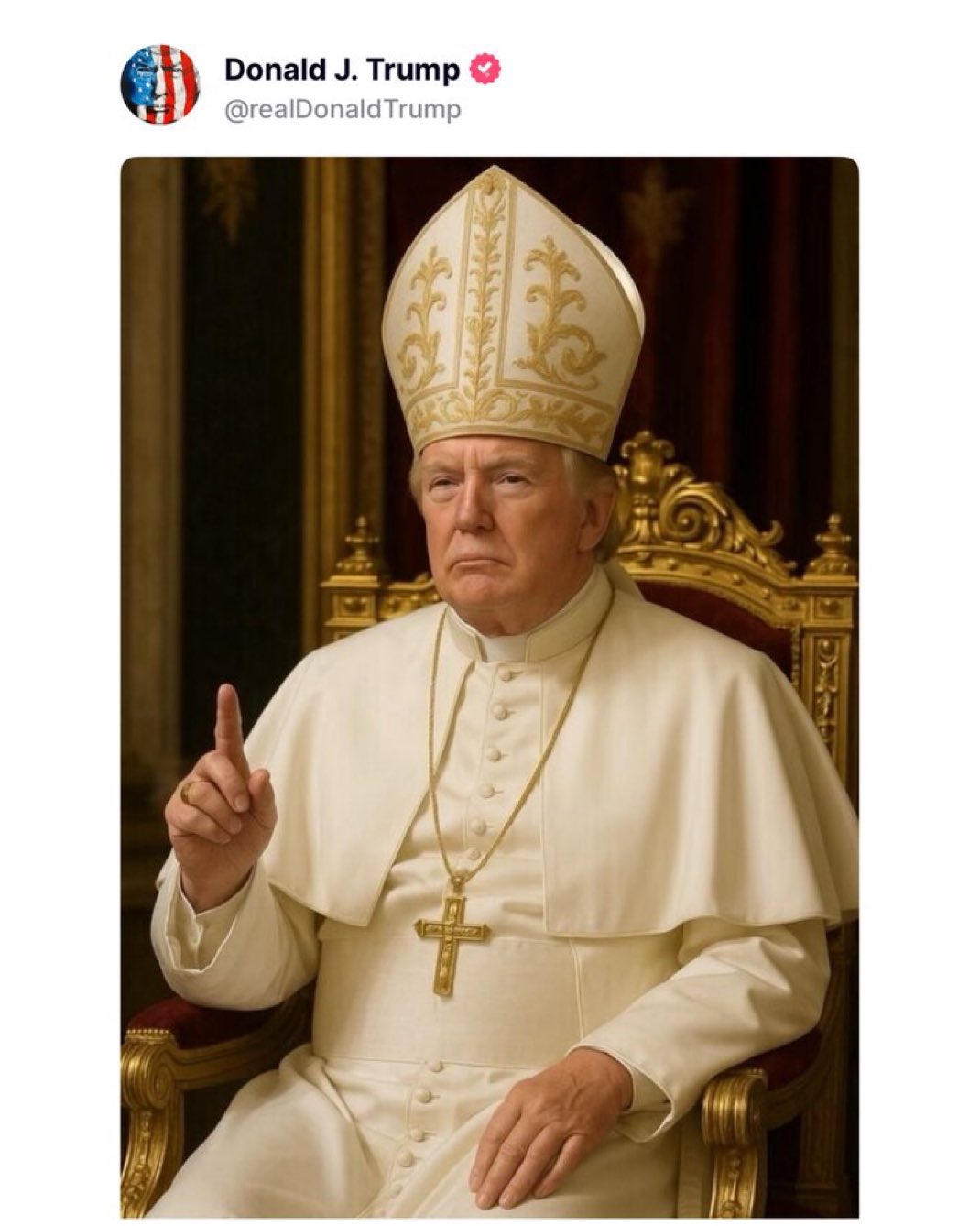
Trump wasn’t totally fixated on economic matters … he still found time in his busy schedule to troll Catholics on his Truth Social platform.
On Wednesday, in the prelude to a cabinet meeting, U.S. President Donald Trump made yet another remark to chill the blood for those concerned about his country. Trump’s cat-and-mouse game of arbitrary changes to American import tariffs is starting to raise concerns about prices and supply chains for consumer goods. The American economy has unexpectedly shrunk in the first 100 days of Trump 2.0, even though workers and businesses are scrambling to make purchases before the effects of Trump tariffs set in. The underlying state of the economy is probably worse than the short-term numbers.
Trump says this is all a matter of “get(ting) rid of the Biden ‘Overhang'”, i.e., it’s his immediate predecessor’s fault. And let’s face it: no other politician on Earth would say anything else 100 days into an executive term. If that was as far as Trump went, it wouldn’t be of unusual concern. What struck me was his separate remark implying that, yeah, tariffs might foul up supply chains a little in the transition to the glorious economy of the future, but haven’t we Americans had it too soft for too long?
“Maybe the children will have two dolls instead of 30 dolls,” the president mused. “So maybe the two dolls will cost a couple bucks more than they would normally.” The message, which brazenly puts the contentment of children front and centre, is one you can’t imagine any other American leader delivering so directly in peacetime: have you all considered being happy with less?
The answer one would expect the median American voter to give is “Hell no”. It’s crazy that I should have to write this, but consumer abundance is a defining feature of the United States! During the Cold War, American supermarkets were the unanswerable argument for economic freedom: you could summarize the United States pretty reasonably as “It’s the country that coined the word ‘super-market'”. In our hyper-interconnected social-media world, I see a dozen conversations a week in which some European boasts of affordable healthcare, walkable neighbourhoods and having July and August and half of September off work every year: the inevitable answer from Americans is “OK, but have you been inside a Buc-ee’s, Gustav?”
Of course, it’s been a very long time since media-decried austerity in government has actually meant any kind of actual reduction in outlay … it’s usually just a (very) slight decrease in the rate of increase rather than actual dollar-value reduction. But, as Chris Bray points out, this time for sure:
I was planning to spend $100 on groceries this morning, but then I decided to slash my grocery budget, so the amount I actually spent on groceries plummeted to just $99.97, plus a small eight dollar supplemental on previously deferred grocery needs, bringing the total to a shockingly parsimonious $107.97. These major cuts caused serious alarm in my household.
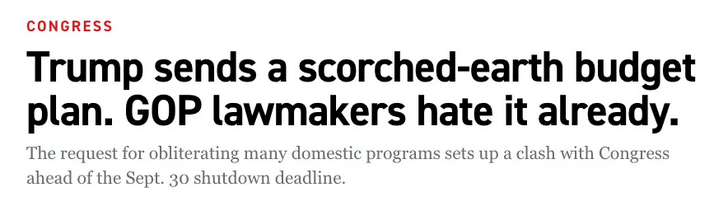
Donald Trump, Politico warns, is scorching the earth:
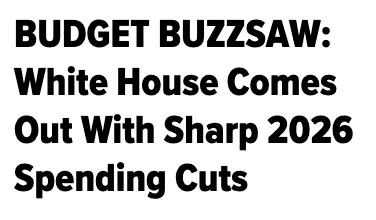
This is the common theme everywhere, as the administration offers the first not-very-detailed hints about its plans for FY ‘26 discretionary federal outlays. The Huffington Post concludes that Trump is pulling out the BUZZSAW:
The Federal News Network sums up the size of the hit, and compare the topline number to the language about scorched earth and buzzsaws:
Overall, the administration is looking to increase national security spending next year by 13% and decrease non-defense discretionary spending by 7.6%, meaning the White House is asking for $1.7 trillion for the discretionary budget down from $1.83 trillion this year.
While the White House plans don’t get into the subject of total federal spending, focusing narrowly on discretionary spending, the implication is that federal spending overall will go from about $7 trillion to about … $7 trillion. But TBD.
You can read the entire White House proposal for discretionary funding here. Trump is proposing deep cuts in some federal departments and programs, but is also proposing to offset those cuts with sharp increases in military spending and “homeland security”, meaning border security and sending poor gentle immigrants to places where Chris Van Hollen will fly to stare into their beautiful eyes.
Comments Off on Make America Austere Again?
The Bloody Battle of Agincourt | Animated Episode
The Rest Is History
Published 30 Nov 2024“We few, we happy few, we band of brothers”.
The Battle of Agincourt in 1415 endures as perhaps the most totemic battle in the whole of English history. Thanks in part to Shakespeare’s masterful Henry V, the myths and legends of that bloody day echo across time, forever enshrining the young Henry as the greatest warrior king England had ever known. So too the enduring idea of the English as plucky underdogs, facing down unfavourable odds with brazen grit. And though the exact numbers of men who fought in the two armies is hotly contested, the prospect was certainly intimidating for the English host looking down upon the vast French force amassed below them the day before the battle. Hungry and weary after an unexpectedly long march, and demoralised by the number of French that would be taking to the field, the situation certainly seemed dire for the English. One man amongst them, however, held true to his belief that the day could still be won: Henry V. An undeniably brilliant military commander, he infused his men with a sense of patriotic mission, convincing them that theirs was truly a divinely ordained task, and therefore in this — and his careful strategic planning the night before the battle — he proves a striking case of one individual changing the course of history. However, the French too had plans in place for the day ahead: total warfare. In other words, to overwhelm the English in a single devastating moment of impact, sweeping the lethal Welsh archers aside. So it was that dawn broke on the 25th of October to the site of King Henry wearing a helmet surmounted by a glittering crown and bearing the emblems of both France and England, astride his little grey horse, and riding up and down his lines of weathered silver clad men, preparing them to stride into legend … then, as the French cavalry began their charge, the sky went black as 75,000 arrows blocked out the sun. What else would that apocalyptic day hold in store?
Join Tom and Dominic as they describe the epochal Battle of Agincourt. From the days building up to it, to the moment that the two armies shattered together in the rain and mud of France. It is a story of courage and cowardice, kings and peasants, blood and bowels, tragedy and triumph.
00:00 What is to come …
00:50 Shakespeare and Henry V
02:53 Agincourt is exceptional
04:15 The battle is a test of God’s favour
05:27 The English see the French forces …
09:30 The French aren’t offering battle
10:40 Why the French delay
11:13 The French think they’re going to win
11:35 An ominous silence
12:35 Henry’s plan
20:50 The French plan
24:28 How big were the armies
28:49 The lay of the land
34:50 Henry makes the first move
37:00 The French charge into darkness
38:57 The French army advances
45:50 Reaction to the slaughter
(more…)
Comments Off on The Bloody Battle of Agincourt | Animated Episode
QotD: English intelligentsia and the Soviet Union
I am well acquainted with all the arguments against freedom of thought and speech — the arguments which claim that it cannot exist, and the arguments which claim that it ought not to. I answer simply that they don’t convince me and that our civilization over a period of 400 years has been founded on the opposite notice. For quite a decade past I have believed that the existing Russian regime is a mainly evil thing, and I claim the right to say so, in spite of the fact that we are allies with the U.S.S.R. in a war which I want to see won. If I had to choose a text to justify myself, I should choose the line from Milton:
“By the known rules of ancient liberty.”The word ancient emphasizes the fact that intellectual freedom is a deep‐rooted tradition without which our characteristic Western culture could only doubtfully exist. From that tradition many of our intellectuals are visibly turning away. They have accepted the principle that a book should be published or suppressed, praised or damned, not on its merits but according to political expediency.
And others who do not actually hold this view assent to it from sheer cowardice. An example of this is the failure of the numerous and vocal English pacifists to raise their voices against the prevalent worship of Russian militarism. According to these pacifists, all violence is evil, and they have urged us at every stage of the war to give in or at least to make a compromise peace. But how many of them have ever suggested that war is also evil when it is waged by the Red Army? Apparently the Russians have a right to defend themselves, whereas for us to do so is a deadly sin. One can explain this contradiction in only one way — that is, by a cowardly desire to keep in with the bulk of the intelligentsia, whose patriotism is directed toward the U.S.S.R. rather than toward Britain.
I know that the English intelligentsia have plenty of reason for their timidity and dishonesty; indeed, I know by heart the arguments by which they justify themselves. But at least let us have no more nonsense about defending liberty against fascism. If liberty means anything at all, it means the right to tell people what they do not want to hear. The common people still vaguely subscribe to that doctrine and act on it. In our country — it is not the same in all countries: it was not so in Republican France, and it is not so in the United States today — it is the liberals who fear liberty and the intellectuals who want to do dirt on the intellect: it is to draw attention to that fact I have written this preface.
George Orwell “The Freedom of the Press”, 1945 (written as the preface to Animal Farm, but not published in Orwell’s lifetime).
Comments Off on QotD: English intelligentsia and the Soviet Union
May 4, 2025
The Clean German Myth, Doomed B-17 Pilots, and Japan’s Rapid Victories – Out of the Foxholes Live
World War Two
Published 3 May, 20205Indy and Sparty tackle some more of your interesting questions in another live Out of the Foxholes. Today they look at loss rates of B-17 crews, the myth of the clean Wehrmacht, and ask why the West was apparently so unprepared for Japan’s attack.
(more…)
Comments Off on The Clean German Myth, Doomed B-17 Pilots, and Japan’s Rapid Victories – Out of the Foxholes Live


