Quotulatiousness

May 31, 2025

Depending on how you read the tea leaves, are all the signed treaties now to be ignored?

Filed under: Cancon, Government, History — Tags: , , , , , — Nicholas @ 04:00

In The Free Press Rupa Subramanya discusses King Charles’s land acknowledgement at the start of the Throne Speech earlier this week:
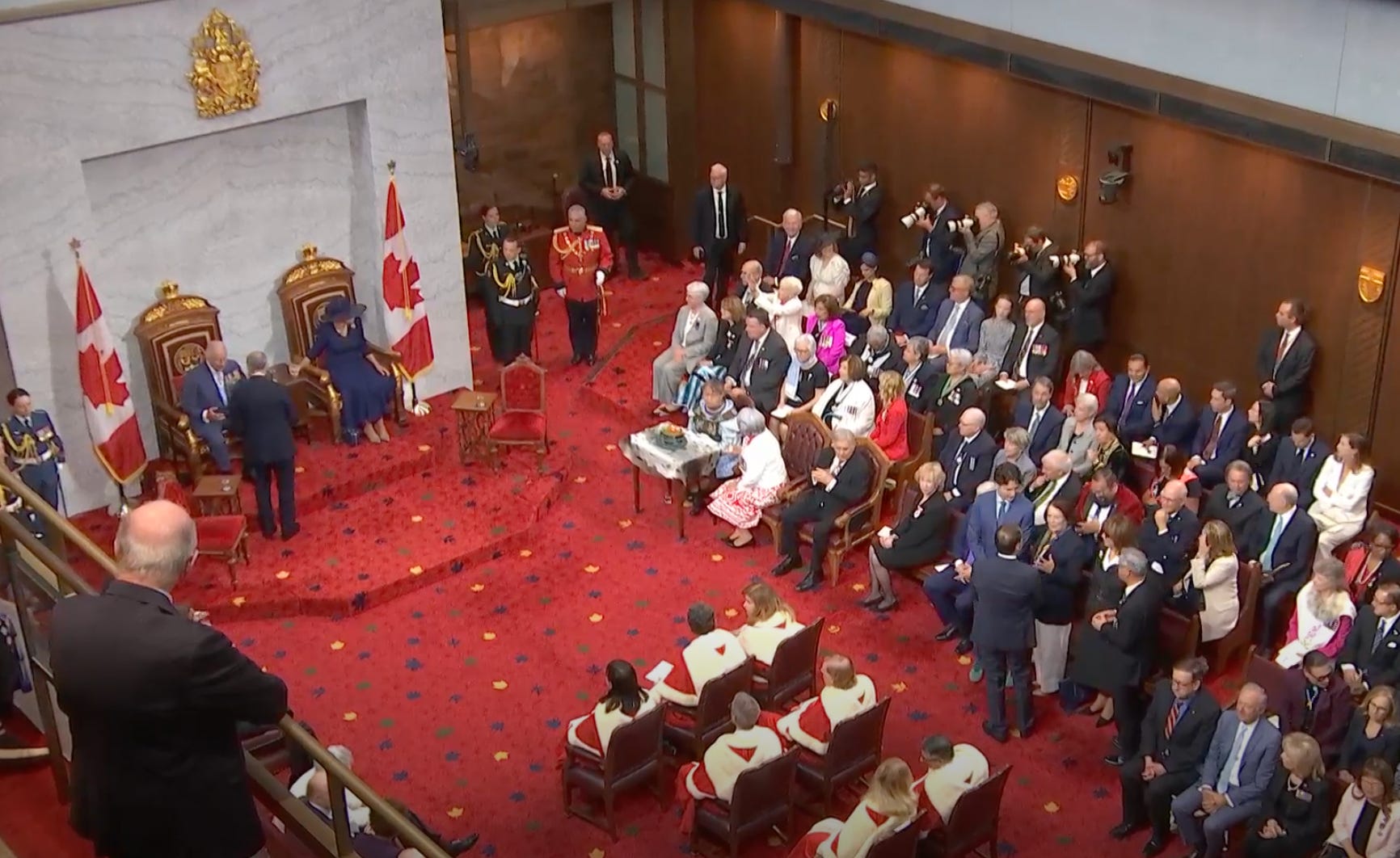
Mark Carney joins our visiting King in the traditional Making of the Small Talk.
Photo by Paul Wells from his Substack

Canadians have a fondness for land acknowledgments, [NR: while some of us think they’re merely virtue signalling on steriods which will end up causing more mischief in the long run] which have now become common at police press conferences, on Air Canada flights, at hockey games, and even at a Taylor Swift concert.

But nothing has caused more commotion than the spectacle of King Charles III opening the 45th legislative session of Parliament on May 27 with a land acknowledgment, when he declared from his throne: “I would like to acknowledge that we are gathered on the unceded territory of the Algonquin Anishinabe people. This land acknowledgment is a recognition of shared history as a nation.”

People will point out that King Charles’s speech was written by Canadian prime minister Mark Carney’s government (true) and that as the monarch he was being respectful to Canadian traditions (fine). But there is something deeply funny about the literal King of England talking about the lands his predecessors brutally conquered centuries ago like they’re still up grabs.

Kicking off Parliament with a speech is a time-honored tradition, but it’s rare for the monarch to deliver it in person, and is normally delivered by the governor general, Canada’s official stand-in for the king. The reason the king was there was to push back against the idea that Canada is for sale.

“There is no better way to assert Canada’s sovereignty than by inviting the sovereign,” said Philippe Lagassé, a constitutional expert at Carleton University in Ottawa, Ontario. “Carney invited the king as part of his renewed emphasis on Canadian nationalism rooted in our institutions and history.” (Unlike the U.S., which broke from Britain in 1776, Canada remained a colony until 1867, when it became a constitutional monarchy with a British-style parliamentary system and the UK monarch as head of state.)

Lagassé added that Carney’s invite to Charles was also likely done to “leverage President Trump’s affection for the king in Canada’s favor.”

Trump may love the monarchy, but Canadians have traditionally been indifferent towards it. But that’s changing, thanks to Trump’s “51st state” rhetoric.

According to a recent poll, 66 percent of Canadians now believe the monarchy helps set the country apart from the United States, up from 54 percent in April 2023. In 2023, 67 percent thought the royal family should have no formal role in Canadian society; today, that number has dropped to 56 percent.

In his speech, King Charles didn’t mention Trump by name, but the subtext was hard to miss: “Canada faces another critical moment. Democracy, pluralism, the rule of law, self-determination, and freedom are values which Canadians hold dear, and ones which the government is determined to protect.”


“U.S. libertarians [are] the best friends Canada doesn’t know it has”

In the National Post, Colby Cosh sings the praises of American libertarians for their work in trying to dismantle some of Donald Trump’s dubiously Constitutional extensions of presidential power:

The James L. Watson Court of International Trade Building at 1 Federal Plaza in Lower Manhattan, New York City.
Photo by Americasroof via Wikimedia Commons.

The U.S. Court of International Trade (CIT) issued a decision Wednesday that annuls various salvos of surprise economic tariffs, including ones on Canada, that have been enacted by President Donald Trump since his inauguration in January. I won’t lie to you: I had the same initial reaction to this consequential news that you probably did, which was “Hooray!” and then “Huh, there’s a U.S. Court of International Trade?”

This court is surely unfamiliar even to most Americans, no doubt because much of its work involves settling issues like “Do hockey pants count as ‘garments’ or ‘sports equipment’ under customs law?” Nevertheless, the CIT does have exclusive jurisdiction over civil actions involving U.S. trade law. It’s just that no president has ever before rewritten the tariff schedule of the republic in the half-mad fashion of a child taking crayons to a fresh-painted wall.

The American Constitution, from day one, has unambiguously assigned the right to set international tariffs to Congress. Congress is allowed to delegate its powers to the president and his agents for limited or temporary purposes, but it can’t abandon those powers to him altogether. Defining this legal frontier is what the CIT was asked to do, and their demarcation of it will now swim upward through higher appellate courts (its decision has been put on hold in the meantime).

The lawsuit was actually two parallel suits raising overlapping objections to the tariffs. One was brought forward by 12 U.S. states, and the other was filed by a group of tariff-exposed American businesses, including manufacturers of bikes, electronics kits and fishing equipment. The latter set of plaintiffs was roped together by the usual posse of heroic libertarians and legal originalists, including George Mason University law prof Ilya Somin.

About 24 hours after Trump originally announced the “Liberation Day” worldwide tariffs, Somin quickly blogged about how insanely unconstitutional the whole idea was, and concluded his article essentially by saying “I’m darn well gonna do something about this nonsense”. I don’t mean to suggest he deserves primary credit; I only intend to call attention, once again, to U.S. libertarians being the best friends Canada doesn’t know it has.

Social Hierarchy in the Early Roman Empire

Filed under: Europe, History — Tags: , , , , — Nicholas @ 02:00

seangabb
Published 31 Dec 2024

The second lecture in the series – an exploration of social divisions within the Early Roman Empire. Contents include:

00:00:00 – Introduction
00:05:37 – The Roman Social Structure
00:09:02 – The Position of the Emperor
00:11:49 – Perception and Role of the Emperor
00:19:24 – Evolution of the Imperial Senate
00:22:19 – What Kind of Men became Senators?
00:25:34 – The Functions of Senators
00:27:41 – The Equestrian Order
00:30:56 – Local Government
00:35:49 – The Imperial Bureaucracy
00:37:16 – Narcissus, Pallas, Felix
00:42:12 – Ordinary People
00:43:06 – Roman Citizenship
00:45:15 – How to Become a Citizen?
00:47:21 – Justice According to Class
00:51:34 – How was Status Legally Determined?
00:59:44 – Patron and Client
(more…)

QotD: Explaining the science to the non-scientific layperson

Filed under: Education, Media, Quotations, Science — Tags: , , , , — Nicholas @ 01:00

There’s a famous video in which Richard Feynman is asked by a BBC journalist if he can explain magnetism to him, and Feynman pauses for a moment and says “no”. The journalist is totally incredulous, and demands to know what Feynman means by that, and the great scientist tells him that he knows so little of the basics, and magnetism is so deep and so tricky,1 that it would be impossible to explain much of anything without either misleading him or giving him a false understanding.

I’ve always thought that nearly all pop science books fall into one version or another of this trap. Either they abandon all attempts at explaining the difficult concept in simple terms, or they simplify and elide so much as to become actively misleading.2 I call the latter horn of the dilemma “string theory is like a taco”-syndrome, and it’s by far the more common failure case. This is because undersimplification makes your audience feel dumb, while oversimplification makes them feel smart, so you sell a lot more books by oversimplifying. Unfortunately the effects on the audience of oversimplification are far more dangerous and insidious. After reading something impenetrable, you at least still know that you don’t really understand it, so there’s still a chance for you to go on and learn it some other way. Reading an oversimplified explanation, however, can fool you into thinking that you now grasp the concept, when in reality all you’ve grasped is a lossy analogy that will lead you astray.

All of which is to say I think it’s pretty impressive how well [author David] Reich does at diving into some of the real statistical meat of his techniques while still making them comprehensible to a smart layman. He has the gift that the greatest scientific expositors possess of being able to communicate in simple terms what it is that makes a problem hard, and then also giving you the broad strokes of an elegant solution to that hard problem. He doesn’t pretend that he hasn’t left anything out, instead he points out exactly where he’s glossed over details, so that you can go back and look them up if you want. This doesn’t sound all that impressive, but it’s actually really freaking hard to pull off, especially in a field that’s new and hence hasn’t been reformulated and recondensed a hundred times until it’s turned into a crystalline version of itself.

Okay, what was your favorite interesting genetic fact that this book taught you about a contemporary population? Mine was definitely that the various Indian jatis are as genetically distinct from one another as the Ashkenazi Jews are from everybody else. Not one group, but hundreds and hundreds of groups, all living in close proximity to each other, have gone millennia with incredibly minimal genetic mixing. How is that possible? It makes me take some of the assertions made by classical Indian texts a little bit more seriously.

Jane Psmith and John Psmith, “JOINT REVIEW: Who We Are and How We Got Here, by David Reich”, Mr. and Mrs. Psmith’s Bookshelf, 2023-05-29.


    1. It always bothered me when people ragged on Insane Clown Posse for expressing humility and awe at magnets. In fact their attitude is exactly the appropriate one. Back when ICP were in the news more often, I made a minor hobby of demanding that anybody who made fun of them explain magnets scientifically to me on the spot. Nobody ever succeeded.

    2. And sometimes, remarkably, a pop science book manages to make both mistakes at the same time. I’m reminded of Edward Frenkel’s horrible book Love & Math, which is full of passages like: “Think of the Hitchin fibration as a box of donuts, except that there are donuts attached not only to a grid of points in the base of the carton box, but to all points in the base. So we have infinitely many donuts — Homer Simpson would sure love that! It turns out that the mirror dual Hitchin moduli space, the one associated to the Langlands dual group, is also a donut topic/fibration over the same base. Donuts. Is there anything they can’t do?”

May 30, 2025

Progressives are still putting their faith in doxxing and cancellations … do they still work?

Filed under: Media, Politics — Tags: , , — Nicholas @ 04:00

Spaceman Spiff calls our attention to the latest attempt to un-person a writer who has managed to outrage progressives:

The popular pseudonymous Substack writer, Morgoth, has been doxxed. Outed by an organization dedicated to tackling extremism and online harm.

You can read about his ordeal here:

They produced an article to unmask Morgoth’s real-world identity against his wishes, including photographs. It is replete with incendiary accusations we have grown accustomed to seeing in these attempts to discredit writers who challenge the status quo.

The impression presented is one of a bigoted figure, someone dangerously unhinged. It bears little relation to reality as Morgoth’s readers will confirm. But that hardly matters.

Doxxing exercises exist so the laptop class can efficiently file people into a convenient extremist bucket. All the hard work has been done so the distracted can skim the article and take what they need. Fascism, white supremacy, hate, racism, bigotry; take your pick.

Doxxing is not about facts, it is about keywords. More accurately it is about “hate crimes”. Those who transgress these ever-changing taboos are unfit to live among us.

Even better the piece can be exploited by others. Fascist influencer Morgoth, online hatemonger Morgoth, disgraced racist Morgoth. The current obsession with speech controls can make good use of an incestuous network of activists posing as reporters. Since the material now exists journalists can reference it to further discredit should this be needed in future.

The shrill nature of these denouncements is the giveaway all is not well in the world of perception management. No plan survives contact with the enemy, and the desire to corral all dissidents into one big extremist bucket sounds fine on paper. But much of what Morgoth writes about is widely discussed by the public at large, even if ignored by the traditional media or the political world. If Morgoth is a racist hate-driven genocidal monster then so are most of the population, which of course they are not.

This kind of thing used to work well. But as Morgoth’s own articles allude to, their enemy is reality not Substackers.

The curiously suicidal ideas the educated classes cling to are largely based on magical thinking. We can change the weather by blowing up power stations and levying taxes; we can successfully assimilate millions of hostile foreigners who dislike us and our culture; women will be happier if they work longer hours and don’t have children.

The degree of propaganda needed to maintain today’s narratives is considerable. Less advertised is how brittle it has become. Challenges to these narratives, and the theoretical foundations upon which they rest, are therefore feared by their promoters, and rightly so.

From this perspective people writing online and criticizing today’s sacred cows are worth targeting and smearing. Hence the exposure, the denouncements, the dredging up of comments from a decade ago, out of context and out of time. They know their audience don’t really care. They just need the satisfying feeling they are on the right side of history.

Senate to once again try to pass internet age verification and website blocking

Filed under: Cancon, Government, Liberty, Politics, Technology — Tags: , , , , , , — Nicholas @ 03:00

Some ideas are so horrible that they never, ever die. The Canadian Senate nearly got an age verification and website blocking ban into law during the last Parliament, and as Michael Geist discusses, they’re not giving up now:

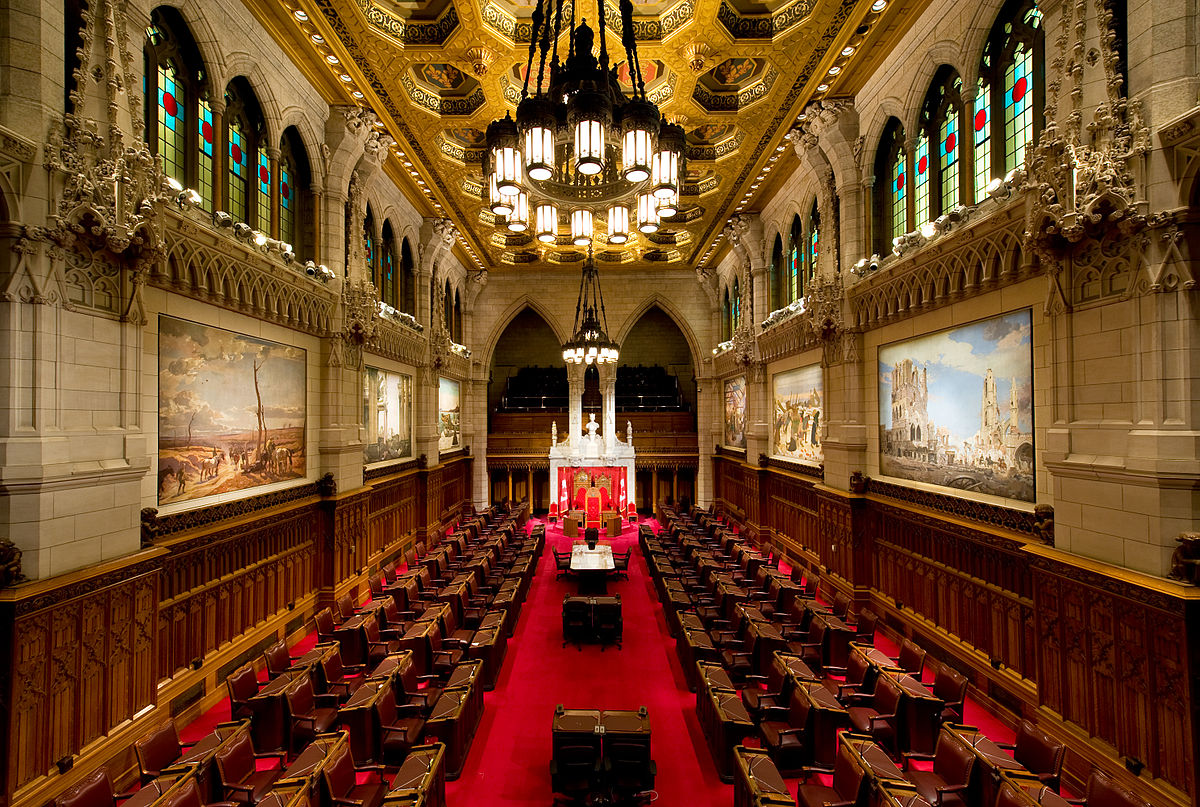
“In the east wing of the Centre Block is the Senate chamber, in which are the thrones for the Canadian monarch and consort, or for the federal viceroy and his or her consort, and from which either the sovereign or the governor general gives the Speech from the Throne and grants Royal Assent to bills passed by parliament. The senators themselves sit in the chamber, arranged so that those belonging to the governing party are to the right of the Speaker of the Senate and the opposition to the speaker’s left. The overall colour in the Senate chamber is red, seen in the upholstery, carpeting, and draperies, and reflecting the colour scheme of the House of Lords in the United Kingdom; red was a more royal colour, associated with the Crown and hereditary peers. Capping the room is a gilt ceiling with deep octagonal coffers, each filled with heraldic symbols, including maple leafs, fleur-de-lis, lions rampant, clàrsach, Welsh Dragons, and lions passant. On the east and west walls of the chamber are eight murals depicting scenes from the First World War; painted in between 1916 and 1920.”
Photo and description by Saffron Blaze via Wikimedia Commons.

The last Parliament featured debate over several contentious Internet-related bills, notably streaming and news laws (Bills C-11 and C-18), online harms (Bill C-63) and Internet age verification and website blocking (Bill S-210). Bill S-210 fell below the radar screen for many months as it started in the Senate and received only cursory review in the House. The bill faced only a final vote in the House but it died with the election call. This week, the bill’s sponsor, Senator Julie Miville-Dechêne, wasted no time in bringing it back. Now Bill S-209, the bill starts from scratch in the Senate with the same basic framework but with some notable changes that address at least some of the concerns raised by the prior bill (a fulsome review of those concerns can be heard in a Law Bytes podcast I conducted with Senator Miville-Dechêne).

Bill S-209 creates an offence for any organization making available pornographic material to anyone under the age of 18 for commercial purposes. The penalty for doing so is $250,000 for the first offence and up to $500,000 for any subsequent offences. The previous bill used the term “sexually explicit material”, borrowing from the Criminal Code provision. This raised concerns as the definition in the Criminal Code is used in conjunction with other sexual crimes. The bill now features its own definition for pornographic material, which is defined as

    any photographic, film, video or other visual representation, whether or not it was made by electronic or mechanical means, the dominant characteristic of which is the depiction, for a sexual purpose, of a person’s genital organs or anal region or, if the person is female, her breasts, but does not include child pornography as defined in subsection 163.1(1) of the Criminal Code.

Organizations can rely on three potential defences:

  1. The organization instituted a government-approved “prescribed age-verification or age estimation method” to limit access. There is a major global business of vendors that sell these technologies and who are vocal proponents of this kind of legislation.
  2. The organization can make the case that there is “legitimate purpose related to science, medicine, education or the arts”.
  3. The organization took steps required to limit access after having received a notification from the enforcement agency (likely the CRTC).

Note that Bill S-209 has expanded the scope of available technologies for implementation: while S-210 only included age verification, S-209 adds age estimation technologies. Age estimation may benefit from limiting the amount of data that needs to be collected from an individual, but it also suffers from inaccuracies. For example, using estimation to distinguish between a 17 and 18 year old is difficult for both humans and computers, yet the law depends upon it. Given the standard for highly effective technologies, age estimation technologies may not receive government approvals, leaving only age verification in place.

Was Germany Really Starved Into Surrender in WW1?

Filed under: Britain, Economics, Germany, History, Military, USA, WW1 — Tags: , , , , , , — Nicholas @ 02:00

The Great War
Published 10 Jan 2025

From 1914 to 1919, Allied warships in the Atlantic and Mediterranean controlled maritime trade to and from the Central Powers – stopping shipments of weapons and raw materials, but also food, from reaching their enemies. At the same time, hundreds of thousands of German civilians died of hunger-related causes. Often, these deaths and even the outcome of the war are attributed to the naval blockade – but did the British really starve Germany into surrender in WW1?
(more…)

QotD: “Have fun storming the castle!”

… the expected threat is going to shape the calculation of what margin of security is acceptable, which brings us back to our besieger’s playbook. You may recall when we looked at the Assyrian siege toolkit, that many of the most effective techniques assumed a large, well-coordinated army which could dispose of a lot of labor (from the soldiers) on many different projects at once while also having enough troops ready to fight to keep the enemy bottled up and enough logistic support to keep the army in the field for however long all of that took. In short, this is a playbook that strong, well-organized states (with strong, well-organized armies) are going to excel at. But, as we’ve just noted, the castle emerges in the context of fragmentation which produces a lot of little polities (it would be premature to call them states) with generally quite limited administrative and military capacity; the “big army” siege playbook which demands a lot of coordination, labor and expertise is, for the most part, out of reach.

Clifford Rogers has already laid out a pretty lay-person accessible account of the medieval siege playbook (in Soldiers’ Lives Through History: The Middle Ages (2007), 111-143; the book is pricey, so consider your local library), so I won’t re-invent the wheel here but merely note some general features. Rogers distinguishes between hasty assaults using mostly ladders launched as soon as possible as a gamble with a small number of troops to try to avoid a long siege, and deliberate assaults made after considerable preparation, often using towers, sapping, moveable shelters designed to resist arrow fire and possibly even catapults. We’ve already discussed hasty assaults here, so let’s focus on deliberate assaults.

While sapping (tunneling under and collapsing fortifications) remained in use, apart from filling in ditches, the mole-and-ramp style assaults of the ancient world are far less common, precisely because most armies (due to the aforementioned fragmentation combined with the increasing importance in warfare of a fairly small mounted elite) lacked both the organizational capacity and the raw numbers to do them. The nature of these armies as retinues of retinues also made coordination between army elements difficult. The Siege of Antioch (1097-8) [during] the First Crusade is instructive; though the siege lasted nine months, the crusaders struggled to even effectively blockade the city until a shipment of siege materials (lumber, mostly) arrived in March of 1098 (five months after the beginning of the siege). Meanwhile, coordinating so that part of the army guarded the exits of the city (to prevent raids by the garrison) while the other part of the army foraged supplies had proved mostly too difficult, leading to bitter supply shortages among the crusaders. Even with materials delivered to them, the crusaders used them to build a pair of fortified towers blocking exits from the city, rather than the sort of elaborate sapping and ramps; the city was taken not by assault but by treachery – a very common outcome to a siege! – when Bohemond of Taranto bribed a guard within the city to let the crusaders sneak a small force in. All of this despite the fact that the crusader army was uncommonly large by medieval European standards, numbering perhaps 45,000.

Crucially, in both hasty and deliberate assaults, the emphasis for the small army toolkit tends to be on escalade (going over the walls) using ladders or moveable wooden towers, rather than the complex systems of earthworks favored by the “big army” siege system or breaching – a task which medieval (or ancient!) artillery was generally not capable of. The latter, of course, is a much more certain method of assault – give a Roman army a few months and almost any fortress could be taken with near certainty – but it was a much more demanding method in terms of the required labor and coordination. Thwarting escalade is mostly a question of the height of defenses (because a taller wall requires a taller ladder, tower or ramp) and good fields of fire for the defenders (particularly the ability to fire at attackers directly up against the wall, since that’s where the ladders are likely to be).

The other major threat to castle walls (apart from the ever-present threat of sapping) was catapults, but I want to deal with those next time for reasons that I suspect will make sense then. For now it is worth simply noting that catapults, even the mighty trebuchets of the 14th century were generally used to degrade defenses (smashing towers, destroying crenellation, damaging gatehouses) rather than to produce breaches. They could in some cases do that, but only with tremendous effort and a lot of time (and sometimes not even then). Consequently, for most castles the greatest threat remained escalade, followed by treachery or starvation, followed by sapping, followed by artillery.

Bret Devereaux, “Collections: Fortification, Part III: Castling”, A Collection of Unmitigated Pedantry, 2021-12-10.

May 29, 2025

Now that a Royal Marine general is head of the Royal Navy, is he the “First Land Lord”?

Filed under: Britain, Military — Tags: , , — Nicholas @ 05:00

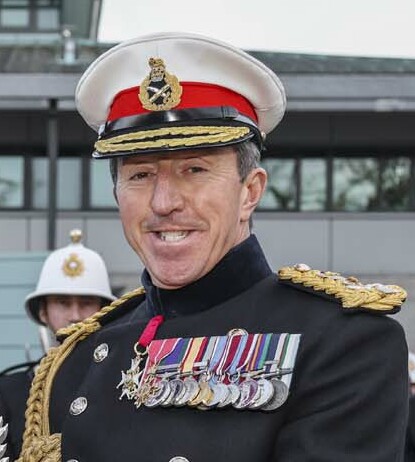
Sir Humphrey on the appointment of Royal Marine General Sir Gwyn Jenkins as the top flag officer of the Royal Navy — the first RM general officer to hold this position:

Vice Chief of the Defence Staff, General Sir Gwyn Jenkins in Lympstone, 2022.
Photo credit – LPhot Barry Swainsbury – https://www.royalnavy.mod.uk/-/media/royal-navy-responsive/images/news/new/221128-new-commandant-general-royal-marines-appointed/2.jpg, OGL 3, Link

General Sir Gwyn Jenkins has taken over as the professional head of the Royal Navy, the first Royal Marine to occupy the role of “First Sea Lord and Chief of the Naval Staff”. This is a move which is to be warmly welcomed, although the General will have many challenges ahead of him during his tenure.

While most have welcomed the move, there has been some mild hysteria on social media at the idea of a General heading the Royal Navy – what madness is this? The argument seems to be that apparently because Royal Marines haven’t commanded ships, they are somehow not able to lead the Royal Navy. Such an argument is fatuous nonsense.

The RN is a surprisingly tribal organisation of roughly 30,000 people, with its regular personnel broadly divided into four fighting arms – the Surface Fleet, the Submarine Service, the Fleet Air Arm and the Royal Marines. The surface fleet is the closest to being a “generalist” branch, although in its own way it is intensely tribal with different branches, organisations and structures. The Submariners and the FAA are unsurprisingly a bit of a closed shop, due to their missions, role and locations – it is not quite a “private navy”, but it would be rare for many personnel to serve at both Faslane supporting submarines and then to Culdrose or Yeovilton supporting aircraft. It is better to think of these fighting arms as smaller versions of the RN, each with its own culture, ethos and experience, and very different ways of bringing the fight to the enemy.

There have been First Sea Lords from the Surface Fleet, Submarine Service and FAA – no one has questioned the ability of an admiral who may have spent large parts of their career within a tribal part of the Service to lead all of it appropriately. Yet some seem to think that the General is somehow unable to do this due to his Royal Marines past. This makes very little sense – surely if this were true, how could any 1SL lead the Royal Marines effectively given they have, to the authors knowledge, never held a green beret?

The role of the 1st Sea Lord is not to stride the bridge in battle and fight wars against the enemy. He (and hopefully soon She) is the professional head of a complex organisation, employing tens of thousands of service personnel, reservists, civil servants and contractors on every continent. There are Royal Navy personnel based around the globe, from the Arctic to the Antarctic, and from the depths of the ocean to the skies far above. This role is about leadership, delivering the Government of the day’s desired defence policy outcomes, setting strategic direction for the Service and ensuring that it can deliver on its responsibilities.

The role of 1SL is part CEO, part diplomat, part public engagement and orator, and part politician. They need to be able to set a vision but accept their ability to deliver it is limited due to the time taken for naval procurement – while HMS VENTURER was rolled out of the yard today (27 May) some 10 years after the Type 31 was conceived, there have been no less than five permanent 1SL incumbents in this time. The post holder is also ultimately responsible for the delivery of operations, including the Deterrent, to the Prime Minister, and in providing advice to No10 on naval military matters.

The King of Canada

Filed under: Britain, Cancon, Government, History — Tags: , , , , , , — Nicholas @ 04:00

In the National Post, Colby Cosh tweaks the berries of the tiny number of dedicated Canadian republicans:

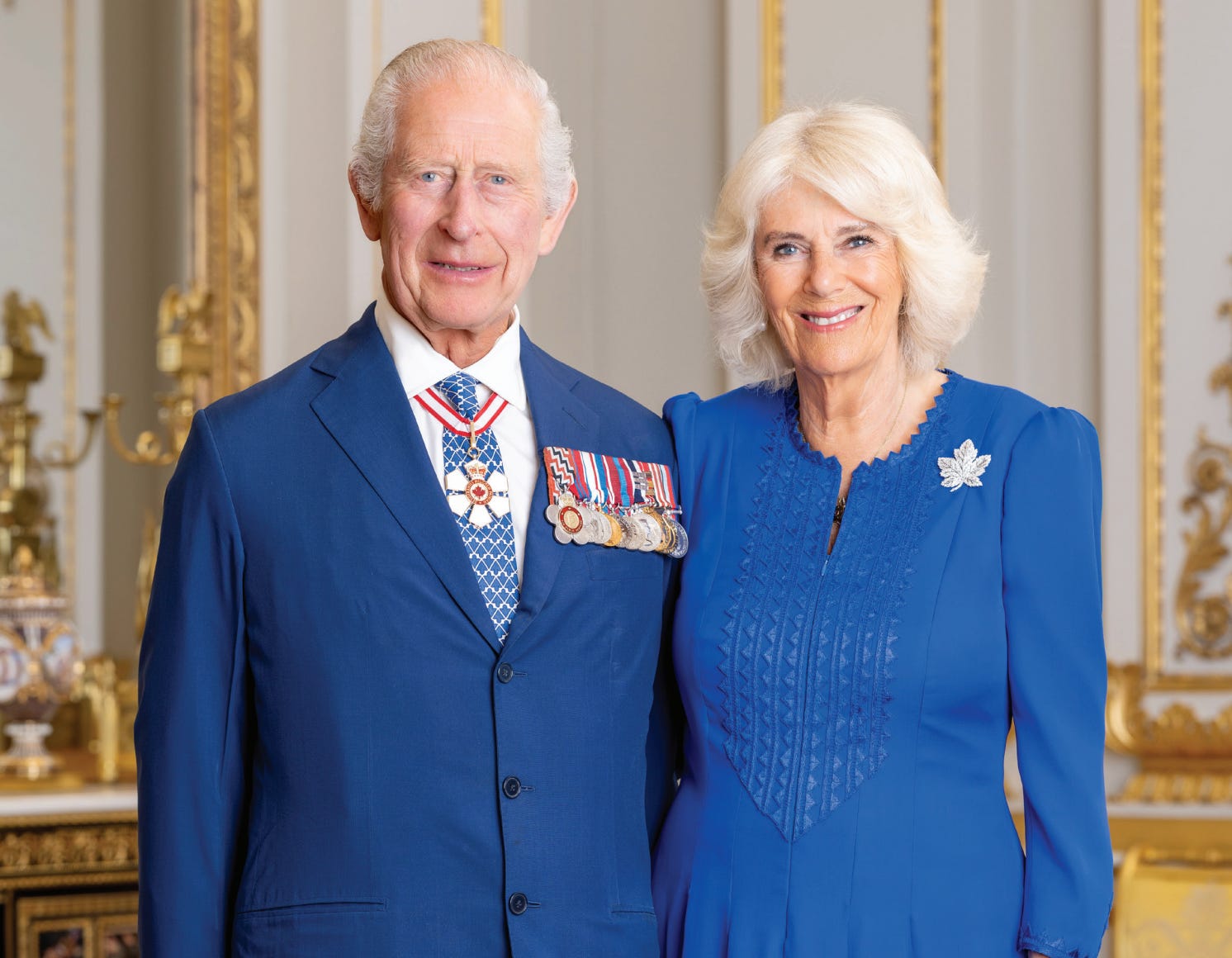
King Charles III and Queen Camilla, official portrait by Millie Pilkington.

The Post and other Canadian organs have been full of conscious praise for our unusual absentee monarchy lately, what with the King being in the capital to give the throne speech in person. But Canadian republicans must be hoping that our people will instinctively reject the spectacle, and at least see the genuine need for that blessing without which no sovereign state can hope to be taken seriously — a president.

There are rumblings about behind-the-scenes diplomatic tensions between Canada and the United Kingdom over the royal visit, rumblings which the Sunday Times (of London) put in print this weekend. The crux of the story is that Canada and the U.K. are not quite using the same playbook in dealing with the volatile and cutthroat Trump administration.

Sir Keir Starmer’s Labour government is applying lots of soft-soap, using Trump’s fondness for the British monarchy and its highly ornamented nature as a means of getting special treatment in trade negotiations. Meanwhile, Canada and its government hope to use the presence in Canada of Canada’s King as a subtle way of asserting independence, determination and strength as we bear the economic blows of Trumpian whim.

And — wait for it — the crazy part is, THOSE TWO KINGS ARE THE SAME EXACT DUDE. WHAAAT?

To a republican, this seems like a mystery concocted to obfuscate a logical weakness in the system. No doubt they see it just the same way an atheist looks at the centuries of early Christian debate over the Holy Trinity. It’s not exactly as though the U.K. and Canada are at war, or as though there is any overt disharmony between the two states. But the monarchists have to concede at least this much: when mutually sovereign countries have a shared head of state, you do in fact end up with the exotic possibility that George XIV of Canada might one day, in theory, have to issue a declaration of war on George XIV of Great Britain and Northern Ireland. This is baked into the improvised post-Imperial ontology of our government and of Britain’s.

This is why Canadian monarchists are so fussy about the independent constitutional footing on which the Canadian Crown rests. We do this, implicitly insisting that our system of government was reinvented in 1931, while at the same time arguing that the advantages of monarchy include antiquity, historical continuity and the preservation of a special bond between Commonwealth realms. Perhaps we are sneaky imperialist (or racist) hypocrites. Perhaps we just feel that those advantages are legitimate and important, and that the Statute of Westminster is an optimum compromise that preserves them while guaranteeing our sovereign freedom of action in the interplay of governments.

“Kollidge Inglish Majors kan so reed gud!”

Filed under: Education, Media, USA — Tags: , , — Nicholas @ 03:00

On Substack, Kitten provides a sample of the many, many, many, many reactions to an earlier viral piece called College English majors can’t read:

I think it’s safe to say that “lack of funding” isn’t the problem

Well, that was a wild ride. As of the time of this writing, College English majors can’t read has 120,000 views and 535 comments. Comments and restacks are still rolling in but not at the furious pace they were in the few days after publication. It went viral on twitter, with my tweet announcing the article getting 768 retweets and 1.5M views, with thousands of comments spread across various quote tweets. It was shared to Reddit in several different threads, many of which themselves spawned hundreds of comments. It went viral on Hacker News. It was shared on Vox Day. It was published on Revolver News. Hundreds of people linked it in their Instagram and Facebook posts. A bunch of people shared it on Slack or Microsoft Teams. And most endearing of all, thousands of people forwarded the newsletter around by email like an AOL chain letter from your grandma (Fwd:Fwd:Re:Fwd: You won’t BELIEVE what they are teaching in college now!!!!)

[…]

The people have spoken, and they speak in a single clear voice: they want to hear about how dumb college kids are. They want to bathe in delicious schadenfreude. They want all the embarrassing and gory details about how Suzie in Kansas couldn’t figure out what a megalosaurus is, how heavily she breathed during the 16 seconds she tapped Google searches into her phone before giving up. And their bloodlust will be slaked one way or another.

[…]

The title is inaccurate, college kids can read fine

I got this comment a bunch of different times, and I think that one particular guy made the same comment at least four different times that I saw, in different places. Basically, this nitpicking goes: these kids can read just fine, they just have trouble understanding and interpreting hard texts, and this means the title is sensational and not literally true. This is a fair point, and I deeply treasure our nation’s strategic reserve of turbospergs ready to call out technical inaccuracies wherever they rear their ugly heads. I should note for the turbospergs reading this that “rearing their ugly heads” is figurative language, article titles do not have bodies and do not move, you have me dead to rights on that one.

But most readers were quick to chide the spergs that this is an article about different levels of functional literacy, and that “read” can have different connotations depending on the context. Obviously we’re talking about more than just sounding out the words on the page in this case. And also, College English majors can’t read is just a much better title than the long but more technically accurate one you would have me write instead.

The study is bad and you can’t believe its results

A lot of people made this comment in one form or another, for a variety of reasons. If you want to read a detailed takedown, I suggest this long post by Holly MathNerd. She has a lot of different objections about the methodology and how the results generalize to the population of college kids. It’s worth reading and taking seriously if you’re the scientific minded type, she knows what she’s talking about.

One very large objection that should give you pause: there are multiple layers of potential selection bias taking place. We’re looking at just a couple schools in Kansas at a single point in time, not a nationally representative sample of students. These aren’t exactly top-tier schools, of course they don’t have the best kids! And worse, they recruited study participants the way they always recruit undergrads for this kind of study, by asking for volunteers in class or even by hand-selecting students and encouraging them to join up. This means the researchers weren’t getting a random sample of their students, they were getting the kids who were dumb enough to waste their time on a silly research task. Or even worse: they picked problematic kids on purpose to prove a point.

This is a fair criticism, and I don’t want to minimize it, but I don’t think it ultimately matters much. The reason is that we know how these kids tested on the ACT Reading subtest and how that compares to the national standard.

    The 85 subjects in our test group came to college with an average ACT Reading score of 22.4

The national average for college students on the ACT Reading subtest is 21.2, so these kids are a bit above average nationally. (20 to 23 is considered a competitive score for admission to most schools, with 24 to 28 being the standard for more selective schools). This is reasonably strong evidence that they are not significantly dumber than typical college students nationwide. Maybe not representative, sure, but certainly not dumber than average.

And despite being competitive for admission according to Educational Testing Service, 22.4 is not a good score!

    According to Educational Testing Service, [students with a score of 22.4] read on a “low-intermediate level”, able to answer only about 60 percent of the questions correctly and usually able only to “infer the main ideas or purpose of straightforward paragraphs in uncomplicated literary narratives”, “locate important details in uncomplicated passages” and “make simple inferences about how details are used in passages”

So maybe these results don’t actually generalize to students nationwide, maybe this wasn’t a fair sample. But if you’re skeptical on the question of generalization, another way to view this study is as an ethnography rather than a quantitative result — the researchers discovered and documented a group of college English majors with truly terrible reading comprehension. Whether or not this result generalizes to college kids everywhere, these particular kids exist. And they can’t read. Personally I think the ethnographic details are what make this study so evocative, and I wish more research took this form. My hunch is nobody would be talking about this at all without these details — distilled down to a raw quantitative result (half of kids score below median on test, news at 11), nobody would care.

Q&A: The Falklands War of 1982

Forgotten Weapons
Published 3 Jan 2025

Since I spent a couple weeks hiking across the Falklands and then visiting battlefields (and penguins), it seems reasonable to do a Q&A video about the place and the 1982 war there between Argentina and the UK. All the questions were provided by Forgotten Weapons Patrons.

01:38 – How did the FAL perform, seeing as both sides used it?
03:43 – Effectiveness of light and heavy weapons in the war
08:49 – Would the British have been better off Yomping with AR15s, like the SAS used?
10:09 – Is there much local animosity to Argentina today?
12:21 – Local food and adult beverages
15:31 – What do people do for fun on the Falklands?
17:52 – Oldest small arm in service during the war?
20:18 – Military equipment wreckage on the islands
22:06 – Value of full powered rifle round in the FI terrain?
24:31 – Minefields
25:44 – Interaction of weapons with different effective ranges
28:46 – Did Exocet spur development of CIWS?
31:00 – What has been done to defend the islands against another invasion?
33:51 – Issues with an army designed to fight the USSR in Europe deploying to the South Atlantic?
35:30 – Weirdest weapon used in the conflict?
36:29 – Field modifications of small arms and unique kit
38:20 – Were British vehicle at risk of damage there?
39:40 – Engagement ranges
40:23 – Relevancy of bayonet fighting
41:28 – Unique equipment used by the Falkland Islands Defense Force
43:27 – American view of the Falklands War today
44:41 – Which Yomp route did we take?
45:01 – Did we visit Ajax Bay or the cemetery?
46:00 – Reality vs my expectations of the islands
46:57 – How would the war go if it happened today instead of in 1982?
48:25 – Did British soldiers use Argentine FALs?
(more…)

QotD: FDR and Herbert Hoover in the Great Depression

November 1932. Hoover has just lost the election, but is a lame duck until March. The European debt crisis flashes up again. Hoover knows how to solve it. But:

    He had already met with congressional leaders and learned, as he had suspected, that they would not change their stance without Roosevelt’s support. Seized with the urgency of the moment, he continued to bombard his opponents with proposals for cooperation toward solutions, going so far as to suggest that Democratic nominees, not Republicans, be sent to Europe to engage in negotiations, all to no avail. Notwithstanding what editorialists called his “personal and moral responsibility” to engage with the outgoing administration, Roosevelt had instructed Democratic leaders in Congress not to let Hoover “tinker” with the debts. He had also let it be known that any solution to the problem would occur on his watch – “Roosevelt holds he and not Hoover will fix debt policy”, read the headlines. Thus ended what the New York Times called Hoover’s magnanimous proposal for “unity and constructive action”, not to mention his 12-year effort to convince America of its obligation and self-interest in fostering European political and financial stability …

    During the debt discussions and to some extent as a result of them, the economy turned south again. Several other factors contributed. Investors were exchanging US dollars for gold as doubt spread about Roosevelt’s intentions to remain on the gold standard. Gold stocks in the Federal Reserve thus declined, threatening the stability of the financial sector … what’s more, the effectiveness of [Hoover’s bank support plan], which had succeeded in stabilizing the banking system, was severely compromised by [Democrats’] insistence on publicizing its loans, as the administration had warned. For these reasons, Hoover would forever blame Roosevelt and the Democratic Congress for spoiling his hard-earned recovery, an argument that has only recently gained currency among economists.

And:

    Alarmed at these threats to recovery, Hoover pushed Democratic congressional leaders and the incoming administration for action. He wanted to cut federal spending, reorganize the executive branch to save money, reestablish the confidentiality of RFC loans, introduce bankruptcy legislation to protect foreclosures, grant new powers to the Federal Reserve, and pass new banking regulation, including measures to protect depositors … He was frustrated at every turn by Democratic leadership taking cues from the President-Elect … On February 5, Congress took the obstructionism a degree further by closing shop with 23 days left in its session.

In mid-February, there is another run on the banks, worse than all the other runs on the banks thus far. Hoover asks Congress to do something – Congress says they will only listen to President-Elect Roosevelt. Hoover writes a letter to Roosevelt begging him to give Congress permission to act, saying it is a national emergency and he has to act right now. Roosevelt refuses to respond to the letter for eleven days, by which time the banks have all failed.

Then, a month later, he stands up before the American people and says they have nothing to fear but fear itself – a line he stole from Hoover – and accepts their adulation as Destined Savior. He keeps this Destined Savior status throughout his administration. In 1939, Roosevelt still had everyone convinced that Hoover was totally discredited by his failure to solve the Great Depression in three years – whereas Roosevelt had failed to solve it for six but that was totally okay and he deserved credit for being a bold leader who tried really hard.

So how come Hoover bears so much of the blame in public consciousness? Whyte points to three factors.

First, Hoover just the bad luck of being in office when an international depression struck. Its beginning wasn’t his fault, its persistence wasn’t his fault, but it happened on his watch and he got blamed.

Second, in 1928 the Democratic National Committee took the unprecedented step of continuing to exist even after a presidential election. It dedicated itself to the sort of PR we now take for granted: critical responses to major speeches, coordinated messaging among Democratic politicians, working alongside friendly media to create a narrative. The Republicans had nothing like it; the RNC forgot to exist for the 1930 midterms, and Hoover was forced to personally coordinate Republican campaigns from his White House office. Although Hoover was good (some would say obsessed) at reacting to specific threats on his personal reputation, the idea of coordinating a media narrative felt too much like the kind of politics he felt was beneath him. So he didn’t try. When the Democrats launched a massive public blitz to get everyone to call homeless encampments “Hoovervilles”, he privately fumed but publicly held his tongue. FDR and the Democrats stayed relentlessly on message and the accusation stuck.

And third, Hoover was dead-set against welfare. However admirable his attempts to reverse the Depression, stabilize banking, etc, he drew the line at a national dole for the Depression’s victims. This was one of FDR’s chief accusations against him, and it was entirely correct. Hoover knew that going down that route would lead pretty much where it led Roosevelt – to a dectupling of the size of government and the abandonment of the Constitutional vision of a small federal government presiding over substantially autonomous states. Herbert Hoover, history’s greatest philanthropist and ender-of-famines, would go down in history as the guy who refused to feed starving people. And they hated him for it.

Scott Alexander, “Book Review: Hoover”, Slate Star Codex, 2020-03-17.

May 28, 2025

The Korean War Week 49 – Race to Trap 70,000 Soldiers – May 27, 1951

Filed under: China, History, Military, USA — Tags: , , , , — Nicholas @ 04:00

The Korean War by Indy Neidell
Published 27 May 2025

The Chinese Spring Offensive continues this week, but comes to its end — it has cost the Communist forces tens of thousands of men, but even as it ends, the UN counteroffensive begins — and costs them tens of thousands more! And in Washington the MacArthur hearings continue, and it is obvious by now to all and sundry that General Douglas MacArthur had been very much out of line and President Truman was within his authority for firing him.

Chapters
00:00 Intro
00:41 Recap
01:12 More PVA and KPA Attacks
03:41 The Counterattack Begins
07:14 Advances Everywhere
13:07 NSC 48/5
17:45 End of the Hearings?
19:05 Summary
19:18 Conclusion
(more…)

The Throne Speech

Filed under: Cancon, Media, Politics, USA — Tags: , , , , , — Nicholas @ 03:00

On his Substack, Paul Wells reports on the first Throne Speech delivered by the reigning monarch since the 1970s:

Mark Carney joins our visiting King in the traditional Making of the Small Talk.
Photo by Paul Wells from his Substack

We’re like Charlie Brown with Lucy’s football, or I guess, since the new PM is said to prefer British spellings, Charlye Brownne with Lewsey’s Foote Ball. Each generation of Canadian leadership tries to find a new way to make throne speeches exciting. These attempts are forever doomed, because no generation of Canadian leadership is exciting and because the format — a statement of intent from a dignitary who is forbidden to harbour autonomous intent — tends to short-circuit the delivery.

This time the delivery mechanism was the King of Canada, Charles Philip Arthur George, popping over from his secondary residence at Buckingham. His French tops Mary Simon’s, though his Inuktitut is shaky. He did his best to sound excited, or resolute, about the CBSA’s “new powers to examine goods”.

A quarter-century ago the reliably impish John Fraser told me he was preparing a book called Eminent Canadians that would survey recent developments in four Canadian institutions. The institutions he’d selected were the office of the Prime Minister; the Globe and Mail; the Anglican Church; — and here Fraser urged me to guess the fourth. Canadian institution? I dunno, the armed forces? The NHL? “The Crown”, Fraser said with a twinkle. Thus was I prepped for this week’s extended round of you-know-he’s-really-the-king-of-Canada browbeating.

This throne speech was like many before it, though out of deference for the deliverer it was on the short side, 21 pages tucked inside wide margins. In substance it was a paraphrase of Mark Carney’s already-semi-legendary Single Mandate Letter for cabinet ministers. There were sections on redefining Canada’s relationship with the United States; on internal trade; on crimefighting and national defence; and on “spending less and investing more”, which, I mean, we’ll see.

The mandate letter seems to have supplanted the Liberal election platform as the main blueprint for Carney’s action. The two aren’t wildly incompatible, but the mandate letter/throne speech is streamlined and puts stuff in different order.

I saw two surprises big enough to make me write today, but first I want to point to a few elements that are worth noting in the less-surprising stuff. That’s right, I’m trying to be useful, not just smart-assed, so here’s a way to thank me. […]

First, Carney (through His Majesty) makes claims for the “new economic and security relationship with the United States” that seem unrealistic. He expects “transformational benefits for both sovereign nations”. But surely any cross-border negotiation can only be, at best, an exercise in damage control? Any security costs that would be newly borne by Canada would represent a net cost. Trade arrangements short of the substantially free trade we’ve enjoyed for 40 years will also represent a net cost. The point of seeking “one Canadian economy” and taking relations with third countries more seriously is to offset the cost of a degraded Canada-US relationship, no?

Under “more affordable”, the throne speech repeats campaign promises for income-tax cuts and cuts to GST on new homes. The list of tangible financial benefits to individuals doesn’t go much past that. “The Government will protect the programs that are already saving families thousands of dollars every year. These include child care and pharmacare.” “Protect” is an old Ottawa word meaning “not extend”.

The goals for the “one Canadian economy” now include “free trade across the nation”, at both federal and provincial levels of government, “by Canada Day”. Which is 34 days away. The staffing and mandate of another new entity, a single-wicket “Major Federal Project Office”, may end up mattering more to this government’s success and Canada’s prosperity than the name of the PM’s next chief of staff, so put an asterisk next to that.

The government repeats a mysterious claim I’ve found shaky since Carney became a Liberal leadership candidate. It “will take a series of measures to catalyse new investment to create better jobs and higher incomes for Canadians. The scale of the Government’s initiative will match the challenges of our times and the ambitions of Canadians.” The challenges of our times, at least, are large.

So again: if the Canada Infrastructure Bank, the Canada Growth Fund and the Freeland-Sabia investment tax credits are sufficient to catalyse (British spelling) new investment, why duplicate them?

And if they haven’t worked, why keep them?

Older Posts »

Powered by WordPress