Tor editor Teresa Nielsen Hayden had a wonderful rant some years back. She had been talking to an animal trainer, who explained to her why otters were untrainable. Other animals, it seemed, when given their food reward or whatever by their human handler, would seem to think, “Great, he liked it! I’ll do that again!” Otters, by contrast, would seem to think, “Great, he liked it! Now I’ll do something else that’s even cooler!” Writers, Teresa concluded in a moment of Zen enlightenment, were otters. At least from an editor’s point of view.
When I boot up a new book in my brain, I am not greatly interested in what has and hasn’t won awards. I want to write something else that’s even cooler.
Lois McMaster Bujold, interview at Blogcritics, 2005-05-24.
April 12, 2022
QotD: Writers are like otters
April 5, 2022
QotD: The “rules” of bad writing
Bad writers are also prone to logical fallacies and misnomers. There’s really no excuse for this, as there are lists of common logical fallacies and, of course, searchable on-line dictionaries in every language. In casual writing, like blogging or internet commentary, this is tolerable. When it shows up in a professional publication, it suggest the writer and the editor are not good at their jobs. A brilliantly worded comparison between two unrelated things is still a false comparison. It suggests dishonesty on the part of the writer.
Certain words seem to be popular with bad writers. The word “dialectic” has become an acid test for sloppy reasoning and bad writing. The word “elide” is another one that is popular with bad writers for some reason. “Epistemology” is another example, popular with the legacy conservative writers. Bad writers seem to think cool sounding words or complex grammar will make their ideas cleverer. Orwell’s second rule is “Never use a long word where a short one will do.” It’s commonly abused by bad writers.
Finally, another common feature of bad writing is the disconnect between the seriousness of subject and how the writer approaches the subject. Bad writers, like Jonah Goldberg, write about serious topics, using pop culture references and vaudeville jokes. On the other hand, feminists write about petty nonsense as if the fate of the world hinges on their opinion. The tone should always match the subject. Bad writers never respect the subject they are addressing or their reader’s interest in the subject.
The Z Man, “How To Be A Bad Writer”, The Z Blog, 2019-03-03.
March 30, 2022
QotD: Orwell on political writing
George Orwell, “Politics and the English Language”, 1946.
March 24, 2022
QotD: Tolkien’s wartime experiences and The Lord of the Rings
Tolkien arrived on the Western Front in June 1916 as a signals officer in the 11th Lancashire Fusiliers, and experienced the agony of the Somme at first hand. In just three and a half months, his battalion lost 600 men. Yet it was now, amid the horror of the trenches, that he began work on his great cycle of Middle-earth stories. As he later told his son Christopher, his first stories were written “in grimy canteens, at lectures in cold fogs, in huts full of blasphemy and smut, or by candlelight in bell-tents, even some down in dugouts under shell fire”.
But he never saw his work as pure escapism. Quite the opposite. He had begun writing, he explained, “to express [my] feeling about good, evil, fair, foul in some way: to rationalise it, and prevent it just festering”. More than ever, he believed that myth and fantasy offered the only salvation from the corruption of industrial society. And far from shaking his faith, the slaughter on the Somme only strengthened his belief that to make sense of this broken, bleeding world, he must look back to the great legends of the North.
Yet The Lord of the Rings is not just a war book. There’s yet another layer, because it’s also very clearly an anti-modern, anti-industrial book, shaped by Tolkien’s memories of Edwardian Birmingham, with its forges, factories and chimneys. As a disciple of the Victorian medievalists, he was always bound to loathe modern industry, since opposition to the machine age came as part of the package. But his antipathy to all things mechanical was all the more intense because he identified them — understandably enough — with killing.
And although Tolkien objected when reviewers drew parallels between the events of The Lord of the Rings and the course of the Second World War, he often did the same himself. Again and again he told his son Christopher that by embracing industrialised warfare, the Allies had chosen the path of evil. “We are attempting to conquer Sauron with the Ring,” he wrote in May 1944. “But the penalty is, as you will know, to breed new Saurons, and slowly turn Men and Elves into Orcs.” Even as the end of the war approached, Tolkien’s mood remained bleak. This, he wrote sadly, had been, “the first War of the Machines … leaving, alas, everyone the poorer, many bereaved or maimed and millions dead, and only one thing triumphant: the Machines”.
“Trivial”, then? Clearly not. Tolkien was at once a war writer and an ecological writer; a product of High Victorianism and also a distant relative of the modernist writers who, like him, were trying to make sense of the shattered world of the Twenties and Thirties. But he wasn’t just a man of his time; he remains a guide for our own.
Dominic Sandbrook, “This is Tolkien’s world”, UnHerd, 2021-12-09.
March 17, 2022
QotD: The curse of creativity
Gregory Wolfe, “In God’s Image: The virtue of creativity”, National Review, 2005-05-27.
March 7, 2022
QotD: Historical fiction and fantasy works usually leave out the vast majority of the people who did all the work
But the actual human landscape of the pre-modern period was defined – in agrarian societies, at least – by vast numbers of farms and farmers. Their work proceeded on this cyclical basis, from plowing to sowing to weeding to harvesting and threshing to storage and then back again. Religious observances and social festivals were in turn organized around that calendar (it is not an accident how many Holy Days and big festivals seem to cluster around the harvest season in late Autumn/early Winter, or in Spring). The uneven labor demands of this cycle (intense in plowing and reaping, but easier in between) in turn also provided for the background hum of much early urban life, where the “cities” were for the most part just large towns surrounded by farmland (where often the folks living in the cities might work farmland just outside of the gates). People looked forward to festivals and events organized along the agricultural calendar, to the opportunities a good harvest might provide them to do things like get married or expand their farms. The human drama that defines our lives was no less real for the men and women who toiled in the fields or the farmhouses.
And of course all of this activity was necessary to support literally any other kind of activity.
Bret Devereaux, “Collections: Bread, How Did They Make It? Part III: Actually Farming”, A Collection of Unmitigated Pedantry, 2020-08-06.
January 5, 2022
John Ronald Reuel Tolkien
In The Critic, David Engels outlines the early life and career of J.R.R. Tolkien:

The biography of the British writer and philologist John Ronald Reuel Tolkien (1892-1973) is quickly summarised and, despite a few unusual cornerstones such as his early childhood in South Africa, the tragic death of his parents and the highly romantic love for his later wife Edith, not very spectacular. An existence confined entirely to the British Isles except for a few forays into the continent; a military service in the Great War only moderately traumatic compared to other fates; an honourable but hardly groundbreaking academic career; a life as father of a family that knew the most varied but hardly extraordinary fortunes.
Not really the stuff of legends — except for the global success of The Lord of the Rings, which arrived too late to set Tolkien’s existence on a different course. The (deeply unsatisfying) 2019 film adaptation of Tolkien’s youth attempts to surround him with the aura of a scholarly genius and war hero, and to explain his literary work biographically — but this reductionist attempt rather hinders the understanding of his oeuvre. Tolkien’s works are not exceptional because his life was: on the contrary, their exceptionality only gains its full significance when they are understood against the background of an altogether quite normal existence.
Of course, with such an undramatic approach, it is tempting to associate Tolkien’s enormous mythopoeic activity with the catchword “escapism”, and to reduce it once again to his biography, albeit this time not as a correspondence but as a compensation. This, too, misses the point — all the more so because Tolkien’s earliest literary activity goes far back into his teenage years: his work is not a reaction to his life, but rather the two grew in union, not unlike the mythical trees Telperion and Laurelin. Indeed, one might even regard Tolkien’s rather ordinary academic and family life as a consequence of his consuming, lifelong work on myth rather than the other way around. But what was Tolkien’s intention — and what can we learn from him?
In the beginning, there was disappointment. The Anglo-Saxon world, unlike France or Germany, has scarcely left any traces of an indigenous myth tradition; even the saga of King Arthur belongs to the pre-Anglo-Saxon, Celtic tradition. The Norman Conquest destroyed the entire Anglo-Saxon legend tradition, apart from a few nursery rhymes and place names and a very brittle literary corpus.
As an ardent lover of the Northwest of the Old World, the young Tolkien felt cut off from his own heritage and enthusiastically took up Indo-European linguistics as a technique for reconstructing the historical and mythical tradition of times long past. He set about, partly in play, partly in earnest, creatively deciphering and reconstructing the hitherto misunderstood evidence of England’s dark centuries. In the process, the boundary between etymology and mythopoetics quickly blurred, as Tolkien enriched the hypothetical material obtained by merging it with the archetypal content of the other legends of the ancient world. He created a mythical tradition that took on a character of its own.
But it would be wrong to interpret this legendarium, which was born out of linguistics but soon took on increasingly literary features, as a mere poetic game. Especially in the initial phase of his attempts, Tolkien endeavoured to introduce the increasingly coherent legends and sagas, which are known to the general public mainly through the posthumous Silmarillion and the publishing activities of his son Christopher, by use of a wide variety of framework plots, some of which have an old Anglo-Saxon character and some which are set in modern times. The leitmotif was the dream of the great wave that swallowed up a green island, which later became the seed of the “Fall of Númenor”; an image that haunted Tolkien himself often enough in his sleep and led him to state that those images, recorded partly in dreams and partly in a half-awake state, were not to be regarded as mere fiction, but rather as access to something true and permanent, which he fleshed out in various literary ways, but whose core consistently bore the character of a vision.
November 23, 2021
Tucker Carlson’s new book The Long Slide
Wilfred M. McClay reviews Carlson’s collected essays for First Things:
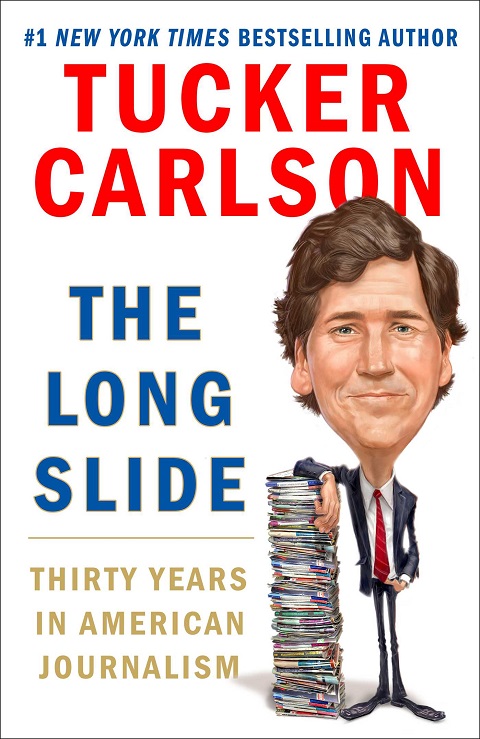
Tucker Carlson has become such a fixture in the world of cable-television news that it’s easy to forget he began his journalistic career as a writer. And a very good one at that, as this wide-ranging and immensely entertaining selection of essays from the past three decades serves to demonstrate. Carlson’s easygoing, witty, and compulsively readable prose has appeared everywhere from The Weekly Standard (where he was on staff during the nineties) to the New York Times, the Spectator, Forbes, New Republic, Talk, GQ, Esquire, and Politico, which in January 2016 published Carlson’s astonishing and prophetic article titled “Donald Trump is Shocking, Vulgar, and Right”. That essay has been preserved for posterity in these pages, along with twenty-two other pieces, plus a bombshell of an introduction written expressly for the occasion. More of that in a moment.
The first response of many of today’s readers, particularly those who don’t like the tenor of Carlson’s generally right-populist politics or the preppy swagger and bubbly humor of his TV persona, will be to dismiss The Long Slide as an effort to cash in on the author’s current notoriety by recycling old material to make a buck. That was my assumption when I first opened this collection. But the book has an underlying unity, and a serious message. It evokes a bygone age, an era of magazine and newspaper journalism that seems golden in retrospect, and is now so completely gone that one must strain to imagine that it ever existed at all. The simple fact is that almost none of these essays could be published today, certainly not in the same venues: They are full of language and imagery and a certain brisk cheerfulness toward their subject matter that could not possibly pass muster with the Twittering mob of humorless and ignorant moralists who dictate the editorial policies of today’s elite journalism.
Carlson’s writing style reflects the influence of the New Journalists such as Tom Wolfe and Hunter Thompson, who brought a jaunty, whiz-bang you-are-there narrative verve and high-spirited drama to the task of telling vividly detailed stories about unusual people and places, generally relating them in the first person. Carlson’s prose is not as spectacular as Wolfe’s or as thrillingly unhinged as Thompson’s. But it has its own virtues, being crystal clear, conversational, direct, and vigorous, never sending a lardy adjective to do the work of a well-chosen image, and never using gimmicky wild punctuation or stretched-out words to fortify a point. He’s a blue-blazer and button-down-collar guy, not a compulsive wearer of prim white suits or a wigged-out drug gourmand wearing a bucket hat and aviator glasses. But many of Carlson’s writings give the same sense of reporting as an unfolding adventure, a traveling road show revolving around the reactions and experiences of the author himself.
Carlson usually shows a certain fundamental affection for the people he writes about, even if he also ribs or mocks them in some ways. In particular, there is none of that ugly contempt for the “booboisie” and ordinary Americans that one finds, for example, in the pages of H.L. Mencken, and in a great deal of prestige journalism. Instead, he reserves his contempt for the well-heeled know-it-alls who genuinely deserve it. In that sense, the Carlson of these essays does not seem very different from the Carlson of today. He always has been a bit of a traitor to his class, and commendably so.
November 16, 2021
Mike Solana interviews Chris Best, the co-founder and CEO of Substack
Not long after I started hearing about Substack, some of my favourite writers and bloggers began to move their work to the new platform. I now subscribe to more than a dozen Substack authors, although being a penniless blogger, I’m restricted to the free offerings in each case. Thus far I’m definitely seeing Substack as a positive influence in the online world, so this Mike Solana post was of some interest to me:

MIKE SOLANA: In your and Hamish McKenzie’s recent essay, “The internet needs better rules, not stricter referees”, you say Substack is changing the publishing model. Before we get into all that, how would you characterize the publishing landscape before Substack?
CHRIS BEST: My general story on this is we’re coming out of an age of attention-monster social media. People used to get bored. People used to have this problem of like, I don’t know what to do with my time. Then the internet, and especially the mobile internet, took over ALL of our time and attention. It filled up every crevice in our life.
In the first phase of that — the attention suck — it was like this giant land grab. If you were making something that competed for attention space, you wanted to grab as much as possible, as quickly as possible, because there’s only so much. You were competing for people’s 10 minutes while they were waiting in line at the grocery store or whatever. So publishers made content free, and they made it as broadly-compelling as possible. The goal was to grab as much attention as possible in the lowest friction way possible, and to turn that attention into money through advertising.
And listen, none of that was nefarious. None of that was like, people with tented fingers going, “Aha! This will create something bad!” But when you create a system like this, you end up with a certain incentive structure. Then, if you build your algorithms to serve your business model, the incentive structure you create for people participating in your network drives a certain sort of behavior.
The platforms all optimized for things that brought cheap engagement at all costs, that interaction weighed to some of the worst aspects of human nature, and drove emergent behavior that gave us many of the things we see today. The legacy media just got totally steamrolled by all of this, and lives in the world created by these platforms.
SOLANA: Do you really feel that Substack is completely protected from this scaled advertising dynamic with its subscription model? There are a lot of legacy media institutions that have subscriptions, and have had subscriptions for the last 10 or 20 years, in addition to running ads. Personally, I’m also getting requests to run ads on Pirate Wires fairly often. I’m not biting, which maybe answers my question before I’ve asked it, but … do you really see this all changing?
BEST: I think the subscription model is necessary, but not sufficient, right? First of all, as a writer, that you can actually make real money doing this is by itself a big deal. I’ve convinced a lot of people to do subscription instead of ads, and usually they come back to me later like, “Thank you, you changed my life. I can’t believe I was ever thinking the other thing.”
People tend to think about this like, “I could make money with ads. I could make money with subscriptions. Two moneys is better than one money.” But when you’re making the best possible product to drive subscriptions, what you end up having to write is qualitatively different — and better — than the thing you’d have to do to drive the most ad revenue.
If you want to earn and keep the trust of a relatively small number of people who value your writing really deeply, deeply enough to pay for it, and you want that number to grow, the work you do in that world is different than the work you do if you’re like, “I need to get as many people to hear my Casper mattress ad read as possible.”
However, to your point, it’s not enough. One of the big problems with Substack now is people are like, “Great, we’ve got this place where the incentive structure works differently, and I want create this better product to earn and keep the trust of my subscribers … but the way that people find out about my stuff is still on Twitter.”
So we’re kind of downstream from this, you know, attention sewage factory of incentives. I think for Substack to live up to the idea of letting readers take back their mind, and their attention, and helping us all create this kind of alternate universe of content with different laws of physics … we need to do more on that front.
QotD: Writing SF and fantasy
Lois McMaster Bujold, interview at Blogcritics, 2005-05-24.
November 13, 2021
The patron saint of “Gonzo” journalism was a pretty cruddy human being
As I mentioned in an earlier post on one of Hunter S. Thompson’s famous early books, I discovered the writer at a particularly susceptible age … teenagers of my generation were generally suckers for counter-culture heroes (being too young to be actual hippies because we were in primary school when the Summer of Love flew past, and therefore feeling we’d missed out on something Big and Important and Meaningful). As a gullible teen, I believed Fear and Loathing in Las Vegas was mostly factual with some obvious-even-to-me embroideries for dramatic or comedic effect. I could easily forgive the guessed-at 10% fiction, but Thompson eventually admitted that the majority of the story was bullshit. Entertaining bullshit, but bullshit.
Which, as it happens, turns out to have been Thompson’s life-long modus operandi, as Kevin Mims repeatedly highlights in his Quillette review of David S. Wills’ biography called High White Notes: The Rise and Fall of Gonzo Journalism:
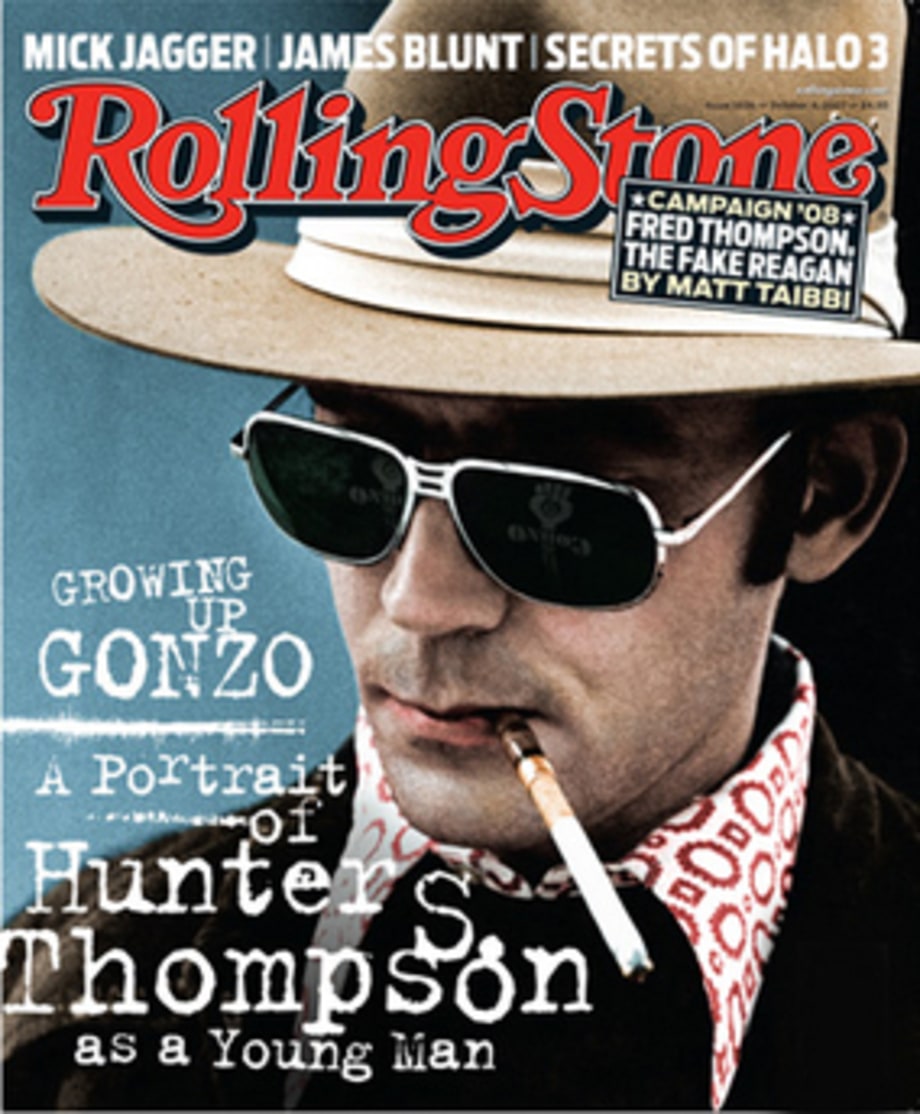
In High White Notes, his riveting new biography of Hunter S. Thompson, journalist David S. Wills describes Thompson as America’s first rock star reporter and compares him to Mick Jagger. But by the time I finished the book, I’d decided that Thompson bore a closer resemblance to Donald Trump. The two men were born nine years apart, during white American masculinity’s golden age. Both were obsessed with politics without possessing anything that could be described as a coherent political philosophy. Both men longed for some mythical American paradise of the past. Both men screwed over multiple friends and business partners. Both men would have gone broke if not for the frequent intervention of helpful patrons. Both men were egomaniacs fond of self-mythologizing and loath to share a spotlight with anyone. Both men enjoyed making disparaging remarks about women, minorities, the disabled, and other disadvantaged people. Both men were frequently disloyal to their most loyal aiders and abetters. Thompson’s endless letter writing and self-pitying 3am telephone calls to friends and colleagues were the 20th century equivalent of Trump’s late-night Twitter tantrums. Both men generally exaggerated their successes and blamed their failures on others. Both men mistreated their wives. Both men nursed a constant (and not entirely irrational) sense of grievance against perceived enemies in the government and the media. Both men had a colossal sense of entitlement …
The list could go on and on. Trump actually fares better than Thompson by various measures. For instance, Trump has never had a drug or alcohol problem, as far as I know. Thompson was a drug and alcohol problem. The first US president in living memory without a White House pet seems to have no interest in animals. Thompson enjoyed tormenting them. Rumors have circulated since 2015 that a recording exists of Trump using a racial slur but since the evidence has never surfaced, it might be fairer to conclude (at least provisionally) that this is not one of his many character failings. Thompson’s published and (especially) unpublished writings are full of such language.
All of which may lead you to conclude that High White Notes is not a favorable account of Hunter S. Thompson’s life and work. To the contrary, David S. Wills is a Thompson devotee who considers his subject to have been a great writer and, at times, a great journalist. But Wills is an honest guide, so his endlessly entertaining biography manages to be both a fan’s celebration and unsparing in its criticism of Thompson and his work.
Though impressive, the book is not without faults. Wills relies too heavily on cliché (“This book will pull no punches”; “breathing down his neck for the final manuscript”; “women threw themselves at him” etc.), and has a tendency to find profundity in unnaturally strained readings of Thompson’s prose. For instance, Wills describes a scene from a 1970 profile Thompson wrote of French skier Jean-Claude Killy, in which three young boys approach Thompson and ask if he is Killy. Thompson tells them that he is, then holds up his pipe and says, “I’m just sitting here smoking marijuana. This is what makes me ski so fast.” This sounds to me like standard Thompson misbehavior, but Wills infers something more complex: “On the surface, it appears to be comedy for the sake of comedy but in fact it is a comment on the nature of celebrity and in particular Killy’s empty figurehead status.” And when Thompson describes Killy as resembling “a teenage bank clerk with a foolproof embezzlement scheme,” Wills remarks, “Thompson has succeeded mightily not just in conveying [Killy’s] appearance but in hinting at his personality. He has placed an image in the head of his reader that will stick there permanently. It was something F. Scott Fitzgerald achieved, albeit in more words, when he had Nick Carraway describe Jay Gatsby’s smile.” (The book, by the way, takes its title from Fitzgerald, who used the phrase to describe short passages of writing so beautiful that they stand out from the larger work of which they are a part.)
[…]
Thompson’s big break as a writer came in 1965 when he was hired to write an article about the Hell’s Angels motorcycle gang for the Nation. The piece was so popular that Thompson found himself besieged by publishers who wanted him to expand it into a full-length nonfiction book. The Thompsons moved into the Haight-Ashbury district of San Francisco and Thompson set about writing Hell’s Angels, the 1967 book that would make him famous. Even in that first book, written before he had fully formulated the concept of Gonzo journalism, Thompson was already tinkering with the truth and engaging in the kind of self-mythologizing that would become a hallmark of his work. And that didn’t sit well with the Hell’s Angels themselves. According to Sonny Barger, a founding member of the Angels, Thompson “would talk himself up that he was a tough guy, when he wasn’t. When anything happened, he would run and hide.” Barger’s assessment of the book was terse: “It was junk.”
Wills notes that Thompson “tended to write about himself in ways that built his legend … to prove his machismo on paper. The back cover [of Hell’s Angels] describes him as ‘America’s most brazen and ballsy journalist’ and in the book he tells the story of first meeting the Angels and trying to impress them by shooting out the windows of his own San Francisco home. Such moments of bravado tend to enter the story very briefly and seem to serve little purpose beyond this self-mythologizing.”
But it was exactly this kind of self-mythologizing — the bragging about his drug use and general misbehavior — that editors of American magazines found so exciting about Thompson’s work, so it’s no wonder that he engaged in so much of it. It was his wild man persona that made Warren Hinckle of Scanlan’s Monthly want to unleash him among the socialites of Louisville. Still, Thompson didn’t fully emerge as a countercultural hero until he began to write for a small start-up publication in San Francisco called Rolling Stone.
November 7, 2021
Apparently we need to block the “Random Penguin & Schuster” merger to protect the 0.001%
In the most recent SHuSH newsletter from Kenneth Whyte, the US Department of Justice case against allowing the proposed merger of Penguin Random House and Simon & Schuster is examined in some detail:

On Tuesday, the US Justice Department (DOJ) filed suit to block Penguin Random House from purchasing its rival, Simon & Schuster, for $2.18 billion. It promises to be a fascinating case, in part because there’s so much at stake for the two firms involved, and also because of the unusual angle from which the DOJ is attacking the file.
As one of two US agencies responsible for enforcing antitrust law (the other is the Federal Trade Commission), the DOJ believes the proposed deal, struck last year, would leave Penguin Random House, already the world’s largest publisher of consumer books, “towering over its rivals”. The combined entity would have revenues more than twice its next closest competitor, and “outsized influence over who and what is published, and how much authors are paid for their work”.
Bertelsmann, owner of Penguin Random House, and Viacom, owner of Simon & Schuster, promise to fight the DOJ in court. They acknowledge that the Big Five Publishers, a grouping that also includes Hachette, HarperCollins, and Macmillan, will be a Big Four after the merger, but maintain that these firms plus new publishing entrants, such as Amazon, and an abundance of small and midsize publishers will provide sufficient competition for authors and books. “The publishing industry is, and following this transaction will remain, a vibrant and highly competitive environment,” they said in a joint statement.
So far, so ordinary corporate behaviour. Who or what do we need to protect, beyond hoping to maintain something vaguely resembling a competitive marketplace for books? A tiny sub-set of authors:
With this suit, the DOJ is taking a narrower approach. One test of whether a merger results in illegal market dominance is spelled out in the Horizontal Merger Guidelines jointly issued by the DOJ and the FTC: it asks if the combined firm would be in a position to increase its profits by imposing a price cut — a small but significant and lasting price cut — on one of its suppliers. In other words, if the new and enlarged Penguin Random House is better able than the old Penguin Random House to squeeze one supplier on one product line, the merger is illegal.
To apply this test to the deal, the DOJ needs to identify which supplier and which product line is vulnerable if the firms are allowed to merge. It has a range of options. Book publishing is a complicated marketplace, with many suppliers and product lines. Publishers sell books to retailers, and market books to consumers; they buy distribution services, printing, advertising, editorial services, and so on. The DOJ might have argued that a merged Penguin Random House-Simon & Schuster would have the muscle to make its printers or copyeditors reduce their rates. Or that it could force retailers to accept smaller cuts of sales revenue.
Instead, the DOJ put its chips on the discreet line of business in which authors supply manuscripts to publishing houses. Its complaint says that the combined firm would have the power to improve its profits by significantly and permanently lowering the advances it pays to authors for the rights to publish their books.
Advances, notes the DOJ, provide the bulk of author income at the Big Five publishing houses (few authors earn out their advances and collect further royalties). Were Penguin Random House and Simon & Schuster to combine, there would be nothing to deter it “from imposing a small, but significant, and non-transitory decrease in advances”. And if it did so, the complaint maintains, authors would have nowhere to turn. The DOJ ignores the existence of the other three members of the Big Five. It admits that the US has 3,000 small and mid-size houses but, these, according to the complaint, are economically irrelevant, mere “farm teams” for the big houses. Self-publishing, it adds, is not a serious alternative.
That may sound like the DOJ is suing to stop this merger on behalf of the writing community, a heartwarming notion, but it’s not. The lawsuit is primarily concerned with a small subset of writers: those who produce “anticipated top-selling books”. According to the complaint, there exists a small but definable market for “anticipated top-selling books”. It represents a distinct line of commerce, as required under the Clayton Act, and that is the real focus of the complaint.
The DOJ is going to war for sellers of “anticipated top-selling books”, the .001% of the publishing world.
Its lawyers foresee a time when Penguin Random House-Simon & Schuster will target John Grisham and his ilk with lower advances, and John Grisham will have no choice but to accept. So far as the DOJ is concerned, that is how this merger fails the Horizontal Merger Guidelines, and why it is illegal. The phrase “anticipated top-selling books” appears 29 times in a 26-page document.
October 26, 2021
QotD: Blogging
We’ll see. In a way blogs are the refutation of the old joke: “The food’s so bad here.” “Yes, and such small portions.” Dole out crap in large amounts all day and you don’t guarantee traffic; eventually people will tired of poking through the heap with a stick looking for diamonds.
Somewhere in there, there’s a metaphor.
James Lileks, The Bleat, 2005-05-10.
October 1, 2021
Social media proves Derrida correct – “il n’y a pas de hors-texte” (“there is nothing outside the text”)
A look at how social media — especially Twitter — shows that Derrida had a valid point … even if that isn’t the original intent.
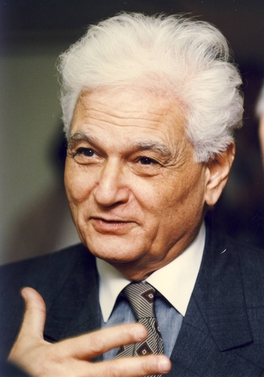
Jacques Derrida (1930-2004).
Photo from https://bettyrojtman.huji.ac.il/media-gallery/detail/15698/15538 via Wikimedia Commons.
Derrida once said “il n’y a pas de hors-texte“, “there is nothing outside the text”, and since the social damage to words uttered ratio of that phrase must be among the highest in history, it’s worth exploring. Just so we’re clear, I have no idea what Derrida was trying to do with “deconstruction”, outside of the most basic general concept (I often doubt Derrida his own self had any idea what he was trying to do, but that’s irrelevant). But let’s do some “deconstruction” of our own on that phrase, since that has some interesting implications.
If you take it as written — that there is nothing outside the text; that is, that the text exists as a complete unit of meaning, for its own sake — then it seems to argue for a kind of “positivism” in communications. Something like Orwell’s desire to develop “window pane” prose — writing so clear that the author would disappear and only the ideas would come through, unfiltered. Alas, this is a habit of mind that seems impossible to develop. No matter how clear your prose is, “writing” is one of those dialectical relationships so beloved of Marxists and stoned sophomores (lot of overlap between those groups, admittedly). In some vague, yet real and obvious, way, “writing” doesn’t exist apart from “reading”. Sure, sure, you can make marks on a page, but that’s all it is, until someone sits down to read it …
… at which point his personality comes into play, his worldview, his circumstances, his history, to be somewhat pretentious about it. And this will be true even if — in a lot of cases, especially if — you confine your prose to simple statements of fact. For instance, back in the early days of smartphones, I watched a minor miscommunication between a buddy and his girlfriend escalate into something very close to a relationship-ending fight, simply because neither party would stop texting and, you know, actually use the telephone they were texting with. A five minute phone call would’ve straightened it all out, and needless to say a face-to-face chat would’ve solved the “problem” in about ten seconds, but since text messages are devoid of subcommunication and, crucially, context, each party naturally brings his or her own biases to it, and, well … screaming, relationship-ending blowout for the win.
See also: Twitter. Like most people, I gave it a look-see when I first heard about it. I quickly concluded that it wasn’t for me. Not because it was vapid garbage, you understand — Facebook was always vapid garbage, but it had some utility for all that, as Twitter does — but because I just don’t think in discrete chunks the way Twitter requires. I just can’t process the fact that “replies” are their own distinct utterances, devoid of all other context, that can come in at random times. A Twitter “thread” is a mad babble of people shouting past each other; it’s not “communication” in any sense my brain can handle, so I dropped it …
September 12, 2021
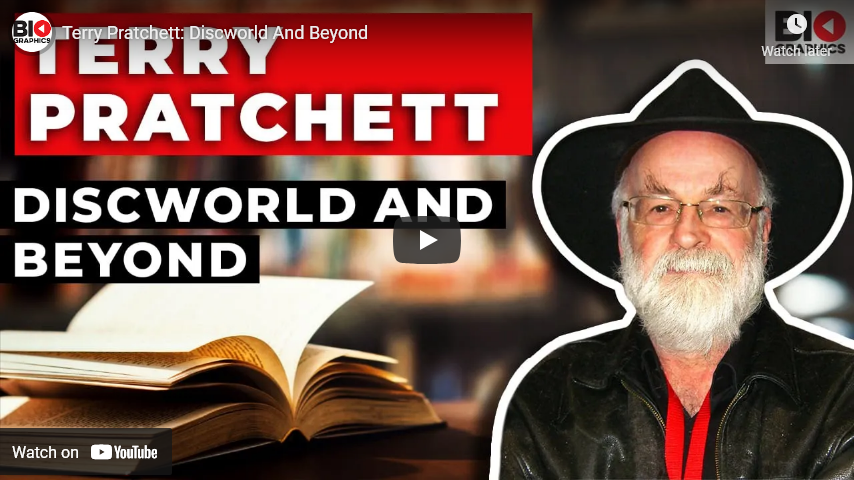
Terry Pratchett: Discworld And Beyond
Biographics
Published 19 Mar 2021Dive into Discworld.