
Calvin: “I used to hate writing assignments, but now I enjoy them. I realized that the purpose of writing is to inflate weak ideas, obscure poor reasoning, and inhibit clarity. With a little practice, writing can be an intimidating and impenetrable fog! Want to see my book report?”
Hobbes: “‘The Dynamics of Interbeing and Monological Imperatives in Dick and Jane: A Study In Psychic Transrelational Gender Modes.'”
Calvin: “Academia, here I come!”
Bill Watterson, Calvin and Hobbes.
September 7, 2021
QotD: Calvin was right
Comments Off on QotD: Calvin was right
September 3, 2021
QotD: Drama critics
It’s a second-rate job, folks. Being a drama critic on Broadway wouldn’t keep a decent mind occupied 10% of the time. So you don’t even get second-raters. You get the dregs, the stage-struck but untalented neurotic who eventually drifts into criticism as a means of clinging peripherally to the arts. And most of your cruel critics come this way: they are getting their own back.
William Goldman, The Season: A Candid Look at Broadway, 1969.
Comments Off on QotD: Drama critics
August 1, 2021
Christopher Hitchens on George Orwell
DailyHitchens
Published 22 Jan 2010Aug 7, 2009. Christopher Hitchens talks with EconTalk host Russ Roberts about George Orwell. Drawing on his book Why Orwell Matters, Hitchens talks about Orwell’s opposition to imperialism, fascism, and Stalinism, his moral courage, and his devotion to language. Along the way, Hitchens makes the case for why Orwell matters. For more videos, updates and info on Christopher Hitchens, please visit http://www.dailyhitchens.com

Comments Off on Christopher Hitchens on George Orwell
July 19, 2021
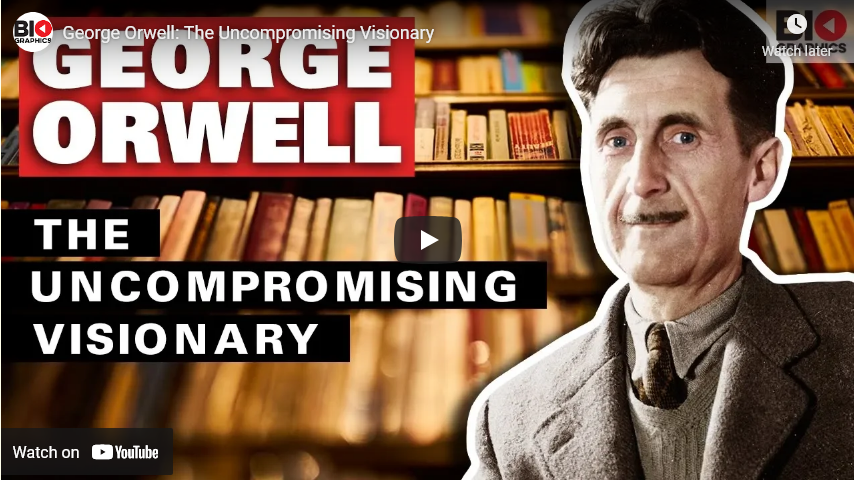
George Orwell: The Uncompromising Visionary
Biographics
Published 29 Nov 2019This video is #sponsored by NordVPN.
Credits:
Host – Simon Whistler
Author – Morris M
Producer – Jennifer Da Silva
Executive Producer – Shell HarrisBusiness inquiries to biographics.email@gmail.com
Source/Further reading:
Britannica’s Orwell Bio: https://www.britannica.com/biography/…
Excellent, very informative ONDB biography (paywall for non-UK users. UK users need only enter library card number to access): https://www.oxforddnb.com/view/10.109…
Spanish civil war: https://encyclopedia.ushmm.org/conten…
https://www.history.com/this-day-in-h…
Orwell’s mistakes on the Spanish Civil War: https://www.theguardian.com/books/201…
Orwell at the BBC: https://www.bbc.com/news/entertainmen…
Comments Off on George Orwell: The Uncompromising Visionary
July 9, 2021
Alexander Larman on George MacDonald Fraser’s Flashman novels
I happened upon a copy of the first Flashman in my teens and was totally taken in by the assertion that the book was about “a real historical figure involved in most of the Victorian era’s most notorious episodes and that his papers were discovered during a sale of household furniture at Ashby, Leicestershire in 1965.” I’d watched the TV adaptation of Tom Brown’s Schooldays, so I had some awareness about the character Flashman, which only helped keep the cover story going for me. I absolutely loved the book and while it eventually became clear that it was fiction, I haunted the bookshops for years afterwards searching for more from Fraser. In The Critic, Alexander Larman looks at the author and his works — which almost certainly could never have been published in this neo-Victorian age:
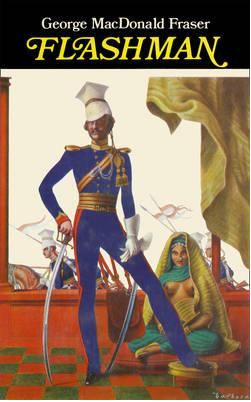
When Flashy first entered the scene in bestselling form in 1969, there was confusion as to whether the tales were fanciful fiction or eyebrow-raising fact. This was due to MacDonald Fraser’s straight-faced claim that his protagonist was a real historical figure involved in most of the Victorian era’s most notorious episodes and that his papers were discovered during a sale of household furniture at Ashby, Leicestershire in 1965.
MacDonald Fraser presented himself as an impartial editor. He wrote, “I have no reason to doubt that it is a completely truthful account; where Flashman touches on historical fact he is almost invariably accurate, and readers can judge whether he is to be believed or not on more personal matters.”
The subterfuge succeeded. A third of the initial reviews treated it as a serious work of non-fiction, rather than a brilliantly conceived and superbly written counter-factual piece.
Not bad for the continued exploits of a minor character in the sanctimonious Victorian novel Tom Brown’s Schooldays, whose major achievement is to bully the protagonist and his friend Harry “Scud” East, before being expelled for drunkenness. It set its creator on a hugely lucrative path, and established him as one of the great comic novelists of his day.
MacDonald Fraser was a contradictory figure. A patriotic right-winger who had a deep respect for other cultures and peoples; one of Hollywood’s most in-demand screenwriters who happily lived on the Isle of Man in a self-conscious recreation of “the good old days”; a fully paid-up reactionary who wished to reintroduce corporal and capital punishment, but who loathed British incursions abroad.
Above all, he despised cant and hypocrisy. He described Tony Blair as “not just the worst prime minister we’ve ever had, but by far the worst prime minister we’ve ever had” and angrily added, “it makes my blood boil to think of the British soldiers who’ve died for that little liar.”
Christopher Hitchens, who may not have agreed with his views on foreign expeditions, but knew a thing or two about the value of being able to hold one’s drink, was a friend of MacDonald Fraser’s. When Hitchens telephoned him on his eightieth birthday to offer his regards, he was stoutly informed that he shared the company of “Charlemagne, Casanova, Hans Christian Andersen and Kenneth Tynan” on that date.
Their politics may have differed — Christopher acknowledged MacDonald Fraser’s “robust Toryism” — but Hitchens respected the older writer’s enduring affection for his Zulu, Sikh and Afghan characters, as well as the dutiful admiration he showed towards both American culture and its presidents.
Comments Off on Alexander Larman on George MacDonald Fraser’s Flashman novels
June 6, 2021
George Orwell’s “Politics And The English Language” remains the best guide to writing non-fiction
Despite pulling most of his writing behind a paywall, I still get the occasional “Weekly Dish” post excerpt from Andrew Sullivan, including his homage to the still-relevant Orwell essay “Politics and the English Language”:
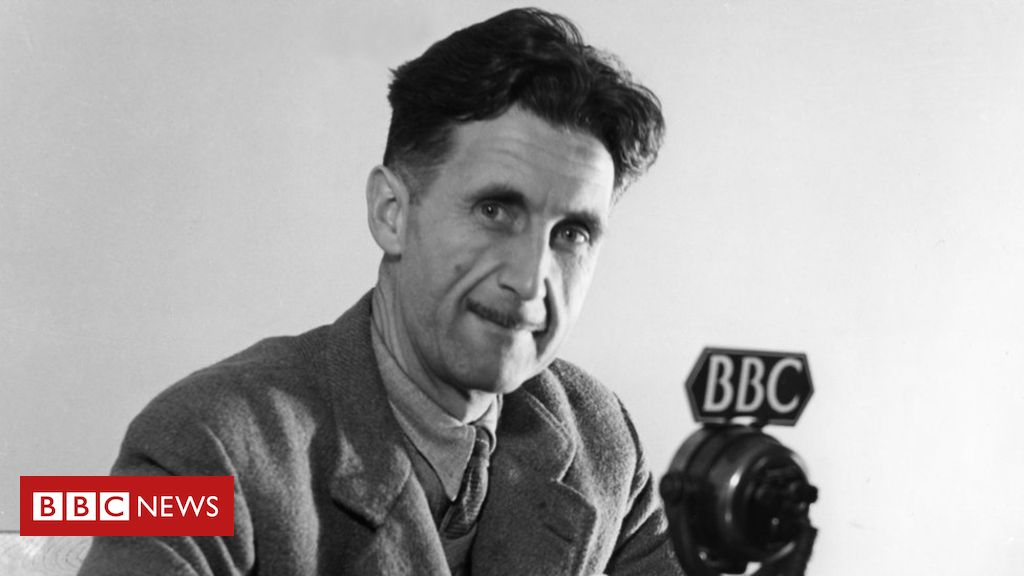
From time to time, I make sure to re-read George Orwell’s classic essay, “Politics And The English Language“. It remains the best guide to writing non-fiction, and it usually prompts a wave of self-loathing even more piercing than my habitual kind. What it shows so brilliantly is how language itself is central to politics, that clarity is as hard as it is vital, and that blather is as lazy as it is dangerous. It’s dangerous because the relationship between our words and our politics goes both ways: “[The English language] becomes ugly and inaccurate because our thoughts are foolish, but the slovenliness of our language makes it easier for us to have foolish thoughts”. We create language and language creates us. If the language is corrupted, so are we.
Near the end of the essay, Orwell lists a few rules to keep writing clear, accessible and meaningful:
i. Never use a metaphor, simile or other figure of speech which you are used to seeing in print.
ii. Never use a long word where a short one will do.
iii. If it is possible to cut a word out, always cut it out.
iv. Never use the passive where you can use the active.
v. Never use a foreign phrase, a scientific word or a jargon word if you can think of an everyday English equivalent.
vi. Break any of these rules sooner than say anything outright barbarous.
Originality, simplicity, brevity, active verbs, everyday language, decency: as simple as it is very, very hard. It’s a relief in a way to recall that Orwell thought things were pretty damn shitty in his day as well, but the more you read broadly across most elite media platforms these days, the more similar it all sounds. To reverse Orwell’s virtues: so much of it is repetition, complexity, length, passive verbs, endless jargon, barbarism.
I was just reading about the panic that occurred in the American Medical Association, when their journal’s deputy editor argued on a podcast that socio-economic factors were more significant in poor outcomes for non-whites than “structural racism”. As you might imagine, any kind of questioning of this orthodoxy required the defenestration of the deputy editor and the resignation of the editor-in-chief. The episode was withdrawn from public viewing, and the top editor replaced it with a Maoist apology/confession before he accepted his own fate.
But I was most struck by the statement put out in response by a group called “The Institute for Antiracism in Medicine”. Here it is:
The podcast and associated promotional message are extremely problematic for minoritized members of our medical community. Racism was created with intention and must therefore be undone with intention. Structural racism has deeply permeated the field of medicine and must be actively dissolved through proper antiracist education and purposeful equitable policy creation. The delivery of messages suggesting that racism is non-existent and therefore non-problematic within the medical field is harmful to both our underrepresented minoritized physicians and the marginalized communities served in this country.
Consider the language for a moment. I don’t want to single out this group — they are merely representative of countless others, all engaged in the recitation of certain doctrines, and I just want an example. But I do want to say that this paragraph is effectively dead, drained of almost any meaning, nailed to the perch of pious pabulum. It is prose, in Orwell’s words, that “consists less and less of words chosen for the sake of their meaning, and more and more of phrases tacked together like the sections of a prefabricated hen-house.”
It is chock-full of long, compounded nouns and adjectives, riddled with the passive voice, lurching and leaning, like a passenger walking the aisle on a moving train, on pre-packaged phrases to keep itself going.
Notice the unnecessary longevity: a tweet becomes an “associated promotional message”. Notice the deadness of the neologisms: “minoritized”, “marginalized”, “non-problematic”. As Orwell noted: “the normal way of coining a new word is to use a Latin or Greek root with the appropriate affix and, where necessary, the -ize formation. It is often easier to make up words of this kind (deregionalize, impermissible, extramarital, non-fragmentatory and so forth) than to think up the English words that will cover one’s meaning.” Go back and see if you can put the words “minoritized” or “non-problematic” into everyday English.
Part of the goal of this is political, of course. The more you repeat words like “proper antiracist education” or “systemic racism” or “racial inequity” or “lived experience” or “heteronormativity”, the more they become part of the landscape of words, designed to dull one’s curiosity about what on earth any of them can possible mean. A mass of ideological abstractions, in Orwell’s words, “falls upon the facts like soft snow, blurring the outlines and covering up all the details.”
Then this: “Racism was created with intention.” Abstract noun, passive voice, vague meaning. Who “created” it? What was the intention exactly? Hasn’t racist tribalism been a feature of human society for tens of thousands of years? They never say. Or this phrase: “purposeful equitable policy creation”. Again: what are they talking about? It is as vague as “doing the work” — and as deliberate as the use of a highly contested term like “structural racism” to define objective reality. These are phrases not designed to say anything real. They are phrases designed to send a message of orthodoxy, and, as Orwell also noted, “orthodoxy, of whatever colour, seems to demand a lifeless, imitative style”. Try reading Slate or Vox or the Huffington Post: the tedium you feel is the tedium of a language rendered lifeless by ideology.
Comments Off on George Orwell’s “Politics And The English Language” remains the best guide to writing non-fiction
May 15, 2021
QotD: Military history
Victor Davis Hanson, Carnage and Culture: Landmark Battles in the Rise of Western Power, 2001.
Comments Off on QotD: Military history
April 28, 2021
QotD: George Orwell’s other novels
This would be a harsh and rather glib judgement, but many writers have faced worse. The book that suggested Wigan Pier, JB Priestley’s English Journey, was once hugely influential, even being credited with winning Labour the 1945 election, and is now regarded as a quaint piece of social commentary. That Priestley conducted his travels from a chauffeur-driven car, while Orwell willingly subjected himself to filthy evenings in slum bed and breakfasts and hostels, is a telling distinction between the two writers and their approaches: it is also undeniably true that Priestley died at 89, a grand old man of letters, and that Orwell’s premature death was one brought on by the tuberculosis that had affected him for years before his death. Yet Priestley is now remembered mainly for An Inspector Calls, and Orwell remains an iconic figure, beloved by millions. His canonisation was made explicit by a statue of him by Martin Jennings being erected outside Broadcasting House in 2017, complete with the phrase “If liberty means anything at all, it means the right to tell people what they do not want to hear”.
Yet it is doubtful that many of his admirers have read his earlier novels, namely Burmese Days, A Clergyman’s Daughter, Keep the Aspidistra Flying and Coming Up For Air. All four were brought out by the left-wing publisher Victor Gollancz, between 1934 and 1939, and each of them is autobiographical in nature. Burmese Days draws on Orwell’s faintly unlikely time in Burma in the Twenties with the Indian Imperial Police, and A Clergyman’s Daughter uses both his life with his family in Southwold (which appears faintly disguised in the novel as “Knype Hill”) and his days tramping for its narrative. Keep the Aspidistra Flying finds Orwell mining his experiences in the lower reaches of the London literary scene, including his time working in a bookshop in Hampstead, and Coming Up For Air, written while Orwell was recuperating in Marrakesh, is suffused with an intense nostalgia for an England that may never have really existed, but is of a piece with the fascination, and repulsion, for the tenets of “Englishness” that Orwell wrote about over and over again in his essays and reportage.
Alexander Larman, “The lesser-known Orwell: are his novels deserving of reappraisal?”, The Critic, 2021-01-07.
Comments Off on QotD: George Orwell’s other novels
March 25, 2021
Hunter S. Thompson’s Fear and Loathing in Las Vegas
I first read Thompson’s Fear and Loathing in the late 1970s and being as callow and inexperienced as most teenagers, I took it for a mostly factual exploit (along with many older readers who didn’t have my excuse for gullibility). I passed the book on to one of my friends who became mildly obsessed with “Raoul Duke” and the adventures recounted in the book. I’ve long since lost touch with him, but I’m sure he’d be horribly disappointed to discover that Thompson probably imagined 90% of it:
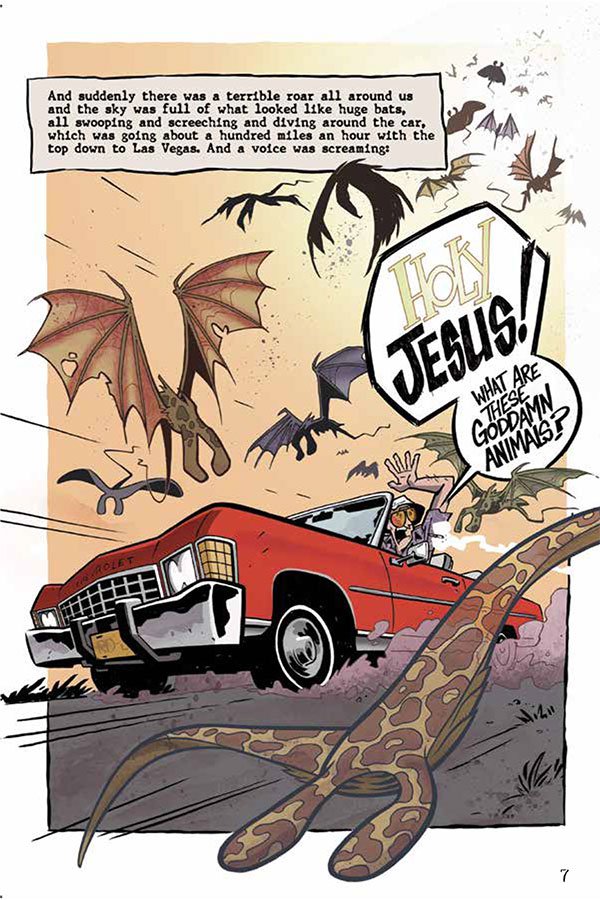
We were somewhere around Barstow on the edge of the desert when the drugs began to take hold. I remember saying something like “I feel a bit lightheaded; maybe you should drive …” And suddenly there was a terrible roar all around us and the sky was full of what looked like huge bats, all swooping and screeching and diving around the car, which was going about a hundred miles an hour with the top down to Las Vegas.
From the outset, Fear and Loathing in Las Vegas is an outrageous and darkly amusing tale of two crazed men turned loose in the world’s capital of decadence. Raoul Duke and Doctor Gonzo, clearly based upon Thompson and Acosta, are carrying a veritable pharmacopoeia in the trunk of their rented car, and throughout the novel they abuse a litany of substances as they stumble through casinos, bars, and hotels terrorising staff and patrons alike. Though Duke and Gonzo are, like the real Thompson and Acosta, tasked with covering the Mint 400, their assignment is quickly lost in the carnage. Near the end of the book, Duke admits he “didn’t even know who’d won the race.”
If you are unfamiliar with Thompson’s work, you may wonder why it matters that their efforts to complete a minor assignment ended in failure. Authors like Ernest Hemingway had mined their journalistic experience for material to incorporate into their fiction, so it is hardly unusual that Thompson would find inspiration for a novel whilst covering the Mint 400. But his approach with this book went beyond mere inspiration. Throughout Fear and Loathing, reality and imagination are blurred to the extent that no one really has much idea of what really happened on their trip.
[…]
In this letter, he made the startling confession that Fear and Loathing had not merely exaggerated the debauchery that took place in Vegas, but that there had in fact been no drugs at all. Could this really be true? Was the most notorious drug book of its era really inspired by a drug-free journey?
Before we can answer that, it is important to note the chronology of events on which the book was based. Whilst the book portrays the two men tearing apart hotels and casinos over a period of several days, there were in fact two distinct trips. First, they went to cover the Mint 400 on Mach 21st–23rd, then they returned for the National District Attorneys’ Conference on Narcotics and Dangerous Drugs on April 25th–29th. Thompson simply rolled the two events together into a single narrative. The evidence suggests that, during the first trip, Thompson and Acosta drank heavily and perhaps smoked a little pot, but certainly did no serious drug-taking. The famed pharmacopeia in the trunk of their convertible was fictitious:
The trunk of the car looked like a mobile police narcotics lab. We had two bags of grass, seventy-five pellets of mescaline, five sheets of high-powered blotter acid, a salt shaker half full of cocaine, and a whole galaxy of multi-colored uppers, downers, screamers, laughers … and also a quart of tequila, a quart of rum, a case of Budweiser, a pint of raw ether and two dozen amyls.
As tempting as it is to believe that this existed, it was a product of Thompson’s prodigious imagination. He was, however, keen to keep his readers in the dark, hence his letter to Silberman and the inclusion of his photo on the back cover. Since childhood, he had been obsessed with appearing as an outlaw, yet real outlaws never explicitly said that’s what they were. They merely hinted at it.
Of course, Thompson’s “drug-diet” did consist of various illegal substances, which made his descriptions of their effects rather convincing, but not only did he remain mostly drug-free in Vegas, he also wrote the novel with little more than beer and tobacco in his system. Back home in Colorado, he polished his story carefully through many drafts. The result was a far more intelligent and coherent work than almost anything else he published.
It was only during the second of the two trips that they began to consume drugs, but even then their indulgence was mild when compared with Duke and Gonzo’s extravagant excesses. They had marijuana, a few pills, and possibly some mescaline, but nothing else. His descriptions of LSD came from experiments several years earlier, the parts about adrenochrome were entirely fabricated, and — surprisingly — Thompson had not yet tried cocaine by 1971.
Comments Off on Hunter S. Thompson’s Fear and Loathing in Las Vegas
March 13, 2021
The Paperback Revolution
The History Guy: History Deserves to Be Remembered
Published 12 Mar 2021Sponsored by Blinkist. The first 100 people who go to https://www.blinkist.com/thehistoryguy are going to get unlimited access for one week to try it out. You’ll also get 25% off if you want the full membership.
Today, the most popular book format in the world is not a traditional hardcover book, nor an ebook, but a paperback — a format that changed the what, how, when and how much the world reads. It is history that deserves to be remembered.
This is original content based on research by The History Guy. Images in the Public Domain are carefully selected and provide illustration. As very few images of the actual event are available in the Public Domain, images of similar objects and events are used for illustration.
You can purchase the bow tie worn in this episode at The Tie Bar:
https://www.thetiebar.com/?utm_campai…All events are portrayed in historical context and for educational purposes. No images or content are primarily intended to shock and disgust. Those who do not learn from history are doomed to repeat it. Non censuram.
Find The History Guy at:
Patreon: https://www.patreon.com/TheHistoryGuy
Please send suggestions for future episodes: Suggestions@TheHistoryGuy.netThe History Guy: History Deserves to Be Remembered is the place to find short snippets of forgotten history from five to fifteen minutes long. If you like history too, this is the channel for you.
Awesome The History Guy merchandise is available at:
teespring.com/stores/the-history-guyScript by THG
#history #thehistoryguy #Books

March 5, 2021
QotD: P.G. Wodehouse’s Jeeves and Wooster
Everybody has those books, and authors, that they go to when they are in need of escapism. For me, PG Wodehouse’s Jeeves and Wooster series have always been these tales. Nightly incursions into their pages during the pandemic made the misery and boredom of those long days and weeks considerably more bearable. He wrote 35 short stories and 11 novels featuring the duo, beginning in 1915 with Extricating Young Gussie (although purists prefer to begin with Leave it to Jeeves which appeared the following year and features the most recognisable incarnation of the characters), and ending shortly before his death in 1975 with 1974’s Aunts Aren’t Gentlemen. Undoubtedly, if Wodehouse had somehow lived another five or ten years, there would have been more stories, but his prolific dedication to “the graft” has left us with a truly splendid collection of tales, all revolving around a pre-lapsarian world that was always a fantastical creation, even when Wodehouse began writing. By the time of the last book’s publication, when Britain was immersed in the three-day week and the dying days of the Heath government, the events depicted bore as much relation to readers’ everyday lives as if Wodehouse had been writing about events on Mars.
This was, of course, the point from the beginning. As Evelyn Waugh, a great admirer, famously said, “Mr. Wodehouse’s idyllic world can never stale. He will continue to release future generations from captivity that may be more irksome than our own. He has made a world for us to live in and delight in.” Nobody has ever sat down to read about the adventures of Jeeves, Bertie, Bingo Little, Gussie Fink-Nottle, the terrifying Aunt Agatha and Roderick Spode (to say nothing of his black short-wearing followers) and expected gritty social realism.
Instead, they have come to marvel at the twentieth century’s greatest comic prose stylist’s apparently endless invention, in which matrimony is a predicament to be averted at all costs, where the distaste of one’s gentleman’s gentleman for an ill-considered sartorial faux pas can lead to a (happily temporary) breakdown in amicable relations, and where the sole work undertaken by Bertie is to contribute an article about “What the well-dressed man is wearing” to his aunt’s periodical. Like his prize for scripture knowledge, he remains proud of this modest achievement, and continually refers to it throughout his adventures.
Alexander Larman, “The enduring appeal of Jeeves and Wooster”, The Critic, 2020-10-16.
Comments Off on QotD: P.G. Wodehouse’s Jeeves and Wooster
February 14, 2021
QotD: Pauline Réage’s Story of O
I am reading Story of O, a novel written in 1954 that recounts the titular character’s journey into sexual bondage, violent penetrations, beatings, whippings, burnings, chains, gags, and dungeons. Readers only familiar with the pedestrian 1975 adaption are advised not to be put off — director Just Jaeckin’s film benefits from the lovely Corinne Cléry’s beguiling performance in the title role, but his soft-focus softcore aesthetic (gauzy white linen dresses and a smooth classical guitar soundtrack) miss the tenderness, the elegance, and the literary grace of the source. Graham Greene described Story of O as a “rare thing, a pornographic book well written and without a trace of obscenity”; Brian Aldiss remarked that O makes “pornography (if that is what it is) an art”; even JK Rowling has offered praise for the book, observing that, “If you’ve read Story of O you’ve kind of read the ultimate.” But it is JG Ballard’s description of the novel as “a deeply moral homily … touched by the magic of love” that resonates most powerfully with me. O is a radical instruction in morals (the book has a clear sense of feminine virtue, for one thing), and yet this sexual morality is unlike any I can find in our contemporary expression of sexual ethics, where self-expression is valued more than self-giving.
O is the story of a woman objectified and humiliated, of a woman who submits to being violated by the countless tongues and phalluses and fingers which enter her. The novel is more sensual than suspenseful — although there is a clear narrative, it is not a story driven by plot, but rather by a series of erotic episodes (Geraldine Bedell writing for the Observer described them as written with “a hallucinatory, erotic intensity”). It is a psychologically as well as sexually penetrative story of surrender, of being mastered and of becoming enslaved, especially its first chapter which describes the elegant sexual tortures of the Chateau at Roissy, a kind of playboy mansion with fewer grottos and more dungeons.
It is here that, at the request of her lover René, O acquiesces in her complete submission. The cast of characters is sparse: O and René; Jacqueline, a young model whom O seduces, and Jacqueline’s 16-year-old sister, Natalie, a virgin eager to be initiated into the sexual rites of Roissy; Anne-Marie, an older and more ruthless mistress than are the many men at the Chateau; sundry blondes, brunettes, and redheads arranged alluringly throughout the text; and finally O’s ultimate lover, the sophisticated Sir Stephen, a kind of father-figure to René who ends up laying claim to O, flogging her, shackling her labia with an iron ring, and branding her with his initials as his slave, “a condition,” the narrator tells us, “of which O herself was proud.” As I read of the many exquisite ways O gives herself for men’s uses, I begin to wonder if the book was presenting me not with a picture of masculine sexual fantasies, but with a vision of my own.
The novel was written by the mysterious Pauline Réage, a pseudonym. In what is arguably one of the most successful literary secrets, Réage’s identity was kept hidden for decades. It wasn’t until 40 years after the novel’s publication that the then 86-year-old Dominique Aury, a respected editor and French intellectual, revealed that she was the author. It seems fitting that in a novel of sexual submission, Aury — Dominique, dominance, dominatrix — maintained such strict control over her own identity. Even Dominique Aury was not her “real” name: she was born Anne Desclos, but legally changed it in 1940. Aury’s nested names and identities are like a meta-fictitious exercise in un-making and making the self, for questions of self-identity and self-integrity lie at the heart of her novel.
Marilyn Simon, “My Own Private Chateau — Pauline Réage’s Story of O Revisited”, Quillete, 2020-10-18.
Comments Off on QotD: Pauline Réage’s Story of O
January 28, 2021
QotD: Art for art’s sake
Severian, “The Entertainer”, Rotten Chestnuts, 2020-10-08.
Comments Off on QotD: Art for art’s sake
January 26, 2021
QotD: “A world organized around institutional mass slavery”
New hypothesis: It’s a category error, all right, but not because they didn’t think in terms of labor costs. It’s because they couldn’t think in terms of labor costs.
A world organized around institutional mass slavery is, in a very real sense, a timeless world. Herodotus (I think) actually says somewhere that nothing worth mentioning happened before him, and you can see echoes of this attitude even as late as the Antebellum South. You see their attitude described as “conservative,” but since that’s egghead shorthand for “evil” you can ignore it. They weren’t consciously backward-looking; rather, they were deeply rooted to their place and station. To the outsider, it looked like they were trying to hold time back, but to the insider, time — clock time, industrial time, the time of the Protestant work ethic — barely existed at all.
So with the Classical World. The Romans, for instance, are endlessly frustrating to their admirers (of which I am an ardent one). Their only economic fix, for instance, was debasing the currency, i.e. a primitive form of inflation. You guys could figure out how to hew an artificial harbor out of some desert rocks — a trick we’d have a hard time pulling off today — but you couldn’t figure out fiat currency? Or a better political system than the tetrarchy? Or that the forts-and-legions paradigm just isn’t cutting it? Or … etc.
Stuff like that is why Spengler said classical, Apollonian culture was fundamentally different from, and incompatible with, our Faustian culture. According to Spengler, the master metaphor for the Apollonian is the human body, which is beautiful but changeless (emphasis mine, not Spengler’s). You can improve your body somewhat, but only within certain tight limits, and the body’s fundamental form is always the same (we could time warp Julius Caesar into the Current Year and still recognize him as a fellow homo sap., no matter how different his mind might be).
The Faustian, though — that would be us — organizes his worldview around space, infinite space. Practically speaking, this results in our attitude of innovation-for-innovation’s sake. We send a man to the moon because we can, but such an idea would never occur to the Romans, for the same reason they didn’t apply all their awesome engineering knowledge to the problems of governance. Hacking a harbor out of the desert is a tremendous feat, but it’s a local feat — a one-shot deal, a very specific response to a very specific local problem, with no broader applications.
This, I suggest, is because the timeless world of institutional mass slavery naturally selects for the kind of man who is at home in the world of institutional mass slavery. It’s a world of very low future time orientation, because “time” hardly exists at all. Forget machinery for a sec; the Roman world was full of enormous problems that had teeny-tiny, head-slappingly obvious fixes. Julius Caesar, for instance, was considered some kind of prodigy because he could sight-read books. Which really was a noteworthy feat, because Romans didn’t even put spaces between their words, much less use any sort of punctuation marks. And they were radical innovators compared to the Ancient Egyptians, since at least Roman writing all ran left-to-right; hieroglyphics can be read in any direction, including vertically, and I’m pretty sure there are examples of them changing text orientations in the middle of the same inscription. It’s not hard to imagine some legion commander actually losing a battle because he had to stop and sound out an important communique from a subordinate …
… and yet the Romans, for all their technical skill, never even figured that tiny change out. See also: The Chinese doing fuck-all with movable type, vs. (Faustian) Europeans using it to conquer the world. China, too, was a timeless society. As Derb says somewhere, Classical Chinese isn’t even really writing; it’s more of an aide-memoire — designed to remind readers of stuff they already know, not to communicate new information.
Your post-Roman European, by contrast, lived in a world where high future time orientation was an absolute must. You don’t need hypotheses like the famous “lead in the drinking water pipes” to explain the seemingly bizarre things the Romans did, or didn’t do; all you need is time orientation, a fundamental attitude of “this is a variation on an old problem” vs. “this is an entirely new situation that requires a new response.” Life in the post-Roman world was solitary, poor, nasty, brutish, and short — every man for himself; think through the consequences of your actions very carefully before you do them, or die horribly. Those who failed to do so died. Bake that into the genetic cake for a few generations, and you get Renaissance Man, who’d see a million possible applications for the aeolipile.
Severian, “Bio-Marxism”, Rotten Chestnuts, 2020-09-24.
Comments Off on QotD: “A world organized around institutional mass slavery”
January 17, 2021
QotD: Hunter S. Thompson
James Lileks, The Bleat, 2005-02-21
Comments Off on QotD: Hunter S. Thompson


