Undoubtedly, the Mediaeval Romans – now exclusively Greek in their language – made little effort to be original in their literature. They had virtually the whole body of Classical Greek literature in their libraries and in their heads. For them, this was both a wonderful possession and a fetter on the imagination. It was in their language, and not in their language. Any educated person could understand it. But the language had moved on – changes of pronunciation and dynamics and vocabulary. The classics were the accepted model for composition. But to write like the ancients was furiously hard. Imagine a world in which we spoke Standard English, but felt compelled, for everything above a short e-mail, to write in the language of Shakespeare and the Authorised Version of the Bible. Some of us might manage a good pastiche. Most of us would simply memorise the whole of the Bible, and, overlooking its actual content, write by adapting and rearranging remembered clauses. It would encourage an original literature. Because Latin soon became a completely foreign language in the West – and because we in England were so barbarous, we had to write in our own language – Western Mediaeval literature is often a fine thing. The Mediaeval Romans never had a dark age in our sense. Their historians in the fifteenth century wrote up the fall of Constantinople to the Turks in the same language as Thucydides. Poor Greeks.
Sean Gabb, “The Mediaeval Roman Empire: An Unlikely Emergence and Survival”, SeanGabb.co.uk, 2018-09-14.
January 3, 2021
QotD: Literary stasis in the Byzantine empire
January 2, 2021
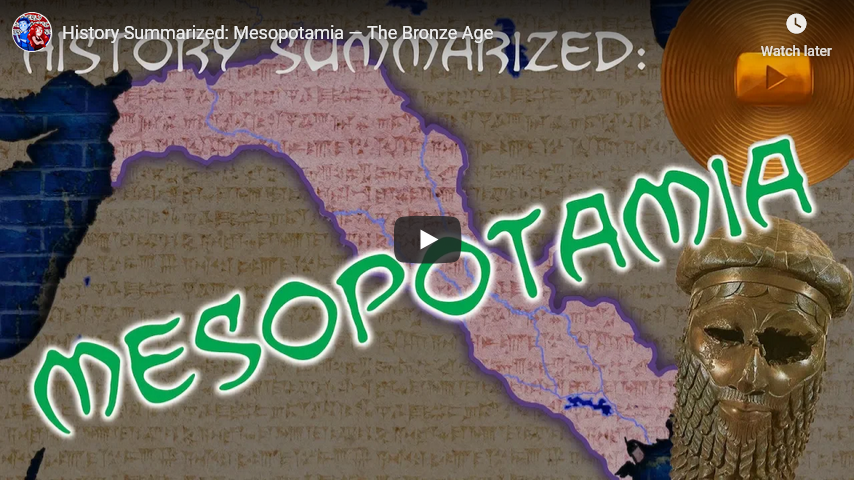
History Summarized: Mesopotamia — The Bronze Age
Overly Sarcastic Productions
Published 22 Feb 2019Let’s spin the clock way back to the beginning of urbanized civilization, and learn about the long history of Mesopotamia from the dawn of the city to the collapse of the last Sumerian empire.
This video is part of The Bronze Age collaboration.
Find 10 other great videos with this playlist: https://goo.gl/4JLV8s
Previous video — Cynical Historian: https://youtu.be/xSDn0HSXjgo
Next video — Epimetheus: https://youtu.be/-RrAoL_PVmoFurther reading: “Babylon: Mesopotamia and the Birth of Civilization” By Paul Kriwaczek: https://goo.gl/nyQAdS
PATREON: www.patreon.com/OSP
MERCH LINKS:
Shirts – https://overlysarcasticproducts.threa…
All the other stuff – http://www.cafepress.com/OverlySarcas…
December 18, 2020
QotD: Hunter S. Thompson’s view of humanity
Colby Cosh, “Q: Where’s Cosh?”, ColbyCosh.com, 2005-02-21
November 25, 2020
Jan Morris, RIP
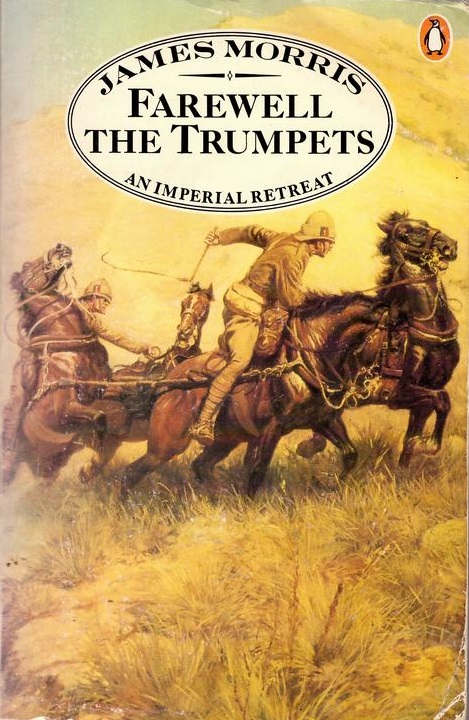
By an odd co-incidence, I began reading the third volume of Morris’s British Empire trilogy just last night and today I discovered that she recently died at age 94. The particular edition I have has Morris’s original male name on the cover, but her female name in the “note about the author”:
Jan Morris, who died last week at the age of 94, may have lived one of the more various and accomplished lives on record. She was, in turn, a soldier, a newspaper correspondent with a number of scoops to her name, a fine memoirist, and a writer of books whose scope encompassed the world.
Any dutiful obituarist must also note something else which happened fifty years ago. It is likely for ever to feature in the first paragraph, if not the first line, of everything written about Morris. She was born a man, named James by her parents, and underwent what her publishers and profilers term “a change of sexual role” in 1972 – back when such a thing was a rarity and rather dangerous to accomplish.
I hope to leave that subject aside for a moment while contemplating her place in letters. By the end of her long life, Morris had become something of a national treasure and an institution. Her quixotic obsessions – a personal, mythical interpretation of the Welsh side of her family and her home in that country, and the late First Sea Lord Jackie Fisher – became the subject of stories shared by friends, editors and admirers.
She gave wise and funny interviews to the papers about savouring mussels without dignity and why whether what one is doing is kind ought, in a good world, to be the modest test applied to action.
Other profilers note her long companionship with Elizabeth (née Tuckniss) – first through marriage, then a legally-divorced close friendship, and finally a civil partnership, with the ceremony witnessed by a local couple who afterwards invited the two for tea. Elizabeth survives Jan, but a visiting journalist or two was shown the headstone which is planned for both of them. They will lie on a Welsh island they owned in the Dwyfor, a river that runs by their home. The stone reads: “Here lie two friends, at the end of one life”.
These are beautiful stories, but they should not retroactively colour in fully our impressions of Morris. Nor should a sense – repeated in some otherwise careful obituaries – that as “James”, Morris’s “written voice always sounded certain”. Whereas as Jan, her writing grew more introspective and aware of the ways that time and tide conspire to decay the facades of men as much as they do institutions and places. This was exhibited notably in her Pax Britannica trilogy, which chronicled Britain’s imperial decline.
October 31, 2020
Halloween Special: Edgar Allan Poe
Overly Sarcastic Productions
Published 30 Oct 2015Happy halloween! Today we’re looking into the mind of one of the most well-known horror writers, Edgar Allan Poe!
On today’s roster: “The Pit And The Pendulum”, “The Mask of Red Death”, “The Cask of Amontillado”, and “The Tell-Tale Heart”.
October 30, 2020
Halloween Special: H. P. Lovecraft
Overly Sarcastic Productions
Published 31 Oct 2018HAPPY HALLOWEEN IT’S TIME TO GET SPOOKY WITH HISTORY’S MOST PROBLEMATIC HORROR WRITER LET’S GOOOOO
While there’s something to be said for separating the art from the artist, I think there’s a lot of merit in CONTEXTUALIZING the art WITH the artist. Did Lovecraft write some pretty incredible horror? Sure! Was he also a raging xenophobe? Absolutely! Are his perspectives on life connected with the stories he felt compelled to tell? Duh! If you look at Lovecraft’s writing through the lens of his life, clear patterns emerge that allow us to pin down what exactly he built his horror cosmology out of. It’s an invaluable analytical tool that allows us to take apart his writings by getting inside his head. So before you yell at me for Not Separating The Artist From The Art, know that it was completely intentional and I’m not sorry.
3:20 – THE CALL OF CTHULHU
8:40 – COOL AIR
10:36 – THE COLOR OUT OF SPACE
14:38 – THE DUNWICH HORROR
19:32 – THE SHADOW OVER INNSMOUTHPATREON: www.patreon.com/user?u=4664797
MERCH LINKS:
Shirts – https://overlysarcasticproducts.threa…
All the other stuff – http://www.cafepress.com/OverlySarcas…
From the comments:
Overly Sarcastic Productions
1 year ago
Hey gang! Can’t help but notice the comment section is a little bit on fire. That’s all good with me, but one recurring complaint I’ve noticed has started to get under my skin – namely that my explanation of non-euclidean geometry was insufficient, or even – dare I say – inaccurate. Now this is a fair complaint, because after a lifetime of experience finding that people’s eyes glaze over when I talk math at them, I concluded that interrupting a half-hour horror video with a long-winded explanation of a mathematical concept wouldn’t go over too well. I put it in layman’s terms and used a simple example to illustrate the point. However, since some of the more mathematically-inclined of you took offense, I now present in full a short (but comprehensive) explanation of what exactly non-euclidean geometry is.First, we axiomatically establish euclidean geometry. Euclidean geometry has five axioms:
1. We can draw a straight line between any two points.
2. We can infinitely extend a finite straight line.
3. We can draw a circle with any center and radius.
4. All right angles are equal to one another.
5. If two lines intersect with a third line, and the sum of the inner angles of those intersections is less than 180º, then those two lines must intersect if extended far enough.Axiom #5 is known as the PARALLEL POSTULATE. It has many equivalent statements, including the Triangle Postulate (“the sum of the angles in every triangle is 180º”) and Playfair’s Axiom (“given a line and a point not on that line, there exists ONE line parallel to the given line that intersects the given point”).
Euclidean geometry is, broadly, how geometry works on a flat plane.
However, there are geometries where the parallel postulate DOES NOT hold. These geometries are called “non-euclidean geometries”. There are, in fact, an infinite number of these geometries, and because the only defining characteristic is “the parallel postulate does not hold”, they can be all kinds of crazy shapes. (As you can see, my explanation of “this is just how geometry works on a curved surface” is quite reductive, but at the same time serves to get the general impression across without going into too much detail.)
An example of a non-euclidean geometry is “Elliptic geometry”, geometry on n-dimensional ellipses, which includes “Spherical geometry” as a subset. Spherical geometry is, predictably enough, how geometry works on the two-dimensional surface of a three-dimensional sphere.
In spherical geometry, “points” are defined the same as in euclidean geometry, but “line” is redefined to be “the shortest distance between two points over the surface of the sphere”, since there is no such thing as a “straight line” on a curved surface. All “lines” in spherical geometry are segments of “great circles” (which is defined as the set of points that exist at the intersection between the sphere and a plane passing through the center of that sphere).
The axiom that separates spherical geometry from euclidean geometry and replaces the parallel postulate is “5. There are NO parallel lines”. In spherical geometry, every line is a segment of a great circle, and any two great circles intersect at exactly two points. If two lines intersect when extended, they cannot be parallel, and thus there are no parallel lines in spherical geometry.
Since the Parallel Postulate is equivalent to Playfair’s Axiom, the fact that no parallel lines exist in spherical geometry negates Playfair’s Axiom, which thus negates the Parallel Postulate and defines spherical geometry as a non-euclidean geometry. Also, since the Triangle Postulate is another equivalent property to the Parallel Postulate, it is thus negated in spherical geometry. Hence, my use in-video of an example of a triangle drawn on the surface of a sphere whose inner angles sum greater than 180º.
Hope that cleared things up (and helped explain why I didn’t want to say “see, non-euclidean geometry is just a geometry where Euclid’s Parallel Postulate doesn’t hold – hold on, let me get the chalkboard to explain what THAT is-” in the video)
Peace!
-R ✌️
October 22, 2020
QotD: The needs of creative people
The question of where to live on such a low income while trying to write becomes crucial: in the middle of nowhere with cheap rent, or in the city where day jobs help pay for housing? Compromise clouds every decision.
And this simply will not do. You see, creative people, that’s people like Ms Delaney, must live in locales befitting their importance, not their budget. You, taxpayer, come hither. And bring your wallet.
The city of Sydney recently tried to address the problem of artists being priced out by introducing six rent-subsidised studio spaces in Darlinghurst. Those chosen get a year-lease and pay reduced rent of $250 a week on a one-bedroom with work studio.
Creative people, being so creative, deserve nothing less than special treatment. I mean, you can’t expect a creative person to write at any old desk in any old room in any old part of town. What’s needed is a lifestyle at some other sucker’s expense. And so that garret has to be in a fashionable suburb or somewhere happening, where the creative vibrations are at their strongest and genius will surely follow. And that pad of choice has to come before the publishing deal and film rights and the swimming pool full of cash. Indeed, it has to materialise before the book itself, or any part thereof. How else can their brilliance flourish, as it most surely will, what with all that creativity. Our betters just need a little cake before they eat those damn vegetables. And possibly ice cream. Here’s some money that other, less glamorous people had to actually earn. You fabulous creature, you.
David Thompson, “The Humble Among Us”, David Thompson, 2014-01-21.
September 6, 2020
QotD: The process of writing fiction
Adding in a consciousness of the audience while doing all this would be like the tap-dancing centipede, who did fine until he started thinking about where he was putting all those feet.
Lois McMaster Bujold, introduction to the Taiwanese edition of The Curse of Chalion by Fantasy Foundation/Cite Publishing, 2020-03-25.
August 3, 2020
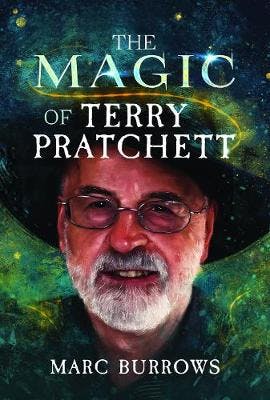
The Magic of Terry Pratchett by Marc Burrows
Rachel Cunliffe looks at a recent biography of the great science fiction/fantasy author Terry Pratchett by Marc Burrows:
A satirical sci-fi/fantasy writer might not seem the obvious choice to dissect the world-changing magnitude of an unforeseen pandemic — or so you might think if you’ve never read any of his books. But anyone familiar with the Pratchett’s oeuvre will know that the scouring wit and the unflinching grasp of humanity at its best and worst found within his pages would be the only true way to understand what has happened to our world since the start of the year.
Alas, we will never know how Sir Terry would have woven the government’s dysfunctional pandemic response, the etiquette of social distancing, mask and anti-mask culture or the mass shift to remote working into the realm of the Discworld (although we can be fairly confident that he would have done). But glimpses can be found in The Magic Of Terry Pratchett, a new biography by writer and comedian Marc Burrows.
This is the first full biography of the great man, from his upbringing in the quintessentially English hamlet of Forty Green, Buckinghamshire, to his battle with Alzheimer’s (which Pratchett dubbed “the Embuggerance”) and ferocious campaign for a law change to allow assisted dying — and featuring a whistle-stop tour of his 60-odd books.
It is, as Burrows admits from the start, the project of a committed fanboy. The author never actually got to speak to his literary hero (“This book is my chance to meet Terry Pratchett. It’s yours as well,” he explains early on), and has instead pieced together his life story through old interviews, archives, and conversations with friends and contemporaries.
The result is an engaging quest to get to know the man that both explores and adds to the mythology surrounding him. Pratchett was, as Burrows makes clear, a storyteller first and foremost, and some of his oft-repeated anecdotes — such as encountering a dead body age 17 on his first day as a junior reporter, or filing his copy from a shed on the roof — may have been based more on fantasy than reality. Where he cannot verify, Burrows sticks to the strategy taken by Tony Wilson in the film 24 Hour Party People: “When you have to choose between the truth and the legend, print the legend”.
As such, while this book will no doubt be of greatest interest to Pratchett fans, even those who have never opened a Discworld novel will find themselves entertained by its numerous detours — encompassing the educational apartheid of the 1950s, a surreal stint doing PR for Britain’s nuclear industry, and the once vibrant, now sadly endangered local journalism ecosystem.
July 27, 2020
H.L. Mencken
In the latest Libertarian Enterprise, Eric Oppen (with whom I’ve had a few brief email conversations) discusses the work of the “Sage of Baltimore”:
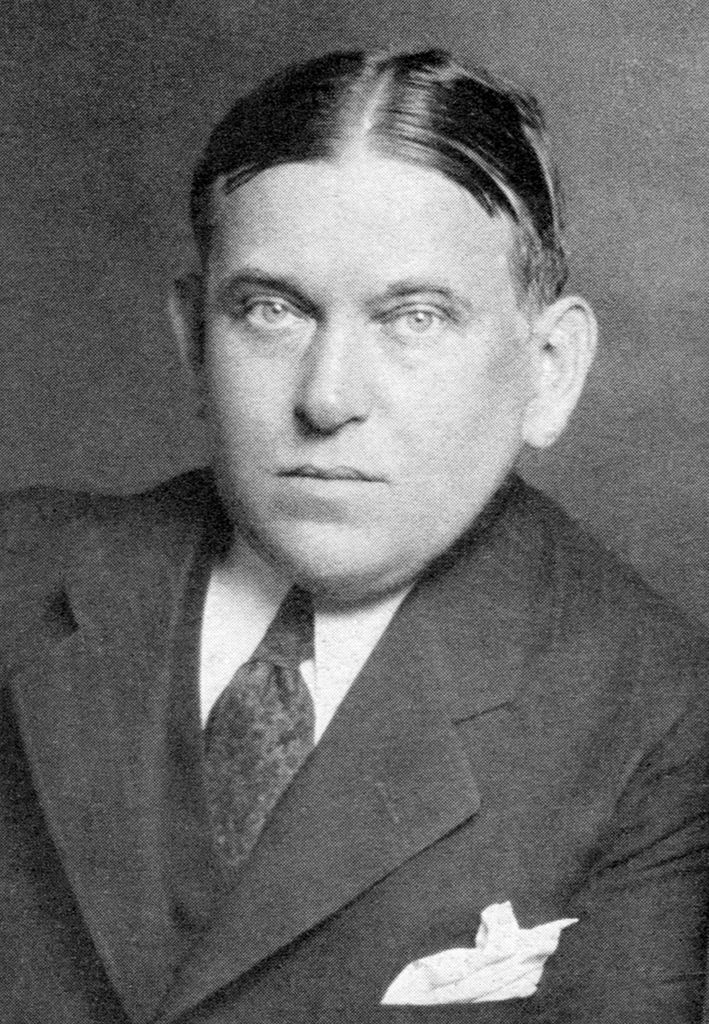
H.L. Mencken in 1928.
Photo by Ben Pinchot for Theatre Magazine, August 1928.
I would say that, on the whole, Mencken is still quite readable and enjoyable, and many of his observations on the American scene are still as valid as when he made them. He has his weaknesses. He’s not much of an historian, which limits him when he takes up historical subjects. He never got over what he saw as the unfair treatment the German cause got in the American press between 1914 and the entry of the US into World War One. He also often identifies people as Jewish or black when it’s not really relevant to what he’s saying, but this was more a custom of his time than out-and-out bigotry. While he often has uncomplimentary things to say about Jews, and blacks, his greatest scorn is reserved for “the lintheads” — his term for the poor whites of the South. He regarded them as barely worthy of human status.
[…] his views on most subjects were quite compatible with libertarian positions. He was an inveterate opponent of government overreaching (which was behind a lot of his ferocious opposition to Prohibition) and while I don’t think he’d approve of drug use, he’d see our War on (Some Unpopular) Drugs as the assault on the Constitution that it is. While he was by no means hostile to blacks, and went out of his way to promote black writers (many of the figures in the “Harlem Renaissance” owed a lot to his support), he’d also denounce affirmative action and our current frenzy of “anti-racism” in scathing terms. His views on the Civil Rights Act of 1964 and how it has been turned into an alternate, and superior, Constitution would probably scorch the paint off the walls.
Mencken’s views on people’s private lives would have infuriated many of his contemporaries. While he disapproved of homosexuality, referring to it negatively in entries in his private diaries, he was by no means a howling “homophobe.” His writings on the travails of Oscar Wilde are very sympathetic to Wilde’s sufferings, which Mencken thought were wholly disproportionate to what he was known to have done. Mencken referred to Lord Alfred Douglas, in a review of Douglas’ book about Wilde, as a Tartuffe — that is to say, a posturing hypocrite.
Having been a reporter for years in Baltimore, back when reporters were very like the old film noir view of them, Mencken was very much a man of the world, and inclined to great tolerance on others’ sex lives. When he wrote of prostitutes, he refrained from the sort of pious moralizing that was expected in his time. He said that prostitutes often actively preferred their profession to other work available to them, and that most of them ended up respectably married. He kept his own love life very private, and was a faithful husband to his wife throughout their brief marriage, but he does mention, here and there, having had other lovers, whom he does not name even in writings designated to come to light only long after everybody involved was dead. By his own account in his Diary, he lost his virginity at age fourteen to a girl of his own age, who had already had other experiences before him. He felt that such experiences, unless pregnancy happened, did no one any harm.
While he was an atheist, Mencken had no particular hostility to religion per se, no matter what the Fundamentalists of his day thought. His book Treatise on the Gods makes interesting reading, although it is marred, in my view, by Mencken’s lack of knowledge of languages. He praises Christianity for having “the most gorgeous poetry,” but as far as I know, he could not read Hebrew, Aramaic or Greek, and was thinking in terms of the King James Bible and the Book of Common Prayer. However, the book is still worth reading, although a serious student of the subject would find it limited.
If you’ve been a regular visitor to the blog, you’ll know I have a huge regard for H.L. Mencken’s work and there are many Mencken quotes that have done duty as QotD entries over the years.
July 10, 2020
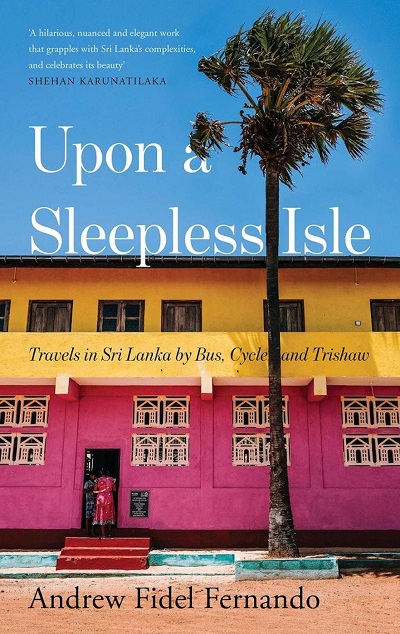
Upon a Sleepless Isle by Andrew Fidel Fernando
In The Critic, A.S.H. Smyth reviews this Gratiaen Prize-winning travel memoir of Sri Lanka:
Having returned to Sri Lanka from school and uni in New Zealand, and spent a few years consolidating a career in cricket journalism, AFF (as he is also known) decides to tour the country on a solo self-educational adventure – not least because big chunks of it were basically off-limits during his upbringing, thanks to the 26-year civil conflict with the LTTE/”Tamil Tigers”.
The book begins:
The smiles in Sri Lanka are as wide as the horizon, visitors say. The nation’s treasures are as boundless as the ocean, many report. But never let it be forgotten that the ineptitude of the government is as vast and as awesome as the heavens …
At this point, our intrepid would-be traveller just wants the ID card to which he, as a Sri Lankan citizen, is well entitled. But there follow six pages of brutal savaging of the bureaucracy (remember that bear scene in The Revenant …?), and then short treatises on social scandal, unsustainable development, the traffic, tourists, and the glossy travel magazines that bring them here. And we haven’t even left Colombo yet.
But he gets out and about soon enough, and in a punchy 240-page mildly-memoirish survey, utilising pretty much every form of transport barring the bullock cart, he sees the elephant herds at Minneriya, climbs the 1/8-Mile-High Club that was the rock fortress of Sigiriya, explores a highwayman’s hideout near Kandy, the surreal Lego-ish hill town of Nuwara Eliya, the tea estates, the ancient waterworks around Polonnaruwa, the temple-strewn Anuradhapura, the otherworldly Mannar island, the Southern beach towns, and on through the flattened LTTE heartlands up into Jaffna. (Cricket nerds, be advised: there is no cricket in this book.)
In all, his journey amounts to about seven or eight weeks on the road, and, Sri Lanka being a fairly small place, it’s worth noting that his is an entirely normal tourist itinerary – a visitor with even a mid-level budget and modest accommodation demands could cover all of it in a three-week holiday – just done more slowly and, crucially, with better local “access”, specifically linguistic.
Like all good “city-bred pansy” writer types, he gets into scrapes (a tuktuk crash), and makes a fool of himself (“helping” some fishermen), and the whole thing is narrated with much irreverent humour and ironic side-eye, topped off with a great line in exaggerated street-chat/aunty gossip and the occasional murderously-deft flick of the stiletto: “if you had the financial means to inspire a government worker out of apathy …” – all facets not exactly over-represented in Sri Lankan English letters (non-fiction, anyway. Novels are full of it).
Nor is his apparent economy dependent on foreknowledge on the reader’s part (aided certainly by the author’s more-or-less ingenuous exploratory conceit). Whatever learning AFF was already armed with here is lightly worn, he works in the historical and social context of each leg of the journey with a minimum of fuss (a certain journalistic pragmatism and efficiency paying off there, one assumes), and there’s really no time at which you feel he’s had to throw his bucket down the well of Wikipedia to get through to the end of a particular informative sub-section.
That said, considerable amounts of this material were new to me (which, in a whistlestop tour of the entire island, is not saying nothing). His trip to the abandoned rebel-descendant jungle village of Kumana is as intriguing as the details of the 1817 Uva rebellion are grim. And in particular, I’m grateful to him for introducing me to the life and works of the archaeologist John Still, and clueing me up as to the origin of the phrase “white elephant”: “after the Thai royal practice of presenting unpopular courtiers with tuskers that were ruinously expensive to maintain.”
Alas for AFF – the curse of writing first-draft history – Upon a Sleepless Isle also offers (or rather offered) two major hostages to fortune. Namely, his repeated and overt enthusiasm about the transition away from the family-oriented regime of Mahinda Rajapaksa (2005-15), and his vocal sympathy and support for Sri Lanka’s peaceful and tolerant Muslim minority. Only three months after the book was published, a series of domestic Muslim terrorist attacks took place around the country, killing hundreds, which in turn helped to usher in the present (Gotabaya) Rajapaksa government. These have aged almost so badly that it adds a certain piquancy to read his already-blasted hopes of just two years ago.
July 8, 2020
Harry Potter fandom, Millennials, and the continued decline of traditional religious beliefs
In The Critic, Oliver Wiseman talks to Tara Isabella Burton about her book Strange Rites:

J.K. Rowling’s Harry Potter books have been pivotal for many Millennials in encouraging them to move away from traditional religious beliefs.
I want to start with Harry Potter, which is — perhaps surprisingly — central to the argument you make in the book, so, as an introduction to your broader thesis, what does Harry Potter have to do with America’s new religions?
It’s funny. When Harry Potter first came out in the nineties, there was a flurry American Christian voices saying “This book promotes witchcraft. There’s going to be a whole new religious movement devoted to Harry Potter books.” In the way they meant it, that was absolutely not true. But I think that there was something to it in terms of an inadvertent change to the religious landscape.
What Harry Potter did, or, more accurately, what it was the canary in the coal mine for, was a transformation, linked to the rise of at-home internet access, in how we talk about cultural properties andhow we relate to cultural properties. The transition to an internet space defined by user-generated content and what is often called participatory culture coincided with the publication of the Harry Potter books.
Between the first Harry Potter book’s release in 1997 and the fourth book’s publication in 2000 we went from 19 million Americans with internet access to more than 100 million. It’s that backdrop that really explains the shift. You did have fan cultures before. There were Star Wars conventions, for example, but there was quite a high bar to entry. You had to get on the right mailing list and it was done via post. It was quite a lot of work. You couldn’t just log on and enter a community, which is really what could happen with Harry Potter fandom.
J.K. Rowling was also one of the first major writers to openly accept and embrace fan fiction. So what you ended up seeing was something that started with Harry Potter fandom that then became an element of fandom online more broadly which in turn, I would argue, shaped millennial-and-younger culture. It was this idea that you weren’t just a reader of consumer of texts. It wasn’t just a top down hierarchical thing. Instead, mediated through the anonymity of the internet, you a kind of tribalism from talking to people in different geographical areas as well as things like fan fiction and later meme culture that meant you could change, shift, reimagine a text in your own way. And what’s so interesting about that is that sensibility — the sensibility that we have not only the right but the responsibility, the authority as consumers to also be creators, to rework ideas outside of existing texts — has spilled over into all aspects of our political life and of our religious life. And that is really something that is the product of user generated content and the internet.
To bring this to religion more specifically, 36 per cent of Americans born after 1985 are religiously unaffiliated, compared to about 23 per cent of the national average. That’s a huge generational shift in religious affiliation and organisation. That is not the same thing as saying that these are atheists or that these people are not religious. Some 72 per cent of them say they believe in some sort of higher power. About 17 per cent say they believe in the Judaeo-Christian God.
We’re in a religious or spiritual landscape that privileges mixing and matching, and unbundling — a bit of tarot here, a bit of meditation there. And a resistance to institutional and authoritative declarations in terms of how religion should be practised is very much something that has its roots in internet culture, of which Harry Potter was a forerunner.
June 20, 2020
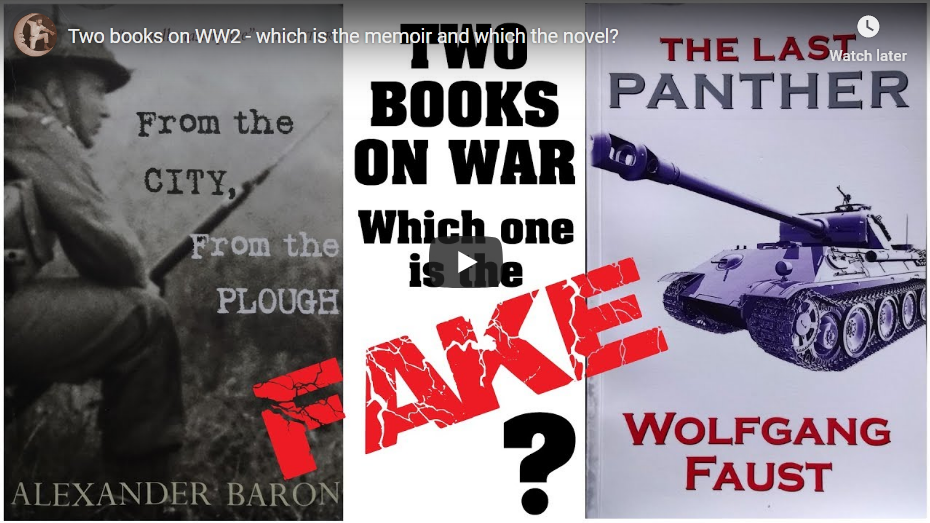
Two books on WW2 – which is the memoir and which the novel?
Lindybeige
Published 4 Mar 2018Two books I have read recently. When is a book a memoir and when is it a novel? WW2 from two different perspectives.
Support me on Patreon: https://www.patreon.com/Lindybeige
The books:
From the City, From the Plough by Alexander Baron (Bernstein)
The Last Panther by Wolfgang Faust (Chris Ziedler)Buy the music – the music played at the end of my videos is now available here: https://lindybeige.bandcamp.com/track…
Lindybeige: a channel of archaeology, ancient and medieval warfare, rants, swing dance, travelogues, evolution, and whatever else occurs to me to make.
▼ Follow me…
Twitter: https://twitter.com/Lindybeige I may have some drivel to contribute to the Twittersphere, plus you get notice of uploads.
website: http://www.LloydianAspects.co.uk
June 8, 2020
Andrew Sullivan can’t write about the riots or he’ll lose his job
I’d wondered why he hadn’t directly addressed the biggest news item in the United States over the last week:
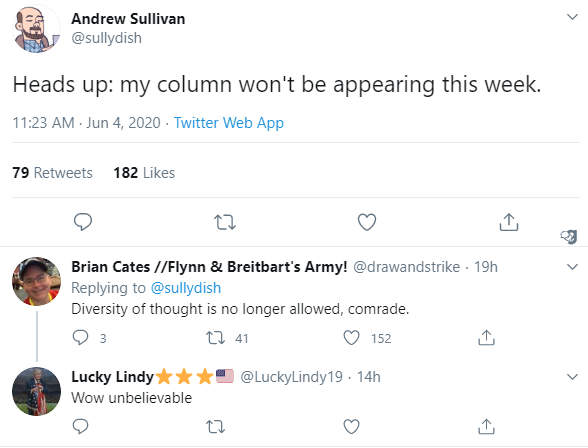
What has happened to New York media? Just as the New York Times was experiencing its own Inner Mongolia Moment over the now notorious Sen. Tom Cotton “Send in the Troops” op-ed, the Maoists at New York magazine were going after their best columnist, Andrew Sullivan.
Sullivan revealed on Twitter yesterday that his column wouldn’t be appearing. The reason? His editors are not allowing him to write about the riots.
Presumably Sullivan’s editors are frightened that he might make the radically bourgeois point that looting and violence are wrong.
Cockburn understands that Sullivan is not just forbidden from writing for the New York magazine about the riots; his contract means he cannot write on the topic for another publication. He is therefore legally unable to write anything about the protests without losing his job — at the magazine that, in 1970, published Radical Chic, Tom Wolfe’s brilliant and controversial excoriation of progressive piety. It’s the bonfire of the liberals!
March 31, 2020
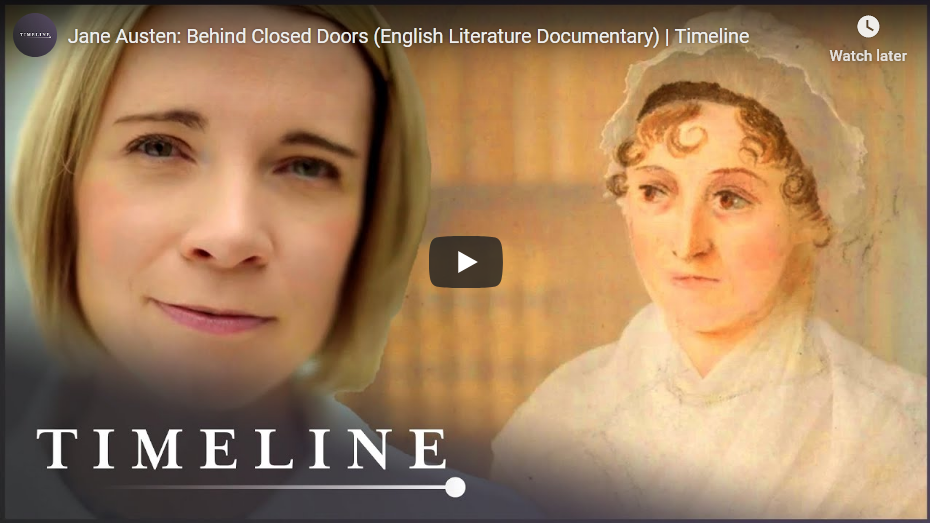
Jane Austen: Behind Closed Doors (English Literature Documentary) | Timeline
Timeline – World History Documentaries
Published 31 Dec 2019Lucy Worsley explores the different houses in which Jane Austen lived and stayed, to discover just how much they shaped Jane’s life and novels.
On a journey that takes her across England, Lucy visits properties that still exist, from grand stately homes to seaside holiday apartments, and brings to life those that have disappeared. The result is a revealing insight into one of the world’s best-loved authors.
Content licensed from Beyond Distribution to Little Dot Studios. Any queries, please contact us at: owned-enquiries@littledotstudios.com