
… the push-model of book sales. Long before there was an Amazon, chain bookstores had cozy deals with publishers that sent most indie bookstores (now beloved in effigy by the left) out of business.
And then the left dominated publishing establishment had a brilliant idea. For decades they’d been trying to forecast failure and success, and failings. Books they pushed out the wazzoo (A river in Sundon’tshine) died on the vine when bookstores refused to stock them because the owners had read them. The books they had designated as to be ignored caught someone’s fancy, and suddenly were all over.
This was inefficient. It caused way too much printing that never got distributed, and much last minute rushed reprinting. (Even leaving aside how often people chose to read the WRONG things, something that started to matter more and more in the last two decades.)
So they came up with the push model. It was, from a certain perspective, brilliant.
That perspective is the one where the real world doesn’t really exist, so you don’t need to hear from it.
Because the managers of the big corporate bookstores ALSO didn’t read, they took instruction beautifully. So the publishers could say “you’ll take 100 of x and 2 of y” and they DID.
For a little while it worked beautifully, in the sense that there were no surprise bestsellers, (and publishing houses hated those. I know someone who unexpectedly sold out her print run in a week. The publishing house took the book out of print. No, seriously.) and the books that got seen and talked about were picked by the publisher. (BTW this wasn’t even always or primarily political. Sure, that existed too sometimes, but mostly it was the crazy fads that publishing convinced itself of. For instance, sometime in the mid two thousands they convinced themselves no one wanted historical mysteries — they weren’t selling, true, probably because they were on NO shelves — but everyone wanted “chick-lit mysteries” that had covers with lots of shoes and dresses and whose plots were “Sex in the City with murder.” I remember trying to find something to read, giving up and going to the used bookstore (then a hundred miles away in Denver) for my mystery fix.)
Of course, they sold less. In fact, as time went on and people got out of the habit of going to the bookstore, because there was never anything they could find to read. I mean, I remember being chased from Science Fiction to Mystery to finally History, to at last the sort of “utility” book you find in the discount bins you know “a chart of history” type of thing just to find something to buy on our bookstore night.
Then we gave up.
Eventually the broken feedback mechanism gave us the demise of Borders — and B & N is not feeling so good itself — and a yawning, desperate chasm in customers’ need for books that meant the way was wide open for Indie and Amazon. Even the early badly proofed indie books were like a breath of fresh air because for the first time I could read outside the trends being pushed.
Sarah Hoyt, “Breaking the Gears”, According to Hoyt, 2018-01-03.
March 25, 2020
QotD: The broken feedback mechanism that brought down the chain bookstores
March 16, 2020
University lectures developed historically due to the extremely high cost of books…
… now that books are extremely cheap, universities should long since have adapted:

University College, University of Toronto, 31 July, 2008.
Photo by “SurlyDuff” via Wikimedia Commons.
As Brad Delong has been pointing out for years the very method of university teaching arose from a technological issue. Books were expensive. No, expensive. A scholar might amass a library of 50 volumes in a lifetime if they were assiduous at the game. Hundreds indicated an active collector spending significant sums. At which point, to educate the impecunious – students have never been known as the rich – it makes sense for education to be one person with a book reading it to a room full of others. The lecture that is.
Books are now cheap. That education method no longer needs to be.
So too with this idea of essays. Sure, it’s a good thing to be able to research, write down an argument and all these things. But that world out there has changed. Getting someone else to do it for you is now cheap. Less than the money you could earn pulling pints in the time it might take to do it. Well, -ish, -ish, around and about.
This is also all global. Changing UK law to ban the [essay] mills isn’t going to change matters a jot. Nor tittle in fact.
What needs to be changed is the method of education which leads to students being asked to produce essays unsupervised.
What’s so odd is that the educational establishment is near entirely Marxist. The state of technology determines the mode of social relations of whatever it is. OK, technology has changed, the mode of educational relations needs to change.
Essays – just as an example here – must be produced under exam conditions. Done, problem solved.
March 8, 2020
QotD: The essential difference between intentions and results
The results can be uproariously funny, like the “push model” in publishing leading eventually to the success of indie ebooks. (The short explanation is this: the push model is where, in dealing with chain bookstores, the publishers, who are overwhelmingly leftist, realized they could push them to stock whatever books they wanted to succeed, and then the customers would have to buy them because they were the only thing available. The end result was a nosedive in book sales, the death of Borders, and eventually the success of indie-published ebooks.) However, even there, on the way there, there was the tragedy of people not being able to find good things to read for a long time. (I remember us calling bookstore trips “going to be disappointed by Barnes and Noble.”)
Other times, their carefully laid plans are foiled by new technology — see, for instance, their slow-crawl through news reporting and other institutions being nullified by the internet and blogs, and a bunch of us bums working in their pajamas. […]
But often the tragic/comic effects of their action lead directly to their undoing, in a beautiful, almost Shakespearean effect.
Sarah Hoyt, “Nobody Expects These Predictions”, PJ Media, 2017-12-31.
March 6, 2020
Some of the early influences on Terry Pratchett’s writing
That is, the books that made him love reading and how he incorporated those early works into his own style. This is from a very late interview with Tom Chivers published after his death in 2015:
“I wasn’t particularly interested in books,” he says. “And my mum, God bless her, she rolled up her sleeves and gave me a penny per page, and it worked beautifully. I think she only gave me about thruppence, because the third book was The Wind in the Willows.” He was so enthused after this, she no longer needed to pay him. Indeed, Pratchett got a job in Beaconsfield library. “You’re talking to a man who thinks, mostly, that his school days assisted him not at all, but the library did, in spades.” He looks at me sharply. “You, when you were young, read lots of books, didn’t you? A –” he pauses, and chooses his next word carefully – “a —-load, I believe?” I did, I reassure him. “A library boy. I recognise the kind. I was the same.” He had an indifferent time at school – he grumbles about the “death or glory” nature of the 11-plus (he passed easily), and about old teachers who had a grudge against him at the High Wycombe Technical High School (“sort of half a grammar school. A big woodwork place”). But the fire kindled by Kenneth Grahame, and Ratty, Mole and Badger, grew, and blazed.
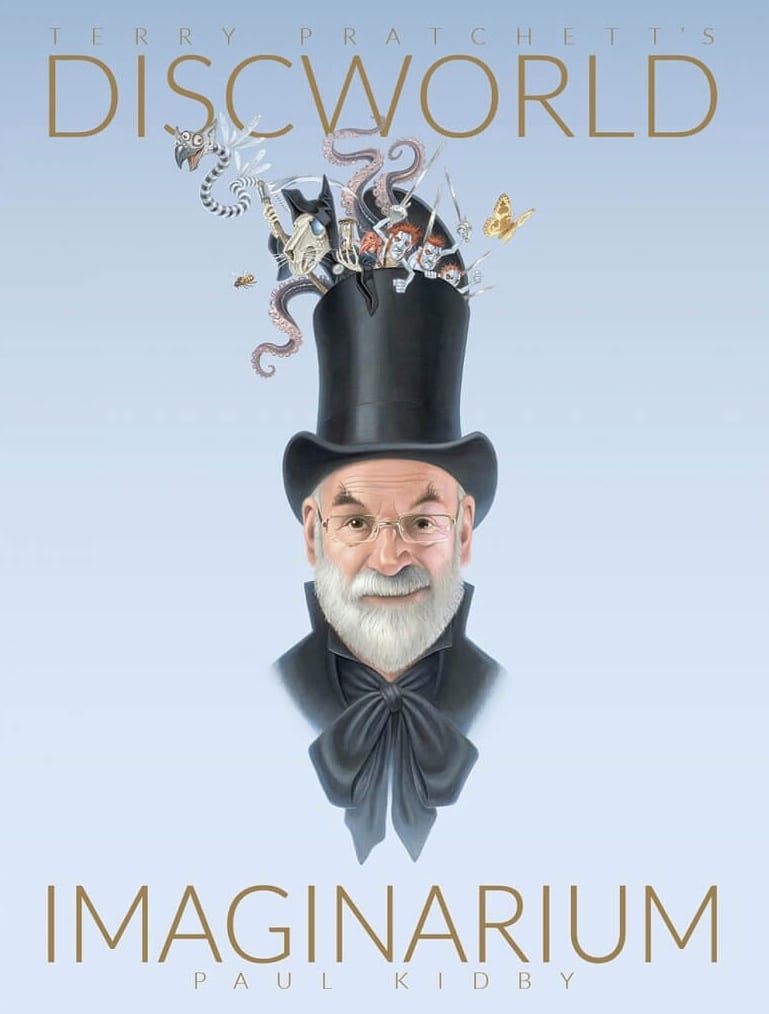
The cover of Discworld Imaginarium by Terry Pratchett’s “artist of choice”, Paul Kidby.
Pratchett’s own sense of humour, a sort of gentle, English, observational thing, stems from this period. “Wodehouse, obviously, but also I tore my way through the Just William books. Richmal Crompton was a very good writer. I think it was from her that I learnt irony. It took me a while to work it out.” Do you think you could define irony, I ask him. “Sort of like iron.” I deserved that, I acknowledge. “When you get hit on the head with it, you know it.”
He also fell in love with RJ Yeatman and WC Sellar, authors of 1066 and All That (“in the Thirties, when the middle classes were getting richer, the two of them really got as much fun out of that as you could. The Thirties were an awful lot of fun. Or at least until the end. Bad ending, the decade, admittedly”) and fell out with his headmaster for “bringing in a copy of Mad magazine. How horrible! And a copy of Private Eye. Seditious.” But it was the now defunct satirical magazine Punch which really formed the comic voice in which he now speaks. “I read my way through all the bound Punches. It was the best way to read history; you got it without granny looking over your shoulder, and it was just astonishing.
“And just about any writer of distinction, anywhere in the English language, worked for Punch. Mark Twain. Jerome K Jerome. And they spoke with the same voice, which opened the door for me – the same kind of slightly satirical, people-are-rather-silly-but-they’re-not-that-bad voice, friendly about humanity, fond of its foibles.” Apart from the books, the other influences of his youth are clear in his own writing – especially the later Ankh-set works, in which he frequently extols the virtues of the poor-but-respectable people living in tiny, tidy terraced houses, and of the self-made men and women. “There used to be a sort of dignity in labour,” he says. “I don’t think there is now.”
He has spoken, often, of how his time on local newspapers made him. He started at 16, in high dudgeon at his headmaster: “On my last day at the school, I left all my stuff behind and phoned up the editor of a local newspaper. He actually used some cliché like, ‘I like the cut of your jib, young man’, or something.” It is the stuff of legend that he saw his first dead body the next day, “work experience really meaning something in those days”, as he put it in his author’s bio in his books.
“Truthfully, without over-egging it, as I often do,” he says, “the library and journalism, those things made me who I am. Journalism makes you think fast. You have to speak to people in all walks of life. Especially local journalism. London journalism can p— in someone’s face and they can’t do anything about it. Try that in local journalism, and someone’s down to complain. Everyone should have one local journalism job in their lives, especially if they’re a nosy parker.” He talks of local journalists in the same way he does his parents, with a sense of quiet heroism. “I interviewed an elderly journalist who’d worked in a small town for a very, very long time. I asked: is it boring? And he said: over there, that’s where a couple pushed their daughter into the attic because she’d had a black baby. And over there, that’s where a man was caught in flagrante delicto with a barnyard fowl. And he’d said to the magistrates, ‘Well, it was my fowl’. Even those small moments, they make you realise the world is not as you thought.”
March 2, 2020
History-Makers: Anna Komnena
Overly Sarcastic Productions
Published 28 Feb 2020She’s a Princess! She’s a Poet! She’s a Historian! She’s Anna Komnena — the COOLEST writer in the Byzantine Empire! On this episode of History-Makers, jump into the reign of Alexios Komnenos from the perspective of his daughter Anna, and learn about the emperor who saved the Byzantines from certain doom, as well as the traits that make Anna’s Alexiad a masterpiece.
This video was edited by Sophia Ricciardi, AKA “Indigo”.
Our content is intended for teenage audiences and up.Sources & Further Reading: The Alexiad — obviously, what are you waiting for? (Also Norwich’s Byzantium)
PATREON: https://www.Patreon.com/OSP
DISCORD: https://discord.gg/h3AqJPe
MERCH LINKS: https://www.redbubble.com/people/OSPY…
OUR WEBSITE: https://www.OverlySarcasticProductions.com
Find us on Twitter https://www.Twitter.com/OSPYouTube
Find us on Reddit https://www.Reddit.com/r/OSP/

February 29, 2020
QotD: Perceived causes of madness during the Renaissance
In some cases, it was the result of an excess of passions, flightiness, or imagination: the most famous example is Don Quixote, who went crazy after reading too many fiction books. This was actually considered a very serious risk by practically all classical authorities, especially for women. Foucault quotes Edme-Pierre Beauchesne:
In the earliest epochs of French gallantry and manners, the less perfected minds of women were content with facts and events as marvelous as they were unbelievable; now they demand believable facts yet sentiments so marvelous that their own minds are disturbed and confounded by them; they then seek, in all that surrounds them, to realize the marvels by which they are enchanted; but everything seems to them without sentiment and without life, because they are trying to find what does not exist in nature.
And a newspaper of the time:
The existence of so many authors has produced a host of readers, and continued reading generates every nervous complaint; perhaps of all the causes that have harmed women’s health, the principal one has been the infinite multiplication of novels in the last hundred years … a girl who at ten reads instead of running will, at twenty, be a woman with the vapors and not a good nurse.
Novels weren’t the only danger, of course. There were other hazards to watch for, like waking up too late:
The moment at which our women rise in Paris is far removed from that which nature has indicated; the best hours of the day have slipped away; the purest air has disappeared; no one has benefited from it. The vapors, the harmful exhalations, attracted by the sun’s heat, are already rising in the atmosphere.
Also, freedom:
For a long time, certain forms of melancholia were considered specifically English; this was a fact in medicine and a constant in literature … Spurzheim made a synthesis of all these analyses in one of the last texts devoted to them. Madness, “more frequent in England than anywhere else,” is merely the penalty of the liberty that reigns there, and of the wealth universally enjoyed. Freedom of conscience entails more dangers than authority and despotism. “Religious sentiments exist without restriction; every individual is entitled to preach to anyone who will listen to him”, and by listening to such different opinions, “minds are disturbed in the search for truth.”
These are a very selective sampling of quotes from just one of Foucault’s many chapters, and some of them are separated by centuries from others, but the overall impression I got was that conformity/wholesomeness/clean living was salubrious, and deviations from these likely to cause madness. Essentially, if you deviate from your humanity a little bit of the way – by failing to be a godly, sober-living, and industrious person – then that can compound on itself and make you lose practically all of your humanity. You will end up a feral madman, little different from a beast.
Scott Alexander, “Book review: Madness and Civilization”, Slate Star Codex, 2018-01-04.
February 27, 2020
QotD: Clichés of bad travel writing
Kerry Howley, “But the People Are So Friendly“, Hit and Run, 2005-08-18.
January 24, 2020
QotD: Writing as a career
Colby Cosh “Who let him in?”, ColbyCosh.com, 2005-01-19.
January 19, 2020
QotD: Bad fiction writers often know little or no economic theory
It is clear that she comes from an academic background, since she thinks that shelves are allotted by order of “importance.”
This is a problem for me as a reader often because I run into a lot of writers like her. It’s less important in things like romance, though even there it can get weird, like when some authors assume that the best thing possible in the Regency would be being a duke AND a doctor. (Head>desk, repeat.) This is because they misunderstand the relative wealth and importance of earning a living in the professions.
But there are a ton of books in mystery that hit the wall. Those that require understanding of how the world worked. So the economics these writers write are what you expect from exquisitely maleducated people. They learned sociology and various grievance studies. So you know, factories are bad places where people are forced to work in terrible conditions — for the 21st century. None of these darlings has the slightest idea what actual conditions were like at farms in the Regency, say — and do not even get health care or counseling, and are probably totally deprived of free ice cream.
I have now walled mysteries, some romances and a few fantasies, because they assume people who build and run factories are “evil exploiters” and villains. (As opposed to you know not building anything and letting the peasants starve.)
I’ve walled even more of them when the villain becomes “reformed” and just gives his whole fortune away to people who probably drink it away within a week and, presumably, dies in a gutter shortly thereafter.
In science fiction and fantasy this is even more painful. You’ll have entire worlds getting paid for things, without it making any sense, since there is no galactic agreement on money, no universally agreed upon standard, nothing that makes whatever they hand you worth anything. We have entire worlds paid for things that make no sense to transport inter-world with the money existent at that time. You have “exploited” groups, that you can’t figure out why anyone would exploit or what sense it makes.
Then there is the soc jus in these worlds, which often consists of upending historic injustices by creating worse injustices and, oh, yeah, incidentally making it impossible for the economics to function and starving everyone in the world. If you’re going to do that call it Planet Venezuela already, okay?
And don’t get me started on the economics of worlds with magic, where monetizing magic is somehow either wrong or no one ever thought of doing it (because everyone in that world is born mentally impaired.)
Sarah Hoyt, “A Fundamental Misunderstanding of Supply and Demand”, According to Hoyt, 2019-11-06.
December 20, 2019
J.R.R. Tolkien: Author of Worlds
Biographics
Published 12 Apr 2018Known as “the father of modern fantasy” his epic tales of legend and lore have been enjoyed by millions of people all over the world — devoured in popular books and adapted for Hollywood blockbuster films. Unbelievably bright, he was a distinguished university professor, poet, historian, and expert linguist. As a child, he even made up his own languages for pure fun.
Visit our companion website for more: http://biographics.org
Credits:
Host – Simon Whistler
Author – Crystal Sullivan
Producer – Samuel Avila
Executive Producer – Shell HarrisBusiness inquiries to biographics.email@gmail.com
Biographies by the book, get J.R.R. Tolkien’s biography from Amazon: http://amzn.to/2ChRfIV

November 27, 2019
Herodotus’ Histories – Tom Holland
The Study of Antiquity and the Middle Ages
Published 24 Mar 2018The classical scholar Tom Holland introduces his new translation of Herodotus’ masterpiece – The Histories.
The Histories (Greek: Ἱστορίαι; Ancient Greek: [his.to.rí.ai̯]; also known as The History) of Herodotus is now considered the founding work of history in Western literature.
Written in 440 BC in the Ionic dialect of classical Greek, The Histories serves as a record of the ancient traditions, politics, geography, and clashes of various cultures that were known in Western Asia, Northern Africa and Greece at that time. Although not a fully impartial record, it remains one of the West’s most important sources regarding these affairs.
Moreover, it established the genre and study of history in the Western world (despite the existence of historical records and chronicles beforehand).
The Histories also stands as one of the first accounts of the rise of the Persian Empire, as well as the events and causes of the Greco-Persian Wars between the Achaemenid Empire and the Greek city-states in the 5th century BC. Herodotus portrays the conflict as one between the forces of slavery (the Persians) on the one hand, and freedom (the Athenians and the confederacy of Greek city-states which united against the invaders) on the other.
The Histories was at some point divided into the nine books that appear in modern editions, conventionally named after the nine Muses.
November 13, 2019
George Orwell: A Life in Pictures
Albion Noise
Published 27 Dec 2015George Orwell: A Life in Pictures is a 2003 BBC Television docudrama telling the life story of the British author George Orwell. Chris Langham plays the part of Orwell. No surviving sound recordings or video of the real George Orwell have been found.
Awards:
International Emmy 2004 for Best Arts Programme
Grierson Award 2004 for Best Documentary on the Arts
November 2, 2019
QotD: Business writing
[…]
OK, the most consistent mistake … not mistake, but inefficiency of business writing — and it was very consistent — is the absolute refusal on the part of the writer to tell you right away what message he or she is trying to deliver. I used to say to them, “The most important thing you have to say should be in the first sentence.” And “Oh, no, you can’t. I’m an engineer. We did a 10-year study, this is way too complicated.”
And inevitably, they were wrong. Inevitably, if they really thought about it, they were able to, in one sentence, summarize why it was really important. But they refused to do that because the way they found out was by spending 10 years of study and all this data and everything, and that’s the way they wanted everyone to look at what they did. They wanted their supervisors to go plowing through all they had done to come to this brilliant conclusion that they had come to.
COWEN: Through their history, through their thought patterns.
Drag everybody through it. And it was the one thing the newspaper people were taught to do that made more sense. You don’t have your reader’s attention very long, so get to the point. I found it was very difficult to get even really smart businesspeople to get to the point. Sometimes it was because they really couldn’t tell you what the point was.
What I wanted to say, but rarely felt comfortable saying, was, “If you don’t know what the point is, then you can’t really write this report.” But it was always too complicated for a layperson like me to understand. That was the way they did it. I was being hired by their bosses to tell them, “No, we want you to write clearly, and we want you to get to the point.”
COWEN: And why were they, at this meta level, resistant to your message?
Because nobody else was doing it. When I would start the class, I’d have 32 people in the class typically, and when they would turn in all their samples of writing, every one of them wrote the same way. They all wrote business-ese writing. This is my parody of it, but it was, “Enclosed please find the enclosed enclosure.” That kind of formal, nonsensical, meaningless flow of words. Somewhere in there would be something important, something significant, or maybe not.
Dave Barry, interviewed by Tyler Cowan in “Dave Barry on Humor, Writing, and Life as a Florida Man”, Medium, 2017-08-16.
October 26, 2019
QotD: Pulp fantasy writers
Damon Knight, quoted by John C. Wright, “Conan and the Critic”, John C. Wright’s Journal, 2017-11-01.
October 19, 2019
QotD: Writing to length
So why do inexperienced authors write long? I suspect it’s because they assume that they’ll get only one chance to impress the editor, which causes them to empty their bag of tricks every time they write a piece. (This reminds me of another of my critical commandments: Don’t tell everything you know.) Flashiness is a sin of youth. The older and more self-assured a writer is, the more likely he is to appreciate the virtues of simplicity and economy.
I don’t know whether it’s possible to teach this lesson to young writers. The older I get, the more I wonder whether anything can be taught to anyone. Still, I did my best to get it across to my students, and I like to think that at least some of them were paying attention.
Terry Teachout, “To the point”, About Last Night, 2007-06-01.


