Not all of us are rich yet, of course. A billion or so people on the planet drag along on the equivalent of $3 a day or less. But as recently as 1800, almost everybody did.
The Great Enrichment began in 17th-century Holland. By the 18th century, it had moved to England, Scotland and the American colonies, and now it has spread to much of the rest of the world.
Economists and historians agree on its startling magnitude: By 2010, the average daily income in a wide range of countries, including Japan, the United States, Botswana and Brazil, had soared 1,000 to 3,000 percent over the levels of 1800. People moved from tents and mud huts to split-levels and city condominiums, from waterborne diseases to 80-year life spans, from ignorance to literacy.
You might think the rich have become richer and the poor even poorer. But by the standard of basic comfort in essentials, the poorest people on the planet have gained the most. In places like Ireland, Singapore, Finland and Italy, even people who are relatively poor have adequate food, education, lodging and medical care — none of which their ancestors had. Not remotely.
Inequality of financial wealth goes up and down, but over the long term it has been reduced. Financial inequality was greater in 1800 and 1900 than it is now, as even the French economist Thomas Piketty has acknowledged. By the more important standard of basic comfort in consumption, inequality within and between countries has fallen nearly continuously.
Dierdre N. McCloskey, “The Formula for a Richer World? Equality, Liberty, Justice”, New York Times, 2016-09-02.
July 4, 2018
QotD: “The world is rich and will become still richer. Quit worrying”
June 30, 2018
Wealthy virtue-signalling hurts the poor
At Catellaxy Files, Rafe Champion discusses some of the points raised by Matt Ridley in his recent book:
Essentially, the poor pay for the virtue-signalling of the rich. Dr Matt Ridley opens chapter 14 of Climate Science: The Facts with some blunt claims.
Here is a simple fact about the world today. Climate change is doing more good than harm. Here is another fact. Climate change policy is doing more harm than good.
On top of that he points out that the poor are carrying the cost of today’s climate policy. That is something for the ALP [Australian Labour Party] and the social justice warriors to think about.
This should remind people of another great postwar example of destructive virtue-signalling – massive foreign aid to the developing nations aka the Third World. That did more harm than good for the people of the Third World, apart from the crony criminals in power. The great Lord Peter Bauer was onto that very smartly, starting in the 1940s and his findings have been consolidated lately, notably by William Easterly [in] The White Man’s Burden: Why the west’s efforts to aid the rest have done so much ill and so little good. There are exceptions to the rule such as hands-on medical care and private education.
Ridley mentions in passing some of the cases where apparently smart people have made very bad calls, starting with a prominent and wealthy leftwinger who he debated on TV. Faced with the charge that climate policy was hurting the poor he replied “But what about my grandchildren?”. As though the future wellbeing of the presumably affluent and privileged grandchildren of the talking head might be threatened by policies that help the poor who are with us at present. Ridley also cited a son of Charles Darwin who thought that eugenic breeding programs were essential to save civilization and Paul Ehrlich who in 1972 predicted that millions would die due to over-population (prompting the one-child policy in China).
June 11, 2018
L. Neil Smith on the Koch brothers and the libertarian movement
In the latest issue of the Libertarian Enterprise, L. Neil Smith discusses his experiences working with the Koch brothers:
It says here that David Koch is retiring. In case you don’t know, he is the younger of two oil billionaire brothers associated with the libertarian movement who bankrolled the Cato Institute, and whom “progressives” love to hate, automatically blaming them for what little they don’t blame Donald Trump for.
Genuine libertarians and conservatives don’t like them much, either, for a variety of reasons. My own first is that I served on the 1977 Libertarian Party National Platform Committee with Charlie, David’s older brother and found him to be a timid, unimaginative soul, more concerned with credibility and respectability than with truth or principle. At the time, the think-tank he and his brother created was attempting to turn the LP into a wholly-owned subsidiary (David ran in 1980 for Vice President with Ed Clark), and I didn’t like that, either.
The Koch brothers are also open-borderists, siding with establishment Republicans like that smirk-weasel Paul Ryan who want an imported servant-class they can abuse. I’ve changed my mind on that issue for good and sufficient reasons, and they ought to be good and sufficient for the Koch Brothers, too, if they were really libertarians. American culture is unique and wonderful; I do not want to see it changed or destroyed as the cultures of Sweden and England are being, by uncontrolled mass immigration. Letting a lot of Third Worlders into the United States of America is like letting a lot of Californians into Colorado. Pretty soon it’ll be just like the mess they made and left behind.
We have a saying here: “Don’t Californicate Colorado”.
David is retiring, it says here, due to an extremely long bout with prostate cancer. It does not say what his prognosis is. My own father, whom I miss every day, fought prostate cancer for six ghastly years and died. I’m sorry David has it now; I would not wish that fate on anybody.
But the reason I’m writing this is to speak the truth, to a great big pile of money, if not to power. The Kochs don’t have power because they don’t have a clue how to spend money politically, and, among other counter-productive follies, they threw their dough away with all four hands, supporting a think-tank incapable of reaching the people by the millions the way Donald Trump has. I have never known anyone who read a paper produced by the Cato Institute or listened to a lecture given by one of their wonks — except other wonks.
May 22, 2018
QotD: Capitalism is the most feminist economic system ever
We really do need to be pointing out that the Good Old Days are now. Both technological advance and productivity growth have been driven by that combination of capitalism and markets. Capitalism, in its lust for profits, leading to the invention. Markets and the ability to copy what works being what creates the general uplift in standards by the spreading and wide use of those inventions.
The net effect of this has been, well, it’s been to make women’s lives vastly better. Starting with the point that many women actually have lives as a result. Childbirth has moved from being the leading cause of female death* to a mild risk which kills very few – each one a tragedy which is why we’re so happy that we have reduced that risk. We’ve automated all the heavy lifting in society meaning that women can indeed, with their generally lighter musculature, compete in near all areas of work. We’ve done more automation of household drudgery than we have of anything else too, freeing the distaff side from that chain upon their ambitions.
We’ve even freed all from the child bearing consequences of bonking – much to the great pleasure of man and woman alike.
Women today are the most privileged, richest, group of women who have ever stumbled across the surface of this planet. And in comparison to the men in their society they’re the most equal too. All of which leads to an interesting question. Just why are they whining so much?
*Possibly an exaggeration but not much of one. Certainly not about the mid 19th century before Semmelweiss.
Tim Worstall, “Capitalism Is The Most Feminist Economic System Ever”, Continental Telegraph, 2018-04-30.
April 30, 2018
The Empire of Mali – Mansa Musa – Extra History – #3
Extra Credits
Published on 28 Apr 2018Mansa Musa is remembered as the richest person in the entire history of the world, but he also worked hard to establish the empire of Mali as a political and even religious superpower. However, his excessive wealth started creating bigger problems…
April 11, 2018
Penn & Teller: Dalai Lama and Tibet
infinit888
Published on 13 May 2008Mainstream media seems to be only pushing the story about an oppressed Tibet and referring to the Dalai Lama as a saint.
This is a compilation of clips from Penn & Teller’s Bullshit! “Holier Than Thou” speaking about Tibet and the Dalai Lama.
QotD: Wealth hath its (social) privileges
Rich people — left, right, center — think what they have to say is interesting because they get used to people treating them that way.
Ramesh Ponnuru, Twitter, 2016-07-21.
March 25, 2018
The appearance of wealth
Victor Davis Hanson on how the wealthy once were eager to appear as distinct from the common herd as possible:
Even in the mostly egalitarian city-states of relatively poor classical Greece, the wealthy were readily identifiable. A man of privilege was easy to spot by his remarkable possession of a horse, the fine quality of his tunic, or by his mastery of Greek syntax and vocabulary.
An anonymous and irascible Athenian author — dubbed “The Old Oligarch” by the nineteenth-century British classicist Gilbert Murray — wrote a bitter diatribe known as “The Constitution of the Athenians.” The harangue, composed in the late fifth century B.C., blasted the liberal politics and culture of Athens. The grouchy elitist complained that poor people in Athens don’t get out of the way of rich people. He was angry that only in radically democratic imperial Athens was it hard to calibrate a man by his mere appearance: “You would often hit an Athenian citizen by mistake on the assumption that he was a slave. For the people there are no better dressed than the slaves and metics, nor are they any more handsome.”
The Old Oligarch’s essay reveals an ancient truth about privilege and status. Throughout history, the elite in most of the Western world were easy to distinguish. Visible class distinctions characterized ancient Rome, Renaissance Florence, the Paris of the nineteenth century, and the major cities of twentieth century America.
A variety of recent social trends and revolutionary economic breakthroughs have blurred the line separating the elite from the masses.
First, the cultural revolution of the 1960s made it cool for everyone to dress sloppily and to talk with slang and profanity. Levis, T-shirts, and sneakers became the hip American uniform, a way of superficially equalizing the unequal. Contrived informality radiated the veneer of class solidarity. Multimillionaires like Bruce Springsteen and Bono appear indistinguishable from welders on the street.
The locus classicus is perhaps Facebook owner Mark Zuckerberg, who wears T-shirts, jeans, and flip flops to work. His reported wealth of $71 billion makes him the world’s fifth-richest man. The median net worth of Americans is about $45,000. Zuckerberg is worth more than the collective wealth of about 1.5 million Americans — or about all the household wealth in Philadelphia put together. And yet, he looks perfectly ordinary. When I walk the Stanford campus — where many of the world’s wealthiest send their children — the son of a Silicon Valley billionaire looks no different from a machinist’s daughter on full support from Akron.
Second, technology has done its part to dilute superficial class distinctions. The nineteenth-century gap between a rich man in his fine carriage — with footman and driver — and someone walking three miles to work has disappeared. The driving experience between a $20,000 Kia bought on credit with $1,000 down and a $80,0000 Mercedes paid in cash is mostly reduced to the superficial logo on the hood and trunk. An alien from Mars could not easily distinguish, at least by sight, between the two cars. Even after a ten-minute ride, an alien might be puzzled: What exactly did that extra $60,000 buy?
February 19, 2018
Graphing good news
In the Times Literary Supplement, David Wootton reviews Enlightenment Now: A manifesto for science, reason, humanism and progress by Steven Pinker:
This book consists essentially of seventy-two graphs – and, despite that, it is gripping, provocative and (many will find) infuriating. The graphs all have time on the horizontal axis, and on the vertical axis something important that can be measured against it – life expectancy, for example, or suicide rates, or income. In some graphs the line, or lines (often the graphs compare trends in several countries) fall as they go from left to right; in others they rise. In every single one, the overall picture (with the inevitable blips and bounces) is of life getting better and better. Suicide rates fall, homicides fall, incomes rise, life expectancies rise, literacy rates rise and so on and on through seventy-two variations. Most of these graphs are not new: some simply update graphs which appeared in Pinker’s earlier The Better Angels of Our Nature (2011); others come from recognized purveyors of statistical information. The graphs that weren’t in Better Angels extend the argument of that book, that war and homicide are on the decline across the globe, to assert that life has been getting better and better in all sorts of other respects. The claim isn’t new: a shorter version is to be found in Johan Norberg’s Progress (2017). But the range and scope of the evidence adduced is new. The only major claim not supported by a graph (or indeed much evidence of any kind) is the assertion that all this progress has something to do with the Enlightenment.
Since the argument of the book is almost entirely contained in the graphs, those who want to attack the argument are going to attack the figures on which the graphs are based. Good luck to them: arguments based on statistics, like all interesting arguments, should be tested and tested again. Better Angels caused a vitriolic dispute between Pinker and Nassim Nicholas Taleb as to whether major wars are becoming less frequent. In Taleb’s view the question is a bit like asking whether major earthquakes are getting less frequent or not: they happen so rarely, and so randomly, that you would need records going back over a vast stretch of time to reach any meaningful conclusion; a graph showing falling death rates in wars over the past seventy years won’t do the job. But it certainly will tell you that lots of generalizations about modern war are wrong. Much, indeed most, of Pinker’s argument survived Taleb’s attack, which in any case was directed at only one graph among many.
A more radical line of criticism of Better Angels came from John Gray. How can one find a common standard of measurement for the suffering of a concentration camp victim, of a soldier who died in the trenches, and of someone killed in the firebombing of Dresden? To turn to economics, how can one find a common standard of measurement for books and washing machines, oranges and steak pies? Money, you might think, provides that standard, but what happens if many of the goods being measured – electric lighting, cars, televisions, computers – get cheaper and cheaper as time goes on, so that a rising standard of living is concealed by falling prices? For Gray, to place one’s faith in statistics, which claim to be measuring the unmeasurable, is no different from believing in conversations with angels or in the efficacy of Buddhist prayer wheels. Quantification is our religion.
February 17, 2018
The great enrichening of 1960-2016
Marian Tupy explains why all the Malthusian worry about overpopulation in the Third World was wrong:
Many people believe that global population growth leads to greater poverty and more famines, but evidence suggests otherwise. Between 1960 and 2016, the world’s population increased by 145 percent. Over the same time period, real average annual per capita income in the world rose by 183 percent.
Instead of a rise in poverty rates, the world saw the greatest poverty reduction in human history. In 1981, the World Bank estimated, 42.2 percent of humanity lived on less than $1.90 per person per day (adjusted for purchasing power). In 2013, that figure stood at 10.7 percent. That’s a reduction of 75 percent. According to the Bank’s more recent estimates, absolute poverty fell to less than 10 percent in 2015.
Rising incomes helped lower the infant mortality rate from 64.8 per 1,000 live births in 1990 to 30.5 in 2016. That’s a 53 percent reduction. Over the same time period, the mortality rate for children under five years of age declined from 93.4 per 1,000 to 40.8. That’s a reduction of 56 percent. The number of maternal deaths declined from 532,000 in 1990 to 303,000 in 2015 — a 43 percent decrease.
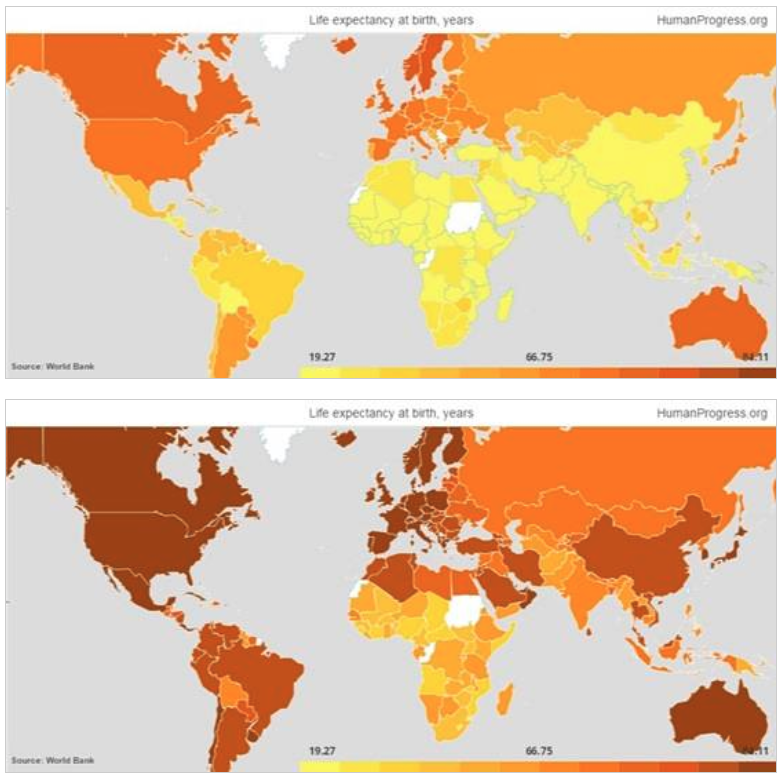
Famine has all but disappeared outside of war zones. In 1961, food supply in 54 out of 183 countries was less than 2,000 calories per person per day. That was true of only two countries in 2013. In 1960, average life expectancy in the world was 52.6 years. In 2015, it was 71.9 years — a 37 percent increase.
In 1960, American workers worked, on average, 1,930 hours per year. In 2017, they worked 1,758 hours per year — a reduction of 9 percent. The data for the world are patchy. That said, a personal calculation based on the available data for 31 rich and middle-income countries suggests a 14 percent decline in hours worked per worker per year.
And because everyone loves pictures, here’s one from an earlier article by the same author showing increases in life expectancy between 1960 (top) and 2015 (bottom):
February 15, 2018
DicKtionary – D is for Dollars – Hetty Green
TimeGhost
Published on 14 Feb 2018D is for dollars, 100 to the penny,
Some have but few, others have many,
Some hoard them too – the frugal and mean,
And none was more frugal than one Hetty Green.Hosted and Written by: Indy Neidell
Based on a concept by Astrid Deinhard and Indy Neidell
Produced by: Spartacus Olsson
Executive Producers: Bodo Rittenauer, Astrid Deinhard, Indy Neidell, Spartacus Olsson
Edited by: Bastian BeißwengerA TimeGhost format produced by OnLion Entertainment GmbH
December 19, 2017
QotD: Do-gooders, busybodies and other nuisances
Wealthy people – by which I mean people healthy, well-fed, well-clothed, well-shod, well-housed, and well-leisured and literate – are often deformed by the lovelier angels within their breasts into saviors. Busybodies. Officious do-gooders. Arrogant meddlers. Tyrants seeking as personal payoff not crass material gain but the perverted satisfaction of lording it over other people for what these tyrants sincerely believe to be the good of these other people.
Saviors need victims to save. And if such victims are not real and readily available, the saviors conjure them up by convincing themselves that this or that group of people are helpless victims eager to be raised from the muck of their misfortunes by the saviors. Sometimes the saviors convince even the groups they seek to save that they – the members of these groups – are indeed mired in a muck from which they can be extracted only by the saviors.
As society grows wealthier, the need to be saved by others from earthly misfortunes grows steadily less frequent and less dire while the itch to save others from earthly misfortunes grows steadily more frequent and more intense. A great irony is that, insofar as this itch to save grows faster than the need to be saved declines, the need to be saved might actually rise because the actions of those who itch to save more often than not worsen, rather than improve, the well-being of those who are the targets of the saviors’ efforts.
Don Boudreaux, “Saviors Need Victims Who Need Saving”, Cafe Hayek, 2016-04-23.
December 17, 2017
QotD: Modern eco-paganism
… consider the emergence of a Nature-worshipping environmentalism that would have been viewed as a crazy luxury in the hardscrabble times of 1800 or even of 1933. The economist and student of theology Robert Nelson calls environmentalism the new religion of the West (a West that nonetheless, outside of places like Poland or the United States, imagines itself to be irreligious) […] The economist and think-tank maven Fred L. Smith, Jr. speaks of “eco-paganism”: “Most environmentalists do not, of course, see themselves as pagans,” he writes. “Yet many do espouse a watered-down form of pantheism which elevates nature to near the status of a deity.” By now the good people of rich and secular places such as Sweden, though contemptuous of the childish absurdity (as most Swedes believe it to be) of their ancestors’ worship of a Lutheran God, have found their transcendent in the worship of Nature, and spend their Sunday mornings devoutly gathering mushrooms and lingonberries in Nature’s forest.
Deirdre McCloskey, Bourgeois Equality, 2016.
December 12, 2017
Kill the Mortgage Interest Deduction Now!
ReasonTV
Published on 11 Dec 2017Thankfully, one of the biggest scams in the American tax code is finally under attack in the House version of Republican tax reform.
It’s the mortgage-interest deduction, which lets homeowners deduct interest paid on mortgages of up to $1 million for two houses. Ever since owning a home has been a central tenet of the American Dream since the end of World War II and the rise of suburbia, it’s been a given that deducting mortgage interest from your taxes is as American as apple pie.
_____The House plan would limit filers to deducting interest on the first $500,000 of a mortgage on just one house, sending a blind panic through wealthy home owners, realtors, and the building trades, all of whom are terrified that a government subsidy is being yanked away from them.
But the real problem with the House bill is that it doesn’t go far enough. We should scrap the mortgage-interest deduction altogether and let housing prices reflect real market values.
The mortgage-interest deduction is typically justified by claiming that it lets people—especially vaguely defined “middle-class” people–afford homes. But it also increases the price of housing by making it artificially cheap to borrow, meaning homebuyers are willing to pay more. England, Canada, and Australia don’t let their taxpayers deduct their mortgage interest and they all have higher rates of homeownership than the United States.
The mortgage-interest deduction disproportionately benefits the wealthiest Americans, who soak up almost all the $70 billion a year it costs in foregone revenue each year. Reason Foundation’s director of economic research, Anthony Randazzo calculates that only 20 percent of tax filers claim the mortgage-interest deduction. That group by and large are part of six-figure households in a country where the median household income is $57,000.
Killing the mortgage-interest deduction might cause a one-time 7 percent drop in real estate prices, according to one estimate, with wealthy homeowners feeling most of the pain.
As a homeowner, that seems like a small price to pay to end a policy that distorts the real estate market, complicates the tax code, and benefits mostly wealthier Americans on the false promise that it makes home-owning affordable for the middle class.
The mortgage-interest deduction is just special interest pandering wrapped in a gooey story that equates “the American Dream” with having a mortgage. The tax code should be designed to raise the revenue necessary to pay for essential services, not to nudge and prod us into spending money on something the government decides is good for us.
Produced by Todd Krainin. Written and narrated by Nick Gillespie.
November 23, 2017
If you think your taxes are too low, you can easily give the government more of your money
As discussed fairly recently, the government requires you to pay taxes up to a certain point, but there’s nothing stopping you from paying more than they ask. For Canadian federal taxes, Her Majesty in right of Canada would be delighted to accept any additional money you wish to donate. I’m sure your provincial or territorial government has a similar mechanism set up. Equivalent schemes are definitely available in the UK and probably other Commonwealth countries.
In the US, the tax rates are in the news again and the usual (ultra-wealthy) suspects are lining up to demand that the government not lower their taxes:
There’s an amusing ritual that takes place in Washington every time there’s a big debate about tax policy. A bunch of rich leftists will sign a letter or hold a press conference to announce that they should be paying higher taxes rather than lower taxes.
I’ve debated some of these people in the past, pointing out that they are “neurotic” and “guilt-ridden.”
But they apparently didn’t take my criticisms seriously and go into therapy, They’re now back and the Washington Post provides very favorable coverage to their latest exercise in masochism.
More than 400 American millionaires and billionaires are sending a letter to Congress this week urging Republican lawmakers not to cut their taxes. The wealthy Americans — including doctors, lawyers, entrepreneurs and chief executive — say the GOP is making a mistake by reducing taxes on the richest families… Instead of petitioning tax cuts for the wealthy, the letter tells Congress to raises taxes on rich people like them. …The letter was put together by Responsible Wealth, a group that advocates progressive causes. Signers include Ben & Jerry’s Ice Cream founders Ben Cohen and Jerry Greenfield, fashion designer Eileen Fisher, billionaire hedge fund manager George Soros… Most of the signers of the letter come from California, New York and Massachusetts.
Earlier in the month, I would have told these “limousine liberals” not to worry because I was pessimistic about the chances of a tax bill getting enacted. But then the Senate GOP unveiled a better-than-expected plan and I’m now semi-hopeful that something will make its way through the process.
That doesn’t mean, however, that these rich leftists should be despondent.
Because I’m a nice guy, today’s column is going to let them know that they don’t have to accept a tax cut. The Treasury Department has a website that they can use to voluntarily send extra money to Washington. It’s called “gifts to reduce the public debt,” and people like George Soros can have their accountants and lawyers calculate the value of any tax cut and then use this form to send that amount of money to D.C.