Quotulatiousness

October 11, 2023

“It’s our first-ever live-streamed pogrom”

Filed under: Media, Middle East, Military — Tags: , , , , , — Nicholas @ 05:00

In The Line, Matt Gurney recounts (some of) the opening atrocities of the terror attacks on Israel by Hamas terror squads:

As I write this, Israel seems close to clearing out its invaded southern areas. In the coming hours, we will be presented with more scenes of horror and atrocity as new killing sites are found. Israel’s counterattack into Gaza will almost certainly be massive, far beyond any of the campaigns we’ve seen in recent years, and we’ll see all the awful carnage that causes from close up, too. Hamas has already said they will respond to these retaliatory actions by killing their hostages one by one and sharing the video and audio of the killings for the world to see. I believe that they will indeed do exactly that. You should all prepare yourselves for that.

For me, though, as we wait for the future to arrive, I’ve been thinking about the books on my shelf and what they tell us about the past. Books about the Holocaust and Sept. 11, and how the world grappled with truly evil regimes in eras past. There are lessons there, in simple black and white. What I saw on my phone wasn’t that. It was visceral, and awful, but in its own way, usefully clarifying.

But how many people saw what I did?

[…]

During that time, and I’m limiting my summary here to reasonably verified videos, I’ve seen an Israeli family forced to watch the apparent execution of one of their children/siblings; a man having his head either smashed in or chopped off with what looked like a garden tool of some kind (the video was a bit grainy); I’ve seen what looks like some kind of shelter that was breached, with all the occupants inside gunned down. A terrorist steps inside into ankle-deep blood and corpses and puts a few rifle rounds into bodies that are still moving.

I’ve seen a shocked looking woman being dragged out of a vehicle, her pants soaked with blood flowing from between her legs, and I know what that is. (See first photo, above.) I’ve also seen a video that I’m not sure, but that I think, happened to catch a glimpse of a rape in progress. I didn’t have the stomach to go back and watch that one again, though, so I can’t be totally sure. Whatever it was, the woman was terrified and the men around her were delighted. They enjoyed her fear and torment.

How many others have seen these things? I would bet a bunch, but not a majority, or even close to a majority. Most news savvy people are probably aware that there is a conflict, and may even know the outlines of it, but if they aren’t well-plugged into the online ecosystem for news and don’t know where to look and have hepful media contacts in the region to help filter out the garbage sources, what they’ve seen of it is sanitized and curated by well-meaning news editors whose default assumption is that graphic detail is to be avoided lest the reader or viewer be traumatized and send in a complaint.

I glanced throughout the weekend and again this morning at the major Canadian news websites, and the photos are mostly what you’d expect. Evocative, but not graphic. The most graphic ones shown aren’t a fraction of what’s available. The presentation of this story looks familiar because of all the other times we’ve seen some version of it: rockets flying up atop their exhaust trails, tanks manoeuvring over desert sand, troops looking grim as they put on their equipment, clouds of smoke and dust over Gaza. This is all bulked out by the odd tasteful photo of a grieving family member, from either side. Or perhaps even both sides, for balance.

This situation completely inverts the truism that many of us overly online people have had to cling to in recent years: this time, Twitter is real life. It’s the rest of the presentation of reality that is distorting your understanding of what’s happening. Twitter is a tire fire these days, full of bots and deliberate disinformation accounts, but for those with local sources and who’ve taken the time to curate their trusted sources — and again, Ukraine has been what forced me to do that — it can still be an invaluable tool.

But you’ve got to work at that. How many do? There is a very good chance that many of the people forming and expressing opinions about this right now are doing so with only a pretty basic understanding of what’s actually happened. The coverage they’re seeing of it looks familiar, so they’ll assume it’s basically the same as ever, if maybe slightly worse. They won’t bother assessing it or wondering if they should tweak their usual prior default response to The Latest Middle East Violent Flare Up. They see a headline on the CBC and Reuters and simply man their usual culture war battlestation. It’s a reflex by now.

That’s a mistake this time. This is one is different. Not exactly unprecedented; Lord knows Israel has suffered defeats and intelligence failures before. But none like this in 50 years, and never in an age when the simple act of seizing a victim’s phone allowed the raping and butchering to be uploaded onto the Facebook pages of the victims for their families and friends to watch. It’s our first-ever live-streamed pogrom, and I can’t be the only one who spent part of the long weekend warily glancing at some of the history books on my shelf, remembering scenes described therein that many of us have now seen happen live from our homes.

October 8, 2023

Can we get back to de mortuis nil nisi bonum any time soon?

Filed under: Media, Politics, USA — Tags: , , , , , , — Nicholas @ 05:00

The Latin phrase refers to speaking nothing but good of the (recently) deceased, but as partisan passions rise, the urge to wave the bloody shirt and denigrate the dead overwhelms decency and common sense:

Of all the vices that can contribute to the collapse of civil society, a special place of honor surely needs to be reserved for mocking the newly murdered.

I don’t mean mocking the newly dead. The somewhat mawkish view that no ill should be spoken of the recently departed has always seemed rather priggish to me. It would, in fact, be absurd if we decided that in the wake of, say, Mitch McConnell’s or Noam Chomsky’s death, we couldn’t criticize their lives, careers, and beliefs. “If they’d given him an enema, they could have buried him in a matchbox” was my old friend Christopher Hitchens’ comment on the passing of Jerry Falwell. Rude, surely. Too soon, sure. But a swipe, not a gloat. And on Fox News. To Ralph Reed.

What crosses the line of what Orwell prized as “common decency” is using the occasion of someone’s untimely death to say they deserved it. “The homosexuals have declared war on nature, and now nature is exacting an awful retribution” was Pat Buchanan’s charming response to the outbreak of the AIDS epidemic. In the same vein today, on the other side as it were, there’s a “Herman Cain Award” subreddit with half a million members, devoted to naming and mocking vaccine skeptics who subsequently died of Covid. A giant, unified chorus of “ha-ha”s across the decades.

Social media and CCTV cameras have made the schadenfreude more visceral. This past week, a young “social justice” activist, Ryan Carson, was knifed to death on the street by a deranged 18-year-old assailant, as Carson’s girlfriend, paralyzed with shock, looked on. We might once have just heard of or read about this attack. Now we see it as it happens. Its reach might once have been limited by media gatekeepers. Now it can reach millions in a matter of hours on social media. And if you’re Elon Musk and your strategy for Twitter is to make it a more visual, visceral, sticky site, it’s gold. Within hours of Carson’s death, his last, terrifying moments were accessible to millions: a snuff video in all but name, now available to be monetized by gawkers.

And indecent gawkers. “It’s good to make fun of people who support criminals when they get murdered by criminals,” commented one on Twitter. “Ryan Carson took the phrase ‘bleeding heart liberal’ way too literally,” said another. (Carson’s actual heart was pierced by the murder weapon.) Other virtual tricoteuses went after the traumatized bystander: “Ryan Carson’s girlfriend is the Douche of the Week. 1. Showed almost no concern as her guy was murdered. 2. Expressed zero concern as he lay on the ground dying. Didn’t even bend down. 3. Refused to give police the murderer’s description. Soulless Marxist.” Another: “WHAT??? Ryan Carson’s girlfriend … started a GoFundMe page to make money off his death. I would tell her to eat trash but that’s cannibalism.” Or this: “She didn’t react when he was stabbed but she sure didn’t hesitate to raise $50k on go fund me. Makes you wonder.”

Makes you wonder what exactly? Twitter reminds me of Trump: you can’t believe it can go lower — until it always does.

I should stipulate, I suppose, that I doubt I would have been one of Ryan Carson’s favorite writers. His views on crime and policing were, to my mind, hopelessly naive and deeply counter-productive for real social justice. He also once tweeted upon news of Rush Limbaugh’s death — “lmao hell yeah” — and called himself, presumably with a wink, “COO of Antifa.” But many of us have lost our moral bearings in this cold civil war. And Carson was a human being, son of a mother and father, murdered senselessly, traumatizing a whole host of others. In that context, nothing else matters but his humanity. Lambaste his views; but don’t delight in his death even as millions can see his final, deeply vulnerable moments of panic and fear.

The same should be said to the online trolls who went after Josh Kruger, a lefty Philly journalist (and Dish reader) killed in his home this week, and Pava LaPere, a BLM-touting entrepreneur in Baltimore murdered brutally the week before. (I’ll spare you the Twitter comments.) The impulse to use anything to advance a narrative: this is how far we’ve sunk into bitter, vicious tribalism.

And is it me or is Musk’s Twitter obviously making all this worse, putting out more and more videos of street crime, bar fights, robberies, and brawls, often with racial tension fueling them? In our collective psyche there is the problem of mentally ill people committing crimes on the streets, and there is also the problem of everyone constantly seeing videos of mentally ill people committing crimes on the streets. It distorts our judgment; it privileges the vivid and violent over the lucid and peaceful. It normalizes and numbs us to violence and can incentivize it. And this emotive tribal priming makes us more likely to react to the deaths of our political opponents with glee.

September 25, 2023

Ted Gioia explains why he loves writing for Substack

Filed under: Media, Technology — Tags: , , , , — Nicholas @ 03:00

It’s much easier to reach the audience he wants to share with using his Substack than either Twit-er, er, I mean “X”, or Facebook:

Below I look at some surprising ways Substack has changed the media (and social media) landscape.

This gives me a good excuse to recommend the new Substack app. It’s now my go-to source for informed writing — providing access to a smarter and more diverse group of authors, thinkers, and creators than I’ve found anywhere else.

I’ve now been on Substack for 30 months, and the improvements in the platform during that time have far exceeded my expectations. I didn’t know any music writers on Substack back when I launched, but it now boasts a better roster of critics than any newspaper or magazine. By the way, I’m also subscribing to writers in a dozen or so other fields (culinary arts, economics, literature, finance, technology, psychology, etc.).

I’m a heavy user. I must have signed up for almost a hundred Substacks.

Substack has also added a lot of new features during those 30 months. I especially like Notes, which is similar to Twitter but with extra IQ points. And I’ve also benefited from cross-posting, recommendations, and many other new features. I also applaud options I don’t currently use (like chat and podcasts), because they empower writers and readers.

The reality is that Substack is innovating faster than I can keep up with. But I like it that way. It’s creating an interconnected and independent media ecosystem here.

Best of all are the core values behind all this:

  • Substack supports writers — who receive almost 90% of subscription revenues. This is the exact opposite of the traditional publishing model, where royalty rates of around 10% are typical.
  • I don’t need to attract advertisers, and this frees me from the conflicts-of-interest advertising brings to other platforms.
  • There’s no surveillance or selling of users’ private information here.
  • I share my articles directly with readers, and no algorithm or gatekeeper intervenes to prevent our direct connection.

For these and other reasons, I’ve been an advocate for the platform. And that’s a good introduction to my subject today.

September 20, 2023

“Future Edward Gibbons’ [will] have no problem piecing together precisely how our society went down the toilet”

Filed under: Cancon, Media, Politics — Tags: , , , , — Nicholas @ 04:00

In The Line, Andrew MacDougall finds something good to say about social media:

“Automotive Social Media Marketing” by socialautomotive is licensed under CC BY 2.0

Say what you will about social media, but one unalloyed good is the future Edward Gibbons’ of this parish are going to have no problem piecing together precisely how our society went down the toilet.

Future historians will not only know what happened as we cratered, but, thanks to our ubiquitous digital sketch pads, they will have all of the horrific micro detail. They will know how many times we circled the bowl, what we were saying about circling the bowl as we were circling it and which streaks we were or weren’t arguing about as we went down. Social media is an infinite canvas home to a limitless number of voices and — while we might not be richer for it in the present — our future societal homicide detectives will be forever grateful that we left so many stains to analyze.

For example, when historians consider — as they surely will — whether the moment Canada truly began to crumble was when a WestJet cabin crew allowed Conservative leader Pierre Poilievre to grab the conch and address a planeload of (mostly) Conservative Party of Canada delegates on his way back from a successful party convention, we will have a panoply of voices to consult. From all walks of life and social stations, too. What, for example, did a famous singer like Jann Arden have to say about the whole episode?

Well, thanks to our good friend ex-Twitter we don’t have to guess; we know. And what Arden said was: “Hey @WestJet you and I will not be doing business ever again. This is so ridiculously disappointing.”

In life, I try my best not to be insensitive, but imagine having so little going on that this is considered a good use of your time? Imagine possessing such a delicate constitution that you would rather chain yourself [to] the be-vomited reclining seats of Air Canada than ever fly WestJet again. When you live in Calgary. And what has to be going on to then quote-tweet a bunch of nasty replies and joust with a network of digital cretins, as Arden went on to do. Dozens of them. Who stirs the sewage and then pins the best turds to their page?

As someone who has spent (far) too much time wasting time on platforms like ex-Twitter, I feel I speak from experience. I’ve picked a fair few fights I didn’t need to pick. Both with randoms, and rock stars. I have fed the trolls and I have done performative tweeting. And you know what I’ve learned? The only people who win are our algorithmic overlords. People like Arden are the modern-day Olds-and-Milner lab mice hammering the dopamine reward button — look at me get likes and retweets! — until they (metaphorically) die.

August 19, 2023

“Twitter used to work well, but now he receives negative comments, which means that it has stopped working”

Filed under: Media, Politics, Technology, USA — Tags: , , , — Nicholas @ 03:00

Chris Bray on the claims that Twitter, er, I mean “X” is broken from people who are suddenly being exposed to unfriendly opinions that the old platform used to kindly keep out of their very comfortable bubbles:

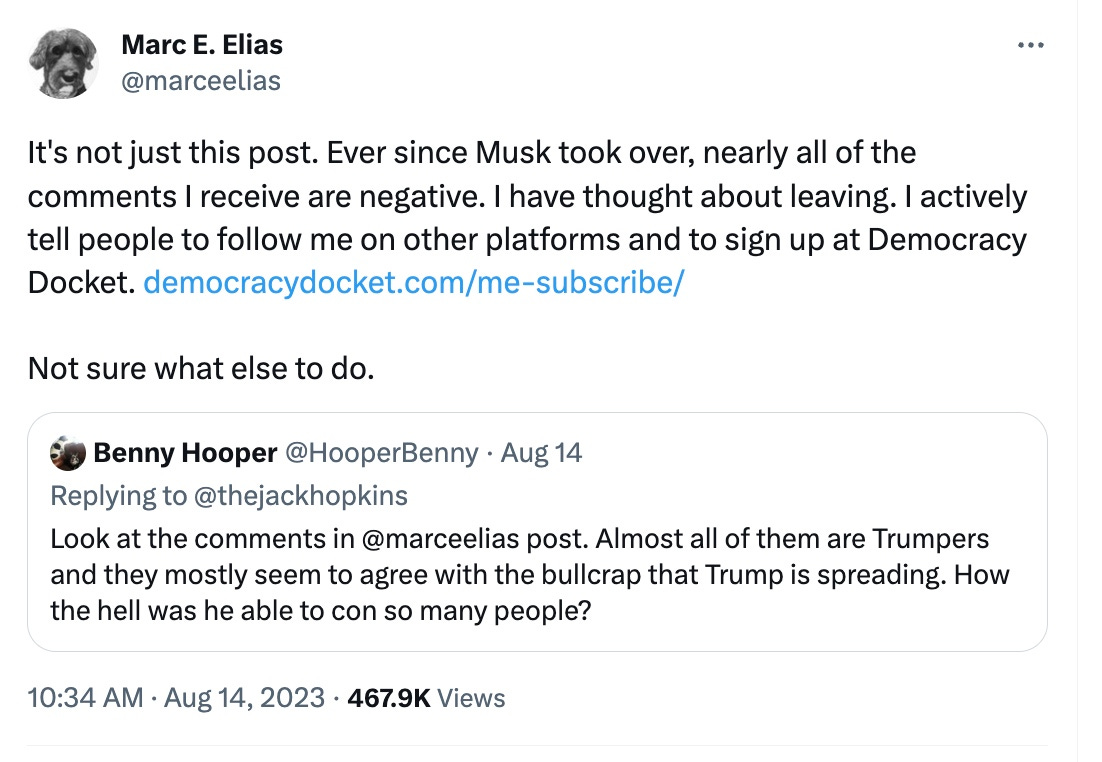
The Democratic Party’s go-to election lawyer, Marc Elias, is disturbed by the decline of Twitter:

Twitter used to work well, but now he receives negative comments, which means that it has stopped working. People can criticize him and express disagreement, so the platform is broken. If it worked, he would only be praised.

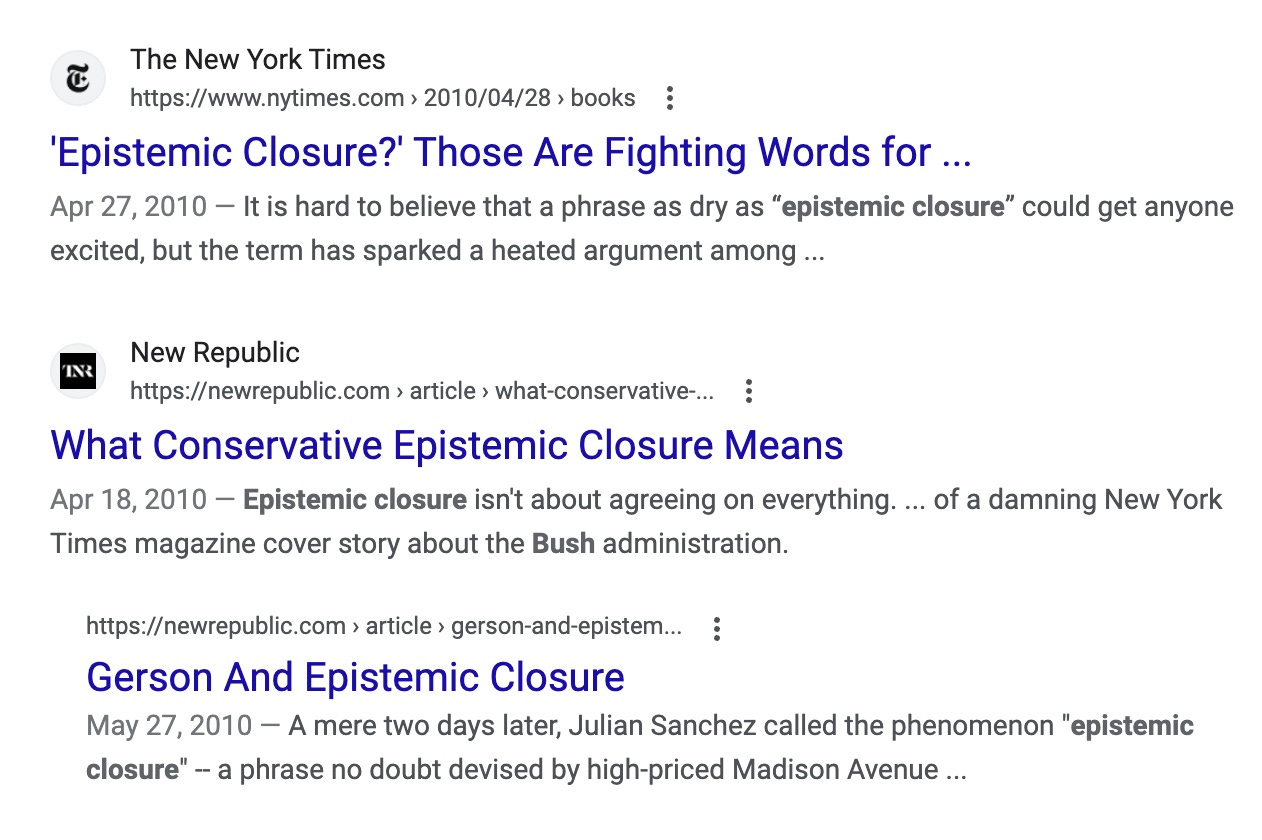
“Epistemic closure” had its pet rock moment in 2010, as the news media looked back on the George W. Bush years and the Iraq War and concluded that American neoconservatives had simply lost their ability to think.

[…]

It was supposed to mean this:

    It’s rather about information, and what counts as evidence about the real world … if one only gets information from a narrow set of sources that feed back into each other but do not engage beyond themselves, that one will have a closed mind … regardless of what one does with that information.

And this:

    Epistemic closure is a fancy term for the practice of defining – or redefining – reality in ways that support your pre-existing ideological preferences. Most of us think of it as “creating and living in a bubble”.

It was a fair enough point, as Bush watched sectarian brutality continue in post-Saddam Iraq and kept drawing the conclusion that everyone everywhere really yearns for democratic pluralism, honest elections, and a free press.

But that era’s epistemic closure is bush-league — sorry — compared to the sealed-in-a-jar-in-a-closed-box-in-a-deep-cave closure of the “mainstream” mind in 2023. If you’ve been on social media since roughly the night of November 8, 2016 and you’ve expressed disagreement with a politician, academic, or media figure, you’ve been a Russian bot, and Putin told you to say that. Criticism of institutions can’t simply arise from authentic grievances, or even from an authentically felt but misperceived grievance; rather, criticism is an op, a calculated string-pulling effort by manipulative forces. The far-right Putin-aligned Nazi grifters are tricking you into believing that you’re unhappy with the Biden administration. Your brain has been fooled by cognitive warfare, see?

August 6, 2023

What’s in a (tech) name?

Filed under: Business, Media, Technology, USA — Tags: , , , , , — Nicholas @ 03:00

Ted Gioia isn’t a fan of all the recent rebrandings of social media platforms, and tries to explain “why web platforms keep changing their names like criminals in the Witness Protection Program”:

“Automotive Social Media Marketing” by socialautomotive is licensed under CC BY 2.0

When I first heard that Twitter was renaming itself as X, I thought it was a joke.

Not a funny joke, just a goofy one. Elon Musk has a taste for schoolboy humor — and on many occasions has posted something undignified for a laugh. I assumed X was another example of this.

Who could take that name seriously?

Just consider the significations of X:

  • The crossbones you put in front of a skull on a bottle of poison;
  • A mistake on a test, marked by the teacher in red;
  • How you sign your name if you can’t read or write;
  • Something you haven’t figured out in algebra;
  • A movie that’s dirty, raunchy, or offensive in some manner;
  • A mark on a map where stolen wealth has been buried by pirates or criminals;
  • The street name for an illegal drug (MDMA) with various adverse long-term effects — including depression, anxiety, and impairments of cognition, memory, and learning;
  • A symbol of betrayal (i.e., a double cross);
  • In marketing language, an inferior product, as in “Brand X”;
  • A radioactive ray so dangerous that it killed the people who invented and developed it.

Given these associations, nobody in their right mind would replace a familiar, proven brand name with X. Mr. Musk must be joking again. Or so I thought.

But I thought wrong.

If this were an isolated event, I would dismiss it as just one more quirk on the part of an eccentric CEO. But these horrible rebrands are now standard practice in Silicon Valley, especially among dominant Internet platforms.

Why did Google change its corporate name to Alphabet? Why did Facebook change its corporate name to Meta? These were two of the best known brand names in the history of capitalism. Why get rid of them?

And consider this bizarre coincidence. The very same month that Twitter became X, Instagram launched its own text posting option. But it refused to use the familiar Instagram name, instead calling this new feature Threads.

Threads is another word that has all sorts of negative connotations. It refers to something old and torn. It’s associated with poverty and an embarrassing appearance.

What gives?

Do you remember the carefree early days of the web? Brand names were innocent and playful — they sounded like something from a nursery rhyme: Yahoo, Google, Tumblr. Twitter was one of those cutesy names.

Its symbol was a chirping bird. So sweet. So innocent.

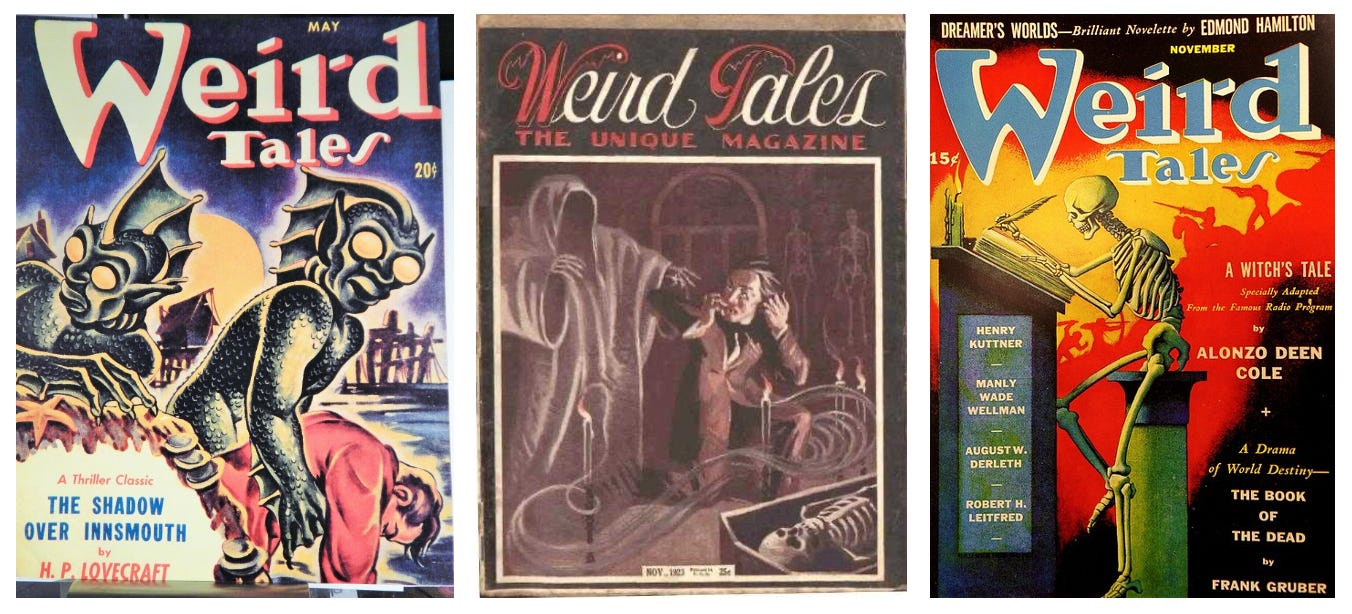
But nowadays, web platforms take on names straight out of an H.P. Lovecraft horror story — Threads, X, Ghost, Twitch, Discord, etc.

Today’s writing prompt: Use all of those words in the opening lines of a story. Then send it off to an editor at Weird Tales.

Current day techno bro vibe

April 14, 2023

Twists and turns in the “Twitter Files” narrative

Filed under: Business, Government, Media, Politics, Technology, USA — Tags: , , , , — Nicholas @ 03:00

Matt Taibbi recounts how he got involved in the “Twitter Files” in the first place through the hysterical and hypocritical responses of so many mainstream media outlets up to the most recent twist as Twitter owner Elon Musk burns off so much of the credit he got for exposing the information in the first place:

I was amazed at this story’s coverage. From the Guardian last November: “Elon Musk’s Twitter is fast proving that free speech at all costs is a dangerous fantasy.” From the Washington Post: “Musk’s ‘free speech’ agenda dismantles safety work at Twitter, insiders say.” The Post story was about the “troubling” decision to re-instate the Babylon Bee, and numerous stories like it implied the world would end if this “‘free speech’ agenda” was imposed.

I didn’t have to know any of the particulars of the intramural Twitter dispute to think anyone who wanted to censor the Babylon Bee was crazy. To paraphrase Kurt Vonnegut, going to war against a satire site was like dressing up in a suit of armor to attack a hot fudge sundae. This was an obvious moral panic and the very real consternation at papers like the Washington Post and sites like Slate over these issues seemed to offer the new owners of Twitter a huge opening. With critics this obnoxious, even a step in the direction of free speech values would likely win back audiences that saw the platform as a humorless garrison of authoritarian attitudes.

This was the context under which I met Musk and the circle of adjutants who would become the go-betweens delivering the material that came to be known as the Twitter Files. I would have accepted such an invitation from Hannibal Lecter, but I actually liked Musk. His distaste for the blue-check thought police who’d spent more than a half-year working themselves into hysterics at the thought of him buying Twitter — which had become the private playground of entitled mainstream journalists — appeared rooted in more than just personal animus. He talked about wanting to restore transparency, but also seemed to think his purchase was funny, which I also did (spending $44 billion with a laugh as even a partial motive was hard not to admire).

Moreover the decision to release the company’s dirty laundry for the world to see was a potentially historic act. To this day I think he did something incredibly important by opening up these communications for the public.

Taibbi and the other Twitter File journalists were, of course, damned by the majority of the establishment media outlets and accused of every variant of mopery, dopery, and gross malfeasance by the blue check myrmidons. Some of that must have been anticipated, but a lot of it seems to have surprised even Taibbi and company for its blatant hypocrisy and incandescent rage.

But all was not well between the Twitter Files team and the new owner of Twitter:

We were never on the same side as Musk exactly, but there was a clear confluence of interests rooted in the fact that the same institutional villains who wanted to suppress the info in the Files also wanted to bankrupt Musk. That’s what makes the developments of the last week so disappointing. There was a natural opening to push back on the worst actors with significant public support if Musk could hold it together and at least look like he was delivering on the implied promise to return Twitter to its “free speech wing of the free speech party” roots. Instead, he stepped into another optics Punji Trap, censoring the same Twitter Files reports that initially made him a transparency folk hero.

Even more bizarre, the triggering incident revolved around Substack, a relatively small company that’s nonetheless one of the few oases of independent media and free speech left in America. In my wildest imagination I couldn’t have scripted these developments, especially my own very involuntary role.

I first found out there was a problem between Twitter and Substack early last Friday, in the morning hours just after imploding under Mehdi Hasan’s Andrey Vyshinsky Jr. act on MSNBC. As that joyous experience included scenes of me refusing on camera to perform on-demand ritual criticism of Elon Musk, I first thought I was being pranked by news of Substack URLs being suppressed by him. “No way,” I thought, but other Substack writers insisted it was true: their articles were indeed being labeled, and likes and retweets of Substack pages were being prohibited.

March 14, 2023

QotD: Facebook’s entire structure is designed to prevent information “going viral”

Filed under: Business, Media, Quotations, USA — Tags: , , , — Nicholas @ 01:00

Imagine that you came up with something amazing to share with people. Let’s pretend that you created the most amusing video in the world. Or came up with the funniest joke anyone has ever heard. Or maybe you have just experienced something remarkable that millions of people would want to know about. Or let’s assume you took a photograph that would blow people’s minds. Or perhaps you have just composed the catchiest tune ever.

You might think that social media is where to go to share this very cool thing, and watch it go viral. And, in fact, that happens on Twitter and a few other platforms. I’m not always right in forecasting which things I post will go viral, but a few times every year I will share something on Twitter that grabs people’s attention so much that it gets tens of thousands of retweets and likes. Millions of people might see it.

That’s what going viral is all about.

Now here’s the kicker. I put up that same item on my Facebook author’s page, and the company will actively work to prevent people from seeing it. And adding insult (a company specialty), they will send me an alert telling me: This post could go viral if you pay us money for promoting it.

At first glance, this just seems another way to maximize profits. And who can blame Mark Zuckerberg for wanting to get a few more dollars in his bank account? Let’s feel some pity for a guy who just lost $100 billion.

But the real devastating part of this story is that Facebook is actually preventing users from sharing the funniest joke in the world. Facebook actually hates seeing some videos go viral, even if they are the most amusing things on the web. Every day they work to prevent folks from seeing a mind-blowing photo — and many other things that can’t be monetized.

This can’t be good for the user experience. This can’t be what users want, or what they would tell the company in a focus group or via market research.

And it certainly can’t be good for business.

So I’m amused when I hear how Facebook is envious of TikTok, which has much superior user engagement. Well, duh. Of course TikTok has greater engagement — that’s because Facebook has put systems in place to prevent entertaining things from going viral. They are now scrambling to work around this tiny detail, but they won’t succeed.

I’ve reduced my Facebook posts by at least 70%, and this was the main reason. I can’t be the only person who has responded in this way.

It’s not in the company’s DNA to promote interesting things on its platform. That’s why I wasn’t surprised when Facebook’s recent attempt to imitate Substack collapsed in total failure. I knew that would happen on day one — because Facebook will never let writers go viral on the platform. Mr. Z. wants to get paid before anything goes viral, and that’s the exact opposite of Substack’s successful formula — which rewards the creator more than the platform.

When Facebook initially launched this touted publishing platform, somebody asked me what I thought about it. “Facebook has the power to give a writer access to millions of readers,” I replied, “but they will never let it happen. The entire internal structure of the company is designed to prevent this.”

The speed of the collapse, however, was surprising. Facebook announced the launch of Bulletin on June 29, 2021. Facebook announced the termination of Bulletin on October 4, 2022.

Even King Henry VIII’s wives lasted longer than that.

Ted Gioia, “How Web Platforms Collapse”, The Honest Broker, 2022-12-05.

March 13, 2023

When did the “elites” of the West become so bumbling and incompetent?

Filed under: Government, Media, Politics, USA — Tags: , , , , — Nicholas @ 03:00

Chris Bray on the blatant decay of western political leadership on display at the #Twitterfiles hearing in Washington D.C.:

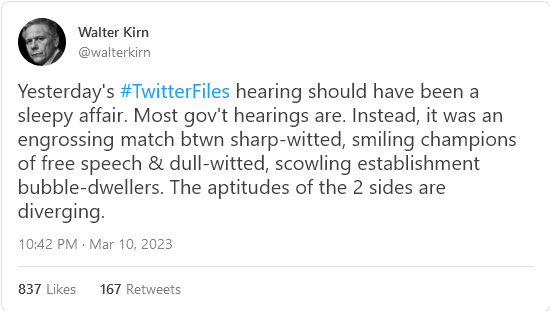
I should probably just go back to sleep for a decade, because Walter Kirn always has it covered:

I was trying to be clever about this yesterday, but it should be said plainly for the space aliens who eventually find the ruins of our former civilization and have to use the surviving digital evidence to report to their superiors on the collapse of the earth losers.

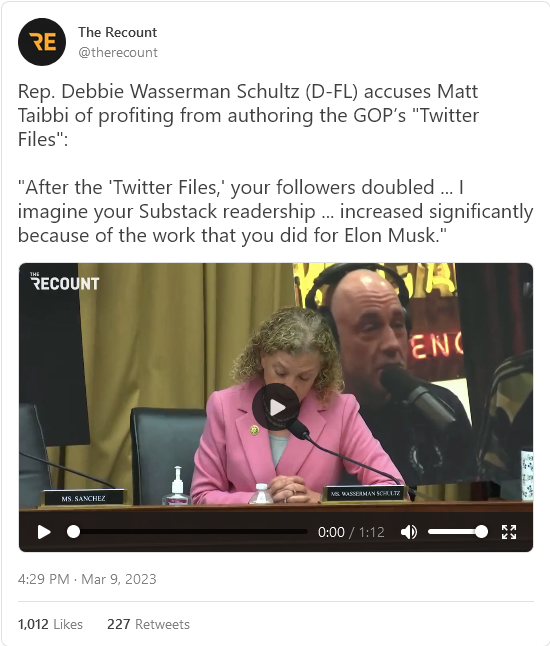
The most striking thing about the average member of the contemporary political class — the “elite”, and yes, I know — isn’t that they’re almost invariably wrong, or that they’re never interesting, or that they have no wisdom of any kind that ever shines through anything they do, ever. Instead, the most striking thing about the contemporary political class is that most of them can’t actually speak, in the sense that you ask them something and then they think and then words come out. Here, watch:

Even in the screenshot, her face is pointed downward at a piece of paper. She’s only ever reading. She’s looking at prepared questions and giving voice to a script, like a much dumber Anne Hathaway. And, yes, what the script says is idiotic — Matt Taibbi gets paid for his journalismz!!!!! (unlike members of Congress, who take a vow of poverty and work for free) — but the more interesting thing to me is that this person, in her fifty-trillionth term in Congress, can’t say what she thinks without reading it. Mr. Taibbi, it says on this piece of paper that you are a very bad person.

They don’t know anything. They don’t think anything. They have no ability, no insight, no value to offer. So they make our laws.

March 5, 2023

“Natural Woman” – classic hit song or hate crime in progress?

Filed under: Media, Politics, USA — Tags: , , , , , , — Nicholas @ 03:00

Janice Fiamengo on the hoax “cancellation” attempt on the late Aretha Franklin’s hit song:

For at least a few hours, it looked as if the 1960s soul classic “(You Make Me Feel Like a) Natural Woman“, memorably performed by Aretha Franklin, was imperiled by woke attack. Various conservative and right-wing media reported in late January that a trans awareness group was demanding via Twitter that the song be canceled because of its exclusionary emphasis on “natural” womanhood. It was dutifully noted that this was the latest salvo in the trans “assault on women”, and a women’s activist was reported as saying, “I don’t think many women really know how much we’re hated”.

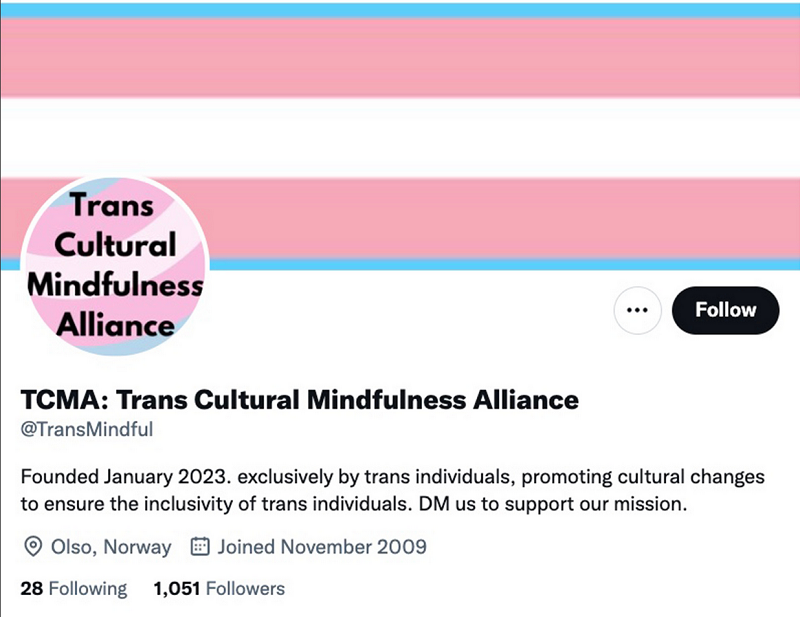
It turned out that the complaint about “Natural Woman”, which received well over one million views and provoked thousands of responses, had been made by a parody account. Aretha Franklin was safe — at least for now. But commentary on the song has a surprising history, as we’ll see, that complicates the standard claims about the trans erasure of women.

The Twitter account at the center of the faux controversy was TCMA, the Trans Cultural Mindfulness Alliance, which began tweeting in January of 2023 to highlight the lunatic fringe of trans advocacy. Many of the tweets by TCMA exaggerate actual trans activist positions so adroitly that even on a second or third reading, they seem plausible. On January 20, for example, TCMA tweeted that “Many children learn gender from their pets”, and advised parents that “Just because you bring home a ‘gendered’ pet, allow your child to choose the gender of the pet — don’t assign it one ‘at will’.”

A day later, TCMA tweeted that it would be petitioning the Norwegian government “to no longer include gender on birth certificates” and it condemned media, in another tweet, for emphasizing child abuse by same-sex couples while failing to cover the “wonton abuse” (steamed or deep fried?!) in the church.

The purpose of the account seems fairly clear: to show how dogmatic statements by activists are often hard to tell apart from parodies of the same. Something strange is going on when people in positions of cultural power not infrequently express themselves in a manner indistinguishable from parody.

March 3, 2023

Progressives have steadily transitioned to the movement that denies that any personal conduct rules should apply

Filed under: Law, Liberty, Media, Politics, USA — Tags: , , , , , — Nicholas @ 05:00

Freddie deBoer challenges his fellow leftists to identify who were the theorists that introduced the notion that personal responsibility is an anti-socialist position:

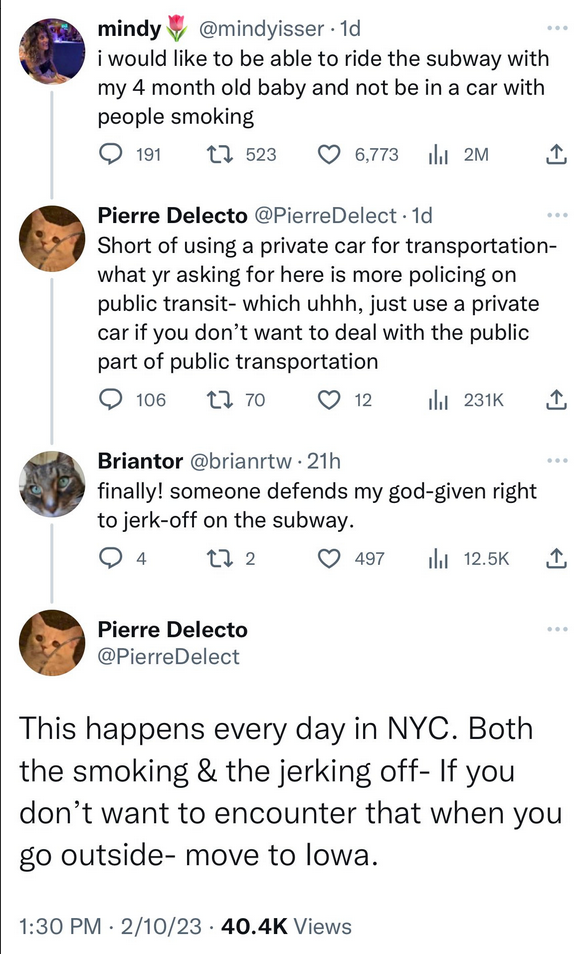
The woman whose account appears at the top of this picture started a Twitter storm, somehow, by publicly wishing that she could take her child onto the subway without exposing them to secondhand smoke. She was beset by a certain online species of ostensible leftist who is against ever trying to enforce any kind of rule, anywhere, ever. See, rules are the hand of oppression, or something, and since most of society’s rules are meant to be enforced by the police, trying to enforce them (merely wishing that they be enforced) is an endorsement of the police and their violence …

I find this attitude has become inescapable. It’s not just the attitude that the enforcement of societal rules and norms is bad, but that this is the default assumption of all right-thinking people — it’s not just a left-wing perspective but the left-wing perspective. Like so much else in contemporary left-of-center discourse, it demonstrates the total ideological poverty we’re working with. Nobody has read anything, so nobody knows anything, so you’re constantly getting yelled at by self-described radicals who have no solid footing in any systematic approach to left politics at all. Like I said before, we’re living in definitional collapse; the struggle right now is not merely that socialism can’t win but that so many self-described socialists have no deeper ideological moorings than whatever they’ve absorbed from Tumblr and “breadtube”. They think that to be a socialist means to disdain all rules because there is no substance to their socialism at all.

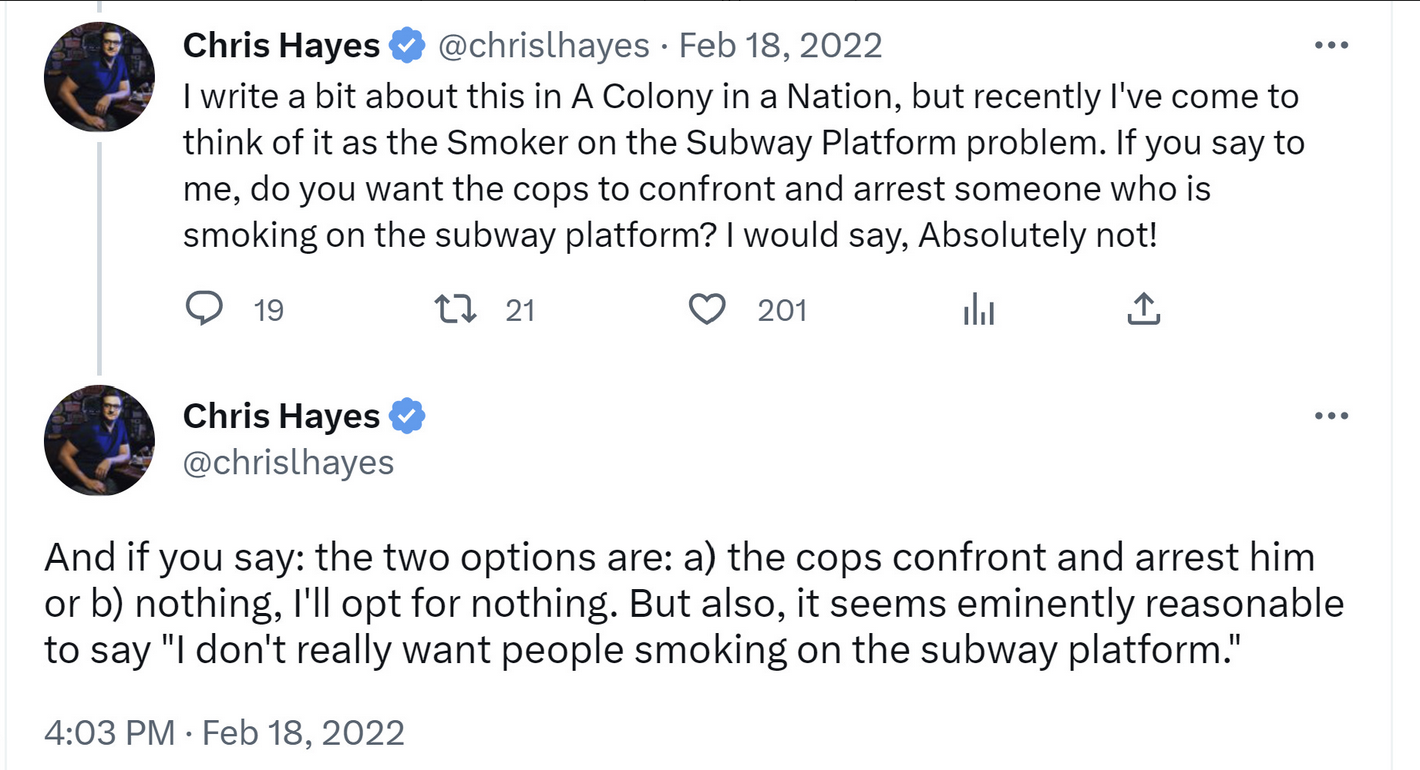
Chris Hayes considered the subway smoking problem last year.

Conceptually, I don’t think these problems are hard at all: the left, the socialist left, has never advocated for a system in which there are literally no expectations on personal behavior. It’s quite bizarre to suggest that this was ever a thing! Only certain extreme forms of anarchism have ever implied that society should have no rules. Go back through the history of socialist theorists and number all of the ones who believed that there should be no laws and no police to enforce them. You won’t find many! Instead you’ll find people who believed in the need for both laws that govern human behavior and constabulary forces to enforce those laws. That’s the solution to the conundrum, my friends — you have rules and you have police that enforce those rules. The belief, and the hope, is that a socialist society is one with far less need for aggressive policing, thanks to far greater economic equality, and maybe someday, after the end of material need, we can consider a policeless society. But not having any social rules or people who enforce those rules is not a socialist concept and never has been. What I would ask Chris Hayes and people like him is … what is the leftist tradition that you’re drawing from that implies that there should be no enforcement of behavioral norms? What thinker? What book? What philosophy? Or, could it be that you’ve developed this totally substance-free approach to basic order because you’ve been habituated to talking this way through exposure to people on social media who know nothing about anything in particular?

Of course, there’s big problems with American policing. Very big problems indeed. So what we do is reform policing. (I address this at length in my next book, coming this fall from Simon & Schuster.) Alternatively, if you’re really committed to this “no rules, no enforcement” thing, you become an anarchist of a very particular stripe — most versions of anarchism have both rules and enforcement mechanisms for them — and you and your compatriots can try to change the system. All twelve of you. In the house your wealthy parents bought for you.

February 16, 2023

A modern irregular verb: I mis-spoke. You spread misinformation. He has been banned from social media

I derive my headline from the original words of Bernard Woolley: “That’s one of those irregular verbs, isn’t it? I give confidential security briefings. You leak. He has been charged under section 2a of the Official Secrets Act.” It was a joke in Yes, Minister, but as Jon Miltimore shows, it’s a model for how the powers-that-be want to treat how information is shared on social media:

As Reuters reported in a recent fact-check, Mr. Gore was guilty of misrepresenting scientific data — or “spreading ‘misinformation'”.

In 2009, many responded playfully to Gore’s faux pas.

“Like most politicians, practicing and reformed, Al Gore has been known to stretch the truth on occasion”, NPR noted, adding that Gore had also claimed he’d helped create the internet.

Today, misinformation is treated in a much different way — at least in some instances. Throughout the COVID-19 pandemic, many writers and scientists who questioned the government’s use of lockdowns, mask mandates, enforced social distancing, and vaccine mandates were banned from social media platforms while others lost their jobs.

San Francisco attorney Michael Senger was permanently banned from Twitter after calling the government’s pandemic response “a giant fraud”. Prior to him, it was former New York Times reporter Alex Berenson who got the boot after questioning the efficacy of vaccines in preventing COVID-19 transmission. Months earlier it was author Naomi Wolf, a political advisor to the presidential campaigns of Bill Clinton and Al Gore.

All of these accounts were reinstated after Elon Musk purchased the company. Twitter is hardly alone, however. Facebook and YouTube also announced policies banning the spread of COVID misinformation, particularly information related to vaccines, which is what got Drs. Peter McCullough and Robert Malone ostracized and banned.

Some may argue these policies are vital, since they protect readers from false information. However, there is nothing that says Big Tech can only ban information that is false. On the contrary, in court proceedings Twitter has claimed it has “the right to ban any user any time for any reason” and can discriminate “on the basis of religion, or gender, or sexual preference, or physical disability, or mental disability”.

Facebook, meanwhile, has argued in court that the army of fact-checkers they employ to protect readers from false information are merely sharing “opinions”, and are therefore exempt from defamation claims.

[…]

What Big Tech is doing is concerning, but the fact that this censorship is taking place in coordination with the federal government makes it doubly so.

In July, in arguably the most anti-free speech pronouncement made at the White House in modern history, White House press secretary Jen Psaki noted the White House is “flagging problematic posts for Facebook”.

“We are in regular touch with these social media platforms, and those engagements typically happen through members of our senior staff, but also members of our COVID-19 team”, Psaki explained. (Today we know that these companies are staffed with dozens of former CIA and FBI officials.)

All of this is being done in the name of science, but let’s be clear: there’s nothing scientific about censorship.

January 8, 2023

Conservatives “vote harder”, progressives take advantage of “procedural outcome manipulations”

Theophilus Chilton on a key difference between progressives and conservatives in how they address perceived problems with “the system”:

“Polling Place Vote Here” by Scott Beale is licensed under CC BY-NC-ND 2.0 .

Over the past decade or so, many folks on the broad Right have noticed that practically all of our institutions don’t really work as they should. The natural tendency on the part of normie conservatives is to chalk this up to incompetence and corruption. Granted, those do come into play – and will continue to do so increasingly. Yet structurally speaking, our institutional dysfunctionality runs a lot deeper than a little graft or some skimming off the top. Our institutional failures are both purposeful and towards a specific end.

Normies can perhaps be forgiven for not immediately coming to this conclusion. After all, as the name suggests, they’re the norm. They’re the mainstream. They’re not out on the “fringe” somewhere, for better or for worse. These are conservatives who have been conditioned by decades of playing by the rules to trust the rules and the processes under which government and institutions operate (even if they think they “distrust government” or whatever). They’re the ones who believe we have to keep voting harder because voting is the only “proper” way to act in our system. And yet, many times they end up being mystified that not only do the institutions and procedures not “work right” but that nobody in power (even their own so-called representatives) seems the least bit bothered by this.

Yet, purposeful it truly is. There is a concept about our institutions that I wish every conservative understood, which is that of “manipulating procedure outcomes”. Basically, what this refers to is the process by which bad actors will take an established procedure — a rule or statute, an institution inside or outside of government, a social or political norm — and subvert it to their own use while still “technically” adhering to procedure. However, the process of doing so completely warps the results from those which “should” happen had the procedure been played straight. This intentionality explains why our institutional failures always seem to tend in one direction — Cthulhu always seems to swim left, so to speak. The American Left are masters at manipulating procedural outcomes, while the American Right rigidly tries to adhere to “the way things oughta be” and end up getting outmanoeuvered every time.

Allow me to give some examples of this; seeing them will start to train the eye towards recognising other instances of this process.

Let’s take, for example, the recent revelations of government censorship of dissident ideas and individuals that we saw in the Twitter files. Now, we all know that the government can’t censor speech and ideas because of the First Amendment. So this means that they’d never do so … right? (LOL) Well, as the Twitter files revealed — and which absolutely assuredly applies to every other major tech company in the field — FedGov and the alphabet agencies simply use companies like Twitter as a way to work around the 1A. They can’t censor directly, but they can rely upon a combination of selective pressure on tech companies and ideologically friendly personnel within these companies to censor and gather information about right-leaning, and especially dissident Right, users all the same. And technically, none of this is illegal, because muh private company and all that. So a functional illegality nevertheless remains within the boundaries of “procedure”.

The same type of manipulation is underway with regards to the Second Amendment, too. Again, the plain wording of the 2A, as well as a long train of prior judicial interpretive precedence, militates against federal and state governments really being able to restrict the gun rights of Americans (not that they don’t try anywise). They can’t make it illegal to buy or own guns. Schemes like prohibitively taxing ammo won’t pass muster either. So if you’re a left-wing fruitcake who hates the Constitution and badly wants to disarm your fellow Americans for further nefarious purposes, what do you do?

Well, you make it too legally dangerous for gun owners to actually use their guns for anything beyond target shooting. You install a bunch of Soros-funded prosecutors in all the jurisdictions that you can so that you can go light on criminals but throw the book at gun owners who defend themselves from criminals. You creatively interpret laws to mean that harming someone while defending yourself is a crime or, barring that, open up self-defenders to civil attack from the criminal’s family. From a self-defence perspective you set up an anarchotyrannical regimen that can be used against ideological enemies. This is basically the same thing the Bolsheviks did when they were consolidating their power as “Russia” transitioned to “the Soviet Union”, as recorded by Solzhenitsin in The Gulag Archipelago. They used administrative courts and ideological judges to punish people who legitimately defended themselves against criminals. If you injured someone who was attacking or robbing you, you went to the gulag. Of course, as we’re also seeing today, these criminals were functionally agents of the Regime by that point.

December 31, 2022

The Twitter Files – “Let’s at least try to stop lying for a while, see what happens. How bad can it be?”

Filed under: Government, Media, Politics, Technology, USA — Tags: , , , , — Nicholas @ 05:00

Matt Taibbi on the continuing revelations about Twitter’s deep entanglements with agencies of the US (and probably many other) government:

In the coming days you’ll find a new thread on Twitter, along with a two-part article here at TK explaining the latest #TwitterFiles findings. Even as someone in the middle of it, naturally jazzed by everything I’m reading, I feel the necessity of explaining why it’s important to keep hammering at this.

Any lawyer who’s ever sifted though a large discovery file will report the task is like archaeology. You dig a little, find a bit of a claw, dust some more and find a tooth, then hours later it’s the outline of a pelvis bone, and so on. After a while you think you’re looking at something that was alive once, but what?

Who knows? At the moment, all we can do is show a few pieces of what we think might be a larger story. I believe the broader picture will eventually describe a company that was directly or indirectly blamed for allowing Donald Trump to get elected, and whose subjugation and takeover by a furious combination of politicians, enforcement officials, and media then became a priority as soon as Trump took office.

These next few pieces are the result of looking at two discrete data sets, one ranging from mid-2017 to early 2018, and the other spanning from roughly March 2020 through the present. In the first piece focused on that late 2017 period, you see how Washington politicians learned that Twitter could be trained quickly to cooperate and cede control over its moderation process through a combination of threatened legislation and bad press.

In the second, you see how the cycle of threats and bad media that first emerged in 2017 became institutionalized, to the point where a long list of government enforcement agencies essentially got to operate Twitter as an involuntary contractor, heading into the 2020 election. Requests for moderation were funneled mainly through the FBI, the self-described “belly button” of the federal government (not a joke, an agent really calls it that).

The company leadership knew as far back as 2017 that giving in to even one request to suspend this or that set of accused “hostile foreign accounts” would lead to an endless cycle of such demands. “Will work to contain that”, offered one comms official, without much enthusiasm, after the company caved for the first time that year. By 2020, Twitter was living the hell its leaders created for themselves.

What does it all mean? I haven’t really had time to think it over. Surely, though, it means something. I’ve been amused by the accusation that these stories are “cherry-picked”. As opposed to what, the perfectly representative sample of the human experience you normally read in news? Former baseball analytics whiz Nate Silver chimed in on this front:

December 28, 2022

The Twitter Files – “How does anyone run a business under these conditions?”

Chris Bray on the sheer magnitude of government(s) meddling in Twitter’s business (even though, yes, Twitter’s management was totally on-board politically with most or all of this meddling):

[…] Twitter has been constantly flooded with requests from at least dozens of separate federal entities, all of them needy and pushy and consuming the company’s time and energy: CENTCOM wants a meeting this week and CDC wants a meeting this week and NIH wants a meeting this week and the FBI wants a meeting this week and the White House wants a meeting this week and DHS wants a meeting this week and DOD wants a meeting this week even though CENTCOM already has one, and several members of Congress have some concerns they want the senior team to address this week, and …

Now: Twitter is a global platform. I would bet a kidney that there’s a Twitter Files equivalent for the Ottawa Police Department during the Freedom Convoy, and an RCMP file, and a Trudeau government file, and that Chrystia Freeland had some thoughts to share about some tweets she didn’t like. I would bet the other kidney that Twitter has equivalent files, in dozens of languages, from multiple government agencies in Iran and New Zealand and Australia and the Netherlands and the UK and Brazil and on and on an on.

As for my third kidney — just go with it, and we’ll clean up the biological metaphors later — state and local governments also expect Twitter to act on their content concerns and complaints about disinformation, which means fifty governors and attorneys general and state directors of public health and state police commanders picking up the phone, and 3,243 sheriffs and district attorneys and public health directors expecting to be able to reach out to their partners at Twitter, and close to 20,000 mayors and police chiefs, and thousands of state legislators and tens of thousands of city councilmembers, and on and on and on. “You tell this Jack Dorsey that I’m the damn mayor pro tem here in Glendale, and I want my concerns to be dealt with.”

And so, if we accept the premise that governments have special rights to demand content moderation, if the staff director of a legislative committee in the Arkansas state legislature and a sheriff in Maryland and the flag officers at all the MACOMS and Jen Psaki’s deputy assistant and a member of a county board of supervisors in Oregon and the chief of staff to the governor of Rhode Island, being Very Important People, all expect to by God get a direct meeting with Twitter executives because @buttchug623 is saying some things that they do not like at all, and oh by the way the prime minister of the Democratic Republic of the Congo is holding on line 6 and he’s pissed and when can you pencil in a half-hour with Turkmenistan’s finance minister, then how much does it cost to manage all of those relationships?

The regulatory affairs staffing buries the business — you can’t pay for that much face time with that many self-important officials. We need to schedule the senior management team for a meeting with the White House this week, ’cause they don’t like Alex Berenson. How does anyone run a business under these conditions? “Before you cook that cheeseburger for order number seven, the deputy assistant secretary for sustainable agriculture would like to share some thoughts on the environmental trajectory of industrial protein cultivation. And about that milkshake …”

In addition to the free speech problem and the pathologies of gleichschaltung, the Twitter files are about the way government without boundaries consumes resources from every entity it touches.

Twitter’s path to bankruptcy runs through the premise that every government official who doesn’t like a tweet deserves a meeting.

« Newer PostsOlder Posts »

Powered by WordPress