Quotulatiousness

December 19, 2022

“Both sides have their crazy folks … But usually, they’re on the semi-fringe”

Filed under: Media, Politics, USA — Tags: , , , — Nicholas @ 03:00

Tom Knighton on the increasing difficulty of taking some people seriously:

There are some people who are completely unhinged. We all know this and have seen it ourselves throughout our lives. This is especially true if you spend much time in the political space.

Both sides have their crazy folks. They exist in the realm of conspiracy theories, rationalizations, and fearmongering with absolutely no basis in reality.

But usually, they’re on the semi-fringe.

Or, at least, they used to be.

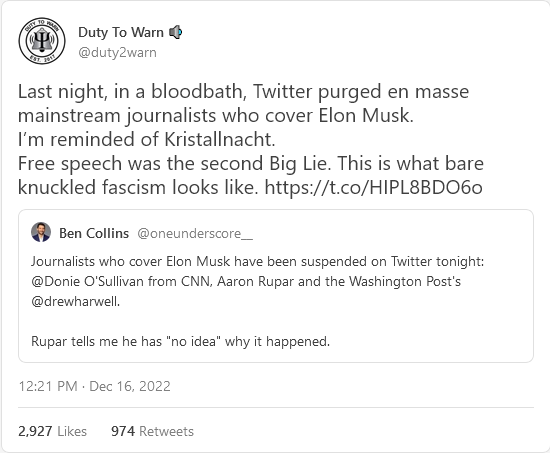
However, I came across this tweet from an account with over 400,000 followers and reportedly run by a group of mental health professionals, and if this isn’t the height of unhinged, I don’t know what is.

Now look, I know that the official reason these journalists were suspended was because of doxxing, but I don’t know just how valid that is. I didn’t see their tweets so I can’t say.

I do know that they caught a seven-day suspension, so they’ll all be back.

But for these jackwagons to claim it reminds them of Kristallnacht

At least 91 Jews were murdered during Kristallnacht. Some experts say the actual death toll should be higher due to post-arrest maltreatment with at least one saying over 630 people died as a result of Kristallnacht.

I looked to see if this was a parody account, but it doesn’t look like it, which means these dipsticks are serious.

And that’s terrifying.

See, if they’re mental health professionals, then it means at least some in our mental health system are crazier than most trying to get help in the first place. This is beyond deranged.

And yet, it’s unlikely that those more than 400,000 followers are hate followers. They’re people who actually like what these people say and take it seriously. That’s downright terrifying.

December 16, 2022

“To hear Musk tell it, his motivation is obvious: It’s about saving the world”

Filed under: Business, Media, Politics, USA — Tags: , , , , — Nicholas @ 05:00

Bari Weiss at The Free Press (formerly known as Common Sense) on what went on in preparing to reveal the “Twitter files” and what Elon Musk is hoping to accomplish with Twitter:

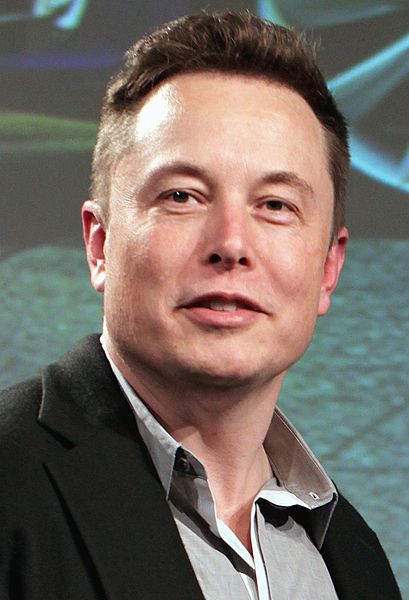
Elon Musk at the 2015 Tesla Motors annual meeting.
Photo by Steve Jurvetson via Wikimedia Commons.

“I’m not going to spend $44 billion to reinstate a satire blog”, Musk said about the Babylon Bee, which had been banned from Twitter in March 2022. “I did it because I was worried about the future of civilization”, he told us late one night. 

As far as Musk sees things, “birth rates are plummeting, the thought police are gaining power, and even having an opinion is enough to be shunned. We are trending in a bad direction.”

He says he wants to transform Twitter from a social media platform distrusted and despised by at least half the country into one widely trusted by most Americans. To have it fulfill its highest mission: that of a digital town square where all ideas can be heard, and the best will win out. 

“If there is one information source that breaks ranks, then I think it ultimately forces others not to have the same narrative”, he said. “If even one organization competes hard for the truth, others will have to follow.” 

To win back that trust, Musk figured it would require being honest about what had, until very recently, been going on at the company he had just bought: the suppression of disfavored users; the curtailing of certain political views; the censorship of stories like the Hunter Biden laptop; and the extent to which the government had tried to influence such decisions.

“We have a goal here, which is to clear the decks of any prior wrongdoing and move forward with a clean slate”, Musk said in one of many conversations that took place over the course of a week. “I’m sleeping at Twitter HQ for a reason. This is a code-red situation.” (He put it even more forcefully on Twitter, where he said that the company was a “crime scene”.) And so he has been sleeping there on-and-off, claiming a sofa. His 2-year-old son, named X, was almost always nearby. 

Musk, who is a South African native, analogized the work of cleaning-house at Twitter several times to a kind of Truth and Reconciliation Commission. But what looks to some like truth and reconciliation can look to others like revenge.

At one point after midnight, as Musk showed off a closet of swag, including t-shirts left by the previous crew that said “Stay Woke”, he joked: “The barbarians have crashed through the gates and are pillaging the merch!”

Remember: After Musk made his offer to buy Twitter in April, he tried to get out of it in July, arguing that the company had not been honest about the percentage of fake users and bots on the site. But the company sued to force the deal, and he went ahead with it. 

Musk estimates that he paid at least twice what it was worth but that he had to “chew down this hairball” — which is to say, he had to buy Twitter. 

The price tag isn’t his only grievance. There’s also the fact that the company, to hear him tell it, wasn’t really a functioning company at all.

When Musk took over, he said, he found Twitter in disarray. Employees had unlimited vacation time and permanent work from home. The company had stopped doing performance reviews altogether, according to a long-time Twitter employee. “As long as Twitter could just keep its head above water and be roughly cash-flow break-even, then that’s all that they cared about”, Musk said. 

Musk calls the Twitter he purchased a “non-profit”. Twitter, as it existed, wasn’t pursuing net earnings but “social influence”, he said. “This was fundamentally an activist organization”. 

Since he took the helm at Twitter, he has fired 80 percent of the staff. He has insisted that those not prepared to be “extremely hardcore” and work “long hours at high intensity” show themselves out. Several engineers I spoke to had been working 18-hour days for the past month. They looked like it.

“It’s like if an aircraft was going in one direction and then suddenly pulled a U-turn and hit the afterburners in the other direction. That’s what happened to Twitter”, Musk said, making a vroom noise and laughing. 

December 10, 2022

“Notes from the administration of a private social media company: ‘Weekly sync with FBI/DHS/DNI'”

Filed under: Law, Media, Politics, USA — Tags: , , , , , — Nicholas @ 05:00

Chris Bray on the tendency of people in a group to “go along to get along” with the group consensus:

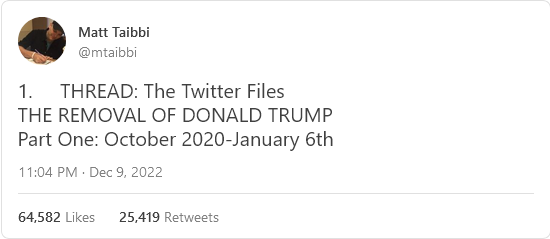
Elon Musk has gone from letting us in on some very interesting things to holy shit somebody just dropped a bomb, with a little help from Matt Taibbi:

Especially:

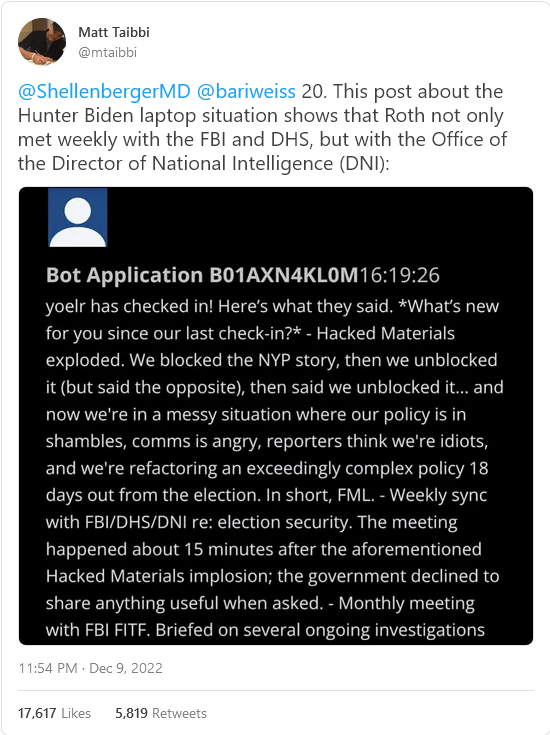
Notes from the administration of a private social media company: “Weekly sync with FBI/DHS/DNI“. Re: election security, they say, in a discussion about killing a story that harmed one political party and helped the other political party.

This isn’t left and right, anymore — if you regard yourself as a liberal, a progressive, a Democrat, or any other related identity, surely you agree that the national security state shouldn’t be intervening in our political discourse, even though in this instance the person who was harmed was Donald Trump. Surely this is something we can all agree on, across lines of identity and party politics. Right?

“We blocked the NYP story”, of course, means that they blocked the story from the New York Post about Hunter Biden’s laptop, wide public awareness of which could have changed the outcome of the election. So the alphabet-soup agencies were shaping the public discourse around partisan politics during the run-up to an election, at least sometimes telling private social media companies what posts and accounts they wanted limited, silenced, and removed. And Twitter was glad to comply. (See Taibbi’s complete thread for more.) Federal agencies intervened in our politics, for what the available evidence strongly suggests to have been partisan ends.

I suspect the statement “could have changed the outcome of the election” is overstated. From everything I’ve read, the election results were “fortified” enough to survive any amount of unwelcome fact leaking through to the voters. I mean, really: who would want to live in a country where the unwashed voters might have a say in what went on with the government?

November 23, 2022

The potential mass-casualty event of Trump being re-instated on Twitter

Filed under: Media, Politics, USA — Tags: , , , — Nicholas @ 03:00

You can almost hear Tom Knighton‘s eyes rolling here:

I’m not the biggest fan of Donald Trump. Most of his policies — the things he enacted quietly as he went — were pretty decent, including criminal justice reform and reducing federal regulations.

He just couldn’t stop tweeting.

I joked more than once that I wish someone would lock his phone so he couldn’t get on the app. However, I never once thought he should be banned from the platform.

But he was.

Now, he’s back.

Sort of.

His account isn’t banned anymore, though as of this writing, he doesn’t appear to be using it.

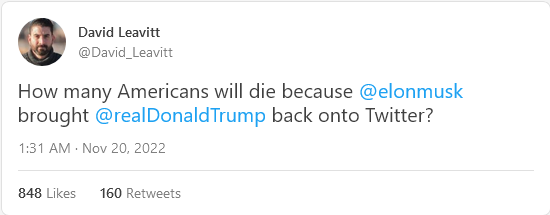
Yet this is, apparently, something just short of genocide if you listen to some journalists.

No, seriously.

I hoped this was a troll, but it’s not.

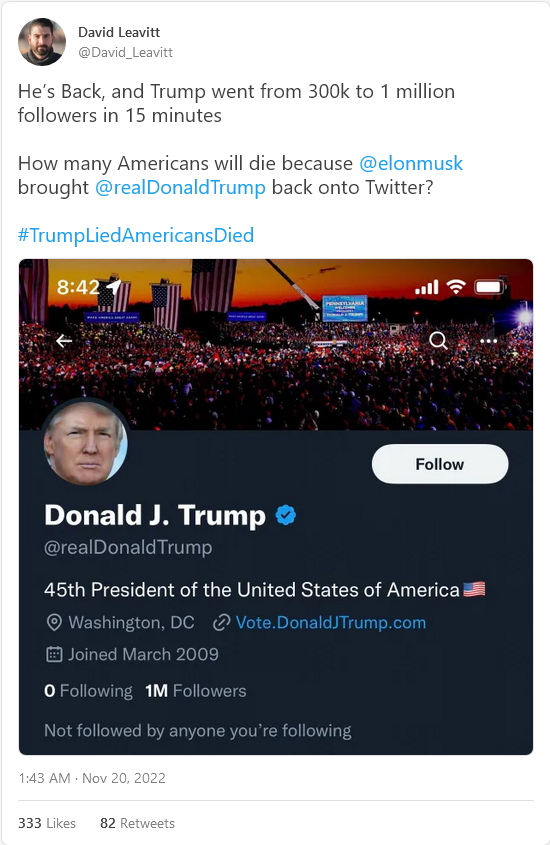
He apparently actually believes this is a thing, too, because it’s not the only time he claimed Trump being on Twitter will result in people’s deaths.

Again, there’s no word whether Trump will return to use the platform. As of this writing, his last tweet is from January 8th, 2021, so even if Trump’s tweets somehow could result in people’s death, it doesn’t seem like it matters since he’s not back on the platform.

But this unhinged individual has the old-school blue checkmark, the one given because an individual is “notable”.

Yet he also has his cover photo set to a screenshot of him being blocked by Trump. In other words, it looks like the boy is a might obsessed with the Orange One.

And this is the problem.

It’s not about Trump, but the media. This is a guy with mainstream media bylines aplenty. He’s got the old Twitter mark of approval, and he’s literally arguing that a former president having the ability to voice his thoughts on a social media platform will result in people’s deaths.

Does he think Elon Musk has weaponized tweeting and only given the launch codes to Trump?

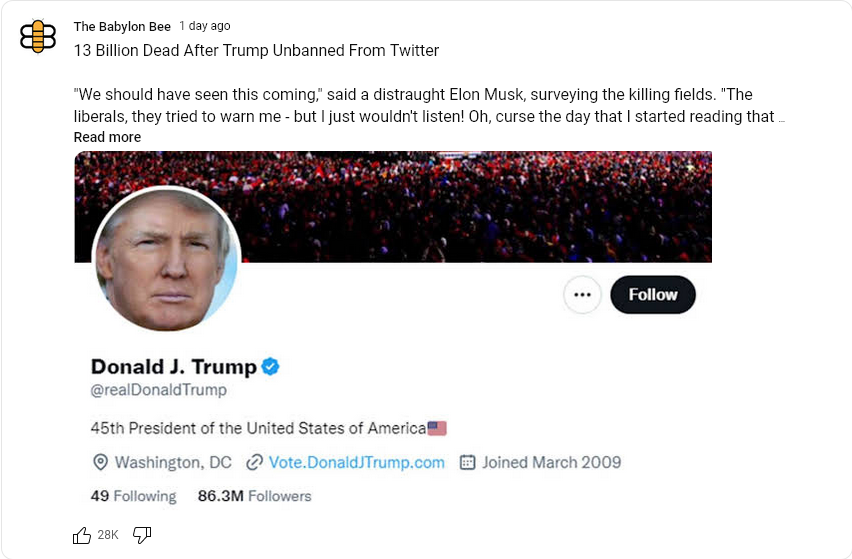
The Babylon Bee (or as Instapundit says, “America’s Newspaper of Record”) is already on this hot new calamity:

November 18, 2022

WOLLT IHR DEN TOTALEN TWEET?

Filed under: Germany, History, Humour, Media, Technology — Tags: , , , , , — Nicholas @ 05:00

When German public TV is willing to invoke literal Nazi imagery, you know the Twitter situation has gotten out of hand:

After Germany’s “first” public television network, ARD, compared Elon Musk reducing Twitter censorship to “letting rats out of their holes”, Germany’s “second” public television network, ZDF, has now compared Musk to Nazi Propaganda Minister Joseph Goebbels! (The network’s name Zweites Deutsches Fernsehen literally means “Second German Television”.)

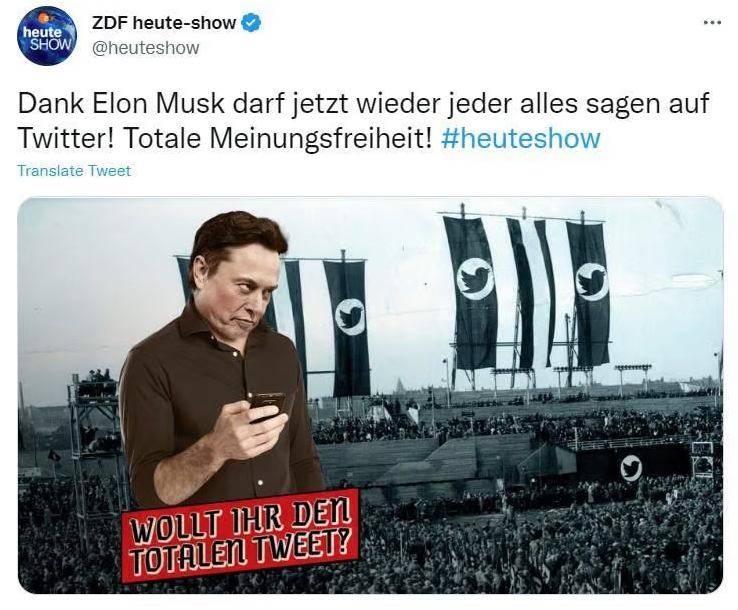
Thus, last Friday, ZDF’s would-be comedy program, the “Heute Show”, posted the below tweet and photoshop.

The Tweet reads: “Thanks to Elon Musk, you’re allowed to say anything again on Twitter! Total freedom of speech! #heuteshow.” The caption, whose color scheme and font invoke Nazi-era propaganda, reads “Do you want total tweet?” It is an allusion to Goebbels’s 1943 speech at the Berlin Sportspalast, in which the Nazi Minister of Propaganda famously shouted, “Do you want total war?” – in response to which audience members leapt to their feet shouting “Yes!” and raising their arms in the Hitler-salute.

The background image appears to show a Nazi Party rally with the swastikas replaced by the Twitter bird logo. Two smaller swastikas are still visible in the lower left-hand corner of the full-size image.

Leaving aside the extreme mental contortionism required to associate freedom of speech with Nazi Germany, if ever there was a don’t-throw-stones-in-glass-houses moment, this was it. For, as so happens, during the Second World War, the founding director of ZDF, Karl Holzamer, himself served in one of the propaganda units that none other than Goebbels’s Ministry of Propaganda embedded with the different divisions of the Germany military.

Holzamer served in a propaganda unit of the Luftwaffe or German air force. As noted in a 2012 article titled “Goebbels’s Soldiers” in the German daily Die Frankfurter Rundschau, Holzamer was embedded with the Luftwaffe during its April 1941 bombing of Belgrade and was “the first” to report on the German subjugation of the Yugoslav capital.

November 3, 2022

Twitter’s evolution from protecting celebrities to shaping “the narrative”

Filed under: Media, Politics, Technology, USA — Tags: , , , — Nicholas @ 03:00

At Common Sense, Walter Kirn recounts his own recognition of how Twitter has changed since he first opened an account in 2009 (incidentally, the same year I did … but unlike Walter, I still have about the same number of followers there as I did in my first year):

The platform belonged to celebrities back then, who hawked their movies, albums, and TV shows in words that were their own, supposedly, fostering in fans a dubious intimacy with figures they knew only from interviews. One of these stars, an investor in the platform, was Ashton Kutcher, the prankish, grinning actor who became omnipresent for a spell and then, stupendously enriched, largely vanished from public consciousness. It seemed that Twitter had sped-up fame such that it bloomed and died in record time.

The power of the new platform struck me first in 2012. Two incidents. The first one, a small one, occurred in Indianapolis, where I’d gone to watch the Super Bowl. I attended a party the night before the game at which many Hollywood folk were present, including an actor on a cable TV show who played a roguish businessman. The actor was extremely drunk, lurching about and hitting on young women, and it happened that my wife, back home, whom I’d texted about the scene, was able to read real-time tweets about his antics from other partygoers. A few hours afterward she noticed that these tweets had disappeared. Instant reality-editing. Impressive.

I concluded that Twitter was in the business not only of promoting reputations, but of protecting them. It offered special deals for special people. Until then, I’d thought of it as a neutral broker.

[…]

My own habits on Twitter changed around that time. Observational humor had been my mainstay mode, but I realized that Twitter had become an engine of serious opinions on current affairs. On election night in 2016, while working at another journal, Harper’s, I was given control of the magazine’s Twitter feed and asked to think out loud about events while following them on cable news. I saw early that Trump was on his way to victory — or at least he was doing much better than predicted — and I offered a series of tart remarks about the crestfallen manners of various pundits who couldn’t hide their mounting disappointment.

The official election results were still unknown — Clinton retained a chance to win, in theory — but before the tale was told, my editors yanked my credentials for the account and gave them to someone else. The new person swerved from the storyline I’d set (which reflected reality) and adopted a mocking tone about Trump’s chances, even posting a picture of a campaign hat sitting glumly on a folding chair at his headquarters in New York City.

It struck me at first as pure denial. Later I decided that it was far more intentional — that my left-leaning magazine wished to preserve the illusion for its readers that the election’s outcome was unforeseeable, possibly to maintain suspense or so it could later act startled and disturbed in concert with its TV peers. Its Twitter feed, as a record of its reactions, had to align with this narrative.

I grew convinced that night that Twitter meant trouble for me. It had become an opinion-sculpting instrument, an oracle of the establishment, and I knew I would end up out of step with it, if only because I’m of a temperament which habitually goes against the flow to challenge and test the flow, to keep it honest. Mass agreement, in my experience, both as a person and a journalist, is typically achieved at a cost to reality and truth.

October 28, 2022

The real tech startup lifecycle

Filed under: Business, Humour, Technology, USA — Tags: , , , , — Nicholas @ 03:00

Dave Burge (aka @Iowahawk on the Twits) beautifully encapsulates the lifecycle of most successful tech startups:

I like the thing where people assume everybody working at Twitter is a computer science PhD slinging 5000 lines of code daily with stacks of job offers for Silicon Valley headhunters, and not a small army of 27-year old cat lady hall monitors

Successful social media companies begin in a shed with 12 coders, and end up in a sumptuous glass tower with 1200 HR staffers, 2000 product managers, 5000 salespeople, 20 gourmet chefs, and 12 coders

True story, I was in SV a few weeks ago and visited a startup that’s gone from $4MM to $100+MM rev in 2 years. HQ currently cramped office with 30-40 coders in a strip mall, but moving to office tower soon. I’m like, man, you’ll eventually be missing this.

Why do successful tech companies have so many seemingly useless employees? For the same reason recording stars have entourages

Here’s the sociology: 5 coders form startup. Least embarrassing one becomes CEO. The other ones, CFO, COO, CMO, and best coder becomes CTO.

Company gets big; CFO, COO CMO hold a dick measuring contest to hire the biggest dept.

CTO still wants to be the only coder.

I suspect it really does takes 1000 or more developers to keep Twitter running; backend, DB, security, adtech/martech etc. But I’d guess a significant # of Twitter devs are basically translating what triggers the cat ladies into AI algorithms.

October 16, 2022

“Musk’s plebeian sense of humor is probably a big part of why the establishment can’t stand him”

Filed under: Business, Media, Politics, USA — Tags: , , , , — Nicholas @ 05:00

Patrick Carroll speculates on why Elon Musk is so disliked by the other rich and powerful folks in his 0.01% demographic:

This isn’t the first time Musk has brought his playful, irreverent, meme-culture spirit to the market. A few years ago he launched his car into space because he thought it would be amusing, and some of his companies now accept Dogecoin as payment.

Musk in general seems rather fun, relatable, and laid back. He doesn’t take himself too seriously, and that’s probably a big part of why people like him.

Another reason he’s so likable is that he doesn’t mind poking fun at politicians, executives, and other “blue-check” elites. To the contrary, he seems to enjoy it.

Examples of Musk mocking the elites abound.

[…]

The question then becomes, how do we combat the insistence on political correctness? How do we push back when moral busybodies insert themselves in matters that are none of their business?

At first, it’s tempting to meet them on their own terms, to politely and logically state our case and request that they leave us alone. And sometimes that can be the right move. But often, a much more effective approach is to do what Elon Musk is doing: become the fool.

Rather than taking the elites seriously, the fool uses wit, humor, and satire to highlight how ridiculous the elites have become. He employs clever mockery and a tactful mischievousness to call the authority of the elites into question. When done well, this approach can be brilliantly effective. There’s a reason joking about politicians was banned in the Soviet Union.

The story of the Weasley twins and Professor Umbridge in Harry Potter and the Order of the Phoenix is one of my favorite examples of how mischievousness and mockery can be used to expose and embarrass those who take things too seriously. As you probably know, Umbridge was committed to formality and order, and she imposed stringent limits on fun and games. Now, the Weasley twins — the jesters of Hogwarts, as it were — could have responded with vitriol. They could have written angry letters, signed a petition, and gone through all the proper channels to get her removed. But instead, they threw a party in the middle of exams, making a complete mockery of her seriousness. They gave her the one thing she couldn’t stand: fun. And wasn’t that way more powerful?

If I had to guess, Musk’s plebeian sense of humor is probably a big part of why the establishment can’t stand him. They don’t mind someone who challenges them through the proper channels and in a respectful manner — that’s actually playing into their hand, because it concedes they are deserving of respect in the first place. What they can’t stand is being taken lightly, being teased and ridiculed and ultimately ignored.

Why can’t they stand that? Because our reverence for the elites is actually the source of their power. They win as long as we take them seriously. They lose the moment we don’t.

May 29, 2022

QotD: Was Biden’s Afghan evacuation driven by Twitter “optics”?

Filed under: Asia, Military, Politics, Quotations, USA — Tags: , , , , , — Nicholas @ 01:00

Take the Afghanistan bugout. As Z Man pointed out in his column today, it was gonna happen. And it was going to be a cock up; that’s just the nature of these things. A halfway competent Apparat would’ve let Bad Orange Man own it. They could’ve milked it for years. Hell, decades — it was 2012 before we were finally allowed to stop talking about who did or didn’t do what in Vietnam.

But the Apparat didn’t do that, and the reason was: Twitter.

All the Blue Checkmarks on Twatter agreed that “letting” Bad Orange Man pull out of Afghanistan would be “handing him a win”. After all, he said he was going to do it! And if he somehow got out before the 20th anniversary, that’d be an even bigger win. Obviously, then, they had to “let” Biden do it, because that’s a “win”. And of course he had to do it in August, so that he could “spike the football” on 9/11/2021.

So the withdrawal had to be pushed into 2021, and it had to be slapdash. Indeed, it had to be the exact opposite of whatever Bad Orange Man was planning to do, so that there was no possible way Bad Orange Man could claim a “win”. It had to be all Biden …

… and so it was. With results that anyone smarter than a concussed goldfish — which of course excludes everyone with a Blue Checkmark — could’ve predicted.

If the Blue Checkmark Borg on Twatter, then, decides that Brandon needs to look tough by nuking Moscow, then it’s go time. And since the social dynamic on Twitter is ever-spiraling lunacy — the only way to “win” Twitter is by being more screechingly insane about everything than everyone else — then whoever gets there fustest with the mostest is going to drive the “decision”.

Severian, “Ukraine”, Founding Questions, 2022-02-24.

May 21, 2022

QotD: People on social media

Filed under: Humour, Media, Quotations — Tags: , — Nicholas @ 01:00

I’ve come to the conclusion that at least 1 in 5 people on social media are the reason silica gel packets need to have “Do Not Eat” on them.

Amanda (Pandamoanimum) on Twitter, 2015-09-13.

May 3, 2022

Is all of social media just a “giant domestic surveillance operation”?

Filed under: Business, Media, Technology, USA — Tags: , , , , , , , , — Nicholas @ 05:00

Severian posted this last week, but I’m only just getting caught up now:

I was wrong about Musk buying Twitter. Lot of that going around — the Z Man got a whole podcast on “avoiding error” from his misread of the situation. It’s well worth a listen. I, too, had a “hot take” on Musk’s offer — not that it was particularly hot, as most folks on this side were saying it, but I too thought it was a stunt. After all, Musk, like Bezos and all the other “new commerce” billionaires, don’t exist without massive government support. I figured his “offer” was stoyak — he’s got something in the works in the Imperial Capital and needed to play hardball with somebody.

But I was also working off my longstanding assumption that Twitter, Faceborg, and all the rest are essentially CIA / NSA fronts. When I first heard about Facebook, my first thought was “Wait, don’t we already have Friendster? What does this bring to the table?” My second thought was the first one I’d had about Friendster: “That’s clever, I guess, but how on earth is this going to make money? Even if they saturate it with ads, to the point where it’s unusable — which will happen in about two weeks — they can’t monetize your personal data any farther. People are pretty set in their habits — once the algorithm figures out you’re the kind of guy who likes anime and New Wave music, any further data is useless.”

Being a much more naive, trusting sort back then, I figured it was just stupidity. You know, Pets.com level stupidity. The VC boys were trying to get another dotcom bubble inflated, because if the first one proved anything, it’s that people are dumb and will keep falling for the same obvious scam over and over. I could hear them in the board rooms: “This time, instead of sticking ‘cyber’ in front of everything, we’ll call it ‘Web 2.0.’ Cha-ching!”

Obviously that didn’t happen. So I went with the common explanation that was floating around in those days, that “social media” sites made their money by selling your data to advertisers. But that doesn’t pass the smell test either. For one thing, as I said above, your habits don’t change very much. For another, as anyone who has any experience with them knows, those algorithms really suck. The other day, for instance, I was listening to some old music one of the streaming music sites. And I mean really old. Nothing I’d played the whole morning had been composed after the 17th century, but the service’s algorithm was convinced that what I’d really like to listen to next was some rapper.

Indeed, the whole point of the ads on Pandora, Spotify, whatever seems to be: To annoy you to the point where you pay for their premium service. Pandora, for instance, either really really really believes I want a Surface Pro 8 and some Taco Bell, or they’re just playing those ads every two songs to annoy me into buying the premium service (which is every ad that isn’t Surface Pro or Taco Bell). Which is just bizarre, because I haven’t had Taco Bell since college — which was 30 years ago, and I paid cash — and this essay right here is the first time I have ever even typed the words “Surface Pro 8”, much less looked at the product.

I really wouldn’t be surprised that the “algorithm” is reading itself. Hey, this guy sure has seen a lot of ads for Taco Bell and Surface Pro! He must really want some!

But the algorithm for companies whose entire business model is e-commerce is no better. Amazon seems to have gone to a “push” model — they must be selling their suppliers on the idea that they can push you stuff, which is why they always pimp the same four or five items in the “Amazon’s Choice” recommendations, no matter what you’re searching for. And these again are laughably wrong — the only things I get off Amazon are used history and philosophy books, and stuff for my dog. Based on this, they have concluded that what I’m really looking for are chick lit and beach gear.

Given all that, I came to the conclusion that “social media” (and Amazon too, probably) really only have one customer, who really does have a use for your data, and that customer’s initials are CIA. It’s a giant domestic surveillance operation.

And why wouldn’t it be? The Regime has had a legitimacy problem for a long time, and a “feedback loop” problem for longer than that. Even if we assume no ulterior motives whatsoever — fat chance, but let’s stipulate — the fact remains that public opinion polling, however you want to define it, has a similar problem as psychological studies. Since the vast majority of study participants are college undergrads, what you get is WEIRD — that’s Western, educated, industrialized, rich and democratic, and also in a very narrow age range. Psych studies that purport to be universal are, at their very best, snapshots inside the head of the BCG.

If you haven’t encountered the Basic College Girl, he provided a thumbnail sketch here.

May 2, 2022

Free speech is different from those days when people wore tricorn hats and buckles on their shoes

Filed under: History, Liberty, Media, Politics, USA — Tags: , , , , — Nicholas @ 05:00

At least, those who have a strong aversion to Elon Musk allowing free speech on Twitter believe things were very different back in the olden days and we can’t allow just anyone to say whatever they want in the current year, else chaos descend:

Recently, Max Boot said that social media has to be handled differently than media did in the past, because in the 1980s we only had three TV networks and we mostly communicated ideas by chiseling pictures into rocks and firing them at neighboring towns with a trebuchet. Or, I don’t know, something like that, which I talked about here.

Now a Time magazine correspondent named Charlotte Alter — more about her in a moment — says the same thing, but with different periodization:

    But “free speech” in the 21st century means something very different than it did in the 18th, when the Founders enshrined it in the Constitution. The right to say what you want without being imprisoned is not the same as the right to broadcast disinformation to millions of people on a corporate platform. This nuance seems to be lost on some techno-wizards who see any restriction as the enemy of innovation.

That’s all she says about speech in the 18th century, so it beats the shit out of me what this comparison is supposed to mean, and I kind of suspect that it beats the shit out of her, too. But again, Alter’s it was different back then is no better than the last one that got on my nerves. The idea that the conflict over information now is wholly different than the conflict over information then is just the usual nonsense.

First, the Founders had just fought a revolutionary war that was born from print culture, from an explosion of written sources that were widely shared and widely contested. Someone like the Massachusetts colonial official Thomas Hutchinson absolutely thought, and said very clearly, that he was engaged in a contest with idiots who were spreading disinformation in print. I’ve already written about this, too.

Again, here’s how the historian Bernard Bailyn sums up Hutchinson’s view of the idiots and demagogues (like John Adams) that he was arguing with in the decade before the Revolution, and tell me if it sounds the slightest bit different than the current “misinformation” discourse from our own Thomas Hutchinsons: “The common run of the people, lacking the necessary education, leisure, and economic independence to make an impartial assessment of public problems, were mercurial playthings of leaders who could profit by exciting their fears.” I’m not sure if Hutchinson was Max Boot living in a past life or David French living in a past life, but I take this as clear evidence that at least one of them did, in fact, have past lives, and that they’ve been the same elitist whiner every time the wheel of existence has turned.

Second, all of the things the Founders enshrined in the Constitution were the products of a fierce and sustained rhetorical contest in print, as Federalists and Anti-Federalists — writing pseudonymously, like some asshole on Twitter — fought over the likely practical effects of their ideological differences. Brutus and Cato thought Publius was spreading disinformation, and Publius returned the favor. Newspapers all over the country reprinted their exchanges; 18th century political discourse was wide open, it was broadly disseminated, and it ran hot. If you want to argue that “free speech” in the 21st century means something different than it meant in the 18th, you have to say how. People argued then. In print. And then the arguments went out all over the place. I Swear.

March 26, 2022

QotD: The evolution of Twitter

Filed under: Humour, Media, Quotations — Tags: , — Nicholas @ 01:00

Twitter 2009.

I like apples.
     I like pears.
That’s cool.
     Yeah.

Twitter 2018.

I like apples.
     So you’re anti pears then.
No, I just prefer apples.
     So you hate pears.
I never said that.
     Fucking pear hater.
I don’t hate pears!
     Yes you do. You make me sick. Scum.

Amanda (Pandamoanimum), Twitter, 2018-09-13.

March 3, 2022

If wars could be won by propaganda alone, Ukraine would already be staging a virtual victory parade

Filed under: Media, Military, Russia, Technology — Tags: , , , , , — Nicholas @ 03:00

I’ve gotten a bit tired of reminding people on social media that almost everything we think we know about the fighting in Ukraine is — to a greater or lesser extent — propaganda by one side or the other. That said, Ukraine’s propaganda efforts have been far more effective than the Russian equivalents. In The Line, Jen Gerson rounds up some of the best-known stories that have flashed across Twitter and other social media platforms since the combat began:

Perhaps it’s simply the inevitable consequence of protracted news overload, but the war in Ukraine feels surreal. Pulling up the news, following Twitter, none of it feels like reality, but rather like we’re all collectively remembering an event that was always destined to happen. Perhaps I’m the only one suffering from this dissociative state? Or perhaps not; is anyone else feeling as if our daily life has taken on this faded quality of a simulacrum?

Maybe this is the inevitable sensation of watching a war play out on Twitter and TikTok. It has a participatory quality that offers the sensation of being a part of the conflict without the dose of necessary, reality-evoking risk.

Did you see the viral video of the Ukrainian babushka demanding the Russian soldier keep sunflower seeds in his pocket so that he leaves behind flowers when he dies? Or the one of the soldiers on Snake Island telling the Russian warship to “go fuck yourself” when asked to surrender? Reportedly, 13 died after that ship blew the station apart — though it appears that this was false and they in fact were taken alive.

Did you watch the Twitter video of Ukrainian Volodymyr Zelensky filming himself on the streets of Kyiv to thwart rumours that he had fled? Or the guy who moved an anti-tank mine from the road with a cigarette drooping out of his mouth?

Did you hear about the Ghost of Kyiv, a mysterious fighter pilot who has allegedly scored more kills than any other in recent memory?

Or the TikTok video of the young woman teaching her contemporaries how to operate an abandoned Russian tank; the stranded artillery towed by Ukrainian farmers; the men stuffing polystyrene into Molotov cocktails to make peasants’ napalm?

Oh, and in case you missed it: an official music video lionizing the Ukrainian drone, Bayraktar.

I can’t assess the reality of any of this — and I presume some or all of it is staged. That’s what propaganda is, after all. All I can do is examine the transparent unreality of it all, to take note of the ephemeral, the narrative. And from here, the Ukrainians are absolutely crushing the propaganda war.

On Monday, David Patrikarakos also came to the same conclusion in UnHerd after viewing the online echoes of the war:

The internet is a chaotic place, but it is nonetheless ruled by a series of iron laws, especially when it comes to what we put on it. Perhaps the most important one is that whatever you post, try to make it visual. Once that’s established it’s about what sort of image will best hoover up those likes and shares and retweets. Well, that’s down to where you are and who your audience is. But as a rule of thumb there are two things that generally never fail: blondes and guns.

Over the past few days, the very brave and very blonde Ukrainian MP Kira Rudik has been tweeting various pictures of herself posing with an AK47. She began last Friday:

What is striking about the photos is not that Rudik posted them: she is a people’s representative in a time of war — it’s exactly the sort of thing she should be posting. What’s so interesting, and smart, is how she did it. Rudik does not pose in a uniform, or even in camouflage fatigues. She does not salute or lift the AK triumphantly; in fact, the way she holds it makes it clear that she’s not used to holding a weapon of any sort. The photo is taken not in a base or even in an office, but clearly in the living room of her home, just by a window that looks out onto a small patio.

The final touch though — and it’s a genius one — is that she doesn’t have shoes on; instead she stands barefoot, her toes painted a delicate pink.

In one sense, this all seems irretrievably amateurish — but that’s the point. Of the many things the internet craves, authenticity is sacrosanct. And this is a model of the genre. The tweet is designed to do two things: first, to show that Ukrainians will stand and fight for their homeland; and second, to humanise those whom we are told will be doing the fighting. And it does this by showing them to be the most ordinary of people; people standing in their bare feet, vulnerable and ordinary — just like civilians across the world. As such, they stand in total contrast to the stormtroopers invading their lands. It’s pink toenails versus mud-encrusted jackboots; smiling mothers versus bearded Chechens — all shorthand for the battle playing out between Ukraine and Russia.

As Kurt Schlichter said, “The first report is always wrong and nobody knows nothing”:

The battle in Ukraine seems to be one of the most covered and worst covered events in history. You cannot spend more than two minutes on social media without crossing paths with a snippet of shaky cell phone footage of a Russian tank burning or some heroic story of sturdy Ukrainian resistance. You have experts on TV trying to tell you what’s happening but no one is actually giving you any real information. Maybe you think the Ukrainians are winning, that their counterattacks are driving out the Russian invaders. There are plenty of sources saying 2800 or 5300 or some other oddly large and specific number of Russian soldiers are dead. All hail the coming victory!

Well, we’ll see.

Don’t believe a damn thing you see or hear right now. I’d like to. I want the Ukrainians to win. But I understand that I, like you, am a target of information operations by Ukrainians, Russians, and even Americans. Get woke to it.

All that exciting footage? What do you know about where it was shot, or when? Nada. Zip. Zero. We’ve seen people trying to pass off simulator footage as real battle footage. We’ve seen explosions and fires without context. What caused them? Who knows when all you have is the label on the video? All those Russian tanks on fire? Well, guess what kind of equipment the Ukrainians use.

I don’t know if the Ukrainians are winning or losing, but I know that a lot of people in the media want them to win. So do I, but simply because I would prefer they send the Russkies packing does not mean that I am blind to what is an obvious and effective propaganda campaign designed to keep the West in Ukraine’s corner. And it has worked, with a few sketchy, wacky exceptions. I am impressed by the information operation designed to get resonant stories out there, like the defiant guardians of Snake Island, the “Ghost of Kyiv”, or that Ukrainian marine who was forced to blow himself up to take out the bridge. It’s like they were designed to appeal to us.

In short, we don’t know what’s happening — for excellent military reasons on both sides — and much of what we’re being told is almost certainly pure fiction. Keep your bullshit filters up and re-calibrate ’em if and when you get genuine information, but good luck on finding any of that in the immediate future.

November 14, 2021

Literary corner – the life and work of the great American author, Bort Juggs

Filed under: Books, Humour, USA — Tags: , , , — Nicholas @ 03:00

I hang my head in shame for having to admit that until Saturday, I had never encountered the legendary Bort Juggs. Fortunately the latest edition of the SHuSH newsletter from Kenneth Whyte helped open my eyes:

Twitter has less and less to recommend it these days but still has its moments, especially in its literary corners. One of my favorite follows is @TheEsteemedFox who a couple of weeks ago posted this:

And then the fun started:

The thread continues, so go RTWT if you know what’s good for you.

« Newer PostsOlder Posts »

Powered by WordPress