
Published on 6 Apr 2017
Historical footage of the places and highlights of one of the greatest train journeys in the world, a trip across Canada from sea to sea on the Trans-Canada Limited, Canada’s fastest transcontinental train.
The Trans-Canada Limited was considered as one of the world’s finest trains in its time. The concept of this train was that of a de luxe ‘Hotel-on-Wheels.’ It was the world’s longest-distance all-first-class sleeper train, with the fastest time across the North American continent from one ocean to the other.
The Trans-Canada Limited was operated by the Canadian Pacific Railway. It was inaugurated in 1919, just after World War I, and lasted until 1930.
As a result of the economic depression following the great Stock Market Crash of October 1929, it was cancelled in 1931. As with any other CPR passenger train, the equipment was the very best available, yet in June of 1929 the whole train was completely re-outfitted with 10 brand new sets of cars – each set costing in excess of one million dollars.
This early travelogue documents travel across Canada by rail, introducing major cities and places of interest. Traveling over 3,600 miles from the Atlantic Ocean to the Pacific takes five days to by the Canadian Pacific Railway.
The journey starts in Saint John, New Brunswick on the Bay of Fundy. Highlights of the trip are: Algonquin Hotel; salmon fishing. Quebec City is the oldest city in the North America; The Chateau Frontenac Hotel towering over the St Lawrence.
Montreal is Canadian Pacific headquarters and Trans-Canada Limited. Ottawa is the capital of the nation. Toronto is the Queen City. Niagara Falls is connected to the French River and Georgian Bay. [edit: no, unless you include the Niagara River, Lake Erie, the Detroit River, Lake St. Clair, the St. Clair River, and Lake Huron] Canadian Pacific steamer carries its passengers across the Great Lakes.
Winnipeg to the prairies and across the prairies through Regina and Saskatoon. Arrival at Calgary and Edmonton. Banff and Lake Louise are located in the Canadian Rockies. Through the Rockies, the train ends in Vancouver where English Bay and Stanley Park are located. The city of Victoria gives an image of England on the Pacific.
Source footage: The National Archives of Canada – https://www.canada.ca/en/library-archives.html
May 1, 2017
The Canadian Pacific Railway – 1920s Across Canada by Train, All ABOARD!
April 29, 2017
100 Days of Trump: Three Best and Worst Moments of Presidency So Far
Published on 28 Apr 2017
Reason presents the three worst—and the three best—achievements of President Trump’s first 100 days.
____________________________________________Third Worst Moment: Replace and Repeal FAIL.
Along with his pledge to build a wall on the southern border and deport illegal immigrants en masse, Trump’s campaign was all about ramming through the “Repeal and Replace Obamacare Act,” which would have cut red tape, gotten rid of the individual mandate, and created a true marketplace for medical insurance. Instead, thanks to the president’s own lack of savvy and GOP dithering, it didn’t even get a proper vote in Congress.
Third Best Moment: The nomination and confirmation of Neil Gorsuch.
The nomination of an intellectually powerful and highly respected jurist to replace the late Antonin Scalia on the Supreme Court demonstrated that President Trump isn’t the flake that many critics figured him to be. Neil Gorsuch might not be libertarian, but he is, in the estimation of Georgetown Law’s Randy Barnett, a serious thinker who believes that government power is and should be limited.
Second Worst Moment: The Country That Bombs Together.
The one action for which President Trump has received bipartisan praise was the bombing of a Syrian government air base to protest the alleged use of chemical weapons by the Assad regime. Even opposition leaders such as Nancy Pelosi and Chuck Schumer signed on to a starkly humanitarian intervention that served no greater purpose than rallying voters here in America.
Second Best Moment: Deregulatory appointees at the FDA, FCC, and EPA.
There’s no question that Trump has picked some terrible cabinet members—Attorney General Jeff Sessions has openly talked about ramping up the war on pot in states where it’s legal, for instance. He also defends asset-forfeiture abuse and has hinted at reviving federal porn prosecutions, too. But picks such as Ajit Pai at the Federal Communications Commission, Scott Gottlieb at the Food and Drug Administration, and Scott Pruitt at the Environmental Protection Agency are serious deregulators who are already starting to prune back regulations that accomplish little but cost taxpayers and innovators lots of time, money, and resources.
Worst Moment: Muslim Travel Ban.
The president has issued two executive decrees calling for a moratorium on travel from several majority-Muslim countries and the suspension of America’s refugee program. Both have been stayed by federal courts and it remains unclear if one will ever become the law of the land. Regardless it’s anti-American to effectively establish a religious test for travelers and migrants here—and it also undermines attempts to reach out to the vast majority of Muslims who are the primary targets of Islamic fundamentalism.
Best Moment: He’s Getting Real.
Every new president enters office thinking they can direct the course of human history via his pen or, in the case of Trump, his Twitter feed. For all his bluster and lack of self-awareness, he’s also learning that the world is more complicated than he reckoned. He’s pushed back deadines for all sorts of projects, from funding for his stupid and useless immigration wall to a timeline for tax reform, which shows that he is living in the real world at least. To the extent he realizes that his best path forward is in cutting economic regulations rather than vilifying immigrants, renegotiating trade deals, and starting new wars, he’ll not only be a better president—he’ll create a better America too.
Written by Nick Gillespie. Produced by Paul Detrick and Alexis Garcia.
April 17, 2017
Why big organizations act like idiots (United Airlines is only the most recent example)
Charlie Martin knows about big corporations making themselves look foolish … and far too often doubling down on the stupid:
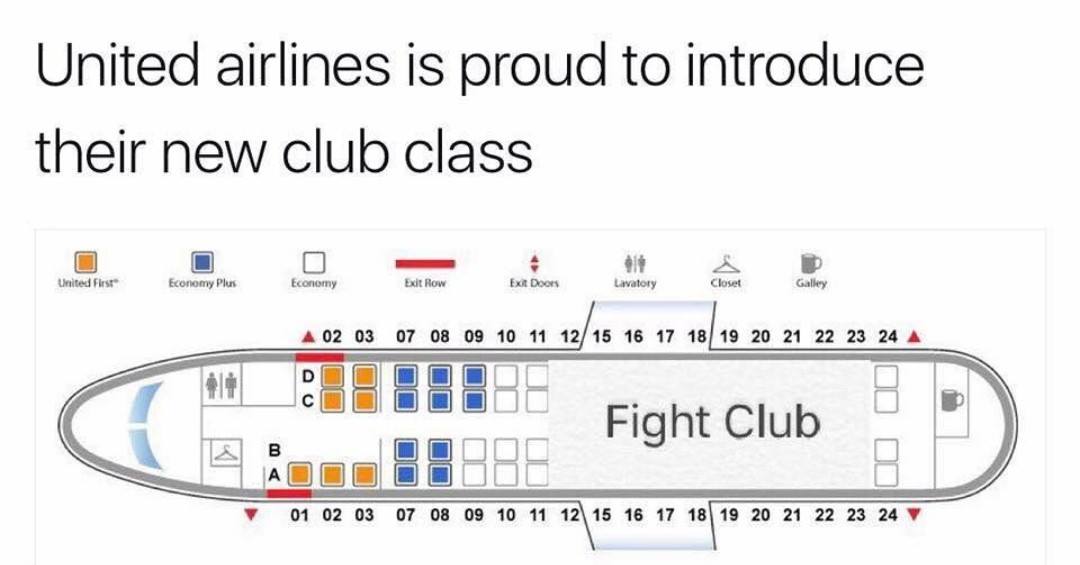
This whole recent thing with United Airlines has me thinking, once again, about how big organizations act like idiots. […]
Like all good consultants, I have a Model, mostly cribbed from others, based on two observations:
- The SNAFU principle: the farther up a hierarchy information has to travel, the more information is lost. This is because no one likes giving people bad news, so the news tends to get better the farther up it goes.
- The Peter Principle (modified): people rise in a hierarchy to the limits of their competence in rising in a hierarchy; further, the skill of rising in a hierarchy is largely independent of the skills needed to deal with actual issues.
Of course, the implication of this is something I’ve called Carl’s Corollary (for a friend and co-worker Carl Madison, who first pointed it out). Carl’s Corollary implies that most decisions are being made by people less and less competent to deal with the situation, using increasingly bad information.
Naturally, this results in bad decisions being made. The usual result is that once the bad decision has been made, someone is identified to be responsible, that person is punished, and a new policy is issued to make sure no one makes that mistake again.
[…]
United, though, has a different scheme, clearly. They have a Book, and it Must Be Followed. No one on the ground in Chicago — at least no one in reach of the gate — had the authority to do anything but offer an $800 voucher, which just wasn’t enough. (I can relate. I used to be a “45 weeks a year” road warrior, and there were some nights where if they’d have tried to bump me off a flight home, I would have either killed someone or just thrown myself on the floor of the terminal screaming.) So they followed the Book, and when they couldn’t get Dao to leave, they followed the book again saying he was disruptive, and then the mall airport cops went all Cartman on him…
https://media.giphy.com/media/B1TMcmoBAaSZi/giphy.gif
… and the rest was history.
Now, imagine if, instead, the gate people had the authority to offer more. And the gate agents knew their primary responsibility was to make customers happy and not get bad publicity.
April 13, 2017
United Airlines Honest Commercial [Jimmy Kimmel]
Published on Apr 11, 2017
“No one wanted to volunteer to get off the plane because the next flight wasn’t until 2 p.m. the next day, which is almost a full 24 hours later,” said Bridges, who added that the airline selected which flyers to eject “based on an internal algorithm that weighs in … who was the last to purchase.” Bridges said the unidentified passenger was told he had to leave, but the man refused to do so.
“He said he was a doctor, he had patients he had to see in the morning, he wasn’t going to get off the plane,” Bridges recounted, “and the gate agent was like, ‘You have to get off the plane. If you don’t get off, we’ll call in security.’ And he was like, ‘Fine, call security, I’m not getting off the plane.’”
Bridges said the man wasn’t being violent with security and police officers who responded, but did say he was “kind of [flailing] his arms and trying to keep them away from him and ultimately they had to use the force, as you can see in the video.”
The shocked passengers berated United employees who boarded the plane in the ejected flyers’ place.
Late Monday, United CEO Oscar Munoz issued a statement apologizing for having to “re-accommodate these customers.”
“Does that look like re-accommodation to you?” Carlson asked. “There’s no mention of the fact that this guy is bloody and unconscious. That’s re-accommodation, according to United Airlines.”
[http://www.foxnews.com/travel/2017/04/10/united-airlines-passenger-describes-moment-unconscious-man-was-dragged-off-plane.html]
April 12, 2017
United Airlines implies that the beatings will continue until customer morale improves
One of several videos from other passengers on the flight:
Some reactions from around the net to a United Airlines initiative to treat their customers like unruly prison inmates:
Southwest changes slogan in wake of #United pic.twitter.com/fnNf5NtRo2
— Jordan (@jordansammy) April 11, 2017
The world is rightly abuzz over an awful incident yesterday in which a man was beaten and dragged off a plane by police at Chicago’s O’Hare airport for the crime of wanting to use the seat he’s paid for on a United Airline flight getting ready to leave for Louisville.
The man claimed to be a doctor who had patients to see the next morning, explaining why he neither took an initial offer made to everyone on the plane to accept $400 and a hotel room for the night in exchange for voluntarily giving up his seat nor wanted to obey a straight-up order to leave, in an attempt on United’s part to clear four seats for its own employees on the full flight.
No one considered even the $800 that was offered after everyone had boarded enough for the inconvenience, so United picked four seats and just ordered those in them to vacate. But the one man in question was not interested in obeying. (Buzzfeed reports, based on tweets from other passengers, that the bloodied man did eventually return to the plane.)
While United’s customer service policies in this case are clearly heinous and absurd, let’s not forget to also cast blame on the police officers who actually committed the brutality on United’s behalf. NPR reports that the cops attacking the man “appear to be wearing the uniforms of Chicago aviation police.”
However violent and unreasonable the incident might appear to us mere ignorant peasants, the CEO assures his minions that beatings of this sort are totally within normal procedural guidelines:
The head of United Airlines said in an email to his employees Monday that the security guards who violently dragged a passenger from his seat were following “established procedures for dealing with situations like this,” according to a tweet by CNBC reporter Steve Kopack.
“As you will read, the situation was unfortunately compounded when one of the passengers we politely asked to deplane refused and it became necessary to contact the Chicago Aviation Security Officers to help. Our employees followed established procedures for dealing with situations like this,” wrote Oscar Munoz, CEO of United Airlines.
Munoz’s message to staff comes amid public scrutiny after a passenger refused to relinquish his seat on an overbooked plane and was violently dragged off the plane by three security officers.
Surfaced videos of the incident have since gone viral.
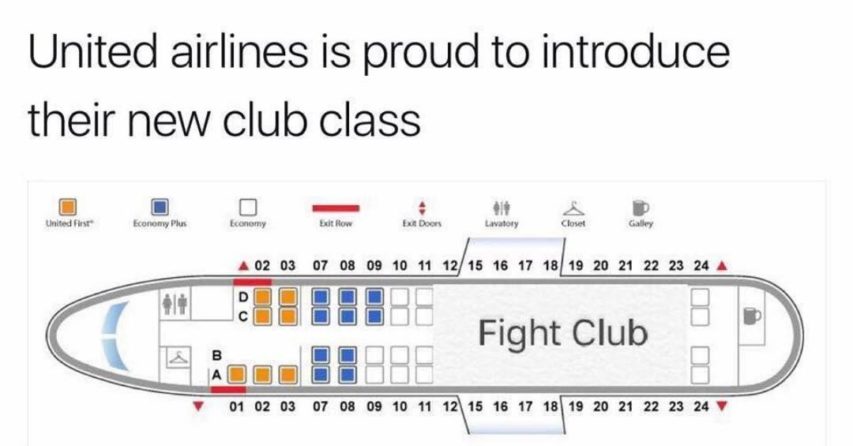
Headline: passenger beaten, abused by United Airlines
Me: how could he tell— David Burge (@iowahawkblog) April 10, 2017
February 23, 2017
January 10, 2017
Gentrification hit the BDSM community years back
In Salon, Annalee Newitz wrote about a quaint little San Francisco B&B that offered specialized services to the BDSM community before George W. Bush was inaugurated:
In a quiet San Francisco neighborhood, surrounded by views of tree-covered hills, a quaint little B&B welcomes visitors from across the country. Guests can choose from four well-appointed rooms in this refurbished turn-of-the-century house, all personally decorated by Elizabeth, the proprietor. While they’re staying at Elizabeth’s B&B — called Differences — guests are also welcome to use all the amenities of the house: an extensive dungeon in the basement, metal hooks tucked into lacy corners and the genuine antique bondage devices adorning the rooms. Of course, guests will also need to make their own pancakes — B&B stands for bed and bondage here. Elizabeth doesn’t do breakfast.
Like other renegade subcultures, S/M is gradually becoming gentrified. This is partly economic — getting flogged on a Friday night isn’t as cheap as it used to be. Dozens of exclusive sex stores have popped up, peddling high-end toys, devices and leatherware. A typical private “play party” runs each guest as much as $30 (this is a site cost — you pay for the space, not the sex). Certain clubs even enforce a pricey dress code: If you aren’t all gussied up in latex or leather, you don’t get in the door.
This isn’t the kind of gentrification one sees in urban landscapes where yuppies suck up all the warehouse spaces and formerly low-income housing. Nor can one locate some previous version of the S/M community that was less wealthy. Indeed, tracing S/M’s origins back to its Founding Daddies — the Marquis de Sade and Leopold von Sacher-Masoch — one finds that S/M’s earliest class connections are purely aristocratic.
[…]
Odder still to an outsider would be the experience of attending an S/M seminar at QSM’s San Francisco warehouse, where a room full of well-dressed people in orderly rows of folding chairs watch politely as a well-known “dominant” demonstrates how to torture nipples correctly and why it’s important to employ bondage devices that won’t cause nerve damage. To avoid appearing “unsafe,” players plan their taboo violations and transgressions to a ‘T.’ It can be too much — Joe, a member of the coordinating committee for the Third Annual Leather Leadership Conference, notes ruefully that “the S/M community is, at times, overwhelmingly geeky. Players will spend hours and days debating finer points of flogging safety instead of just getting together and having fun.”
Given the lack of law-breaking and general air of wholesomeness in the S/M scene, it’s no wonder that Jack and Jill Suburb have come to join the fun. The question is, what gets lost in the translation when S/M values begin to percolate into the white-picket-fence world of middle America?
H/T to “SG” for the link.
September 4, 2016
Our First Trip To WW1 Locations Was An Epic Journey I THE GREAT WAR Special
Published on 3 Sep 2016
Map of all the locations we went to: http://bit.ly/2bxRZCg
Indy & Flo talk about our first trip to original WW1 locations in Poland and Ukraine. The trip was a great experience for all of us and you will surely like the future episodes we will publish throughout the next months. Thanks again to everyone who made this possible.
May 23, 2016
QotD: Yachting news
It is pleasing to see a man travelling in style. Erkan Gürsoy, age sixty-eight, took the northern route for his latest visit to his native Turkey, which is usual when flying to the Old World from British Columbia. But he gave this a twist by avoiding the airlines. Instead he negotiated the Northwest Passage, then crossed the rough Atlantic (weathering a hurricane), in a 36-foot aluminum yacht of his own construction. The Altan Girl, and her master, arrived safely at Çanakkale (near Troy in the Dardanelles), somewhat dimpled by the ice. Polar bears were also among Mr Gürsoy’s perils, as I gather from reports.
Most solo sailors come from inland locations, I have noticed, and this one from the Turkish interior. My theory is that people raised along the coast would know better. My own frankly escapist sailing fantasies owe much to a childhood spent mostly well inland, so that I was fully four years before I’d even seen an ocean. I remember that first encounter vividly. It turned out to be larger than I had expected.
Mr Gürsoy makes his living in Nanaimo manufacturing aluminum boats, mostly as tenders for larger vessels. He calls his stock-in-trade the “non-deflatable” — the hulls ringed around with fat aluminum irrigation tubing. He has a patent on that, and while admitting that his craft are rather ugly, notes that they are hard to sink. (From photographs I see that he is not much into concealing welds, either.) They are also rather noisy, for those riding inside, and they do bounce about on the waves. But on few other ships can one drum so impressively, to discourage those pesky bears, when trapped in ice that is crushing you like a pop can.
Clearly, from the accounts I have read, and by the full Aristotelian definition, a magnificent man.
David Warren, “Yachting news”, Essays in Idleness, 2015-02-11.
May 3, 2016
How to properly enjoy driving the Autobahn
Larry Correia just got back from a trip to Europe, where he discovered the joys of Germany’s Autobahn system:
Of all the languages, German was by far the easiest to pick up words and phrases for me. Despite being related to Portuguese and Spanish, French sounds totally eluded me. And Czech is HARD (they have like 46 ways to make conjunctions). But German shares a lot of word roots with English, and the actual structure is pretty straight forward. Plus it is fun to just walk around and make up vaguely German sounding names for things, like a pigeon is Das Poopinbirden.
The next day we drove across all of Germany to the Czech Republic, and I got to experience the autobahn, which my whole life has been this sort of mythical place that has no speed limits, and is filled with drivers that understand slow traffic stays right, and where they never camp in the left lane, and in fact, if you’re blocking the left lane, they’ll come right up on your bumper at 100 miles an hour, honking, and flashing their lights. It was a place devoid of mercy, unforgiving of weakness. So we set out.
Apparently there are two kinds of tourist drivers on the autobahn. Those who are weak, fearful, whose crying pillows smell of lilacs and shame, who stay in the truck lane, or who wander out into the left occasionally, timidly, to be honked at and chased aside by awesome Teutonic Super Drivers…
And the other kind is the American who manages to average 180km an hour across all of Germany in a Volvo diesel station wagon.
It was AMAZING. I felt like a race car driver across an entire country. You know why German cars don’t have cup holders? Because if you stop to drink while driving, YOU WILL DIE. And you should. You need to be on. I’d get a gap, jump out to the left, floor it (because fuel economy is for hippies I’m on the mother f’ing autobahn!), and nobody pulls out in front of me in a minivan to enforce their personal speed limit, people ahead of me going slower (like 100mph) immediately get out of the way, and when some bad ass comes up behind me in a super car, I get out of his way, and then they blast past me like I’m standing still.
It was beautiful.
You wouldn’t think a diesel Volvo would be comfy at 112 miles an hour, but it really is. Yes. I friggin’ love the autobahn. If I lived here I would buy a giant BMW or Audi and drive very fast, all the time. Why can’t we have something like this here? I would like to institute autobahn style rules on I-15 in Utah. Sure, a few thousand people would probably die in the first weekend, but after that it would be awesome.
March 19, 2016
The Monopoly Markup
Published on 18 Mar 2015
Ever wonder why pharmaceuticals are so expensive? In this video, we show how low elasticity of demand results in monopoly markups. This is especially the case with goods that involve the “you can’t take it with you” effect (for example, people with serious medical conditions are relatively insensitive to the price of life-saving drugs) and the “other people’s money” effect (if third parties pay for the medicine, people are less sensitive to price).
January 17, 2016
Tabatha Southey is getting nostalgic for plates
Perhaps I’ve been lucky to have (mostly) avoided this restaurant serving trend:
I’ve been away seven weeks now, travelling, working, researching a book, seeing friends, but it’s time to come home; I miss plates.
I’ve been staying in London mostly, visited other cities from there, and then I was in Dublin for a while. In all these places I ate out a lot, and I can report that the restaurant industry is in the midst of a tableware crisis. There’s barely a plate to be found any more, and the first time you’re served a dry-aged rump of beef with celeriac gratin, chanterelles and red wine jus on a cutting board, it’s possible to be charmed.
After all, you are not a tablecloth, but soon the tide of things being served on other things that were just not meant to be served on starts to wear on you.
I have a high whimsy-tolerance. Doctors have often remarked upon it. Sometimes half an hour into a puppet show involving a talking reflex hammer and a musical stethoscope, a doctor will say, “This is very unusual,” and make a note on my chart, but recently my whimsy-tolerance has been tested.
I miss plates. Why, in one day on this trip, I was served breakfast on a chalk slate, lunch on a clip-board and dinner on a wooden cutting board shaped like a clover leaf. I’ve been served frites in a beer stein, and the ones I could reach were delicious, and so my verdict was a resolved “Fun!” – until my slow-baked quince, wild honey ewe’s yoghurt, bee pollen and almonds arrived in a vintage teacup balanced on a strip of artfully weathered barn board, and then the next morning at breakfast, I was served a waffle on another waffle with maple syrup in a stem vase.
What was under that waffle I do not care to know, but everything I’ve been served of late suggests that that non-plate waffle presenting item was handcrafted from a substance that Dwell magazine would call “reclaimed ash flooring from a demolished church in Ohio,” and the rest of us would call “wood.”
I miss plates.
January 16, 2016
Introduction to Price Discrimination
Published on 7 Apr 2015
Price discrimination is common: movie theaters charge seniors less money than they charge young adults. Computer software companies sell to businesses and students at different rates, often offering discounts to students. These price differences reflect variations in the elasticity of demand for these different groups. When demand curves are different, it is more profitable to set different prices in different markets. We’ll also cover arbitrage and take a look at some examples of price discrimination in the airline industry
December 14, 2015
The Monopoly Markup
Published on 18 Mar 2015
Ever wonder why pharmaceuticals are so expensive? In this video, we show how low elasticity of demand results in monopoly markups. This is especially the case with goods that involve the “you can’t take it with you” effect (for example, people with serious medical conditions are relatively insensitive to the price of life-saving drugs) and the “other people’s money” effect (if third parties pay for the medicine, people are less sensitive to price).
December 12, 2015
The US government’s no-fly list
Kevin Williamson on the travesty that is the no-fly list:
There are many popular demons in American public life: Barack Obama and his monarchical pretensions, Valerie Jarrett and her two-bit Svengali act, or, if your tastes run in the other direction, the Koch brothers, the NRA, the scheming behind-the-scenes influences of Big Whatever. But take a moment to doff your hat to the long, energetic, and wide-ranging careers of three of our most enduring bad guys: laziness, corruption, and stupidity, which deserve special recognition for their role in the recent debates over gun control, terrorism, and crime.
The Democratic party’s dramatic slide into naked authoritarianism — voting in the Senate to repeal the First Amendment, trying to lock up governors for vetoing legislation, and seeking to jail political opponents for holding unpopular views on global warming, etc. — has been both worrisome and dramatic. The Democrats even have a new position on the ancient civil-rights issue of due process, and that position is: “F— you.” The Bill of Rights guarantees Americans (like it or not) the right to keep and bear arms; it also reiterates the legal doctrine of some centuries standing that government may not deprive citizens of their rights without due process. In the case of gun rights, that generally means one of two things: the legal process by which one is convicted of a felony or the legal process by which one is declared mentally incompetent, usually as a prelude to involuntary commitment into a mental facility. The no-fly list and the terrorism watch list contain no such due process. Some bureaucrat somewhere in the executive branch puts a name onto a list, and that’s that. The ACLU has rightly called this “Kafkaesque.”
Here’s where our old friends laziness and stupidity play a really prominent role: The no-fly list is not composed of identities, but merely names. Lots of people share the same name. So, for instance, the late Senator Ted Kennedy ended up on the no-fly list, because somebody had used his name (or a similar name) as an alias. Among people called “Kevin Williamson,” we find myself, the famous Scream screenwriter, a notable Scottish politician and political activist (he is also the author of Drugs and the Party Line), a Canadian entertainment journalist, a fine woodworker who sells his wares on Twitter, and a famous underwear model for whom I am unlikely to be mistaken. If a trip to the DMV or the IRS one day eventually sends me over the edge into full-on barking mad durka-durka-Mohammed-jihad territory, those other Kevin Williamsons are going to suffer simply because we share a name.
And, of course, every third actual dirtbag terrorist has the same name as a million other ordinary schmoes, because Arabic names tend to be a little repetitive. (Is there a Mohammed al-Mohammed in the house? Seriously, go to LinkedIn and see how many graphic designers and accountants walking this good green Earth share that name.)


