
The Korean War by Indy Neidell
Published 12 Nov 2024MacArthur’s forces struggle to make sense of the recent Communist Chinese intervention in Korea, especially when the Chinese vanish as quickly as they arrived. Back in the US, the war’s popularity has reached an all-time low on the eve of the crucial 1950 midterm elections. Is MacArthur about to pay the price for his failure to deliver results on the ground?
Chapters
00:00 Intro
01:01 Recap
01:24 The Chinese Vanish
02:37 The East
04:35 The US Situation
11:28 Bombing the Yalu
13:03 Summary
13:23 Conclusion
14:26 CTA
(more…)
November 13, 2024
The Korean War Week 21 – US Elections Threaten MacArthur! – November 12, 1950
Comments Off on The Korean War Week 21 – US Elections Threaten MacArthur! – November 12, 1950
November 2, 2024
The Short SA.4 Sperrin; Britain’s Back-Up, Back-up Nuclear Bomber
Ed Nash’s Military Matters
Published Jul 9, 2024No, I have no idea how you pronounce “Gyron”.
Comments Off on The Short SA.4 Sperrin; Britain’s Back-Up, Back-up Nuclear Bomber
August 15, 2024
Yet another revisionist history of World War II
In the latest anonymous review at Astral Codex Ten, the book to be considered is How the War Was Won by Phillips Payson O’Brien:
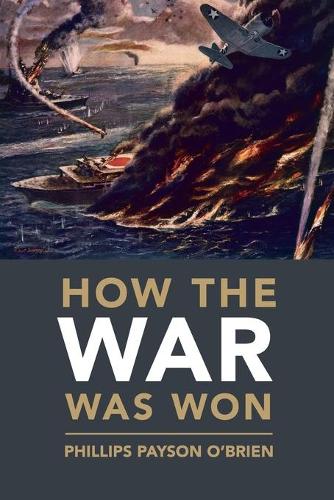
To a first approximation, there are a million books about World War II. Why should you care about How the War Was Won (hereinafter “HtWWW”) by Phillips Payson O’Brien?
- It provides a new, transformative view of the conflict by focusing on production of key goods and what affected that production instead of the ups and downs of battles at the front.
- That particular lens used can (and should) be applied outside of just World War II, and you can get a feel for how that might be done by reading HtWWW.
- I have lectured about World War II and read many, many books about it. I have never texted friends more excerpts of a book than this one.
I have some criticisms of HtWWW, but if the criticisms dissuade you from reading the book, I will have failed. These complaints are like tut-tutting Einstein’s penmanship.
The Wikipedia-Level Story of World War II (and O’Brien’s Counterargument)
To understand why O’Brien’s argument is so novel, you need to know the modern-day conventional understanding of the story of World War II. Here is my summary of the conventional narrative of World War II:
- Germany conquered Poland and France. It tried to bomb the UK into submission/maybe enable an invasion. That effort failed when Germany was defeated in the Battle of Britain, thanks largely to the plucky efforts of British airmen (memorably summarized by Winston Churchill: “Never in the field of human conflict was so much owed by so many to so few”.)
- Stymied in the West, Germany invaded the Soviet Union, won a bunch of crushing victories, but then got turned back at the gates of Moscow. The Soviets moved all of their factories east of the Ural Mountains and produced a vast tide of T-34 tanks that overpowered the Germans.
- The Germans suffered a catastrophic defeat at Stalingrad and a bloody strategic defeat at Kursk, after which the Soviets relentlessly pounded Germany to defeat.
- The US and the UK sent a lot of material help and eventually fought the Germans too, most notably in the D-Day invasion and the Battle of the Bulge. However, most of the fighting was done by the Soviets.
- It is very difficult to say how important the aerial bombing campaigns of the Western Allies were in defeating Germany. The Germans moved much of their production underground, insulating them from truly disastrous effects.
- The U.S. mostly fought alone against Japan, which won a series of impressive early victories (e.g., Pearl Harbor, the conquest of Singapore) until the decisive Battle of Midway, after which the vastly larger US industrial base outproduced Japan into oblivion.
- The US bombed the Japanese into submission by destroying Japanese cities, ultimately by dropping atom bombs on Hiroshima and Nagasaki.
By examining where the Axis focused their productive capacities and how the Allies disrupted those capacities, O’Brien challenges virtually every part of that narrative:
- The Battle of Britain was not a close-run thing. The fact that British fighter planes were flying over their own territory meant their attrition rate of pilots and aircraft were far lower than the Germans’.
- American and British bombing mattered far more to the war’s outcome than the battles of the Eastern Front, which consumed a much smaller portion of German expenditures.
- American and British airpower made German battlefield victories on the Western Front virtually impossible and dramatically limited the force Germany could bring to bear in the East.
- Japan (really, Japan plus the giant empire it conquered at the beginning of the war) was an industrial behemoth to rival the Soviet Union. However, the destruction of the Japanese merchant fleet by American air and sea forces wrecked Japan’s economy.
- The firebombing of Japanese cities and the atomic bombings of Hiroshima and Nagasaki had an ambiguous strategic effect. American air power played a much more important role in severing Japan from the natural resources it had conquered in the early part of the war.
Comments Off on Yet another revisionist history of World War II
August 11, 2024
The US drops two atomic bombs on Japan – WW2 – Week 311 – August 10, 1945
World War Two
Published 10 Aug 2024This week atomic bombs are for the first time in history dropped on cities — Hiroshima and Nagasaki in Japan. The bombs kill over 100,000 people and flatten large parts of the urban area. The Japanese government is actually meeting while the second bomb is dropped to consider their response to the first and to the demands for unconditional surrender. The response is not just to that first bomb, though, for on the 8th the Soviets tell the Japanese not only that they will not help them negotiate some sort of settled peace with the other Allies, they too are declaring war on Japan, and indeed invade Manchuria. With two atomic bombs and an invasion instead of mediating help, Japanese Emperor Hirohito cuts off any debate and says that Japan will surrender. This could happen next week.
00:00 Intro
00:17 Recap
00:44 Hiroshima Bombing
02:35 The Bombing Mission
04:19 Descriptions Of The Blast
06:38 The Nagasaki Bomb
07:37 The Tactics
08:31 The Japanese Response
12:55 Soviets Invade Manchuria
16:18 Splitting Korea
18:07 Operation Zipper
19:31 End Notes
20:08 Summary
20:30 Conclusion
(more…)
Comments Off on The US drops two atomic bombs on Japan – WW2 – Week 311 – August 10, 1945
August 7, 2024
Unleashing the Atom: The Bombing of Hiroshima and Nagasaki – War Against Humanity 139
This video is only available on YouTube itself – click the image above or click here.
World War Two
Published 6 Aug 2024In August 1945, the United States became the first, and to this day only, nation ever to employ nuclear weapons in war. After The fledgling technology proves itself on the testing ground, it is ready for immediate use. The price for this innovation is paid by hundreds of thousands of Japanese civilians who are blinded, burned, crushed, irradiated, and finally burned in a humanitarian crisis never seen before and never since. Join us to hear the gut-wrenching accounts of survivors and understand the motivations behind this tragic outcome to ensure that the horrors of nuclear war are never forgotten and never again unleashed upon the world and its people.
Comments Off on Unleashing the Atom: The Bombing of Hiroshima and Nagasaki – War Against Humanity 139
August 4, 2024
Mokusatsu! – WW2 – Week 310 – August 3, 1945
World War Two
Published 3 Aug 2024The Japanese reaction to the Allied ultimatum for unconditional surrender is … mokusatsu. This can be translated several ways, but all involve not giving a response. Meanwhile, materials for atomic bombs to be dropped on Japan are delivered to Tinian, though the ship making the delivery is sunk by a Japanese submarine days afterward. The active war continues in Burma and China, and the Potsdam Conference ends in Germany with the map of Poland very much re-drawn.
00:00 Intro
00:56 Mokusatsu
05:47 Delivering Atomic Material
07:22 Sinking The Indianapolis
09:26 Bombing Japan
12:22 The War In Burma And China
14:07 Potsdam Confernece Ends
17:02 Conclusion
(more…)
Comments Off on Mokusatsu! – WW2 – Week 310 – August 3, 1945
July 28, 2024
Allies Issue Potsdam Declaration – WW2 – Week 309 – July 27, 1945
World War Two
Published 27 Jul 2024China, Britain, and the US issue a Declaration demanding Japan’s unconditional surrender, and promising complete destruction if this does not happen and happen soon. The plan is to for the Americans to use their atomic bombs on Japan if she does not comply, but by the end of the week the Japanese have not replied. They still have hopes for the Soviets to mediate some sort sort of peace. What they don’t have is a navy, as its final destruction comes this week.
00:00 Intro
00:50 Recap
01:32 The Potsdam Conference
04:41 Japanese Hopes
05:56 The Potsdam Declaration
10:53 The Initial Reaction
14:48 The End Of The Japanese Navy
15:05 The War On Land
19:10 Summary
19:30 Conclusion
(more…)
Comments Off on Allies Issue Potsdam Declaration – WW2 – Week 309 – July 27, 1945
July 16, 2024
This Jet Age – Farnborough Airshow, 1953
spottydog4477
Published Dec 25, 2009
Comments Off on This Jet Age – Farnborough Airshow, 1953
June 28, 2024
Japan Decides on Peace – Are They Too Late? – War Against Humanity 137
World War Two
Published 27 Jun 2024The US bombers continue destroying Japanese cities with a rain of firebombs. As the country burns, the Japanese leadership and Emperor Hirohito finally realise they must seek peace.
(more…)
Comments Off on Japan Decides on Peace – Are They Too Late? – War Against Humanity 137
June 2, 2024
Japan vows to fight to the end! – WW2 – Week 301 – June 01, 1945
World War Two
Published 1 Jun 2024This week President Truman and his aides meet to discuss the use of the atomic bomb. In Japan, the Imperial government vows to fight on even as Yokohama is turned to ash by firebombing. On Okinawa, Japanese 32nd Army withdraws from the defences of Shuri Castle but there is still plenty of hard fighting left for the Americans. There are US Navy command reshuffles and the stage is set for an Allied conference in Potsdam.
Chapters
01:21 Recap
05:08 The Fight on Okinawa
08:38 The Interim Committee And The Bomb
14:02 Notes
(more…)
Comments Off on Japan vows to fight to the end! – WW2 – Week 301 – June 01, 1945
February 28, 2024
V-2: Hitler’s Wunderwaffe
World War Two
Published 27 Feb 2024Hitler hopes that the V-2 rocket will turn the tide of the war. It’s cutting edge technology and impossible to intercept. Right now, the first long-range ballistic missile is raining death on London and Antwerp. But is it too little, too late? Find out the backstory to this powerful weapon.
(more…)
Comments Off on V-2: Hitler’s Wunderwaffe
February 4, 2024
Is the Red Army too fast for its own good? – WW2 – Week 284 – February 3, 1945
World War Two
Published 3 Feb 2024Soviet forces have reached the old German border in force, however, logistical issues and a strong enemy presence possibly threatening their flanks means that a drive on Berlin may not be doable just now. Heinrich Himmler is in charge of the new Army Group to defend the Reich, and he has a host of problems. On the Western Front, the Allies finally eliminated the Colmar Pocket, and in the Philippines, the American advance reaches Manila, and the battle for the city is about to begin.
(more…)
Comments Off on Is the Red Army too fast for its own good? – WW2 – Week 284 – February 3, 1945
September 26, 2023
Postwar Warsaw became beautiful, but postwar Coventry became a modernist eyesore
Ed West’s Wrong Side of History remembers how the devastation of Warsaw during World War 2 was replaced by as true a copy as the Poles could manage, while Coventry — a by-word for urban destruction in Britain — became a plaything in the hands of urban planners:
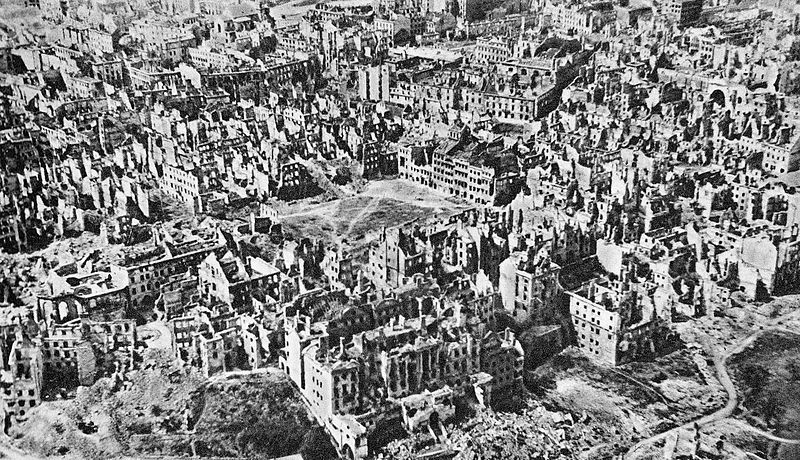
Stare Miasto w Warszawie po wojnie (Old Town in Warsaw after the war)
Polish Press Agency via Wikimedia Commons.
Fifteen months after its Jewish ghetto rose up in a last ditch attempt to avoid annihilation, the people of the city carried out one final act of defiance against Nazi occupation in August 1944.
The Soviets, having helped to start the war in 1939 with the fourth partition of Poland, deliberately halted their advance and refused to help the city in its torment. Without Russian cooperation, the western allies could do little more than an airlift of weapons and supplies, which was doomed to failure.
The Polish Army and resistance fought bravely – some 20,000 Germans were killed or wounded – but at huge cost. As many as 200,000 Poles, most civilians, were killed in the battle and over 80% of the city destroyed – worse destruction than Hiroshima or Nagasaki. And so the Nazis had carried out their plan to erase the Polish capital — yet this was something the Poles refused to accept, even after 1944
Today the Old Town is as beautiful as it ever was, and visitors from around the world come to walk its streets – witnesses to perhaps the most remarkable ever story of urban rebirth.
With the city a pile of rubble and corpses, the post-war communist authorities considered moving the capital elsewhere, and some suggested that the remains of Warsaw be left as a memorial to war, but the civic leaders insisted otherwise – the city would rise again
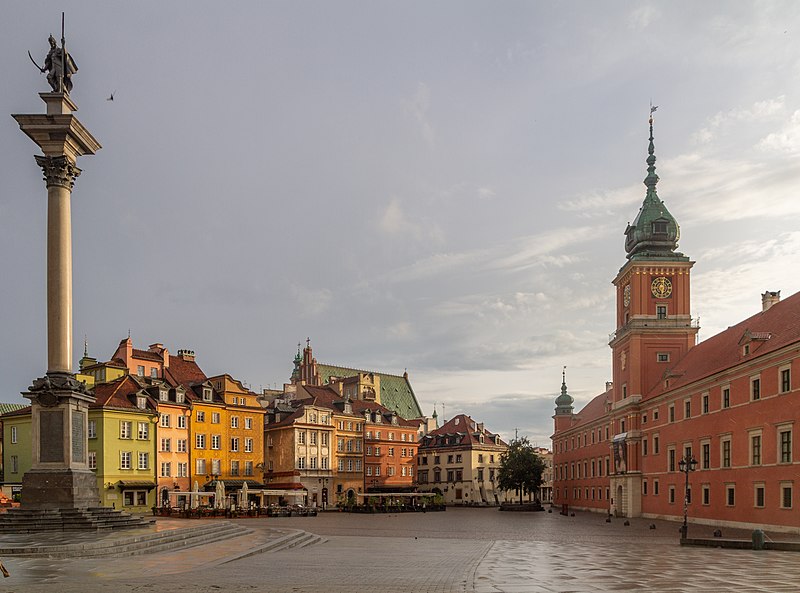
Plac Zamkowy, Warszawa (Castle Square in Warsaw)
Photo by Makxym Kozlenko via Wikimedia Commons.
Warsaw was fought over, bombed, shelled, invaded and twice was the epicentre of brutal urban guerilla warfare, leaving the city in literal ruins. Coventry, on the other hand, wasn’t bombed by the Luftwaffe until 1940 — but the damage had already began at the hands of the urban planners:
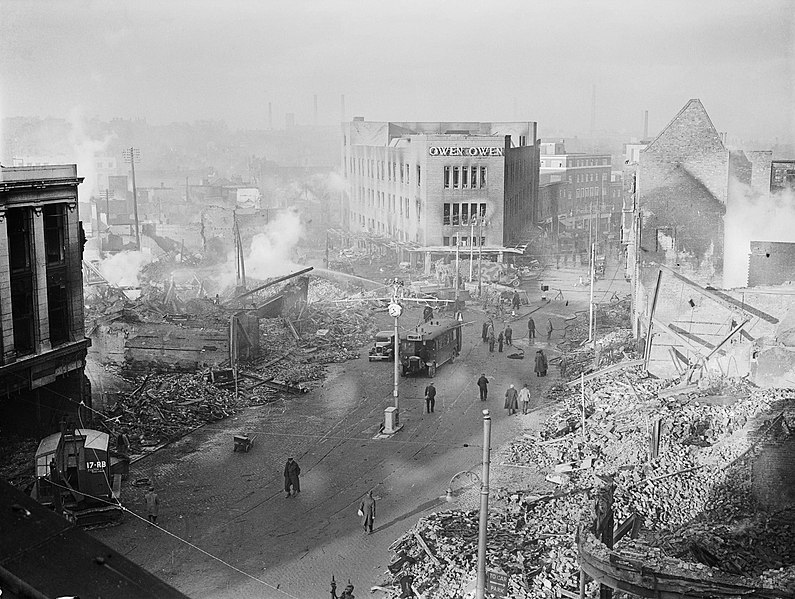
Broadgate in Coventry city centre following the Coventry Blitz of 14/15 November 1940. The burnt out shell of the Owen Owen department store (which had only opened in 1937) overlooks a scene of devastation.
War Office photo via Wikimedia Commons.
The attack was devastating, to the local people and the national psyche, and local historian W.G. Hoskins wrote that “For English people, at least, the word Coventry has had a special sound ever since that night”. Yet Coventry also became a byword for how to not to rebuild a city – indeed the city authorities even saw the Blitz as an opportunity to remake the city in their own image.
Coventry forms a chapter in Gavin Stamp’s Britain’s Lost Cities, a remarkable – if depressing – coffee table book illustrating what was done to our urban centres. Stamp wrote:
British propaganda was quick to exploit this catastrophe to emphasise German ruthlessness and barbarism and to make Coventry into a symbol of British resilience. Photographs of the ruins of the ancient Cathedral were published around the world, and it was insisted that it would rise again, just as the city itself would be replanned and rebuilt, better than before.
But the story of the destruction of Coventry is not so simple or straightforward. … severe as the damage was, a large number of ancient buildings survived the war – only to be destroyed in the cause of replanning the city. But what is most shocking is that the finest streets of old Coventry, filled with picturesque half-timbered houses, had been swept away before the outbreak of war – destroyed not by the Luftwaffe but by the City Engineer. Even without the second world war, old Coventry would probably have been planned out of existence anyway.
In one respect, Coventry had been ready for the attacks … the vision of “Coventry of Tomorrow” was exhibited in May 1940 – before the bombing started. [City engineer] Gibson later recalled that “we used to watch from the roof to see which buildings were blazing and then dash downstairs to check how much easier it would be to put our plans into action”.
The Society for the Protection of Ancient Buildings had estimated that 120 timber houses had survived the war … two thirds of these would disappear over the next few years as the city engineer pressed forward with his plans … A few buildings were retained, but removed from their original sites and moved to Spon Street as a sanitised and inauthentic historic quarter.
Today, whatever integrity the post-war building ever had has been undermined by subsequent undistinguished alterations and replacements. Coventry has been more transformed in the 20th century than any other city in Britain, both in terms of its buildings and street pattern. The three medieval spires may still stand, but otherwise the appearance of England’s Nuremberg can only be appreciated in old photographs.
In fact, the destruction had begun before the war. In order to make the city easier for drivers, the west side had been knocked down in the 1930s, the area around Chapel St and Fleet St replaced by Corporation St in 1929-1931. After the war it would become a shopping centre.
Old buildings by Holy Trinity Church were destroyed in 1936-7, and that same year Butcher Row and the Bull Ring were similarly pulled down, the Lord Mayor calling the former “a blot in the city”.
Indeed, the city architect Donald Gibson hailed the Blitz as “a blessing in disguise. The Jerries cleared out the core of the city, a chaotic mess, and now we can start anew.” He said later that “We used to watch from the roof to see which buildings were blazing and then dash downstairs to check how much easier it would be to put our plans into action”.
Gibson’s plan became city council policy in February 1941, with a new civic centre and a shopping precinct inside a ring road. The City Engineer Ernest Ford wanted to preserve some old buildings, including the timber Ford’s Hospital, which had survived the Blitz. Gibson said it was an “unnecessary problem” and in the way of a new straight road.
Comments Off on Postwar Warsaw became beautiful, but postwar Coventry became a modernist eyesore
September 22, 2023
Is the Slovak Uprising Doomed to Fail? – War Against Humanity 115
World War Two
Published 21 Sep 2023Even as they battle an uprising in Slovakia, the Nazis see the opportunity to continue their racial realignment of Europe. The latest victims of this genocidal legacy are Anne Frank and her family, who arrive at Auschwitz. In Britain, the V-1 menace is defeated. But as London breathes a sigh of relief, the Nazis and their allies reduce Warsaw to rubble in a rampage of burning, looting, rape, and murder.
(more…)
Comments Off on Is the Slovak Uprising Doomed to Fail? – War Against Humanity 115
September 21, 2023
A new paper on the cancellation of the Avro Arrow in 1959
The National Post republished a Canadian Press article about a new research paper by Alan Barnes in the Canadian Military History journal:
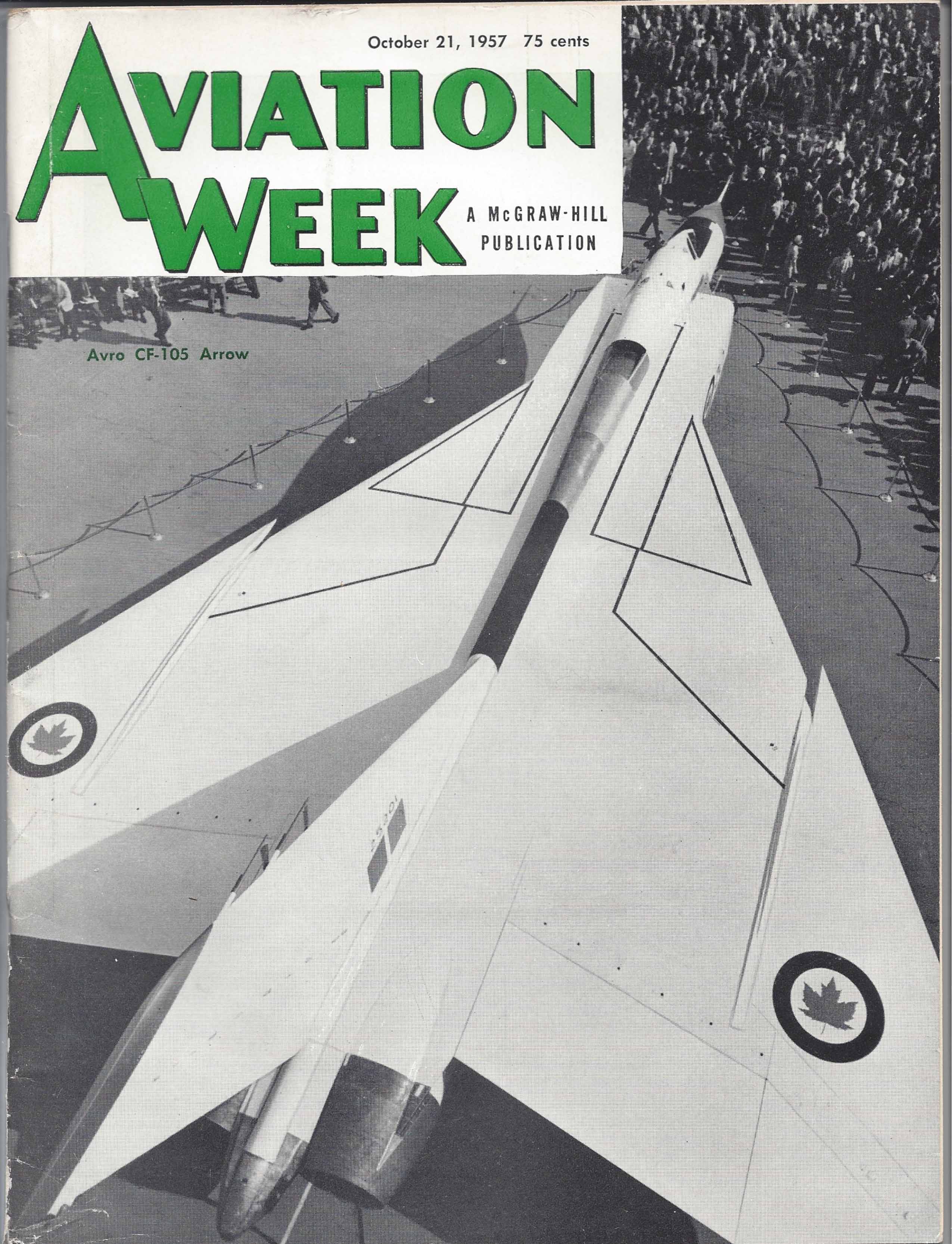
In the years after the Second World War, Canada developed its ability to prepare strategic intelligence assessments on defence and foreign policy, the paper notes. It would no longer have to rely entirely on assessments from the United States and Britain.
The analytic capability allowed Canada to fully participate in preparing the assessments on the Soviet threat to North America that would underpin joint Canada-U.S. planning for continental defence, Barnes notes.
“The CF-100 Canuck, a jet interceptor developed and manufactured in Canada, was just entering service, but there were already concerns that it might soon be outclassed by newer Soviet bombers operating at higher altitudes and faster speeds.”
In November 1952, the Royal Canadian Air Force called for an aircraft with a speed of Mach 2 and the ability to fly at 50,000 feet. “These demanding specifications contributed to the escalating costs and frequent delays in the CF-105 program.”
The Soviets would soon display a new long-range jet bomber, the Bison, at the 1954 May Day parade in Moscow. At an airshow the following year, a fly-past of 28 Bison seemed to indicate that the bomber had entered serial production, two years earlier than predicted, the paper says. In fact, only 18 prototype aircraft participated in the airshow, flying past several times to give the impression of larger numbers.
Even so, this display, along with the appearance of a new Soviet long-range turboprop bomber, the Tu-95 (dubbed the Bear), raised fears that the Soviet Union would soon outnumber the United States in intercontinental bombers, sparking a “Bomber Gap” controversy that figured prominently in American politics, the paper says.
[…]
A January 1958 assessment, “The Threat to North America, 1958-1967”, by Canada’s Joint Intelligence Committee, a co-ordinating body, ultimately had the greatest impact on decisions related to the Arrow, the paper says.
The assessment laid out clear judgments concerning the imminent transition from crewed bombers to ballistic missiles and described the limited size and capabilities of the Soviet bomber force, Barnes notes.
It observed that the Soviet ballistic missiles which were on the verge of being developed were likely to be markedly superior to the foreseeable defences, and concluded that missiles would progressively replace aircraft as the main threat to North America.
The assessment said this meant there would be little justification for the Soviet Union to increase the number of bombers, or to introduce new ones, after 1960.
“The (Joint Intelligence Committee)’s January 1958 assessment was correct in foreseeing Moscow’s shift from bombers to missiles over the subsequent decade,” Barnes writes.
He points out that following the Sputnik launch, Soviet leader Nikita Khrushchev came to see missiles as a panacea for a range of defence problems and as a cheaper alternative to conventional weapons. “With the Soviet bomber force now looking irrelevant and obsolete, it was relegated to a secondary position in Soviet military thinking.”
Comments Off on A new paper on the cancellation of the Avro Arrow in 1959


