
“Scientific racism,” the theory that races fall into a hierarchy of mental sophistication with Northern Europeans at the top, is a prime example. It was popular in the decades flanking the turn of the 20th century, apparently supported by craniometry and mental testing, before being discredited in the middle of the 20th century by better science and by the horrors of Nazism. Yet to pin ideological racism on science, in particular on the theory of evolution, is bad intellectual history. Racist beliefs have been omnipresent across history and regions of the world. Slavery has been practiced by every major civilization and was commonly rationalized by the belief that enslaved peoples were inherently suited to servitude, often by God’s design. Statements from ancient Greek and medieval Arab writers about the biological inferiority of Africans would curdle your blood, and Cicero’s opinion of Britons was not much more charitable.
Steven Pinker, “The Intellectual War on Science”, Chronicle of Higher Education, 2018-02-13.
March 8, 2018
QotD: Rationalizing slavery
February 23, 2018
Timothy Sandefur’s Frederick Douglass: Self-Made Man
Jonathan Bean responds to a negative review of Sandefur’s new biography in the New York Times:
Frederick Douglass, whose bicentennial birthday fell on Valentine’s Day, is one of the great figures in American history, a hero whose legacy is celebrated even by those who might otherwise contest his actual ideas.
Illustrating this truth, the New York Times marked the occasion by publishing a largely negative review of Timothy Sandefur’s new biography, Frederick Douglass: Self-Made Man — a book that depicts the African-American ex-slave and social reformer as a classical liberal who championed individual liberty based upon natural rights, self-reliance, and Rule of Law.
The book reviewer, Yale University historian David W. Blight, criticizes Sandefur and other “conservatives” for “co-opting” Douglass. (Sandefur is a self-described libertarian, but in Blight’s mind, ‘libertarian’ and ‘conservative’ are distinctions without a difference.) In making this complaint, Blight demonstrates his confusion as to the meaning of “the Right” and classical liberalism.
Blight concedes that Douglass was a “radical thinker and a proponent of classic 19th-century political liberalism” who “loved the Declaration of Independence” and “the natural-rights tradition.” On these issues, Blight’s view is consistent with Sandefur’s libertarian interpretation of Douglass.
Yet, Blight goes on to protest that the libertarians (or conservatives — he conflates the two groups) are wrong to co-opt Douglass because the great abolitionist “believed that freedom was safe only with the state and under law.”
But this view of freedom’s security is not one that libertarians would dispute. To say otherwise is to make a classic straw man argument.
[…]
Blight’s review gets two things about political classification especially wrong. First, classical liberalism is neither Left nor Right. Throughout history, classical liberals have extolled “unalienable Rights,” individual freedom from government control, the U.S. Constitution as a guarantor of freedom, color-blind law, and capitalism. These values distinguish classical liberalism from left-wing liberalism, with its emphasis on group rights, equality of outcomes, and hostility to free-market capitalism. They also put classical liberals squarely in opposition to nativists and white supremacists who used the law as a weapon to exclude “undesirable” immigrants or separate the races in the American South.
Second, “libertarianism” — the modern descendant of classical liberalism — is not and never has been a “do-nothing” philosophy. Classic liberals (or libertarians) were activists for abolishing slavery, eradicating segregation, defending immigrants’ rights, passing anti-lynching measures, and much more. Indeed, although they recognized the role that law played in protecting the exercise of liberty, it was the law that so often violated the inalienable rights of Americans. Classical liberals fought slavery, segregation, pernicious immigration quotas, internment, and “affirmative action” because these government measures denied individuals equal protection of the law.
Blight’s conceptual errors may account for why he sometimes badly misreads his subject. He claims, for example, that Douglass loved “the reinvented Constitution — the one rewritten in Washington during Reconstruction, not the one created in Philadelphia in 1789.” This is a gross mischaracterization of Douglass’s views.
November 2, 2017
Misunderstood Moments in History – The Spartan Myth
Invicta
Published on 27 Oct 2017The Spartans are immortalized in history as super soldiers bred for war. However most of what we think we know about them is a lie. Today we will unmask the truth behind the Spartan Myth.
The Great Courses Plus is currently available to watch through a web browser to almost anyone in the world and optimized for the US market. The Great Courses Plus is currently working to both optimize the product globally and accept credit card payments globally.
Documentary Credits:
Research: Dr Roel Konijnendijk
Script: Invicta
Artwork: Milek J
Editing: Invicta
Music: Total War OST, SoundnoteDocumentary Bibliography:
Paul Anthony Cartledge, The Spartans: The World of the Warrior-heroes of Ancient Greece
Nigel Kennell, Spartans: A New History (2010)
S. Hodkinson, Property and Wealth in Classical Sparta (2000)
J. Ducat, Spartan Education: Youth and Society in the Classical Period (2006)
S.M. Rusch, Sparta at War: Strategy, Tactics and Campaigns, 550-362 BC (2011)
E. Rawson, The Spartan Tradition in European Thought (1969)
S. Hodkinson & I.M. Morris (eds.), Sparta in Modern Thought (2012)
September 18, 2017
QotD: …of (some of) the people, by (some of) the people…
… it IS possible to have a Res Publica – by the people – government, but only as long as it is by the ‘deserving’ few. The worst excesses of these proto-democracies can be undercut by an extreme limiting of the franchise – preferably to an effective oligarchy of voters narrow enough to be more self-interested in keeping control against the uneducated and undisciplined rule of the genuine majority, but this is hard to achieve. The Serene Republic of Venice achieved it for almost a thousand years by limiting the franchise to the great and the good families, and the early United States managed to hold it together for about 90 years by limiting it by racial profiling as well as property franchise… but note that both were, like all the Greek and Roman republics, slave based societies: so their claims to be genuine democracies are hopelessly confused to anyone with a consistent or comprehensible ideological viewpoint. In their case ‘the people’ simply meant, the deserving few that we will allow to vote.
This limiting of the franchise to the deserving actually continues in very successful – one could even say the ONLY successful – republics of the modern world. The ancient Greek and Roman franchises were honestly based on ‘those who contribute get a say’. Contribution a that time being buying the expensive armour yourself, putting in the training time, and taking the risk in the front lines of battle: to prove you put the good of the state and your fellow citizens above your own interests. (Though it is notable that their Republics almost instantly graduated to imperialistic and aggressive expansion, which pretty quickly made republican government unworkable, and inevitably led to such champions of democracy as Alexander the Great and Julius Caesar.)
The only long term successful modern Republic – Switzerland – still has compulsory military service; as does Israel, the only successful democracy ever established in the Middle East.
The other ways to limit the franchise – Like the first (1770’s), second (1860’s) and third (1880’s) American attempts of a franchise limited by race/property; or the first (1790’s), second (1820’s) or third (1860’s) French attempts at a property based franchise (which often saw as few as 20% of people with a vote): were actually much less successful than the equivalent slow Westminster style expansions of the franchise under a developing constitutional monarchy. (No Western Westminster system state has ever had a coup, let alone a civil war.) France has had 5 republics, 3 monarchies and 2 emperors in less than 200 years; and the United States has similarly run through several major reformations of their race/property franchise system since their – 600,000 dead – little debate about their system.
(The American comparison with France is amusing. The first American republic was smashed by the Confederate Defection; the second was an anti-democratic imposition on the South – with no voting rights for Confederate ‘activists’ – after the Confederacy War of Independence was crushed; the third ‘republic’ was when the white southerners were re-enfranchised and promptly disenfranchised the blacks who had been the only voters in the south for the previous 20 years – and whose elected black representatives had not been allowed in the front door or the dining rooms of Congress; the fourth republic… well you get the idea. The US system, with all its defections, jumps and retreats, simply can’t be called a continuously expanding development the way Westminster systems are.)
Nigel Davies, “The ‘Arab Spring’, 1848, and the 30 Years War/s”, Rethinking History, 2015-09-19.
August 24, 2017
Teaching history in the South – the “Lost Cause” school of historiography
Warren Meyer gives some background on how most people in the Southern US were taught the history of the “War Between the States”:
The Lost Cause School: I want to provide some help for those not from the South to understand the southern side of the statue thing. In particular, how can good people who believe themselves not to be racist support these statues? You have to recognize that most folks of my generation in the South were raised on the lost cause school of Civil War historiography. I went to one of the great private high schools in the South and realized later I had been steeped in Lost Cause. All the public schools taught it. Here is the Wikipedia summary:
The Lost Cause of the Confederacy, or simply Lost Cause, is a set of revisionist beliefs that describes the Confederate cause as a heroic one against great odds despite its defeat. The beliefs endorse the virtues of the antebellum South, viewing the American Civil War as an honorable struggle for the Southern way of life, while minimizing or denying the central role of slavery. While it was not taught in the North, aspects of it did win acceptance there and helped the process of reunifying American whites.
The Lost Cause belief system synthesized numerous ideas into a coherent package. Lost Cause supporters argue that slavery was not the main cause of the Civil War, and claim that few scholars saw it as such before the 1950s. In order to reach this conclusion, they often deny or minimize the writings and speeches of Confederate leaders of the time in favor of later-written revisionist documents. Supporters often stressed the idea of secession as a defense against a Northern threat to their way of life and say that threat violated the states’ rights guaranteed by the Union. They believed any state had the right to secede, a point strongly denied by the North. The Lost Cause portrayed the South as more profoundly Christian than the greedy North. It portrayed the slavery system as more benevolent than cruel, emphasizing that it taught Christianity and civilization. In explaining Confederate defeat, the Lost Cause said the main factor was not qualitative inferiority in leadership or fighting ability but the massive quantitative superiority of the Yankee industrial machine.
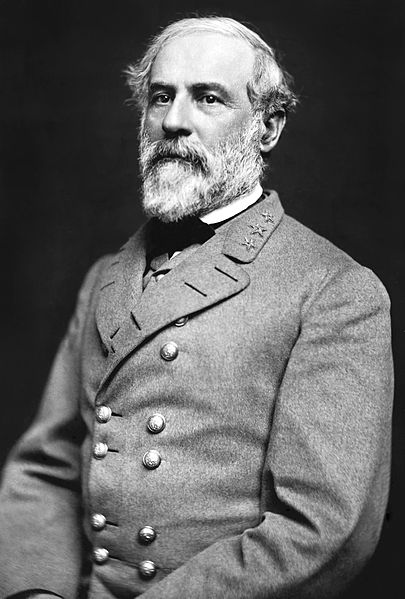
Confederate General Robert E. Lee, commander of the Army of Northern Virginia (via Wikimedia)
Obviously this was promoted by the white supremacists after the war, but in the 20th century many well-meaning people in the South who are not racist and by no means want to see a return of slavery or Jim Crow still retain elements of this story, particularly the vision of the Confederacy as a scrappy underdog. But everything in these two paragraphs including the downplaying of slavery in the causes of the Civil War was being taught when I grew up. It wasn’t until a civil war course in college (from James McPherson no less, boy was I a lucky dog there) that I read source material from the time and was deprogrammed.
The comparisons of the current statue removal to Protestant reformation iconoclasm seem particularly apt to me. You see, growing up in the South, Confederate generals were our saints. And the word “generals” is important. No one I knew growing up would think to revere, say, Jefferson Davis. Only the hard-core white supremacists revered Jefferson Davis. Real lost cause non-racist southerners revered Robert E. Lee. He was our Jesus (see: Dukes of Hazard). Every town in the south still has a Robert E Lee High School. Had I not gone to private school, I would have gone to Houston’s Lee High (I had a friend who went to college at Lehigh in New Jersey. Whenever he told folks in the South he went there, they would inevitably answer “yes, but where did you go to college.”) So Lee was by far and away at the top of the pantheon. Then you had folks like Stonewall Jackson and J.E.B. Stuart who were probably our Peter and Paul. Then all the rest of the generals trailing off through the equivalents of St. Bartholomew or whoever. We even had a Judas, General James Longstreet, who for a variety of reasons was reviled by the Lost Cause school and was blamed for many of Lee’s, and the South’s, losses.
If you want to see the Southern generals the way much of the South sees them, watch the movie Gettysburg, which I like quite a bit (based on the book Killer Angels, I believe, also a good read). The Southern Generals are good, talented men trying to make the best of a losing cause. Slavery is, in this movie, irrelevant to them. They are fighting for their beloved homes in the South, not for slavery. The movie even has Longstreet saying something like “we should have freed the slaves and then fired on Fort Sumter”.
The movie Gettysburg is excellent, but if you don’t know much about the actual battle, you might end up thinking the entire conflict revolved around the 20th Maine …
July 3, 2017
Meet the Romans with Mary Beard 3/3 – HD
Published on 16 May 2013
1. All Roads Lead to Rome
2. Street life
3. Behind Closed Doors
June 24, 2017
The Articles of Confederation – Lies – Extra History
Published on Jun 17, 2017
The Articles of Confederation gave the United States their name, but even beyond that, they exposed many of the issues that would underlie this new nation for the rest of its history. James Portnow interviews series writer Soraya Een Hajji about the Articles of Confederation!
May 24, 2017
QotD: The evil of political correctness
PC [political correctness] represents, in essence, the institutionalisation of dishonesty, of deception, where people are given carte blanche to behave in an immoral way — ‘erect those fences, release the dogs, deport those people’ — but are encouraged to make it all seem nice and ‘non-hostile’. It brings to mind Wilde’s observation in his essay ‘The Soul of Man Under Socialism’, that ‘the worst slave-owners were those who were kind to their slaves, and so prevented the horror of the system being realised by those who suffered from it, and understood by those who contemplated it’. So today, the worst people in politics are those who are nice about the individuals they repress, whether it’s British politicians whose policies keep migrants in degrading limbo in Calais yet who insist everybody use nice words when talking about those migrants, or American army officials who kill Afghans yet demand that their soldiers write only PC, gay-friendly messages on the bombs that do the killing (as, remarkably, happened during the Afghan War).
Some apologists for PC describe it as simply ‘being nice’: ‘institutionalised politeness’. There’s nothing remotely nice about PC. It is the friendly slave-owner; it suppresses open, honest discussion; it obfuscates the divisions and tensions in modern society through stymying the expression of certain ideas; it is the ornate lid on a society which, however civil we make our speech, remains fractured, sometimes tense, packed with clashing interests that will never be resolved by niceness. Whether PC is being used as a glossy cover for brutal policies, as in the case of Calais, or is being used to justify anew old racial and gender divisions, as it does when it demands that we recognise and celebrate the alleged differences between blacks and whites and between men (competitive) and women (consensual), PC is a tool of censorship and conservatism, its chief accomplishment being the repression of difficult words and ideas in the name of pacifying public life.
Brendan O’Neill, “The Calais migrants and the moral bankruptcy of PC”, Spiked, 2015-08-03.
March 11, 2017
Catherine the Great – III: Empress Catherine at Last – Extra History
Published on Feb 11, 2017
When the conspiracy to seat Catherine on the throne of Russia was exposed, she had to move quickly. While Peter III blundered through a day of miscommunications, Catherine swiftly seized power, secured the loyalty of the army, and demanded his abdication.
February 15, 2017
Yale’s name change doesn’t go far enough
Names matter, as the recent decision to rename Calhoun College at Yale clearly indicates. As a distinguished alumni of Yale, Calhoun rated having a college named after him, until modern awareness of his involvement in the slavery issue demanded that his name be expunged immediately. Case closed, right?
Well, not so fast. As it turns out that there are much worse examples of things named after slave owners and slave trade supporters at Yale:
Calhoun owned slaves. But so did Timothy Dwight, Calhoun’s mentor at Yale, who has a college named in his honor. So did Benjamin Silliman, who also gives his name to a residential college, and whose mother was the largest slave owner in Fairfield County, Conn. So did Ezra Stiles, John Davenport and even Jonathan Edwards, all of whom have colleges named in their honor at Yale.
Writing in these pages last summer, I suggested that Yale table the question of John Calhoun and tackle some figures even more obnoxious to contemporary sensitivities. One example was Elihu Yale, the American-born British merchant who, as an administrator in India, was an active participant in the slave trade.
President Salovey’s letter announcing that Calhoun College would be renamed argues that “unlike … Elihu Yale, who made a gift that supported the founding of our university … Calhoun has no similarly strong association with our campus.” What can that mean? Calhoun graduated valedictorian from Yale College in 1804. Is that not a “strong association”? (Grace Hopper held two advanced degrees from the university but had no association with the undergraduate Yale College.)
As far as I have been able to determine, Elihu Yale never set foot in New Haven. His benefaction of some books and goods worth £800 helped found Yale College, not Yale University. And whereas the 11th edition of the Encyclopaedia Britannica praises Calhoun for his “just and kind” treatment of slaves and the “stainless integrity” of his character, Elihu Yale had slaves flogged, hanged a stable boy for stealing a horse, and was eventually removed from his post in India for corruption. Is all that not “fundamentally at odds” with the mission of Peter Salovey’s Yale?
I anticipate a quicker response to these revelations than the administrators managed in the Calhoun College case…
H/T to Amy Alkon for the link.
January 22, 2017
Simón Bolívar – III: Leavings and Returns – Extra History
Published on Dec 3, 2016
The failure of his first attempted revolution in Venezuela only fanned the flames of Simón Bolívar’s determination to end Spanish reign over South America. Convinced that he needed to unite the entire continent in freedom, he gathered troops and set out with a new purpose. But his ferocity threatened to overwhelm his ideals.
January 5, 2017
Thomas Sowell
David Warren on the recently announced retirement of economist Thomas Sowell:
Born in the rural poverty of North Carolina, raised in Harlem, he remained personally acquainted with the fate of his race. A disciplined and unexciteable controversialist, he rose closest to exhibiting passion when discussing, for instance, the destruction of the black family by the Great Society of Lyndon Baines Johnson — how it arrested the social and economic advancement blacks had been making by their own efforts to overcome the monstrous history of slavery. By its “helping hand” the government rewarded unwed motherhood, punished enterprise, and promoted crime. In addition to family, it undermined religion, and finally helped install the abortion mills which disproportionally reduce the black population. And all of this by legislation drumrolled from the start with pseudo-Christian moral posturing.
Sowell could understand this through the economic analysis of moral hazard. Reward people for making irresponsible life choices, for discarding prudence and embracing victimhood and dependency — the result may be predicted. The question whether the policies were the product of invincible stupidity or demonic inspiration is moot: for stupidity is among the devil’s excavating tools. He is a master policy analyst, to whom men are merely statistics to be crunched; and to the stupid man he proposes the job-ready shovel, by which to dig his own grave.
October 26, 2016
QotD: Argument against slavery
Aphorism inspired by some smarmy political writing against libertarianism that I saw earlier today:
The polite answer to someone arguing that a slave should learn to love his chains is an extended counterargument, but the correct answer is a bullet through the arguer’s head.
Eric S. Raymond, Google+, 2016-10-15.
August 25, 2016
The Brothers Gracchi – I: How Republics Fall – Extra History
Published on 6 Aug 2016
Rome had doubled the size of its empire in a single generation, but such expansion came at great cost. The wars enriched the wealthy and impoverished the soldiers who fought in them. Into these turbulent times came a talented and well-connected young man named Tiberius Gracchus, who soon learned the power of appealing to the populace over the elite.
____________Rome had expanded rapidly during the 2nd century BCE. It now stretched from Spain to Greece, with holdings in Africa, and showed no signs of stopping. At home, this growth destabilized the entire economy. Slaves from captured lands became field workers for the wealthy. Common soldiers who used to own land could no longer tend it during the long campaigns, and returned to find themselves either bankrupt or forced to sell to the large slave-owning elites. Now these displaced landowners flooded Rome looking for work, but many of them remained unemployed or underemployed. In the midst of this, two boys named Tiberius and Gaius were born to the Gracchus family. They were plebeians, but of the most distinguished order. Their mother, Cornelia, was the daughter of Scipio Africanus. Their father was a two-time consul who’d celebrated two triumphs for winning great campaigns. But their father died early, so Cornelia raised her children alone and made sure they had a firm grounding in the liberal arts. As soon as he could, the elder boy, Tiberius, ran for office as a military tribune and joined the final campaign against Carthage. There he earned great honor for himself, and learned from the Scipio Aemilianus, his half-brother who also happened to be the leading general. Upon return to Rome, he ran for quaeastor and was sent to serve in the Numantian Wars in Spain. This time, the general he served under was struggling and suffered defeat after defeat. At the end, he tried to flee, only to be captured by the Numantians along with the entire army. The Numantians insisted on discussing surrender terms with Tiberius Gracchus, whose father had long ago earned their respect, and he successfully negotiated the release of 20,000 captured soldiers. In Rome, however, the elites looked on his treaty with scorn: they felt his surrender made Rome look weak. The families of the soldiers had a far different perspective: they celebrated Tiberius, and even saved him from punishment at the hands of the Senate. He had learned that power could be found in appealing to the people.
August 5, 2016
QotD: Slavery as an American invention
I started giving quizzes to my juniors and seniors. I gave them a ten-question American history test… just to see where they are. The vast majority of my students – I’m talking nine out of ten, in every single class, for seven consecutive years – they have no idea that slavery existed anywhere in the world before the United States. Moses, Pharaoh, they know none of it. They’re 100% convinced that slavery is a uniquely American invention… How do you give an adequate view of history and culture to kids when that’s what they think of their own country – that America invented slavery? That’s all they know.
Dr. Duke Pesta, in conversation with Stefan Molyneux, transcribed by David Thompson, 2016-07-27.


