
… the “slave power conspiracy” was a misnomer. Oh, the Southern senators all voted together, but that’s not a conspiracy. “Conspiracy” implies an end, a goal, and the slave power simply didn’t have one. Their actions were purely negative, and if that meant absolutely nothing got done, well, so be it. They were deeply skeptical of federal power anyway; if vetoing anything and everything that might somehow affect slavery meant that the nation would simply drift along, directionless, that suited them just fine.
But there was another conspiracy afoot in the 1850s: The abolition conspiracy. You don’t hear about this one in high school history because the victors write the textbooks, but it was quite real. And this one really was a conspiracy, in that they had a clear goal: The end of chattel slavery. And it was a conspiracy in a more fundamental sense, in that it was illegal. The so-called “slave power conspiracy” was obstructionist to the bone, but it’s perfectly legal for legislators to vote against proposed legislation. It’s not legal to advocate armed insurrection but that’s what the abolitionists did.
On October 16, 1859, a lunatic abolitionist named John Brown led a partisan band in an attack on the Federal arsenal at Harper’s Ferry, Virginia. He wanted to distribute the stolen guns to local slaves, thus sparking a race war. We know this because Brown was captured alive, and the great state of Virginia put him on trial, as they were legally required to do. Being a fanatic, and knowing that he was a dead man already, Brown took the opportunity to advertise his cause to the world …
At which point it became obvious that not only did Brown have the financial backing of several prominent Northerners, but he had the moral backing of a large segment of the Northern population. Brown became a martyr, literally — he was frequently compared to Jesus Christ in Northern periodicals. The important thing to note is this: Brown was captured in armed insurrection against the United States, and lots of the country was ok with it. This man simply decided that the legal processes could never result in the outcome he deemed morally necessary, so he took the law into his own hands — with the active connivance of prominent Northern financiers and intellectuals, and the avid approval of many Northern citizens.
Remember that, and Southern belligerency makes a whole lot more sense. The North was obviously ready to go to the gun in 1861, because they’d already gone to the gun in 1859. The “John Brown Moment,” then, is the point at which violence becomes inevitable, because one significant, influential segment of the country not only passively tolerates it, but actively cheers it.
Severian, “The John Brown Moment”, Rotten Chestnuts, 2019-07-16.
September 2, 2019
QotD: The abolition conspiracy of the 1850s
August 30, 2019
Academia and social media create a toxic, abusive environment
Phillip Magness recounts his experiences on Twitter when he pointed out that a major work that the New York Times used in their 1619 Project suffers from some significant statistical problems:

About a week ago I began scrutinizing how the New York Times‘ 1619 Project relied upon the work of the controversial “New History of Capitalism” genre of historical scholarship to advance a sweeping indictment of free markets over the historical evils of slavery. The problems with this literature are many, and prominent among them is its use of shoddy statistical work by Cornell University historian Ed Baptist to grossly exaggerate the historical effect of slave-produced cotton on American economic development. Baptist’s unusual rehabilitation of the old Confederacy-linked “King Cotton” thesis is unsupported by evidence and widely rejected by economic historians. His book The Half Has Never Been Told has nonetheless acquired a vocal following among historians and journalists, including providing the basis of a feature article in the Times series on slavery.
Curious about the following Baptist’s work had acquired despite its clear problems, I presented several questions on Twitter for its enthusiasts in the academy.
Were they aware that Baptist’s statistics, including his estimate of slavery’s share of the antebellum economy, arose from a documented mathematical error? Did they know his thesis had been scrutinized by leading economic historians, who found problems of misrepresented evidence and citations to documents that did not support what Baptist claimed? Had Baptist made any effort to respond to his critics? Or, more importantly, had he corrected his statistical mistakes, which continue to be cited in the press, in academic works, and even in congressional hearings on the legacy of slavery despite their inaccuracy?
Unless you’re new to the social media cesspit, you won’t be surprised to find out that his inquiries generated a lot of heated responses, including some academics indulging in “keyboard warrior” tactics to discredit him while avoiding engaging with the points he was attempting to raise.
Social media brings with it a mixed bag of everything from intellectual exchange to juvenile antics to a corrosive undermining of basic discourse, as my colleague Max Gulker recently catalogued. But there also seems to be something about Twitter that brings out the very worst in academics.
A quick foray onto the site and a few minutes of reading will provide ample evidence that Araujo’s outburst is not atypical among the regulars of History Twitter. Or Econ Twitter. Or English, Philosophy, and Sociology Twitter. Politics are often, though not always, the occasion, which in practice translates into distinguished professors at elite institutions striving their hardest to reduce themselves to intellectual parity with a certain presidential account’s own notorious stream of insults and derision.
The more disturbing examples come from the medium’s effects on scholarly discussion though.
In theory, a functional academic Twitter community would permit intellectuals to instantaneously present their ideas before peers all over the world and receive real-time feedback on research discoveries or scholarly challenges to controversial ideas. They could tap the expertise of others for suggestions on roadblocks in the processes of scholarly production. They could solicit constructive criticism from opponents. Or they could challenge problematic arguments in the existing literature, prompting scholars to examine the strengths and weaknesses of each. Imagine a global conference or seminar room where you can not only find academic peers working on common interests, but also solicit their advice — or push back against contested areas of their work.
August 15, 2019
Slavery in the American colonies
Tim Worstall outlines the history of slavery in the area under British rule that eventually became the United States:
This is so well known, what did in fact happen, that even Wikipedia has it unencumbered by wokeness.
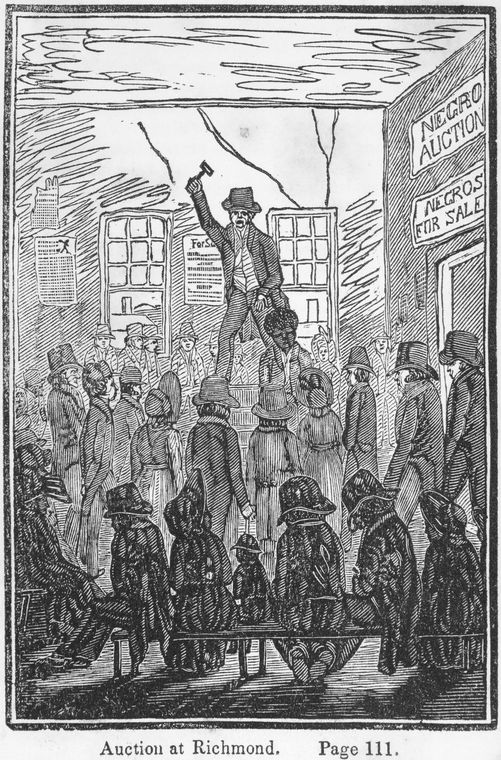
Auction at Richmond. (1834)
“Five hundred thousand strokes for freedom; a series of anti-slavery tracts, of which half a million are now first issued by the friends of the Negro.” by Armistead, Wilson, 1819?-1868 and “Picture of slavery in the United States of America” by Bourne, George, 1780-1845
New York Public Library via Wikimedia Commons.
The first 19 or so Africans to reach the English colonies arrived in Jamestown, Virginia, in 1619, brought by English privateers who had seized them from a captured Portuguese slave ship. Slaves were usually baptized in Africa before embarking. As English custom then considered baptized Christians exempt from slavery, colonists treated these Africans as indentured servants, and they joined about 1,000 English indentured servants already in the colony. The Africans were freed after a prescribed period and given the use of land and supplies by their former masters. The historian Ira Berlin noted that what he called the “charter generation” in the colonies was sometimes made up of mixed-race men (Atlantic Creoles) who were indentured servants, and whose ancestry was African and Iberian. They were descendants of African women and Portuguese or Spanish men who worked in African ports as traders or facilitators in the slave trade. For example, Anthony Johnson arrived in Virginia in 1621 from Angola as an indentured servant; he became free and a property owner, eventually buying and owning slaves himself. The transformation of the social status of Africans, from indentured servitude to slaves in a racial caste which they could not leave or escape, happened gradually.
There were no laws regarding slavery early in Virginia’s history. But, in 1640, a Virginia court sentenced John Punch, an African, to slavery after he attempted to flee his service. The two whites with whom he fled were sentenced only to an additional year of their indenture, and three years’ service to the colony. This marked the first legal sanctioning of slavery in the English colonies and was one of the first legal distinctions made between Europeans and Africans.
That’s the 1640 start, if you prefer that. When the distinction was made between black and white runaways from that indenture.
Worth noting that there was nothing unusual about indenture. Very similar indeed to the idea and practice of apprenticeship at the time. In effect, a time limited ownership of the labor – not the person – in return for certain benefits such as transport, sustenance, training and so on. This was actually the manner in which anyone at all entered the skilled working class. Sure, it all sounds a bit feudal but then that’s because it was rather the overhang of that feudal system. And it really did apply to people irrespective of skin colour or racial – even national – background.
England hadn’t had chattel slavery since the Anglo Saxons – Scotland and certain miners being evidence that all of Britain wasn’t so lucky – and it was rather more the Moors, Ottomans, Arabs, various places below the Olive Line, who still had full on slavery.
This then full changed in the colonies. And Anthony Johnson, that arrival from Angola in 1621, who makes the history here:
When Anthony Johnson was released from servitude, he was legally recognized as a “free Negro.” He became a successful farmer. In 1651 he owned 250 acres (100 ha), and the services of five indentured servants (four white and one black). In 1653, John Casor, a black indentured servant whose contract Johnson appeared to have bought in the early 1640s, approached Captain Goldsmith, claiming his indenture had expired seven years earlier and that he was being held illegally by Johnson. A neighbor, Robert Parker, intervened and persuaded Johnson to free Casor.
Parker offered Casor work, and he signed a term of indenture to the planter. Johnson sued Parker in the Northampton Court in 1654 for the return of Casor. The court initially found in favor of Parker, but Johnson appealed. In 1655, the court reversed its ruling. Finding that Anthony Johnson still “owned” John Casor, the court ordered that he be returned with the court dues paid by Robert Parker.
This was the first instance of a judicial determination in the Thirteen Colonies holding that a person who had committed no crime could be held in servitude for life. Though Casor was the first person declared a slave in a civil case, there were both black and white indentured servants sentenced to lifetime servitude before him.
That first instance of that full on chattel slavery in the colonies that became the US was firstly in 1655 – we even know the date, March 8 – and it was of a black owning a black. Oh, and free blacks owning slaves themselves was something that never did entirely disappear from American life, not until slavery itself did in the 1860s.
This all is more than mere pendantry too. Because slavery was not simply the invention of white Europeans to oppress black Africans. A few places in NW Europe – see England above – didn’t have slavery for several hundred years before the Atlantic trade. The rest of the world carried on, quite gaily, having it. To the point that the very word “Slav” is cognate with slave. The Mamluks who ruled Egypt were a caste of mercenaries composed of slaves. The Ottoman Sultan took as his tribute from the Balkans and elsewhere male children who were then sent to Egypt to enlist. Their own children could not join that ruling caste and army. It was a non-hereditary ruling army of slaves, weird as it may seem. Africa itself was awash with slavery and the Arab slave trade up into North Africa and the Mediterranean was a trade in something already happening.
July 21, 2019
QotD: History in a totalitarian age
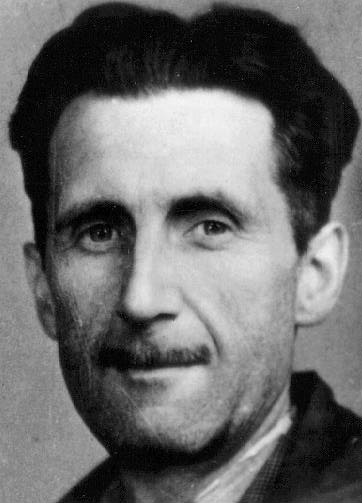
Orwell’s press card portrait, 1943
I know it is the fashion to say that most of recorded history is lies anyway. I am willing to believe that history is for the most part inaccurate and biased, but what is peculiar to our own age is the abandonment of the idea that history could be truthfully written. In the past people deliberately lied, or they unconsciously coloured what they wrote, or they struggled after the truth, well knowing that they must make many mistakes; but in each case they believed that “facts” existed and were more or less discoverable. And in practice there was always a considerable body of fact which would have been agreed to by almost everyone. If you look up the history of the last war in, for instance, the Encyclopaedia Britannica, you will find that a respectable amount of the material is drawn from German sources. A British and a German historian would disagree deeply on many things, even on fundamentals, but there would still be that body of, as it were, neutral fact on which neither would seriously challenge the other. It is just this common basis of agreement, with its implication that human beings are all one species of animal, that totalitarianism destroys. Nazi theory indeed specifically denies that such a thing as “the truth” exists. There is, for instance, no such thing as “Science”. There is only “German Science”, “Jewish Science”, etc. The implied objective of this line of thought is a nightmare world in which the Leader, or some ruling clique, controls not only the future but the past. If the Leader says of such and such an event, “It never happened” — well, it never happened. If he says that two and two are five — well, two and two are five. This prospect frightens me much more than bombs — and after our experiences of the last few years that is not a frivolous statement.
But is it perhaps childish or morbid to terrify oneself with visions of a totalitarian future? Before writing off the totalitarian world as a nightmare that can’t come true, just remember that in 1925 the world of today would have seemed a nightmare that couldn’t come true. Against that shifting phantasmagoric world in which black may be white tomorrow and yesterday’s weather can be changed by decree, there are in reality only two safeguards. One is that however much you deny the truth, the truth goes on existing, as it were, behind your back, and you consequently can’t violate it in ways that impair military efficiency. The other is that so long as some parts of the earth remain unconquered, the liberal tradition can be kept alive. Let Fascism, or possibly even a combination of several Fascisms, conquer the whole world, and those two conditions no longer exist. We in England underrate the danger of this kind of thing, because our traditions and our past security have given us a sentimental belief that it all comes right in the end and the thing you most fear never really happens. Nourished for hundreds of years on a literature in which Right invariably triumphs in the last chapter, we believe half-instinctively that evil always defeats itself in the long run. Pacifism, for instance, is founded largely on this belief. Don’t resist evil, and it will somehow destroy itself. But why should it? What evidence is there that it does? And what instance is there of a modern industrialized state collapsing unless conquered from the outside by military force?
Consider for instance the re-institution of slavery. Who could have imagined twenty years ago that slavery would return to Europe? Well, slavery has been restored under our noses. The forced-labour camps all over Europe and North Africa where Poles, Russians, Jews and political prisoners of every race toil at road-making or swamp-draining for their bare rations, are simple chattle slavery. The most one can say is that the buying and selling of slaves by individuals is not yet permitted. In other ways — the breaking-up of families, for instance — the conditions are probably worse than they were on the American cotton plantations. There is no reason for thinking that this state of affairs will change while any totalitarian domination endures. We don’t grasp its full implications, because in our mystical way we feel that a regime founded on slavery must collapse. But it is worth comparing the duration of the slave empires of antiquity with that of any modern state. Civilizations founded on slavery have lasted for such periods as four thousand years.
When I think of antiquity, the detail that frightens me is that those hundreds of millions of slaves on whose backs civilization rested generation after generation have left behind them no record whatever. We do not even know their names. In the whole of Greek and Roman history, how many slaves’ names are known to you? I can think of two, or possibly three. One is Spartacus and the other is Epictetus. Also, in the Roman room at the British Museum there is a glass jar with the maker’s name inscribed on the bottom, “Felix fecit“. I have a mental picture of poor Felix (a Gaul with red hair and a metal collar round his neck), but in fact he may not have been a slave; so there are only two slaves whose names I definitely know, and probably few people can remember more. The rest have gone down into utter silence.
George Orwell, “Looking back on the Spanish War”, New Road, 1943 (republished in England, Your England and Other Essays, 1953).
May 19, 2019
Siege of Vienna & Queen Nzinga – Lies – Extra History
Extra Credits
Published on 18 May 2019Writer Rob Rath talks about all the cool stories and facts we didn’t get to cover in our two special short series on the Siege of Vienna, and the life of Queen Nzinga.
Join us on Patreon! http://bit.ly/EHPatreon
From the comments:
Extra Credits
Timestamps:
2:00 – Demonetization sucks. THANK YOU PATRONS!
7:15 – Istanbul was Constantinople now it’s Istanbul not Constantinople been a long time gone oh Constantinople
11:07 – the arrival of the Winged Hussars wasn’t exactly the same as Rohan answering Gondor’s call for aid
16:20 – Nzinga’s controversial role in slavery
19:25 – what’s next on Extra History?
21:02 – SIX DEGREES OF WALPOLERecommended reading:
The Enemy at the Gate: Habsburgs, Ottomans, and the Battle for Europe by Andrew Wheatcroft
The Siege of Vienna: The Last Great Trial Between Cross & Crescent by John Stoye
Hispanics and the Civil War: From Battlefield to Homefront by the National Park ServiceMusic videos:
Queen Nzinga: https://www.youtube.com/watch?v=N94H6F0WObcSiege of Vienna: https://www.youtube.com/watch?v=jQ_HV57cgbg
May 13, 2019
U.S. Civil War – Surprising Soldiers – Extra History
Extra Credits
Published on 11 May 2019Historians have been learning that the US Civil War armies were a lot more diverse than previously accounted for — partly because many soldiers who hailed from other countries and nations used adopted names. Chinese, Hawaiian, Hispanic, and Cherokee soldiers all participated on both sides of the US civil war — suffering even more conflict in some cases.
Researchers are beginning to learn that the makeup of the Union and Confederate armies in the US Civil War was a lot more nuanced and diverse than we had previously known. Here is an episode on the accounts of some of those surprising soldiers!
Join us on Patreon! http://bit.ly/EHPatreon
April 29, 2019
Queen Nzinga – Rise of a Legend – Extra History – #1
Extra Credits
Published on 27 Apr 2019Nzinga didn’t start out as a queen — but when she saw how incompetently her brother was running affairs in Ndongo (what would become Angola), she took advantage of his decision to send her to negotiate with the Portuguese — much to his grief later. Nzinga established herself against colonial forces and did not budge.
Queen Nzinga of the Ndongo and Matamba Kingdoms, a scion of the Mbundu people, will spend forty years standing between the Portuguese and their ambitions, using everything at her command — her cunning, her ruthless intellect, her military acumen, even the bodies of her people — whatever it takes to succeed.
Thanks again to Cassandra Khaw for guest-writing this mini-series!
Join us on Patreon! http://bit.ly/EHPatreon
December 7, 2018
The Anti-Authoritarian Politics of Harry Potter
Foundation for Economic Education
Published on 6 Dec 2018JK Rowling’s wizarding world isn’t all wands, charms, and transfigurations. The magical universe inhabited by characters like Harry Potter and Newt Scamander is rife with the dangerous incompetence of adults, unchecked corruption, and appalling abuses of power, and not just by Voldemort or Grindelwald.
_____________
Written & Produced by Sean W. Malone
Edited by Arash Ayrom & Sean W. Malone
August 19, 2018
Poor whites in the pre-Civil War South
Colby Cosh retweeted this fascinating thread by Keri Leigh Merritt (embed through the ThreadReaderApp):
August 17, 2018
Thomas Clarkson: The First Abolitionist
Foundation for Economic Education
Published on 26 Jul 2018The brutal and cruel transatlantic slave trade lasted for more than 300 hundred years. In 1785, Thomas Clarkson, a man you’ve probably never heard of, firmly held to his belief that no man can rightly claim ownership over another. That year he vowed to end the transatlantic slave trade. This is his story.
July 22, 2018
Debunking the “King Cotton” school of history
In the current issue of Reason, Dierdre McCloskey discusses the claim that America became rich only or primarily due to exploitation of slave labour in the south:
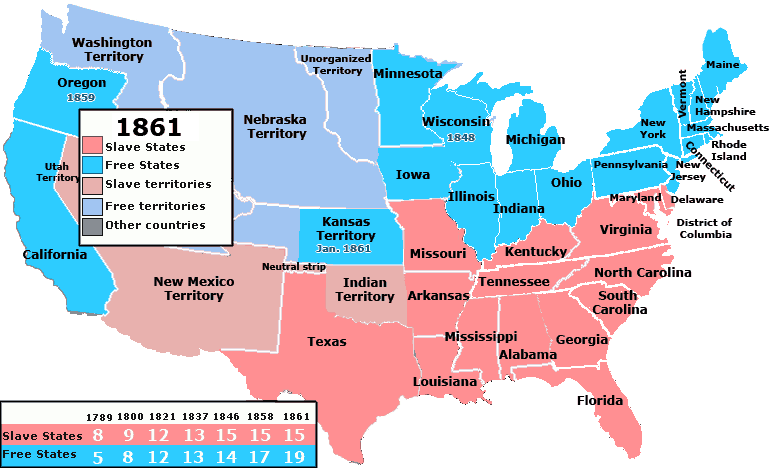
Map showing which areas of the United States did and did not allow slavery between January 1861 to February 4 1861. On February 4 1861, the Confederate States of America was created. Territories and states which had not specifically banned slavery are colored red/pink.
Map by Golbez, via Wikimedia Commons.
In his second inaugural, Abraham Lincoln declared that “if God wills that [the Civil War] continue until all the wealth piled by the bondsman’s 250 years of unrequited toil shall be sunk…as was said 3,000 years ago, so still it must be said, ‘the judgments of the Lord are true and righteous altogether.'”
It is a noble sentiment. Yet the economic idea implied — that exploitation made us rich — is mistaken. Slavery made a few Southerners rich; a few Northerners, too. But it was ingenuity and innovation that enriched Americans generally, including at last the descendants of the slaves.
It’s hard to dispel the idea embedded in Lincoln’s poetry. TeachUSHistory.org assumes “that northern finance made the Cotton Kingdom possible” because “northern factories required that cotton.” The idea underlies recent books of a new King Cotton school of history: Walter Johnson’s River of Dark Dreams (Harvard University Press), Sven Beckert’s Empire of Cotton: A Global History (Knopf), and Edward Baptist’s The Half Has Never Been Told: Slavery and the Making of American Capitalism (Basic Books).
The rise of capitalism depended, the King Cottoners claim, on the making of cotton cloth in Manchester, England, and Manchester, New Hampshire. The raw cotton, they say, could come only from the South. The growing of cotton, in turn, is said to have depended on slavery. The conclusion — just as our good friends on the left have been saying all these years — is that capitalism was conceived in sin, the sin of slavery.
Yet each step in the logic of the King Cotton historians is mistaken. The enrichment of the modern world did not depend on cotton textiles. Cotton mills, true, were pioneers of some industrial techniques, techniques applied to wool and linen as well. And many other techniques, in iron making and engineering and mining and farming, had nothing to do with cotton. Britain in 1790 and the U.S. in 1860 were not nation-sized cotton mills.
Nor is it true that if a supply chain is interrupted there are no possible substitutes. Such is the theory behind strategic bombing, as of the Ho Chi Minh trail. Yet only in the short run is it “necessary” for a good to come from a particular region by a particular route. A missing link can be replaced, as in fact it was during the blockade of raw cotton from the South during the war. British and other European manufacturers turned to Egypt to provide some of what the South could not.
May 14, 2018
The Empire of Mali – The Final Bloody Act – Extra History – #5
Extra Credits
Published on 12 May 2018The Mali Empire comes to an end after the rise of rival powers and weakened by colonial influences, but not without leaving a legacy as a place of wealth and splendor.
May 7, 2018
The Empire of Mali – The Cracks Begin to Show – Extra History – #4
Extra Credits
Published on 5 May 2018After Mansa Musa’s death, the rivers of gold started drying up, and bitterness snaked out from the fringes of the vast Mali Empire. Wars were coming…
EDIT: 7:45 says 1930s. Our scripts have this written down as the 1370s. 🙂
April 2, 2018
African-American history
At According to Hoyt, Amanda S. Green is doing a deep dive on Thomas Sowell’s book Black Rednecks and White Liberals. In this installment, she discusses the history of African-Americans from first arrival in the early 1600s to the post bellum exodus from former slave states to the northern cities:
If you were to ask most anyone how African-Americans first came to the United States, you’d be told they came as slaves. Thanks to our schools and public misconception, we are not taught about those who came as indentured servants. Of course, we aren’t taught about the whites who came over in similar circumstances. To be honest, it is something I learned the hard way when I was in school too many years ago to count. I made the mistake of asking about indentured servants in a history class and being told such things hadn’t existed here in the States, at least not for whites. Funny, I have the original handwritten advertisement that had to be published notifying the people of New Jersey that my own ancestors had fulfilled the terms of their indenture and were now free persons.
That is a part of our history, be you speaking about black or white history, we have chosen to forget. Unfortunately, that has led to more than a little “confusion” about our nation and problems we still encounter today.
The first misconception that needs to be shattered is that blacks first came to America as slaves. That’s wrong. The first Africans brought to Colonial Virginia in 1619 came as indentured servants, a status shared by a number of whites. (BRAWL, pg. 41) This status of being “indentured” meant they could work off their indenture or buy it out. Once they had, they became free persons. The first law recognizing perpetual slavery was passed in 1661 in Virginia. (Note, this is part of the “red neck” sector of what would become the United States. More on that later.)
[…]
Many of the issues caused by this mass migration to the North came about because of the differences between the “free people of color” native to the North and those moving there. The northern “free people of color” were more literate and more urbanized than their Southern counterparts. In 1850, most free people of color in the North were literate while most slaves were not. It would take 50 years for most people of color to become literate or, to put it into context, two generations. Urbanization didn’t really occur until 1940. As Sowell notes, the “size of the free black population increased after the United States came into existence as an independent nation, as the ideology of freedom associated with the American revolution led most Northern states to abolish slavery, and even in the South, enough white slave owners freed their slaves to cause the free black population there to nearly double and then redouble between 1790 and 1810.” (BRAWL, pg. 41)
Among the consequences of the extreme range of education and acculturation within the Negro community has been the larger society’s erection of racial barriers provoked by black rednecks, which barriers then deeply offended those individuals at the other end of the cultural spectrum … That internal social barriers within the black community became more pronounced at the same time as white barriers against blacks in general suggests that more than coincidence was involved, since both occurred in the wake of the mass arrival of black rednecks from the South. (BRAWL, pg. 44-45)
These barriers prevented the “cultural elites from separating themselves as much as they would like from the lower class blacks”. It forced them to live close to those they wanted to be set apart from. It forced them to share schools, churches and other institutions essential to their way of life. This led to a hypocrisy Sowell notes – one where these elites protested against the social and economic barriers raised by the whites while, in turn, wanting to erect those same barriers between themselves and the lower class blacks.
Another thing Sowell points out is that it took more than a light complexion or money to become an elite in this society. There was a behavioral aspect as well. One illustration of this behavior is the more stable family life the black elites enjoyed. Stable families with few separations or divorces marked this black elite society, unlike its counterpart.
So what changed? What curbed the social freedoms the “free people of color” enjoyed in the North prior to the Civil War?
March 9, 2018
“Cracker culture”
At According to Hoyt, Amanda S. Green is doing a deep dive on Thomas Sowell’s book Black Rednecks and White Liberals. In her discussion of the lead essay that gave its name to the book, there’s an interesting digression on southern white “cracker culture” and its origins:
According to Sowell, this sub-culture began in England and was transplanted to the South when the area was settled. Over the decades and centuries, it has died out in England and has “largely” died out in the South, no matter what the race. However, it has survived in the “poorest and worst of the urban black ghettos.” (BR&WL, p. 2)
Sowell’s first premise of the common sub-culture is followed quickly by a second. “It is not uncommon for a culture to survive longer where it is transplanted and to retain characteristics lost in its place of origin.” (BR&WL, p. 2) To support this idea, he gives examples of linguistic artifacts in Mexican Spanish and the French spoken in Quebec. There are German dialects that have died out in their homeland but continue to exist here in the U. S. In fact, there are examples of this in the South. But it goes beyond just linguistics. This permeation of the common sub-culture has fingers in all aspects of Southern life. And these differences between Southern and Northern life were noted more than a century ago.
Southern whites not only spoke the English language in very different ways from whites in other regions, their churches, their roads, their homes, their music, their education, their food, and their sex lives were all sharply different from those of of New England in particular. (BR&WL, p. 2)
It was easy for Frederick Law Olmsted and Alexis de Tocqueville to say the differences had their roots in slavery. Sowell admits such a conclusion seemed reasonable but that it will fail under a “closer scrutiny of history”.
Imagine that. Someone wants to actually look beyond the obvious to see what the roots of the lifestyle and situation might be. It’s too bad our schools and universities aren’t teaching this sort of critical thinking to their students.
It is perhaps understandable that the great, overwhelming moral curse of slavery has presented a tempting causal explanation of the peculiar subculture of Southern whites, as well as that of blacks.Yet this same subculture had existed among Southern whites and their ancestors in those parts of the British Isles from which they came, long before they had ever seen a black slave. (BR&WL, p. 3)
With this as his starting point, Sowell turns his attention to the study of the nature of the “crackers” and “rednecks” in Britain long before they arrived in America.
According to Sowell, most of the “common white people” who settled the South, came from the northern border of England, that no-man’s land between England and Scotland. Others came from Ulster County, Ireland. To say those were areas where there was little law and order might be putting it mildly. They were at a minimum, resistant to authority. Yes, if you’re thinking of Mel Gibson in Braveheart right now, you aren’t the only one. The majority of these settlers came to the South before the “progress” of the 18th Century, the Anglicization of Scotland, Wales and Ireland. Professor Grady McWhiney, in Cracker Culture: Celtic Ways in the Old South, writes:
…had the South been peopled by nineteenth-century Scots, Welshmen, and Ulstermen, the course of Southern history would doubtless have been radically different. Nineteenth-century Scottish and Scotch-Irish immigrants did in fact fit quite comfortably into northern American society. (BR&WL, p. 5)
But what does this really mean?
What the rednecks or crackers brought with them across the ocean was a whole constellation of attitudes, values, and behavior patterns that might have made sense in the world in which they had lived for centuries, but which would prove to be counterproductive in the world to which they were going — and counterproductive to the blacks who would live in their midst for centuries before emerging into freedom and migrating to the great urban centers of the United States, taking with them similar values. (BR&WL, p. 6)
These attitudes, values and behavior patterns included “an aversion to work, proneness to violence, neglect of education, sexual promiscuity, improvidence, drunkenness, lack of entrepreneurship, reckless searches for excitement, lively music and dance, and a style of religious oratory marked by strident rhetoric, unbridled emotions, and flamboyant imagery … Touchy pride, vanity, and boastful self-dramatization were also part of this redneck among people from regions of Britain “where the civilization was the least developed.” (BR&WL, p. 6)
Sowell makes clear, however, (mainly because he has to clarify statements that shouldn’t need to be clarified because too many have taken easy offense and used that offense to attack and twist his words) that all this doesn’t mean cultures have remained unchanged over the years or that there are no differences between blacks and whites in this subculture. Even so, “what is remarkable is how pervasive and how close the similarities have been.” (BR&WL, p. 7)
[…]
Pride had yet another side to it. Among the definitions of a “cracker” in the Oxford dictionary is a “braggart” — one who “talks trash” in today’s vernacular — a wisecracker. More than mere wisecracks were involved, however. The pattern is one said by Professor McWhiney to go back to descriptions of ancient Celts as “boasters and threateners, and given to bombastic self-dramatisation.” Examples today come readily to mind, not only from ghetto life and gangsta rap, but also from militant black “leaders,” spokesmen or activists. What is painfully ironic is that such attitudes and behavior are projected today as aspects of a distinctive “black identity,” when in fact they are part of a centuries-old pattern among the whites in whose midst generations of blacks lived in the South. (BR&WL, pp. 12-13)


