Quotulatiousness

November 2, 2020

In the University of Michigan’s Sexual Health Certificate Program, “mainstream sexual health issues that affect wide swaths of the population, such as marriage, reproduction, and family life, were treated as niche topics”

Filed under: Education, Health, Politics, USA — Tags: , , , , , , — Nicholas @ 05:00

In Quillette, Tim Courtois explains what the University of Michigan’s Sexual Health Certificate Program is actually intended to teach:

When I signed up for the University of Michigan’s unique, year-long “Sexual Health Certificate Program” (SHCP), however, I truly did believe the experience would be both professionally and intellectually rewarding. I care about sexuality. I know that it is a fundamental component of the human search for joy and meaning. As a Michigan-based psychotherapist and licensed professional counselor, I wanted to deepen my understanding of sexuality, and become better equipped to provide care for the many clients who come to me with issues related to sexual health. The American Association of Sexuality Educators, Counselors, and Therapists sounded like the perfect fit for me, and the idea of becoming an AASECT-certified sex therapist appealed to me. I applied and was accepted for the 2019-2020 cohort. When I showed up, my class included participants from around the world — including Iceland, Egypt, Lebanon, and China — just as you’d expect at the kind of high-value, authoritative program that we all believed we’d signed up for.
The doubts started to creep in early, though — on day one, to be exact. Our first classroom module was titled “Sexual Attitude Reassessment.” I amused myself with the thought that this sounded like an unsettling euphemism for a brainwashing session. Sadly, that’s what it was.

It quickly became clear that the issue of sexuality — the ostensible subject — often would serve merely as a pretext for more general harangues about society, and the urgent need to remake it according to AASECT’s ideological blueprint. In a keynote lecture entitled “Why Fetishism Matters,” the speaker argued that the world we inhabit is socially constructed, and told us (with what now seems like admirable candor), “I’m not neutral. I’m here to recruit you to a particular point of view about how kink should be valued.” The same speaker said that he’d been accused of teaching students that any form of sexual behavior is acceptable as long as there is consent from all parties. “Yes, that’s exactly right,” he said. Clearly, our attitude “reassessment” was well underway.
From the get-go, the scientific content was mostly superficial, and was often undercut by claims that the very idea of truth is a harmful (and even oppressive) construct. The teaching was not so much impartial and informative as it was evangelistic. Yet it was also self-contradictory: Declarations that there are no real “correct” moral values were uttered (without irony) alongside absolutist proclamations about the correct way to understand sex — and morality.

As I learned, “Sexual Attitude Reassessment” (SAR) is an established term in the field, one that is often used to describe curriculum content that serves to educate sexual-health professionals about the wide range of sexual experiences that they may encounter among clients. The object is to ensure they won’t be shocked when such encounters occur, and to invite them to reassess their judgments and assumptions about various expressions of sexuality. These are valid and important goals. Unfortunately, the SAR in the SHCP descended into an exercise in overstimulation and desensitization — specifically, two full days of pornographic videos and interviews. At times, it felt like the famous brainwashing scene from A Clockwork Orange. There was a series of videos of people masturbating (one of which involved a strange interaction with a cat), a woman with “objectiphilia” who had a sexual attraction to her church pipe organ, various sadomasochistic acts, and a presentation on polyamory designed to make it clear that the polyamorous lifestyle is healthy, wholesome, and problem-free.

The focus on BDSM was a particular fixation throughout the program. In the SAR, we were shown videos of a woman meticulously applying genital clamps to the scrotum of a willing man, and a dominatrix teaching a class how to properly beat people while demonstrating on an eager participant. We also watched an interview with a sex-dungeon “dom” (the male equivalent of a dominatrix) who described one of his experiences: His client had instructed him, as the dom recounted it, “I want you to bind me and then beat me until I scream. And no matter how much I scream or beg you to stop, I want you to keep beating me.” The dom did as he was told, continuing the beatings through the customer’s begging and pleading, until the client went totally limp and silent, seeming to dissociate. At this point, the dom unbound the man, who then began to weep uncontrollably in the dom’s arms.

BDSM is a real and active sexual subculture, and I don’t object to its inclusion in the course materials. But I was shocked to see how much further the professors in the program took things, insisting that BDSM behaviors — up to and including the sexual “Fight Club” style of behavior described above — must be uncritically viewed as wholesome and beautiful. Students learned to sing from the same psalm book, with one memorably exclaiming “I’m so inspired by the wisdom and beauty in the BDSM community!” and insisting that the behavioral codes observed among BDSM participants can help us create a similar climate of safety and respect “in all our relationships.”

The program was focused on an agenda of “centering” the experience of minorities — in this case, sexual minorities. This meant that huge portions of time in class after class were spent focusing on BDSM, LGBTQIA+ issues, and polyamory, not to mention the obligatory discussions of oppression and privilege that were shoehorned into every discussion. Meanwhile, mainstream sexual health issues that affect wide swaths of the population, such as marriage, reproduction, and family life, were treated as niche topics. Further, while many Americans view sexuality through the prism of faith, religion hardly came up at all. And when it did, it was typically so that religious values could be denigrated. Even the few religious people in the program got the message: Whenever any made passing reference to their own observant religiosity, it was usually in a spirit of shame or penance.

In a few brief web searches to find a public domain or Creative Commons image to use for this post, I realized that web search engines offer “safe” options for a reason…

October 31, 2020

Atun-Shei’s Dracula

Filed under: Books, Britain, Europe, History, Media — Tags: , , , , , — Nicholas @ 06:00

Atun-Shei Films
Published 30 Oct 2020

🎃 Get 50% OFF 👉🏻 your first 6 months of Babbel 🕰 limited time only! HERE: http://bit.ly/AtunSheiFilms

An in-depth analysis of Dracula, the original 1897 book by Bram Stoker, possibly the most influential horror novel ever written. Why has the Count enjoyed such longevity in popular culture? What made Dracula so scary for Victorian readers? And what – pray tell – makes vampires so attractive?

Support Atun-Shei Films on Patreon ► https://www.patreon.com/atunsheifilms

Leave a Tip via Paypal ► https://www.paypal.me/atunsheifilms

Buy Merch ► teespring.com/stores/atun-shei-films

#BramStoker #Dracula #Analysis

Reddit ► https://www.reddit.com/r/atunsheifilms
Twitter ► https://twitter.com/atun_shei

~REFERENCES~

[1] “Dracula Movies” (2016). IMDB https://www.imdb.com/list/ls058255047/

[2] Leslie S. Klinger. The New Annotated Dracula (2008). W.W. Norton & Company, Page xvi

[3] Klinger, Page xxi

[4] Dr. Andrzej Diniejko. “Slums and Slumming in Late-Victorian London.” The Victorian Web http://www.victorianweb.org/history/s…

[5] Gill Davies. “London in Dracula; Dracula in London” (2004). Literary London: Interdisciplinary Studies in the Representation of London, Volume 2 Number 1 http://www.literarylondon.org/london-…

[6] Klinger, xxxii-xli

[7] “An 1897 Review of Bram Stoker’s Dracula” (2019). Literary Hub https://bookmarks.reviews/an-1897-rev…

[8] “The Spectator‘s Review of Dracula, 1897″ (2012). The Spectator https://www.spectator.co.uk/article/t…

[9] olly Furneaux. “Victorian Se•ualities” (2014). British Library https://www.bl.uk/romantics-and-victo…

[10] Klinger, Page xvii-xviii

[11] Greg Buzwell. “Daughters of Decadence: The New Woman in the Victorian Fin De Siécle” (2014). British Library https://www.bl.uk/romantics-and-victo…

October 4, 2020

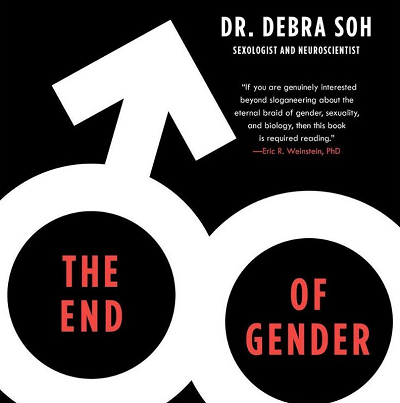
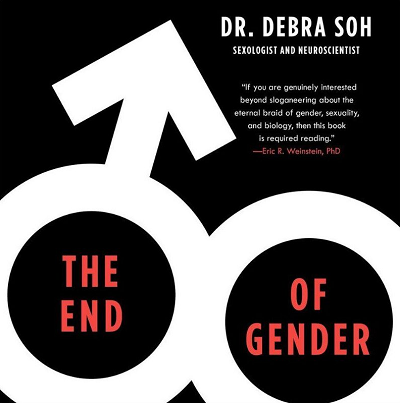
The End of Gender by Dr. Debra Soh

Filed under: Books — Tags: , , , — Nicholas @ 03:00

In The Critic, Louise Perry reviews Debra Soh’s recent book The End of Gender:

Contrary to what is commonly believed, sex is defined not by chromosomes or our genitals or hormonal profiles, but by gametes, which are mature reproductive cells. There are only two types of gametes: small ones called sperm that are produced by males, and large ones called eggs that are produced by females. There are no intermediate types of gametes between egg and sperm cells. Sex is therefore binary. It is not a spectrum.

The chapters in the first two thirds of the book are mostly concerned with the transgender movement. Soh works through trans activist claims with admirable thoroughness — no, not all people with gender dysphoria will benefit from transitioning; yes, natal males do have a physical advantage over natal females in sports; no, not all trans people are motivated to transition for the same reasons.

This last point is particularly explosive in political terms, but there is no doubt that Soh is on firm ground scientifically. Researchers have long been aware of the existence of two distinct categories of trans women — that is, natal males who identify as women. One group — sometimes called “homosexual transsexuals” — usually transition at a young age, have sexual relationships exclusively with men, and tend to be stereotypically feminine from childhood.

Another group — known as “autogynephiles” — have a very different profile: transitioning later, usually having sexual relationships exclusively with women, and often living as conventionally masculine men until they begin the transition process. And this second group are motivated to transition as a result of autogynephilia (sexual arousal at the idea of being a woman), a fact that trans activists are reluctant to acknowledge, preferring, as Soh puts it, “to neutralise the sexual aspect of their wishes to transition”. But she attempts an optimistic argument for tolerance:

    In our sex-negative culture, trans women’s concerns are dismissed as a sexual fetish if anything about transitioning relates to sexual desire … I advocate for compassion and not being judgmental.

Soh, who writes for Playboy and other outlets, describes herself as sex-positive and supports destigmatising all discussion of sexual desire. Although I sometimes grew bored with the regular detours in which Soh writes about how much she loves going clubbing with her gay friends, or describes the confiding relationships she has formed with the parents of trans-identifying children, I understand the purpose of these sections: reassurance. This is a book written by a liberal for liberals, which prescribes a medicinal dose of yet more liberalism — more tolerance, more scientific inquiry, and more intellectual diversity. And liberal readers will no doubt be comforted that Soh’s live-and-let-live framing allows them to play the role of open-minded progressive, rather than (as trans activists would have it) bigoted reactionary.

August 22, 2020

Debra Soh’s new book is “a cancel-culture grenade”

Filed under: Books, Health, Media, Politics — Tags: , , , , , , — Nicholas @ 05:00

Jen Gerson knows that any positive mention of Debra Soh’s The End of Gender: Debunking Myths About Sex and Identity has a strong resemblance to square-dancing in a minefield. Cancellations may fall like raindrops on the career of anyone so unenlightened as to even acknowledge the existence of such a work:

For that, at its heart, is what Soh’s book is: a lucid discussion of the best science we have to date on the nature of gender and sex, written for a lay audience. What gives the title its sizzle is not the content, but rather the cultural climate in which it is being published.

It maps the depth, scope and scale of current Culture War trenches in this particular theatre of battle. The End of Gender stomps on tripwires like the gender binary, whether transgender women are women, autogynephilia, Rapid Onset Gender Dysphoria, bathroom bans, and more.

It’s a cancel-culture grenade.

That’s not because these subjects ought to be contentious. Soh’s approach and tone are largely neutral. Rather, the controversy the book will inevitably incite is a reflection of a culture that has been warped into a state of existential terror by the very notion that these ideas can be responsibly discussed.

Soh begins by defining her terms.

So much of the debate around the most difficult topics of sex and gender stem from the simple fact that we are misusing the basic language. For example, sex and gender are not interchangeable concepts, even though they are often treated as such.

Sex is a term of biology. One’s sex, Soh argues, is determined by his or her gametes. With the exception of rare intersex disorders, 99 per cent of the population has a clearly defined biological sex that slots into one of two dimorphic categories: male or female.

Gender is more complicated. It’s now popular to state that there are more than two genders, but Soh disputes this. She argues that gender — or the set of characteristics that signal one’s sex to society — is also dimorphic. For 99 per cent of the population, gender correlates with sex. Further, even when expressions of gender are at odds with one’s biological sex, this, too, is mediated by biology. Whether one presents as gender typical or gender atypical is the result of prenatal testosterone exposure.

Soh notes that claiming to be gender non-binary, or gender fluid — or any one of a thousand variations that transcend the limiting concepts of male and female — is increasingly trendy, especially among teenagers and young adults. It seems to be the latest form of identity experimentation.

There are two reasons for this trend.

The first is that seeing the world through an intersectional framework encourages progressives to reverse the traditional hierarchies of race, sex and power. Therefore, claiming a marginalized identity — like genderqueer non-binary unicorn — accrues status within progressive peer circles.

The second is that the culture has undergone a massive awakening to transgender rights over the past decade. This has contributed expressive categories and vocabularies for people who otherwise might have struggled to find the language to explore their most authentic selves. As the cues, like cosmetics and dress, that we used to signal our gender are socially constructed, gender expression is limited only by our creativity.

QotD: Sex-differentiated status hierarchies

Filed under: Health, Politics, Quotations, USA — Tags: , , , , , — Nicholas @ 01:00

Jordan Peterson had this to say about sex-differentiated status hierarchies:

    Girls can win by winning in their own hierarchy — by being good at what girls value, as girls. They can add to this victory by winning in the boys’ hierarchy. Boys, however, can only win by winning in the male hierarchy. They will lose status, among girls and boys, by being good at what girls value. It costs them in reputation among the boys, and in attractiveness among the girls. Girls aren’t attracted to boys who are their friends, even though they might like them, whatever that means. They are attracted to boys who win status contests with other boys.

“whatever that means”. Heh. Shivvy way to say, “which means nothing”.

When JP discusses sex differences, he could be reading CH posts. Whatever one thinks of the criticisms leveled against him (some are valid), he does have a decent grasp of the sexual market and how men and women navigate divergent routes through an ocean of mate prospects to get what they want.

However, this is one of the rare instances when I disagree with his premise. He’s generally correct that, at least within the bounds of our current cultural arrangement, women have two status hierarchies available to them while men only have one. Our gynarcho-tyranny not only encourages but aggressively impresses upon women the urgency and even moral duty of succeeding in male domains (leaning in), while simultaneously encouraging men to sacrifice their status within their own male domains to make way for more women (and consequently rendering themselves less sexually attractive to women who are now their equal or higher in social status).

Women who do succeed in the man’s world can expect to ascend the intrafemale status ladder (more precisely, the intra-feminist status ladder), but where JP is wrong is assuming these women don’t also suffer an SMV status loss the near-equivalent of the SMV status loss suffered by men who succeed at girlie games of one-uppance.

Just as girls aren’t attracted to effeminate males, and other men are repulsed by nancyboys, the inverse is as true: men aren’t attracted to masculine, status-striving girls, and other women don’t subconsciously look up to mouthy careerist shrikes with the same mix of envy and admiration that they look up to physically beautiful women.

CH, “Sex-Based Status”, Chateau Heartiste, 2018-06-04.

August 7, 2020

QotD: Celibacy and chastity

Filed under: History, Quotations, Religion — Tags: , , , , — Nicholas @ 01:00

Despite the common misunderstanding of the word, “celibate” does not refer to someone who abstains from sex. “Celibate” refers to someone who forgoes marriage — the part about not having sex is implied, at least in the Christian world, give or take an Alexander VI or two. “Chaste,” at the same time, doesn’t quite mean what people think it does: It refers principally to the abstention from extramarital sex, which in the case of the celibate means abstention from sex categorically. But chastity is part of marriage, too, describing a reverent attitude toward sex. In the Christian view (which is to say, in the view of Western civilization until ten minutes ago), the procreative act is the means by which men and women in union with one another participate in God’s creative work. “Chastity” means a lot more than mere abstinence. Chastity isn’t some kind of genital veganism.

There has been some pretty elevated stuff written on that subject, and if you want to take that particular high road, then Professor Robert George of Princeton is your guy. But consider the low road, too. There’s another conclusion, maybe a little bit cynical, that could be drawn from this: If you are a sexually frustrated young man, the smart play would be to join a church.

Kevin D. Williamson, “Advice for Incels”, National Review, 2018-05-10.

July 26, 2020

J.K. Rowling receives an apology

Filed under: Books, Britain, Media, Politics — Tags: , , , , , , — Nicholas @ 03:00

In his first Weekly Dish newsletter, Andrew Sullivan reports on the retraction and apology by The Day to J.K. Rowling:

J.K. Rowling’s Harry Potter books have been pivotal for many Millennials in encouraging them to move away from traditional religious beliefs.

We’re used to public apologies by now, but this one is a little different. It comes from a magazine for schoolchildren in England, called The Day. It reads:

    We accept that our article implied that … JK Rowling … had attacked and harmed trans people. The article was critical of JK Rowling personally and suggested that our readers should boycott her work and shame her into changing her behaviour … We did not intend to suggest that JK Rowling was transphobic or that she should be boycotted. We accept that our comparisons of JK Rowling to people such as Picasso, who celebrated sexual violence, and Wagner, who was praised by the Nazis for his antisemitic and racist views, were clumsy, offensive and wrong … We unreservedly apologise to JK Rowling for the offence caused, and are happy to retract these false allegations and to set the record straight.

The Day had been referring to JK Rowling’s open letter on trans issues, which you can read in its entirety here and judge for yourself.

I have to say it’s good to see this apology in print. It remains simply amazing to me that the author of the Harry Potter books, a bone fide liberal, a passionate feminist and a strong supporter of gay equality can be casually described, as Vox’s Zack Beauchamp did yesterday, as “one of the most visible anti-trans figures in our culture.” It is, in fact, bonkers. Rowling has absolutely no issue with the existence, dignity and equality of transgender people. Her now infamous letter is elegant, calm, reasonable and open-hearted. Among other things, Rowling wrote: “I believe the majority of trans-identified people not only pose zero threat to others, but are vulnerable for all the reasons I’ve outlined. Trans people need and deserve protection.”

She became interested in the question after a consultant, Maya Forsteter, lost a contract in the UK for believing and saying that sex is a biological reality. When Forsteter took her case to an employment tribunal, the judge ruled against her, arguing that such a view was a form of bigotry, in so far as it seemed to deny the gender of trans people (which, of course, it doesn’t). Rowling was perturbed by this. And I can see why: in order either to defend or oppose transgender rights, you need to be able to discuss what being transgender means. That will necessarily require an understanding of the human mind and body, the architectonic role of biology in the creation of two sexes, and the nature of the small minority whose genital and biological sex differs from the sex of their brain.

This is not an easy question. It requires some thinking through. And in a liberal democracy, we should be able to debate the subject freely and openly. I’ve done my best to do that in this column, and have come to many of the conclusions Rowling has. She does not question the existence of trans people, or the imperative to respect their dignity and equality as fully-formed human beings. She believes they should be protected from discrimination in every field, and given the same opportunities as anyone else. She would address any trans person as the gender they present, as would I. Of course. That those of us who hold these views are now deemed bigots is, quite simply, preposterous.

[…]

It pains me to see where this debate has gone. There’s so much common ground. And I do not doubt that taking into account the lived experiences of trans people is important. But if we cannot state an objective fact without being deemed a bigot, and if we cannot debate a subject because debating itself is a form of hate, we have all but abandoned any pretense of liberal democracy. And if a woman as sophisticated and eloquent and humane as JK Rowling is now deemed a foul bigot for having a different opinion, then the word bigotry has ceased to have any meaning at all.

July 17, 2020

QotD: Gandhi’s views on chastity

Filed under: Health, History, India, Quotations, Religion — Tags: , , , — Nicholas @ 01:00

… even more important, because it is dealt with in the movie directly — if of course dishonestly — is Gandhi’s parallel obsession with brahmacharya, or sexual chastity. There is a scene late in the film in which Margaret Bourke-White (again!) asks Gandhi’s wife if he has ever broken his vow of chastity, taken, at that time, about forty years before. Gandhi’s wife, by now a sweet old lady, answers wistfully, with a pathetic little note of hope, “Not yet.” What lies behind this adorable scene is the following: Gandhi held as one of his most profound beliefs (a fundamental doctrine of Hindu medicine) that a man, as a matter of the utmost importance, must conserve his bindu, or seminal fluid. Koestler (in The Lotus and the Robot) gives a succinct account of this belief, widespread among orthodox Hindus: “A man’s vital energy is concentrated in his seminal fluid, and this is stored in a cavity in the skull. It is the most precious substance in the body … an elixir of life both in the physical and mystical sense, distilled from the blood … A large store of bindu of pure quality guarantees health, longevity, and supernatural powers … Conversely, every loss of it is a physical and spiritual impoverishment.” Gandhi himself said in so many words, “A man who is unchaste loses stamina, becomes emasculated and cowardly, while in the chaste man secretions [semen] are sublimated into a vital force pervading his whole being.” And again, still Gandhi: “Ability to retain and assimilate the vital liquid is a matter of long training. When properly conserved it is transmuted into matchless energy and strength.” Most male Hindus go ahead and have sexual relations anyway, of course, but the belief in the value of bindu leaves the whole culture in what many observers have called a permanent state of “semen anxiety.” When Gandhi once had a nocturnal emission he almost had a nervous breakdown.

Gandhi was a truly fanatical opponent of sex for pleasure, and worked it out carefully that a married couple should be allowed to have sex three or four times in a lifetime, merely to have children, and favored embodying this restriction in the law of the land. The sexual-gratification wing of the present-day feminist movement would find little to attract them in Gandhi’s doctrine, since in all his seventy-nine years it never crossed his mind once that there could be anything enjoyable in sex for women, and he was constantly enjoining Indian women to deny themselves to men, to refuse to let their husbands “abuse” them. Gandhi had been married at thirteen, and when he took his vow of chastity, after twenty-four years of sexual activity, he ordered his two oldest sons, both young men, to be totally chaste as well.

Richard Grenier, “The Gandhi Nobody Knows”, Commentary, 1983-03-01.

June 29, 2020

Today on NeoNaziHuntingExpeditions, we track down Neo Nazi Bronies

Filed under: Media, Politics, USA — Tags: , , , , , , , — Nicholas @ 05:00

In Quillette, Daniel Friedman examines the claims made in a recent Atlantic investigation into Nazis in the My Little Pony community (that is, adult fans of the show, not little girls … I think):

Image found by searching for “Neo Nazi Bronies”, listed URL – http://www.democraticunderground.com/1014960111

The evidence of this Nazi problem in the My Little Pony fandom is that, on a My Little Pony imageboard called Derpibooru, over 900 images were tagged as “racist,” and images mocking Black Lives Matter were upvoted by users while images supporting the movement were downvoted, even as the site’s administrators made a statement of support for the protests. After much controversy, the imageboard banned uploading images “created for no reason other than to incite controversy” and removed the 926 images tagged “racism” or “racist.” This move was extremely controversial within the Derpibooru community, many members of which oppose any moderation.

Atlantic reporter Kaitlyn Tiffany suggests that the strong free-speech norms of the Derpibooru boards stem from its origins on 4Chan, which Tiffany describes as “the largest den of chaos and toxic beliefs available on the Internet.” She describes the Brony community as being divided between those who “genuinely enjoy My Little Pony and the wholesome escapism it provides” and trolls who think it is “edgy and provocative to be an adult obsessed with cartoon ponies.” This frames the Derpibooru imageboard as a place where innocent cartoon fans are unknowingly subjected to subversive, racist memes and images that may send people down a rabbit hole of far-right content.

However, claims that a significant portion of the Brony community are Nazis, or that a significant amount of the content on Brony imageboards is right-wing propaganda or racist memes has to be put in the proper context. First of all, the 926 images tagged “racist” exist on a board that hosts over two million images. If you order all the site’s various tags by how many images fall within their categories, there are 12 full pages of other, more popular tags you have to scroll through to find the “racism” tag. One thousand two hundred and seventy-five images are tagged “politics” and include images both supporting and opposing Black Lives Matter. Discussion of these issues is a tiny fraction of one percent of the content on the My Little Pony imageboard.

By contrast, 315,867 images on the Derpibooru forum are tagged as sexually explicit, a further 127,414 images are tagged as sexually suggestive and 105,521 images are tagged as containing “questionable” sexual content. The truth is that Derpibooru’s lax moderation norms and anti-censorship culture don’t exist to protect objectionable political content; this imageboard is unmoderated because it is an enormous repository of fan-made My Little Pony pornography.

The Atlantic article fails to place the 926 racist images in the context of the larger scope of the two million images hosted by the Derpibooru board, because less than one-quarter of one percent of the site’s content is of a political nature. And the Atlantic article avoids mentioning the half-million pornographic images the site hosts, because doing so reveals that the community’s widespread opposition to content moderation on their imageboard is about protecting sexually explicit content rather than creating a space for hateful politics to flourish, and it further reveals that the Bronies are 500 times more interested in having sex with My Little Pony characters than they are in spreading racist pony memes.

The article creates an impression that the alt-Right is using seemingly-innocent cartoon fandoms as a Trojan horse to conceal and spread a sinister ideology, but the truth is that the only thing these guys are interested in hiding inside a horse is their dicks.

June 6, 2020

QotD: The Fountainhead

Filed under: Architecture, Books, Humour, Quotations — Tags: , , — Nicholas @ 01:00

Like most of my contemporaries, I first read The Fountainhead when I was 18 years old. I loved it. I too missed the point. I thought it was a book about a strong-willed architect … and his love life … I deliberately skipped over all the passages about egoism and altruism. And I spent the next year hoping I would meet a gaunt, orange-haired architect who would rape me. Or failing that, an architect who would rape me. Or failing that, an architect. I am certain that The Fountainhead did a great deal more for architects than Architectural Forum ever dreamed.

Nora Ephron, The New York Times Book Review (1968), quoted in Reason Online

May 11, 2020

QotD: Certainty is liberation

Filed under: Education, Humour, Liberty, Quotations, USA — Tags: , , , — Nicholas @ 01:00

My last semester of college was a total blowoff. I already had enough credits to graduate at the end of the previous term, but I figured that since I was on scholarship, I might as well use the remaining time to really lock down a job. One fell into my lap over the break, but it was too late to withdraw my registration and file for graduation. And that wasn’t all. My GPA was such that I could’ve failed every single class in that final semester and still graduated. And finally, the job was all the way across the country …

In short, absolutely nothing I did, or didn’t do, that final semester meant anything at all. I was as responsibility-free as an “adult” human can ever hope to get.

This had some interesting consequences. I got laid a lot more, for one thing — sorry about the crudity, but it’s a great illustration of the principle. The principle being: “When you truly don’t care, you project this invincible vibe that attracts people.” My friends were all shocked — not just about the getting laid part, but the fact that my whole personality seemed to change. I am not, as you might imagine, the most outgoing, happy-go-lucky guy, but that semester I was.

I mean, why not? I’d hit on varsity cheerleaders and sorority goddesses. I turned in wildly counter-intuitive assignments, just to see what would happen. I signed up for Intro to Conversational Chinese. Totally bombed it, but seriously, why not? I’ve always wanted to know if I have a knack for languages (turns out I don’t), and that was the hardest one in the course catalog. So long as I stayed alive and out of jail, I could do whatever the hell I wanted … so I did.

The lesson I drew from this: Certainty is liberation. It’s bliss. I still had anxieties, of course — e.g. how was I going to do in my new life, all the way across the continent? — but in my current context, I had no worries at all. I was King of the Dorm, because, quite simply, I could afford to be. I had three hots and a cot, endless free time, and a give-a-damn meter stuck on zero.

If I were quicker on the uptake, I’d have identified that instant as my turn to the Shitlord side of the Force. What in god’s name am I doing, hitting on the homecoming queen? Doesn’t matter. She could blow me off so viciously that dudes three blocks over would wince and cover themselves,* and I couldn’t care less. Why not shoot for the moon? If I win, I’m a dorm legend; if I fail, I’m still a dorm legend for having the balls to try it. In two months, I’ll be a thousand miles away and nobody will care about either of us.

*She didn’t. She didn’t go out with me, of course, but she was very nice and gracious, as most truly pretty girls are. Another valuable lesson learned.

Severian, “The Emotion is the Tell”, Rotten Chestnuts, 2020-01-24.

March 23, 2020

QotD: Men’s blindness toward women

Filed under: Health, Politics, Quotations, USA — Tags: , , , , , , — Nicholas @ 01:00

There is a lot of talk about Toxic Masculinity. No one ever talks about Toxic Femininity. Though every woman who is a functional human being knows about it, as does anyone who has ever lived or worked in a predominantly female environment.

So, why does no one talk about it? Well, mostly because the left believes that “designated victims”™ are sacred and must never be called on their own bullshit, no matter how smelly. Hence also the bizarre idea of racial “privilege” that tells you holocaust survivors should be attacked for “white privilege” but the Obama girls raised as the creme de la creme, and never facing a day of privation in their lives don’t have any privilege and are victims.

But there’s also other stuff going into it. To an extent — to the extent that historically for biological reasons men dominated public life — the fact that no one talks about the bad side of female modes of being in society is the result of patriarchy.

Men are ridiculously, idiotically, insanely blinkered about women. They don’t really see women as they see other men, but through rosy glasses as much better than men. The “oh so smart” former president with the depth of a rain puddle in Colorado told us that women are so much better than men and that the world would be better under women. Which means he’s basically a bog standard male who has never given the matter a thought, and is going on what “everybody knows.” (It occurs to me this man, if he’d been born to an ultra conservative Arab family in one of the ultra conservative Muslim countries would also be telling us that women’s hair emits seductive rays. He’s a suit that speaks. Or an empty chair, if you prefer.)

Of course it is right evolutionarilly that men should feel that way about women. It keeps the species going. It is also bizarre though, and leaves men curiously defenseless now that women view themselves as an aggrieved class and are trying to take over public life and exclude men.

In fact it leaves as the only defense in society that most women — even the feminists who pretend otherwise — unless completely and extensively broken and indoctrinated know what other women are and therefore will not trust any of them. As they shouldn’t. I can’t imagine a worse hell than what Obama is proposing.

Sarah Hoyt, “Toxic Femininity”, According to Hoyt, 2019-12-18.

March 21, 2020

Modern Classics Summarized: Stranger In A Strange Land

Filed under: Books, Humour, Religion — Tags: , , , , , , — Nicholas @ 04:00

Overly Sarcastic Productions
Published 20 Mar 2020

This book is:
10% Mike
20% stars
15% concentrated power of mars
5% water
50% cult
and 100% topics that are very adult

This video was requested by our longtime patron Joshua A. Demic!

Can you use the “product of the times” defense if the book was wildly controversial for its time? Asking for a comment section…

Our content is intended for teenage audiences and up. No, seriously. We REALLY MEAN IT.

PATREON: https://www.Patreon.com/OSP

MERCH LINKS: https://www.redbubble.com/people/OSPY…

OUR WEBSITE: https://www.OverlySarcasticProductions.com
Find us on Twitter https://www.Twitter.com/OSPYouTube
Find us on Reddit https://www.Reddit.com/r/OSP/
Discord: https://discord.gg/h3AqJPe

March 1, 2020

QotD: Women who “drag home strangers for a little nail-and-bail”

Filed under: Health, Quotations — Tags: , , , — Nicholas @ 01:00

There are those women who, in bringing some himbo home for a hookup, really go that extra mile — taking a lot of turns on the way so he’ll never again find his way back to their apartment.

So, no, Sex and the City‘s Samantha isn’t a completely fictional character in how, after sex, she brushes men off herself like large, penis-equipped crumbs. […] I referenced research from anthropologist John Marshall Townsend, who discovered that Samantha’s post-sex detachment is pretty atypical — that many women who intend to use and lose a guy often find themselves going all clingypants the next morning.

Understanding what allows the Samantha type to escape this takes separating the women who have casual sex from those who feel okay about it afterward.

Women have casual sex for various reasons. For some, it seems the feminist thing to do — to prove they can do anything a man can do, whether it’s working on an oil rig or dragging home strangers for a little nail-and-bail. Townsend notes that women hook up because they aren’t ready for a relationship, because they’re trying to punch up their sex skills, or — as with rock groupies — to get some small piece of a guy they know is out of their league. Other women see hookups as the “free candy!” they can use to lure some unsuspecting man into the relationship van.

There’s a widespread belief, even held by some researchers, that higher testosterone levels in women mean a higher libido, but testosterone’s role in female desire is like that Facebook relationship status: “It’s complicated.” Research by clinical psychologist Nora Charles, among others, suggests that “factors other than … hormones” are behind which women become the Princess Shag-a-lots.

Personality seems to be one of those factors. In looking at what’s called “sociosexuality” — what sort of person has casual sex — psychologist Jeffrey A. Simpson finds that extraversion (being outgoing, exhibitionistic, and adventure-seeking), aggressiveness, and impulsivity are associated with greater willingness to have an uncommitted tumble.

However, once again, all the reasons a woman’s more likely to have casual sex don’t stop her from getting tangled up in feelings afterward. The deciding factor seems to be where she falls on what the late British psychiatrist John Bowlby called our “attachment system.” According to Bowlby, how you relate in close relationships — “securely,” “anxiously,” or “avoidantly” — appears to stem from how well your mother (or other primary caregiver) sussed out and responded to your needs and freakouts as an infant.

If she was consistently responsive (but not overprotective), you’re probably “securely attached,” meaning you have a solid emotional base and feel you can count on others to be there for you. This allows you to be both independent and interdependent.

Being “anxiously attached” comes out of having a caregiver who was inconsistently there for you (perhaps because they were worn thin) or who was overprotective. This leads to fear and clinginess in relationships (the human barnacle approach to love).

And finally, being “avoidantly attached” is a response to a cold, rejecting caregiver — one who just wasn’t all that interested in showing up for you. Not surprisingly, perhaps to avoid risking all-out rejection by being too demanding, the avoidantly attached tend to adapt by becoming people who push other people away.

It’s avoidantly attached women who social psychologist Phillip Shaver and his colleagues find can have casual sex without emotional intimacy — and, in fact, tend to see their “discard after using” attitude as a point of pride. (It sounds better to be a “sexual shopaholic” than a person with unresolved psychological problems.)

Amy Alkon, “Shaggedy Ann”, Advice Goddess, 2016-09-27.

January 20, 2020

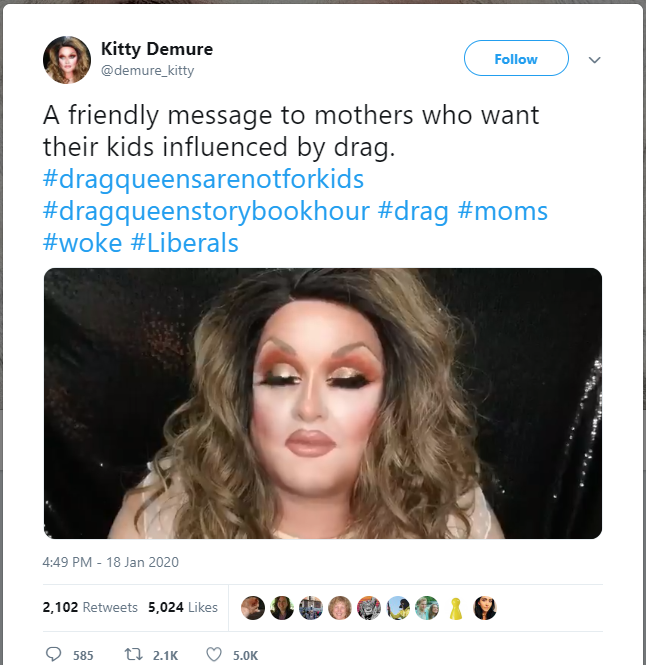
A Drag Queen speaks out against Drag Queen Story Hour for kids

Filed under: Books, Education, Health, Politics, USA — Tags: , , , — Nicholas @ 03:00

Libby Emmons reports on a rare bird indeed — a Drag Queen who doesn’t think it’s appropriate to have other Drag Queens visit schools and libraries to read to pre-teen kids:

Drag Queen Kitty Demure has taken to Twitter to speak out against the sexualization of children by woke people co-opting drag culture and rebranding it as an educational tool.

“I have absolutely no idea why you would want [drag queens] to influence your child. Would you want a stripper or porn star to influence your child?”

Demure notes that just as you wouldn’t take your kids out to see porn stars or strippers read stories while in full dress and makeup, you shouldn’t take them to see drag. There’s an effort to introduce kids earlier and earlier to adult sexuality. The idea is that this will help kids be more open-minded and understanding about the difference. What it really does is normalize deviant adult behaviour in children’s minds and override their own instincts. Giving children access to sexual content makes them think this kind of thing is for them, it opens doors that should stay closed until a child is of age.

Demure says here what all of us know: drag culture is adult entertainment. The look is sexualized. The names are sexualized. In fact, the entire concept of drag is a send-up of beauty queen culture. Beauty queen culture is sexualized as well, and while that is sometimes subsumed beneath the surface, it’s obviously fully part of it. That’s what drag plays on. Drag can be lots of fun, but it’s grown-up fun, not for kids.

« Newer PostsOlder Posts »

Powered by WordPress