
Rome’s tremendous run of victories from 264 to 168 (and beyond) fundamentally changed the nature of the Roman state. The end of the First Punic War (in 241) brought Rome its first overseas province, Sicily which wasn’t integrated into the socii-system that prevailed in Italy. Part of what made the socii-system work is that while Etruscans, Romans, Latins, Samnites, Sabines, S. Italian Greeks and so on had very different languages, religions and cultures, centuries of Italian conflict (and then decades of service in Rome’s armies) had left them with fairly similar military systems, making it relatively easy to plug them in to the Roman army. Moreover, being in Rome’s Italian neighborhood meant that Rome could simply inform the socii of how many troops they were expected to supply that year and the socii could simply show up at the muster at the appointed time (which is how it worked, Plb. 6.21.4). Communities on Sicily (or other far-away places) couldn’t simply walk to the point of muster and might be more difficult to integrate into core Roman army. Moreover, because they were far away and information moves slowly in antiquity, Rome was going to need some sort of permanent representative present in these places anyway, in a way that was simply unnecessary for Italian communities.
Consequently, instead of being added to the system of the socii, these new territories were organized as provinces (which is to say they were assigned to the oversight of a magistrate, that’s what a provincia is, a job, not a place). Instead of contributing troops, they contributed taxes (in money and grain) and the subordination of these communities was much more direct, since communities within a province were still under the command of a magistrate.
We’ll get to the provinces and their role in shaping Roman attitudes towards identity and culture a bit later, but for the various peoples of Roman Italy, the main impact of this shift was to change the balance of rewards for military service. Whereas before most of the gains of conquest were in loot and land – which the socii shared in – now Roman conquests outside of Italy created permanent revenue streams (taxes!) which flowed to Rome only. Roman politicians began attempting to use those revenue streams to provide public goods to the people – land distribution, free military equipment, cheap grain – but these benefits, provided by Rome to its citizens, were unavailable to the socii.
At the same time, as the close of the second century approached, it became clear that the opportunity to march up the ladder of status was breaking down, consumed by the increasingly tense maelstrom of the politics of the Republic. In essence while it was obvious as early as the 120s (and perhaps earlier) that a major citizenship overhaul was needed which would extend some form of Roman citizenship to many of the socii, it seems that everyone in Rome’s political class was conscious that whoever actually did it would – by virtue of consolidating all of those new citizens behind them as a political bloc – gain immensely in the political system. Consequently, repeated efforts in the 120s, the 100s and the 90s failed, caught up in the intensifying gridlock and political dysfunction of Rome in the period.
Consequently, just as Rome’s expanding empire had made citizenship increasingly valuable, actually getting that citizenship was made almost impossible by the gridlock of Rome’s political system gumming up the works of the traditional stepwise march up the ladder of statuses in the Roman alliance.
Finally in 91, after one last effort by Livius Drusus, a tribune of the plebs, failed, the socii finally got fed up and decided to demand with force what decades of politics had denied them. It should be stressed that the motivations behind the resulting conflict, the Social War (91-87), were complex; some Italians revolted for citizenship, some to get rid of the Romans entirely. The sudden uprising by roughly half of the socii at last prompted Rome to act – in 90, the Romans offered citizenship to all of the communities of socii who had stayed loyal (as a way of keeping them so). That offer was quickly extended to rebellious socii who laid down arms and rejoined the Romans. The following year, the citizenship grant was extended to communities which had missed the first one. The willingness to finally extend citizenship won Rome the war, as the socii who had only wanted equality with the Romans, being offered it, switched sides to get it, leaving only a handful of the hardest cases (particularly the Samnites, who never missed an opportunity to rebel against Rome) isolated and vulnerable.
The consequence of the Social War was that the slow process of minting new citizens or of Italian communities slowly moving up the ladder of status was radically accelerated in just a few years. In 95 BC, out of perhaps five million Italians, perhaps one million were Roman citizens (including here men, women and children). By 85 BC, perhaps four million were (with the remainder being almost entirely enslaved persons); the number of Roman citizens had essentially quadrupled overnight. Over time, that momentous decision would lead to a steady cultural drift which would largely erase the differences in languages, religion and culture between the various Italic peoples, but that had not happened yet and so confronted with brutal military necessity, the Romans had once again chose victory through diversity, rather than defeat through homogeneity. The result was a Roman citizen body that was bewilderingly diverse, even by Roman standards.
(Please note that the demographic numbers here are very approximate and rounded. There is a robust debate about the population of Roman Italy, which it isn’t worth getting in to here. For anyone wanting the a recent survey of the questions, L. de Ligt, Peasants, Citizens and Soldiers: Studies in the Demographic History of Roman Italy 225 BC – AD 100 (2012) is the place to start, but be warned that Roman demography is pretty technical and detail oriented and functionally impossible to make beginner-friendly.)
Bret Devereaux, “Collections: The Queen’s Latin or Who Were the Romans, Part II: Citizens and Allies”, A Collection of Unmitigated Pedantry, 2021-06-25.
July 30, 2024
QotD: The Roman Republic and the Social War
July 17, 2024
Re:View – The First Punic War
Invicta
Published Apr 4, 2024A parody Re:View episode from @RedLetterMedia on the First Punic War! Mike and Rich react to watching the events of Rome and Carthage’s great wars for the first time.
This video was a work of love which pays homage to some of my favorite RLM quotes from the following episodes:
Best of the Worst: Hawk Jones, Winterbeast, and ROAR
Best of the Worst: Twin Dragon Encounter, American Rickshaw, and Infested
Half in the Bag Episode 43: The Hobbit: An Unexpected Journey
Half in the Bag Episode 63: The Hobbit: The Desolation of Smaug
Half in the Bag Episode 81: The Hobbit: The Battle of the Five Armies
Half in the Bag: Indiana Jones and the Dial of Destiny
Half in the Bag: Rogue One
Half in the Bag: The 70-Minute Rise of Skywalker Review
Star Trek Discovery (Pilot Episodes) – re:View
Star Trek Discovery Season 1 – re:View
Star Trek Discovery Season 2 – re:View
Star Trek: Galaxy – re:View
Star Trek: Picard Episodes 4 and 5 – re:View
Star Trek: Picard Episodes 6, 7 and 8 – re:View
Starship Troopers – re:View
The Good, The Bad and the Ugly – re:ViewTimestamps:
00:00 Intro
03:05 Backstory
08:13 Outbreak of War
10:53 War at Sea
13:45 Battle of Ecnomus
15:42 Invasion of Africa
17:31 Climax
20:35 Outro
(more…)
July 12, 2024
QotD: Membership in the Senate during the Roman Republic
Despite that lack of formal powers, the Senate of the Roman Republic largely directed the overall actions of the republic, coordinating its strategic policy (both military and diplomatic), setting priorities for legislation, handling Rome’s finances and assigning and directing the actions of the various magistrates. The Senate – not the Pontifex Maximus1 – was also the final authority for questions of religion. The paradox exists because the Senate’s power is almost entirely based in its auctoritas and the strong set of political norms and cultural assumptions which push Romans to defer to that auctoritas [the Mos maiorum].
[…]
We should start with who is in the Senate. Now what you will generally hear in survey courses is this neat summary: the Senate had 300 members (600 after Sulla) and included all Romans who had obtained the office of the quaestorship or higher and its members were selected by the censors. And for a basic summary, that actually serves pretty well, but thinking about it for a few minutes one quickly realizes that there must be quite a bit of uncertainty and complexity underneath those neat easy rules. And indeed, there is!
First we can start with eligibility by holding office. We know that in the Sullan constitution, holding the quaestorship entitled one into entrance into the Senate. Lintott notes that the lex repetundarum of 123/4 lumped every office aedile-and-above together in a phrasing “anyone who has or shall have been in the Senate” when setting eligibility for the juries for the repetundae courts (the aim being to exclude the magistrate class from judging itself on corruption charges), and so assumes that prior to Sulla, it was aediles and up (but not quaestors) who were entitled to be in the Senate.2 The problem immediately occurs: these higher offices don’t provide enough members to reach the frequently attested 300-Senator size of the Senate with any reasonable set of life expectancies.
By contrast, if we assume that the quaestors were enrolled in the Senate, as we know them to have been post-Sulla (Cicero is a senator for sure in 73, having been quaestor in 75), we have eight quaestors a year elected around age 30 each with roughly 30 years of life expectancy3 we get a much more reasonable 240, to which we might add some holders of senior priesthoods who didn’t go into politics and the ten sitting tribunes and perhaps a few reputable scions of important families selected by the censors to reach 300 without too much difficulty. The alternative is to assume the core membership of the Senate was aediles and up, which would provide only around 150 members, in which case the censors would have to supplement that number with important, reputable Romans.
To which we may then ask: who might they choose? The obvious candidates would be … current and former quaestors and plebeian tribunes. And so we end up with a six-of-one, half-dozen of the other situation, where it is possible that quaestors were not automatically enrolled before Sulla, but were customarily chosen by the censors to “fill out” the Senate. Notably, when Sulla wants to expand the Senate, he radically expands (to twenty) the number of quaestors, which in turn provides roughly enough Senators for his reported 600-person Senate.
That leads us to the role of the censors: if holding a sufficiently high office (be it the quaestorship or aedileship) entitles one to membership for life in the Senate, what on earth is the role of the censors in selecting the Senate’s membership? Here the answer is in the sources for us: we repeatedly see the formula that the meetings of the Senate were attended by two groups: the Senators themselves and “those who are permitted to state their opinion in the Senate”. Presumably the distinction here is between men designated as senators by the censors and men not yet so designated who nevertheless, by virtue of office-holding, have a right to speak in the Senate. It’s also plausible that men who were still iuniores might not yet be Senators (whose very name, after all, implies old age; Senator has at its root senex, “old man”) or perhaps men still under the potestas of a living father (who thus could hardly be one of the patres conscripti, a standard term for Senators) might be included in the latter group.
In any case, the censors seem to have three roles here. First, they confirm the membership in the Senate of individuals entitled to it by having held high office. Second, they can fill out an incomplete Senate with additional Roman aristocrats so that it reaches the appropriate size. Finally, they can remove a Senator for moral turpitude, though this is rare and it is clear that the conduct generally needed to be egregious.
In this way, we get a Senate that is as our sources describe: roughly 300 members at any given time (brought to the right number every five years by the censors), consisting mostly of former office holders (with some add-ons) who have held offices at or above the quaestorship and whose membership has been approved by the censors, though office holders might enter the Senate – provisionally, as it were – immediately pending censorial confirmation at a later date. If it seems like I am giving short shrift to the “filling the rank” add-ons the censors might provide, it is because – as we’ll see in a moment – Senate procedure combined with Roman cultural norms was likely to render them quite unimportant. The role of senior ex-magistrates in the Senate was to speak, the role of junior ex-magistrates (and certainly of any senator who had not held high office!) was to listen and indicate concurrence with a previously expressed opinion, as we’re going to see when we get to procedure.
Bret Devereaux, “Collections: How to Roman Republic 101, Part IV: The Senate”, A Collection of Unmitigated Pedantry, 2023-09-22.
1. I stress this point because this is a common mistake: assuming that the Pontifex Maximus as Rome’s highest priest was in some way the “boss” of all of Rome’s other priests. He was not; he was the presiding officer of the college of Pontiffs and the manager of the calendar (this was a very significant role), but the Pontifex Maximus was not the head of some priestly hierarchy and his power over the other pontifices was limited. Moreover his power over other religious officials (the augures, haruspices, the quindecimviri sacris faciundis and so on) was very limited. Instead, these figures report to the Senate, though the Senate will generally defer to the judgment of the pontifices.
2. With sitting tribunes able to attend meetings of the Senate, but not being granted lifelong membership.
3. A touch higher than the 24 years a L3 Model West life table (what we generally use to simulate Roman populations) leads us to expect, but then these are elites who are likely to be well nourished and not in hazardous occupations, so they might live a bit longer.
July 6, 2024
QotD: The Roman Republic at war … many wars … many simultaneous wars
It certainly cannot be said of this period that the Romans always won the battles (though they won more than their fair share, they also lost some very major ones quite badly) or that they always had the best generals (though, again, they tended to fare better than average in this department). Things did not always go their way; whole armies were lost in disastrous battles, whole fleets dashed apart in storms. Rome came very close at points to defeat; in 242, the Roman treasury was bankrupt and their last fleet financed privately for lack of funds (Plb. 1.59.6-7). During the Second Punic War, at one point the Roman censors checked the census records of every Roman citizen liable for conscription and found only 2,000 men of prime military age (out of perhaps 200,000 or so; Taylor (2020), 27-41 has a discussion of the various reconstructions of Roman census figures here) who hadn’t served in just the previous four years (Liv. 24.18.8-9). In essence the Romans had drafted everyone who could be drafted (and the 2,000 remainders were stripped of citizenship on the almost certainly correct assumption that the only way to not have been drafted in those four years but also not have a recorded exemption was intentional draft-dodging).
And the military demands made on Roman armies and resources were exceptional. Roman forces operated as far east as Anatolia and as far west as Spain at the same time. Livy, who records the disposition of Roman forces on a year-for-year basis during much of this period (we are uncommonly well informed about the back half of the period because those books of Livy mostly survive), presents some truly preposterous Roman dispositions. Brunt (Italian Manpower (1971), 422) figures that the Romans must have had something like 225,000 men under arms (Romans and socii) each year between 214 and 212, immediately following a series of three crushing defeats in which the Romans probably lost close to 80,000 men. I want to put that figure in perspective for a moment: Alexander the Great invaded the entire Persian Empire with an army of 43,000 infantry and 5,500 cavalry. The Romans, having lost close to Alexander’s entire invasion force twice over, immediately raised more than four times as many men and kept fighting.
These armies were split between a bewildering array of fronts (e.g. Liv 24.10 or 25.3): multiple armies in southern Italy (against Hannibal and rebellious socii now supporting him), northern Italy (against the Cisalpine Gauls, who also backed Hannibal) and Sicily (where Syracuse threatened revolt) and Spain (a Carthaginian possession) and Illyria (fighting the Antigonids) and with fleets active in both the Adriatic and Tyrrhenian Sea supporting those operations. And of course a force defending Rome itself because did I mention Hannibal was in Italy?
If you will pardon me embellishing a Babylon 5 quote, “Only an idiot fights a war on two fronts. Only the heir to the throne of the kingdom of idiots would fight a war on twelve fronts.” And apparently, only the Romans would then win that war anyway.
(I should note that, for those interested in reading up on this, the state-of-the-art account of Rome’s ability to marshal these truly incredible amounts of resources and especially men is the aforementioned, M. Taylor, Soldiers & Silver (2020), which presents the consensus position of scholars better than anything else out there. I’d be remiss if I didn’t note that my own book project takes aim at this consensus and hopes to overturn parts of it, but seeing as how my book isn’t done, for now Taylor holds the field (also it’s a good book which is why I recommended it)).
Bret Devereaux, “Collections: The Queen’s Latin or Who Were the Romans, Part II: Citizens and Allies”, A Collection of Unmitigated Pedantry, 2021-06-25.
June 30, 2024
QotD: The use of pictorial and archaeological evidence in studying the ancient world
Which brings us at last to the big dog, archaeological evidence (although all of the aforementioned also show up in the archaeological record). Archaeology is wonderful, easily the biggest contributor to the improvement in our knowledge of the ancient world over the last century; my own research relies heavily on archaeological evidence. And the best part of it is we are getting more and better archaeological evidence all the time. Some archaeological finds are truly spectacular, like the discovery of the remains of the wrecks from the Battle of the Aegates Islands (241), the decisive engagement that ended Rome’s first war with Carthage (underwater archaeology in general in a young part of archaeology, which is itself a young field so we may well expect more marvels to come).
But (you knew there would be a but), archaeological evidence is really only able to answer certain specific questions and most research topics are simply not archaeologically visible. If your research question is related to what objects were at a specific place at a given time (objects here being broad; “pots” or “houses” or “farms” or even “people” if you are OK with those people being dead), good news, archaeology can help you (probably). But if your research question does not touch on that, you are mostly out of luck. If your object of study doesn’t leave any archaeological evidence … then it doesn’t leave any evidence. Most plagues, wars, famines, rulers, laws simply do not have archaeologically visible impacts, while social values, opinions, beliefs don’t leave archaeological evidence in any case.
Take, for instance, our evidence for the Cult of Mithras in the Roman Empire. This religion leaves us archaeological evidence in the form of identifiable ritual sanctuaries (“mithraeums“). Archaeology can tell us a lot about the normal size and structure of these places, but it can’t tell us much about what people there believed, or what rituals they did, or who they were, with only a handful of exceptions, which is why so much of what we think we might know about Mithraism is still very speculative.
Moreover, archaeology only works for objects that leave archaeological remains! Different materials preserve at different rates. Ceramic and stone? Great! Metals? Less great; these tend to get melted down when they don’t rust. Wood or textiles? Worse, almost never survives. This is why we have so much data on loom weights (stone, ceramic) but less on looms (wood, textile), and so much data on spindle whorls (stone, ceramic) but less on spindle-sticks or distaffs (wood). Compounding this are preservation accidents, in that things that survive tend to be things thrown away or buried with bodies and those practices will impact your archaeological record.
But the best part about archaeology is that it has network effects, which is to say that the more archaeology we do, the more useful each find becomes. New discoveries help to date and understand old discoveries and with lots of archaeological evidence, you can do really neat things like charting trade networks or changing land-use patterns. The problem is that you really do need a lot to generate a representative sample so you know you aren’t wrongly extrapolating from exceptions, and for right now, only the best excavated regions (Italy, to a lesser extent Greece and Egypt) are at the point where we can talk about, for instance, changing patterns of land use and population with any detail. And even then, uncertainties are huge.
Finally, archaeology, like everything else, works best with literary evidence. Take, for example, pre-Roman Gaul. The Gauls, due to their deposition practices are very archaeologically visible. Rich burial assemblages, large ritual deposits and archaeologically visible hill-fort settlements mean that the archaeological record for pre-Roman Gaul is very robust (in some cases more robust that the equivalent Roman context; we can be far more confident about the shape and construction of Gallic weapons than contemporary Roman ones, for instance). But effectively no literary sources for Gaul until contact with the Romans and Greeks. Consequently, almost everything about their values, culture, social organization in the pre-Roman period is speculative, with enormous numbers of questions and few answers.
If you want to ask me, “When did the Gauls shift to using longer swords” I can tell you with remarkable precision, in some cases, region by region (but generally c. 250 BC, with the trend intensifying in the late second century). But if you want to ask, “what was it like to rule a Gallic polity in c. 250 BC?” The best we can do is reason from what we see Caesar describing in c. 50 BC and hope that was typical two hundred years earlier.
Bret Devereaux, “Fireside Friday: March 26, 2021 (On the Nature of Ancient Evidence”, A Collection of Unmitigated Pedantry, 2021-03-26.
June 24, 2024
History Summarized: Augustus Versus Antony
Overly Sarcastic Productions
Published Apr 6, 2018Now that Caesar’s assassins are out of the picture, which would-be dictator will defeat the other to become the sole-ruler of Rome? In today’s episode of “How Long Before There’s Another Civil War?”: Not a lot … honestly not a very long time … BUT THEN WE GET THE ROMAN EMPIRE WOOOOOOOOO~~~
June 22, 2024
The End of Everything
In First Things, Francis X. Maier reviews Victor Davis Hanson’s recent work The End of Everything: How Wars Descend into Annihilation:

A senior fellow in military history and classics at Stanford University’s Hoover Institution, Hanson is a specialist on the human dimension and costs of war. His focus in The End of Everything is, as usual, on the past; specifically, the destruction of four great civilizations: ancient Thebes, Carthage, Constantinople, and the Aztec Empire. In each case, an otherwise enduring civilization was not merely conquered, but “annihilated” — in other words, completely erased and replaced. How such catastrophes could happen is the substance of Hanson’s book. And the lessons therein are worth noting.
In every case, the defeated suffered from fatal delusions. Each civilization overestimated its own strength or skill; each misread the willingness of allies to support it; and each underestimated the determination, strength, and ferocity of its enemy.
Thebes had a superb military heritage, but the Thebans’ tactics were outdated and their leadership no match for Macedon’s Alexander the Great. The city was razed and its surviving population scattered. Carthage — a thriving commercial center of 500,000 even after two military defeats by Rome — misread the greed, jealousy, and hatred of Rome, and Roman willingness to violate its own favorable treaty terms to extinguish its former enemy. The long Roman siege of the Third Punic War saw the killing or starvation of 450,000 Carthaginians, the survivors sold into slavery, the city leveled, and the land rendered uninhabitable for a century.
The Byzantine Empire, Rome’s successor in the East, survived for a millennium on superior military technology, genius diplomacy, impregnable fortifications, and confidence in the protection of heaven. By 1453, a shrunken and sclerotic Byzantine state could rely on none of these advantages, nor on any real help from the Christian West. But it nonetheless clung to a belief in the mantle of heaven and its own ability to withstand a determined Ottoman siege. The result was not merely defeat, but the erasure of any significant Greek and Christian presence in Constantinople. As for the Aztecs, they fatally misread Spanish intentions, ruthlessness, and duplicity, as well as the hatred of their conquered “allies” who switched sides and fought alongside the conquistadors.
The industrial-scale nature of human sacrifice and sacred cannibalism practiced by the Aztecs — more than 20,000 captives were ritually butchered each year — horrified the Spanish. It reinforced their fury and worked to justify their own ferocious violence, just as the Carthaginian practice of infant sacrifice had enraged the Romans. In the end, despite the seemingly massive strength of Aztec armies, a small group of Spanish adventurers utterly destroyed Tenochtitlán, the beautiful and architecturally elaborate Aztec capital, and wiped out an entire culture.
History never repeats itself, but patterns of human thought and behavior repeat themselves all the time. We humans are capable of astonishing acts of virtue, unselfish service, and heroism. We’re also capable of obscene, unimaginable violence. Anyone doubting the latter need only check the record of the last century. Or last year’s October 7 savagery, courtesy of Hamas.
The takeaway from Hanson’s book might be summarized in passages like this one:
Modern civilization faces a toxic paradox. The more that technologically advanced mankind develops the ability to wipe out wartime enemies, the more it develops a postmodern conceit that total war is an obsolete exercise, [assuming, mistakenly] that disagreements among civilized people will always be arbitrated by the cooler, more sophisticated, and more diplomatically minded. The same hubris that posits that complex tools of mass destruction can be created but never used, also fuels the fatal vanity that war itself is an anachronism and no longer an existential concern—at least in comparison to the supposedly greater threats of naturally occurring pandemics, meteoric impacts, man-made climate change, or overpopulation.
Or this one:
The gullibility, and indeed ignorance, of contemporary governments and leaders about the intent, hatred, ruthlessness, and capability of their enemies are not surprising. The retreat to comfortable nonchalance and credulousness, often the cargo of affluence and leisure, is predictable given unchanging human nature, despite the pretensions of a postmodern technologically advanced global village.
I suppose the lesson is this: There’s nothing sacred about the Pax Americana. Nothing guarantees its survival, legitimacy, comforts, power, or wealth. A sardonic observer like the Roman poet Juvenal — were he alive — might even observe that today’s America seems less like the “city on a hill” of Scripture, and more like a Carthaginian tophet, or the ritual site of child sacrifice. Of course, that would be unfair. A biblical leaven remains in the American experiment, and many good people still believe in its best ideals.
June 18, 2024
QotD: The peoples incorporated or “allied” to Rome in the Republic’s Italian expansion
In one very important way, pre-Roman Italy was very much not like Greece: whereas in Greece all of those communities shared a single language, religion and broad cultural context, Roman Italy was a much more culturally complex place. Consequently, as the Romans slowly absorbed pre-Roman Italy into the Roman Italy of the Republic, that meant managing the truly wild variety of different peoples in their alliance system. Let’s quickly go through them all, moving from North to South.
The Romans called the region south of the Alps but north of the Rubicon River Cisalpine Gaul and while we think of it as part of Italy, the Romans did not. That said, Gallic peoples had pushed into Italy before and a branch of the Senones occupied the lands between Ariminum and Ancona. Although Gallic peoples were always a factor in Italy, the Romans don’t seem to have incorporated their communities as socii; indeed the Romans were generally at their most ruthless when it came to interactions with Gallic peoples (despite the tendency to locate the “unassimilable” people on the Eastern edge of Rome’s empire, it was in fact the Gauls that the Romans most often considered in this way, though as we will see, wrongly so). That’s not to say that there was no cultural contact, of course; the Romans ended up adopting almost all of the Gallic military equipment set, for instance. In any event, it wouldn’t be until the late first century BCE that Cisalpine Gaul was merged into Italy proper, so we won’t deal too much with the Gauls just yet. I do want to note that, when we are thinking about the diversity of the place, even to speak of “the Gauls” is to be terribly reductive, as we are really thinking of at least half a dozen different Gallic peoples (Senones, Boii, Inubres, Lingones, etc) along with the Ligures and the Veneti, who may have been blends of Gallic and Italic peoples (though we are more poorly informed about both than we’d like).
Moving south then, we first meet the Etruscans, who we’ve already discussed, their communities – independent cities joined together in defensive confederations before being converted into allies of the Romans – clustered on north-western coast of Italy. They had a language entirely unrelated to Latin – or indeed, any other known language – and their own unique religion and culture. The Romans adopted some portions of that culture (in particular the religious practices) but the Etruscans remained distinct well into the first century. While a number of Etruscan communities backed the Samnites in the Third Samnite War (298-290 BC) culminating in the Battle of Sentinum (295) as a last-ditch effort to prevent Roman hegemony over the peninsula, the Etruscans subsequently remained quite loyal to Rome, holding with the Romans in both the Second Punic and Social Wars. It is important to keep in mind that while we tend to talk about “the Etruscans” (as the Romans sometimes do) they would have thought of themselves first through their civic identity, as Perusines, Clusians, Populinians and so on (much like their Greek contemporaries).
Moving further south, we have the peoples of the Apennines (the mountain range that cuts down the center of Italy). The people of the northern Apennines were the Umbri (that is, Umbrian speakers), though this linguistic classification hides further cultural and political differences. We’ve met the Sabines – one such group, but there were also the Volsci and Marsi (the latter particularly well known for being hard fighters as allies to Rome; Appian reports that the Marsi had a saying prior to the Social War, “No Triumph against the Marsi nor without the Marsi”). Further south along the Apennines were the Oscan speakers, most notably the Samnites (who resisted the Romans most strongly) but also the Lucanians and Paelignians (the latter also get a reputation for being hard fighters, particularly in Livy). The Umbrian and Oscan language families are related (though about as different from each other as Italian from Spanish; they and Latin are not generally mutually intelligible) and there does seem to have been some cultural commonality between these two large groups, but also a lot of differences. Their religion included a number of practices and gods unknown to the Romans, some later adopted (Oscan Flosa adapted as Latin Flora, goddess of flowers) and some not (e.g. the “Sacred Spring” rite, Strabo 5.4.12).
Also Oscan speakers, the Campanians settled in Campania (surprise!) at some early point (perhaps around 1000-900 BC) and by the fifth century were living in urban communities politically more similar to Latium and Etruria (or Greece, which will make sense in a moment) than their fellow Oscan speakers in the hills above, to the point that the Campanians turned to Rome to aid them against the also-Oscan-speaking Samnites. The leading city of the Campanians was Capua, but as Fronda (op. cit.) notes, they were meaningful divisions among them; Capua’s very prominence meant that many of the other Campanians were aligned against it, a division the Romans exploited.
The Oscans struggled for territory in Southern Italy with the Greeks – told you we’d get to them. The Greeks founded colonies along the southern part of Italy, expelling or merging with the local inhabitants beginning in the seventh century. These Greek colonies have distinctive material culture (though the Italic peoples around them often adopted elements of it they found useful), their own language (Greek), and their own religion. I want to stress here that Greek religion is not equivalent to Roman religion, to the point that the Romans are sticklers about which gods are worshipped with Roman rites and which are worshipped with the ritus graecus (“Greek rites”) which, while not a point-for-point reconstruction of Greek rituals, did involve different dress, different interpretations of omens, and so on.
All of these peoples (except the Gauls) ended up in Rome’s alliance system, fighting as socii in Rome’s wars. The point of all of this is that this wasn’t an alliance between, say, the Romans and the “Italians” with the latter being really quite a lot like the Romans except not being from Rome. Rather, Rome had constructed a hegemony (an “alliance” in name only, as I hope we’ve made clear) over (::deep breath::) Latins, Romans, Etruscans, Sabines, Volsci, Marsi, Lucanians, Paelignians, Samnites, Campanians, and Greeks, along with some people we didn’t mention (the Falisci, Picenes – North and South, Opici, Aequi, Hernici, Vestini, etc.). Many of these groups can be further broken down – the Samnites consisted of five different tribes in a confederation, for instance.
In short, Roman Italy under the Republic was preposterously multicultural (in the literal meaning of that word) … and it turns out that’s why they won.
Bret Devereaux, “Collections: The Queen’s Latin or Who Were the Romans, Part II: Citizens and Allies”, A Collection of Unmitigated Pedantry, 2021-06-25.
May 27, 2024
QotD: The Cursus Honorum in the Roman republic
The second caution is that the cursus honorum was, for most of its history, a customary thing, a part of the mos maiorum, rather than a matter of law. But of course the Romans, especially the Roman aristocracy, take both the formal and informal rules of this “game” very seriously. While unusual or spectacular figures could occasionally bend the rules, for most of the third and second century, political careers followed the rough outlines of the cursus honorum, with occasional efforts to codify parts of the process in law during the second century, beginning with the Lex Villia in 180 BC, but we ought to understand that law and others of the sort as mostly attempting to codify and spell out what were traditional practices, like the generally understood minimum ages for the offices, or the interval between holding the same office twice.
That said, there is a very recognizable pattern that was in some cases written into law and in other cases merely customary (but remember that Roman culture is one where “merely customary” carries a lot of force). Now the cursus formally begins with the first major office, the quaestorship, but there are quite a few things that an aspiring Roman elite needs to do first. The legal requirement is that our fellow – and it must be a fellow, as Roman women cannot hold office (or vote) – needs to have completed ten years of military service (Polyb. 6.19.1-3). But there are better and worse ways to discharge this requirement. The best way is being appointed as junior officers, military tribunes, in the legions. We’ll talk about this office in a bit, but during this period it served both as a good first stepping stone into political prominence as well as something more established Roman politicians did between major office-holding, perhaps as a way of remaining prominent or to curry favor with the more senior politicians they served under or simply because military exigency meant that more experienced hands were wanted to lead the army.
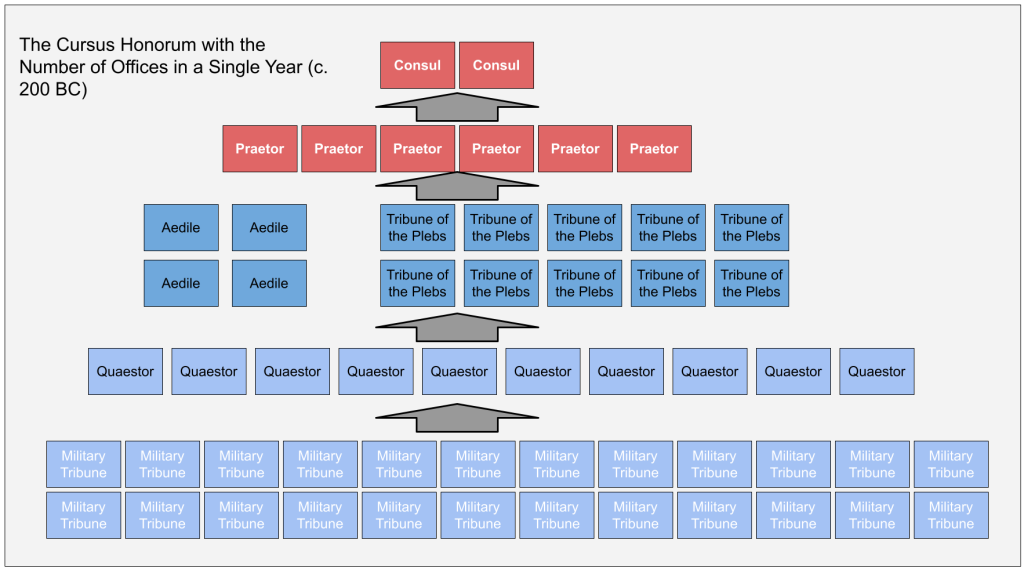
A diagram of the elected offices of the cursus honorum. Note that there were additional appointed military tribunes.
There are a bunch of other minor magistrates that are effectively “pre-cursus” offices too, but we don’t know a lot about them and they don’t seem generally to show up as often in the careers of the sort of Romans making their way up to the consulship, though this may be simply because our sources don’t mention them as much at all and so we simply don’t know who was holding them in basically any year. We’ll talk about them at the end of this set of posts, because they are important (particularly for non-elites).
I should note at the outset: all of these offices are elected annually unless otherwise noted, with a term of service of one year. You never hold the same office twice until you reach the consulship, at which point you can seek re-election, after a respectable delay (which is later codified into law and then ignored), but you may serve as a military tribune several times (this was normal, in fact, as far as we can tell).
The first major office of the cursus was the quaestorship. The number of quaestors elected grows over time. Initially just two, their number is increased to four in 421 (two assigned to Rome, one to each of the consuls) and then to six in the 260s (initially handling the fleet, then later to assist Roman praetors or pro-magistrates in the provinces) and then eight in 227. There may have been two more added to make ten somewhere in the Middle Republic, but recent scholarship has cast doubt on this, so the number may have remained eight until being expanded to twenty under Sulla in 81 BC through the aptly named lex Cornelia de XX quaestoribus (the Cornelian Law on Twenty Quaestors, Sulla being Lucius Cornelius Sulla Felix).2 It’s not clear if there was a legal minimum age for the quaestors and we only know the ages of a few (25, 27, 29 and 30, for the curious) so all we can say is that officeholders tended to hold the office in their twenties, right after finishing their mandatory stint of military service.3 Serving as a quaestor enables entrance into the Senate, though one has to wait for the next census to be added to the Senate rolls by the censors.
After the quaestorship, aspirants for higher office had a few options. One option was the office of aedile; there were after 367 four of these fellows. Two were plebeian aediles and were not open to patricians, while the two more prestigious spots were the “curule” aediles, open to both patricians and plebeians. The other option at this stage for plebeian political hopefuls was to seek election as a tribune of the plebs, of which there were ten annually, we’ll talk about these fellows in a later post because they have wide-ranging, spectacular and quite particular powers.
After this was the praetorship, the first office which came with imperium. Initially there may have just been one praetor; by the 240s there are two (what will become the praetor urbanus and the praetor peregrinus). In 227 the number increases to four, with the two new praetors created to handle administration in Sicily, Sardinia and Corsica. That number then increases to six in 198/7, with the added praetors generally being sent to Spain. Finally Sulla raises the number to eight in 81 BC. The minimum age seems to have been 39 for this office.
Finally comes the consulship, the chief magistrate of the Roman Republic, who also carried imperium but of a superior sort to the praetors. There were always two consuls and their number was never augmented. For our period (pre-Sulla) the consuls led Rome’s primary field armies and were also the movers of major legislation. Achieving the consulship was the goal of every Roman embarking on a political career. This is the only office that gets “repeats”.
Finally there is one office after the cursus honorum and that is the censorship. Two are elected every five years for an 18 month term in which they carry out the census. Election to the censorship generally goes to senior former-consuls and is one way to mark a particularly successful political career. That said, Romans tend to dream about the consulship, not the censorship and if you had a choice between being censor once or holding the consulship two or three times, the latter was more prestigious.
With the offices now laid out, we’ll go through them in rough ascending sequence. Today we’ll look at the military tribunes, the quaestors and the aediles; next week we’ll talk about imperium and the regular offices that carry it (consuls, praetors and pro-magistrates). Then, the week after that, we’ll look at at two offices with odd powers (tribunes of the plebs and censors), along with minor magistrates. Finally, there’s another irregular office, that of dictator, which we have already discussed! So you can go read about it there!
One thing I want to note at the outset is the “elimination contest” structure of the cursus honorum. To take the situation as it stands from 197 to 82, there are dozens and dozens of military tribunes, but just eight quaestors and just six praetors and then just two consuls. At each stage there was thus likely to be increasingly stiff competition to move forward. To achieve an office in the first year of eligibility (in suo anno, “in his own year”) was a major achievement; many aspiring politicians might require multiple attempts to win elections. But of course these are all annual offices, so someone trying again for the second or third time for the consulship is now also competing against multiple years of other failed aspirants plus this new year’s candidates in suo anno. We’ll come back to the implications of this at the end but I wanted to note it at the outset that even given the relatively small(ish) size of Rome’s aristocracy, these offices are fiercely competitive as one gets higher up.
Bret Devereaux, “Collections: How to Roman Republic 101, Part IIIa: Starting Down the Path of Honors”, A Collection of Unmitigated Pedantry, 2023-08-11.
1. See Lintott, op. cit. 104-5, n. 47.
2. These dates and numbers, by the by, follows F.P. Polo and A.D. Fernández, The Quaestorship in the Roman Republic (2019).
3. If you are wondering about how anyone can manage to hold the office before 27, given ten years of military service and 17 being the age when Roman conscription starts, well, we don’t really know either. The best supposition is that some promising young aristocrats seem to have started their military service early, perhaps in the retinues (the cohors amicorum) of their influential relatives. Tiberius Gracchus at 25 is the youngest quaestor we know of, but he’s in the army by at most age 16 with Scipio Aemilianus at Carthage in 146.
May 15, 2024
QotD: Recruiting an army in the Roman Republic
So, on the appointed day(s), Polybius tells us all Romans liable for service of military age assemble in Rome and are called up on the Capitoline Hill for selection. This was a point that raised a lot of skepticism from historians,1 mostly concerning the number of people involved, but those concerns have all pretty much been resolved. While there might have been something like 323,000 Roman citizen males in the third or second century, they’re not all liable for general conscription, which was restricted to the iuniores – Roman citizen men between the ages of 17 and 46, who numbered fewer, probably around 228,000; seniores in theory could be conscripted, but in practice only were in an emergency. In practice the number is probably lower still as unless things were truly dire, men in their late 30s or 40s with several years of service could be pretty confident they wouldn’t be called and might as well stay home and rely on a neighbor of family member to report back in the unlikely event they were called. That’s still, of course, too many to bring up on to the Capitoline or to sort through calling out names, but as Polybius notes they don’t all come up, they’re called up by tribe. The Roman tribes were one of Rome’s two systems of voting units (the other, of centuries, we’ll come to in just a moment) and there were 35 of them, four urban tribes for those living in the city and 31 rural tribes for those living outside the city.
So what is actually happening is that the consul sets the date for the dilectus, then assigns his military tribunes to their legions (this matters because the tribunes will then do a round-robin selection of recruits to ensure each legion is of equivalent equality), then calls up one tribe at a time, with each tribe having perhaps around 6-7,000 iunores in it. Conveniently, the Capitoline is plenty large enough for that number, with estimates of its holding capacity tending to be between 12,000 and 25,000 or so.2 And while Polybius makes it seem like all of this happens on one day, it probably didn’t. Livy notes of one dilectus in 169, conducted in haste, was completed in 11 days; presumably the process was normally longer (though that’s 11 days for all three steps, not just the first one, Livy 43.14.9-10).
Once each tribe is up on the Capitoline, recruits are selected in batches; Polybius says in batches of four, but this probably means in batches equal to the number of legions being enrolled, as Polybius’ entire schema assumes a normal year with four legions being enrolled. Now Polybius doesn’t clarify how selection here would work and here Livy comes in awfully handy because we can glean little details from various points in his narrative (the work of doing this is a big chunk of Pearson (2021), whose reconstruction I follow here because I think it is correct). We know that the censors compile a list not just of Roman senators but of all Roman citizen households, including self-reported wealth and the number of members in the household, updated every five years. That self-reported wealth is used to slot Romans into voting centuries, the other Roman voting unit, the comitia centuriata; those centuries correspond neatly to how Romans serve in the army, with the equites and five classes of pedites (infantry). Because of a quirk of the Roman system, the top slice of the top class of pedites also serve on horseback, and Polybius is conveniently explicit that the censors select and record this too.
So at dilectus time, the consuls, their military tribunes (and their state-supplied clerk, a scriba) have a list of every Roman citizen liable for conscription, with the century and tribe they belong to, the former telling you what kind of soldier they can afford to be when called and the latter what group they’ll be called in. And we know from other sources (Valerius Maximus 6.3.4) that names are being read out, rather than just, say, selecting men at sight out of a crowd. That actually makes a lot of sense as dilectus (“select”) may really be dis-lego, “read apart”, from lego (-ere, legi, lectum) “to read”.3 And that matters because the other thing the Romans clearly have a record of us who has served in the past. We know that because in an episode that is both quite famous but also really important for understanding this process, in 214 – after four of the most demanding years of military activity in Roman history, due to the Second Punic War – the Roman censors identified 2,000 Roman iuniores who had not served in the previous four years (or claimed and been granted an exemption), struck them from the census rolls (in effect, revoking their citizenship) and then packed them off to serve as infantry (regardless of their wealth) in Sicily.4
So what happens as each tribe comes up is that the tribunes can call out the names – in batches – of men with the least amount of service, of the particular wealth categories they are going to need to fill out the combat roles in the legion.5 The tribunes for each legion pick one recruit from each batch that comes up, going round-robin so every legion gets the same number of first-picks. Presumably once the necessary fellows are picked out of one tribe, that tribe is sent down the Capitoline and the next called up.
Once that is done the oath is administered. This oath is the sacramentum militare; we do not have its text in the Republic (we do have the text for the imperial period), but Polybius summarizes its content that soldiers swear to obey the orders of the consuls and to execute them as best they are able. The Romans, being practical, have one soldier swear the full oath and then every other soldier come up and say, “like that guy said” (I’m not even really joking, see Polyb. 6.21.3) to get everyone all sworn in. Of course such an oath is a religious matter and so understood to be quite binding.
Then the tribunes fix a day for all of the new recruits to present themselves again (without arms, Polybius specifies) and dismiss them. Strikingly, Polybius only says they are dismissed at this point – not, as later, dismissed to their homes. This makes me assume that the oath being described is administered tribe by tribe before the tribe is sent down (this also seems likely because fitting the last tribe and four legions worth of recruits on the Capitoline starts to get pretty tight, space-wise). Selecting with the various tribes might, after all, take a couple of days, so the tribunes might be telling the recruits of the first few tribes what day the entire legion will be assembled (that’ll be Phase II) after they’ve worked through all of the tribes. Meanwhile, once your tribe was called, you didn’t have to hang around in Rome any longer, if you weren’t selected you could go home, while the picked recruits might stick around in Rome waiting for Phase II.
That leads to the other logistical question for Phase I: the feasibility of having basically all of the iuniores in Rome for the process. Doubts about this have led to the suggestion that perhaps the dilectus in Rome was mirrored by smaller versions held in other areas of Roman territory in Italy (the ager Romanus) for Roman citizens out there. The problem with that assumption is that the text doesn’t support it. The Romans send out conscription officers (conquisitores) exactly twice that we know of, in 213 and 212 (Livy 23.32.19 and 25.5.5-9) and these are clearly exceptional responses to the failure of the dilectus in the darkest days of the Second Punic War (the latter is empowered to recruit under-age boys if they look strong enough to bear arms, for instance). But I also think it was probably unnecessary: this was a regular occurrence, so people would know to make arrangements for it and the city of Rome could prepare for the sudden influx of young men. This is, after all, also a city with regular “market days”, (the nundinae) which presumably would also cause the population to briefly swell, though not as much. And we’re doing this in an off-time in the agricultural calendar, so the farmhands can be spared.
Moreover, Rome isn’t that far away for most Romans. Strikingly, when the Romans do send out conquisitores, they split them with half working within 50 miles of Rome and half beyond that (Livy 25.5.5-9). The implication – that most of the recruits to be found are going to be within that 50 mile radius – is clear, and it makes a lot of sense given the layout of the ager Romanus. Certainly there were communities of Roman citizens farther out, but evidently not so many. Fifty miles down decent roads is a two-day walk; short enough that Roman iuniores could fill a sack with provisions, walk all the way to Rome, stay a few days for the first phase of the dilectus and walk all the way back home again at the end. We’re not told how communities farther afield might handle it, but they may well have trekked in too, or else perhaps sent a few young men with instructions to bring back a list of everyone who was called.
Meanwhile the other part of this phase is happening: the socii. Polybius reports that “at the same time the consuls send their orders to allied cities in Italy, which they with to contribute troops, stating the numbers required and the day and place at which the men selected must present themselves.”6 Livy gives us more clarity on how this would be done, providing in his description of the muster of 193 the neat detail that representatives of the communities of socii met with the consuls on the Capitoline (Livy 34.36.5). And that makes a ton of sense – this is happening at the same time as the selection, so that’s where the consuls are.
We also know the consuls have another document, the formula togatorum, which spells out the liability of each community of socii for recruits; we know less about this document than we might like. Polybius tells us that the socii were supposed to compile lists of men liable for recruitment (Polyb. 2.23-4) and an inscription of the Lex Agraria of 111 BC refers to, “the allies or members of the Latin name, from whom the Romans are accustomed to demand soldiers in the land of Italy ex formula togatorum“.7 That then supplies us with a name for the document. Finally, we know that in 177, some of the socii complained that many of the households in their territory had migrated into other communities but that they conscription obligations had not been changed (Livy 41.8), which tells us there was a formal system of obligations and it seems to have been written down in something called the formula togatorum, to which Polybius alludes.
What was written down? Really, we don’t know. It has been suggested that it might have been a sliding scale of obligations (“for every X number of Romans, recruit Y number of Paeligni”) or a standard total (“every year, recruit Y Paeligni”) or a maximum (“the total number of Paeligni we can demand is Y, plus one more guy whose job is to throw flags at things”.). In practice, it was clearly flexible,8 which makes me suspect it was perhaps a list of maximum capabilities from which the consuls could easily compute a fair enough distribution of service demands. A pure ratio doesn’t make much sense to me, because the socii come in their own units, which probably had normal sizes to them.
So, while the military tribunes are handling the recruitment of citizens into the legions, the consuls are right there, but probably focused on meeting with representatives of each community of the socii and telling them how many men Rome will need this year. Once told, those representatives are sent back to their communities, who handle recruitment on their own; Rome retains no conscription apparatus among the socii – no conscription offices, no records or census officials, nada. The consuls spell out how many troops they need and the rest of it was the socii‘s elected official’s problem.
Bret Devereaux, “Collections: How To Raise a Roman Army: The Dilectus“, A Collection of Unmitigated Pedantry, 2023-06-16.
1. Particularly in P.A. Brunt, Italian Manpower (1971).
2. Pearson (2021) compiles them; the issue is also discussed in Taylor (2020).
3. The philological argument here is Pearson (2021), 16-17. It is not air-tight because legere has a lot of meanings, including “to pick out” along with “to read”. That said, given that the verb of being recruited into the army is conscribere (“to write together, to conscript”), there really is a strong implication that this is a process with written records, which the rest of the evidence confirms. I think Pearson may or may not be right about the understood meaning of dilectus implying writing, but the process surely involved written records, as she argues.
4. A punishment post, this is also where the survivors of the Battle of Cannae were sent. Both groups remain stuck in Sicily until pulled into Scipio Africanus’ expedition to Africa in 205, so these fellows don’t get to go home and get their citizenship back until the conclusion of the war in 201.
5. In particular, we generally assume the lowest classes of Roman pedites probably could only afford to serve as light troops, the velites, while the wealthy equites had their own selection procedure for the cavalry done first. Of course, rich Romans not selected for the cavalry might serve as infantrymen if registered in the centuries of pedites which is presumably how Marcus Cato, son of the Censor, ends up in the infantry at Pydna (Plut. Aem. 21).
6. Polyb. 6.21.4. Paton’s trans.
7. Crawford, Roman Statutes (1996), 118 for the text of that inscription.
8. Something pointed out by L. de Ligt in his chapter in the Blackwell A Companion to the Roman Army (2007).
May 9, 2024
QotD: Rome’s socii system
In any case, the Romans win the war and impose a peace treaty the terms of which, according to Dionysius of Halicarnassus went thusly:1
Let there be peace between the Romans and all the Latin cities as long as the heavens and the earth shall remain where they are. Let them neither make war upon another themselves nor bring in foreign enemies nor grant a safe passage to those who shall make war upon either. Let them assist one another, when warred upon, with all their forces, and let each have an equal share of the spoils and booty taken in their common wars. Let suits relating to private contracts be determined within ten days, and in the nation where the contract was made. And let it not be permitted to add anything to, or take anything away from these treaties except by the consent both of the Romans and of all the Latins.
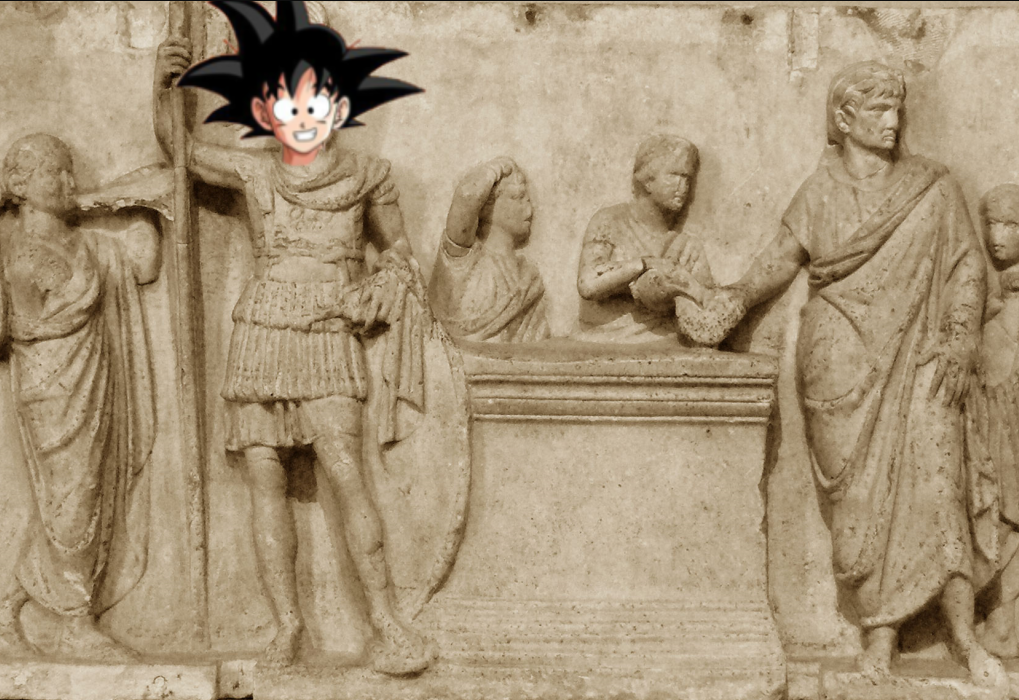
This is the origin point for Rome’s use of what I’ve termed the “Goku Model of Imperialism” – “I beat you, therefore we are friends”. Having soundly defeated – at least according to our sources – the Latins, Rome doesn’t annex or destroy them, nor does it impose tribute, but rather imposes a treaty of alliance on them (in practice I suspect we might want to understand that Rome’s position was not so dominant as our sources suggest, thus the relatively good terms the Latins get). The treaty sounds like an equal relationship, until one remembers that it is the entire Latin league – thirty or more communities – as one party and then just Rome as the other party.
I will still make no apologies for this visual gag.
Image modified by Bret Devereaux.Rome proceeds, in the century or so that follows, to use this alliance to defeat their other neighbors, both the nearest major Etruscan centers as well as the Aequi and Sabines who lived in the hills to the north-east of Rome and the Volsci who lived to the south of Latium. Roman relations with the Latins seem to fray in the early 300s, presumably because the greatest threat to their communities was increasingly not the Volsci, but Rome’s emerging regional power. That leads to a collapse of the Foedus Cassianum in 341 and another war between Rome and the Latin League. Once again our sources are much later, so we might be somewhat skeptical of the details they provide, but the upshot is that at the end the Romans won by 338.
Rome’s expansion into most areas follows a familiar pattern: Rome enters a region by concluding an alliance with some weaker power in a region and then rushing to the aid of that weaker power; in some cases this was a long-term relationship that had been around for some time (like the long Roman friendship with Etruscan Caere) and in some cases it was a very new and opportunistic friendship (as with Capua’s appeal to the Romans for aid in 343). In either case, Rome formed a treaty with the community it was “protecting” and then moved against its local enemies. Once defeated, it imposed treaties on them, too. Rome might also seize land in these wars from the defeated party (before it imposed that treaty); if these were far away, Rome might settle a colony on that land rather than annexing it into Rome’s core territory (the ager Romanus). These new communities – the Latin colonies – were created with treaty obligations towards Rome.
Note the change: what was initially an alliance between one party (Rome) and another party (the Latin League) has instead become an alliance system, a series of bilateral treaties between Rome and a slew of smaller communities. And they were smaller, because Rome often took land in these wars, so that by the third century, the Roman citizen body represented roughly 40% of the total, making Rome much bigger than any other allied community. This shift was probably gradual, rather than there being some dramatic policy change at any point. Rome accrued its Italian empire the same way it would accrue its Mediterranean one: as a result of a series of localized, ad hoc decisions which collectively added up to the result without ever being intended to constitute a single, unified policy.
The Romans called all of these allied communities and their people socii, “allies” – a bit of a euphemism, because these were no longer equal alliances. We’ll get into the terms in a moment, but it seems clear that by 338 that these “allies” are promising to have no foreign policy save for their alliance with Rome and to contribute soldiers to Roman armies. So Rome is in the driver’s seat determining where the alliance will go; Rome does not have to consult the allies when it goes to war and indeed does not do so. The socii cannot take Rome to war (but Rome will go to war immediately if a community of socii is attacked). This is no longer an equal arrangement, but it is useful for the Romans to pretend it is.
The next major series of Roman conflicts are with the Samnites. Rome is, according to Livy, at least, drawn into fighting the Samnites because of its suddenly concluded alliance with Capua and the Campanians (though Rome had been more loosely allied to the Samnites shortly before). In practice, the first two Samnite Wars (343-341, 326-304) were fought to determine control over Campania and the Bay of Naples, with Rome fighting to expand its influence there (by making those communities allies or protecting those who were) while the Samnites pushed back.
The Third Samnite War (298-290) becomes something rather different: a containment war. Rome’s growing power – through its “alliance” system – was clearly on a course to dominate the peninsula, so a large coalition of opponents, essentially every meaningful Italian power not already in Rome’s alliance system, banded together in a coalition to try to stop it (except for the Greeks). What started as another war between Rome and the Samnites soon pulled in the remaining independent Etruscan powers and then even a Gallic tribe (the Senones) in an effort to contain Rome. The Romans manage to pull out a victory (though it was a close run thing) and in the process managed to pull yet more communities into the growing alliance system. It seems – the sources here are confused – that the decade that followed, the Romans lock down much of Etruria as well.
The Greek cities in southern Italy now at last recognize their peril and call in Pyrrhus of Epirus to try to beat back Rome, leading to the Pyrrhic War (280-275). Pyrrhus wins some initial battles but – famously – at such cost that he is unable to win the war. Pyrrhus withdraws in 275 and Rome is then able over the next few years to mop up the Greek cities in Southern Italy, with the ringleader, Tarentum, falling to Rome in 272. Rome imposed treaties on them, too, pulling them into the alliance system. Thus, by 264 Rome’s alliance system covered essentially the whole of Italy South of the Po River. It had emerged as an ad hoc system and admittedly our sources don’t give us a good sense of how and when the terms of the alliance change; in many cases it seems our sources, writing much later, may not know. They have the foedus Cassianum, with its rather more equal terms, and knowledge of the system as it seems to have existed in the late third century and the dates and wars by which this or that community was voluntarily or forcibly integrated, but not the details of by what terms and so on.
Bret Devereaux, “Collections: How to Roman Republic 101, Addenda: The Socii“, A Collection of Unmitigated Pedantry, 2023-10-20.
1. trans. Earnest Clay (1940).
May 7, 2024
QotD: Cicero’s De Senectute
John Byron Kuhner, “Marlene Dietrich’s War on Nature”, First Things, 2024-02-05.
May 4, 2024
Shakespeare Summarized: Antony and Cleopatra
Overly Sarcastic Productions
Published Dec 2, 2016Hey, remember almost exactly three years ago when I summarized Julius Caesar? Published on December 1st, even? A coincidence I totally planned when I spontaneously decided to do this video today?
May 3, 2024
“Columbia Delenda Est“
From late last month, Robert Graboyes, who is an alumni of Columbia University, thought it appropriate to follow Cato the Elder’s prescription for Carthage in this case:

Low Memorial Library, Columbia University, 1921.
From Wikimedia. Textured and rendered as ruins by Robert Graboyes.
As an alumnus of Columbia University (MPhil and PhD), I recommend that every peaceful, legal means available be employed to destroy the reputation of my alma mater — an institution that has chosen to make itself Ground Zero for Jew-hatred in America. Paraphrasing Cato the Elder:
“Columbia Delenda Est” — “Columbia Must Be Destroyed.”
Cato’s entreaty — “Carthago Delenda Est” — was intended not only to punish the Carthaginians, but also to warn other states from behaving as Carthage had. Laying waste to Columbia’s prestige would send a chilling message to other institutions choosing to tolerate, appease, and celebrate threats and acts against Jews.
WHY COLUMBIA SPECIFICALLY?
America’s elite universities are awash in antisemitism. When Rep. Elise Stefanik repeatedly asked the presidents of Harvard, Pennsylvania, and MIT whether they would discipline students calling for the genocide of Jews, the feckless trio humiliated themselves before an international audience — though they seem unaware of that fact.
Recently, a Jewish student at Yale was stabbed in the eye by a protestor wielding a Palestinian flag. At Berkeley, students invited to the (Jewish) law school dean’s home decided that was an appropriate setting for a pro-Hamas demonstration and refused to desist or leave when asked. Encampments similar to Columbia’s are ongoing at Emerson College, MIT, NYU, Rutgers, the New School, Tufts, UMaryland, UMichigan, UNC-Chapel Hill, Vanderbilt, Washington U, and Yale. Thousands of antisemitic incidents have been recorded at hundreds of schools. The University of Southern California has surrendered to the mob by canceling this year’s commencement ceremony.
Use the wrong pronoun or wear a sombrero on Cinco de Mayo, and your university will consider bringing out the firehoses and German shepherds; but assault Jewish students and call for their extermination (along with the eradication of a sovereign nation), and the same university will defend your actions as representing the sacred right to free and open speech. Antisemitism has spread like ebola across American Academia. But there are at least three good reasons to single out Columbia.
FIRST: With antisemitism blooming at so many American universities, it is impractical to try attacking the phenomenon everywhere all at once. It is better to choose one prestigious university, inflict as much pain as possible on that lone institution, and let the stinking carcass of its reputation stand as a warning to other universities — leaving all of them to wonder which university is second on the list. This strategy reminds me of a passage from Hagakure: Way of the Samurai:
According to what one of the elders said, taking an enemy on the battlefield is like a hawk taking a bird. Even though it enters into the midst of a thousand of them, it gives no attention to any bird other than the one that it has first marked.
Or, more prosaically, as activist Saul Alinsky wrote in his Rules for Radicals:
Pick the target, freeze it, personalize it, and polarize it.
SECOND: Columbia is located in New York City — the world’s leading media market. No doubt, that geographic locale has contributed to the school’s outsized prominence in the current wave of on-campus pogroms. Any blowback falling on Columbia as a result of its moral collapse will also will attract blaring coverage by the press and/or by the denizens of social media. The school’s locale will guarantee maximum publicity as the school’s reputation crumbles, brick by brick.
THIRD: The offenses at Columbia have been especially egregious. Even by today’s standards, the number of offenses at Columbia (some violent and threatening, some merely hateful) are breathtaking. The examples reported on a single day (April 20) illustrate the lie that “anti-Zionism” is anything other than rebranded Jew-hatred:
- A protestor holding a sign saying “Al-Qasam’s [sic] next target” who stood in front of a group of Jewish students holding Israeli flags and singing
- A Jewish student wearing a yarmulke being shoved and screamed at by protestors, “you’ve got blood on your hands!” when he attempted to recover an Israeli flag stolen by a protestor, who then ran to a cheering crowd of anti-Israel protestors that attempted to burn the flag. (The student additionally claims a rock was thrown at his face and protestors screamed, “Kill the Zionist”)
- Protestors screaming “go back to Poland!” and “yehudim, yehudim [which translates to Jews, Jews]” at Jewish Columbia students trying to leave campus
- Protestors circling around the main gates and entrance to campus, with one stating, “I am Hamas”, which was documented in video
- Crowds screaming “tear down the gates” and various hateful chants in English and Arabic as individuals unaffiliated with the university climbed the University’s gates
- A Jewish Columbia student being splashed with water by a protestor
- Protestors chanting, “Al-Qassam you make us proud! Take another soldier out!”, “We say justice, you say how? Burn Tel Aviv to the ground!”, and “Hamas we love you. We support your rockets too!”
- A protestor delivering a speech on campus that exclaimed, “We are here today because on October 7 the Palestinian resistance in Gaza broke through the walls of their open air prison, shattering the illusion of the invincibility of their occupiers. [Cheers from the crowd.] By setting up this encampment in the heart of the Zionist stronghold of Columbia University, we intend to do the same”
- A protestor standing immediately outside Columbia’s gates leading a crowd in Arabic chants glorifying terrorism and encouraging students to become terrorist “martyrs” after which he explained in English that the chant translated to “mother of the shahid, mother of the martyr, I wish my mother was in your place”.
Columbia has allowed the mobs and tents to linger, rather than speedily removing them and restoring order and safety to campus. Professors have endorsed and participated in the encampment, as have legions of students. The university chose to shut down in-person classes rather than taking steps to assure the safety of Jewish students. Recognizing this, a rabbi associated with the university urged Jewish students to leave for the sake of their safety.
April 30, 2024
QotD: The ambitious Roman’s path to glory and riches
At no point, however, did the putative justification for war come into play. Picking a war with the Parthians wasn’t bad in itself. Nor was “picking a war with the Parthians because you gots to get paid”. Certainly picking a war with, say, the Gauls wasn’t bad in itself, and “picking a war with the Gauls because I need to capture and sell a few thousand slaves to cover my debts” was so far from being bad, guys like Caesar, if I recall my Gallic Wars correctly, openly declared it from jump street. And though Caesar surely would’ve been prosecuted if he’d lost, and Crassus if he’d lived, suggesting that anyone owed an apology to the Gauls or Parthians would’ve gotten you locked up as a dangerous lunatic.
A confident, manly power might lose a war or two. Hell, they might lose a bunch — the Romans got beat all the time, and so did the British. But no matter how bad the loss, or how embarrassing the peace treaty, they shrugged it off. You win some, you lose some, and when it’s clear you’re going to lose — or when it becomes clear that there’s no possible way “victory” will ever be worth the cost — you cut your losses and came home. HM forces, for instance, lost no less than three wars in Afghanistan. And so what? Great Britain was still the world’s preeminent power. They never even dreamed of apologizing — that’s the Great Game, old sock.
Severian, “Friday Mailbag / Grab Bag”, Rotten Chestnuts, 2021-07-23.


