Quotulatiousness

October 5, 2022

“The centre ground on domestic policy and public services is Corbynism with a union flag on it and the word ‘British'”

Filed under: Britain, Economics, Media, Politics — Tags: , , , — Nicholas @ 03:00

Ed West on the decidedly conservative cast of many British voters’ core beliefs:

Jeremy Corbyn, then-Leader of the Labour Party speaking at a Rally in Hayfield, Peak District, UK on 25th July 2018 in support of Ruth George MP.
Photo by Sophie Brown via Wikimedia Commons.

It wasn’t until I was a fairly grown up that I learned just how conservative many Labour voters were. My parents’ Labour-supporting friends had mostly belonged to what Ken Livingstone called ‘the party of the metropolitan pervert’, London types who worked in creative industries or the public sector and held ultra-liberal views (at least for the 90s). But out there in the real world there were all these Labour supporters who were even more Right-wing than my dad, whether on crime, immigration, Europe, sexual relations or pretty much any social issue. They just wanted, in Blackadder’s words, a few less fat bastards eating all the pie.

That is pretty much where the public are now. As Aaron Bastani put it: “The centre ground on domestic policy and public services is Corbynism with a union flag on it and the word ‘British'”.

Although Jeremy Corbyn lost decisively in 2019, many have forgotten the political lesson of the Corbyn era — that it wasn’t his economic policies that put people off, but his lack of patriotism. He came from that long line of Quaker-Unitarian radicals who have always been seen as too sympathetic to Britain’s enemies, whether it was Robespierre, Napoleon, the USSR, Irish republicans or Islamic radicals.

Corbynomics is certainly more popular than what the current Tory Party is offering, especially that served up in the recent mini-budget, after which it could be said that things are developing not necessarily to the Government’s advantage.

I don’t have strong opinions on the aborted 45% tax cut; it didn’t seem very wise, or fair, but I’m not sure how drastic it was; Robert Colvile in The Sunday Times suggests that the proposal was not as bold as people make out. Yet it seems to be hugely unpopular, except with the Institute for Economic Affairs.

But I’m not convinced that makes it bad.

The IEA’s Kristian Niemietz has repeatedly pointed out that free-market economics is generally quite unpopular, and during the depths of the Brexit dispute he wrote a piece opposing what he called “Bregalitarianism”:

    The Bregalitarian loves to wallow in faux-indignation every time an opponent – which can be a Remainer, but it can also just be a more cautious, less enthusiastic Brexiteer – mentions the possibility that not everyone who cast a vote on 23 June 2016 was fully aware of all the possible ramifications. “How DARE you suggest that 17.4 million voters are stupid!”, cries the Bregalitarian. “How DARE you be so patronising and insulting!”

    I find this Bregalitarian rhetoric deeply disingenuous – and never more so than when free-marketeers engage in it … Here’s a little home truth: if you are a free-marketeer in Britain in 2018, you are part of a small and unpopular minority. The vast majority of the British public disagree with you on virtually everything. There is majority support for a (re-) nationalisation of energy companies, the railways, water and bus companies. There is majority support for rent controls and various price controls.

    As a free-marketeer, you probably want, if not fully privatised, then at least mixed systems of healthcare and education, with much greater private sector involvement. If so, you are almost alone in Britain with that view. There is also majority support for a lot more government regulation, a lot more government interference with private business decisions, higher taxes and a larger state.

Indeed, public opinion on economic issues is quite eye-watering: a full 28 per cent of British adults want banks to be run by the state, and 30 per cent even want internet providers nationalised. A quarter want travel agents nationalised.

September 28, 2022

This Is Why We Can’t Have Nice Infrastructure

Filed under: Architecture, Bureaucracy, Government, USA — Tags: , , , , , — Nicholas @ 02:00

Kite & Key Media
Published 31 May 2021

America is a land of constant progress. Sometimes it seems like there’s nothing we can’t accomplish. And then we try to build something…

In recent years, infrastructure projects have taken way too long and cost way more than they should. Boston’s “Big Dig”, for example, took 15 years and cost more than 5x as much as projected. California’s High-Speed Rail was supposed to run between L.A. and San Francisco by 2020. Instead, some track nowhere near either city might be ready by 2027.

Why can’t America build quickly or cost effectively anymore? A well-intentioned regulatory law from the 1970s has a lot to do with it…

When the National Environmental Policy Act (NEPA) first took effect in the 1970s, the environmental impact analysis it required from builders before a project could begin would often run less than 10 pages. Today, the average is more than 600 pages.

Maybe delays and ballooning costs are worth it to protect the planet, right? Here’s the crazy part: NEPA doesn’t even guarantee that. In some cases, it’s actually making us less green.
(more…)

September 14, 2022

Whisky – Scotland’s Water of Life

Tasting History with Max Miller
Published 13 Sep 2022

(more…)

September 2, 2022

The winner in 1932 campaigned against high taxes, big government, and more debt. Then he turned all those up to 11

At the Foundation for Economic Education, Lawrence W. Reed notes that we often get the opposite of what we vote for, and perhaps the best example of that was the 1932 presidential campaign between high-taxing, big-spending, government-expanding Republican Herbert Hoover and Franklin Delano Roosevelt, who ran against all of Hoover’s excesses … until inauguration day, anyway:

Top left: The Tennessee Valley Authority, part of the New Deal, being signed into law in 1933.
Top right: FDR (President Franklin Delano Roosevelt) was responsible for the New Deal.
Bottom: A public mural from one of the artists employed by the New Deal’s WPA program.
Wikimedia Commons.

If you were a socialist (or a modern “liberal” or “progressive”) in 1932, you faced an embarrassment of riches at the ballot box. You could go for Norman Thomas. Or perhaps Verne Reynolds of the Socialist Labor Party. Or William Foster of the Communist Party. Maybe Jacob Coxey of the Farmer-Labor Party or even William Upshaw of the Prohibition Party. You could have voted for Hoover who, after all, had delivered sky-high tax rates, big deficits, lots of debt, higher spending, and trade-choking tariffs in his four-year term. Roosevelt’s own running mate, John Nance Garner of Texas, declared that Republican Hoover was “taking the country down the path to socialism”.

Journalist H.L. Mencken famously noted that “Every election is a sort of advance auction sale of stolen goods.” If you agreed with Mencken and preferred a non-socialist candidate who promised to get government off your back and out of your pocket in 1932, Franklin Roosevelt was your man — that is, until March 1933 when he assumed office and took a sharp turn in the other direction.

The platform on which Roosevelt ran that year denounced the incumbent administration for its reckless growth of government. The Democrats promised no less than a 25 percent reduction in federal spending if elected.

Roosevelt accused Hoover of governing as though, in FDR’s words, “we ought to center control of everything in Washington as rapidly as possible.” On September 29 in Iowa, the Democrat presidential nominee blasted Hooverism in these terms:

    I accuse the present Administration of being the greatest spending Administration in peace times in all our history. It is an Administration that has piled bureau on bureau, commission on commission, and has failed to anticipate the dire needs and the reduced earning power of the people. Bureaus and bureaucrats, commissions and commissioners have been retained at the expense of the taxpayer.

    Now, I read in the past few days in the newspapers that the President is at work on a plan to consolidate and simplify the Federal bureaucracy. My friends, four long years ago, in the campaign of 1928, he, as a candidate, proposed to do this same thing. And today, once more a candidate, he is still proposing, and I leave you to draw your own inferences. And on my part, I ask you very simply to assign to me the task of reducing the annual operating expenses of your national government.

Once in the White House, he did no such thing. He doubled federal spending in his first term. New “alphabet agencies” were added to the bureaucracy. Nothing of any consequence in the budget was either cut or made more efficient. He gave us our booze back by ending Prohibition, but then embarked upon a spending spree that any drunk with your wallet would envy. Taxes went up in FDR’s administration, not down as he had promised.

Don’t take my word for it. It’s all a matter of public record even if your teacher or professor never told you any of this. For details, I recommend these books: Burton Folsom’s New Deal or Raw Deal; Murray Rothbard’s America’s Great Depression; my own Great Myths of the Great Depression; and the two I want to tell you about now, John T. Flynn’s As We Go Marching and The Roosevelt Myth.

For every thousand books written, perhaps one may come to enjoy the appellation “classic”. That label is reserved for a volume that through the force of its originality and thoroughness, shifts paradigms and serves as a timeless, indispensable source of insight.

Such a book is The Roosevelt Myth. First published in 1948, Flynn’s definitive analysis of America’s 32nd president is arguably the best and most thoroughly documented chronicle of the person and politics of Franklin Delano Roosevelt. Flynn’s 1944 book, As We Go Marching, focuses on the fascist-style economic planning during World War II and is very illuminating as well.

August 24, 2022

“A spectre is haunting Britain – the spectre of whingers”

Filed under: Britain, Business — Tags: , , — Nicholas @ 05:00

A pub that was partially an inspiration for George Orwell’s description of the “perfect pub” is under threat from post-covid NIMBY complaints:

Google street view of the Compton Arms in Islington.

George Orwell’s favourite pub could be closed down because four neighbours have moaned about the noise.

A spectre is haunting Britain – the spectre of whingers. The dead hand of NIMBYism is felt on so many of our national crises, from the housing crisis to the “drought” to the energy crisis. The comfortably off classes have fought tooth and nail, all too successfully, in recent decades to block the building of anything – from houses to reservoirs – that might make life easier for everyone else. But their killjoy war on pubs might just be their most grating accomplishment.

The Compton Arms in Islington is the latest pub, still struggling in the wake of lockdown and now faced with soaring energy costs, to be threatened with closure over a handful of complaints. It’s been open since the 1800s. George Orwell drank there and it reportedly inspired his essay “The Moon Under Water”, published in the Evening Standard in 1946, which laid out his idea of the perfect pub. Now it has been slapped with a licence review by the local council after four neighbours complained that it was a “public nuisance” and posed a danger to health.

Given the Compton Arms was just voted the second-best pub in the UK by Time Out, with a review that hails its “seasonally led” “small-plates menu”, it seems unlikely to have become some den of criminal depravity. The furious explanation of Nick Stephens, the pub’s owner, seems more plausible – that some killjoys on this well-to-do Highbury side street got used to the pub being shut during lockdown and are now throwing their toys out of the pram.

“Our managers have gone to extreme lengths and worked their socks off to run the pub considerately (and exceptionally) – in spite of some more than challenging behaviour from some of the four complainants”, Stephens posted on Facebook. “A minority get used to the quiet then decide the pub that’s been there since the 1800s, that is an asset of community value, is now a nuisance.” He says that if this “minority of four” succeeds, the Compton won’t be financially viable “for us … or any other responsible operator”.

This is a story we have seen playing out time and again across the UK. An unholy alliance of whingers and council bureaucrats are shutting down and imposing punishing restrictions on much-loved pubs, stopping them from staying open later or blocking the opening of new venues over often ludicrous claims of noise and disruption. There seems to have been a particular flurry of this in recent months, following the end of lockdown and the entrenchment of working from home.

August 18, 2022

The acute lack of numbers in every climate debate

Filed under: Economics, Environment, Government, Media, Politics, USA — Tags: , , , — Nicholas @ 03:00

The Grumpy Economist notes that every discussion of laws and regulations “to tackle climate change” only ever seem to cover one side of the issue — how much your taxes will go up and how much more your life “needs” to be regulated to “save the planet”. The almost universally lacking numbers are the expected benefits of the law or regulation in climate terms:

Most legislation or regulation that spends hundreds of billions of dollars aimed at a purpose is extensively analyzed or scored to that purpose. OK, the numbers are often, er, a bit unreliable, but at least proponents go through the motions and lay out assumptions one can examine and calculate differently. Tax and spending laws come with extensive analysis of just how much the government will make or spend. This is especially true when environment is concerned. Building anything requires detailed environmental assessments. An environmental review typically takes 4.5 years before the lawsuits begin.

In this context, I’m amazed that climate policy typically comes with no numbers, or at least none that I can find readily available in major media. We’re going to spend an additional $250 billion or so on climate policies in the humorously titled “inflation reduction act”. OK, how much carbon will that remove, on net, all things included, how much will that lower the temperature and when, how much and when will it quiet the rise of the oceans?

Finally, I have seen one number, advertised in the Wall Street Journal,

    Our contributor Bjorn Lomborg looked at the Rhodium Group estimate for CO2 emissions reductions from Schumer-Manchin policies. He then plugged them into the United Nations climate model to measure the impact on global temperature by 2100. He finds the bill will reduce the estimated global temperature rise at the end of this century by all of 0.028 degrees Fahrenheit in the optimistic case. In the pessimistic case, the temperature difference will be 0.0009 degrees Fahrenheit.

Bjorn’s twitter stream on the calculation.

Maybe you don’t like Bjorn’s numbers and the IPCC model. (Not exactly a right-wing operation). Maybe you don’t like the Rhodium group’s analysis. A quick reading left me the impression its thumb might be on the wildly over-optimistic side of what this rathole of pork can produce, and of experience with what the similar past ratholes have produced:

    Our preliminary estimate is that the IRA can cut US net greenhouse gas emissions down to 31% to 44% below 2005 levels in 2030—with a central estimate of 40% below 2005 levels — compared to 24% to 35% under current policy. The range reflects uncertainty around future fossil fuel prices, economic growth, and technology costs. It will also meaningfully reduce consumer energy costs and bolster US energy security over the medium-term,

10% of 2005 levels is a lot. Subsidies reduce consumer costs, but not the cost to society overall. Clever. How one can claim that clamping down on fossil fuels and subsidizing windmills and solar panels helps energy security with the German example before us is a good question. Bjorn’s point is that even with this immense thumb on the scale, the actual climate benefit is tiny. If you disagree, fine, produce some alternates.

(BTW, politicians who tell you we need to do something about climate to turn off heat waves and stop forest fires are either lying or profoundly ignorant. Nothing even Greta Thunberg proposes will actually lower temperatures in our great grandchildren’s lifetimes. Read carefully, “reduce the temperature rise“. Not “reduce temperatures”.)

July 28, 2022

“… this time it will be worldwide”

Elizabeth Nickson recounts her journey from dedicated environmentalist to persecuted climate dissident and explains why so many of us feel as if we’re living on the slopes of a virtual Vesuvius in 79AD:

A screenshot from a YouTube video showing the protest in front of Parliament in Ottawa on 30 January, 2022.
Photo via Wikimedia Commons.

I was experiencing a time-worn campaign to shut down a voice that conflicted with an over-arching agenda. And in the scheme of things, I was nothing. But in fact, I was almost the only one, everyone else had been chased out. I was an easy kill, required few resources. It was personal, it was vicious beyond belief, and it had nothing to do with truth. If I had continued my work in newspapers, they would have attacked my mother and my brothers, two of the three of whom were fragile.

As of now, this has happened to hundreds of thousands of people in every sector of the economy. The chronicles of the cancelled are many and varied, and they all start with the furies, unbalanced, easily triggered and marshalled to hunt down and kill an enemy. These programs, pogroms, are meticulously planned, they analyze you, find your weakness, and attack it. In my case, it was my solitude, my income, my need to look after my family that made me an easy sacrifice.

I was such an innocent. I thought with my hard-won skills, my ability to reason, to number crunch, to apply economic theory and legit charting, and report, the truth would be valuable, useful.

Every single member of the cancelled has had their faith in the culture badly shaken. They all thought, as I did, that we were in this together, we needed the truth in order to make good decisions, decisions that would promote the good of all.

Not now. Not anymore.

The truth I found behind the fields and forests of the natural world is animating people on the streets in Europe today, the Dutch, French and German farmers. It animated the revolution in Sri Lanka.

Because what I and hundreds of others had found was censored, the destructive agenda has advanced to the point where their backs are against the wall. They don’t have a choice. They have to win. And they are in the millions.

Same with Trump’s people. They aren’t mindless fans or acolytes or sub-human fools. Their backs are against the wall. They have no choice but to fight.

But because I and the many like me, who know what happened, were shut down, disallowed from writing about it, cancelled and vilified, no one understands why this is happening in any depth. City people mock and hate rural people. My photographer colleague/best friend in New York: “racists as far as the eye can see”. My old aristocratic bf London: “Pencil neck turkey farmers”. No city person can take on board that they have allowed legislation and regulation which is destroying the rural economy because they have been brainwashed by the hysteria in the environmental movement. This destruction is not the only reason but it is the fundamental reason for our massive debts and deficits. The base of the economy has been destroyed. We have lost two decades of real growth.

And we did it via censorship.

There is a truism about revolutions in China. All of a sudden, across this great and massive country with its five thousand year culture, people put down their tools and start marching towards the capital, hundreds of millions all at once.

We are almost there. But this time it will be worldwide.

July 19, 2022

Drawing the proper lessons from the massive Rogers outage earlier this month

Filed under: Business, Cancon, Government, Media, Technology — Tags: , , , , — Nicholas @ 05:00

In The Line, Matt Gurney explains the really important lesson that seems to have escaped a lot of the critics who covered the Rogers internet/cell/TV outage that took a third of the country offline for 24 hours or more:

Most of the conclusions reached after the Rogers telecommunication outage two weeks ago are wrong. Millions of people lost home internet, television and cellphone service for the better part of a day (some for much longer). For those who had all their services bundled with Rogers, this meant being entirely cut off, including from access to emergency services. It was a big deal, both in terms of lost economic productivity and for those Canadians who needed help and could not access it.

The problem isn’t with Rogers, though. The problem is with everyone else.

I don’t want to be misunderstood. Rogers is bad. It did have a big problem. I am not a fan. Their customer service is generally awful. Their reliability and performance is decidedly meh and the meh costs a fortune. So don’t take this column as some sort of apologia for Rogers. I am one of their customers, but I’m only one of their customers because none of the other options are much better.

But still. The lesson of two Fridays ago shouldn’t be that Rogers is bad. It also shouldn’t be that the CRTC is bad or that our politicians are spineless and that our regulators are thoroughly captured. All of those things are true, but they’re not the lesson. That wasn’t the failure of two Fridays ago. The failure of two Fridays ago was that when one of our telecom companies went down, a pretty horrifying cross-section of Canadian society had no back-up plan.

Let’s imagine an alternate universe where things in Canada simply functioned better. Close your eyes and just dream it up. You’re in a different Canada now. The CRTC is awesome. Our politicians are terrific. Rogers is an incredibly good company that is masterful at delivering services that are overwhelmingly reliable and affordably priced. Even in this increasingly far-fetched parallel timeline, no telecom company is going to bat a thousand. You will never have 100 per cent service reliability. This alternate Canada still has outages — maybe they’re rare and brief, but they’re not unheard of or impossible.

And that’s why we can’t look at what happened two weeks ago as a failure at Rogers. Obviously Rogers failed. But the real failure was a failure of imagination and planning on the behalf of millions of individuals, and a worryingly diverse set of institutions, that did not have a back-up plan.

July 11, 2022

Canadians deserve better than “core network maintenance problems” for critical cell phone and internet services

Filed under: Business, Cancon, Government, Technology — Tags: , , , , — Nicholas @ 05:00

Our internet service provider, Rogers, suffered a major network failure early on Friday morning, taking down not just wired internet services, but also cable TV, and cell phone services and causing knock-on issues that utterly disrupted many emergency 911 services, government websites, banks (including ATM and point-of-sale terminals) and many more. I subscribe to both Rogers internet and Rogers cell phone services, but fortunately my wife has a different wireless phone provider so we weren’t completely offline all of Friday and most of Saturday. Michael Geist and his family weren’t as lucky:

Like many Canadians, I spent most of the massive Rogers outage completely offline. With the benefit of hindsight, my family made a big mistake by relying on a single provider for everything: broadband, home phone, cable, and wireless services on a family plan. When everything went down, everything really went down. No dial tone, no channels, no connectivity. Work was challenging and contact with the kids shut off. It was disorienting and a reminder of our reliance on communications networks for virtually every aspect of our daily lives.

So what comes next? We cannot let this become nothing more than a “what did you do” memory alongside some nominal credit from Rogers for the inconvenience. Canada obviously has a competition problem when it comes to communications services resulting in some of the highest wireless and broadband pricing in the developed world. Purchasing more of those services as a backup – whether an extra broadband or cellphone connection – will be unaffordable to most and only exacerbate the problem. Even distributing the services among providers likely means that consumers take a financial hit as they walk away from the benefits from a market that has incentivized bundling discounts. Consumers always pay the price in these circumstances, but there are policy solutions that could reduce the risk of catastrophic outages and our reliance on a single provider for so many essential services.

First, there is a need to better understand what happened and why. Rogers CEO says the problem lies with maintenance to the core network, which caused some routers to malfunction. But that’s just tech talk. Canadians deserve answers that explain not only how this happened, but how we find ourselves in a position where malfunctioning routers at one company cause a nationwide payment system to go down, government services to be taken offline, and emergency services to be rendered inaccessible. It is one thing for my household to make a mistake, but another for Interac to do so. That means conducting an open CRTC process into this outage alongside a Parliamentary hearing on the broader issues since this is a matter that requires both regulatory and political response. There is no need to wait: these hearings must happen this month with the goal of identifying the scope and source of the problem along with potential policies that might mitigate future harms.

Neither the CRTC nor the current government has shown much inclination to challenge the big telcos. CRTC Chair Ian Scott has reversed years of a consumer-focused Commission into one more comfortable supporting the big providers, while the government has been far more interested in sabre rattling or shaking down Internet companies than taking on big telecom. Yet as we were reminded on Friday, the linkage to the availability of essential services – payments, health care, government services – runs through the telcos, not the Internet companies.

This is the second object lesson in concentrated power in a small number of government-approved hands this year. Our first wake-up call was when the government prompted chartered Canadian banks to cut off some of their customers from all financial services even though no crimes had been committed and no charges were laid. It’s not clear how many people were affected, but arbitrarily denying people access to their bank accounts and credit cards should have rung alarm bells for many people. Now, we’ve been shown how dangerous it can be to allow a very small number of companies to divide the mobile phone and internet service market between them and use the power of government to keep out potential competitors. Will enough Canadians notice?

July 6, 2022

The ongoing protests by Dutch farmers demand your attention

Protests in many countries in the western world can get violent and even be claimed (by the targets of the protest) to be “insurrections”, but protests in the Netherlands always have more of an edge to them than elsewhere, because when the Dutch really get angry they have, in the past, gone so far as to kill AND EAT their prime minister. The current protests haven’t gone that far yet, but politicians should keep in mind that Dutch farmers can react primally to being treated in the way the Soviets treated the kulaks:

This is really important – you know, on the level of “pay attention or your food supply is next”.

We reported last week that Dutch farmers were attacking government vehicles, blocking roads, and dumping manure on government buildings in response to a new “climate” policy that shut down numerous family farms because their cows were farting too much.

These farmers are now banned from working their own land to feed their families.

Let me explain what’s happening and why it is of the utmost importance as I randomly drop in videos of what the Dutch farmers are doing to keep your attention.

Unelected elites at the World Economic Forum, World Bank, United Nations, and BlackRock think us little people are rodents that are polluting the Earth, and that it’s their job to cull us and tame us so we can follow their smartypants amazingness into what is obviously a glorious future.

These elites get corporations to fall in line by promoting “Environmental-Social-Governance” metrics (a scorecard, if you will) that shows how many woke policies a company is adopting. Do they have a climate pledge? Are they hiring based on skin color, gender, and sexual fetish? Do they fly a rainbow flag over their headquarters? Do they have at least a few dozen “equity” executives to make sure everyone is a good little Marxist?

Companies lose customers by joining this radical, perverse cult, but they get access to the trillions of dollars represented by the elites and the corrupt organizations, from the WEF to the WHO to the mega-investment firms. They don’t care if you boycott them because they are expecting to simply outlast you.

The elites then get governments to fall in line by lobbying, pushing big money into local elections, and taking over school boards and classrooms to ensure good little disciples are being churned out to vote for the right people. They get young people riled up, telling them the planet is burning and that unarmed black men are yelling “Hands up, don’t shoot!” while being gunned down by racist white cops in the streets. Good people watch as their cities burn and politicians bail out the rioters.

July 4, 2022

A first, tentative step to reining back the juggernaut that is the modern administrative state

Filed under: Bureaucracy, Government, Law, USA — Tags: , , , — Nicholas @ 05:00

Brad Polumbo has words of praise for US Supreme Court Justice Neil Gorsuch:

Panorama of the west facade of United States Supreme Court Building at dusk in Washington, D.C., 10 October, 2011.
Photo by Joe Ravi via Wikimedia Commons.

“Vesting federal legislative power in Congress [rather than bureaucrats]”, Gorsuch writes, “is vital because the framers believed that a republic — a thing of the people — would be more likely to enact just laws than a regime administered by a ruling class of largely unaccountable ‘ministers’.”

But what about those, like dissenting Justice Elena Kagan, who say that federal bureaucrats need wide latitude because Congress is failing to, in their view, adequately address climate change?

“Admittedly, lawmaking under our Constitution can be difficult,” Gorsuch acknowledges. “But that is nothing particular to our time nor any accident.”

“The framers believed that the power to make new laws regulating private conduct was a grave one that could, if not properly checked, pose a serious threat to individual liberty …” he said. “As a result, the framers deliberately sought to make lawmaking difficult by insisting that two houses of Congress must agree to any new law and the President must concur or a legislative supermajority must override his veto.”

With an empowered, unelected bureaucracy, “agencies could churn out new laws more or less at whim”, Gorsuch adds. “Intrusions on liberty would not be difficult and rare, but easy and profuse.”

This isn’t hypothetical speculation — it’s exactly what we’ve seen under the status quo.

For a glaring example, just consider the Centers for Disease Control’s pandemic-era “eviction moratorium”. The federal agency unilaterally declared that evictions nationwide were prohibited in many circumstances by citing an old statute that gave the CDC director the ability to order in specific places “such measures to prevent such spread of the diseases as he/she deems reasonably necessary, including inspection, fumigation, disinfection, sanitation, pest extermination, and destruction of animals or articles believed to be sources of infection.”

They went from that to a nationwide “eviction moratorium”. Stretch, much?

That’s right: Unelected government officials effectively commandeered the nation’s rental market, which caused tremendous dysfunction, trampled over property rights, and sabotaged the supply of rental housing. (For which prices are now surging. Shocker!) And, it was years before the courts finally stopped them and struck down the “moratorium”.

(Very expensive) roads, bridges, and railways to nowhere

In Palladium, Brian Balkus wonders why American can’t build anything any more:

Construction of the Fresno River Viaduct in January 2016. The bridge is the first permanent structure being constructed as part of California High-Speed Rail. The BNSF Railway bridge is visible in the background.
Photo by the California High-Speed Rail Authority via Wikimedia Commons.

Sepulveda’s cost and schedule overrun aren’t even the worst of it. Just as unattainable as a shortened commute is the Californian dream of building a bullet train that could take you from Los Angeles to San Francisco in under three hours. In 2008, a year before the Sepulveda project began, the state tried to turn this dream into a reality after voters approved a 512-mile high-speed rail (HSR) project. Amid failing overseas wars and financial crises, at the time it could’ve become a symbol of renewal not just for California but the entire country. Instead, it came to exemplify a dysfunctional government that lacks the capacity to build.

At the time California began accelerating the development of its HSR system it only had 10 employees dedicated to overseeing what was the most expensive infrastructure project in U.S. history. It ended up 14 years (and counting) behind schedule and $44 billion over budget. Incredibly, the state has not laid a single mile of track and it still lacks 10 percent of the land parcels it needs to do so. Half of the project still hasn’t achieved the environmental clearance needed to begin construction. The dream of a Japanese-style bullet train crisscrossing the state is now all but dead due to political opposition, litigation, and a lack of funding.

Despite its failure, the HSR project inaugurated the U.S.’s megaproject era. Once a rare type of project, by 2018 megaprojects comprised 33 percent of the value of all U.S. construction project starts. An alarming number of these have spiraled out of control for many of the same reasons that killed the California bullet train. The decade that followed the financial crisis was a kind of inflection point in the industry; this was when construction projects became noticeably worse and when the long-term implications could no longer be ignored. One of the most cited studies of the U.S.’s declining ability to build reviewed 180 transit megaprojects across the country, revealing that today, U.S. projects take longer to complete and cost nearly 50 percent more on average than those in Europe and Canada.

Having joined Kiewit in 2010, I witnessed these changes first-hand. I have since moved on, but have remained in the broader industry, including working on what are called “strategic pursuits” — the process by which companies compete for megaprojects. This experience has provided insight into the mechanics of how these projects are awarded and why they so frequently fail.

Even if the construction had proceded close to schedule, the economic justification for California’s high speed rail line was never strong … and it’s unlikely the service would have come close to breaking even. It almost certainly would have added significant ongoing costs to Californian taxpayers, and due to the nature of high speed rail services, been effectively a subsidy from working-class Californians to the laptop elites of Los Angeles and the San Francisco Bay area.

All of that, however, are merely additional reasons to believe the project was doomed from inception. Broadly speaking, all major infrastructure projects in the United States are struggling with paperwork and compliance requirements mostly driven by state and federal environmental regulations passed with the best possible intentions (as the saying goes):

Sepulveda’s numerous lawsuits and stakeholder conflicts are an example of a phenomenon that can be traced back to the passage of the National Environmental Policy Act (NEPA) in 1969. NEPA mandates developers to provide environmental impact statements before they can obtain the permits necessary for construction on huge swathes of infrastructure.

Shortly following the passage of NEPA, California’s then-governor Ronald Reagan signed the California Environmental Quality Act (CEQA) into law, which required additional environmental impact analysis. Unlike NEPA, it requires adopting all feasible measures to mitigate these impacts. Interest groups wield CEQA and NEPA like weapons. One study found that 85 percent of CEQA lawsuits were filed by groups with no history of environmental advocacy. The NIMBY attitude of these groups has crippled the ability of California to build anything. As California Governor Gavin Newsom succinctly put it, “NIMBYism is destroying the state”.

It is also destroying the U.S.’s ability to build nationally. The economist Eli Dourado reported in The New York Times that “per-mile spending on the Interstate System of Highways tripled between the 1960’s and 1980’s.” This directly correlates with the passage of NEPA. If anything, the problem has gotten worse over time. Projects receiving funding through the $837 billion stimulus plan passed by Congress in the aftermath of the financial crises were subject to over 192,000 NEPA reviews.

The NEPA/CEQA process incentivizes the public agencies to seek what is often termed a “bulletproof” environmental compliance document to head off future legal challenges. This takes time, with the average EIS taking 4.5 years to complete. Some have taken longer than a decade. A cottage industry of consultants is devoted to completing these documents, earning themselves millions in fees.

June 28, 2022

If your gas can sucks – and it probably does – thank the EPA

Filed under: Bureaucracy, Environment, Government, USA — Tags: , , , — Nicholas @ 05:00

The editors at FEE dug out an old classic article from Jeffrey A. Tucker that still holds up ten years later:

The gas gauge broke. There was no smartphone app to tell me how much was left, so I ran out. I had to call the local gas station to give me enough to get on my way. The gruff but lovable attendant arrived in his truck and started to pour gas in my car’s tank. And pour. And pour.

“Hmmm, I just hate how slow these gas cans are these days,” he grumbled. “There’s no vent on them.”

That sound of frustration in this guy’s voice was strangely familiar, the grumble that comes when something that used to work but doesn’t work anymore, for some odd reason we can’t identify.

I’m pretty alert to such problems these days. Soap doesn’t work. Toilets don’t flush. Clothes washers don’t clean. Light bulbs don’t illuminate. Refrigerators break too soon. Paint discolors. Lawnmowers have to be hacked. It’s all caused by idiotic government regulations that are wrecking our lives one consumer product at a time, all in ways we hardly notice.

It’s like the barbarian invasions that wrecked Rome, taking away the gains we’ve made in bettering our lives. It’s the bureaucrats’ way of reminding market producers and consumers who is in charge.

Surely, the gas can is protected. It’s just a can, for goodness sake. Yet he was right. This one doesn’t have a vent. Who would make a can without a vent unless it was done under duress? After all, everyone knows to vent anything that pours. Otherwise, it doesn’t pour right and is likely to spill.

It took one quick search. The whole trend began in (wait for it) California. Regulations began in 2000, with the idea of preventing spillage. The notion spread and was picked up by the EPA, which is always looking for new and innovative ways to spread as much human misery as possible.

An ominous regulatory announcement from the EPA came in 2007: “Starting with containers manufactured in 2009 … it is expected that the new cans will be built with a simple and inexpensive permeation barrier and new spouts that close automatically.”

The government never said “no vents”. It abolished them de facto with new standards that every state had to adopt by 2009. So for the last three years, you have not been able to buy gas cans that work properly. They are not permitted to have a separate vent. The top has to close automatically. There are other silly things now, too, but the biggest problem is that they do not do well what cans are supposed to do.

And don’t tell me about spillage. It is far more likely to spill when the gas is gurgling out in various uneven ways, when one spout has to both pour and suck in air. That’s when the lawn mower tank becomes suddenly full without warning, when you are shifting the can this way and that just to get the stuff out.

June 23, 2022

Lucki will need to be lucky to keep her job as RCMP Commissioner

Filed under: Cancon, Government, Law, Politics, Weapons — Tags: , , , , , — Nicholas @ 05:00

In The Line, Stephen Maher covers the active collusion between the Commissioner of the RCMP, Brenda Lucki, and the Liberals in Ottawa to use the tragedy in Nova Scotia that took so many lives to push for further federal gun control measures:

It is bitterly ironic that the first female commissioner of the Royal Canadian Mounted Police may have to resign for pushing the force to be more open, but it is hard to imagine that Brenda Lucki will be able to maintain public confidence after evidence presented Tuesday in the inquiry into the Nova Scotia mass shooting.

On April 28, 2020, 10 days after a killer went on a shooting and arson rampage that left 22 innocent people dead in rural Nova Scotia, Supt. Darren Campbell gave a news conference in which he declined to reveal what kind of firearms the killer used because investigators in Canada and the United States were still trying to find out how the killer came to have them.

After the news conference, Lucki summoned Campbell to a conference call where she chewed him out for holding that information back, as the Halifax Examiner reported.

    “The Commissioner said she had promised the Minister of Public Safety and the Prime Minister’s Office that the RCMP (we) would release this information”, Campbell’s notes say. “I tried to explain there was no intent to disrespect anyone however we could not release this information at this time. The Commissioner then said that we didn’t understand, that this was tied to pending gun control legislation that would make officers and the public safer. She was very upset and at one point Deputy Commissioner (Brian) Brennan tried to get things calmed down but that had little effect. Some in the room were reduced to tears and emotional over this belittling reprimand.”

If this is accurate — and a statement from Lucki late Tuesday did not contradict it, reading in part that “I regret the way I approached the meeting and the impact it had on those in attendance” — then it is hard to see how Lucki can stay in her job. Further, the jobs of then-public safety minister Bill Blair and Prime Minister Justin Trudeau are also in jeopardy.

[…]

Trudeau and Blair are in the vote-seeking business, but Lucki is not supposed to be. If Campbell’s notes are accurate, she was confused about that, which is worrying.

We don’t know how much pressure the Liberals were applying. They clearly wanted to make a big splash with their gun announcement, and it would have had more impact if they had been able to say that they were banning the very guns used by the killer.

Pierre Poilievre has called for an emergency committee meeting to look into the matter, and that seems like a good idea. If Lucki was clumsily freelancing, seeking to curry favour with her bosses, she needs to go. If Blair and Trudeau were putting the muscle on her to release politically helpful information even at the risk of damaging an investigation, they need to go. Either way, we need to find out.

June 11, 2022

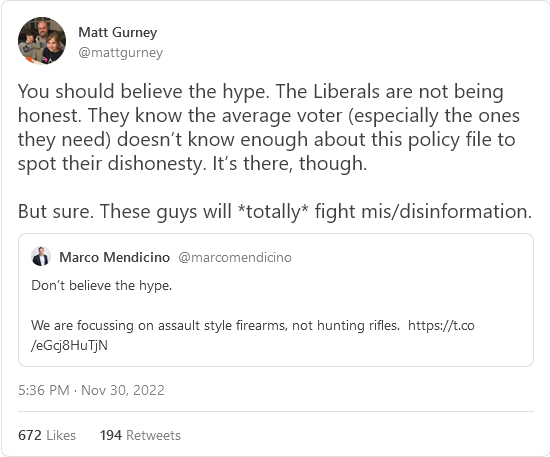
As federal minister of public safety, it’s Marco Mendicino’s job to lie to Canadians

At least, the headline is my interpretation of Matt Gurney‘s somewhat more cautious and measured assessment of the minister’s recent performance:

To celebrate World Press Freedom Day last month, Prime Minister Justin Trudeau said some wonderful things about the importance of truth.

“In the age of disinformation and misinformation,” the statement read, “independent, fact-based reporting is vital. We must all come together to support the work of journalists and double down in the fight against disinformation.”

Stirring stuff. But does the prime minister, his government and the Liberals’ many supporters think any of that actually applies to them?

Marco Mendicino is the federal minister of public safety — a tough job in challenging times. But I’ve come to the unsettling conclusion that Minister Mendicino is not being honest with Canadians.

On the issue of gun control, I’m sorry to say he’s simply lying.

Last week here at The Line, I analyzed the Liberals’ proposed Bill C-21, a package of gun-control measures. My views on this file differ sharply from the government’s. But I’d have hoped that we could at least agree that honesty should be central to the government’s proposals and publicity.

No dice. Last weekend, on CTV’s Question Period, the minister said this: “Bill C-21 doesn’t target law-abiding gun owners, it targets handgun violence, it targets organized crime … I have enormous respect for law-abiding gun owners …”

Well, let’s just go have a gander at the minister’s own webpage, eh? The Public Safety Ministry summarized the proposed legal and regulatory changes. There are 13 specific proposed changes to the Firearms Act. Two are “internal” to the government itself and don’t directly bear on gun owners, law-abiding or otherwise. One targets firearms-related marketing, another is exemptions for “elite sports shooters”. The remaining nine are entirely aimed at the “law-abiding gun owners” the minister insists aren’t being targeted. The page also notes that the government will also be changing regulations (separately from the proposed bill) relating to the safe storage of firearms and ammunition magazine limits … again, aimed entirely and solely at law-abiding gun owners. Indeed, along with some entirely process-focused Criminal Code proposals, there’s only one — one — proposed change that actually focuses on gun smuggling, which is widely believed by law enforcement to be the primary driver of firearms homicides in Canada. (Other planned changes are too vague to be properly analyzed in this context, but could plausibly be aimed at smuggling or blackmarket sales.)

But do the math. One clear mention of smuggling, at least 11 that only affect licensed owners. Denying this is dishonest, full stop.

Let’s be clear: the minister is entirely within his rights to argue that the proposed measures targeting lawful owners are necessary, appropriate and reasonable. These are legitimate debates. What is not up for debate is that the majority of these proposals exclusively target and/or affect law-abiding gun owners. There’s no ambiguity here. The meaning and purpose of C-21 is clear.

« Newer PostsOlder Posts »

Powered by WordPress