
… That I was, unparadoxically, also trying to put in the reader’s head, that Dickens has contributed to the demoralization of our world, was on the surface of my essay. In this respect, I was acknowledging this author’s great power. The reduction of hard moral fact, to mushy simper and what we now call “empathy,” was partly his doing. I detect it even in the unpleasant vibrations of BLM rioters, and other agents of our Left.
They “protest” things that, indirectly, they learnt to protest from the kind-hearted Dickens; subjective hysterias about the world being unfair. Of course it is unfair, as it has always been, and to everyone who has been living in it. But unfairness is a whim, compared to sound moral judgements, and the reticence that should accompany them. We cannot make the world “more fair” by rioting. Dickens, incidentally, agrees with me on that.
He was among the writers (and artists generally) who contributed subtly to our post-Christian worldview, based on emotion, not remorseless thought. Who made, say, Christmas about giving presents to little children, rather than centrally about the birth of Christ. That doesn’t mean his works should be suppressed. On the contrary, they should be read and enjoyed, with this thought in mind. He moralizes, but in a way that may actually subvert morality, by substituting “feelings” for the hard truths, which are to die for.
David Warren, “Retractiones”, Essays in Idleness, 2020-07-29.
December 27, 2020
QotD: Charles Dickens
September 27, 2020
“It is a Chestertonian paradox which Chesterton himself never wrote: a government changing the nature of the state successfully and without opposition because nobody can believe what they are seeing, and so everybody politely ignores it.”
In The Critic, Peter Hitchens on the many civil institutions that have been seriously wounded — not so much by the Wuhan Coronavirus, but by government responses to it:
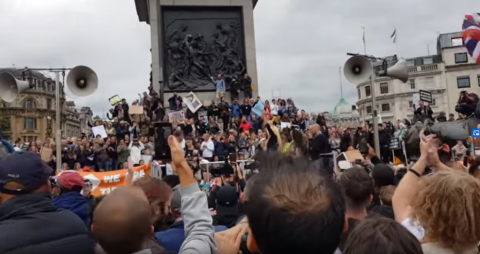
David Icke about to speak at Piers Corbyn’s 20 August anti-masking demonstration in Trafalgar Square.
Screencap from YouTube video – https://www.youtube.com/watch?v=DOZQ58uTWdw
The long retreat of law, reason and freedom has now turned into a rout. It was caused by many things: the mob hysteria which flowered after the death of Princess Diana; the evisceration of education; the spread of intolerant speech codes designed to impose a single opinion on the academy and journalism; the incessant state-sponsored panics over terror; the collapse and decay of institutions and traditions.
These have all at last flowed together into a single force, and we seem powerless against it. Absurdly, the moment at which they have achieved maximum power is accidental, a wild, out of-proportion panic response to a real but limited epidemic.
Outside total war and its obscenities, we have not seen what we are living through now. To list the constitutional events of the last few months is to ask the complacent chattering classes of Britain what it reminds them of: the neutering of parliament into a rubber stamp controlled by the executive; the death of political pluralism; the introduction of government by decree; the disappearance of the last traces of an independent civil service; the silence in the face of these events of media and courts; the subjection of the police to state edicts rather than to law.
[…]
Documents of this kind are not supposed to get out. In better times than these, with active and critical media, this particular passage — with its clear implication that it was the task of the state to scare us into compliance — might have led to the fall of the government. As it is, you will struggle to find mentions of it in the British national press. They are there, but they are hard to find and not on any daily front pages. This is not because of censorship or because of any kind of collective action.
It is because most people, having lived all their lives in relaxed freedom, are quite unable to believe what is in front of their eyes. It is a Chestertonian paradox which Chesterton himself never wrote: a government changing the nature of the state successfully and without opposition because nobody can believe what they are seeing, and so everybody politely ignores it.
This could not have happened, in my view, 60 years ago. Rigorous education, especially of the elite, had at that time created a significant class of people who knew how to think, and how to assess evidence. There would always have been someone, whether it was a Tam Dalyell or a Churchill, to point out the true direction of events and warn against them, prominently. Much of the press would have given this dissent house room, rather than obediently conforming (in order to #ProtectOurNHS). But in the intervening years such rigorous schooling has been replaced by an egalitarian education system which teaches its students what to think, not how to think. Criticism of the past is obligatory, but any cold-eyed assessment of the present — in which new ideas benevolently rule — is disliked and ignored.
As well as this, there have been the various spasms of panic and emotion which convulsed the country after the Cold War ended. These were profound attacks on reason. They were also attacks on limited government and the rule of law, which rest largely on the power of reason. Most people quite like being afraid of something, and many dislike freedom and the responsibility that comes with it. The honest among us all admit it.
Once, before Charles Darwin, Ypres and the Somme, the Christian religion answered those needs. The Fear of the Lord was the Beginning of Wisdom, and the devoted service of Christ was perfect freedom. Faith offered eternal life and helped people to accept temporal death as normal. This belief helped to sustain earthly liberty because, as Edmund Burke pointed out, the man who truly fears God will fear nothing else. No despot can get very far if there are such men around in any number.
September 20, 2020
Andrew Sullivan on the politically deranging effects of social media addiction
In his latest Weekly Dish installment, Andrew Sullivan decries the extreme polarization of the US electorate and points an accusing finger at social media for making things much worse:
An Electoral College victory for Trump, if he loses the popular vote again, would, in this new elite consensus, prove beyond doubt the centuries’ long grip of “white supremacy”. Some are already calling such a victory illegitimate, even though it would be completely constitutional, under the rules everyone has agreed to. The sickening street violence that the far left has downplayed, and permitted to run riot in major cities could be a mere taste of what is to come — along with ever-stronger white nationalist gangs instigating or responding in kind. (Trump’s toleration of this dangerous right-extremism in the past four years is as unforgivable as the left’s excuses for murderous violence.) But the upshot is the same: we will be lucky if the country doesn’t erupt in large-scale civil violence by the end of all this.
And the reason this dystopian scenario is so credible is not just the fault of these political actors. It’s ours too — thanks to the impact of social media. I think we’ve under-estimated just how deep the psychological damage has been in the Trump era — rewiring the minds of everyone, including your faithful correspondent, in ways that make democratic discourse harder and harder and harder to model. The new Netflix documentary, The Social Dilemma, is, for that reason, a true must-watch. It doesn’t say anything shockingly new, but it persuasively weaves together a whole bunch of points to reveal just how deeply and thoroughly fucked we are. Seriously, take a look.
The doc effectively shows how the information system necessary for democratic deliberation has, in effect, been jerry-rigged in the last decade to prevent any reasoning at all. It’s all about the feels, and the irrationality, and the moment, which is why Trump is so perfectly attuned to his time. And what’s smart about the documentary is that it shows no evil genius behind this unspooling, no sinister plot deliberately to destroy our system of government. One of the more basic motives in American life — making money — is all you now need, the documentary shows, to detonate American democracy at its foundation.
For Facebook and Google and Instagram and Twitter, the business goal quickly became maximizing and monetizing human attention via addictive dopamine hits. Attention, they meticulously found, is correlated with emotional intensity, outrage, shock and provocation. Give artificial intelligence this simple knowledge about what distracts and compels humans, let the algorithms do their work, and the profits snowball. The cumulative effect — and it’s always in the same incendiary direction — is mass detachment from reality, and immersion in tribal fever.
With each passing second online, news stories, graphic videos, incendiary quotes, and outrages demonstrate their stunning utility to advertisers as attention seizers, are endlessly tweaked and finessed by AI to be even more effective, and thereby prime our brains for more of the same. They literally restructure our minds. They pickle us in propaganda. They use sophisticated psychological models to trap, beguile, outrage, and prompt us to seek more of the same.
[…]
And online is increasingly where people live. My average screen time this past week was close to ten hours a day. Yes, a lot of that is work-related. But the idea that I have any real conscious life outside this virtual portal is delusional. And if you live in such a madhouse all the time, you will become mad. You don’t go down a rabbit-hole; your mind increasingly is the rabbit hole — rewired that way by algorithmic practice. And you cannot get out, unless you fight the algorithms to a draw, or manage to exert superhuman discipline and end social media use altogether.
But the thing about algorithms and artificial intelligence is that they don’t rest, they have no human flaws, they exploit every weakness we have, and have already taken over. This is not a future dystopia in which some kind of AI robot takes power and kills us all. It is a dystopia already here — burrowed into our minds, literally disabling the basic mental tools required for democracy to work at all.
If you watch video after video of excessive police force against suspects, for example, and your viewing habits are then reinforced by algorithms so you see no countervailing examples, your view about the prevalence of such excessive force will change, regardless of objective reality. A new study shows how this happens. Watching the videos, even more than reading text about them, raises the percentage of white liberals who believe the cops frequently or always use excessive force by around 20 percentage points. The actual data are irrelevant. The BLM movement this summer was less a racial reckoning, as we’re constantly lectured, than a moment of web-induced mass hysteria.
September 4, 2020
“They have insurance”
Brad Polumbo debunks the notion that it’s somehow “okay” to loot and vandalize businesses “because they have insurance” and that somehow means that nobody suffers.
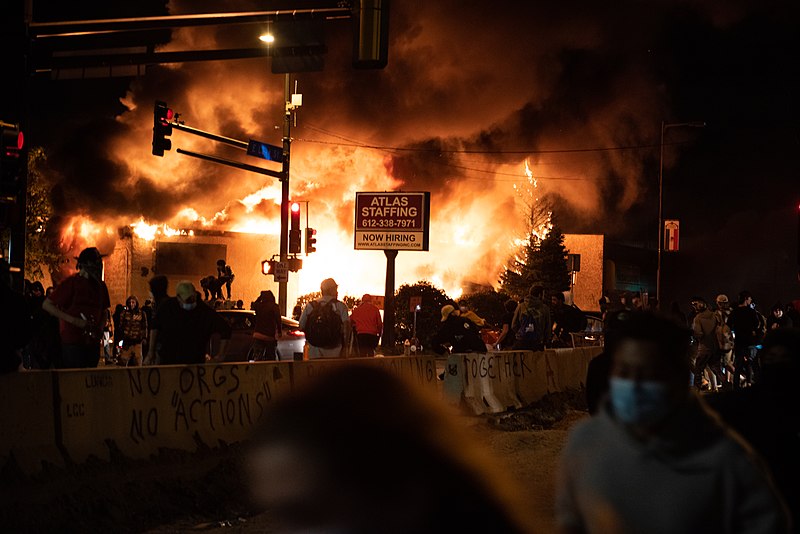
A building burning in Minneapolis following the death of George Floyd.
Photo by Hungryogrephotos via Wikipedia.
Since the death of George Floyd in late May, violent riots and looting have broken out in many major cities, eventually overshadowing peaceful protests and calls for criminal justice reform. From Portland to Chicago to Kenosha, rioters have smashed windows, lit fires, attacked government properties, assaulted people in the streets, and looted storefronts.
In Minneapolis alone, vandals have destroyed at least 1,500 properties, many of them minority-owned businesses, and caused billions of dollars in property damage. Many people have been injured or killed during the chaos.
[…]
Even if all the affected property was fully insured — and it wasn’t — rioting has taken a vast human toll as well.
Consider that at least 15 people were killed during the initial riots after Floyd’s death, and that more have died in the unrest since. When arson and looting consume the streets, people inevitably get hurt and caught in the crossfire. That’s why the Minneapolis police found a burnt corpse in a pawn shop days after arsonists had passed through.
Insurance might fund that property’s restoration, but it can’t bring a dead man back to life.
[…]
Big companies like Walmart and Target generally have expensive, premium insurance plans. But many of the mom-and-pop enterprises and small businesses targeted in the riots didn’t have expensive insurance plans. In some cases, their more modest plans don’t cover damage from riots or don’t cover it in full.
“Situations where there’s a lot of devastation like this, a lot of times people find they’re underinsured and don’t have enough coverage,” Illinois Insurance Association Hotline President Janet Patrick told CBS Minnesota. “And so once the damage has been done, it’s too late. You can’t buy more coverage.”
According to Insurance Journal, 75 percent of US businesses are under-insured. And according to the New York Times, about 40 percent of small businesses have no insurance at all.
September 1, 2020
“John from America” and the South Pacific cargo cults
Steven W. Aunan responds to Vicky Osterweil’s recent book on the joy of looting (which was clearly informed by her almost total innocence of any economic understanding) and also tells the story of the perhaps mythical “John from America” and the cargo cults of islanders in the South Pacific during and after World War II:
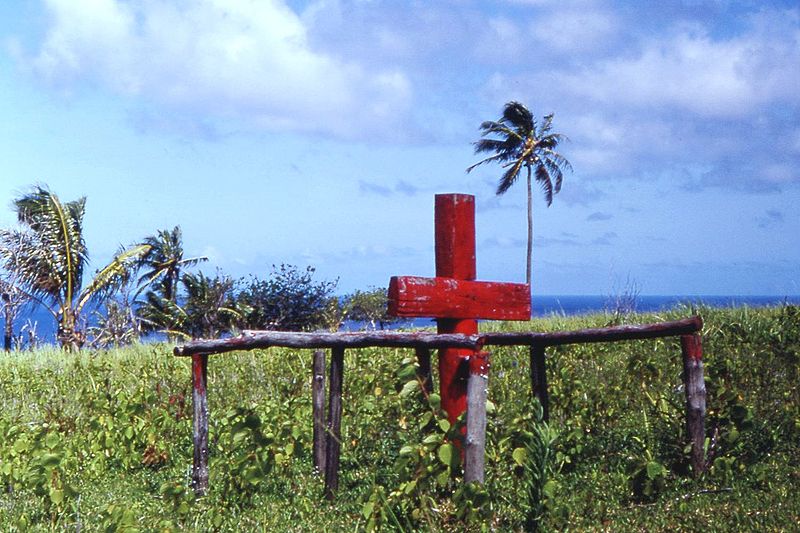
Ceremonial cross of John Frum cargo cult, Tanna island, New Hebrides (now Vanuatu), 1967.
Photo by Tim Ross via Wikimedia Commons.
In 1940, or so goes the myth, a man who identified himself as “John from America” appeared in a native village in the New Hebrides Islands with a message: Rebel against the colonizers, their missions, their schools, their laws, and John would reward them with free housing, clothing, food, and transportation.
The result was the “John Frum Cargo Cult” that persists to this day in the modern-day South Pacific nation of Vanuatu.
Frum’s message was remarkably similar to Vicky Osterweil’s message: rebel against settler domination, against the history of whiteness, and someone will reward you with all the free stuff you need.
Like Osterweil’s chaotic myth of impossibly contradictory Marxist worlds, we can’t be sure who the mythical John Frum was, how or when he arrived, whether he was a man or a spirit-being, if he lived in the U.S. or in the island’s active volcano, or if he first appeared as a tiger on an island where no tigers live, as a black man with a moustache, or as a white man who magically spoke the native language.
You can pick your own truth about Frum, because Marxists will tell you it’s no better than anyone else’s truth.
And, like every other false promise spoken by the fork-tongued followers of the dead white male devil Karl Marx, John Frum brought with him a vision of the future in which the old social order is violently dismantled, a new world is born, and the people emerge with material wealth, happiness, hope, and success.
After Frum left the islands, large numbers of Americans in their flying machines immediately and miraculously followed, building military airstrips and bringing in enormous quantities of cargo. Everything came to pass just as John Frum had promised.
The residents of the islands, of course, did not understand modern manufacturing or transportation, or that World War II was underway. The cargo simply arrived at the airstrip in the jungle, apparently by magic.
Kind of like the Target stores around the country that are repeatedly looted only to be magically restocked by the invisible hand of an invisible genius named John Galt.
August 29, 2020
“Last Sunday in Minsk was indeed a bizarre day”
Vladislav Davidzon reports on recent news from Belarus:
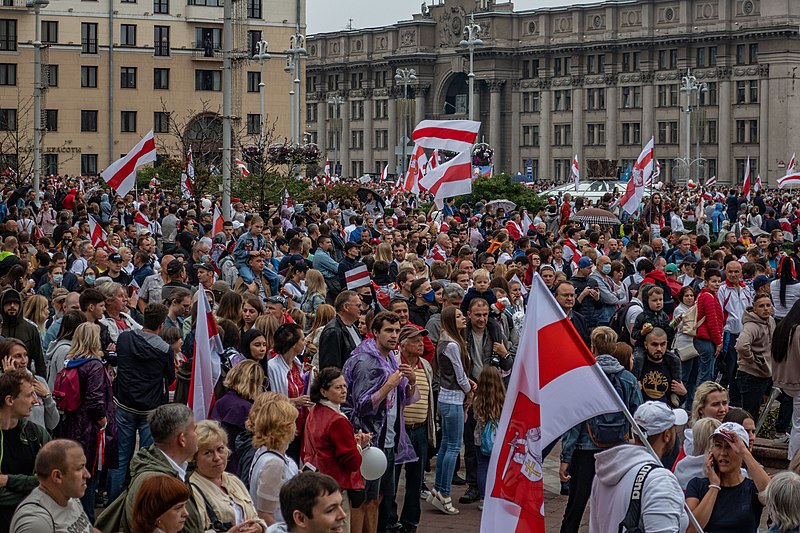
Protest in Minsk against Belarussian President Lukashenko, 23 August 2020.
Photo by Homoatrox via Wikimedia Commons.
“Where were you grandpa,” I dearly hope that my historically minded descendants will inquire of me one day, “when that maddened Belarusian president flew over the crowd of protestors in that helicopter with a machine gun in hand?” Last Sunday in Minsk was indeed a bizarre day. As the protestors of this most velvet of revolutions approached the presidential palace, Lukashenko panicked and ordered his personal military helicopter to fly over the crowd.
We are now into the third week of the political crisis that has wracked Belarus in the wake of the discredited presidential election of 9 August. Following the outcome of the fabricated election, Lukashenko has forfeited all political legitimacy after ruling the country as his own personal kingdom for the past 26 years. Yet, as the daily demonstrations taking place across every town and region demonstrate, Belarus is no longer governable under the old political agreement.
The entire capital of Minsk appears to be in revolt, if only passively. When I discreetly asked the cleaning lady at my hotel where I can go to make a call without being noticed, she replied with a knowing smile: “You can’t, they listen to everything.” The repressive apparatus on which Lukashenko has relied for decades clearly no longer functions. The protests are organised by encrypted telegram channels – many based in Poland and Lithuania – which the government is powerless to stop. NEXTA Live (the main telegram channel of the opposition, managed by an exiled 22-year-old Belarusian activist) has reported an extraordinary one billion views of its posts for the first three weeks of August.
So, it is understandable that the opposition demand that Lukashenko retire. He is 65 years old and will be celebrating his next birthday this coming Sunday (the day that protestors stage their weekly marches, routinely bringing 200,000 people into the streets of the capital). Those who run the opposition telegram channels have taken to referring to him as “a certain pensioner in Minsk”. Thus, “a certain pensioner in Minsk is meeting with the KGB and interior ministry generals today”. A “certain pensioner in Minsk is shaking his fist and threatening NATO”, and a “certain pensioner in Minsk has ordered a flight of Belarusian Mi-24 ‘Hind’ helicopters to intercept a formation of enemy flags bearing balloons on the Lithuanian border”.
August 26, 2020
For British liberals, it’s somehow different when it happens in another country
At Spiked, Brendan O’Neill emphasizes the hypocrisy of some of the people lionizing the Belarussian democrats who also spent the last few years demonizing the democratic process that led to Brexit:
Protest in Minsk against Belarussian President Lukashenko, 23 August 2020.
Photo by Homoatrox via Wikimedia Commons.
British liberals are cheering on the tens of thousands of brave Belarusians who have taken to the streets to demand the enactment of their democratic vote. Which is odd, to say the least, given that the last time British liberals themselves marched in the streets, often in their tens of thousands, it was to demand the crushing of a democratic vote. It was to call upon the state to refuse to enact the democratic wishes of 17.4 million people, the largest democratic bloc in the history of the UK. The hypocrisy is staggering: the British chattering classes celebrate democracy abroad and wage war on it at home.
Belarusians are fighting tooth and nail for their democratic rights. They are marching in the streets in vast numbers – in defiance of the government’s authoritarian clampdown on public gatherings – and workers are going on strike. They are furious with the rigged outcome of the election two weeks ago, which gave their authoritarian president, Alexander Lukashenko, who has been in power for 26 years, yet another term. Lukashenko’s regime claims he won more than 80 per cent of the vote in the election on 9 August while the opposition won around 10 per cent. No one believes this. And they are right not to believe it: Lukashenko has a history of anti-democratic, tyrannical behaviour.
The Belarusians rising up against Lukashenko and demanding the meaningful right to determine who governs their country are an inspiration to democrats everywhere. They are taking enormous risks. They are breaking illiberal laws by taking to the streets of Minsk. At least four people have been killed in the protests. Some demonstrators claim they were tortured by security forces after being arrested. It is testament to people’s yearning for democratic power, for a real say in the future of their country, that so many are flooding the streets of Belarus or downing their tools at work in order to force the regime to listen to their voices. This is democracy in action.
And yet, there is something nauseating in the British chattering classes’ attempt to cosy up to the Belarusian uprising for democracy. For these are the same people who spent the past four years trying to do in the UK what Lukashenko is currently doing in Belarus – that is, silence people’s democratic cry and write off their democratic votes. Lukashenko does it with batons and torture, while our far more polite elites tried to do it with court cases, parliamentary intrigue and a relentless campaign of Project Fear. But the motive was the same: to prevent the supposedly problematic little people from having their say and screwing up political life.
[…]
The British columnists and politicos celebrating the Belarusian uprising have to face up to this fact: they have nothing in common with these brave warriors for democracy. On the contrary, their marches over the past four years were singularly devoted to stopping democracy. Who can forget those huge “People’s Vote” gatherings in which armies of middle-class Remainers would gather in London to sneer at ordinary voters, plead with the government to ignore their votes, and demand that big constitutional questions be taken out of the hands of the dangerous, reckless “low-information” masses. Guess who probably feels similarly to this? Yes, Alexander Lukashenko.
August 24, 2020
QotD: Progressive malevolent narcissism
These are people who will lie as readily as breathing in order to excuse their antisocial urges. They aren’t being obnoxious reluctantly, in desperation, or under duress. They harass, provoke and delight in domination because it gives them pleasure. It makes them feel important and powerful. Power being conceived solely as power over others. It’s a focus for their spite. Anything else is a fig leaf, a pretext. Among Portland’s identikit radicals, the ones exulting in the alarm and misery of others, there is no good faith. And so, you can’t engage with such creatures on their own ostensible terms.
David Thompson, “Shamelessly, He Quotes Himself”, David Thompson, 2020-08-22.
July 29, 2020
The Equity, Inclusivity, and Diversity Industrial Complex
In The Dominion, Ben Woodfinden comments on a Ross Douthat column on the “antiracist” demands of our modern protestariat (the hordes of un- or under-employed university-educated young liberals and socialists):
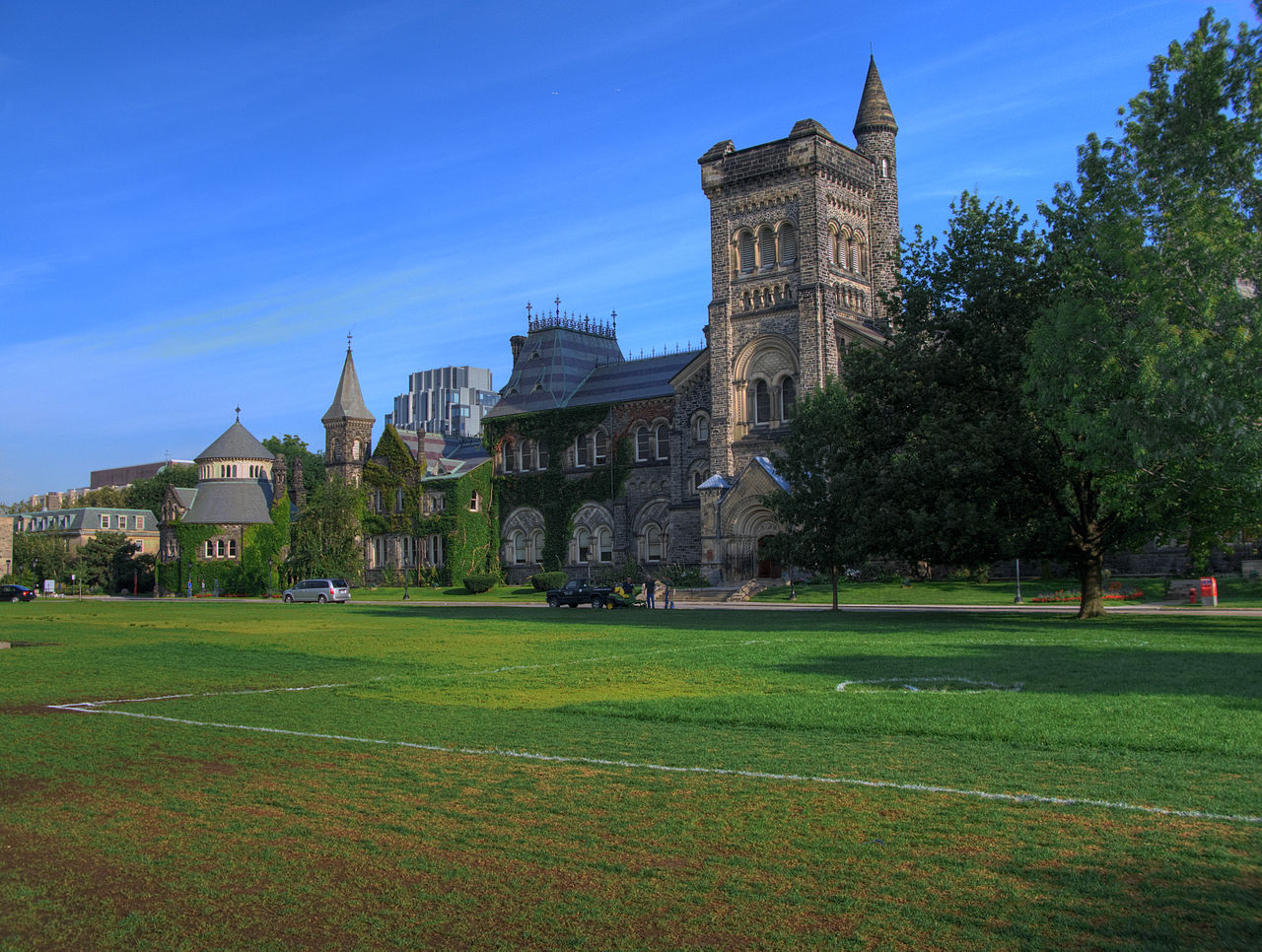
University College, University of Toronto, 31 July, 2008.
Photo by “SurlyDuff” via Wikimedia Commons.
… the most interesting aspect of this lockdown-induced outpouring of collective rage hasn’t been the protests, or the cancellations, but the woke job creation that is going on. The ideology behind things like “white fragility” is increasingly being transformed into what can be described as an equity-inclusivity-diversity (EID) industrial complex that might end up being the most significant long term structural change that emerges out of the protests.
One of the most common responses in elite institutions as they promise to address systemic racism has been the creation of new jobs and positions that will supposedly help to do so. For instance, the Washington Post created a set of new positions that will be focusing on racial issues. This included hiring a “Managing Editor for Diversity and Inclusion.” At Princeton, the administration announced, like many other elite universities, new courses (which means new teaching opportunities) focused on racial injustice, as well as new projects and funding for research to explore and address racial issues. Stanford has created a new Centre for Racial Justice at its law school.
This direct job creation is just the tip of the iceberg. The real EID industrial complex is in the creation of a vast number of new jobs dedicated to the promotion and advancement of the basic tenets of this ascendant ideology through the expansion of human resource departments to deal with these issues, the creation of new EID bureaucrats and administrators in universities, corporations, government departments, the rise of EID consulting and mandatory courses and workshops for employees, new jobs and potential litigation for lawyers, as well as courses and modules in law schools to teach aspiring lawyers about these things.
In the bestselling Ibram X. Kendi book How To Be An Antiracist, one of Kendi’s central solutions is to pass an anti-racist amendment to the U.S. Constitution and permanently establish and fund a Department of Anti-racism. This department:
would be comprised of formally trained experts on racism and no political appointees. The DOA would be responsible for preclearing all local, state and federal public policies to ensure they won’t yield racial inequity, monitor those policies, investigate private racist policies when racial inequity surfaces, and monitor public officials for expressions of racist ideas. The DOA would be empowered with disciplinary tools to wield over and against policymakers and public officials who do not voluntarily change their racist policy and ideas.
The radical tendencies of the bourgeois bolsheviks in the streets might make them seem like true revolutionaries, but what this movement seems to actually want to create, with remarkable success, is new employment opportunities for true believers in the new anti-racist creeds. Racism won’t so much be solved by tearing society down, but by massively expanding new professional and managerial jobs that can guarantee full employment for the credentialed class of true believers.
O’Boyle’s thesis is that the revolutions that swept across European cities in 1848 were because a large surplus of resentful and overeducated men felt society was denying to them what they were rightfully owed. O’Boyle looks at Germany, where university education was cheap, and was “emphasized as an avenue to wealth and power.” This ending up producing an excess of ambitious, but resentful and frustrated men who felt society was not allotting them the status and comfort they deserved. The same was true in France. But in Britain, the opportunities produced by industrialization that had yet to fully materialize on the continent kept this excess surplus of overeducated men much smaller, and helped insulate Britain from revolution.
What if the EID industrial complex actually helps to reduce the scarcity of opportunities in elite fields and institutions that will put a lid on the unrest that overproduction breeds? The EID industry is worth billions of dollars, and in a way it might be the solution liberalism offers to both the radical progressivism of this ideology, and to the challenge posed by elite overproduction.
July 15, 2020
Wilfred Laurier University – from university to indoctrination centre
In the National Post, Barbara Kay notes how things are changing from general support of freedom of speech to cracking down on “dissent” of any nature, with WLU being a leading example:
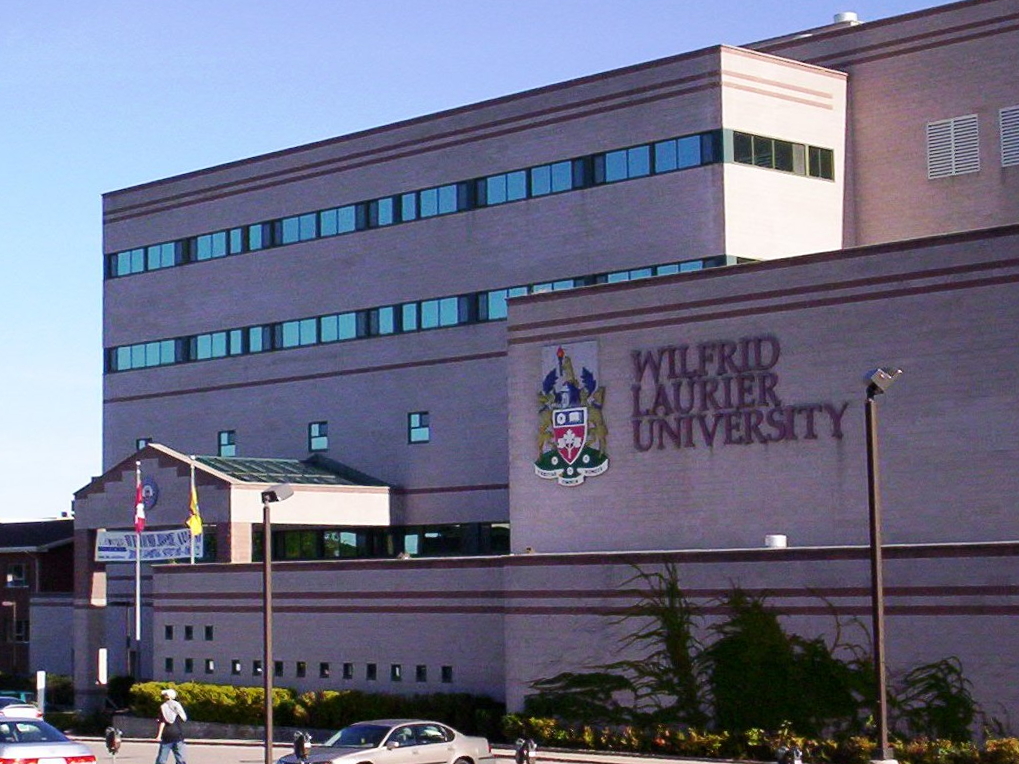
Wilfred Laurier University in Waterloo, Ontario. This photo taken from University Avenue shows the Maureen Forrester Recital Hall and John Aird Centre, 23 September, 2005.
Photo by Radagast via Wikimedia Commons.
My editor, a man in his prime, recently tweeted bemusement that his older readers often preface their emails to him with allusions to their age (“as a 75-year old man …” “I’m an 82-year old woman …”).
I know these readers. Or others like them.
When my oldie readers introduce generation markers in their emails, it’s generally a semaphore signifying bewilderment at a cultural landscape so utterly changed from their youth, they cannot find their bearings. I empathize with these readers because, an oldie myself, I share their anxiety at the continual erosion of classic liberal principles we took for granted as permanent. Especially the freedom to dissent from popular views.
[…]
If you had told us in our youth that one day students would be screaming obscenities and blaring horns to prevent presentations by visiting speakers whose opinions they dislike, as happens frequently in American universities and occasionally in Canada, we would have been shocked. If you had told us that someday a graduate student who exposed her class to a range of opinions on a controversial subject — the norm in my university experience — would be officially censured for including the views of a conservative commentator because his views might “harm” students, we would have been gobsmacked.
Lindsay Shepherd’s 2017 recording of her disciplinary session at Wilfrid Laurier University for the crime of exposing her students to Jordan Peterson’s views on compelled speech brought her to national attention. (Peterson was compared to Hitler by one interrogator. A defamation lawsuit by Peterson against WLU is in progress.) The broadcast of the ruthless performance that reduced Shepherd to tears was a pivotal teaching moment in the illiberalism that governs academia in the name of diversity, equity and inclusion.
Shepherd was the only adult in that room. But she was already an exception to the rule in her cohort, and the chances of another such act of dissidence by a WLU graduate student are slim to vanishing.
July 6, 2020
QotD: The special moral insight of children
So when does the special moral insight of children manifest itself? When they are telling us that algebra is a stupid waste of time and the drinking age should be 14? No, funnily enough, children are only gifted with these special powers when they agree with the adults around them. Our long-standing cultural dichotomy lets adults use them strategically in political arguments, to push them forward as precious angels speaking words of prophecy to make a point, and then say, “hush, they’re just kids” when the children mar that point by acting like, well, children.
Adult organizations helped organize the walkouts, while casting them as a pure expression of youthful insight. Liberal communities proudly enabled the walkouts; liberal parents posted gushing accounts of their children’s protests on Facebook; liberal elite universities rushed to assure kids that walking out wouldn’t hurt them on college applications. Conservative communities, meanwhile, threatened to enforce the rules against disrupting class time. So the protests often ended up a better reflection of adult priorities than childish wisdom.
[…]
That is not to say that gun-control advocacy is stupid. But if you wouldn’t be swayed by a 17-year-old’s passionate advocacy for a lower drinking age — or for that matter, their ideas about Federal Reserve policy — then you should probably apply those same cautions to their other views, especially when they’re under so much pressure to conform. There’s nothing particularly wrong with Wednesday’s mass walkouts. But there’s nothing especially right about them either.
Megan McArdle, “The student walkout said more about adults than kids”, Washington Post, 2018-03-15.
June 18, 2020
The origins of Antifa
Kyle Shideler outlines the history of Antifa from the Weimar Republic to the streets of cities all over the western world:
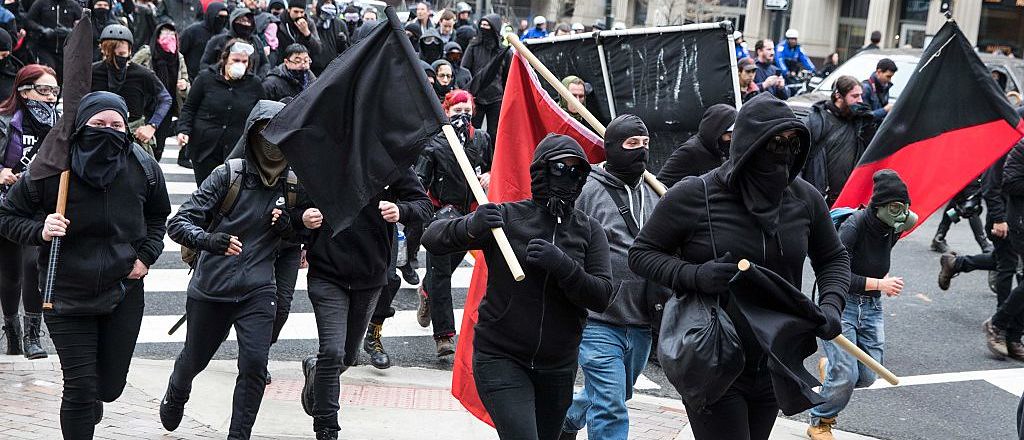
“antifa 8973ag” by cantfightthetendies is licensed under CC BY 2.0

With riots and civil unrest metastasizing across the United States, the president declared he intends to designate Antifa as a terrorist group. Predictably, the talking heads rushed out to declare that Antifa doesn’t really exist, and even if it did the president couldn’t possibly target it using that legal designation. They argue Antifa is an amorphous blob of discontents, not a functioning organization, and certainly not one which could be designated and targeted for concentrated counterterrorism enforcement.
As usual, the Twitterati don’t know what they are talking about. Reality is both simpler and more complex.
To begin at the beginning: Antifa — real name: Antifaschisitsche Aktion — was born during the street-fights of the 1932 Weimar Republic. It was founded by the Stalinist Communist Party of Germany (KPD), although various Communist “anti-fascist defense” units were associated with the KPD much earlier.
Anti-fascist Action’s sole purpose was to help the KPD combat other political parties for control of the streets in the revolutionary politics of the rapidly failing Weimar Republic.
And yes, they fought the Nazis.
But they also fought liberal parties, conservative parties, and anyone and everyone who got in their way. While these early antecedents were short-lived, it is useful to view Antifa in this context. More than anything, Antifa exists to serve as a tool of revolutionary politics in a failed (or failing) state.
Antifa would reestablish itself in the early 1980s, also in Germany, out of Autonomism. Autonomism is an anti-authoritarian anarcho-Marxist ideology associated with the Communist urban guerilla organizations of 1970s and ’80s Europe like Red Army Faction and the Red Brigade. Autonomism would find a home among the young punks of Germany’s squatters’ rights movement. Around this time, Antifa tactics like the “black block,” where large numbers of rioters dress in black and move together in formation as part of a larger protest, were developed.
H/T to Rafe Champion for the link.
June 17, 2020
Alcibiades, the first recorded iconoclast, but far from the last
James Heartfield on the modern day resurgence of iconoclasm:
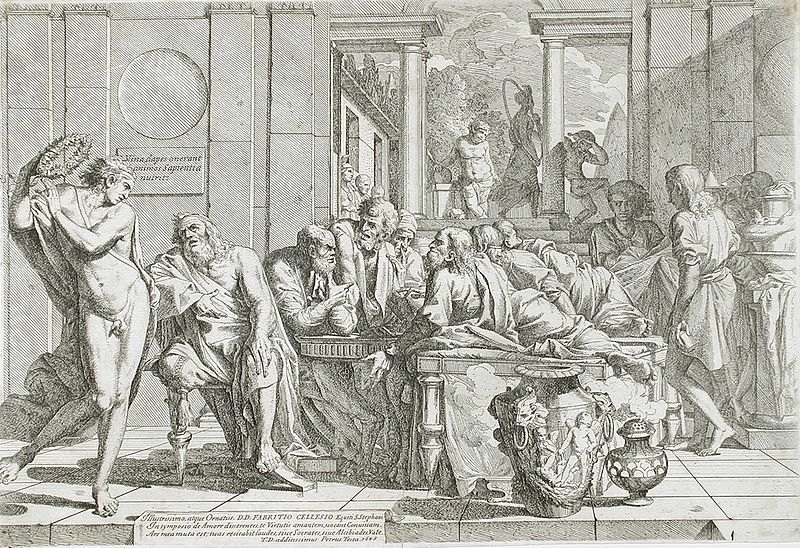
“Drunken Alcibiades interrupting the Symposium”, an engraving from 1648 by Pietro Testa (1611-1650)
Via Wikimedia Commons.
… far more often, the attacks on public symbols are indicative of a breakdown in social solidarity — often with alarming consequences. For activists seeking to win popular support, knocking down statues is a high-risk strategy that can provoke the opposite sentiments to those hoped for. The futurist Marinetti’s proposal to fill in the canals of Venice with concrete to make modern roads is a witty way to make a point, but not a sound policy.
Alcibiades was perhaps the first recorded statue vandal. One night in 415 BC he knocked all the stone cocks off the statues of Hermes in Athens. In 1497, the friar Girolamo Savonarola launched a Bonfire of the Vanities in which artworks, books and statues were destroyed out of a fear they would tempt people away from God. As any lover of old English churches knows, the furies of the Puritan revolution led to the destruction and defacing of Catholic saints’ statues and paintings.
In the modern era, the temptation to destroy monuments has been strong. In the First World War, Britain’s local authorities changed German-sounding names of streets like Bismarck Road — now Waterlow Road — while bully boys attacked German-owned shops. In 1933, Nazi students in Germany organised bonfires of subversive books, while the Reich organised an exhibition of “degenerate” modernist art. The burning of books only served as a trial run for the extermination of people, as the symbolic slaughter failed to yield the results of a “cleansed” Germany.
People often make the point that there are no statues of Hitler in Germany — though those were not taken down by Germans, but by the Allied occupiers. You can still see Albert Speer’s Zeppelinfeld and grandstand in Nuremberg, where many of Hitler’s rallies took place, though not much else of his Nazi architecture survives. Mussolini’s architects, Giuseppe Terragni and Marcello Piacentini, did better — much of their absurdly grandiose work survives. The model of an Allied-led “denazification” was in the minds of the US-led forces that overthrew Saddam Hussein in 2003. The destruction of his statue in Baghdad was largely staged by the allies.
Under the Maoist regimes in China and the Khmer Rouge in Cambodia, some of the worst atrocities after the Nazis were carried out. Mao’s “Cultural Revolution” against the “four olds” led to the destruction of books and artworks. Later, there were showtrials and the politically incorrect were battered by the mob. In the wreckage of Cambodia, Pol Pot led a terrifying war on alleged capitalist-roaders and even intellectuals — who could be handily identified by the fact they wore glasses — that led to millions being killed. Pol Pot declared a “year zero” — that all civilisation before the Khmer Rouge took power would be cancelled. Tragically, the wholesale wiping out of Cambodian culture was only a prelude to the extermination of much of its population. The sentiment of wiping out the wrong history was repeated in the war that al-Qaeda-inspired regimes in Afghanistan and Mali conducted against books and statues that did not match their own Islamist views.
In Soviet Russia, when the communist-allied artists of the Proletkult organisation argued that all Tsarist culture should be expunged, the Bolshevik leader Lenin took them to task for “rejecting the most valuable achievements of the bourgeois epoch”. Instead, he said, they should assimilate and re-work “everything of value in the more than 2,000 years of the development of human thought and culture”. Sadly, Lenin’s wise advice was lost on the Stalinist regimes that followed, during which the policy oscillated between futurist iconoclasm and maudlin Russian sentimentality. History got its revenge in eastern Europe when most of the ubiquitous Lenin and Marx statues came down in the 1990s.
June 12, 2020
An unwelcome return to the 1960s
David Warren reflects on how many parallels we’re seeing in the current year to the worst aspects of the 1960s:
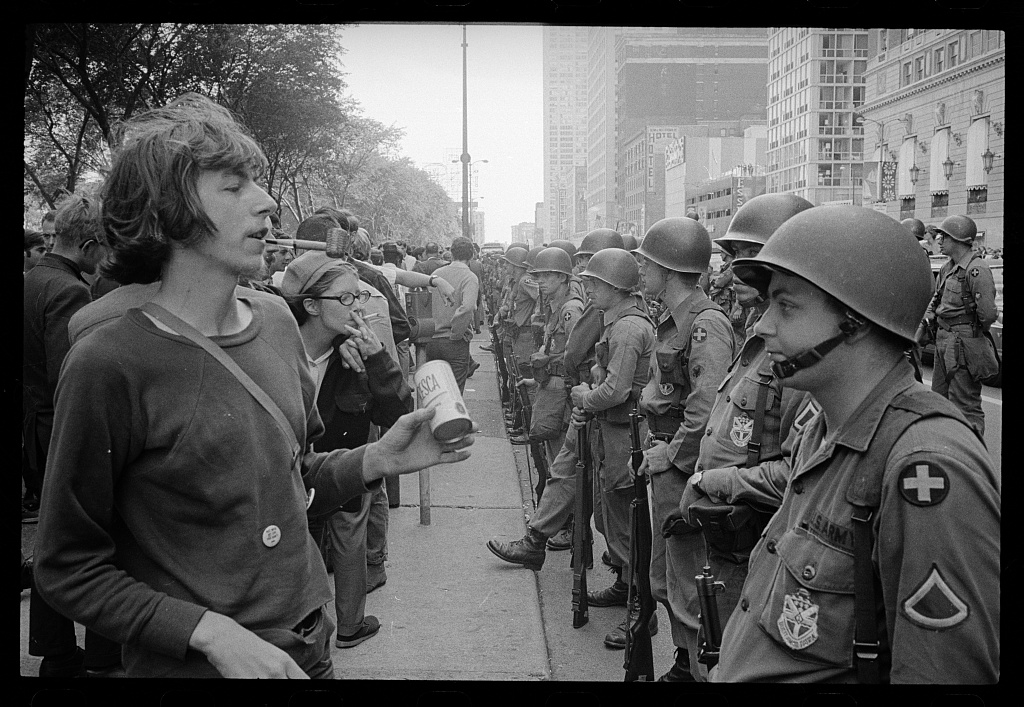
Young “hippie” standing in front of a row of National Guard soldiers, across the street from the Hilton Hotel at Grant Park, at the Democratic National Convention in Chicago, August 26, 1968. Photo by Warren K. Leffler for US News & World Report via Wikimedia Commons.
As an old Cold Warrior, and once “science kid,” whose childhood developed through the 1960s, there is nothing that ought to surprise me. We have Antifa today; we had the Weather Underground then. We have parallels to every event I witnessed through the idiot box of adolescence, and vice versa. Even the destruction of American cities by riots and crime isn’t new; nor the supine response of our liberal leaders. The obvious left bias of news and entertainment was the same then as now, only less shrieking. The replacement of flatfoot journalists, with malicious ideological clowns from the universities, then a work in progress, was by the end of the last century, complete. The poison spread, through all media of information. We’ve reached an Age of Unreason to match Robespierre’s, and seem now to be waiting for a Napoleon.
Charlatans are the handmaids of paganry. That the charlatans slide into violent insurrection, even against the better pagan customs, is not something historically new.
The alternative is improbable: another Age of Faith. This would necessarily include a subsidiary restoration of faith in science — in the modest belief that if we follow the facts where they lead, as opposed to where we want them to go, a lost perception of cosmological order will also be, willy-nilly, restored. “Modern science” — an unambiguously Christian construct — depends entirely on one assumption. It is, that a universe God created will make sense. Logic, or the principle of non-contradiction, will hold up, and where it doesn’t seem to be doing so, it is not God, but we, who have got it wrong.
By the inversion of “values,” at the present day, the sane views are labelled as “psycho.” The truth is not the true, but what we (or our masters) want to call true. This “truth” is “settled,” from one moment to another; and is not to be discovered, but imposed.
June 11, 2020
Current year Iconoclasm
In an Areo article from last year, Alexander Adams discusses the phenomenon of iconoclasm:
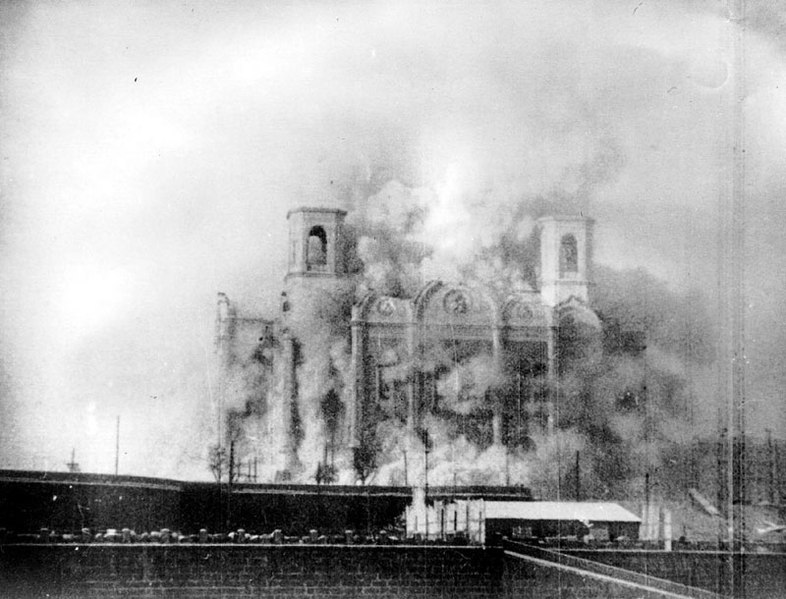
The 1931 demolition of the Cathedral of Christ the Saviour in Moscow.
Public domain image via Wikimedia Commons.
Behind any campaign is the campaigner: the activist convinced of his own righteousness.
The political activist reserves to himself the right to retrospectively edit our history for his satisfaction by removing monuments, those fixtures of civic life, embedded in the memories of generations. The activist often knows almost nothing about the object of his hatred — merely a garbled caricature of a person caught up in the conditions of her age — but the activist acts as if he were not also caught up in the conditions of his own age.
Iconoclasm is an expression of domination and a demonstration of willingness to act — illegally and unethically — to impose the will of one group over an entire population. It asserts control over all aspects of society. It sets a challenge that will elicit a strong reaction. Iconoclasm is a warning that the protection of law and social conventions no longer applies and that the cause will be promoted through physical force if necessary.
The campaigner argues that public art, accumulated piecemeal over 1,000 years of history, must reflect our society and values today — even if that means altering or erasing stories of the values our past society expressed via its monuments, or suppressing evidence of how we arrived at our current situation. The left-wing activist wants to celebrate current-day multiculturalism, but mostly he wants to erase evidence of the historic monoculturalism that preceded it.
Our willingness to live with historical relics we feel ambivalence towards is a demonstration of our toleration of dissent. Likewise, an openness to imagining ourselves in past times — constrained by the conventions and laws of a different era — forces us to question common assumptions about the completeness of our knowledge and our moral certainty. If we can make this leap of empathy, we can free ourselves of ideological possession. We have the ability to empathize with both slave and slave owner. Empathy makes it harder to justify destruction of the cultural relics of an older age or silence the voices of individuals, who might share insights into life.
The toleration we extend towards symbols of former regimes and proponents of ideas with which we disagree shows our willingness to be honest about our nations’ pasts. To accept our flaws as a necessary part of our development is to display the maturity, restraint and empathy that define the confident yet self-critical nation. For if we cannot stand the sight of a dead political opponent carved in stone, how can we restrain ourselves in the face of a living political opponent who speaks against us?


