Quotulatiousness

March 14, 2020

The still-secret “settlement” between the federal government and five hereditary chiefs of the Wet’suwet’en

Filed under: Cancon, Government, History, Law, Politics — Tags: , , , , — Nicholas @ 03:00

Chris Selley points out some of the disturbing features of the as-yet-unrevealed agreement between Her Majesty’s Canadian government and five unelected First Nation chiefs that eventually got the railways running again:

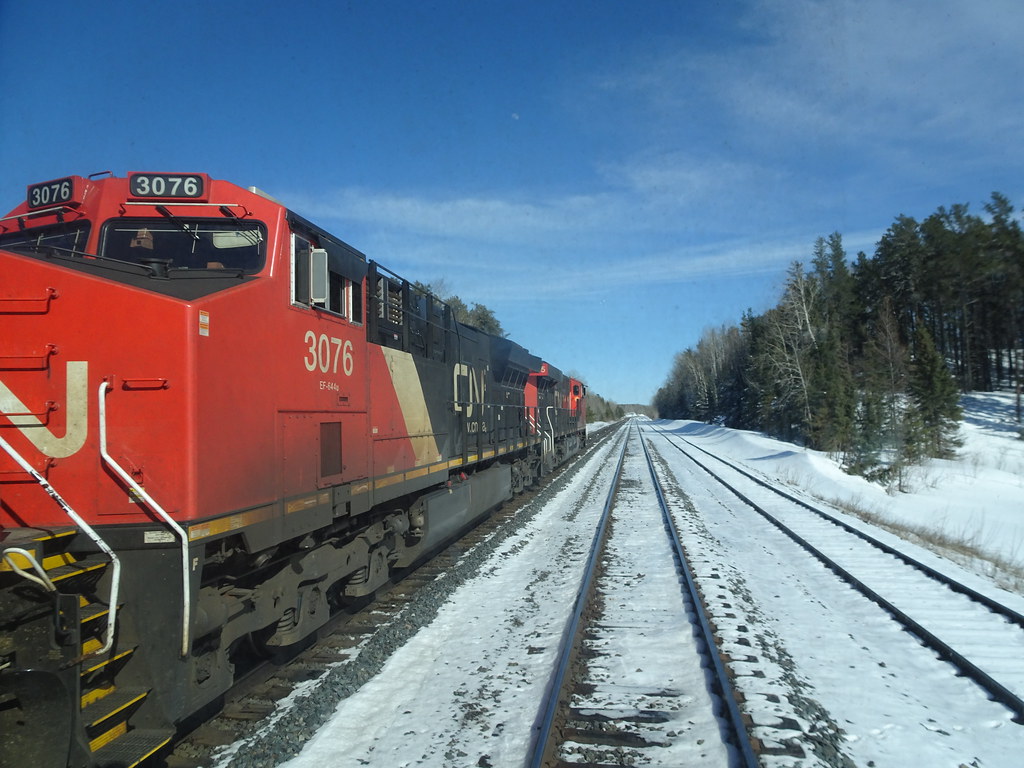
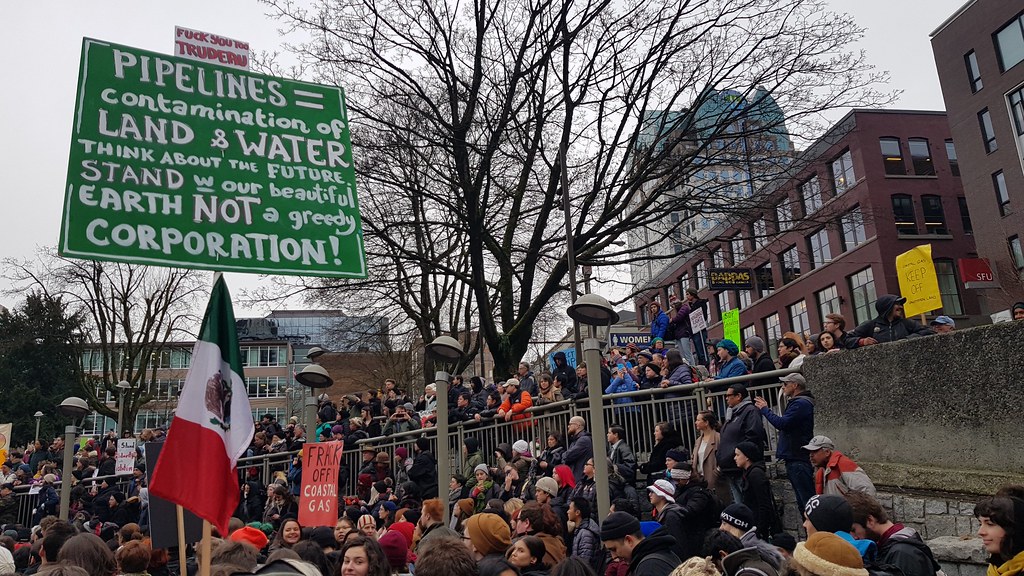
“DSC02285” by Bengt 1955 is licensed under CC BY-NC 2.0

For starters, we still don’t know the details of the arrangement, struck earlier this month between Wet’suwet’en hereditary chiefs and federal and provincial government officials, that allowed for pipeline work to resume. Those details could well represent positive progress on establishing just what the Wet’suwet’en’s legal claim on their lands — affirmed by the Supreme Court in 1997 — really means. But did the government have any business negotiating with the chiefs in question in the first place?

Tait-Day doesn’t think so. The Office of the Hereditary Chiefs of the Wet’suwet’en, she told the committee, is “not accountable to the (Wet’suwet’en) nation.”

“By refusing to hear from elected councils, these governments have without merit prevented the most credible current governing voices from being heard,” she told the committee. “The Indian Act system must be reformed, but that does not invalidate the role of the elected councils. While imperfect, they continue to speak for the people until a better model is implemented.”

Even setting aside the exclusion of elected councils, the negotiations were of dubious legitimacy. They weren’t with the hereditary chiefs per se; rather, they were with the hereditary chiefs who oppose the pipeline. Not all do, and some support it — including Tait-Day, Gloria George and Darlene Glaim, founders of the Wet’suwet’en Matrilineal Coalition. For their apostasy, male chiefs simply stripped them of their titles. This is not in dispute: “We’ve stripped the names from three female hereditary chiefs for supporting the pipeline,” John Ridsdale, whose hereditary title is Chief Na’Moks, told APTN News in 2018. “A name is more important than money.”

Using the title of Chief Woos, Frank Alec has become the leading public face of the anti-pipeline hereditary chiefs. On his behalf, Canadians both Indigenous and non-Indigenous have shut down rail lines and blocked access to the B.C. legislature and marched in the streets. Until 2018, the title of Chief Woos belonged to Glaim. He took it from her precisely because she dared support the pipeline and the benefits that will flow from it to her people.

“By negotiating directly with (the Office of the Hereditary Chiefs of the Wet’suwet’en), Canada and British Columbia give legitimacy to a group of bullies and abusers of women,” Tait-Day told the committee. “We cannot be dictated to by a group of five guys.”

March 11, 2020

Canadian National’s perfect storm

In Trains, Bill Stephens highlights the terrible time Canada’s largest railway has been having since the beginning of the year:

“DSC02285” by Bengt 1955 is licensed under CC BY-NC 2.0

It would be hard to imagine a worse start to the year for Canadian National, whose volume is down 16% due to a string of events that’s mostly odd, unrelated, and unrelenting. CN is taking it on the chin, as no other North American railroad has seen its volume fall by more than 10% this year and rival Canadian Pacific’s traffic is up 10%.

First, there was Mother Nature. Winter arrived in January with eight days of deep cold in Western Canada, forcing CN to restrict train length. Then powerful rainstorms lashed southern British Columbia starting Jan. 30, washing out CN’s main to Vancouver for six days.

The major washouts occurred in the rugged Fraser River canyon directional running zone where CN and CP share trackage, with CN hosting westbounds and CP carrying eastbounds. The railways had to resort to running directional fleets of 15 to 20 trains at a time over CP’s line. The single-track bottleneck caused eastbound traffic to stack up at the Port of Vancouver and westbounds to be staged as far away as the Prairies. The directional running zone ranks among the top three freight mains by tonnage in North America, alongside BNSF Railway’s Southern Transcon in the Southwest and Union Pacific’s triple track across Nebraska. So this blockage was, by itself, a big deal.

Then came nearly a month of civil protests. On Feb. 6, as CN began digging out from the washout backlog, the first of several First Nations blockades set up camp on CN’s tracks. The blockades, protesting a proposed natural gas pipeline in British Columbia, halted traffic on CN’s Montreal-Toronto mainline in the East. Also ultimately affected: CN’s line to Prince Rupert, British Columbia, which was blocked by protests for six days. Other protests came and went in Edmonton, Alberta; Winnipeg, Manitoba; Quebec; and British Columbia. CP was affected, too, but to a much lesser extent. CP even hosted detour traffic for CN between Montreal and Toronto.

As if that wasn’t enough, then came regulatory woes. The same day the protests began, a CP crude oil train derailed and caught fire in Guernsey, Sask., the second such wreck in the area since December. Hours later Transport Canada issued a ministerial order that restricted key trains – those with 20 or more cars of hazardous materials – to 20 mph in metropolitan areas and 25 mph elsewhere. With the stroke of a pen, Transport Minister Marc Garneau’s knee-jerk reaction effectively reduced CN’s overall capacity by a third. You could call this slowdown “Whoa Canada!”

February 29, 2020

“And then, somewhat astonishingly, the Ontario Provincial Police actually upheld the law”

Filed under: Cancon, Government, Law, Politics, Railways — Tags: , , , — Nicholas @ 05:00

Chris Selley calls for some answers in the still-not-fully resolved railway disruptions by First Nations and climate activists and the calling-it-spineless-is-a-compliment reactions of various levels of government to widespread contempt for the law:

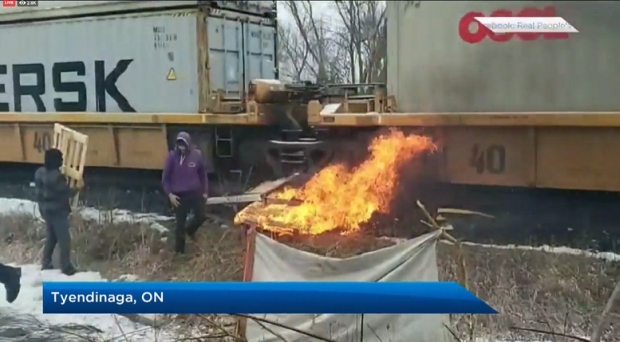
Screencap from a TV report on Mohawk Warriors attempting to set a freight car on fire along the Canadian National mainline through Tyendinaga near Belleville, Ontario.

When Canada’s ongoing spate of rail blockades finally peters out, this country has some work to do. A parliamentary committee might be up to the job, but even a full-on independent inquiry might not be excessive. A small group of Mohawks in Tyendinaga, Ont., in solidarity with an even smaller group of hereditary Wet’suwet’en chiefs, managed to blockade the Canadian National Railway for two weeks, not just holding hostage a chunk of the country’s economy, productivity and mobility, but demanding as ransom the cancellation of a liquefied natural gas pipelines that all First Nations affected by it, and it seems a comfortable majority of their residents, support.

It’s not a national disaster or anything. But as Prime Minister Justin Trudeau belatedly realized, it’s simply not an acceptable outcome in a democracy operating under the rule of law. And there is every reason to believe it could happen again — especially because we don’t really know how or why it ended when it did.

Operating at peak obnoxiousness, Trudeau had scolded those who demanded enforcement of a court order against the Tyendinaga blockade as boors, violence-mongers and idiots: “We are not the kind of country where politicians get to tell the police what to do,” he huffed. And then, frustrated by a lack of Sunny Ways among the federal government’s negotiating partners, he suddenly told the police what to do — or at the very least what he thought should happen.

[…]

The relatively undramatic end to the Tyendinaga blockade, after two weeks of dire warnings about Oka and Ipperwash reruns, raises another key question: Is there any reason we should believe it was safer to enforce the injunction on Day 14, as opposed to Day One or Two or Six?

Attempting negotiations was a perfectly sensible approach, even though it was very difficult to discern any room for compromise when one of the blockaders’ demands was so simple, blunt and inconceivable: shutting down the Coastal GasLink pipeline project. But the government is likely to face similarly unbending demands from future blockaders: Shutting down the Trans Mountain pipeline project, for example. Surely we can’t establish “two weeks of futility and then enforcement” as a policy moving forward. (Some might argue it was already established by a 13-day blockade of CN tracks near Sarnia, Ont., in 2013 — but that wasn’t nearly as crippling a blow to the railway’s operations.)

Police in Quebec were perfectly happy to enforce an injunction against a blockade on Montreal’s South Shore, which ended swiftly and without incident. Another on Mohawk territory in Kahnawake remains in place, and Premier François Legault has been excoriated for suggesting police face a heavily armed populace there — but at least it’s an attempt at an explanation. When it comes to the OPP’s inaction, we have none. For that matter, we probably deserve some insight into how protesters were able to set a roaring bonfire next to a moving train in Tyendinaga, wholly unmolested, just a couple of days after the blockade came down.

February 25, 2020

“Canada is no longer a viable political construct. It is a dead country walking”

Filed under: Cancon, Economics, Government, Politics, Railways — Tags: , , , , — Nicholas @ 03:00

David Solway outlines some of the serious issues Canada needs to tackle … but many of which are issues that the current federal government is striving to avoid tackling:

Canada is presently in the throes of social and political disintegration. A left-leaning electorate has once again empowered a socialist government promoting all the lunatic ideological shibboleths of the day: global warming or “climate change,” radical feminism, indigenous sovereignty, expansionary government, environmental strangulation of energy production, and the presumed efficiency of totalitarian legislation. Industry and manufacturing are abandoning the country in droves and heading south.

Canada is now reaping the whirlwind. The Red-Green Axis consisting of social justice warriors, hereditary band chiefs, renewable energy cronies, cultural Marxists, and their political and media enablers have effectively shut down the country. The economy is at a standstill, legislatures and City Halls have been barricaded, blockades dot the landscape, roads and bridges have been sabotaged, trains have been derailed (three crude-by-rail spillages in the last two months), goods are rotting in warehouses, heating supplies remain undelivered, violent protests and demonstrations continue to wreak havoc — and the hapless Prime Minister, who spent a weak swanning around Africa as the crisis unfolded, is clearly out of his depth and has no idea how to control the mayhem. No surprise here. A wock pupper politico in thrall to the Marxist project and corporate financial interests, Justin Trudeau is generally baffed out when it comes to any serious or demanding concerns involving the welfare of the people and the economic vitality of the nation. Little is to be expected of him in the current emergency apart from boilerplate clichés and vague exhalations of roseate sentiment.

Still, Trudeau may have been right about one thing when he told The New York Times that Canada had no core identity — although this is not what a Prime Minister should say in public. Canada was always two “nations,” based on two founding peoples, the French and the English, which novelist Hugh MacLennan famously described as “two solitudes” in his book of that title. But it may be closer to the truth to portray Canada as an imaginary nation which comprises three territories and ten provinces, two of which, Quebec and Newfoundland, cherish a near-majoritarian conception of themselves as independent countries in their own right. Newfoundland narrowly joined Confederation only in 1949 and Quebec held two successive sovereignty referenda that came a hair’s breadth from breaking up the country.

Quebec separatists don’t need to do much more than sit back, put their feet up, crack a few beers, and watch Justin Trudeau drive the country toward dissolution. Their job is so much easier now…

It is often noted that America is a nation evenly divided between progressivist and conservative populations, a civil dilemma not easily resolved. But Canada is divided approximately 65-35 by these constituencies, and if one considers that the federal Conservative Party in its present manifestation can fairly be described as Liberal Lite, the breakdown is more like 95-5. This means there is no chance of reconciliation between our political disparities, such as they are, and Canada is doomed to plummet down the esker of every failed socialist experiment that preceded it and, indeed, that is presently on display in various foundering nations around the globe — North Korea, Cuba, Venezuela, and counting.

Trudeau père invoked the War Measures Act in 1970 to quell the Quebec separatist movement, the Front de Libération du Québec (FLQ), after a series of bombings and murders. It is obvious that the son has neither the political smarts nor the strength of character to act decisively against those who are busy reducing an already patchwork country into a heap of shards and rubble. And there we find the proof that, whatever Canada may once have been and whatever the talking heads may incessantly proclaim, Canada is no longer a viable political construct. It is a dead country walking.

H/T to Blazing Cat Fur for the link.

February 24, 2020

Bidding farewell to the rule of law in Canada?

Filed under: Cancon, Government, Law, Politics, Railways — Tags: , , , — Nicholas @ 03:00

John Carpay on the importance of the rule of law in civil society and why we’re at risk of losing it here in Canada:

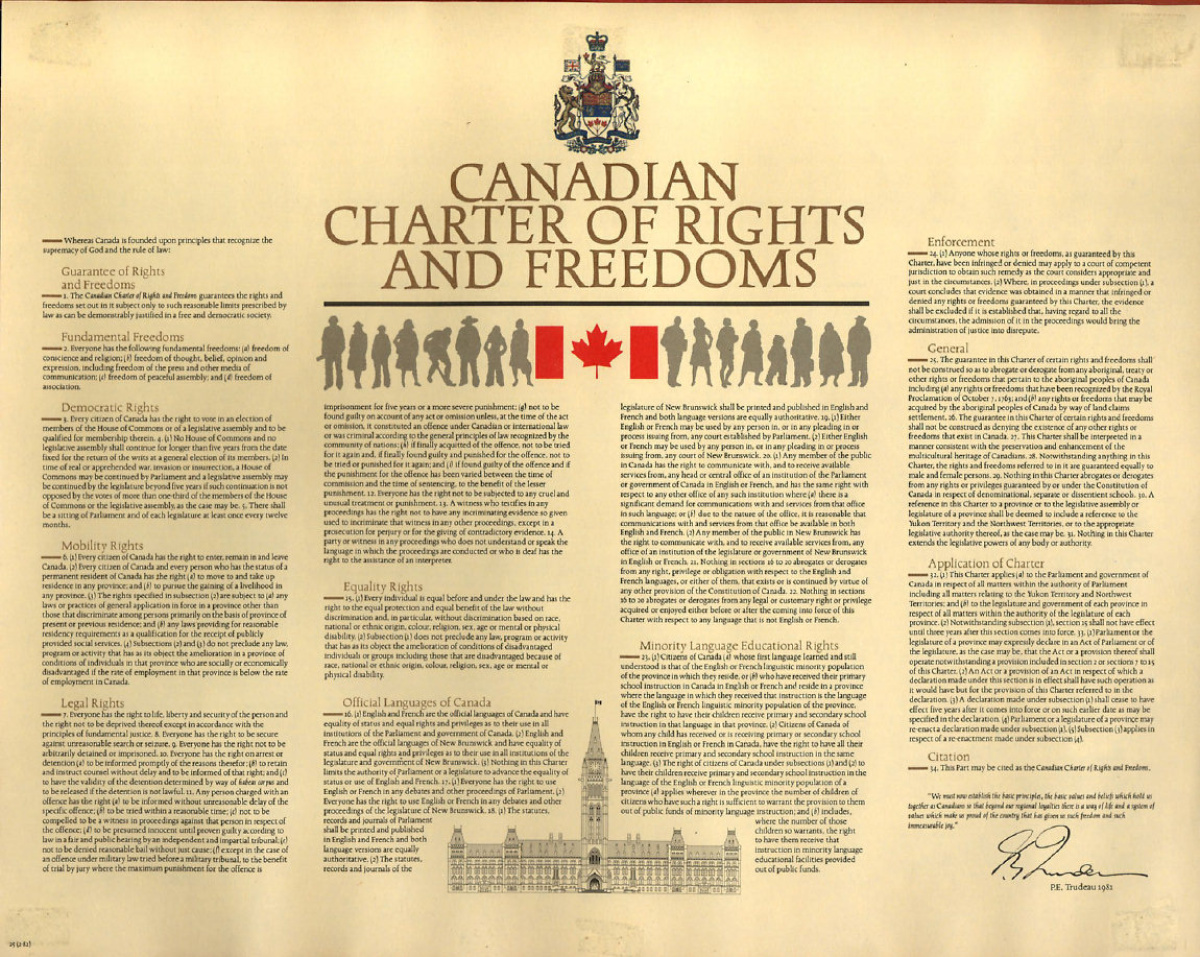
The rule of law is one of the most important legal principles on which Canada is based. Along with the supremacy of God, it is mentioned in the very first words of the Canadian Charter of Rights and Freedoms: “Whereas Canada is founded upon principles that recognize the supremacy of God and the rule of law.”

The rule of law means that we are ruled by laws, not by the whims of a King, or the clamouring of a mob. The rule of law also means that the law applies to everyone, even the King; there can be no exemptions for the King or his favourites.

Countries which practice and uphold the rule of law tend to thrive economically, socially, politically and culturally. Countries which uphold the rule of law become wealthy because people can work, buy, sell and trade in the knowledge that their property and their person are protected by law. Economies thrive when people know that the law will be enforced, and that the law will be applied to everyone, even to the King and his favourites. The rule of law provides investors, foreign and domestic, with confidence to invest their money in business projects.

Conversely, when a country condones law-breaking, investors will put their money elsewhere, and quickly. The world’s poorest and most violent countries are those where politicians are above the law, and the law is not applied equally to all.

The decisions of Canada’s politicians and police to condone – for three weeks or longer – the blockading of railway lines by aggrieved protesters violate the rule of law in at least two ways.

First, our politicians are effectively stating that individuals with strongly held political opinions are entitled to engage in illegal activities, in this case shutting down railway lines. Second, law-breaking is permitted because Prime Minister Justin Trudeau and other politicians sympathize with the protesters’ ideology and demands: the law does not apply to the King’s favourites.

February 23, 2020

Justin’s hidden victory – “… in the fight against global warming, this has to have been Canada’s best two weeks EVER”

As Rex Murphy points out, the nattering nabobs of negativity (okay, he didn’t call ’em that) miss the key benefits of Justin Trudeau’s tour de force of ingenious diplomacy and inaction:

It was at the very heart of Justin Trudeau’s triumph in his first election, that having vanquished the Mordor orcs of Harperland, that the country was going to be served by new thinking and fresh approaches, that anger and conflict would be no more. In an era marked by respectful thinking, exquisitely careful language, above all by the ability to listen, protests would be no more. Concord would reign, all would be sweetness and light.

What few and feeble disputes that might emerge would be defused with a waving of the diversity wand, and a choir drawn from the Liberal backbenches intoning solemnly “this is not who we are as Canadians” before the Centennial Flame on Parliament Hill.

As an ultimate fillip every month a kitten and a ball of wool would be sent to every Canadian household (and Lo, a zen-like tranquillity would settle over the land). To be clear, these would be very progressive kittens, and the wood fair-trade down to the last twisted fibre.

[…]

Looked at in the cool light of reason, in the fight against global warming, this has to have been Canada’s best two weeks EVER. Keep it up and Canada, the whole wide, cold country, can soon declare itself one half-a-continent carbon-emission-free zone. Apocalypse deferred.

How do you spell Hallelujah? Greta Thunberg — Canada has heard you. Find a bamboo raft and come visit us again.

February 21, 2020

Justin Trudeau, Prime Empathizer of Canada

Filed under: Cancon, Government, Law, Politics, Railways — Tags: , , , , , , — Nicholas @ 03:00

The Prime Minstrel channels his inner Bill Clinton, although he just manages to avoid saying that he “feels our pain”:

A strange thing happened Tuesday morning. That strange thing was … an important and interesting exchange on the floor of the House of Commons. It happened during routine proceedings, and not in the Punch-and-Judy exchange of question period. The leaders of the various parties in the House stood and outlined positions on the rail blockades being conducted around the country in support of Wet’suwet’en opponents of B.C.’s Coastal GasLink pipeline.

First came the prime minister. “People are troubled by what they have been witnessing this past week,” he said. Our empathizer-in-chief, the emotional mascot of Confederation, was about to go to work. “Young, old, Indigenous and newcomers are asking themselves what is happening in the country … On all sides, people are upset and frustrated.”

The next three words out of his mouth were: “I get it.” Huh. Is that the sort of thing you say when you’ve actually gotten it? If a friend called you up in a shattered emotional state because he had just lost his job, as people are starting to lose jobs to the Wet’suwet’en solidarity protests, would you say “I get it”?

Beyond this tin-eared reassurance, Trudeau did not have much specific to say, and what there was seemed to contradict itself. “Our government’s priority is to resolve this situation peacefully, but also to protect the rule of law in our country,” he promised. “That is a principle we will always stand up for.” One would have thought the role of a prime minister was to apply the law rather than to “stand up for” it. He gave his usual spiel about the myriad of ways in which the federal government has failed First Nations, again speaking as though someone else were in charge. Certainly very little of it is his own fault: the government he leads has “invested more than any other … to right historic wrongs.”

Trudeau worried aloud that Canada might become “a country where people think they can tamper with rail lines and endanger lives,” but he seemingly renounced the use of force (it’s not “helpful”) against protesters who openly discuss sabotage. What the prime minister means when he talks of the “rule” of something called “law” has been left imperfectly clear.

Chris Selley suggests the government’s fecklessness will continue to prevent any solutions being implemented:

The stupefying weightlessness of Justin Trudeau’s government has never been more evident than in recent days, as it tries to arrange an end to the Mohawk blockade of CN’s main line near Belleville, Ont. At times it seems as if it might just float away, like an improperly tethered bouncy castle in a thunderstorm.

This week has been particularly windy.

[…]

The situation is ludicrous: Because Ontario’s independent provincial police won’t enforce a court injunction, the federal public safety minister seems to be in discussions with B.C.’s solicitor general about whether B.C.’s independent provincial police might back off enforcing a different injunction.

And the worst part of this absurdist theatre festival is how difficult it is to imagine a better alternative. Conservatives continue to call on Trudeau to somehow fix the problem, but the way Canada is set up, it’s really not a federal issue. The RCMP might have some jurisdiction over the railway as federally regulated infrastructure, said University of Toronto law professor Kent Roach, but that hasn’t happened in past cases. It wouldn’t even be up to Trudeau to send in troops: under the Emergencies Act, Roach said, a provincial solicitor-general has to request it.

These are structural issues that any PM will face. Indeed, the biggest difference between the Liberals’ approach to this blockade and the Conservatives’ approach to the 2013 Idle No More protests, which included a 13-day blockade of a CN line in southwestern Ontario, has been one of rhetoric and engagement. The Conservatives talked tougher, but Aboriginal Affairs rebuffed CN’s request to intervene. (Those protesters eventually obeyed a court injunction and left.) The Liberals needlessly tie themselves in knots and insult our intelligence — they know no other way — but they clearly believe it’s their job to broker some kind of resolution.

It’s tough to say which approach is likelier to work. At this point odds seem to favour “neither.” If you have a better, workable idea to get the trains moving, for God’s sake get on the horn to Ottawa.

February 17, 2020

“The rails to hell are laid with good intentions”

In the National Post, Jonathan Kay explains how Canadian governments find themselves in the situation where the basic laws of the land can be flouted at will by a small extremist faction and the police are unwilling to do more than bare peacekeeping duties:

“Vancouver Solidarity with Wet’suwet’en” by jencastrotakespictures is licensed under CC BY-NC-SA 2.0

If you find yourself astounded by the current situation in Canada, whereby protesters have been allowed to shut down a rail network that remains a backbone of passenger travel and industrial transport (and whose coast-to-coast completion in 1885 became a symbol of national unity), it’s useful to revisit the accumulation of symbolic gestures that have steadily destroyed the moral authority of our governments to push back at any assertion of Indigenous rights and grievances. For years, our leaders offered reflexive acquiescence to increasingly expansive claims that Canada remains a white supremacist dystopia, culminating in last year’s campaign to convince us not only that modern Canada is a “genocide” state, but that even the act of expressing disagreement with this description makes you a sort of metaphorical train conductor on the rails to Canadian Dachau. Having publicly tattooed their guilty settler souls with every imaginable hashtag, our leaders now apparently find themselves stopped from restoring the rule of law.

The rails to hell are laid with good intentions. And there is nothing that now signals goodness in Canadian public life more than the land acknowledgment. Certainly, no one can argue with the historical truth that Indigenous peoples populated Canada for thousands of years before the arrival of Europeans. But words have meaning. And the well-understood meaning of these acknowledgments is that Indigenous peoples exercise a sort of broad, vaguely defined moral sovereignty over lands “owned” by Canadian governments, corporations and private citizens — including the lands on which we have constructed roads, rails, ports and legislatures. And since this sovereignty apparently now may be asserted at any time, for pretty much any reason, we have effectively lost the ability to enforce the systematic organization of property rights on which every functional society, Indigenous or non-Indigenous, depends.

The push to recognize Indigenous sovereignty over ancestral lands stretches back generations, an effort rooted in very real constitutional and treaty rights. But what I am describing here is not this formally bounded legal campaign, but rather the more general insistence that the entire country remains stained by original sin, and so must be purified by an open-ended, quasi-spiritual process of “decolonization.” This project began in earnest in 2017 as a counter-reaction to the perceived jingoism of the Canada 150 celebrations. Within the rarified corners of the literary and arts milieus (in which I found myself embedded at the time), decolonization quickly became a sort of state religion, complete with decolonization-themed sensitivity training and confession rituals.

[…]

The people doing the protesting are led by dissidents within one of the affected Indigenous communities, amplified by a critical mass of white environmentalists who are perfectly happy to cherry-pick Indigenous causes based on how well they line up with their own Anti-Racism/Critical Studies term-project requirements. Indeed, there is a certain type of very self-satisfied white Canadian leftist who sees himself as a real-life Lorax. Drawing on antiquated noble-savage stereotypes from the past, these decolonization super-allies cast Indigenous people as their little bar-ba-loot bears. And it just ruins their day when Indigenous leaders refuse to grab their tummies, moan for the CBC cameras, or read their bar-ba-loot scripts.

There is a larger hypocrisy at play here, too. Justin Trudeau and his entourage — currently on world tour, hoping to convince African and Caribbean leaders to hand him the shiny trophy of a UN Security Council seat — don’t take the train much. They fly. So, too, do the provincial politicians passing the buck in equal measure, not to mention the national broadcast journalists offering maudlin profiles of the demonstrators. Forcing ordinary travellers to bear the burden of upholding officially sanctioned upper-middle-class social-justice pieties isn’t “progressive.” It’s reactionary, snobbish elitism with a progressive façade.

February 16, 2020

The Canadian economy taken hostage while the PM swans around the world schmoozing for a temporary Security Council seat

Chris Selley on the state of play in the stand-off between (some) First Nations protesters and their temporary fellow travellers of the various permanent protest class:

“DSC02285” by Bengt 1955 is licensed under CC BY-NC 2.0

The majority of Wet’suwet’en First Nation members support the Coastal GasLink natural gas pipeline project, and they are in an objectively peculiar situation. On the one hand, the RCMP is doing its best to clear away the protesters and let construction proceed. On the other hand, anti-pipeline protesters claiming solidarity with the Wet’suwet’en have created chaos in their name — most notably the total shutdown of CN Rail’s eastern Canadian network, the cancellation of nearly every Canadian passenger train, and the layoffs and untold economic costs that go with that.

If protesters acknowledge the diversity of opinion among the Wet’suwet’en at all, they will defer to the authority of five hereditary chiefs who oppose the project, or observe that the five elected Wet’suwet’en band councils — all of which have signed community benefits agreements — represent a form of settler democracy imposed by the Indian Act.

[…]

Clearly the Wet’suwet’en are a divided community, including on the most basic questions of how they should be governed. It’s a mess. Mind you, look at the state of Canada as a whole.

Just as the RCMP have court authorization to clear protesters and encampments along the pipeline route, the Ontario Provincial Police have court authorization to clear the Mohawk rail blockade near Belleville, Ont. Unlike the RCMP, the OPP refuses to exercise its authority. And we just have to live with that. Conservative politicians are barking at Justin Trudeau to “enforce the law,” but he doesn’t give orders to the OPP, and neither does Ontario Premier Doug Ford, and nor should we want them to.

Still, you might expect senior ministers to have moderately stern words for folks illegally causing economic harm. You might expect the prime minister, at minimum, to be in the country. Instead, Trudeau spent the week swanning around Africa drumming up support for the UN Security Council seat with which he remains unaccountably obsessed, then decamped for the Munich Security Conference, where he was photographed warmly embracing Iranian foreign affairs minister Mohammad Javad Zarif, five weeks after Iran blew an airliner full of Canadians out of the sky over Tehran.

The Little Potato is probably doubly happy to have a valid (in his own mind) excuse for not being in the country at this particular time. He loves being the centre of attention … as long as that attention is friendly. He doesn’t handle situations well if the tempers are higher and the hostility is rising … like much of Canada right now.

The pipeline is a provincial project, not a federal one, but if the OPP won’t end the blockade and the feds aren’t willing to take truly extraordinary measures, then at some point in the foreseeable future it may well make short-term economic sense to give in to their demands. Maybe the feds can buy the pipeline from Coastal GasLink and shut it down.

And what if the Mohawks do lose interest, or are somehow induced to stand down? That now counts as the best-case scenario, and it will have involved shutting down the CN railway for at least a week — maybe two, maybe three — with enormous consequences for people’s livelihoods and the economy as a whole, all in the name of killing a project supported by the vast majority of Indigenous people affected by it. And it will happen again, as many times as any group wants it to, on whatever issue they want it to, for as long as they want it to. Unless someone in power does something unusually bold and concrete in the very near future – and it’s not even clear what that thing would be — we are well on the road as a country to being terminally screwed. In the meantime, we certainly have no lessons on accountable government to give the Wet’suwet’en.

February 15, 2020

Disrupting railways as an activist tactic appears to work really, really well

As Colby Cosh writes, for all the issues Alberta has with the government in Ottawa, nobody seriously suggested messing up the railways to get attention. Perhaps they should have:

“DSC02285” by Bengt 1955 is licensed under CC BY-NC 2.0

It never occurred to us to mess with the rail network in Eastern Canada — to inconvenience the precious commuters of the Golden Horseshoe — as a means of gaining negotiating leverage. Actually, I’m sure some people must have suggested it, but they would have been written off as selfish, dangerous idiots advocating counterproductive tactics.

The economic impact of the rail protests is big, but surely comparable, at the moment, to that of a big storm. Yet because a B.C. Aboriginal community is carrying its fight with the B.C. government to the guts of Canada, the clamour over whether large public works are now possible at all in Canada has instantly achieved new and unfamiliar volume levels.

The Coastal GasLink that is the source of the strife is a provincially regulated work running from Dawson Creek to the coast; unlike the vastly more expensive problems Alberta has encountered, this technically isn’t an issue for the wider federation at all. Except, whoops, it is! Because someone decided to make it one!

The levels of irony dazzle the imagination. The Canadian West was settled by means of passenger rail, which is supposedly one reason it was chosen as a target by the radicals supporting the Wet’suwet’en hereditary chiefs in their pipeline fight. But intercity commuter rail no longer really exists between the West Coast and Hamilton. The West is ultimately as dependent on rail freight as the East, and maybe more so, but it was that commuter inconvenience that gave rise to an immediate sense of national crisis, while Calgary and Saskatoon and Winnipeg snoozed.

And climate-change activists found themselves blocking rail lines in “solidarity” with the Wet’suwet’en, even though the chiefs’ fight is a question of territorial principle rather than carbon sins. This put the greenies in the position of opposing and thwarting actual rail travel. They admit this is anomalous; nobody likes to attach the word “hypocritical” to himself.

One of the protesters pointed out to the Star‘s Alex Boyd how dependence on rail — dependence of the sort that they spend 364 days a year advocating for intra-city commuters — facilitates unlawful, obstructive protest as a means for the self-anointed to “put pressure on decision-makers.” It is a little harder to block paved roads than railroads, and much harder to sabotage them, if it comes to that — which it might have if the police had used force to immediately disperse the protests. For some, this counts as a feature of rail, not a bug.

February 14, 2020

The reaction to the Mohawk blockade near Belleville shows that VIA Rail isn’t a serious company

Mohawk protesters began blocking the main CN and VIA line between Toronto and Montreal near Belleville nearly a week ago. The police, having learned so often that the government and the courts won’t back them up, did little to try to get the blockade lifted other than to prevent active confrontations with the First Nations activists. Canadian National announced that they were being forced to park trains all over Eastern Canada as a result of the blockade and that deliveries of goods would be snarled for quite some time even after service is allowed to resume. VIA rail, on the other hand, seems to care not a bit about the thousands of travellers who have been stranded mid-journey and made no apparent efforts to bring in buses or any other arrangements. Chris Selley says this proves that VIA is not an essential service even in their own minds:

“The 6424” by Stephen Downes is licensed under CC BY-NC-SA 2.0

Of all the bad news to befall VIA Rail this week, with the cancellation of all its trains between Toronto and Ottawa and Toronto and Montreal — that’s roughly 50 per cent of its ridership and 60 per cent of its revenues — the worst news might be just how little news it has made. Mostly, the Mohawk blockade of the CN main line near Belleville, Ont., has been treated as a side story to the anti-pipeline protests and arrests in the British Columbia interior.

That’s what it is in the grand scheme of things: The battle between Wet’suwet’en members and chiefs and the federal government speaks to much larger, existential questions about the future of the Canadian economy, about the Liberal government’s reconciliation agenda, about the very nature of the Canadian federation and the rule of law. This blockade, launched in the name of solidarity with the Wet’suwet’en, just means people have to take the bus, or fly, instead of the train.

But that’s no small inconvenience, no small expense. Canadians in general are not quick to anger, but very few of the VIA refugees interviewed by various news outlets sounded even slightly furious, which they had every right to be. When protesters from the same First Nation blockaded the same set of tracks six years ago, VIA properly exhibited some concern with getting their customers to their destinations and put on replacement buses.

This time around, no buses. No suggestions. No response to media inquiries asking why there are no buses. Just a cancellation notice on the website and a fare-thee-well. At a time when VIA is seeking untold billions from the federal government to build a new Toronto-Ottawa-Montreal route and run vastly more trains, this does not bespeak a company that takes itself very seriously.

[…]

And never mind VIA, what sort of country lets a few people close down a key piece of national infrastructure, in violation of a court injunction — not for an hour or a day, but literally indefinitely? For a time it wasn’t even clear whose job it was to enforce the injunction: On Sunday an Ontario Provincial Police spokesperson told Global News it was up to the CN Police Service. On Tuesday, a CN spokesperson told the National Post it was up to the OPP, and indeed, late Tuesday OPP officers warned protesters to leave or they would be forced out. Perhaps the threat of massive economic disruption finally lit a fire under them: earlier in the day, CN had said it was considering shutting down huge parts of its freight network across the country. Had it just been rail passengers, though, the idea of this side-protest dragging on for weeks or even months seems absurdly plausible.

VIA Rail 918, a General Electric model P42DC locomotive, at Belleville, Ontario on 23 December 2008.
Photo by Martin Cathrae via Wikimedia Commons.

While VIA may not be serious, others are extremely serious:

Left-wing blogs have been offering instructions and maps during the #ShutDownCanada protests on how to blockade and destroy train tracks and other pieces of Canada’s infrastructure, according to True North.

Two websites in particular, these being North Shore and Warrior Up, have instructed demonstrators how to damage Canada’s pipelines, roads and railways.

In some of North Shore’s posts, for instance, they told their readers to stand in solidarity with the Wet’suwet’en tribe by destroying train tracks. In this article, the author makes it perfectly clear that he wants to damage Canada’s economy at large.

More absurdly, however, the article then went on to instruct the reader on how to compose a chemical mixture that destroys steel rail tracks — taking particular care to describe how not to leaving fingerprint or DNA evidence.

Thursday evening, VIA Rail announced their whole passenger network would be shut down until further notice: Service cancellation notice.

January 26, 2020

Trudeau’s illogical gun ban will do nothing to reduce violent crime

Filed under: Cancon, Government, Law, Liberty, Weapons — Tags: , , , , — Nicholas @ 05:00

It will, on the other hand, infringe the rights of law-abiding Canadians and encourage otherwise law-abiding people to disobey the law. It won’t take a single lethal weapon out of the hands of criminals — because they’re already violating the laws that are in force today and won’t be deterred by yet another token rule they won’t obey. At the Post Millennial, D.J. Sumanik explains why the proposed ban is wrong:

Restricted and prohibited weapons seized by Toronto police in a 2012 operation. None of the people from whom these weapons were taken was legally allowed to possess them.
Screen capture from a CTV News report.

I chose the AR-15 for that video because it is the singular most demonized firearm on the planet. The rifle is used to scare uninformed citizens daily. Yet the same rifle has never been used for murder by a legal gun owner in Canada.

In fact, it’s only been used for murder one time in our country over the last 50 years by a gang. A far cry from the narrative that “assault weapons” are lurking in every corner of Canadian society waiting to murder our children.

Justin Trudeau is claiming this firearm and others like it are so deadly, so dangerous, and so extreme that they must be confiscated from every licensed Canadian gun owner across the country. But with only one murder in 50 years, and the gun almost certainly still being the murderer’s hand regardless if there was a ban, the numbers simply don’t add up. In fact they barely register. Semi-auto rifles are extremely rare for use in Canadian gun homicide […] handguns are the firearm of choice for most shootings. Semi-autos only make up a small percentage of rifles and shotguns in our country. So how does this add up to a federal ban costing $600 million in taxpayer money?

Short answer: It doesn’t.

Canada has roughly 2.2 million licensed gun owners who are monitored DAILY by RCMP for red flags. Most people don’t know that. It’s called continuous eligibility screening. If you step out of the line with the law, the cops show up and take your guns.

Some further thoughts.

If only 5 percent of Canadian gun owners were out there shooting up the streets, we’d have 110,000 deaths on our hands annually. According to StatsCan, 2018 left Canada with 249 tragic gun murders. The vast majority were by gangs fighting over drugs in urban centers. Even if you were to incorrectly assume every one of those shootings was a legal gun owner and not a gang member (yeah right) it means 99.9998868% of us pose no threat to society. Can you think of another demographic with that kind of track record? I certainly can’t.

Now, the lives lost in those incidents are valuable. 249 Canadian families are feeling daily pain. Something needs to change. Gang warfare can’t go unchecked. But to punish millions of innocent Canadians who hold such an excellent track record will not help. There’s a very simple truth in all of this: Taking my firearms away in the Yukon will not prevent gang homicide in Toronto.

Furthermore, we as Canadians don’t discriminate against entire groups of people based on the actions of a few bad eggs. For instance, we don’t blame all Muslims in Canada for the actions of 9/11. How is it acceptable for Justin Trudeau to punish gun owners across Canada for gang violence?

January 25, 2020

Petition against the Trudeau government’s proposed “military-style assault rifle” ban goes over 100,000 signatures

Filed under: Cancon, Law, Liberty, Politics, Weapons — Tags: , , , — Nicholas @ 05:00

There may be little point in protesting, as the Trudeau government has a track record of ignoring what Canadians want to do what it intends regardless, but you can still sign the petition here (if you do sign, remember to click the confirmation link in the email you’ll receive after signing the petition). In the Post Millennial, Sam McGriskin reports that the petition has enough confirmed signatures to be the second-largest in Canadian history:

E-petitions can be open for 30, 60, 90 or 120 days for signature based on what the petitioner prefers. The petitions get a government response within 45 days of their opening. Public Safety Minister Bill Blair is overseeing the “buyback program” which Blair estimates could cost anywhere from $400 to $600 million.

Blair’s office did not respond to request for comment from The Post Millennial. His office was asked what the minister’s response is to over 100,000 Canadians calling on the government to drop what many experts see as a completely ineffectual action to curb gun violence. Blair was also asked about fellow Liberal MP Marcus Powlowsk’s letter addressed to him that opposed the gun ban (Powlowsk has since retracted the letter) and Winnipeg Police constable calling the ban “nonsense”.

“When we seize handguns, the handguns are always almost 100% in the possession of people who have no legal right to possess them. They’re almost always stolen or illegally obtained,” said Const. Rob Carver. “I simply don’t see how as a 27-year-old veteran, how adding another layer of law will make any difference, anywhere in this country.”

In Powlowski’s letter to Blair he wrote, “Over the course of the past three months, I have heard a wide variety of views on this proposed ban. I believe it is my role to ensure that these views are brought to your attention for consideration.”

“Given that there is currently no legal definition for a ‘military-style assault rifle’ in Canada, some community members I have spoken with are skeptical that a ban based on this term would make sense as a coherent firearm policy,” the letter continued.

In a CBC interview in the summer of 2018, Blair said that most of the gun crime is committed by illegal handguns smuggled in from the U.S. and he was skeptical of a gun ban being effective in combating gun crime. His position changed drastically once he was appointed by Prime Minister Justin Trudeau as the public safety minister.

Variants of the AK-47

The Liberal voters in downtown Toronto and other major cities want the government to “do something” about gun crimes, but nothing the government can do is going to make much of a difference for people who are already violating multiple laws, so all they can do is make things worse for those who are already obeying the laws as they stand. In the real world, this makes no sense, but in the fantasy world of electoral politics, the government needs to be seen to be “doing something” … and this, stupid as it may be, counts as “something”.

January 16, 2020

QotD: Progressive hatred

Filed under: Politics, Quotations, USA — Tags: , , , , , — Nicholas @ 01:00

Something that has been noticeable for a long time now is that the Left is in a perpetual state of rage. The smallest things send them into spasms of anger. They hate Trump and they really hate his voters. They will go rummaging around in the social media history of people, looking for reasons to hate them. It’s not a general all-encompassing hate, like hating the fans of a rival sports team, but a very personal and cruel hate. They want the victim to suffer and they want to enjoy his suffering.

One reason for this, obviously, is that many people attracted to the Left are mentally unstable, so their politics are just a vehicle for their pathology. Many of the Antifa people, for example, have no coherent political thoughts. They just like being crazy on the streets and causing mayhem. This is the type of person who was attracted to the riots that used to follow the big economic summits. There was never any purpose to their rampages, other than the thrill of smashing things and causing mayhem.

Another more important reason for the rage is the nature of leftist politics in our post-national age. Being on the Left no longer means joining a group that has a tangible enemy, against whom the group throws themselves. The days of unionist, socialists and communists operating as collectives are gone. Even the post-modern movements like climate change and sexual politics is atomized. Much of it is backed by the sorts of people the Left used to oppose like rich people and business.

The Z Man, “It’s Personal”, The Z Blog, 2019-11-12.

December 29, 2019

Changing western views about China

Filed under: Business, China, Economics, Government, Politics — Tags: , , , , — Nicholas @ 05:00

John Gray charts the image of China that has held steady for years among western countries but which has been severely shaken with the unrest in Hong Kong and the Chinese government’s reactions:

“The Chinese People’s Liberation Army is the great school of Mao Zedong Thought”, 1969.
A poster from the Cultural Revolution, featuring an image of Chairman Mao, published by the government of the People’s Republic of China.
Image via Wikimedia Commons.

The most important year of the decade is the one that is just ending. The struggle that will most deeply shape the global scene in years to come is not occurring in Britain, the US, Europe or any Western country. It is underway in Hong Kong, where a popular demand for democracy is confronting the immovable power of the world’s most highly developed authoritarian state.

It is a struggle no government wants to see escalate. More realistic than its Western counterparts, the Chinese leadership shows few signs of believing the conflict can be definitively resolved any time soon. Incremental concessions and large-scale repression both carry high levels of risk for Xi Jinping’s regime. The ideal end-state for Beijing is probably long-term containment. But the situation in the former colony is not stable, and it is difficult to exaggerate the impact that suppressing the protestors by force would have on China’s position in the world.

It is often pointed out that Hong Kong’s economic importance has dwindled with the rise of mainland cities such as Shanghai. But this leaves out how much two-system governance shapes global perceptions of China and its future. Xi’s progress towards a neo-totalitarian surveillance state has deflated the Western elites’ confidence that China is on a path of slow evolution towards liberal democracy. Yet the fantasy still lingers. The likelihood that China will be an authoritarian great power in any realistically imaginable future is too disturbing to contemplate.

It is worth recalling the comforting tale on which Western governments have modelled China’s development. The country was getting rapidly richer, and while average incomes remained low by international standards, the middle class was steadily growing. This process of embourgeoisement would lead to stronger demands for democratic freedoms, and China would become ever more like the West. Embedded in practically every Western government and regularly invoked by the Western businesses that operate in China, this is a story with almost no basis in reality.

It is true that the rise of the middle classes in early 19th-century Europe coincided with an expansion of liberal freedoms in some countries. This was the main thrust of Marx’s analysis of bourgeois democracy. (A little-noted aspect of recent liberal thinking is that it relies heavily on a crude version of Marxian class analysis.) But there is nothing in the historical record that says the middle classes are inherently a force promoting liberalism. In the late 19th century, they backed the restoration of monarchy and empire in France and militarism In Prussia. In the early 20th century, large sections of the European middle classes embraced ethnic nationalism and then fascism. There was not much sign of the freedom-loving bourgeoisie in interwar Europe.

Protests continue in Hong Kong, 25 November 2019.
Photo by Studio Incendo via Wikimedia Commons

While it is so far less developed, a similar pattern of bourgeois support for illiberal politics has emerged in many European countries since the collapse of the Soviet Union. Across the continent, far-Right parties enjoy the support of significant sections of the middle classes. In America, Trump’s constituency includes many from precarious middle income groups.

So, the linkage between the middle classes and liberal values is tenuous throughout Western countries. In the UK and other English-speaking countries, it is middle class students, professors and administrators that have shut down freedom of inquiry and expression in higher education. Woke capitalism and much of the mainstream media are continuing this trend. Threatened by what they call populism, bourgeois liberals have ditched the values that once defined them. Far from being a universal law, middle class support for liberalism looks like a brief historical accident.

« Newer PostsOlder Posts »

Powered by WordPress