Quotulatiousness

November 30, 2019

Hong Kong and China

Filed under: China, Liberty, Politics — Tags: , , , — Nicholas @ 05:00

At Samizdata, Brian Micklethwait considers the state of play in Hong Kong’s defiance of the Chinese Communist Party:

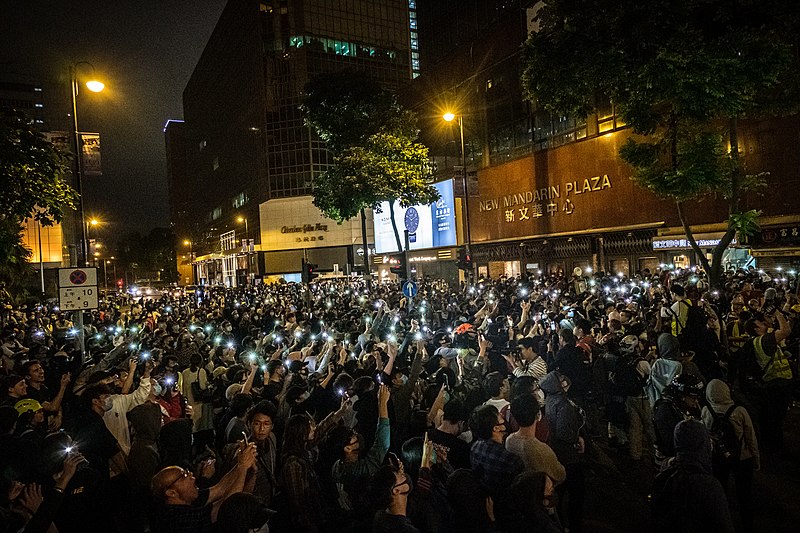
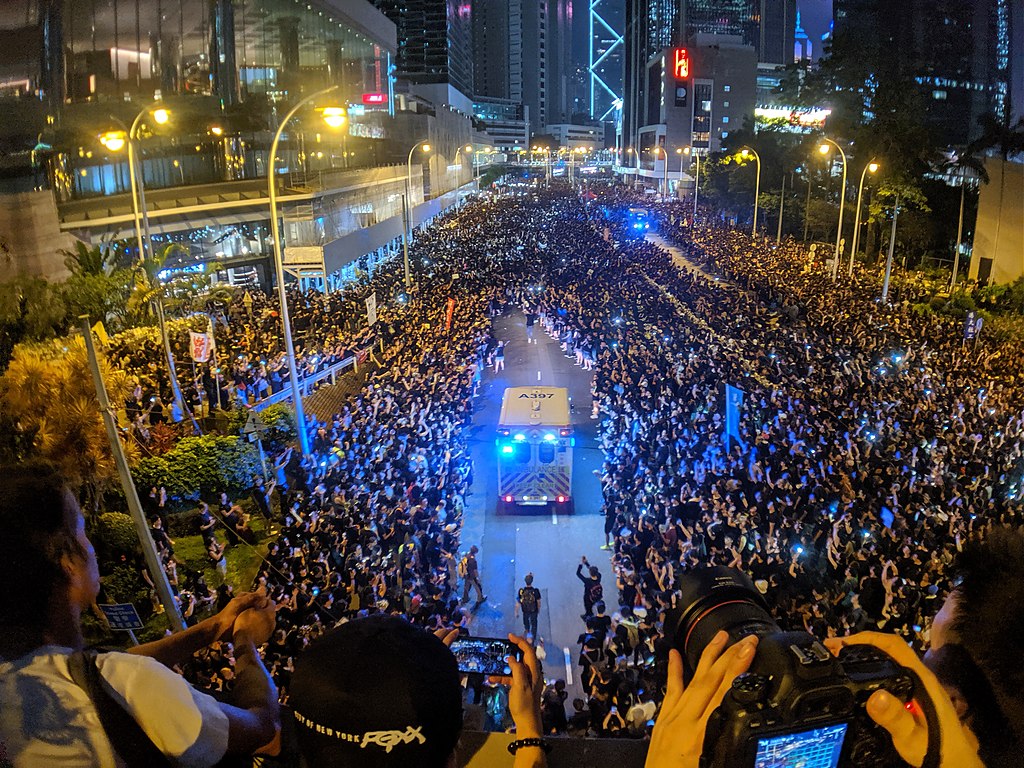
Protests continue in Hong Kong, 25 November 2019.
Photo by Studio Incendo via Wikimedia Commons

How can the HongKongers defeat the Chinese Communists (hereinafter termed ChiComs), and preserve their HongKonger way of life approximately as it now is? In the short run, they probably can’t. During the next few months, the ChiCom repression in Hong Kong will surely get ever nastier, and the bigger plan, to just gobble it up and digest it into ChiCom China will surely bash onwards.

But then again, I thought that these Hong kong demonstrations would all be snuffed out months ago. So what the hell do I know? I thought they’d just send in the tanks, and to hell with “world opinion”. But the ChiComs, it turned out, didn’t want to just kill everyone who dared to disobey, plus anyone else who happened to be standing about nearby. That would not be a good look for them. What are they? Russians? Far too unsophisticated. Instead the plan has been to divide and conquer, and it presumably still is. By putting violent agent provovateurs in among the demonstrators, and by ramping up the violence simultaneously perpetrated by the police, the plan was, and is, to turn the peaceful and hugely well attended demonstrations into far smaller, far more violent street battles of the sort that would disgust regular people. Who would then turn around and support law and order, increased spending on public housing, blah blah. So far, this has not worked.

And for as long as any ChiCom plan for Hong Kong continues not to work, “world opinion” has that much more time to shake itself free from the sneer quotes and get itself organised, to try to help Hong Kong to stay semi-free.

Those district rat-catcher (or whatever) elections last Sunday came at just the wrong time for the ChiComs, because they gave peaceful HongKongers the chance to make their opinions known, about creatures of a far more significant sort than rats, and at just the time when the ChiCom plan should have started seriously shutting the HongKongers up. These elections were a landslide.

The ChiComs are very keen to exude indifference to world opinion, but they clearly do care about it, because if they truly didn’t care about it, those tanks would have gone in months ago, just as I had assumed they would. So, since world opinion clearly has some effect, the first thing the rest of us can do to help the HongKongers is to keep our eyeballs on Hong Kong.

As I say, I continue to be pessimistic about the medium-term future in Hong Kong. But in the longer run, if the HongKongers can’t have a local victory, they can set about getting their revenge. And all of the rest of us who care can join in and help them.

November 29, 2019

Revolts, civil wars, and revolutions

Filed under: Britain, Government, History, Politics — Tags: , , , , , — Nicholas @ 03:00

Severian offers his taxonomy of protest with examples from English history:

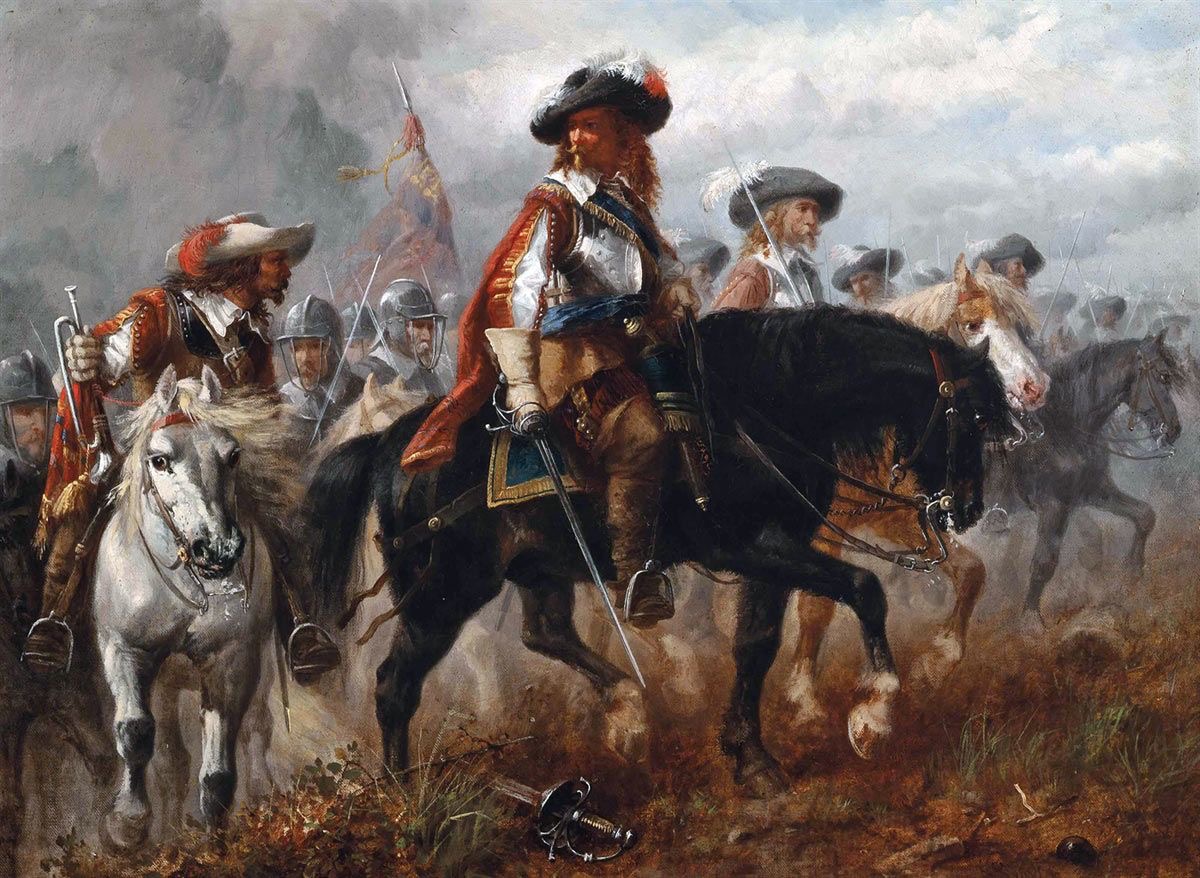
King Charles I and Prince Rupert before the Battle of Naseby 14th June 1645 during the English Civil War.
19th century artist unknown, from Wikimedia Commons.

  • A revolt is a large-scale, semi-organized riot. It aims, at best (e.g. Wat Tyler’s Rebellion), at the redress of specific grievances. At worst, it’s violent nihilism (e.g. the Jacquerie).
  • A civil war aims to replace one leader with another, leaving the underlying civil structure intact — e.g. any of the Roman civil wars post-Augustus.
  • A revolution‘s goal is total social transformation. We’re stipulating that it’s violent, because while stuff like the Industrial Revolution is fascinating, we’re not looking at peaceful change here in the Current Year. Revolutions are necessarily, fundamentally ideological.

I realize this can cause some confusion, as events I’d classify as “revolutions” are called civil wars in the history books, and vice versa. But the difference is important, because it sheds light on the development, course, and outcome of events.

The paradigm case is the English Civil War, 1642-51. This was clearly a revolution, as it aimed at — and achieved — the near-total overthrow of existing society. When Charles I took the throne in 1625, his kingdom was very much closer to a Continental-style divine-right monarchy than most Britons would like to admit. While the English had succeeded in clawing some of their liberties back from the crown after Henry VIII’s death, the fact remains that the Stuart state, like the Tudor state, was despotic. But by 1625, the despot was completely out of step with his people, and his times.

By 1642, the first revolutionary prerequisite was in place: No clear alternative. There were lots of revolts against Henry VIII, and one of them, the Pilgrimage of Grace, had the potential to turn into a civil war, or even a revolution. The revolts against Elizabeth I didn’t quite rise to that level, but the Northern Rebellion, and Essex’s Rebellion certainly imperiled her government. See also Wyatt’s Rebellion against Queen Mary, the Prayer Book Rebellion and Kett’s Rebellion against Edward VI, etc. In all of these, the alternative was clear — return to Rome, replacement of one court faction with another, or return to the old ways.

November 10, 2019

Theodore Dalrymple on today’s doomsday cults

The recent antics of Extinction Rebellion activists in London encouraged Theodore Dalrymple to do a bit of reading on the psychology of such cults and their followers:

Man is the only creature, as far as we know, that enjoys the contemplation of its own disappearance from the face of the earth. We find the prospect of our annihilation by disease, famine, war, asteroid, or climate change deeply satisfying. We feel, somehow, that we deserve it and that the world would be a better planet without us.

When to this strange source of satisfaction is conjoined a license to behave badly in the name of salvation from earthly perdition, we can expect a mass movement that approaches insanity. So it is with the Extinction Rebellion, whose fanatical members have brought chaos to London recently by blocking streets, occupying crossroads, gluing themselves to public buildings and railings, and standing atop underground trains, to the fury of thousands of rush-hour commuters who don’t want to save the world but only get to work.

In order to try to understand their state of mind, I recently read a book by three psychologists, Leon Festinger, Henry W. Riecken, and Stanley Schachter, first published in 1956, called When Prophecy Fails. It recounts the reaction of a small doomsday sect in America founded by a housewife, who believed that most of North America was soon to be inundated by a great flood. When this failed to happen on the predicted date, members did not immediately conclude that the absurd grounds upon which their belief was based were false, but became even more convinced of their truth. When there is a contradiction between what we want to be the case and what is the case, our desire to believe often triumphs, at least for a time.

The beginning of the book gives a brief and selective history of sects that have predicted Man’s total annihilation in the near future, among them that of the Millerites in the 1840s in the United States. Reading the account of this sect, I could not help but think of the Extinction Rebellion that is now gripping London, to the growing fury of the rest of the population.

November 8, 2019

Brendan O’Neill on the “Battle of Canning Town”

Filed under: Britain, Environment, Politics — Tags: , , , — Nicholas @ 05:00

This piece is derived from a speech he gave on November 3rd at the Battle of Ideas festival in London:

One of my favourite political events this year was the Battle of Canning Town. This was the moment when Extinction Rebellion decided to send its painfully middle-class agitators to a working-class part of East London early in the morning to lecture and inconvenience people who just wanted to get to work. What could go wrong?

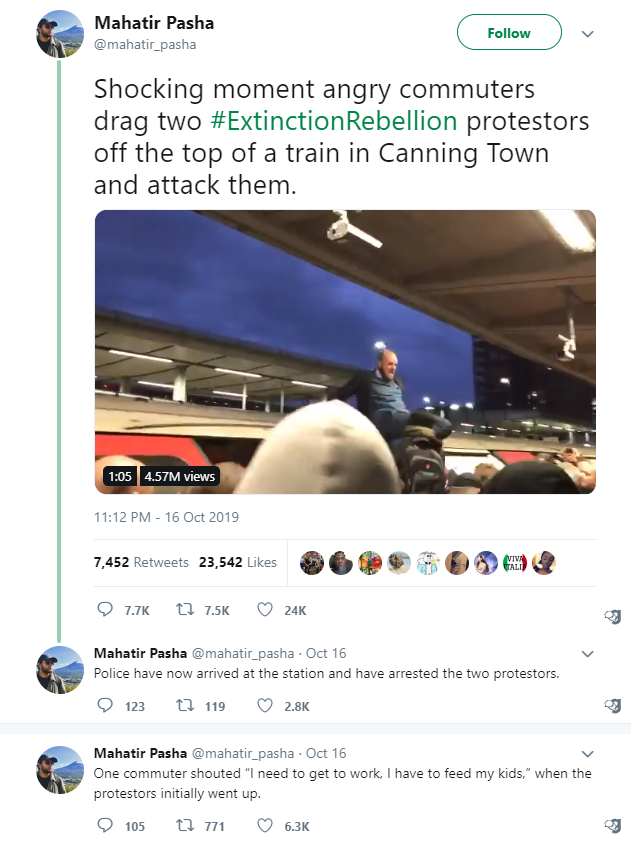
Quite a lot, it turned out. There were many wonderful moments. The two posh greens who climbed on top of a Tube train at Canning Town were mocked and eventually dragged down. A commuter can be heard branding one of the protesters a “ponytail weirdo”. Elsewhere on the Tube system that day, commuters pointed out that the London Underground is run on electricity and is therefore pretty eco-friendly. “Are you that fucking stupid?”, one asked a smug-looking couple of XR agitators. “No wonder you can’t get jobs …”

But the best moment came during the Battle of Canning Town, during that clash between working people and eco-elitists, when one of the commuters shouted at the protesters: “The world is not coming to an end!” I thought that was brilliant. This woman was just trying to get to her job and yet she found herself having to act as the voice of reason against the new hysteria. And she rose to the occasion wonderfully. She said what many of us know to be true: humankind does not face extinction.

The reason I admire the Battle of Canning Town is that it represented a potential turning point in modern green politics. It was really the first time in a long time that eco-hysteria was subjected to public judgement, to democratic rebuke, to the rational scepticism of the people. For far too long green ideology has been insulated from public challenge and public debate and this has allowed it to become increasingly eccentric and even unhinged. The Battle of Canning Town represented a reasoned, bottom-up pushback against the protected hysteria of modern environmentalism.

This is the thing I find most fascinating about Extinction Rebellion: its very name is a lie. Those two words themselves are untrue. Humankind does not face extinction, and all reasonable people know this. We know that there is nothing in the IPCC reports – which themselves are often over-the-top – to justify XR’s harebrained claims that we have 12 years to save the planet, and if we fail billions of people will die. They’ve just made this up.

As for the second word – “rebellion” – this is a lie, too. Extinction Rebellion is not a rebellion. Rather, its ideology and misanthropy are entirely in keeping with the outlook of mainstream politics and popular culture. From the educational sphere to Hollywood’s output, from the political elite to the worlds of advertising and publishing, the ahistorical, anti-human idea that mankind is destroying the planet and will be punished by Weather of Mass Destruction for having done so is entirely accepted, and increasingly unquestionable, in fact.

November 2, 2019

Notepad++ release 7.8.1, also known as the “Free Uyghur” edition, draws unfriendly Chinese attention

Filed under: China, Liberty, Religion, Technology — Tags: , , — Nicholas @ 03:00

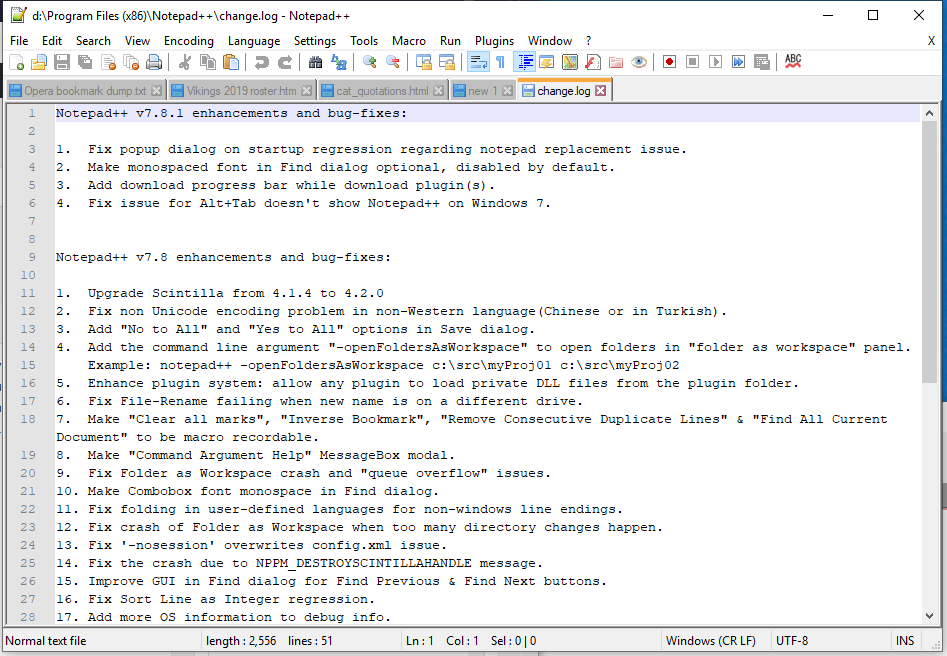
I’ve been using Notepad++ as one of my text editor options for a long time. It’s a very useful tool, and I heartily commend it to anyone needing a Windows text editor that can do a lot more than just edit text. I hadn’t downloaded the most recent version, so I was unaware that the developer was under attack from Chinese government supporters for his explicit designation of version 7.8.1 as the Free Uyghur edition:

On Tuesday, Don HO, the developer of Notepad++, a free GPL source code editor and notepad application for Microsoft Windows, released version 7.8.1, prompting a social media firestorm and a distributed denial of service attack.

Notepad++ v7.8.1 was designated “the Free Uyghur edition,” in reference to the predominantly Muslim ethnic group in western China that faces ongoing human rights violations and persecution at the hands of Beijing.

“The site notepad-plus-plus.org has suffered DDoS attack from 1230 to 1330 Paris time,” HO said in an email to The Register. “I saw the [reduced] amount of visitors via Google analytics then the support of my host confirmed the attack. The DDoS attack has been stopped by an anti-DDoS service provided by our host [Cloudflare].”

Previous politically-themed Notepad++ releases have focused on Tiananmen Square and the terrorist attack on French satirical publication Charlie Hebdo.

A post on the project’s website explains HO’s decision to criticize the Chinese government, something companies with business interests in China generally try not to do for fear of retribution.

From the Notepad++ website:

Human rights in China is always a hotly contested topic. Since 2017, numerous reports have emerged of the Uyghur people being detained in extrajudicial “re-education camps”, subjected to political indoctrination, and sometimes even torture. 2018 estimates place the number of detainees in the hundreds of thousands.

The Uyghurs are not ethnically Chinese but live in China’s so-called autonomous Xinjiang region. The region’s name suggests the Uyghurs have autonomy and self-governance. But similarly to Tibet, Xinjiang is a tightly controlled region of China. After the recent Xinjiang conflict, Beijing has recast the Uyghur ethnic group as a terrorist collective. This has allowed Beijing to justify its transformation of Xinjiang into a surveillance state. There has also been a marked rise of Islamophobia across China.

At least 120,000 members of Kashgar’s Muslim Uyghur minority have been detained in Xinjiang’s re-education camps which aim to change the political thinking of detainees, their identities, and their religious beliefs. Reports from the World Uyghur Congress submitted to the United Nations in July 2018 suggest that 1 million Uyghurs are currently being held in the re-education camps.

October 30, 2019

In case it wasn’t already obvious – “Extinction Rebellion isn’t about the climate”

One of the self-described founders of Extinction Rebellion takes to Medium to explain what the organization’s real goals are:

I’ve been with Extinction Rebellion (XR) from the start. I was one of the 15 people in April 2018 who came together and made the collective decision to try to create the conditions that would initiate a rebellion. I was a coordinator of one of the original five working groups, and I’ve been organising with XR day-and-night since then (frugally living off my savings so I don’t have to work, having quit an industry that paid me £1000/week). And I’ve been in RisingUp (the organisation from which XR has emerged) since the first RisingUp action in November 2016. I’m a RisingUp Holding Group member, and a member of the XR Guardianship Team.

And for the sake of transparency: that previous paragraph is all about me “pulling rank” — I’m trying to convince you to listen to what I have to say …

And I’m here to say that XR isn’t about the climate. You see, the climate’s breakdown is a symptom of a toxic system of that has infected the ways we relate to each other as humans and to all life. This was exacerbated when European “civilisation” was spread around the globe through cruelty and violence (especially) over the last 600 years of colonialism, although the roots of the infections go much further back.

[…]

So Extinction Rebellion isn’t about the climate. It’s not even about “climate justice”, although that is also important. If we only talk about the climate, we’re missing the deeper problems plaguing our culture. And if we don’t excise the cause of the infection, we can never hope to heal from it.

This article is calling to all of those who are involved in XR who sometimes slip into saying it’s a climate movement. It’s a call to the American rebels who made a banner saying “CLIMATE extinction rebellion”. It’s a call to the XR Media & Messaging teams to never get sloppy with the messaging and “reduce” it to climate issues. It’s a call to the XR community to never say we’re a climate movement. Because we’re not. We’re a Rebellion. And we’re rebelling to highlight and heal from the insanity that is leading to our extinction. Now tell the truth and act like it.

October 20, 2019

Disruptive, theatrical “protests” are coming to the end of their usefulness

Filed under: Britain, Environment, Politics — Tags: , , , — Nicholas @ 03:00

As I’ve said in comments on a few posts at other sites, the people who stage “protests” that block access to roads, railway stations, public buildings, and hospitals depend on the reactions of the people being mild, civilized, calm, and peaceful. But the more often these sorts of antics are performed, the thinner that veneer of civilization gets worn. At some point, and sooner than the organizers may realize, the veneer is gone and instead of peaceful commuters you’re disrupting, it’s a mob … and mobs don’t obey civilized rules like “thou shalt not kill”:

Those two were lucky that there was still some restraint being felt by the commuters. But it’s a clear warning sign that may not be attended to:

Extinction Rebellion, though it professes to be anti-Establishment, embodies the left-liberal values of the current Establishment hegemony.

That]s why rarely, if ever, will you hear anyone in government criticising Extinction Rebellion’s ideology, only its methods.

Then again, as one Conservative Brexiteer once told me, you can only fight a war on so many fronts. “Of course I know the whole climate change thing is bollocks,” he said – or words to that effect. “But I can only marshal my forces for one major battle at a time and that battle right now is Brexit.”

That’s how politicians have to think, it’s the nature of politics. Even the great Donald Trump has to play by these rules: look, for example, at how he has chickened out of having a red-team/blue-team scientific debate on global warming.

Happily, though, ordinary people are not constrained by such rules. There comes a point where they simply say to themselves:

    “Sod this for a game of soldiers. I really don’t care whether what I’m about to do is wise or expedient or even legal, come to that. I’m just sick to the back teeth of what’s happening to my country. It’s wrong. It feels wrong. And if the system that is supposed to look after the interests of decent, law-abiding, productive citizens will no long protect the interests of decent, law-abiding, productive citizens then I guess I’ll have to take the law into my own hands.”

Which is exactly what happened at Canning Town Station in the East of London this week.

For months, on and off, Extinction Rebellion activists have been playing havoc with the lives of ordinary people who thought the law was supposed to protect them and their livelihoods from the kind of direct action that Extinction Rebellion and its apologists keep reassuring us is peaceful and in our best interests.

Grudging tolerance has gradually given way to a simmering sense of injustice: “How can it be”, ordinary folk have started to wonder, “that these privileged wanktards with their pointless degrees in Environmental Sciences and Advanced Poi are free to build pyramids at Oxford Circus and block Westminster Bridge when if I tried it I’d get myself chucked in jail?”

That simmering sense of injustice is now erupting into acts of rebellion — real rebellion, not Extinction Rebellion’s state-protected faux-rebellion — like the one in Canning Town Station.

Something very similar is happening with people’s feelings about Brexit: “How can it be right that we live in democracy which refuses to honour a popular vote? Surely honouring a popular vote is the most basic requirement. And if it doesn’t do that, then democracy has failed and we need to start looking at other ways of making our feelings known.”

October 18, 2019

Hong Kong

Filed under: Britain, China, Government, History, Liberty — Tags: , , , — Nicholas @ 05:00

David Warren on how Hong Kong got to be Hong Kong:

The motto of the resistance in Hong Kong is on my lips much lately, though often I am not applying it to Hong Kong. Nor am I not. I look at this “Oriental entrepôt” (as we used to say before political correctness), where once I lived for a couple of months, from a great and widening distance. The people there are quite another generation from that which I remember; of course they seem much younger. The idea of the inhabitants of Hong Kong nearly closing the city with demonstrations, week after week, was not formerly possible to imagine. But their enthusiasm for the personal freedom they once enjoyed (under the aegis of British imperialism and colonialism, descending from opium wars), hardly surprises me.

The British approach was finally, live and let live; but it had an administrative basis. From the 1950s, Hong Kong was an experiment. What would happen if they deregulated almost everything, and cut taxes to match? If they consciously de-politicized the colonial administration? If they shrank police functions to what was needed only to direct traffic, and defeat crime? The result was, as ever, unprecedented prosperity, but more: a people who forgot the habit even of kow-towing to men “dress’d in a little brief authority.”

People were transformed, from indifferent parts in a rusting machine, to free agents. (Unfortunately, in a broader view, prosperity also kills, as people use their freedom only for material gain, and a new jackboot state grows around the need to protect against the consequences.)

Hong Kong is a city now of seven million souls. It has, as it had, economic and social classes — plenty of them — yet the present “troubles” have nought to do with class. Opposition to the Communist government is as broad as it was in all ex-Soviet states, as we discovered when the Berlin Wall fell, and nearly discovered across China in the moment of Tiananmen. Rebellion, to start, is an urban phenomenon; it begins with a sudden collective sense that “we have the numbers.” The fear, upon which all tyrannical regimes depend, evaporates. What happens next is anyone’s guess, except, we can know the regime is doomed.

2019 Hong Kong anti-extradition law protest on 16 June, captured by Studio Incendo from Flickr.
Photo via Wikimedia Commons

October 13, 2019

QotD: The modern British army is custom-tailored to resist reform of any meaningful type

Filed under: Britain, Military, Politics, Quotations — Tags: , , , — Nicholas @ 01:00

This then leaves the army in a bit of a quandary. It has focused on delivery of a global division as its benchmark at a time when the politicians simply do not want to do this. It has focused on keeping 82,000 troops when it can’t afford to keep them all equipped, and to meet the political priority of protecting certain regimental capbadges, it has been forced to sacrifice its far more valuable logistics, communications and other enablers that keep it as a genuinely effective force.

Talking to friends in the army, there is a real sense of anger and frustration among many mid-level officers. The veterans of [Operation] HERRICK feel that the army hasn’t learned lessons and remains bound by tradition and an inability to really learn. Candidly, many feel that the UK “lost” in Afghanistan and hasn’t yet accepted this fact. They feel the army is overly top heavy and rigid and unable to really adapt to 21st century warfare. Suggestions that much of the army exists as a structure to support rapid expansion in the future is met with a hollow snort of derision – we could never do a WW1-style rapid expansion again for the legacy reserve stocks of weapons and equipment have long since been disposed of as part of the move to RAB accounting in the early 2000s.

The operations that the army is likely to be involved in are either low level defence engagement, or as part of NATO reassurance in Eastern Europe. The chances of needing BAOR established again are slim – if we get to the stage where the UK is trading shots with the Russians, then things will be quickly escalating beyond the point where conventional weapons are of value. Home defence remains an issue, although the days of Exercise “Brave Defender” will never be repeated — the threat is completely different. There is simply no credible home threat that needs the army to deploy against invasion or insurrection. It is telling that there has been a move to get back into the Aid to the Civil Power role again, if only because having troops able to do flood relief helps generate positive headlines.

Whenever brave efforts are made to try and look again at how things can be done differently to free up funding (such as closing RHQs or making sense of the archaic HQ and regimental structure) leaks to the press ensure a media and Parliamentary furore that prevents real change being put into play. This stops the army from being able to genuinely restructure itself because the moment it tries to do so, some tired old headline such as “we don’t have an army anymore, only a militia” (an utter fallacy) appears and men of a certain generation with angry moustaches and blazers with badges and purchased medals write to their MPs. In a Parliament without a majority, it only takes a minor backbench rebellion to threaten chaos, meaning no minister will risk reform if it angers the backbenches.

The army today faces a structural and existential crisis. Too large to be properly funded, and politically barred from restructuring itself (although the recent 2017 manifesto pledge is merely to preserve the headline strength of the forces, not the individual services, so there is still hope). Denied a credible enemy that it can prepare to fight against, it has no clear rationale for why it needs to operate at a large scale when the political decision makers are increasingly set against boots on the ground for long term commitment.

Sir Humphrey, “How Do You Solve a Problem Like a Deployable Division?”, Thin Pinstriped Line, 2017-08-06.

October 8, 2019

Sarah Hoyt on the “rough music”

Filed under: China, Economics, France, Media, Politics, USA — Tags: , , , , , — Nicholas @ 09:00

Sarah Hoyt borrows a notion from Terry Pratchett’s Discworld series to explain a real phenomenon in our world:

Pratchett’s “Witches” world was so similar to my own, from jumping over fires to get married (not legal in my day, but there was memory of it) to various local folk superstitions, that it was always a surprise when he pulled something I’d never heard of.

One of these is the “rough music.”

When someone has done just about enough that a small village can no longer put up with him, the men in the village get together and play a barbarous and terrible music as they nerve themselves up for the barbarous and terrible things they have to do.

In Europe — hell, all over the rest of the world — the rough music is playing. Just because no one is reporting on this, it doesn’t mean it’s not going on, and growing, and nerving itself up to … something.

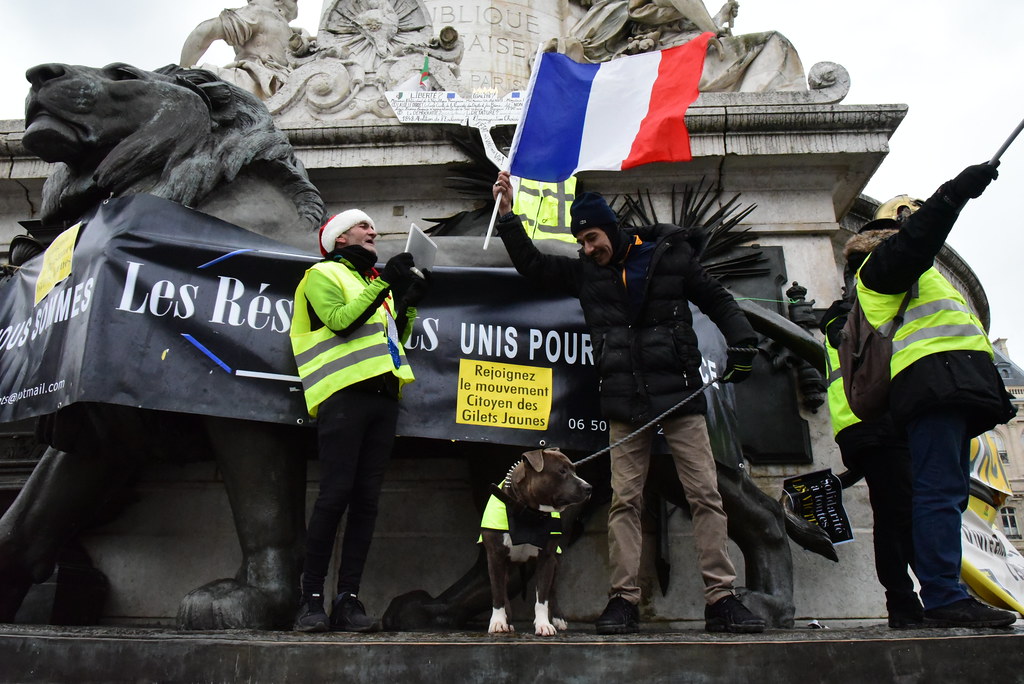
The level at which the Gilets Jaunes have been under reported is extraordinary, except that it hasn’t stopped the uprising either.

(And now I think about it, how much do we see in main stream news about Hong Kong? And it hasn’t stopped the uprising either.)

[…]

So, let’s talk about the rough music. Sure, you can hear it. I can hear it too. The stomp and the drumming can be heard all over the world.

That which can’t go on, won’t.

But I implore you to stop and think: if the rough music plays, what comes after?

There might be no hope for Europe, but Europe’s … ah … how do we put this? Europe’s tenets, their stand before the world, an improvement as they were on everything before them, are not ours.

Even in Europe I suspect when this bursts — and there it will burst. The elites flaying and screaming is only making it worse — you’re going to see things that will make you wonder why on Earth good American boys died in WWII. Because we’re about to get National Socialism, the sequel. National because they’re getting tired of the international elites (and who isn’t) and socialism because the poor bastards have not experienced anything else their entire adult lives.

It will happen. It is necessary. The EU was probably one of the most bizarre ideas in the history of bad ideas. The way it’s run which essentially steals the franchise from ordinary people was just the old style “good families” coming back into power through a back door.

But what comes after will probably be horrific. If we’re all lucky it will also be briefish and like France after the revolution they’ll find their way to something slightly less insane. With or without Napoleon and Europe wide war? Ah … that’s where we need to talk.

First however, let me say that hearing the rough music from the rest of the world is starting to echo here. We see what’s going on there. And we hear strange and stupid stuff, like the “whistleblower of the day” and an impeachment without voting and of course, pancake-gate.

Faced with that kind of behavior you obviously think “It’s insane.” And “We have to stop it.”

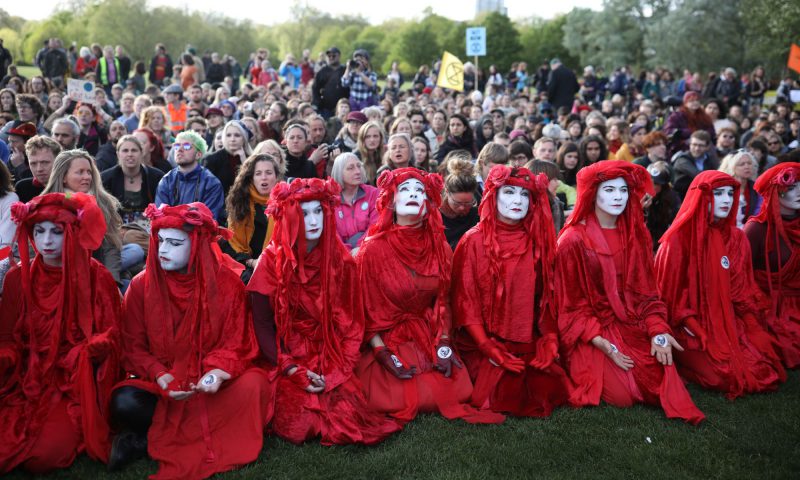
Extinction Rebellion – “an upper-middle-class death cult”

Filed under: Britain, Environment, Politics — Tags: , , , , , — Nicholas @ 05:00

Brendan O’Neill watched a death cult hold one of their ceremonies in public on the streets of London the other day:

This was, of course, Extinction Rebellion. Let us no longer beat around the bush about these people. This is an upper-middle-class death cult.

This is a millenarian movement that might speak of science, but which is driven by sheer irrationalism. By fear, moral exhaustion and misanthropy. This is the deflated, self-loathing bourgeoisie coming together to project their own psycho-social hang-ups on to society at large. They must be criticised and ridiculed out of existence.

Yesterday’s gathering, like so many other Extinction Rebellion gatherings, was middle-aged and middle-class. The commuters heading in and out of King’s Cross looked upon them with bemusement. “Oh, it’s those Extinction freaks”, I heard one young man say. It had the feel of Hampstead and the Home Counties descending on a busy London spot to proselytise the cult of eco-alarmism to the brainwashed, commuting plebs.

It was a gathering to mark Extinction Rebellion’s week of disruption. The group is asking people in London and other cities around the world to “take two weeks off work” and join the revolt against the “climate and ecological crisis”. You can tell who they’re trying to appeal to. Working-class people and the poor of New Delhi, Mumbai and Cape Town – some of the cities in which Extinction Rebellion will be causing disruption – of course cannot afford to take two weeks off work. But then, these protests aren’t for those people. In fact, they’re against those people.

Extinction Rebellion is a reactionary, regressive and elitist movement whose aim is to impose the most disturbing form of austerity imaginable on people across the world. One of the great ironies of “progressive” politics today is that people of a leftist persuasion will say it is borderline fascism if the Tory government closes down a library in Wolverhampton, but then they will cheer this eco-death cult when it demands a virtual halt to economic growth with not a single thought for the devastating, immiserating and outright lethal impact such a course of action would have on the working and struggling peoples of the world.

Extinction Rebellion says mankind is doomed if we do not cut carbon emissions to Net Zero by 2025. That’s six years’ time. Think about it: they want us to halt a vast array of human activity that produces carbon. All that Australian digging for coal; all those Chinese factories employing millions of people and producing billions of things used by people around the world; all those jobs in the UK in the fossil-fuel industries; all those coal-fired power stations; all that flying; all that driving … cut it all back, rein it in, stop it. And the people who rely on these things for their work and their food and their warmth? Screw them. They’re only humans. Horrible, destructive, stupid humans.

The Toronto chapter of the death cult shut down one of the major bridges across the Don Valley on Monday morning:

Just in time for rush hour on Monday morning, hundreds of climate change activists have barricaded themselves across a major four-lane bridge in the heart of Canada’s largest city.

Extinction Rebellion (XR) Toronto, the local arm of an environmental protest group with demonstrations taking place across the world today, shut down traffic on the Prince Edward Viaduct between Bloor Street and Danforth Avenue around 8 a.m. on Monday morning.

Members of the group formed blockages on both sides of the truss bridge with their bodies and props, including a larger-than-life set of letters reading “ACT NOW.”

September 24, 2019

More on the demands from the “climate strike” protests

Filed under: Environment, Politics — Tags: , , , — Nicholas @ 03:00

Arthur Chrenkoff on the far beyond pie-in-the-sky demands coming discordantly from the amorphous climate protest groups coalescing around poor Greta Thunberg and her “climate strike”:

Greta Thunberg at the EU Parliament, 16 April, 2019.
European Parliament photo via Wikimedia Commons.

Fighting “climate change” is a very broad umbrella. What does the Global Climate Strike actually stand for? Greta Thunberg’s (I jokingly referred to her as St Joan of Arc of the Children’s Crusade against Carbon, but the marchers in Paris did carry a poster of Thunberg as a saint) initiative does not offer any extensive manifestos or programs on its website, perhaps not unexpectedly for a child-centric project, but it does provide a brief answer to the question “What are you [as a participant asking for?”:

    The climate crisis is an emergency – we want everyone to start acting like it. We demand climate justice for everyone. Our hotter planet is already hurting millions of people. If we don’t act now to transition fairly and swiftly away from fossil fuels to 100% renewable energy for all, the injustice of the climate crisis will only get worse. We need to act right now to stop burning fossil fuels and ensure a rapid energy revolution with equity, reparations and climate justice at its heart [emphasis in the original].

It’s not much, but already more than a great majority of those taking part are probably aware of they were striking for.

It doesn’t help that some of the more outrageous claims are clearly not true:

What of the other aspects of the Global Climate Strike’s five-sentence program? What exactly is “climate justice”? And what the hell are the “reparations” in this context?

The Strike site doesn’t provide answers, but “climate justice” in the last sentence hyperlinks to the website for The People’s Demands for Climate Justice, which explains itself as “Collectively shaped by people’s movements around the world, these demands are an international statement rooted in southern movements, and with input from numerous climate justice organizations and people’s movements around the world. The People’s Demands lays out a vision for a truly just international climate policy. We must ensure the demands of people, not the fossil fuel industry and other Big Polluters, is what is centered in the lead up to and during COP24 in Poland this December, 2018.” (a case here for updating your website.) While the Global Climate Strike is neither a “convening” nor an “endorsing” organisation among the 403 groups who are, by linking it clearly subscribes to the People’s Demands’ vision. Some of which includes:

    Support global efforts for a just and equitable transition that enables energy democracy, creates new job opportunities, encourages distributed renewable energy, and protects workers and communities most affected by extractive economies …

    Adopt a technology framework that recognizes the importance of endogenous and indigenous technologies and innovations in addressing climate change, and enables developing countries and communities to develop, access, and transfer environmentally sound, socially acceptable, gender responsive and equitable climate technologies.

    Respect and enable non-corporate, community-led climate solutions that recognize the traditional knowledge, practices, wisdom, and resilience of indigenous peoples and local communities, and protect rights over their lands and territories …

    Developed countries must make new concrete pledges of public climate finance accompanied by a definite timeline for delivery.

    Commit to climate reparations to those most affected but least responsible for climate change.

In addition to fossil fuels, the People’s Demands are also against any market mechanisms to reduce emissions (like emission trading schemes), carbon offsets, carbon sequestration technologies, geoengineering and other “techno-fixes”, nuclear power, biofuels and use of biomass to generate energy, and large scale hydro projects – i.e. most of the potential solutions accepted by the serious mainstream climate change political-scientific consensus. This pretty much leaves only solar and wind, geothermal in a few lucky places (like Iceland, which is sitting on top of volcanoes) and small scale hydro to power the entire world post 2030. In other words, a complete fantasy world of green Luddites.

September 23, 2019

The “Global Climate Strike”

The big “let’s all play hooky from school” event’s Toronto organizers have been getting positive coverage from some of the local media, because of course they have. Here’s Tanya Mok for BlogTO, listing the totally reasonable and not in any way unrealistic “demands” of the movement:

FridaysForFuture Demonstration, 25 January 2018 in Berlin.
Photo by C. Suthorn via Wikimedia Commons.

The coalition has made a list of seven demands, which “reflect the rallying cries of the intersectional movements” they belong to. Some of those demands include:

  • Indigenous rights and sovereignty.
  • The protection of forests, land, and water sources.
  • A shift to publicly-owned renewable energy, and reducing national carbon emission by 65% by 203, reaching zero emissions by 2040.
  • A $15 minimum wage for all, and higher taxation on the rich.
  • Universal public services like health care and dental care, free university and college, housing as a human right, and free public transit.
  • Justice for migrants and refugees, allowing status for all. That includes putting an end to deportations and allowing for the full access to public services.

There will be a concert at Queen’s Park after the rally, as well as a follow-up benefit concert at the Tranzac Club in the evening. A giant street mural project run by Greenpeace will also be taking place prior to the rally, around 10 a.m., at the southern point of Queen’s Park.

August 19, 2019

The Peterloo Massacre

Filed under: Britain, History, Liberty, Military, Politics — Tags: , , , — Nicholas @ 05:00

In Spiked on Friday, Brendan O’Neill marked the 200th anniversary of a brutal suppression of thousands of protestors demanding the right to vote in Britain:

The Peterloo Massacre by Richard Carlile (1790-1843)
To Henry Hunt, Esq., as chairman of the meeting assembled in St. Peter’s Field, Manchester, sixteenth day of August, 1819, and to the female Reformers of Manchester and the adjacent towns who were exposed to and suffered from the wanton and fiendish attack made on them by that brutal armed force, the Manchester and Cheshire Yeomanry Cavalry, this plate is dedicated by their fellow labourer, Richard Carlile: a coloured engraving that depicts the Peterloo Massacre (military suppression of a demonstration in Manchester, England by cavalry charge on August 16, 1819 with loss of life) in Manchester, England.

All the poles from which banners are flying have Phrygian caps or liberty caps on top. Not all the details strictly accord with contemporary descriptions; the banner the woman is holding should read: Female Reformers of Roynton — “Let us die like men and not be sold like slaves”.
Manchester Library Services via Wikimedia Commons.

Today is the 200th anniversary of the Peterloo Massacre, when working people in Manchester were attacked and murdered by cavalry forces for daring to demand the right to vote. And what is our political class doing on this anniversary of such an important event in British political history? They are plotting, tirelessly, to overthrow something that millions of working-class people, and others, voted for: Brexit. They are doing what the Peterloo butchers did, only by political means and court cases rather than with bayonets and sabres. Our current political rulers may not physically attack the masses for having the temerity to use their democratic voices — not yet, anyway — but they view us with the exact same seething, elitist contempt as those who did attack the masses in St Peter’s Field on 16 August 1819.

Around 60,000 men, women and children gathered in St Peter’s Field in Manchester 200 years ago to demand parliamentary representation. They wanted that most basic and essential democratic right: the right to vote. The teeming industrial city of Manchester had no elected MPs in parliament. The old “rotten boroughs” system meant that often sparsely populated rural areas sent MPs to the Commons, involving much patronage and sometimes even the buying of votes by wealthy aspiring politicians, while newly industrialised cities full of the growing urban working classes had little to no political representation. Against a background of post-Napoleonic Wars economic depression and a fast-spreading radical desire for meaningful democratic change, the tens of thousands of marchers arrived in St Peter’s Field with a clear demand: let us vote, let us speak.

What happened next is well known. They were attacked by cavalry forces. Troops on horseback wielded sabres against the democratic crowd. They slashed and stabbed, killing 18 people. Around 500 were injured. The slaughter was given the name “Peterloo” as an ironic comparison to the Battle of Waterloo that took place four years earlier, in 1815. The bourgeoisie’s assault on the working-class democrats of Manchester had a deep impact on the radical psyche. New movements emerged in subsequent years, including the Chartists, the working-class movement for democratic representation. But it would be decades before the right to vote had been established across society. In 1867 some working-class men got the right to vote. In 1918, all men and some women got the right to vote. In 1928, finally all women got the vote. The General Election of 1929, 110 years after the march to St Peter’s Field, was the first election in which all adults had the right to vote.

The 200th anniversary of this bloody assault on working-class democrats ought to be a major occasion. It should be a reminder of the incredible, heroic sacrifices earlier generations made to secure people’s right to express themselves, to vote, and to see their votes be enacted. And yet while some in the political and media class will today pay lip service to the heroes of St Peter’s Field and express regret about the massacre of 18 of them, most of the elites will be too busy to do anything of the kind. Busy doing what? Trying to override and crush the votes of 17.4million people, which includes millions of working-class people and eight million women. It is a genuinely alarming and revealing moment: the 200th anniversary of the Peterloo Massacre arrives and the political set is engaged in an effective coup against the people; in a war against “No Deal Brexit” (which really just means a war against Brexit); in a concerted effort to force the ignorant public, as they see us, to vote for a second time and to give the “right” answer on this occasion.

August 16, 2019

Rule Britannia, Britannia Rules the Salt | BETWEEN 2 WARS I 1930 Part 1 of 1

Filed under: Britain, History, India — Tags: , , , , , , , — Nicholas @ 06:00

TimeGhost History
Published on 15 Aug 2019

After the Great War, the British empire is at its peak in terms of population and size. However, resistance against colonialism is starting to brew in the British colonies and dominions.

Join us on Patreon: https://www.patreon.com/TimeGhostHistory

Hosted by: Indy Neidell
Written by: Spartacus Olsson and Francis van Berkel
Directed by: Spartacus Olsson and Astrid Deinhard
Executive Producers: Bodo Rittenauer, Astrid Deinhard, Indy Neidell, Spartacus Olsson
Creative Producer: Joram Appel
Post-Production Director: Wieke Kapteijns
Research by: Francis van Berkel
Edited by: Wieke Kapteijns
Sound design: Iryna Dulka

Portrait Colorizations by Daniel Weiss.

Sources: National Portrait Gallery, Library and Archives Canada, Jenny Scott

A TimeGhost chronological documentary produced by OnLion Entertainment GmbH.

« Newer PostsOlder Posts »

Powered by WordPress