Quotulatiousness

July 14, 2021

Instead of economics, how about “humanomics”?

Filed under: Books, Economics, Education, History — Tags: , , — Nicholas @ 03:00

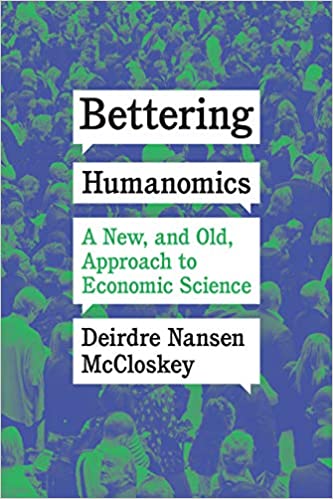
In City Journal, Allison Schrager reviews Bettering Humanomics: A New, and Old, Approach to Economic Science by Deirdre McCloskey:

I thoroughly enjoyed Deirdre McCloskey’s Bettering Humanomics, but I may be a glutton for feelings of intellectual inadequacy. Truth be told, I only understood about 60 percent of the book. It contains countless references to great works of the humanities, economics, and the history of economic thought. A casual reader cannot possibly be familiar with a fraction of them, even within his own field. But McCloskey expects you to know them.

At first this book frustrated and confused me. Then I suspected this reaction was by design. I am, after all, an economist myself: I have dedicated my life to learning my craft and benefited from many years of training at great institutions from important thinkers. But reading Humanomics, I became fully aware of how little I know. I now believe that becoming a fully formed economist requires that I stop watching trash TV in my free time and read the Theory of Moral Sentiments instead. McCloskey pulls no punches, whether on her intellectual opponents or on the reader. Here is one example, where she defends herself from a critic, philosopher Gerald Gaus:

    Aside from these textual matters, I must say I find myself repelled by Gaus’s vision of people as cynical conformists: “we are such deeply social normative creatures, in the sense that we are so attuned to the normative expectations of others, that we can achieve a stable rule-based system of cooperation even when many are not enthusiastic about the moral attitudes and virtues that the rules express.” I invite him to reread Thucydides’s dialogue between the Athenian diplomats and the Melians, and repent.

McCloskey argues that economics would be better if we listened to people — in controlled experiments, chat rooms, meetings, surveys, and at the Rotary. We need to absorb the lessons from art and culture (perhaps trash TV has value, after all). She does not believe that economists need to ditch math and data, but our overreliance on these tools encourages us to view people as abstractions and leads us astray. Such tendencies also help explain the rise of behaviorism, which assumes that humans are flawed creatures who must be nudged by a wise bureaucrat into better choices; recent flirtations with industrial policy; and the belief that, if we just get our government and laws right, growth will follow.

We must consider how individuals see and experience the world around them, and we must recognize that humans are malleable in ways that we don’t account for. For example, McCloskey estimates a quarter of all income comes from “Sweet Talk” — not lies or trickery, but the ability to be persuasive and compelling, a crucial aspect of sales and advertising. It influences how we perceive the world and can be an important part of motivation.

We economists have lost our appreciation for the humanities, and that means that we underestimate the importance of human dignity. This is no small oversight. McCloskey spends about a third of her book arguing that understanding the humanity of the northwestern European population can explain why it industrialized first. Other countries around the world had wealth, strong institutions, and well-trained mathematicians and engineers (perhaps better ones), but industrialization happened in Britain first because it treated its people with dignity and empowered them with both rhetoric and knowledge.

June 11, 2021

The concept of philanthropy is another one with conflicting meanings to the left and to the right

Filed under: Government, Politics, USA — Tags: , , , , — Nicholas @ 05:00

In the Daily Chrenk, Arthur Chrenkoff has a bit of fun outlining the recent kerfuffle over Alexandria Ocasio Cortez’s attempt to use her grandmother’s situation in Puerto Rico for scoring political points, and then explains why the notion of philanthropy is a very different thing to progressives than it is to conservatives:

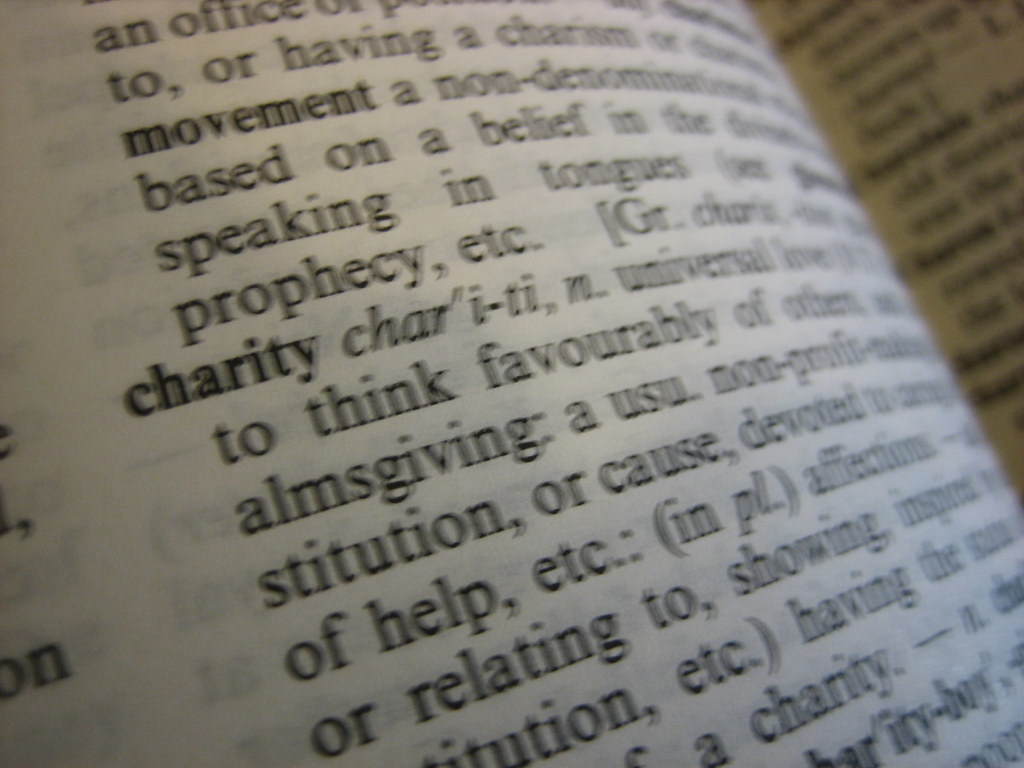
“Charity in the dictionary” by HowardLake is licensed under CC BY-SA 2.0

Well may we laugh about (and be disgusted by) the hypocrisy, corruption and indifference shown by prominent members of the left towards the very people they supposedly care about. But it would be to miss the broader point relating to how the left views the world, the role of politics, and the place of the individual.

It might surprise many that the caring and compassionate left isn’t actually all that big on philanthropy and charity, i.e. people helping other people. What could be wrong with that? Wouldn’t the world be a better place if even more people helped even more other people? Well, no, the left would say, because it’s not something that people should be doing in the first place; it’s not their responsibility. It is up to the state to solve all the social and economic problems; our role as citizens (as well as, thanks to the open borders advocates, non-citizens) is to be the grateful recipients of the government’s largesse. For the more elite group (no pun intended) – “the rich” – their role is to pay for all this with their taxes. Private initiative is by its very nature limited and patchy; only the all-seeing and all-powerful state can ensure that everyone who needs “free” assistance (and that’s literally everyone) gets it in a comprehensive, uniform and fair way. Hence, AOC won’t lift a finger to help her grandmother because it’s the state’s duty to help everyone rebuild their lives after a natural disaster. Occasional Cortex already contributes with her taxes on the hard-earned Congressional salary, and in any case, she’s not some billionaire, you know.

With that attitude, needless to say, you won’t be surprised to learn that much of what goes for the left-wing philanthropy does not actually go to help those in need to solve their problems and provide them what they are lacking. Instead, it is largely channels to finance political agitation by the activist-industrial complex to make the government (whether through lobbying, campaigning or helping elect sympathetic law-makers) take responsibility instead. That’s what people like Soros, Laurene Powell-Jobs (Steve Jobs’ widow) and MacKenzie Scott (Jeff Bezos’ ex) are all about – billions spent to create more activist jobs to agitate for the state to create more public sector jobs to run the “Big Daddy”.

But it goes deeper than that, back to Marx himself in fact and to his analysis of what’s wrong with the world and how to fix it. According to Marxism, both in its original class-based iteration and the more recent race/gender/sexuality variants, every society is divided into two mutually antagonistic groups: the powerful oppressors and the powerless oppressed, with the society structured in the interest of the former by facilitating in every possible way the exploitation and keeping down of the latter. Thus, all the problems, ills and injustices are “systemic” in nature; they are a feature, not a bug. To solve them and so to help the downtrodden you need to overthrow the entire old unjust system and build a new one that benefits the masses. Based on this sort of understanding of the world – to which, coincidentally, people like AOC and BLM founders all subscribe – any private charity is bound to be ineffectual and shortcoming. After all, what can a person, however generous with their money and time – even if there are multitudes of them – do to solve problems that are the direct (and intended) consequence of the way the society has been set up? Nothing, of course. You can’t mend it, you have to end it. But not only is it naïve and pointless to try, it’s actually counter-productive and therefore positively wrong. Because while no philanthropic effort can solve systemic problems, it can actually provide some limited and temporary relief. Such relief, however, by its very nature is a band-aid solution, i.e. not a solution at all. All it does it momentarily numbs the pain, and that is bad, because the oppressed masses need to feel the pain and feel it good in order to spur them into revolutionary action to overthrow their oppressors and on the ruins of the old build the utopian new society of equality and justice. This is the far-left’s accelerationism: the worse it gets, the better it gets (for the prospects of radical change).

May 17, 2021

QotD: Orpheus and Eurydice

Filed under: Europe, Greece, History, Quotations — Tags: , — Nicholas @ 01:00

The Greek myths […] could not tell us of the conquest of Death by Love, because they could not know it yet; but they did know what it was not. They — the Greeks with their legends — were not just pessimistic. They were heroic pessimists.

Orpheus descends into Hades to retrieve his bride, Eurydice. In the account we read in Virgil’s Georgics, the point of the tale is already slightly smoothed, blunted. Orpheus has made the mistake of looking back on her countenance, when he is almost home. He has emerged in the sun, but she is still in the shadows. As he looks back, she recedes, disappears; she is now lost forever. In modern “education” we used to weep for the tragedy. He almost succeeded. It is a tragedy, strictly in the Roman pagan sense.

But it was a tragedy in the Greek sense, first. If we go instead to Plato, and listen to the aristocratic Phaedrus in the Symposium, we learn that Orpheus was thoroughly in the wrong, in his attempt to retrieve Eurydice. He was bound to be punished. His mistake was not a technicality. His living descent into Hades was a challenge not only to the gods, but to nature, and to the truth of things. His love for Eurydice, so affecting in his mournful dirges — moving everyone to tears — was not true love. A coward, he would not die for it.

Hades has presented him with a wraith, in Eurydice’s outward form. Inevitably, this illusion would dissolve in the sunlight. And the fate of Orpheus was now set — the fate of an eloquent softie, who loves an imaginary woman — a woman he had created from the start. He will die at the hands of the real ones he rejected. He will be torn apart by the Maenads, as by wild beasts. His lyre will be destroyed. This is the fate of our shallow romantic star; the pretty boy whose lyre and whose voice had once been an enchantment.

Boethius deals with that backward gaze, in the Consolations of Philosophy. We who seek to lead into the light of the upper day — we triumphalist philosophers — are bound to look back into the Tartarean cave. And when we do, the clarity of our “vision” will be obscured; then ruined, totally. To guide we must be guided; or all will be lost.

David Warren, “A backward glance”, Essays in Idleness, 2021-02-09.

May 10, 2021

QotD: Against the notion of the “Social Contract”

Filed under: Liberty, Politics, Quotations — Tags: , , , , , — Nicholas @ 01:00

As a modern conservative, [Roger] Scruton defends a form of democracy unknown to Aristotle. Following David Hume and Edmund Burke, however, he opposes the idea that the “political order is founded on a contract.” For Scruton, the state of nature is a chimera — an invention of modern political philosophers who had forgotten the debt and gratitude owed to our predecessors. The fictitious state of nature — so central to philosophical liberalism — obscures the fact that membership in a community, with its requisite duties and obligations, is a precondition for meaningful freedom. “Absolute freedom” — doing whatever one wants — is always an invitation to anarchy or tyranny. In the modern world, the nation is the political form that guarantees membership and self-government.

In all of his political writings, Scruton takes on the Left for scorning existing norms and customs, and for promoting a “culture of repudiation.” The Left is “negative.” It dismisses “every aspect of our cultural capital” with the language of brutal invective: accusing every defender of human nature and sound tradition of “racism,” “xenophobia,” “homophobia,” and “sexism.” Like 1984‘s “two minutes of hate,” this language tears down, intimidates, and can never build anything humane or constructive — it is nihilistic to the core. At the same time, Scruton wants to reach out to reasonable liberals who eschew ideology and who still believe in civility and the promise of national belonging. His conservatism can discern the truth in liberalism (another Aristotelian trait) while the partisans of repudiation see half the human race as enemies.

Daniel J. Mahoney, “Beyond the Culture of Repudiation”, Claremont Review of Books, 2018-06.

April 22, 2021

QotD: Moderation in war

Filed under: Britain, History, Military, Quotations — Tags: , — Nicholas @ 01:00

[T]he essence of war is violence and moderation in war is imbecility.

Admiral of the Fleet Lord Fisher, 1913.

April 8, 2021

QotD: Thomas Hobbes and his “state of nature”

Filed under: History, Liberty, Quotations — Tags: , , , — Nicholas @ 01:00

One reason I had such a hard time teaching this stuff to undergraduates back in my ivory tower days was that, ironically, we can imagine a much more “realistic” State of Nature than Hobbes could. We even had a TV show about it: Lost (in which, I’m told, one of the characters was actually named “John Locke”). A large group of strangers, unrelated by blood or affinity, would never be shipwrecked on a deserted island in Hobbes’s day, but we Postmoderns have no problem imagining a large international flight going down. Assume everyone survives the crash, and there’s your State of Nature – a much better one than Hobbes’s.

Under those very specific conditions, something like what Hobbes says might come to pass. In reality, of course, we seem to be much likelier to pull together in a disaster than to immediately go full retard, but let’s envision the most apocalyptic scenario, in which every guy who can bench press his body weight (assuming such still exist on international flights) immediately tries to lord it over everyone else on the island. There, and only there, the stuff Hobbes says about equality is true – the strong guy can beat up the weak guy, and enslave him, but the strong guy has to sleep sometime …

… so pretty soon there are no more strong guys, only various flavors of weak, clever guys, and now they have to band together, because you need three or four of them to accomplish the physical labor that one strong guy could’ve before they murdered him in his bed. And so on, you get the point, eventually everyone grudgingly lays down his arms and starts working together for mutual survival.

At this point, I need to point out something fundamental about Thomas Hobbes, that y’all probably don’t know. Hobbes always considered himself first and foremost a mathematician. But he wasn’t a very good mathematician. He’d thought he’d discovered a way to “square the circle,” for instance, and that’s not a metaphor – that was really a thing back then, and Hobbes’s attempt got ripped to shreds by real mathematicians, who thought they were thereby discrediting his metaphysics and, by implication, his political philosophy …

… fun stuff, but irrelevant, the point is, Hobbes was a bad mathematician. So bad, in fact, that even I, a former History professor who needs to pull off a sock every time I have to count past ten, can see the glaring flaw in his “geometrical” political theory: IF it’s based on “the State of Nature,” and we legitimize the Leviathan because that’s what gets us out of the State of Nature, then once we are free of the State of Nature, what’s the point of the Leviathan?

Hobbes didn’t see it that way, of course. He thought that we really did revert to “the war of all against all” the minute the social contract was broken, and in his context – the English Civil Wars, recall – that’s not unreasonable. But what about all the periods of “normal” government? You know, those periods of peace we created the Leviathan specifically to secure? If we get those – and there’s no point to the exercise otherwise – then we seem to have created an all-powerful government that, while it CAN do everything, really shouldn’t do anything.

Severian, “Hobbes (II)”, Founding Questions, 2020-12-11.

March 31, 2021

QotD: The first and only “inalienable” right

Filed under: Government, History, Liberty, Quotations — Tags: , , , , — Nicholas @ 01:00

Oversimplifying a bit for clarity, “republican” political philosophy after Hobbes is an attempt to use Hobbes’s tools and methods without arriving at his conclusions. That baloney about “inalienable rights” in the US Declaration of Independence is the most famous of these attempts. If you want to know how we got from there to here – from the Founders to the Tyranny of the Intersectional Genderfluids – just recall what those supposedly “inalienable” rights are: Life, Liberty, the Pursuit of Happiness.

It would’ve been far better to have kept the trio in Locke’s original words – life, liberty, and property – but even that wouldn’t have saved us, because the proposition is flawed from the beginning. The full quote is:

    We hold these truths to be self-evident, that all men are created equal, that they are endowed by their Creator with certain unalienable Rights, that among these are Life, Liberty and the pursuit of Happiness …

… and pretty much all of that is wrong.

As we’ve seen, it was a major part of Hobbes’s project to prove that men do in fact have such rights, because it’s not at all “self-evident.” That was the whole point of the Wars of Religion – heretics have NO rights, because they have put themselves beyond the pale of the human community. For the Wars of Religion to end, political legitimacy had to be secularized.

That was Hobbes’s goal. That’s what the “State of Nature” thought experiment was about. Does man has any rights in himself, that flow only from his existence as a human being? In other words, does he have rights NOT endowed by his Creator?

Hobbes argued that we DO have such rights, of course … but, crucially, we only have the full exercise of them in the State of Nature. For Hobbes, all rights are, at bottom, the right to self-defense. Getting out of the State of Nature involves laying at least part of that right down – “alienating” it, in the Latinate English of the 17th century – creating in the process a “corporate person” who “represents” us all. Far from being “inalienable,” then, Life and Liberty, at least, have to be alienated, at least to some degree, if civilization is to exist at all …

… at least according to Hobbes, and do you see what I mean about people trying to adopt his terms while dumping his conclusions?
Hobbes had plenty of examples to hand, writing as he was in the last, nastiest phase of the Wars of Religion. According to Hobbes, the Leviathan – who, let’s recall, can be a Senate or something just as easily as a monarch – absolutely has the right to your life and liberty, since your voluntary surrender of them is what creates the Leviathan in the first place. How else could wars be fought in the gunpowder age? A medieval king leading his personal affinity into battle didn’t have to worry about political theory. An Early Modern king, fielding armies of tens of thousands, did. Without an animating ideology, they’re just mercenaries – ask Machiavelli how that works out.

We’ll skip over that “pursuit of happiness” crap, since that’s probably just Jefferson’s noodle-headed way of alluding to Classical political theory, and circle back to the start: “all men are created equal.” As we’ve seen, this was central to Hobbes’s “State of Nature” thought experiment … but, as is obvious to anyone with real-world experience, it only applies there.

Severian, “Hobbes (II)”, Founding Questions, 2020-12-11.

January 18, 2021

QotD: Francis Bacon on what we now call “Confirmation Bias”

Man is a rational animal, as Aristotle put it. Not that he is always rational, but that he is capable of reason. Reason, trained, leads to happiness. Orwell wasn’t the first person to observe that this didn’t always work in practice.

“The human understanding when it has once adopted an opinion (either as being the received opinion or as being agreeable to itself) draws all things else to support and agree with it” wrote Francis Bacon in his 1620 Novum Organum, one of the major early works of the European Enlightenment and Scientific Revolution. Today, we call this confirmation bias. We don’t form opinions based on the evidence — we often shape the evidence to suit our opinions. We attribute importance to facts which back our preferred theory and dismiss as unimportant those which do not. “It is the peculiar and perpetual error of the human intellect to be more moved and excited by affirmatives than by negatives; whereas it ought properly to hold itself indifferently disposed towards both alike,” Bacon added. We continue to cling to ideas which have been discredited, a phenomenon called belief perseverance. Or worse, our faith in discredited ideas becomes even stronger when we are presented with contrary evidence — the backfire effect. Or we focus on successes and ignore failures, a phenomenon called survivorship bias. Bacon reminds us of the story of Diagoras of Melos, who was shown a picture of those who had escaped shipwreck after making vows to the gods hanging in a temple. Diagoras asked where he could find a picture of those who made vows to the gods but drowned anyway.

Bacon wrote that humans are afflicted with “idols of the mind,” and he identified four. The first are idols of the tribe, flaws in thinking common to all people that come from human nature itself. Second are idols of the cave, or den. All of us, Bacon argued, have a cave in our mind where the light of reason is dimmed, and this cave varies from person to person depending on his or her character, experiences, and environment. Third are idols of the marketplace, associated with the exchange of ideas. As language can never be perfectly precise, it’s possible for falsehoods to develop and spread as a concept as explained by one person to another. Finally come idols of the theatre, ideas which have been presented to us and taken root so deeply and firmly they’ve become hard to remove. In Bacon’s time, this was the philosophy of Aristotle, which had become so fundamental to Western thought that even parts of it which could easily be disproven remained unchallenged for centuries. To manage the effect of the idols, Bacon proposed “radical induction” — the forerunner to the modern scientific method.

Adam Wakeling, “George Orwell and the Struggle against Inevitable Bias”, Quillette, 2020-08-08.

November 14, 2020

The Decline of the Great Library of Alexandria

The History Guy: History Deserves to Be Remembered
Published 27 Mar 2019

Presented by Ms History. The Great Library was a center of knowledge. Its decline was not the single cataclysmic event that may seem to think, but its slow decline is perhaps, even more tragic. It is history that deserves to be remembered.

This is original content based on research by The History Guy. Images in the Public Domain are carefully selected and provide illustration. As images of actual events are sometimes not available, images of similar objects and events are used for illustration.

All events are portrayed in historical context and for educational purposes. No images or content are primarily intended to shock and disgust. Those who do not learn from history are doomed to repeat it. Non censuram.

Ms. History Guy is an avid reader and former reference librarian, and reviews around 100 books per year. Feel free to follow her progress or befriend her on Goodreads where she goes by the name “Heidi the Reader”: https://www.goodreads.com/MsHistory

Patreon: https://www.patreon.com/TheHistoryGuy

The History Guy: History Deserves to Be Remembered is the place to find short snippets of forgotten history from five to fifteen minutes long. If you like history too, this is the channel for you.

Awesome The History Guy merchandise is available at:
teespring.com/stores/the-history-guy

Script by JCG

#history #thehistoryguy #library

October 18, 2020

QotD: Nietzsche’s concept of “eternal recurrence”

Filed under: Books, History, Quotations, Religion — Tags: , , , , — Nicholas @ 01:00

In making Nietzsche’s eternal recurrence the theme of this book, Gillespie has set himself a huge task. Not only is it one of the philosopher’s weakest and most unconvincing theses, it is the one that sits in opposition to nearly everything else he wrote. For Nietzsche, despite his writing appearing wistful and gothic Romantic, was essentially an empiricist. He had no time for the dualism of Plato and only a fleeting but unconvinced interest in Kantian metaphysical idling about what lay beyond the tangible world. Nietzsche wrote that all there was for sure was the here and now.

This is exactly why he was not a militant atheist in the way we understand the expression today. He felt no need to concern himself with the veracity of Christianity’s claims about the afterlife, something we cannot be sure about. He seldom railed against the theological pretensions of Christianity or the absurdity of religion because to him the only thing that mattered was how religion affected us. He objected to Christianity because he saw it as nihilist and life-negating. It taught people to be meek, humble and to accept their lot. Nietzsche was an empiricist in that he wanted people to fulfil their life in the here and now, something that Christianity was hostile to.

Yet Nietzsche’s eternal recurrence belongs strangely to the realm of metaphysics and dualism. Its fatalism and determinism contradicts Nietzsche’s exhortation for each of us to become our own masters and to become who we truly are. While he did not believe in free will, he did believe that the Übermensch could harness and master the forces of his inner “will to power”. Contrarily, the eternal recurrence condemns us to history and supernatural fate. The notion of “eternal recurrence” reeks too much of his youthful dalliance with Schopenhauerian metaphysics.

This is perhaps why Nietzsche rarely mentioned it, and made even less effort to explain it in the books published in his lifetime. It seems too much of a flight of fancy, and the only time he spoke of it in all seriousness is when he recounted one day in August 1881, when walking in the Swiss mountains, when he had a kind of strange, rapturous religious experience – the day when the notion of “eternal recurrence” came to him in the first place.

Patrick West, “Nietzsche and the struggle against nihilism”, Spiked, 2018-08-03.

October 17, 2020

History Hijinks: Greek Wise Guys

Overly Sarcastic Productions
Published 16 Oct 2020

When I first studied Ancient Philosophy in college I thought it was engaging and interesting to discuss and whatever, but only years later did I come to appreciate the true hilarity of these Wise-Guys.

SOURCES & Further Reading: Plato’s Dialogues (Apology & Republic), Aristotle’s Ethics, Gorgias’ Encomium of Helen, and when direct sources aren’t available, there’s a bucketload of great write-ups from Stanford: https://plato.stanford.edu/entries/pr…, https://plato.stanford.edu/entries/de…, https://plato.stanford.edu/entries/ar…, https://plato.stanford.edu/entries/pl…, https://plato.stanford.edu/entries/so…

This video was edited by Sophia Ricciardi AKA “Indigo”. https://www.sophiakricci.com/

Our content is intended for teenage audiences and up.

PATREON: https://www.Patreon.com/OSP

PODCAST: https://overlysarcasticpodcast.transi…

DISCORD: https://discord.gg/kguuvvq

MERCH LINKS: http://rdbl.co/osp

OUR WEBSITE: https://www.OverlySarcasticProductions.com
Find us on Twitter https://www.Twitter.com/OSPYouTube
Find us on Reddit https://www.Reddit.com/r/OSP/

October 16, 2020

“The Art of War” – Wisdom of Sun Tzu – Sabaton History 089 [Official]

Filed under: Books, China, History, Media, Military — Tags: , , , , , , — Nicholas @ 04:00

Sabaton History
Published 15 Oct 2020

Sun Tzu says: “The Art of War is of vital importance to the state. It is a matter of life and death, a road either to safety or to ruin.” The Chinese Art of War by Sun Tzu is one of the most influential books in history. Throughout the centuries it would accompany generals, statesmen, and philosophers alike. Those who follow his teachings, who safeguard themselves against defeat and make sure of victory before the battle is fought, will triumph. Those who know everything about themselves and their enemies will achieve supreme excellence.

The Art of War by Sun Tzu Text: https://www.gutenberg.org/files/132/1…

Support Sabaton History on Patreon: https://www.patreon.com/sabatonhistory

Listen to “The Art of War” on the album The Art of War:
https://music.sabaton.net/TheArtOfWar

Watch the Official Live Clip of “The Art of War” here:
https://www.youtube.com/watch?v=aYoK1…

Listen to Sabaton on Spotify: http://smarturl.it/SabatonSpotify
Official Sabaton Merchandise Shop: http://bit.ly/SabatonOfficialShop

Hosted by: Indy Neidell
Written by: Markus Linke and Indy Neidell
Directed by: Astrid Deinhard and Wieke Kapteijns
Produced by: Pär Sundström, Astrid Deinhard and Spartacus Olsson
Creative Producer: Maria Kyhle
Executive Producers: Pär Sundström, Joakim Brodén, Tomas Sunmo, Indy Neidell, Astrid Deinhard, and Spartacus Olsson
Community Manager: Maria Kyhle
Post-Production Director: Wieke Kapteijns
Editor: Karolina Dołega
Sound Editor: Marek Kaminski
Maps by: Eastory – https://www.youtube.com/c/eastory
Archive: Reuters/Screenocean – https://www.screenocean.com

Visual Sources:
– Pictures of Ming Dinasty courtesy of Yprpyqp from Wikimedia
– Pictures from the period of Opium War courtesy of Massachusetts Institute of Technology © 2010 Visualizing Cultures
– Wellcome Images
– Major National Historical and Cultural Site in China
– Pictures of The Art of War book courtesy of vlasta2, bluefootedbooby on flickr.com
– Metmuseum
– Picture of Eastern Han Calvary courtesy of GaryLee Todd from Wikimedia
– Granger Archive
– Hallwyl Museum
– Nomura Art Museum
– The icons from The Noun Project: Man by vanila, Asian woman by Jaime Serra, Wise Man by Éléonore Sabaté

All music by: Sabaton

An OnLion Entertainment GmbH and Raging Beaver Publishing AB co-Production.

© Raging Beaver Publishing AB, 2019 – all rights reserved.

October 13, 2020

QotD: Generalizations

Filed under: Education, Quotations — Tags: , — Nicholas @ 01:00

Generalizations, indeed, all have their limits — even this one. Apply them often enough, and you will come inevitably upon some disconcerting exception … But because philosophy is long and life is short we must assume, even when we can’t entirely believe, that [things] fall into groups and classes, else we could never hope to study them at all.

H.L. Mencken, Men versus the Man: A Correspondence between Robert Rives La Monte, Socialist, and H.L. Mencken, Individualist, 1910.

October 12, 2020

QotD: Three lessons on weapons handling in moments of danger

Filed under: Quotations, Weapons — Tags: , , , — Nicholas @ 01:00

Nothing most of us will ever do combines the moral weight of life-or-death choice with the concrete immediacy of the moment as thoroughly as the conscious handling of instruments deliberately designed to kill. As such, there are lessons both merciless and priceless to be learned from bearing arms — lessons which are not merely instructive to the intellect but transformative of one’s whole emotional, reflexive, and moral character.

The first and most important of these lessons is this: it all comes down to you.

No one’s finger is on the trigger but your own. All the talk-talk in your head, all the emotions in your heart, all the experiences of your past — these things may inform your choice, but they can’t move your finger. All the socialization and rationalization and justification in the world, all the approval or disapproval of your neighbors — none of these things can pull the trigger either. They can change how you feel about the choice, but only you can actually make the choice. Only you. Only here. Only now. Fire, or not?

A second is this: never count on being able to undo your choices.

If you shoot someone through the heart, dead is dead. You can’t take it back. There are no do-overs. Real choice is like that; you make it, you live with it — or die with it.

A third lesson is this: the universe doesn’t care about motives.

If your gun has an accidental discharge while pointed an unsafe direction, the bullet will kill just as dead as if you had been aiming the shot. “I didn’t mean to” may persuade others that you are less likely to repeat a behavior, but it won’t bring a corpse back to life.

These are hard lessons, but necessary ones. Stated, in print, they may seem trivial or obvious. But ethical maturity consists, in significant part, of knowing these things — not merely at the level of intellect but at the level of emotion, experience and reflex. And nothing teaches these things like repeated confrontation with life-or-death choices in grave knowledge of the consequences of failure.

Eric S. Raymond, “Ethics from the Barrel of a Gun”.

August 5, 2020

Red Toryism, limited government and other Canadian political sinkholes

Filed under: Cancon, Economics, Government, Politics — Tags: , — Nicholas @ 03:00

In his latest article in The Dominion, Ben Woodfinden talks about the political void where most Canadian conservatives keep their notions about what “conservatism” actually means in the Canadian context:

Parliament Hill in Ottawa.
Photo by S Nameirakpam via Wikimedia Commons.

This passage is from the Red Toryism essay:

    Modern Canadian conservatism champions “small government”, seemingly without having any theory of what the state is actually for. Absent such a framework, it is difficult to identify governing priorities let alone to develop a philosophically coherent blueprint for action. When Conservatives get elected, they often have no idea of how to achieve the “fiscal responsibility” they preach. A series of ad hoc actions and policies follow, and the predictable result is failure to roll back the state in any significant or lasting way.

This, predictably, did not please everyone, and in a political landscape where we often still think that the divides between left and right are really about “big” versus “small” government, this was to be expected. But a conservative theory of government needs to escape this paradigm.

While conservatism is a broad tent, one unifying feature should be a commitment to limited government. But limited government is a term that often gets conflated with ideological “small government” that sees most of the modern state as illegitimate, and would eliminate most of it and leave the state to provide just the most minimal night-watchman functions. But small government, while a valid view to hold, is not limited government, and conservative government cannot just be about small government.

Limited government means constitutional government that is accountable and constrained by the rule of law, and while there are aspects of the modern state that need to be reformed, tamed, and limited, conservative government cannot just be about trying (and failing) to shrink the state. Conservatives have too often, I think, adopted the rhetoric of small government, without actually being true believers, and in the process they find it very difficult to actually reform and shape the state because they have put little thought into what government actually ought to be about.

Let me give you an example. Recently my friend Asher Honickman and I wrote a column for the National Post calling for a “parliamentary revival.” One specific and important reform we want to see is an expanded House of Commons to 500 MPs. More MPs would make for better party, and parliamentary government. But multiple people, including well connected conservatives, privately told us that while they think this is a good idea, one reason it won’t happen is because conservatives will just look at it through the lens of more spending of tax dollars on politicians. Instead the conservative impulse is to just try and shrink the size of legislatures to save a little bit of money.

In this case small government ideology actually gets in the way of reforms that would help make government more accountable, and limited. MPs should be held accountable and have their spending and salaries heavily scrutinized, but the cost of 150 more MPs would be nothing in the grand scheme of things.

This misses the point. More MPs would make for more accountable and better parliamentary government, and allow parliament, instead of both the bureaucracy and judiciary to increasingly take over more and more of lawmaking and governing that should be done by elected officials. The choice isn’t between more government or less government, in this case it’s a choice between who you’d rather be governed by; MPs who can scrutinize the government more, legislate with more freedom, and who you can hold to account, versus unelected bureaucrats with minimal oversight and limited accountability to elected officials.

In short, a conservative theory of governance should prioritize limited government, but in some cases this might require an attempt to strengthen (and more spending) on certain parts of government to constrain other parts.

It’s a rare Canadian conservative who’s willing to be quoted as saying that any part of human life is not automatically part of the remit of the federal government … how do you carve a “limited” government philosphy out of that?

« Newer PostsOlder Posts »

Powered by WordPress