It is not a new thought that Communism debased language and, with language, thought. There is a Communist jargon recognizable after a single sentence. Few people in Europe have not joked in their time about “concrete steps,” “contradictions,” “the interpenetration of opposites,” and the rest.
The first time I saw that mind-deadening slogans had the power to take wing and fly far from their origins was in the 1950s when I read an article in The Times of London and saw them in use. “The demo last Saturday was irrefutable proof that the concrete situation…” Words confined to the left as corralled animals had passed into general use and, with them, ideas. One might read whole articles in the conservative and liberal press that were Marxist, but the writers did not know it. But there is an aspect of this heritage that is much harder to see.
Even five, six years ago, Izvestia, Pravda and a thousand other Communist papers were written in a language that seemed designed to fill up as much space as possible without actually saying anything. Because, of course, it was dangerous to take up positions that might have to be defended. Now all these newspapers have rediscovered the use of language. But the heritage of dead and empty language these days is to be found in academia, and particularly in some areas of sociology and psychology.
Doris Lessing, “Questions You Should Never Ask a Writer”, New York Times, 1992-06-26 (reprinted 2007-10-13)
May 19, 2014
QotD: Communism and language
May 2, 2014
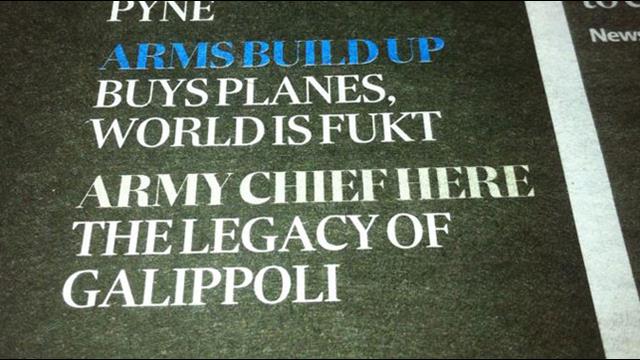
Australian Financial Review says the “World is Fukt”
In my mundane jobs, occasionally filler text is accidentally included in an otherwise ready-to-publish piece of work. Much more rarely, someone on staff uses placeholder headings that are never meant to go beyond their small circle of fellow scribes (sometimes funny, often scatological, risky-but-stress-relieving kind of things). When I was working for [defunct international telecom equipment manufacturer], a fellow writer included the instruction “If you find an error in this document, please dial 1-800-EAT-SHIT” on a cover page. The divisional VP was not amused when that hit his desk.
This is bad when it escapes to the internal audience outside the working group, but it’s much worse when it somehow goes out to the general public:

The financial newspaper which accidentally published a front-page headline reading “World is Fukt” apologised today to its readers for the error-ridden edition.
The respected Australian Financial Review, in a message from editor-in-chief Michael Stutchbury, said the mistake was due to a production and printing error.
“The Australian Financial Review apologises to Western Australian readers for the obviously unacceptable state of the newspaper’s front page on Thursday,” he said in an apology in Monday’s newspaper.
The accidental front page quickly found fans on Twitter, who approved of the headline which read in full: “Arms buildup – Buys planes, World is Fukt”.
They also enjoyed the fact that the headline for a story about a major budget speech by Treasurer Joe Hockey was empty of meaning, reading “Three lines to come here”.
H/T to my best source in Oz, Roger Henry.
April 25, 2014
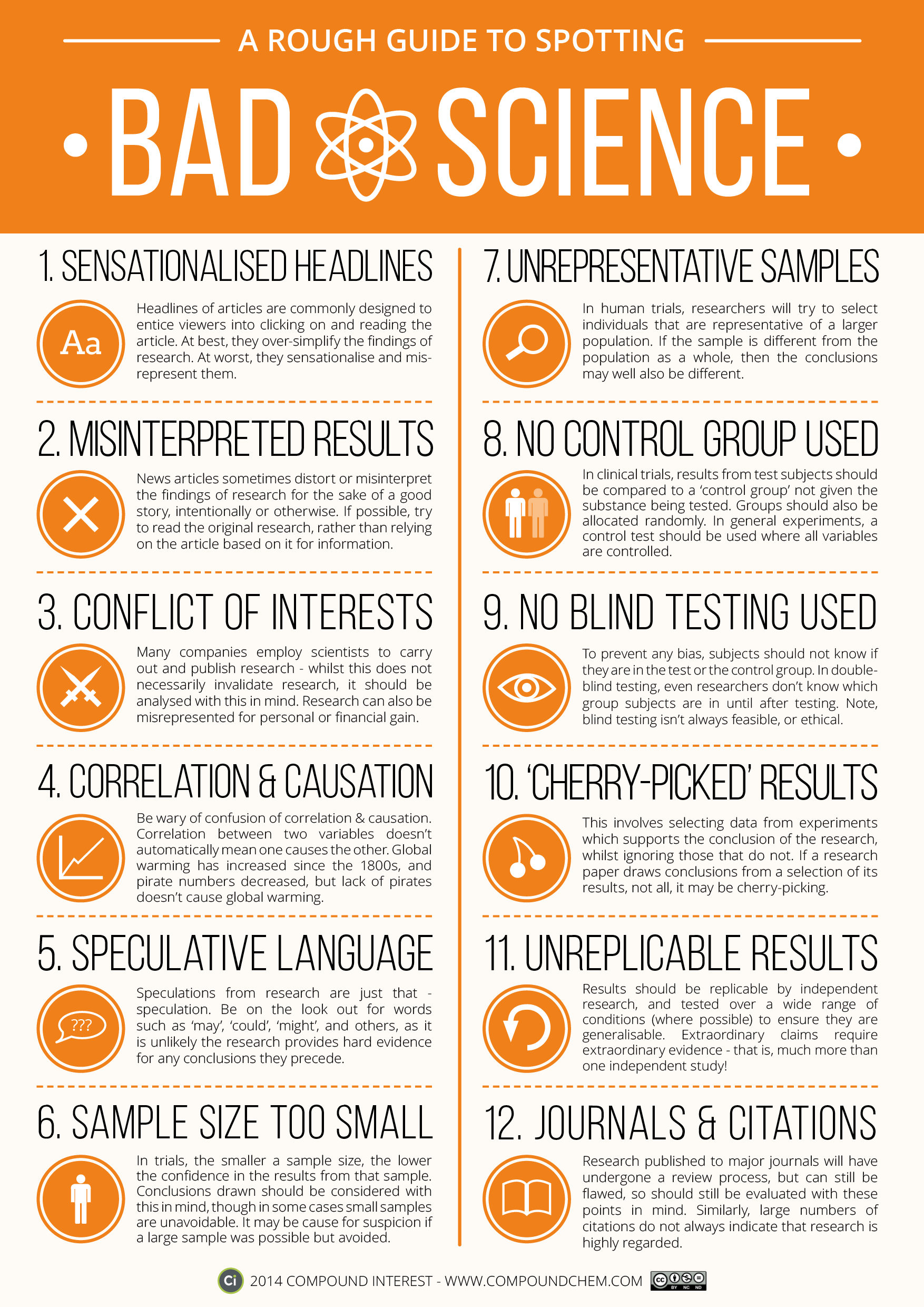
Is it science or “science”? A cheat sheet
At Lifehacker, Alan Henry links to this useful infographic:
Science is amazing, but science reporting can be confusing at times and misleading at worst. The folks at Compound Interest put together this reference graphic that will help you pick out good articles from bad ones, and help you qualify the impact of the study you’re reading
One of the best and worst things about having a scientific background is being able to see when a science story is poorly reported, or a preliminary study published as if it were otherwise. One of the worst things about writing about science worrying you’ll fall into the same trap. It’s a constant struggle, because there are interesting takeaways even from preliminary studies and small sample sizes, but it’s important to qualify them as such so you don’t misrepresent the research. With this guide, you’ll be able to see when a study’s results are interesting food for thought that’s still developing, versus a relatively solid position that has consensus behind it.
April 16, 2014
Thought experiment – in media reports, replace “scientist” with “some guy”
Frank Fleming makes an interesting point:
Our society holds scientists in high esteem. When scientists say something — whether it’s about the composition of matter, the beginning of the universe, or who would win a fight between a giant gorilla and a T. Rex — we all sit up and listen. And it doesn’t matter if they say something that sounds completely ridiculous; as long as a statement is preceded with “scientists say,” we assume it is truth.
There’s just one problem with that: There are no such things as scientists.
Okay, you’re probably saying, “What? Scientists are real! I’ve seen them before! There’s even a famous, blurry photo of a man in a lab coat walking through the woods.” Well, yes, there are people known as scientists and who call themselves such, but the word is pretty much meaningless.
[…]
Which brings us back to our problem. So much of science these days seems to be built on faith — faith being something that doesn’t have anything to do with science. Yet everyone apparently has faith that all these scientists we hear about follow good methods and are smart and logical and unbiased — when we can’t actually know any of that. So often news articles contain phrases such as, “scientists say,” “scientists have proven,” “scientists agree” — and people treat those phrases like they mean something by themselves, when they don’t mean anything at all. It’s like if you wanted music for your wedding, and someone came up to you and said, “I know a guy. He’s a musician.”
“What instrument does he play?”
“He’s a musician.”
“Is he any good?”
“He’s a musician.”
You see, when other occupations are vaguely described, we know to ask questions, but because we have blind faith in science, such reason is lost when we hear the term “scientist.” Which is why I’m arguing that for the sake of better scientific understanding, we should get rid of the word and simply replace it with “some guy.”
It’s not exactly a new phenomenon: Robert Heinlein put these words in the mouth of Lazarus Long, “Most ‘scientists’ are bottle washers and button sorters.” It was true then, and if anything it’s even more true now as we have so many more people working in scientific fields.
April 10, 2014
QotD: Confirmation bias for thee but not for me
The last few days have provided both a good laugh and some food for thought on the important question of confirmation bias — people’s tendency to favor information that confirms their pre-existing views and ignore information that contradicts those views. It’s a subject well worth some reflection.
The laugh came from a familiar source. Without (it seems) a hint of irony, Paul Krugman argued on Monday that everyone is subject to confirmation bias except for people who agree with him. He was responding to this essay Ezra Klein wrote for his newly launched site, Vox.com, which took up the question of confirmation bias and the challenges it poses to democratic politics. Krugman acknowledged the research that Klein cites but then insisted that his own experience suggests it is actually mostly people he disagrees with who tend to ignore evidence and research that contradicts what they want to believe, while people who share his own views are more open-minded, skeptical, and evidence driven. I don’t know when I’ve seen a neater real-world example of an argument that disproves itself. Good times.
Yuval Levin, “Confirmation Bias and Its Limits”, National Review, 2014-04-09
April 4, 2014
Free Speech NOW!
sp!ked launches a new project:
Every man should think what he likes and say what he thinks.’ It is 350 years since Spinoza, the great Dutchman of the Enlightenment, wrote those simple but profound words. And yet every man (and woman) is still not at liberty to think what he or she likes, far less say it. It is for this reason that, today, spiked is kicking off a transatlantic liberty-loving online magazine and real-world campaign called Free Speech Now! — to put the case for unfettered freedom of thought and speech; to carry the Spinoza spirit into the modern age; to make the case anew for allowing everyone to say what he thinks, as honestly and frankly as he likes.
It is true that, unlike in Spinoza’s day, no one in the twenty-first century is dragged to ‘the scaffold’ and ‘put to death’ for saying out loud what lurks in his heart — at least not in the Western world. But right now, right here, in the apparently democratic West, people are being arrested, fined, shamed, censored, cut off, cast out of polite society, and even jailed for the supposed crime of thinking what they like and saying what they think. You might not be hanged by the neck anymore for speaking your mind, but you do risk being hung out to dry, by coppers, the courts, censorious Twittermobs and other self-elected guardians of the allegedly right way of thinking and correct way of speaking.
Ours is an age in which a pastor, in Sweden, can be sentenced to a month in jail for preaching to his own flock in his own church that homosexuality is a sin. In which British football fans can be arrested for referring to themselves as Yids. In which those who too stingingly criticise the Islamic ritual slaughter of animals can be convicted of committing a hate crime. In which Britain’s leading liberal writers and arts people can, sans shame, put their names to a letter calling for state regulation of the press, the very scourge their cultural forebears risked their heads fighting against. In which students in both Britain and America have become bizarrely ban-happy, censoring songs, newspapers and speakers that rile their minds. In which offence-taking has become the central organising principle of much of the political sphere, nurturing virtual gangs of the ostentatiously outraged who have successfully purged from public life articles, adverts and arguments that upset them — a modern-day version of what Spinoza called ‘quarrelsome mobs’, the ‘real disturbers of the peace’.
[…]
The lack of a serious, deep commitment to freedom of speech is generating new forms of intolerance. And not just religious intolerance of the blasphemous, though that undoubtedly still exists (adverts in Europe have been banned for upsetting Christians and books in Britain and America have been shelved for fear that they might offend Muslims). We also have new forms of secular intolerance, with governmental scientists calling for ‘gross intolerance’ of those who promote quackery and serious magazines proposing the imprisonment of those who ‘deny’ climate change. Just as you can’t yell fire in a crowded theatre, so you shouldn’t be free to ‘yell “balderdash” at 10,883 scientific journal articles a year, all saying the same thing’, said a hip online mag this week. In other words, thou shalt not blaspheme against the eco-gospel. Where once mankind struggled hard for the right to ridicule religious truths, now we must fight equally hard for the right to shout balderdash at climate-change theories, and any other modern orthodoxy that winds us up, makes us mad, or which we just don’t like the sound of.
March 31, 2014
Trust is the key to civilization
Victor Davis Hanson explains why the drop in trust — specifically the peoples’ trust in government — is on a steep downward trajectory:
Transparency and truth are the fuels that run sophisticated civilizations. Without them, the state grinds to a halt. Lack of trust — not barbarians on the frontier, global warming or cooling, or even epidemics — doomed civilizations of the past, from imperial Rome to the former Soviet Union.
The United States can withstand the untruth of a particular presidential administration if the permanent government itself is honest. Dwight Eisenhower lied about the downed U-2 spy plane inside the Soviet Union. Almost nothing Richard Nixon said about Watergate was true. Intelligence reports of vast stockpiles of WMD in Iraq proved as accurate as Bill Clinton’s assertion that he never had sexual relations with Monica Lewinsky.
Presidents fib. The nation gets outraged. The independent media dig out the truth. And so the system of trust repairs itself.
What distinguishes democracies from tinhorn dictatorships and totalitarian monstrosities are our permanent meritocratic government bureaus that remain nonpartisan and honestly report the truth.
The Benghazi, Associated Press, and National Security Agency scandals are scary, but not as disturbing as growing doubts about the honesty of permanent government itself.
March 28, 2014
China’s “fake news” problem
The WSJ‘s China Real Time section discusses a recent announcement that the government will be cracking down on “fake news”:
According to the People’s Daily, the official mouthpiece of the Communist Party, such a phenomenon “seriously damages the image of news workers, corrodes the credibility and authoritative nature of the news media, is strongly opposed by all sectors of society, and bitterly detested by the people.” Nine government departments will be involved in the crackdown on such activity, the newspaper said.
By extortion, the government was referring to the practice in which people presenting themselves as journalists — real or not — threaten to report negative information on sources unless they pay them. While it didn’t explicitly spell out what it meant by “fake news,” the government has in recent years been cracking down on the dissemination of rumors or thinly sourced reports that it says contribute to social instability.
[…]
Late last year, in one particularly high-profile case, a Chinese newspaper journalist confessed to accepting hundreds of thousands of yuan in exchange for producing stories defaming a large construction-equipment maker. (Chinese reporters routinely accept hongbao, or small packets of money, when attending press events.) Meanwhile, deal-cutting among IPO candidates faced with media extortionists — in which many companies pay for advertisement space to avoid negative coverage — is common, according Caixin Magazine.
March 27, 2014
The political divergent … who must be stopped
Nick Gillespie uses the current film Divergent as a springboard to discuss why Rand Paul’s “politically divergent” message is so unwelcome to the mainstream media who cheer for team red or team blue:
It turns out that Divergent isn’t just the top movie in America. It’s also playing out in the run-up to the 2016 presidential race, with Sen. Rand Paul, the Kentucky Republican, in the starring role.
Based on the first volume of a wildly popular young-adult trilogy, Divergent is set in America of the near-future, when all people are irrevocably slotted into one of five “factions” based on temperament and personality type. Those who refuse to go along with the program are marked as divergent — and marked for death! “What Makes You Different, Makes You Dangerous,” reads one of the story’s taglines.
Which pretty much sums up Rand Paul, whose libertarian-leaning politics are gaining adherents among the plurality of Americans fed up with bible-thumping, war-happy, budget-busting Republicans and promise-breaking, drone-dispatching, budget-busting Democrats. Professional cheerleaders for Team Red and Team Blue — also known as journalists — aren’t calling for Paul’s literal dispatching, but they are rushing to explain exactly why the opthalmologist has no future in politics.
A national politician who brings a Berkeley crowd to its feet by attacking NSA surveillance programs and wants to balance the budget yesterday? Who supports the Second Amendment and the Fourth Amendment (not to mention the First and the Tenth)? A Christian Republican who says that the GOP “in order to get bigger, will have to agree to disagree on social issues” and has signaled his willngness to get the federal government out of prohibiting gay marriage and marijuana?
Well, we can’t have that, can we? Forget that Paul is showing strongly in polls about the GOP presidential nomination in 2016. “He is not doing enough to build the political network necessary to mount a viable presidential campaign,” tut-tuts The New York Times, which seems to be breathing one long sigh of relief in its recent profile of Paul. “Rand Paul’s Plan to Save Ukraine is Completely Nuts,” avers amateur psychologist Jonathan Chait at New York.
March 22, 2014
The “narrative”
Wilfred McClay noticed the increasing use of the term “narrative” over the last few years:
We have this term now in circulation: “the narrative.” It is one of those somewhat pretentious academic terms that has wormed its way into common speech, like “gender” or “significant other,” bringing hidden freight along with it. Everywhere you look, you find it being used, and by all kinds of people. Elite journalists, who are likely to be products of university life rather than years of shoe-leather reporting, are perhaps the most likely to employ it, as a way of indicating their intellectual sophistication. But conservative populists like Rush Limbaugh and Sean Hannity are just as likely to use it too. Why is that so? What does this development mean?
I think the answer is clear. The ever more common use of “narrative” signifies the widespread and growing skepticism about any and all of the general accounts of events that have been, and are being, provided to us. We are living in an era of pervasive genteel disbelief — nothing so robust as relativism, but instead something more like a sustained “whatever” — and the word “narrative” provides a way of talking neutrally about such accounts while distancing ourselves from a consideration of their truth. Narratives are understood to be “constructed,” and it is assumed that their construction involves conscious or unconscious elements of selectivity — acts of suppression, inflation, and substitution, all meant to fashion the sequencing and coloration of events into an instrument that conveys what the narrator wants us to see and believe.
These days, even your garage mechanic is likely to speak of the White House narrative, the mainstream-media narrative, and indicate an awareness that political leaders try to influence the interpretation of events at a given time, or seek to “change the narrative” when things are not turning out so well for them and there is a strongly felt need to change the subject. The language of “narrative” has become a common way of talking about such things.
One can regret the corrosive side effects of such skepticism, but there are good reasons for it. Halfway through the first quarter of the 21st century, we find ourselves saddled with accounts of our nation’s past, and of the trajectory of American history, that are demonstrably suspect, and disabling in their effects. There is a view of America as an exceptionally guilty nation, the product of a poisonous mixture of territorial rapacity emboldened by racism, violence, and chauvinistic religious conviction, an exploiter of natural resources and despoiler of natural beauty and order such as the planet has never seen. Coexisting with that dire view is a similarly exaggerated Whiggish progressivism, in which all of history is seen as a struggle toward the greater and greater liberation of the individual, and the greater and greater integration of all governance in larger and larger units, administered by cadres of experts actuated by the public interest and by a highly developed sense of justice. The arc of history bends toward the latter view, although its progress is impeded by the malign effects of the former one.
March 17, 2014
Tokenism watch – PhD models
Martha Gill is underwhelmed by Betabrand’s use of PhDs as runway clothing models:
‘Hey ladies, you might have PhDs, but really you all want to be models’
Is there no job you don’t need a ludicrous set of qualifications for nowadays? Clothing company PhD, in a fairly ill-defined attempt to, I don’t know, raise awareness or something, have hit upon a novel concept for a fashion shoot: recruiting only models with PhDs.
“Our designers cooked up a collection of smart fashions for spring, so why not display them on the bodies of women with really big brains?” founder Chris Lindland said in a statement. Supporters have greeted it as a feminist move, saying it helps to promote “different kinds of female role models”.
Hmmm. Does it? I’m really not so sure that it does.
[…]
I mean, I see what they’re trying to do. They are trying to broaden the public’s idea of models, make them more representative, and show that being intelligent is something to aspire to, too. They just haven’t managed to do this. In any way.
You see, what I think they’ve done here is confuse the term “role model” with “clothing model”. The drive to make models more “representative” (see also Dove’s “real women” campaign) is actually setting up modelling to be far more aspirational than it is. It takes as read that being a model is the pinnacle of feminine achievement, and all we need to do to make girls feel good about themselves is to tell them they, too, can all be models. Even if they’re PhD students.
But models are just models. Really, really, ridiculously good-looking people doing what, when it comes down to it, is a fairly crap job.
The photo chosen to accompany the article in the Telegraph is why I originally wrote “runway model” instead of “clothing model”. The photos in the Daily Mail taken from the Betabrand website are much less … ridiculous than the Telegraph implies. They’re just modelling ordinary clothing for ordinary women, not the weird and totally impractical stuff some clothing designers foist on their runway models at fashion shows.
I’d say there’s no story here (despite blogging about it), but there is. It’s just not quite the drive-by that the Telegraph‘s photo editor wants it to be. Betabrand scored a lot of free advertising and (probably) got its clothing line modelled on the cheap as well. It’s rather amusing that the Daily Mail is significantly more realistic in their coverage of this story than the Telegraph.
February 16, 2014
The crime that launched a thousand (bad) editorials
In the New York Post, Larry Getlen retells the tale of Kitty Genovese’s murder and the myths that grew up around it:
The murder of Kitty Genovese shifted from crime to legend a few weeks later, when The New York Times erroneously reported that 38 of her neighbors had seen the attack and watched it unfold without calling for help.
The Times piece was followed by a story in Life magazine, and the narrative spread throughout the world, running in newspapers from Russia and Japan to the Middle East.
New York became internationally infamous as a city filled with thoughtless people who didn’t care about one another; where people could watch their neighbors get stabbed on the street without lifting a finger to help, leaving them to die instead in a pool of their own blood.
The people of Kew Gardens — before that, a relatively crime-free neighborhood where few bothered locking their doors — were referred to in the press as monsters.
But as journalist Kevin Cook details in his new book, Kitty Genovese: The Murder, the Bystanders, the Crime that Changed America (W.W. Norton), some of the real thoughtlessness came from a police commissioner who lazily passed a falsehood to a journalist, and a media that fell so deeply in love with a story that it couldn’t be bothered to determine whether it was true.
February 12, 2014
India’s unhappy relationship with the free press
A recent report from Reporters Without Borders has India at the 140th rank (of 180 countries surveyed) for freedom of the press:
The world’s largest democracy remains one of the most restrictive places for the press.
In a report published Wednesday, Reporters Without Borders, a Paris-based nonprofit, ranked India 140th out of 180 countries surveyed for the free speech it affords the media. This was a one-point jump from the country’s 2013 ranking, when it recorded its steepest fall on the annual-list since 2002.
On Monday, acting on an agreement chalked out by a Delhi court, one of India’s largest publishing houses withdrew a 2009 book that reinterprets Hinduism, the latest instance of a book being removed from circulation in the country.
The authors of Wednesday’s report singled out the insurgency in the disputed territory of Kashmir, where channels of communications, including telephone lines, satellite televisions and the Internet, are routinely suspended in response to unrest, as well as the killings of eight journalists in 2013, for India’s lowly press freedom ranking. The killings included those of Jitendra Singh, a freelancer in the eastern state of Jharkhand, who documented Maoist activists in the state, and that of Rakesh Sharma, a Hindi newspaper reporter who was shot dead in Uttar Pradesh, India’s most populous state, in August.
February 1, 2014
QotD: Captains, Majors, and Colonels
The BBC television show Blackadder is arguably one of the funniest and finest comedies of the late 20th century. Achingly sharp, with jokes that are still funny to this day, it was a four series show which finished with Blackadder Goes Forth set in the First World War. Watching the show today, one is struck by how funny it is, and also worryingly how its anti-establishment jokes aimed at undermining the social structure of the time has become the accepted historical record of the First World War.
The UK has a very strange ‘love hate’ relationship with its military officers — junior ones are portrayed as incompetent (Lieutenant George), Captains are seen as possibly okay (Captain Blackadder), Majors are usually seen retired and with a snifter in their hand (the Major from Fawlty Towers), while Colonels or heaven forbid Generals (General Melchett) are usually seen as inept, incompetent, who do not have a clue about their profession or what it involves. They are seen as people without a clue until the point when they retire, at which point they suddenly become military geniuses, whose angry letters to Broadsheet newspapers warrant being printed on the grounds that they are military commanders who know what they are talking about.
Sir Humphrey, “This is the Captain(s) of Your Ship Speaking… Why there are 260 Captains in the Royal Navy today”, Thin Pinstriped Line, 2013-10-19