The American media and our popular culture both celebrate a fear of safe, nutritious food if it is not labeled “organic.” To be consistent then, why don’t we also celebrate anti-vaxxers’ fear of safe vaccines, which are also not “organic?” To be clear, I am not an anti-vaxxer. I am strongly pro-vaccine. Everyone in my house is vaccinated, and I am appalled at the outbreaks of contagious diseases due to anti-vaxxers. But let’s be clear, a Venn diagram of those who obsess about organic food and anti-vaxxers will reveal a major overlap. If you know an anti-vaxxer, he is most likely committed to an organic diet.
Our culture accepts as a scientific fact that organic food is healthier than non-organic food. You can watch TV, read popular magazines, or listen to healthy-living gurus, and overwhelmingly you will be told that organic food is healthier than non-organic food. Recipes tend to call for organic produce and ingredients. And it goes beyond organic foods. Genetically-modified foods are slandered as “frankenfoods” concocted by mad scientists in a laboratory. Further, we are admonished to avoid anything that is not “natural.”
OK then. Vaccines are genetically modified, lab-made, and certainly not natural. Being anti-vax seems a logical extension of the natural, organic lifestyle.
I know several people — including family members — who have so completely bought into the natural-organic hype that they genuinely believe GMO and non-organic foods are poisonous. They would rather starve themselves and their children to death than ingest a gram of non-organic food. They look at the shelves of a regular grocery store and see rows and rows of poison. There is a medical term for this fear of safe healthy food — it’s called “orthorexia.” I am not shocked that some of these individuals are anti-vaxxers. Instead, I am shocked (and relieved) that some of the orthorexics I know actually do vaccinate themselves and their children.
Buck Throckmorton, “Organic Food & Anti-Vaxxers – Does The Fear of Safe Food Lead to Fear of Safe Vaccines”, Ace of Spades H.Q., 2019-12-08.
March 11, 2020
QotD: Orthorexia
March 6, 2020
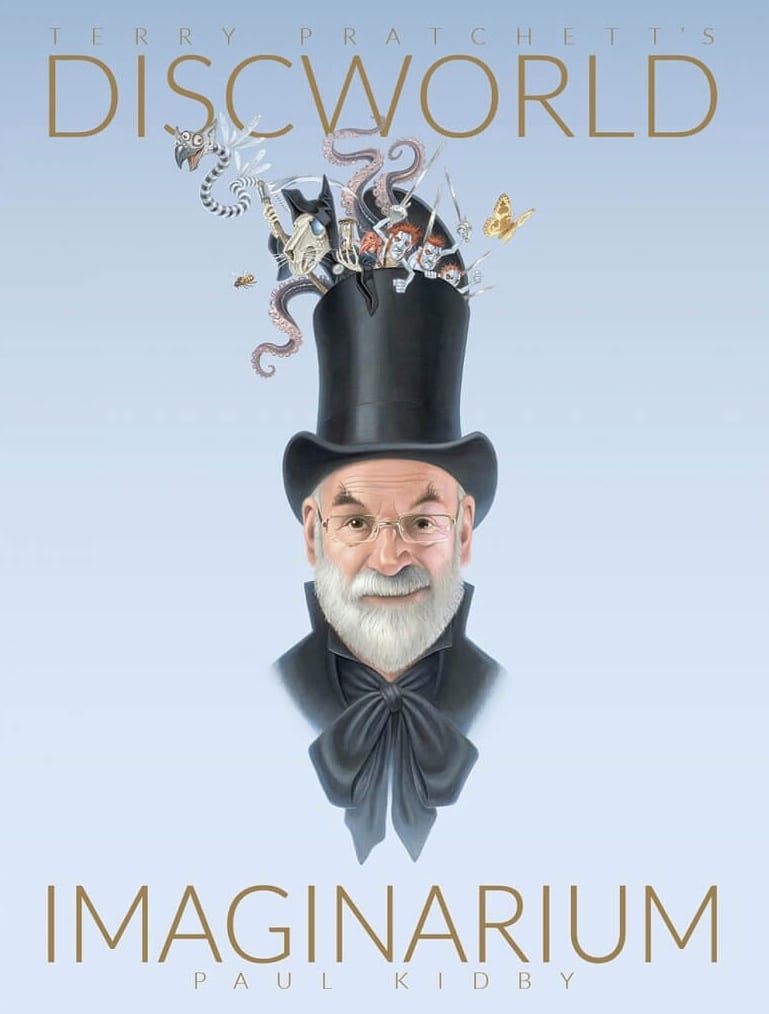
Some of the early influences on Terry Pratchett’s writing
That is, the books that made him love reading and how he incorporated those early works into his own style. This is from a very late interview with Tom Chivers published after his death in 2015:
“I wasn’t particularly interested in books,” he says. “And my mum, God bless her, she rolled up her sleeves and gave me a penny per page, and it worked beautifully. I think she only gave me about thruppence, because the third book was The Wind in the Willows.” He was so enthused after this, she no longer needed to pay him. Indeed, Pratchett got a job in Beaconsfield library. “You’re talking to a man who thinks, mostly, that his school days assisted him not at all, but the library did, in spades.” He looks at me sharply. “You, when you were young, read lots of books, didn’t you? A –” he pauses, and chooses his next word carefully – “a —-load, I believe?” I did, I reassure him. “A library boy. I recognise the kind. I was the same.” He had an indifferent time at school – he grumbles about the “death or glory” nature of the 11-plus (he passed easily), and about old teachers who had a grudge against him at the High Wycombe Technical High School (“sort of half a grammar school. A big woodwork place”). But the fire kindled by Kenneth Grahame, and Ratty, Mole and Badger, grew, and blazed.
Pratchett’s own sense of humour, a sort of gentle, English, observational thing, stems from this period. “Wodehouse, obviously, but also I tore my way through the Just William books. Richmal Crompton was a very good writer. I think it was from her that I learnt irony. It took me a while to work it out.” Do you think you could define irony, I ask him. “Sort of like iron.” I deserved that, I acknowledge. “When you get hit on the head with it, you know it.”
He also fell in love with RJ Yeatman and WC Sellar, authors of 1066 and All That (“in the Thirties, when the middle classes were getting richer, the two of them really got as much fun out of that as you could. The Thirties were an awful lot of fun. Or at least until the end. Bad ending, the decade, admittedly”) and fell out with his headmaster for “bringing in a copy of Mad magazine. How horrible! And a copy of Private Eye. Seditious.” But it was the now defunct satirical magazine Punch which really formed the comic voice in which he now speaks. “I read my way through all the bound Punches. It was the best way to read history; you got it without granny looking over your shoulder, and it was just astonishing.
“And just about any writer of distinction, anywhere in the English language, worked for Punch. Mark Twain. Jerome K Jerome. And they spoke with the same voice, which opened the door for me – the same kind of slightly satirical, people-are-rather-silly-but-they’re-not-that-bad voice, friendly about humanity, fond of its foibles.” Apart from the books, the other influences of his youth are clear in his own writing – especially the later Ankh-set works, in which he frequently extols the virtues of the poor-but-respectable people living in tiny, tidy terraced houses, and of the self-made men and women. “There used to be a sort of dignity in labour,” he says. “I don’t think there is now.”
He has spoken, often, of how his time on local newspapers made him. He started at 16, in high dudgeon at his headmaster: “On my last day at the school, I left all my stuff behind and phoned up the editor of a local newspaper. He actually used some cliché like, ‘I like the cut of your jib, young man’, or something.” It is the stuff of legend that he saw his first dead body the next day, “work experience really meaning something in those days”, as he put it in his author’s bio in his books.
“Truthfully, without over-egging it, as I often do,” he says, “the library and journalism, those things made me who I am. Journalism makes you think fast. You have to speak to people in all walks of life. Especially local journalism. London journalism can p— in someone’s face and they can’t do anything about it. Try that in local journalism, and someone’s down to complain. Everyone should have one local journalism job in their lives, especially if they’re a nosy parker.” He talks of local journalists in the same way he does his parents, with a sense of quiet heroism. “I interviewed an elderly journalist who’d worked in a small town for a very, very long time. I asked: is it boring? And he said: over there, that’s where a couple pushed their daughter into the attic because she’d had a black baby. And over there, that’s where a man was caught in flagrante delicto with a barnyard fowl. And he’d said to the magistrates, ‘Well, it was my fowl’. Even those small moments, they make you realise the world is not as you thought.”
February 23, 2020
QotD: Go eat bugs, plebs!
What is this creepy obsession with the elite telling us to eat bugs? Every few weeks, some mainstream media outlet has one of its gooey writers go off on how delicious and nutritious insects supposedly are, and it’s downright bizarre. The latest piece of pro-pillbug propaganda is from the formerly prestigious Economist, “Why Eating Bugs Is So Popular In Congo,” where the author assures us that “The creepy superfood is rich in protein and magnesium.” Thanks, but I think I’ll get my protein and magnesium in a manner that does not involve gobbling grubs.
What is with these people?
This bug bingeing is a running theme in the mainstream media. The New York Times, taking a break from passively aggressively correcting its garbage takes, asks “Why Aren’t We Eating More Insects?” The answer is, of course, “Because they are insects, you weirdos.”
CNN goes on about “Bugs: The Food That Can Feed, And Maybe Save, The Planet,” as if Brian “Tater” Stelter is going to give up stuffing Cheetos in his talk-hole in exchange for caterpillars.
And National Geographic manages to do the impossible and make us hate the United Nations even more by informing us that the “U.N. Urges Eating Insects,” and offering us “8 Popular Bugs to Try.” Popular with whom?
The Economist is talking about people munching millipedes in Congo, and you have to wonder why we would take Congo’s lead in anything. It’s the Congo – you should carefully examine what the Congo does, then do the opposite. That goes for other strange countries too. Frankly, foreign countries are generally terrible and there is not a lot that other countries have to teach us – I lived on two other continents and this bizarre notion liberal Americans have about other countries being better than us is grossly misplaced. Other countries are mostly terrible.
Exhibit A: They eat bugs.
Do you think the people of Congo are saying, “Beef? Pass. Hand me that plate of maggots!” You don’t eat grasshoppers because you have other options. No one’s first choice is fruit flies.
Kurt Schlicter, “Tell The Nags To Go Pound Sand”, Townhall.com, 2019-11-19.
February 12, 2020
QotD: Experienced political operators after an unexpected paradigm shift
I think this is causing some confusion, blindness and otherwise inexplicably stupid behavior in people who never seemed stupid before. This is what I call The Years the Masks Fell off.
Look, take a just-now thing: the DNC says that all precincts in Iowa WERE counted. The app recorded every vote, they say. They just need to tally them.
Turns out that’s probably not precisely true.
As a friend noticed, that’s not precisely a lie, that’s just “making sh*t up.”
We’re seeing that a lot from the other side of the aisle suddenly. Unbelievably stupid behavior like the sham wow impeachment.
They keep telling us “Who you gonna believe, me or your lying eyes?” and being shocked and appalled when we choose our lying eyes.
[…]
And then they’re shocked, nay astonished, when these tactics don’t work. While we who are standing outside this look at them and go “Who would think that would work? Some two year old?”
I mean half of the bizarre behavior of our government and its agencies falls under that heading too. “Who could think that would work/wouldn’t be found out/made any sense?”
But the thing you have to understand is that you’re not dealing with stupid people. Not by half. You’re dealing with people who were very competent and comfortable in — for lack of a better term — the previous paradigm of politics, or publishing or whatever.
The more comfortable they were; the easier it was for them, the harder it is to accept that it’s gone and it’s not coming back
For instance, the dems could trust the media would cover for them absolutely and completely, and that their pettiness, idiocy or outright corruption would never be revealed.
They got used to it, they got comfortable. They got to believing it was their natural right. It was just the way things were. They were the good people. Their hearts were pure. No one would ever look into their behavior outside the limelight.
If some psychological tests are correct, they grew to believe they were entitled to corruption and unethical behavior for all the “good” they did, such as Clinton thinking he was entitled to all the women he wanted for “fighting for women’s rights” (Which for men like him always mean abortion, but never mind.)
They can’t adapt. They can’t believe things have changed.
Sarah Hoyt, “How Things Have Always Been”, Libertarian Enterprise, 2020-02-09.
January 22, 2020
January 10, 2020
QotD: Deciding what is “newsworthy”
[…] the ripples of battle in their formal sense are guided by the presence of historians, and that means originally Westerners, and more recently in large part Europeans and Americans. And such distortions do not always play out in bias toward Westerners, especially in the present age. In April 2002 the Israeli Defence Forces entered the West Bank community of Jenin to hunt out suspected suicide-murderers, whose co-members had blown up hundreds of Israeli civilians over the prior year. Although fewer than sixty Palestinians were killed in Jenin — the great majority of them combatants — the world media seized upon the street fighting, dubbing it “Jeningrad” as if they were somehow the moral equivalent of one million Germans and Russians lost at Stalingrad. Yet just days after the Israeli withdrawal from Jenin, Pakistan squared off against India. The stakes were surely far higher: One-fifth of the world’s population was involved. Both sides were nuclear powers and issued threats to use their arsenals. In the prior year alone nearly four times more Indians and Pakistanis were killed than Palestinians and Israelis. By any calculation of numbers, the specter of the dead, the geopolitical consequences, or the long-term environmental health of the planet, the world should know all the major cities in Kashmir rather than a few street names in Jenin. And if the world sought to chronicle destruction and death in an Islamic city, then by any fair measure it should have turned its attention to Grozny, where an entire society of Muslim Chechnyans was quite literally obliterated by the Russian army.
The idiosyncracies of historical remembrance of battle do not hinge alone on the presence of a Socrates or Teddy Roosevelt in the ranks. Sometimes there are wild cards of culture and politics as well. In this case and at this time, the fact that Israelis fit the stereotype of affluent and proud Westerners abroad while the Palestinians were constructed as impoverished and oppressed colonial subjects brought to the equation the sympathies of influential Americans and Europeans in the media, universities, and government — the prominent and sometimes worrisome elites who determined to send their reporters, scholars, and diplomats to Jenin rather than to Islamabad or Grozny.
Victor Davis Hanson, Ripples of Battle, 2004.
December 31, 2019
QotD: Canadian journalism
… a Canadian Journalist’s main job is to smooth over any rough spots and shush away worries as the Liberal government plunders the public purse to pay for technocratic solutions to problems we didn’t know we had while adopting a laissez-faire attitude to the problems we do have. If the Opposition has a point, it falls to a Canadian Journalist to correct the record and say that, well, actually, no they don’t.
Josh Lieblein, “Hack or Flack: Aaron Wherry Edition”, Raving Canuck, 2017-11-29.
December 15, 2019
Every time the “wrong” side wins an election…
… we get all the media talking about how the winner needs to tack to the left:

Prime Minister Boris Johnson at his first Cabinet meeting in Downing Street, 25 July 2019.
Official photograph via Wikimedia Commons.
Every single time. Whenever the left is slapped by voters like a bony Antifa moll at a street riot, “expert” analysts rush to the scene of democracy, cordon it off with police tape and announce through a bullhorn that there’s nothing to see here. Move along. They then propose that the winner is morally obliged to sideline the constituency that just elected him and heed the boutique preoccupations of the vanquished instead. Successful right-of-centre candidates must govern for All of Us. Successful leftists, on the other hand, are encouraged to give leftism to the enemy good and hard for the next few-to-several years. Possibly the first man to pull out his ‘horn following Boris Johnson’s emphatic victory is Philip Williams.
The sullen acceptance that Brexit will happen but will unleash crises that – alas – must be solved by a buffoon: check. Schools and hospitals: check. The problem of “an economy excised from Europe”: check. Williams’ piece is the Tate of tropes. But no: Johnson won’t faulter by being true to the shy nationalists who elected him but he might antagonise them by pivoting left to usher Hugh Grant’s coterie into a broader Boris marquee. Given his track record, that is very likely. Let’s not get carried away: Johnson did his Conservative duty regarding Brexit, nothing more. The question is whether or not he has the panache to hold on to his base while trying to expand it. The media will be a huge asset. They are certain to make daily sport of Johnson’s “gaffes,” eccentricities and less than squared away private life. This will endear him to everyman even more.
On the other hand, when the “correct” side wins an election, we’re assured that “elections have consequences”, the’ve been “keeping score”, and that the losers must strap in tight and hold on for dear life because we’re going further left than we ever were promised during the campaign.
Update: Related.
Every US pundit today: pic.twitter.com/smSJRTBQW9
— Luke Savage (@LukewSavage) December 13, 2019
December 1, 2019
November 29, 2019
QotD: The progressive belief in the mind-controlling power of the press (and Facebook)
There’s a piece of graffiti that sums up the woke left’s view of ordinary people. It says: “When the British working class stop reading right-wing news, we will see progressive change.” There it is. In black and white. Scrawled on a wall somewhere but frequently shared on social media by supposed progressives. One sentence that captures why so many modern left-wingers, and in particular the Corbynistas, are so obsessed with the press – because they think it has hypnotised the fickle masses and polluted the plebs’ brains with horrible right-wing ideas. Make no mistake: when the left rages against the media, it is really raging against the masses.
Media-bashing has resurfaced with a vengeance over the past couple of weeks. It isn’t hard to see why. The polls don’t look good for Labour. Some are predicting a wipeout, especially in Labour’s traditional working-class strongholds. And as has been the case for a good 30 years now, when political events don’t go the left’s way – or rather, when the dim public lets the left down – the knives come out for the media.
Corbynista commentators are railing against the “billionaire media”. “Billionaires control the media, and it’s undermining democracy”, say the middle-class left-wingers of Novara Media. How? Because these billionaires are “tell[ing] you what to think”. You, the gullible, ill-educated throng, that is; not us, the well-educated, PhD-owning media leftists at Novara who can see through the lies peddled by evil billionaires.
Brendan O’Neill, “The woke elitism behind the left’s media-bashing”, Spiked, 2019-11-25.
November 9, 2019
The Milk Dud and “sin”
Chris Selley believes that introducing the notion of “sin” as an appropriate thing to discuss with a politician will be a very bad idea for Canadian politics:

Andrew Scheer, paid tool of Big Dairy, chugs some milk during a Press Gallery speech in 2017. I’ve called him the “Milk Dud” ever since.
Screencapture from a CTV video uploaded to YouTube.
At a Wednesday press conference in Ottawa, a Globe and Mail reporter asked Andrew Scheer if he believes homosexuality is a “sin.” He didn’t answer, as has become his trademark on this file; instead he pledged, for the umpteenth time, simply to stand up for gay rights in all their forms.
It has been maddening to watch: Despite literally dozens of opportunities, he could never bring himself to explicitly support equal marriage. Bringing “sin” into the question is a novelty, though, and it’s one of which we need to be exceedingly leery.
[…]
The question of “sin” takes us into new and dangerous territory, however. There is what politicians do, and then there is what they think, and then — buried way down under many layers of irrelevance — there is their personal relationship, if any, with higher powers and their associated scriptures; there is the question of what they think that higher power would make of other people’s behaviour; there is what they believe will happen to those people’s immortal souls.
These are not topics the secular media should be concerning themselves with, and nor should the average voter. No one would approve of someone they like being put through such an inquisition. Liberals would be aghast if their avowedly Catholic leader were asked if his faith played a role in his government not eliminating restrictions on gay and bisexual men donating blood, for example. Liberals often speak glowingly of the days when politicians set aside religion and pursued the greater good — politicians like Pierre Trudeau, a devout Catholic who famously said “what goes on in private between two consulting adults is their own private business,” but who somewhat less famously spoke of “separating the idea of sin and the idea of crime.”
Trudeau Sr. was absolutely right that the state should have no dominion over sin, in any sense of the word. That should go for politics, too. Politicians of known faiths and devoutness have advanced many of progressive Canadians’ most cherished causes — public health care, most notably — and politicians of unknown faiths and devoutness have taken us down dark alleys. And vice versa. There is nothing we can do with information about a politician’s personal metaphysical views except raise new barriers to entry into a politics that needs fewer.
November 6, 2019
QotD: “Fake news” is nothing new
… the basic ideas of “alternative facts” and “fake news” — our updated, revved-up forms of disinformation — were not foreign to Orwell. Working at the BBC as a news producer — a fancy term for war propagandist — he heard some of the Axis powers’ propaganda as well as that of his own side (even if he kept his own hands fairly clean). He justifiably feared that the very concept of objective truth was fading from the modern world. Winston Smith’s job at the Ministry of Truth is to rewrite or “rectify” history, so that it follows the current party line, whatever it may be at that moment.
Orwell himself saw all this happen when he read Catalan newspapers as well as British ones during the Spanish Civil War, several years before joining the BBC. Condemning press distortions, above all how several English newspapers reported the war, he wrote: “I saw great battles where there had been no fighting and complete silence where hundreds of men had been killed … I saw, in fact, history being written not in terms of what happened but what ought to have happened according to various ‘party lines.'” Given the gridlock in American politics, and the never-ending verbal warfare between news outlets on the Right such as Fox News and on the Left such as MSNBC, Orwell appears all too accurate in his “predictions.”
One of the features of the world of Oceania reflecting Orwell’s prescience is its official language, Newspeak, an argot resembling a kind of Morse code that satirizes advertising norms, political jargon, and government bureaucratese. The purpose of Newspeak is to limit thought, on the view that “you can’t think what you lack the words for.” Ultimately, this impoverished language seeks to narrow and control human thought. (Does Twitter represent a step in that direction?) Purged of all nuance and subtlety, denuded of variety, and reduced to a few hundred simple words, Newspeak ultimately promises to render all independent thought (or “thoughtcrime”) impossible. If it cannot be expressed in language, it cannot be thought. And anything can fill the vacuum, such as 2 + 2 = 5. That is the equation — a perfect example of “doublethink” — which O’Brien indoctrinates Winston to accept in Room 101 and which marks the final step of the latter’s brainwashing. As the Party defines it, “doublethink” consists in holding “two contradictory beliefs in one’s mind simultaneously, and accepting both of them.” In 2018, Trump’s lead lawyer, former New York mayor Rudy Giuliani, declared in a TV interview: “Truth isn’t truth.” A few months later, a talking head defended a critical news report on the grounds that, just because it is “not accurate doesn’t mean it’s not true.”
It testifies both to the brilliance of Orwell’s vision and to the bane of our times that Nineteen Eighty-Four retains so much relevance.
John Rodden and John Rossi, “George Orwell Warned Us, But Was Anyone Listening?”, The American Conservative, 2019-10-02.
November 1, 2019
QotD: The much-ballyhoo’d open office benefits are a lie
As urban rents crept up and the economy reached full employment over the last decade, American offices got more and more stuffed. On average, workers now get about 194 square feet of office space per person, down about 8 percent since 2009, according to a report by the real estate firm Cushman & Wakefield. WeWork has been accelerating the trend. At its newest offices, the company can more than double the density of most other offices, giving each worker less than 50 square feet of space.
As a socially anxious introvert with a lot of bespoke workplace rituals (I can’t write without aromatherapy), I used to think I was simply a weirdo for finding modern offices insufferable. I’ve been working from my cozy home office for more than a decade, and now, when I go to the Times‘ headquarters in New York — where, for financial reasons, desks were recently converted from cubicles into open office benches — I cannot for the life of me get anything done.
But after chatting with colleagues, I realized it’s not just me, and not just the Times: Modern offices aren’t designed for deep work. […]
The scourge of open offices is not a new subject for ranting. Open offices were sold to workers as a boon to collaboration — liberated from barriers, stuffed in like sardines, people would chat more and, supposedly, come up with lots of brilliant new ideas. Yet study after study has shown open offices to foster seclusion more than innovation; in order to combat noise, the loss of privacy and the sense of being watched, people in an open office put on headphones, talk less, and feel terrible.
Farhad Manjoo, “Open Offices Are a Capitalist Dead End”, New York Times, 2019-09-25.
October 27, 2019
Freedom of speech under threat (again)
In The Atlantic, Ken White strongly urges pro-free-speech advocates to avoid using some arguments that have been bandied around recently:
What speech should be protected by the First Amendment is open to debate. Americans can, and should, argue about what the law ought to be. That’s what free people do. But while we’re all entitled to our own opinions, we’re not entitled to our own facts, even in 2019. In fact, the First Amendment is broad, robust, aggressively and consistently protected by the Supreme Court, and not subject to the many exceptions and qualifications that commentators seek to graft upon it. The majority of contemptible, bigoted speech is protected.
If you’ve read op-eds about free speech in America, or listened to talking heads on the news, you’ve almost certainly encountered empty, misleading, or simply false tropes about the First Amendment. Those tired tropes are barriers to serious discussions about free speech. Any useful discussion of what the law should be must be informed by an accurate view of what the law is.
[…]“This speech isn’t protected, because you can’t shout ‘Fire!’ in a crowded theater.”
This line, though ubiquitous, is just another way to convey that “not all speech is protected by the First Amendment.” As an argument, it is just as useless.
But the phrase is not just empty. It’s also a historically ignorant way to convey the point. It dates back to a 1919 Supreme Court decision allowing the imprisonment of Charles Schenck for urging resistance to the draft in World War I. Justice Oliver Wendell Holmes Jr. wrote that the “most stringent protection of free speech would not protect a man in falsely shouting fire in a theatre and causing a panic.” This decision led to a series of cases broadly endorsing the government’s ability to suppress speech that questioned official policy. But for more than half a century Schenck has unequivocally and universally been acknowledged as bad law.
Holmes himself repented of the decision — though he continued to indulge his taste for pithy phrases with lines like “Three generations of imbeciles are enough” to justify forcible government sterilization of the handicapped.
So when you smugly drop “You can’t shout ‘Fire!’ in a crowded theater” in a First Amendment debate, you’re misquoting an empty rhetorical device uttered by a career totalitarian in a long-overturned case about jailing draft protesters. This is not persuasive or helpful.
October 19, 2019
QotD: Writing to length
Having spent a good deal of my life writing short pieces on serious subjects for newspapers and magazines, I’ve learned from experience to write organically short – that is, to write a five-hundred-word draft of a five-hundred-word piece instead of writing a thousand-word draft and cutting it in half. Not only does this reduce waste motion, but the finished product is almost always better. When you write a long piece and chop it down to size, it tends to read … well, choppily.
So why do inexperienced authors write long? I suspect it’s because they assume that they’ll get only one chance to impress the editor, which causes them to empty their bag of tricks every time they write a piece. (This reminds me of another of my critical commandments: Don’t tell everything you know.) Flashiness is a sin of youth. The older and more self-assured a writer is, the more likely he is to appreciate the virtues of simplicity and economy.
I don’t know whether it’s possible to teach this lesson to young writers. The older I get, the more I wonder whether anything can be taught to anyone. Still, I did my best to get it across to my students, and I like to think that at least some of them were paying attention.
Terry Teachout, “To the point”, About Last Night, 2007-06-01.