I think this is causing some confusion, blindness and otherwise inexplicably stupid behavior in people who never seemed stupid before. This is what I call The Years the Masks Fell off.
Look, take a just-now thing: the DNC says that all precincts in Iowa WERE counted. The app recorded every vote, they say. They just need to tally them.
Turns out that’s probably not precisely true.
As a friend noticed, that’s not precisely a lie, that’s just “making sh*t up.”
We’re seeing that a lot from the other side of the aisle suddenly. Unbelievably stupid behavior like the sham wow impeachment.
They keep telling us “Who you gonna believe, me or your lying eyes?” and being shocked and appalled when we choose our lying eyes.
[…]
And then they’re shocked, nay astonished, when these tactics don’t work. While we who are standing outside this look at them and go “Who would think that would work? Some two year old?”
I mean half of the bizarre behavior of our government and its agencies falls under that heading too. “Who could think that would work/wouldn’t be found out/made any sense?”
But the thing you have to understand is that you’re not dealing with stupid people. Not by half. You’re dealing with people who were very competent and comfortable in — for lack of a better term — the previous paradigm of politics, or publishing or whatever.
The more comfortable they were; the easier it was for them, the harder it is to accept that it’s gone and it’s not coming back
For instance, the dems could trust the media would cover for them absolutely and completely, and that their pettiness, idiocy or outright corruption would never be revealed.
They got used to it, they got comfortable. They got to believing it was their natural right. It was just the way things were. They were the good people. Their hearts were pure. No one would ever look into their behavior outside the limelight.
If some psychological tests are correct, they grew to believe they were entitled to corruption and unethical behavior for all the “good” they did, such as Clinton thinking he was entitled to all the women he wanted for “fighting for women’s rights” (Which for men like him always mean abortion, but never mind.)
They can’t adapt. They can’t believe things have changed.
Sarah Hoyt, “How Things Have Always Been”, Libertarian Enterprise, 2020-02-09.
February 12, 2020
QotD: Experienced political operators after an unexpected paradigm shift
January 22, 2020
Australian tourism, RIP
As we’ve all been inundated with the shocking images of almost the entire inhabited area of the Australian mainland burning, like this one, for example, claimed on social media to be a “satellite image”:

… it’s not surprising that anecdotal evidence of the decline in bookings from foreign tourists implies that there will be few visitors to the burned-out wasteland that used to be a thriving first-world nation. This, on top of the widely reported “death” of the Great Barrier Reef, means the few dozen dazed survivors will be reduced to cannibalism shortly. Or, as Arthur Chrenkoff suggests, we’ve been sold another bill of goods and things are not quite as desolate and post-apocalyptic as all that:
Just like many other people I know, I have been inundated by messages from family and friends overseas, inquiring about my safety, having been terrified by the media reports of what seemed like an environmental armageddon engulfing the entire country. I had to explain time after time that while the fires have been savage and extensive, they have largely burned through relatively sparsely populated areas (if it all, considering the vast extent of our national parks). No significant town has been threatened and destruction and loss of life, while tragic, have been pretty small in proportion to the area affected.
Yet, watching the hysterical and over-sensationalised coverage overseas has convinced many that the very existence of the nation is at stake. And the social media, if anything, has been even worse, with a number of completely misleading maps and photos exaggerating the extent of the affected areas by two-figure factors. As I pointed out, indeed the area the size of the state of Kentucky has been burned out, but unlike most other places on Earth, certainly in the developed world, Australia fits in nearly eighty Kentuckys, most of them pretty empty of human presence and activity.
Media sensationalises at the best of times in a never-ending quest for more eyeballs (“if it bleeds it leads”, or, in this case, “if it’s on fire, we’re on fire”) but the intersection of a large scale natural disaster with the “climate crisis” activism has generated a truly terrifying inferno of human passions where news becomes propaganda and the narrative trumps the objectivity. A significant proportion of the population — and the majority in the media — want to see the fires as Gaia’s wrath, with the disaster turning into green porn to terrify, titillate and agitate. Tourism has now become one of the casualties of this rhetorical excess, a collateral damage to the pursuit of a political agenda. This crisis is very much man-made and the economic pain unnecessarily inflicted on a whole industry because you wanted to make as terrible a point as possible will hang around your necks like a charred albatross, dear green activists on the streets and those masquerading as journalists.
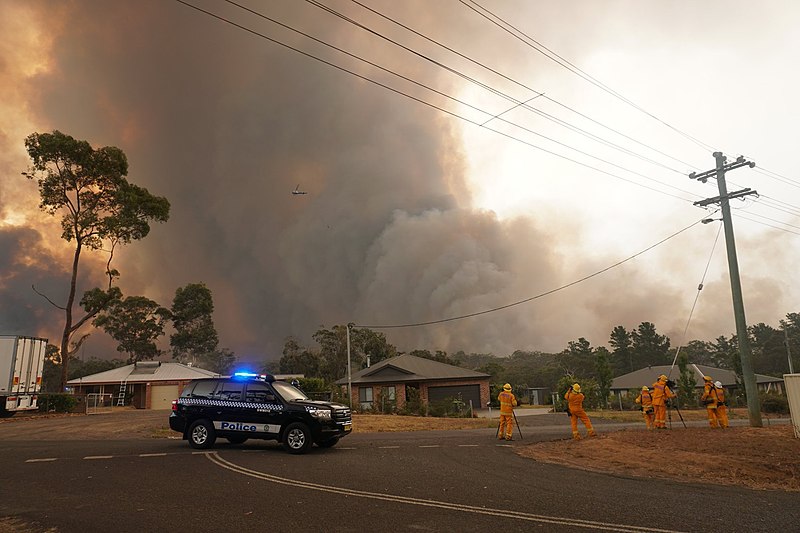
The Green Wattle Creek bushfire moves towards the Southern Highlands township of Yanderra as police evacuate residents from Yanderra Road, 21 December, 2019.
Photo by Helitak430 via Wikimedia Commons
January 10, 2020
QotD: Deciding what is “newsworthy”
The idiosyncracies of historical remembrance of battle do not hinge alone on the presence of a Socrates or Teddy Roosevelt in the ranks. Sometimes there are wild cards of culture and politics as well. In this case and at this time, the fact that Israelis fit the stereotype of affluent and proud Westerners abroad while the Palestinians were constructed as impoverished and oppressed colonial subjects brought to the equation the sympathies of influential Americans and Europeans in the media, universities, and government — the prominent and sometimes worrisome elites who determined to send their reporters, scholars, and diplomats to Jenin rather than to Islamabad or Grozny.
Victor Davis Hanson, Ripples of Battle, 2004.
December 31, 2019
QotD: Canadian journalism
… a Canadian Journalist’s main job is to smooth over any rough spots and shush away worries as the Liberal government plunders the public purse to pay for technocratic solutions to problems we didn’t know we had while adopting a laissez-faire attitude to the problems we do have. If the Opposition has a point, it falls to a Canadian Journalist to correct the record and say that, well, actually, no they don’t.
Josh Lieblein, “Hack or Flack: Aaron Wherry Edition”, Raving Canuck, 2017-11-29.
December 15, 2019
Every time the “wrong” side wins an election…
… we get all the media talking about how the winner needs to tack to the left:
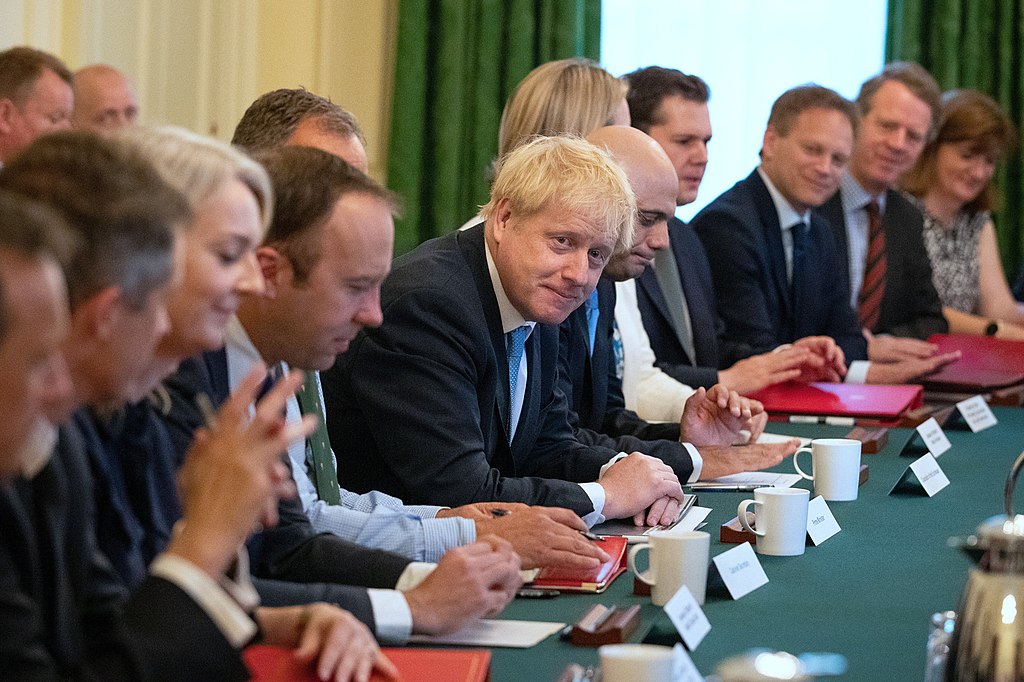
Prime Minister Boris Johnson at his first Cabinet meeting in Downing Street, 25 July 2019.
Official photograph via Wikimedia Commons.
Every single time. Whenever the left is slapped by voters like a bony Antifa moll at a street riot, “expert” analysts rush to the scene of democracy, cordon it off with police tape and announce through a bullhorn that there’s nothing to see here. Move along. They then propose that the winner is morally obliged to sideline the constituency that just elected him and heed the boutique preoccupations of the vanquished instead. Successful right-of-centre candidates must govern for All of Us. Successful leftists, on the other hand, are encouraged to give leftism to the enemy good and hard for the next few-to-several years. Possibly the first man to pull out his ‘horn following Boris Johnson’s emphatic victory is Philip Williams.
The sullen acceptance that Brexit will happen but will unleash crises that – alas – must be solved by a buffoon: check. Schools and hospitals: check. The problem of “an economy excised from Europe”: check. Williams’ piece is the Tate of tropes. But no: Johnson won’t faulter by being true to the shy nationalists who elected him but he might antagonise them by pivoting left to usher Hugh Grant’s coterie into a broader Boris marquee. Given his track record, that is very likely. Let’s not get carried away: Johnson did his Conservative duty regarding Brexit, nothing more. The question is whether or not he has the panache to hold on to his base while trying to expand it. The media will be a huge asset. They are certain to make daily sport of Johnson’s “gaffes,” eccentricities and less than squared away private life. This will endear him to everyman even more.
On the other hand, when the “correct” side wins an election, we’re assured that “elections have consequences”, the’ve been “keeping score”, and that the losers must strap in tight and hold on for dear life because we’re going further left than we ever were promised during the campaign.
Update: Related.
Every US pundit today: pic.twitter.com/smSJRTBQW9
— Luke Savage (@LukewSavage) December 13, 2019
December 1, 2019
Tulsi Gabbard versus the Democratic establishment
At Spiked, Tim Black calls the establishment’s anger and rage at the Democratic presidential candidate “Gabbard Derangement Syndrome”:
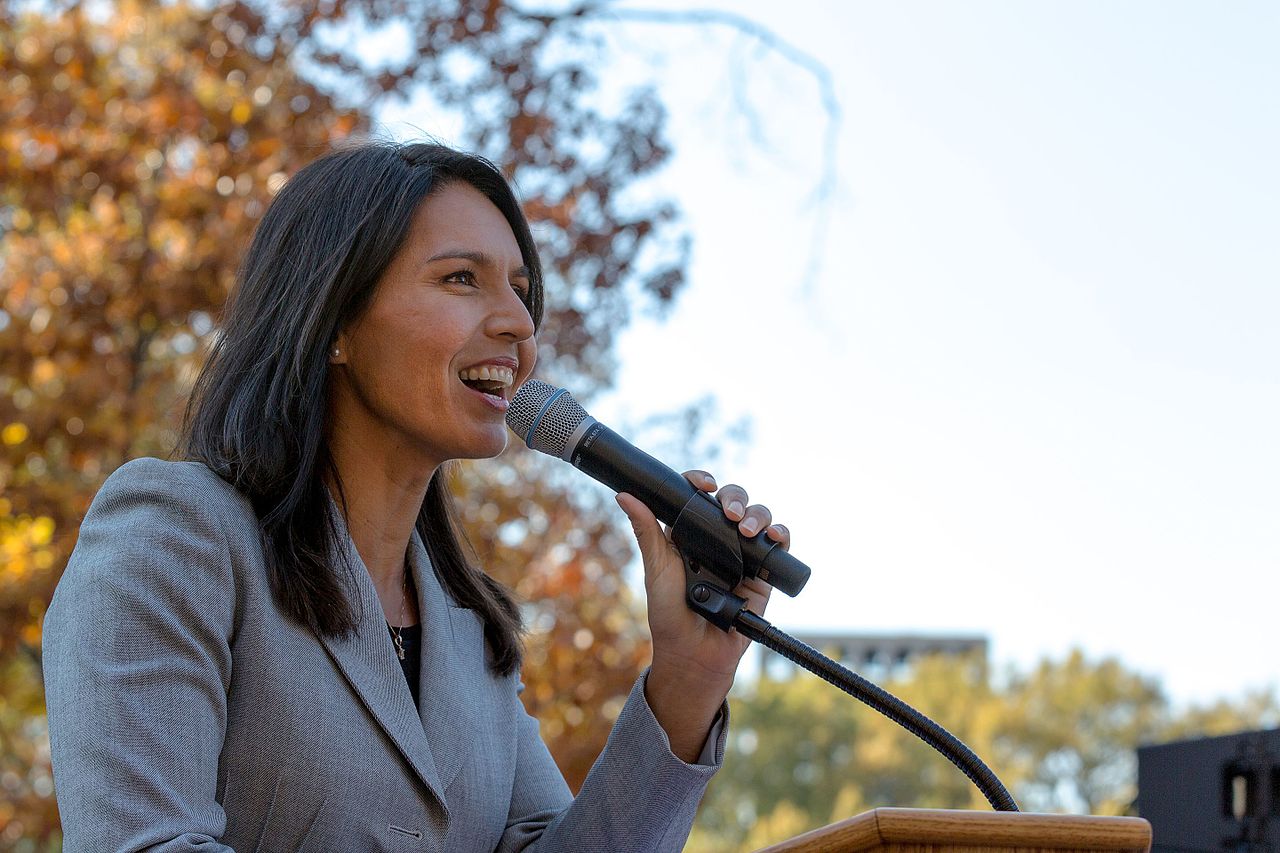
Tulsi Gabbard speaks at the “People’s Rally” in Washington DC on 17 November, 2016.
Photo by Lorie Shaull via Wikimedia Commons.
… the Democratic establishment and its media cheerleaders seem to have become fixated on her. She annoys them. She riles them. And it’s not just because of her ambivalence towards identity politics and the other aspects of her Sanders-style progressivism – indeed, she endorsed Sanders in 2016, much to the chagrin of the Democratic establishment at the time. No, it’s also because of her uncompromising opposition to the “counterproductive regime-change wars” pursued with such ignorant zeal by the likes of Democratic grandee Hillary Clinton. It’s because of her willingness to question the narratives that have justified Western intervention in Syria, including a secret fact-finding mission to Damascus, and a meeting with Bashar al-Assad in 2017. And it’s because she does all this not as a woolly pacifist, but as a war vet.
So where her small but growing band of supporters see a principled 38-year-old, armed with a progressive policy platform, and, above all, a strong commitment to anti-interventionism, her powerful opponents are determined to present her as something altogether more sinister. They talk of her being a poster girl for white supremacists and the alt-right, of her being a Republican stooge in Democratic clothing, and of her being some sort of Russian asset.
It’s genuinely crazy stuff. Last week, the New York Times even laid into her for wearing a white pantsuit for a TV debate, claiming it was somehow cult-like. But that is as nothing compared to the constant innuendo and sometimes outright claims that Gabbard is being backed by Russia and Putin, the seeming power behind all world disorder.
Gabbard’s chances of winning the Democratic nomination are slim, but her recent online spat with Hillary Clinton probably won her a lot of fans outside the establishment:
Then, of course, there’s Hillary Clinton herself, a woman who, since losing to Donald Trump in the 2016 presidential election, is no longer able to go near a bed without spotting reds under it. Gabbard, unsurprisingly, does not escape Clinton’s conspiracist gaze. “I’m not making any predictions but I think [the Russians have] got their eye on somebody who’s currently in the Democratic primary, and they’re grooming her to be the third-party candidate. She’s the favorite of the Russians”, Clinton continued. “They have a bunch of sites and bots and other ways of supporting her so far.”
That’s right. Clinton thinks Gabbard is a Russian plant. She thinks Gabbard is “being groomed” by the Kremlin. She thinks she is being manoeuvred, by Putin and Co, out of the Democratic Party and into a third-party position, so as to split the Democratic vote in 2020. And she thinks that will hand victory once again to Russia’s Manchurian Candidate, Donald Trump, just as she thinks that Jill Stein, the Green Party’s 2016 presidential nominee, was also a Russian asset, used to split the vote three years ago and deprive Hillary of the election victory she still believes should be hers. The entitlement underwriting her deranged conspiracy theory is breathtaking.
November 29, 2019
QotD: The progressive belief in the mind-controlling power of the press (and Facebook)
Media-bashing has resurfaced with a vengeance over the past couple of weeks. It isn’t hard to see why. The polls don’t look good for Labour. Some are predicting a wipeout, especially in Labour’s traditional working-class strongholds. And as has been the case for a good 30 years now, when political events don’t go the left’s way – or rather, when the dim public lets the left down – the knives come out for the media.
Corbynista commentators are railing against the “billionaire media”. “Billionaires control the media, and it’s undermining democracy”, say the middle-class left-wingers of Novara Media. How? Because these billionaires are “tell[ing] you what to think”. You, the gullible, ill-educated throng, that is; not us, the well-educated, PhD-owning media leftists at Novara who can see through the lies peddled by evil billionaires.
Brendan O’Neill, “The woke elitism behind the left’s media-bashing”, Spiked, 2019-11-25.
November 9, 2019
The Milk Dud and “sin”
Chris Selley believes that introducing the notion of “sin” as an appropriate thing to discuss with a politician will be a very bad idea for Canadian politics:
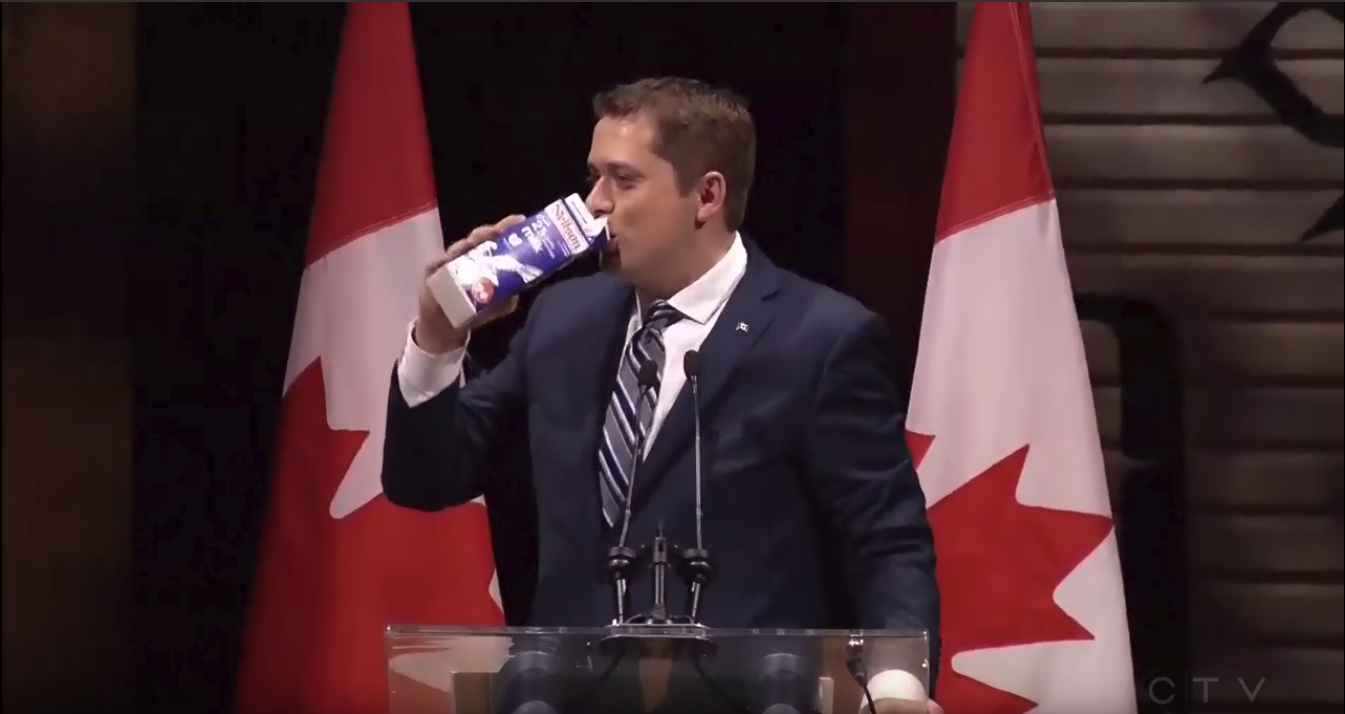
Andrew Scheer, paid tool of Big Dairy, chugs some milk during a Press Gallery speech in 2017. I’ve called him the “Milk Dud” ever since.
Screencapture from a CTV video uploaded to YouTube.
At a Wednesday press conference in Ottawa, a Globe and Mail reporter asked Andrew Scheer if he believes homosexuality is a “sin.” He didn’t answer, as has become his trademark on this file; instead he pledged, for the umpteenth time, simply to stand up for gay rights in all their forms.
It has been maddening to watch: Despite literally dozens of opportunities, he could never bring himself to explicitly support equal marriage. Bringing “sin” into the question is a novelty, though, and it’s one of which we need to be exceedingly leery.
[…]
The question of “sin” takes us into new and dangerous territory, however. There is what politicians do, and then there is what they think, and then — buried way down under many layers of irrelevance — there is their personal relationship, if any, with higher powers and their associated scriptures; there is the question of what they think that higher power would make of other people’s behaviour; there is what they believe will happen to those people’s immortal souls.
These are not topics the secular media should be concerning themselves with, and nor should the average voter. No one would approve of someone they like being put through such an inquisition. Liberals would be aghast if their avowedly Catholic leader were asked if his faith played a role in his government not eliminating restrictions on gay and bisexual men donating blood, for example. Liberals often speak glowingly of the days when politicians set aside religion and pursued the greater good — politicians like Pierre Trudeau, a devout Catholic who famously said “what goes on in private between two consulting adults is their own private business,” but who somewhat less famously spoke of “separating the idea of sin and the idea of crime.”
Trudeau Sr. was absolutely right that the state should have no dominion over sin, in any sense of the word. That should go for politics, too. Politicians of known faiths and devoutness have advanced many of progressive Canadians’ most cherished causes — public health care, most notably — and politicians of unknown faiths and devoutness have taken us down dark alleys. And vice versa. There is nothing we can do with information about a politician’s personal metaphysical views except raise new barriers to entry into a politics that needs fewer.
November 6, 2019
QotD: “Fake news” is nothing new
Orwell himself saw all this happen when he read Catalan newspapers as well as British ones during the Spanish Civil War, several years before joining the BBC. Condemning press distortions, above all how several English newspapers reported the war, he wrote: “I saw great battles where there had been no fighting and complete silence where hundreds of men had been killed … I saw, in fact, history being written not in terms of what happened but what ought to have happened according to various ‘party lines.'” Given the gridlock in American politics, and the never-ending verbal warfare between news outlets on the Right such as Fox News and on the Left such as MSNBC, Orwell appears all too accurate in his “predictions.”
One of the features of the world of Oceania reflecting Orwell’s prescience is its official language, Newspeak, an argot resembling a kind of Morse code that satirizes advertising norms, political jargon, and government bureaucratese. The purpose of Newspeak is to limit thought, on the view that “you can’t think what you lack the words for.” Ultimately, this impoverished language seeks to narrow and control human thought. (Does Twitter represent a step in that direction?) Purged of all nuance and subtlety, denuded of variety, and reduced to a few hundred simple words, Newspeak ultimately promises to render all independent thought (or “thoughtcrime”) impossible. If it cannot be expressed in language, it cannot be thought. And anything can fill the vacuum, such as 2 + 2 = 5. That is the equation — a perfect example of “doublethink” — which O’Brien indoctrinates Winston to accept in Room 101 and which marks the final step of the latter’s brainwashing. As the Party defines it, “doublethink” consists in holding “two contradictory beliefs in one’s mind simultaneously, and accepting both of them.” In 2018, Trump’s lead lawyer, former New York mayor Rudy Giuliani, declared in a TV interview: “Truth isn’t truth.” A few months later, a talking head defended a critical news report on the grounds that, just because it is “not accurate doesn’t mean it’s not true.”
It testifies both to the brilliance of Orwell’s vision and to the bane of our times that Nineteen Eighty-Four retains so much relevance.
John Rodden and John Rossi, “George Orwell Warned Us, But Was Anyone Listening?”, The American Conservative, 2019-10-02.
November 1, 2019
QotD: The much-ballyhoo’d open office benefits are a lie
As a socially anxious introvert with a lot of bespoke workplace rituals (I can’t write without aromatherapy), I used to think I was simply a weirdo for finding modern offices insufferable. I’ve been working from my cozy home office for more than a decade, and now, when I go to the Times‘ headquarters in New York — where, for financial reasons, desks were recently converted from cubicles into open office benches — I cannot for the life of me get anything done.
But after chatting with colleagues, I realized it’s not just me, and not just the Times: Modern offices aren’t designed for deep work. […]
The scourge of open offices is not a new subject for ranting. Open offices were sold to workers as a boon to collaboration — liberated from barriers, stuffed in like sardines, people would chat more and, supposedly, come up with lots of brilliant new ideas. Yet study after study has shown open offices to foster seclusion more than innovation; in order to combat noise, the loss of privacy and the sense of being watched, people in an open office put on headphones, talk less, and feel terrible.
Farhad Manjoo, “Open Offices Are a Capitalist Dead End”, New York Times, 2019-09-25.
October 27, 2019
Freedom of speech under threat (again)
In The Atlantic, Ken White strongly urges pro-free-speech advocates to avoid using some arguments that have been bandied around recently:

What speech should be protected by the First Amendment is open to debate. Americans can, and should, argue about what the law ought to be. That’s what free people do. But while we’re all entitled to our own opinions, we’re not entitled to our own facts, even in 2019. In fact, the First Amendment is broad, robust, aggressively and consistently protected by the Supreme Court, and not subject to the many exceptions and qualifications that commentators seek to graft upon it. The majority of contemptible, bigoted speech is protected.
If you’ve read op-eds about free speech in America, or listened to talking heads on the news, you’ve almost certainly encountered empty, misleading, or simply false tropes about the First Amendment. Those tired tropes are barriers to serious discussions about free speech. Any useful discussion of what the law should be must be informed by an accurate view of what the law is.
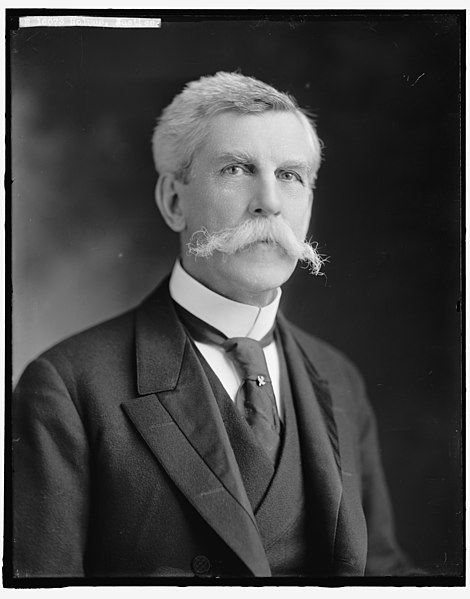
Supreme Court Justice Oliver Wendell Holmes, Jr.
Photo by Harris & Ewing via Wikimedia Commons.
[…]“This speech isn’t protected, because you can’t shout ‘Fire!’ in a crowded theater.”
This line, though ubiquitous, is just another way to convey that “not all speech is protected by the First Amendment.” As an argument, it is just as useless.
But the phrase is not just empty. It’s also a historically ignorant way to convey the point. It dates back to a 1919 Supreme Court decision allowing the imprisonment of Charles Schenck for urging resistance to the draft in World War I. Justice Oliver Wendell Holmes Jr. wrote that the “most stringent protection of free speech would not protect a man in falsely shouting fire in a theatre and causing a panic.” This decision led to a series of cases broadly endorsing the government’s ability to suppress speech that questioned official policy. But for more than half a century Schenck has unequivocally and universally been acknowledged as bad law.
Holmes himself repented of the decision — though he continued to indulge his taste for pithy phrases with lines like “Three generations of imbeciles are enough” to justify forcible government sterilization of the handicapped.
So when you smugly drop “You can’t shout ‘Fire!’ in a crowded theater” in a First Amendment debate, you’re misquoting an empty rhetorical device uttered by a career totalitarian in a long-overturned case about jailing draft protesters. This is not persuasive or helpful.
October 19, 2019
QotD: Writing to length
So why do inexperienced authors write long? I suspect it’s because they assume that they’ll get only one chance to impress the editor, which causes them to empty their bag of tricks every time they write a piece. (This reminds me of another of my critical commandments: Don’t tell everything you know.) Flashiness is a sin of youth. The older and more self-assured a writer is, the more likely he is to appreciate the virtues of simplicity and economy.
I don’t know whether it’s possible to teach this lesson to young writers. The older I get, the more I wonder whether anything can be taught to anyone. Still, I did my best to get it across to my students, and I like to think that at least some of them were paying attention.
Terry Teachout, “To the point”, About Last Night, 2007-06-01.
October 13, 2019
Modern journalism encompasses “activism,” “advocacy,” “partisanship,” “satire,” “hoaxing,” “unbearable self-promotional bluster,” “pranks,” “torquing of facts,” “invective,” “demagoguery” and “stunts”
I’ve always been pretty cynical about the media, so it was no surprise to me when the federal government decided to start explicitly subsidising the rest of the media (they already fund the CBC), and part of the fun was deciding who qualifies for those juicy subsidies. I mean, “journalism” today is a pretty broad category that covers a lot more than the traditional TV, radio, magazine, and newspaper formats. I’m sure everyone is shocked — Shocked! — to discover that the government is playing favourites among the many media outlets over not just who gets subsidies, but even who gets accredited to cover political events.

Jack Layton, leader of the federal New Democratic Party of Canada, on January 2, 2006 in a media scrum outside a campaign rally at the Kent Street legion in Ottawa, Canada.
Photo by Thorfinn Stainforth via Wikimedia Commons.
As we’re in the late stages of a federal election campaign, the question of who is considered to be a “journalist” merits closer attention, as Colby Cosh explains:
Two media outlets of a right-wing character, Rebel Media and the True North Centre for Public Policy, have been denied accreditation for post-debate press appearances at the last minute. The Parliamentary Press Gallery, acting on behalf of the federal Leaders’ Debates Commission, has somehow decided that their delegates are advocates rather than journalists. Oh-ho.
Here, an agent of the state seems to have pushed the “So who’s a journalist?” question really to the forefront, and introduced a distinction between journalism and activism that may not be tenable. The history and practice of journalism, even at the highest levels of public and professional esteem, includes entities and activities that fall into all of the following categories: “activism,” “advocacy,” “partisanship,” “satire,” “hoaxing,” “unbearable self-promotional bluster,” “pranks,” “torquing of facts,” “invective,” “demagoguery” and “stunts.”
If we must march toward state licensing of journalism in double-quick time, and this seems to be happening whether I like it or not, arguments about the definition of journalism will have to recognize these realities. But, of course, the word “journalism” as used from day to day is mostly just a status marker (really, a label concocted for academic use). “Journalism” will resist any historically aware attempt to bound it with a list of scientific-type taxonomic criteria.
This, of course, does not rule out an ignorant or fanciful attempt to set criteria. But most of the concepts in the list I made above, a list of things some people would like to exclude from journalism, are themselves ideas founded on fuzzy judgments of value, or of mere taste.
The media outlaws who found the debate gates shut in their faces got together and sought an injunction requiring the commission to allow them to appear in the magic chamber of questions after the debate. No one had really explained the decision to exclude them; no one could point to a solid pre-existing definition of journalism that they did not meet (surprise!), or to a relevant formal policy of the commission. It really gets the attention of a judge when the state behaves in an arbitrary way, and this proved to be the case, foreseeably, at the oral hearing for the injunction. Which was granted.
But an injunction is a temporary emergency remedy that does not require a full hearing of the facts — only the possibility of immediate incorrigible harm. The question haunting the Dominion — the question of who is a journalist — remains athwart our path.
October 3, 2019
QotD: Media coverage of Liberal and Conservative scandals, respectively
A re-elected Liberal government [will] expand the Learn To Camp program.
Under the Learn To Camp program, every Canadian will be provided with a tub of boot polish, a novelty turban, a jewel to stick in your belly button, and genie slippers with curly toes, and trained how to swish across a Vancouver ballroom while asking other guests to tally your banana.
Oh, wait, sorry, that was last week’s Justin story. In America a ten-minute phone call to some fellow in Kiev is all the pretext you need for two years of multi-million-dollar investigation. But in Canada the news that the Prime Minister has spent half his adult life as the world’s wokest mammy singer is just a blip in the day’s news cycle, soon to be supplanted by a genuinely eye-catching scandal such as whether or not the Tory leader had a valid license from the Insurance Councils of Saskatchewan or the Canadian Association of Insurance Brokers back in 1997, or 1978, or whenever. You can understand why the Canadian media would rather stampede after the Andrew Scheer scandal: what journalist with a nose for a great red-meat story wouldn’t prefer chasing down the officially approved accreditation from the Department of Paperwork’s archives than, say, the fruiterer who supplies the Prime Minstrel with his trouser bananas. Was Justin accredited by the Minstrelsy Council of Quebec or the Canadian Association of Burnt Cork Fetishists? Would that make the story more interesting for the CBC et al?
The Toronto Star, like all good government-subsidized Canadian media, has been doing its best to neutralize the mammy songs. The most potentially damaging of the three (so far) blackface incidents is the middle one – a grainy video from the 1990s showing Boy Justin capering about like an ape. So the Star set its crack investigators on the story and tracked down a much better version of the video, and conclusively proved that Tories were misleading the public when they claimed that the Prime Ministrel in blackface, blackarms, blacklegs and blackwhatever-other-appendage was wearing a T-shirt with a banana on it. After all, the banana would imply Justin is a racist who likens black people to monkeys. Whereas prancing around in full-body blackface waving your arms and sticking your tongue out implies no such monkey-like slur.
So the Star‘s new HD minstrel video is of sufficient quality to show that the banana on the T-shirt is, in fact, the beak of a toucan. Unfortunately, the new video is also of sufficient quality to show that the banana is instead stuffed down Justin’s trousers. That risks suggesting the Prime Minstrel is exploiting old white neuroses about the black man’s sexual prowess. But don’t worry – The Toronto Star is only a day or two away from a full-page exclusive asserting that the Negro, impressive though his endowments be, pales in comparison to the average Quebec high-school drama teacher: When Rastus makes the mistake of appearing on stage next to Justin, he’s the one who needs the banana. Not for nothing is Quebec’s provincial dialect called joual, derived from cheval, as in horse.
Mark Steyn, “Blackface Narcissus”, Steyn Online, 2019-09-30.
September 13, 2019
QotD: Orwell’s campaign against the jackboot
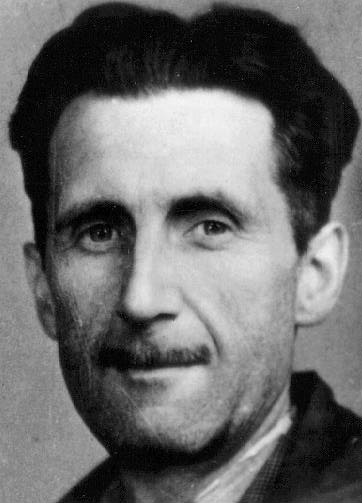
Orwell’s press card portrait, 1943
In spite of my campaign against the jackboot — in which I am not operating single-handed — I notice that jackboots are as common as ever in the columns of the newspapers. Even in the leading articles in the Evening Standard, I have come upon several of them lately. But I am still without any clear information as to what a jackboot is. It is a kind of boot that you put on when you want to behave tyrannically: that is as much as anyone seems to know.
Others besides myself have noted that war, when it gets into the leading articles, is apt to be waged with remarkably old-fashioned weapons. Planes and tanks do make occasional appearances, but as soon as an heroic attitude has to be struck, the only armaments mentioned are the sword (“We shall not sheathe the sword until”, etc., etc.), the spear, the shield, the buckler, the trident, the chariot and the clarion. All of these are hopelessly out of date (the chariot, for instance, has not been in effective use since about A.D. 50), and even the purpose of some of them has been forgotten. What is a buckler, for instance? One school of thought holds that it is a small round shield, but another school believes it to be a kind of belt. A clarion, I believe, is a trumpet, but most people imagine that a “clarion call” merely means a loud noise. One of the early Mass Observation reports, dealing with the coronation of George VI, pointed out that what are called “national occasions” always seem to cause a lapse into archaic language. The “ship of state”, for instance, when it makes one of its official appearances, has a prow and a helm instead of having a bow and a wheel, like modern ships. So far as it is applied to war, the motive for using this kind of language is probably a desire for euphemism. “We will not sheathe the sword” sounds a lot more gentlemanly than “We will keep on dropping block-busters”, though in effect it means the same.
One argument for Basic English is that by existing side by side with Standard English it can act as a sort of corrective to the oratory of statesmen and publicists. High-sounding phrases, when translated into Basic, are often deflated in a surprising way. For example, I presented to a Basic expert the sentence, “He little knew the fate that lay in store for him” — to be told that in Basic this would become “He was far from certain what was going to happen”. It sounds decidedly less impressive, but it means the same. In Basic, I am told, you cannot make a meaningless statement without its being apparent that it is meaningless — which is quite enough to explain why so many schoolmasters, editors, politicians and literary critics object to it.
George Orwell, “As I Please” Tribune, 1944-08-04.