Quotulatiousness

May 30, 2019

Moving the Overton window, illustrated

Filed under: Media, Politics, USA — Tags: , , — Nicholas @ 05:00

The Wikipedia entry for Overton window reads:

The Overton window is a term for the range of ideas tolerated in public discourse, also known as the window of discourse. The term is named after Joseph P. Overton, who stated that an idea’s political viability depends mainly on whether it falls within this range, rather than on politicians’ individual preferences. According to Overton, the window contains the range of policies that a politician can recommend without appearing too extreme to gain or keep public office in the current climate of public opinion.

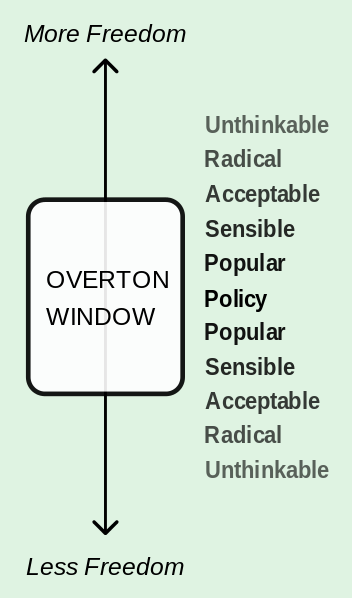
Overton described a spectrum from “more free” to “less free” with regard to government intervention, oriented vertically on an axis, to avoid comparison with the left-right political spectrum. As the spectrum moves or expands, an idea at a given location may become more or less politically acceptable. Political commentator Joshua Treviño postulated that the degrees of acceptance of public ideas are roughly:

  • Unthinkable
  • Radical
  • Acceptable
  • Sensible
  • Popular
  • Policy

The Overton window is an approach to identifying which ideas define the domain of acceptability within a democracy’s possible governmental policies. Proponents of policies outside the window seek to convince or persuade the public in order to move and/or expand the window. Proponents of current policies, or similar ones, within the window seek to convince people that policies outside it should be deemed unacceptable.

There’s also a helpful illustration of the concept:

Diagram of the “Overton Window”, based on a concept promoted by Joseph P. Overton (1960–2003), former director of the Mackinac Center for Public Policy. The term “Overton Window” was coined by colleagues of Joe Overton after his death. In the political theory of the Overton Window, new ideas fall into a range of acceptability to the public, at the edges of which an elected official risks being voted out of office.
Illustration by Hydrargyrum via Wikimedia Commons

To move the Overton window is to shift how the public considers certain ideas, making once unthinkable things merely radical, then acceptable, and so on. Shifting the window is usually something that takes time and media preparation, as a series of tweets from Zach Goldberg handily illustrates:


The full thread can be viewed at this Thread Reader link.

April 24, 2019

The west is being haunted by the spectre of the “far right”

Filed under: Media, Politics — Tags: , , , , , , — Nicholas @ 05:00

Back in my younger days, I attended a seminar — I think it was Marshall Fritz presenting — that discussed the need to “define, or be defined” as a political tool. If you allow your critics or opponents to set the terms of the debate, you’ve already lost. Arthur Chrenkoff knows this well:

It was not Orwell’s original idea that those who control the language control the society and determine its nature. In any case, the left hardly ever needed inspiration from critics on how to achieve their agenda. They are instinctively good at manipulating speech and cultural expression. Watch out, therefore, for the current pattern of marginalising and delegitimising mainstream ideas they are hostile to by associating them with political fringes.

[…] we increasingly live in a world where, if you believe the media, everywhere you turn there’s the “far right”. Mainstream centre-right ideas and concerns are now being redefined as being somehow associated with and tainted by extremism. If you are worried about the violence against and the persecution of Christians you might be far right. If you value the cultural and philosophical heritage of the Western civilisation you might be far right. If you don’t believe in an open borders immigration policy you might be far right. If you prefer local democracy to transnational institutions you might be far right. If you are defending your country from an armed invasion by another country you might be far right too. If these are all to be the indicators of far right extremism, then what exactly is the “normal” right right now?

This effort to use language as a cudgel has several sinister implications. It delegitimises perfectly normal political ideas through guilt by association. It also creates the impression that the (genuine) far right is much bigger, more influential and more threatening and dangerous than it actually is. This in turn is used to downplay and minimise the dangers of Islamist and far-left extremism and terrorism. But perhaps the scariest aspect of it all is that the left, by manufacturing the far right monster, are actually genuinely contributing to the growth of far-right extremism. The relentless flood of identity politics, grievance and victimhood, and shaming and guilting entire sections of population based on their skin colour and culture is genuinely radicalising some misfits into fascism, like the Christchurch terrorist, for example. For every action there is eventually an equal and opposite reaction. The left might think it’s courageously defanging the fascist dragon but instead it’s just sowing its teeth.

March 30, 2019

The EU’s copyright regulation is a stalking horse for online censorship and control

To the amazement of many non-EU observers, the European Parliament passed blatantly authoritarian and corporatist changes to the rules on copyrights that will have potentially vast impact on the internet across the world, not just inside the EU. At City A.M., Kate Andrews explains why this is such bad news for all internet users:

The two most controversial points in the law – Article 11 and Article 13 – are almost certain to stifle digital activity, and interfere with the free way that people currently use online platforms.

Article 11, known as the “link tax”, would make online platforms compensate press publishers for links and article content posted on their sites.

As my colleague Victoria Hewson highlighted in her latest briefing, this approach has been “widely criticised as a distortive measure that seeks to prop up a declining industry”.

As many local and national newspapers decline in readership and revenue, governments have become increasingly protectionist in their attempts to “rebalance” the sector, by cracking down on online platforms.

The link tax has little merit, even if rebalancing is the goal. News outlets which require payment for readership already have logins and paywalls to protect their content from free access.

[…]

Article 13 will also be distortive to the market, as it makes online platforms increasingly liable for copyright infringement.

As Hewson’s briefing notes, major online platforms already have routine screening processes for content that violates copyright law or their own rules. But the new regulations “remove the protection for platforms previously available if they removed violating content promptly on receiving notice of it, and contravene fundamental rights such as free expression and freedom from monitoring”.

The Directive claims that safeguards – including pastiche, parody, and quotations – will be protected, and that meme content has been excluded.

But the algorithms which these platforms will have to implement to adhere to Article 13 are going to struggle to see the difference between infringement and fair use when comparing uploads to content that is registered as copyrighted.

March 26, 2019

Matt Taibbi on “a death-blow for the reputation of the American news media”

Filed under: Law, Media, Politics, USA — Tags: , , , — Nicholas @ 03:00

A revised and updated chapter from his Hate, Inc.:

Note to readers: in light of news that Special Prosecutor Robert Mueller’s investigation is complete, I’m releasing this chapter of Hate Inc. early, with a few new details added up top.

[…]

Over the weekend, the Times tried to soften the emotional blow for the millions of Americans trained in these years to place hopes for the overturn of the Trump presidency in Mueller. As with most press coverage, there was little pretense that the Mueller probe was supposed to be a neutral fact-finding mission, as apposed to religious allegory, with Mueller cast as the hero sent to slay the monster.

The Special Prosecutor literally became a religious figure during the last few years, with votive candles sold in his image and Saturday Night Live cast members singing “All I Want for Christmas is You” to him featuring the rhymey line: “Mueller please come through, because the only option is a coup.”

The Times story today tried to preserve Santa Mueller’s reputation, noting Trump’s Attorney General William Barr’s reaction was an “endorsement” of the fineness of Mueller’s work:

    In an apparent endorsement of an investigation that Mr. Trump has relentlessly attacked as a “witch hunt,” Mr. Barr said Justice Department officials never had to intervene to keep Mr. Mueller from taking an inappropriate or unwarranted step.

Mueller, in other words, never stepped out of the bounds of his job description. But could the same be said for the news media?

For those anxious to keep the dream alive, the Times published its usual graphic of Trump-Russia “contacts,” inviting readers to keep making connections. But in a separate piece by Peter Baker, the paper noted the Mueller news had dire consequences for the press:

    It will be a reckoning for President Trump, to be sure, but also for Robert S. Mueller III, the special counsel, for Congress, for Democrats, for Republicans, for the news media and, yes, for the system as a whole…

This is a damning page one admission by the Times. Despite the connect-the-dots graphic in its other story, and despite the astonishing, emotion-laden editorial the paper also ran suggesting “We don’t need to read the Mueller report” because we know Trump is guilty, Baker at least began the work of preparing Times readers for a hard question: “Have journalists connected too many dots that do not really add up?”

The paper was signaling it understood there would now be questions about whether or not news outlets like itself made galactic errors by betting heavily on a new, politicized approach, trying to be true to “history’s judgment” on top of the hard-enough job of just being true. Worse, in a brutal irony everyone should have seen coming, the press has now handed Trump the mother of campaign issues heading into 2020.

Nothing Trump is accused of from now on by the press will be believed by huge chunks of the population, a group that (perhaps thanks to this story) is now larger than his original base. As Baker notes, a full 50.3% of respondents in a poll conducted this month said they agree with Trump the Mueller probe is a “witch hunt.”

March 24, 2019

Trust in scientific findings decreasing among the general public

Filed under: Education, Environment, Health, Media, Science — Tags: , , — Nicholas @ 03:00

In Scientific American, Louise Lief discusses the problem of rising public distrust of science:

We live in a moment when preventable infectious diseases like measles are spreading because parents distrust vaccines, and scientists at government agencies are being told not to use terms like “evidence-based.” The president dismisses the findings of a National Climate Assessment by more than 300 scientists and 13 federal agencies that warns of massive economic and environmental damage totaling hundreds of billions of dollars, crop failures, disrupted supply chains and multiple threats to human health, saying, “I don’t believe it.”

But when I argued in favor of the proposition (Resolved: “Science writers are responsible for building public trust in science”) during a debate at the National Association of Science Writers’ 2018 annual conference last fall, the majority of science writers and science journalists present voted that building public trust in science was not the responsibility of science writers.

[…]

Kathleen Hall Jamieson, director of the Annenberg Public Policy Center at the University of Pennsylvania’s Annenberg School for Communication also tackled the science trust question at the NASW conference, and researchers at Cardiff University have traced credibility and accuracy problems to press releases from scientists’ own academic institutions.

If a problem is discovered or a study is retracted, said Jamieson, the scientist or scientific journal needs to explain to journalists and the public how the error was discovered, what the problem is, and what steps are being taken to ensure it doesn’t happen again.

Scientists often make it hard for journalists to cover these three interrelated issues, she says. Scholarly journal publication protocols may cause scientists to write one article on the problem they’re investigating, and a second or third article on processes and solutions, resulting in coverage that emphasizes problems and shortchanges corrective action.

For their part, researchers at Cardiff University found that press releases from scientists’ own academic institutions about their work were a significant source of exaggerated claims and spin, even though most scientists can approve their wording.

Their study of press releases from 20 leading British universities on health-related science news found that when the press releases exaggerated, it was likely the news stories would too.

An analysis of 41 news articles on randomized controlled trials based on 70 press releases showed only four articles that contained exaggerated claims not included in the press release or journal abstract. Interestingly, they also found the hype and spin intended to tempt the media did not result in more news coverage.

H/T to Blazing Cat Fur for the link.

February 28, 2019

ProTip – Never, ever, ever read the comments

Filed under: Liberty, Media, Politics, Technology — Tags: , , — Nicholas @ 05:00

Scott Alexander explains why he had to ask the moderators to shut down the r/slatestarcodex subreddit’s Culture War thread:

This post is called “RIP Culture War Thread”, so you may have already guessed things went south. What happened? The short version is: a bunch of people harassed and threatened me for my role in hosting it, I had a nervous breakdown, and I asked the moderators to get rid of it.

I’ll get to the long version eventually, but first I want to stress that this isn’t just my story. It’s the story of everyone who’s tried to host a space for political discussion on the Internet. Take the New York Times, in particular their article Why No Comments? It’s A Matter Of Resources. Translated from corporate-speak, it basically says that unmoderated comment sections had too many “trolls”, so they decided to switch to moderated comment sections only, but they don’t have enough resources to moderate any controversial articles, so commenting on controversial articles is banned.

And it’s not just the New York Times. In the past five years, CNN, NPR, The Atlantic, Vice, Bloomberg, Motherboard, and almost every other major news source has closed their comments – usually accompanied by weird corporate-speak about how “because we really value conversations, we are closing our comment section forever effective immediately”. People have written articles like The Comments Apocalypse, A Brief History Of The End Of The Comments, and Is The Era Of Reader Comments On News Websites Fading? This raises a lot of questions.

Like: I was able to find half a dozen great people to do a great job moderating the Culture War Thread 100% for free without even trying. How come some of the richest and most important news sources in the world can’t find or afford a moderator?

Or: can’t they just hide the comments behind a content warning saying “These comments are unmoderated, read at your own risk, click to expand”?

This confused me until I had my own experience with the Culture War thread.

The fact is, it’s very easy to moderate comment sections. It’s very easy to remove spam, bots, racial slurs, low-effort trolls, and abuse. I do it single-handedly on this blog’s 2000+ weekly comments. r/slatestarcodex’s volunteer team of six moderators did it every day on the CW Thread, and you can scroll through week after week of multiple-thousand-post culture war thread and see how thorough a job they did.

But once you remove all those things, you’re left with people honestly and civilly arguing for their opinions. And that’s the scariest thing of all.

Some people think society should tolerate pedophilia, are obsessed with this, and can rattle off a laundry list of studies that they say justify their opinion. Some people think police officers are enforcers of oppression and this makes them valid targets for violence. Some people think immigrants are destroying the cultural cohesion necessary for a free and prosperous country. Some people think transwomen are a tool of the patriarchy trying to appropriate female spaces. Some people think Charles Murray and The Bell Curve were right about everything. Some people think Islam represents an existential threat to the West. Some people think women are biologically less likely to be good at or interested in technology. Some people think men are biologically more violent and dangerous to children. Some people just really worry a lot about the Freemasons.

Each of these views has adherents who are, no offense, smarter than you are. Each of these views has, at times, won over entire cultures so completely that disagreeing with them then was as unthinkable as agreeing with them is today. I disagree with most of them but don’t want to be too harsh on any of them. Reasoning correctly about these things is excruciatingly hard, trusting consensus opinion would have led you horrifyingly wrong throughout most of the past, and other options, if they exist, are obscure and full of pitfalls. I tend to go with philosophers from Voltaire to Mill to Popper who say the only solution is to let everybody have their say and then try to figure it out in the marketplace of ideas.

But none of those luminaries had to deal with online comment sections.

The thing about an online comment section is that the guy who really likes pedophilia is going to start posting on every thread about sexual minorities “I’m glad those sexual minorities have their rights! Now it’s time to start arguing for pedophile rights!” followed by a ten thousand word manifesto. This person won’t use any racial slurs, won’t be a bot, and can probably reach the same standards of politeness and reasonable-soundingness as anyone else. Any fair moderation policy won’t provide the moderator with any excuse to delete him. But it will be very embarrassing for to New York Times to have anybody who visits their website see pro-pedophilia manifestos a bunch of the time.

“So they should deal with it! That’s the bargain they made when deciding to host the national conversation!”

No, you don’t understand. It’s not just the predictable and natural reputational consequences of having some embarrassing material in a branded space. It’s enemy action.

Every Twitter influencer who wants to profit off of outrage culture is going to be posting 24-7 about how the New York Times endorses pedophilia. Breitbart or some other group that doesn’t like the Times for some reason will publish article after article on New York Times‘ secret pro-pedophile agenda. Allowing any aspect of your brand to come anywhere near something unpopular and taboo is like a giant Christmas present for people who hate you, people who hate everybody and will take whatever targets of opportunity present themselves, and a thousand self-appointed moral crusaders and protectors of the public virtue. It doesn’t matter if taboo material makes up 1% of your comment section; it will inevitably make up 100% of what people hear about your comment section and then of what people think is in your comment section. Finally, it will make up 100% of what people associate with you and your brand. The Chinese Robber Fallacy is a harsh master; all you need is a tiny number of cringeworthy comments, and your political enemies, power-hungry opportunists, and 4channers just in it for the lulz can convince everyone that your entire brand is about being pro-pedophile, catering to the pedophilia demographic, and providing a platform for pedophile supporters. And if you ban the pedophiles, they’ll do the same thing for the next-most-offensive opinion in your comments, and then the next-most-offensive, until you’ve censored everything except “Our benevolent leadership really is doing a great job today, aren’t they?” and the comment section becomes a mockery of its original goal.

I’ll allow one exception to the rule I provided in the headline: the comments at David Thompson’s blog are always worth reading, but I have to assume that David or countless unpaid minions must work very hard indeed to maintain the quality of comments that get posted. I’ve never actively encouraged commenting here at Quotulatiousness, and I don’t spend a lot of time on the various social media sites as I have a low tolerance for the kinds of “conversation” you tend to find there.

January 2, 2019

In non-breaking, non-news … politicians lie

Filed under: Britain, Government, Media, Politics — Tags: , , , , — Nicholas @ 05:00

Hector Dummond explains why what might seem like a shocking revelation from a former Thatcher MP isn’t even getting a raised eyebrow from the British media:

In a highly revealing article former MP Matthew Parris admits that the Conservative Party would often lie so that it could do what it wanted. And when it didn’t lie it fudged and avoided issues in order to prevent the ‘people’ having any say in the country’s governance:

    our challenge was to find ways of ducking the issue. Once I became an MP, I did so by voting for the principle and against the practice. This subversion of democracy (in Theresa May’s phrase) caused me embarrassment, but not a second’s guilt. Sod democracy: hanging was wrong …

    Among ourselves we talked cheerfully about subterfuge. The Britain of 1979 and 1983 most emphatically did not vote for a massive confrontation with the coal miners. We made sure the electorate was never asked.

These candid admissions have been completely ignored by the media. One reason they’ve been ignored is, of course, that most people have come to work this out for themselves, so Parris isn’t telling us anything we don’t already know. But surely hearing it from the horse’s mouth has great value? Why hasn’t the media splashed on this? Why haven’t Parris’s old enemies in the Labour party made hay with it?

The main reason is that most of the media, and virtually all the Labour party, is on his side over this. Even newspapers like the Guardian. You might think the Guardian would be the natural enemy of a former Tory MP, especially one who worked with Thatcher, and certainly on some issues they will regard Parris as an enemy, but the fact is that the Guardian wants government to be free of restraint by the people, because its vision of the state involves a leftist government getting into power, imposing its own ideology onto society and removing the power for the people to have a democratic say from most areas of life. So it can hardly criticise Parris for having done what it longs to do. It doesn’t want to bring about anything that might lessen the freedom government currently has to ignore the voter.

QotD: The early United States

Filed under: Books, History, Quotations, USA — Tags: , , , , — Nicholas @ 01:00

I’ve been reading Gordon Wood’s Empire of Liberty (2009), the best one-volume history of the very early American republic in the years between the enactment of the Constitution and the end of the War of 1812. In many ways, I notice, this story has the structure of an enormous joke. The American revolution was wrought by wealthy landowners, many of whom hoped to reproduce the hierarchical, agrarian lifestyle of the English countryside in the New World. These people became the early Federalists: they largely wanted to mimic the world of old Europe, only with themselves on top as rentiers, eschewing labour and trade alike.

But they had sown the wind. The commercial and intellectual forces they set in motion created a new, chaotic, competitive, egalitarian kind of society. And one way this manifested itself was as a media crisis. The Revolution overthrew all established authority, or tended to, and created the conditions for an unfamiliar kind of unregulated, rampant press — an ecosystem full of lies, partisanship, personal abuse, and scurrility.

Even those who made sneaky use of this new system, like Thomas Jefferson, left testimonies to their overall exhaustion and confusion as literate, curious people. You get the impression that being a reader in that time and place, with rumours of wars and tales of corruption zinging around, was hard work.

Colby Cosh, “In 2017, when the shooting stops, the media warfare begins”, National Post, 2017-02-02.

December 24, 2018

Sun Yat-sen – A Kidnapping in London – Extra History – #2

Filed under: China, History — Tags: , , , , — Nicholas @ 12:00

Extra Credits
Published on 22 Dec 2018

Sun Yat-sen moves to a new city for safety, but it will not last long — a year after the Revive China society is destroyed and scattered, he is unwittingly kidnapped in London. He must rely on the ingenuity of his outside ally, Dr. James Cantlie…

Join us on Patreon! http://bit.ly/EHPatreon

December 4, 2018

QotD: B.H. Liddell Hart and J.F.C. Fuller

Filed under: Britain, History, Military, Quotations, WW2 — Tags: , , — Nicholas @ 01:00

The military commentators of the popular press can mostly be classified as pro-Russian or anti-Russian pro-blimp or anti-blimp. Such errors as believing the Maginot Line impregnable, or predicting that Russia would conquer Germany in three months, have failed to shake their reputation, because they were always saying what their own particular audience wanted to hear. The two military critics most favoured by the intelligentsia are Captain Liddell Hart and Major-General Fuller, the first of whom teaches that the defence is stronger that the attack, and the second that the attack is stronger that the defence. This contradiction has not prevented both of them from being accepted as authorities by the same public. The secret reason for their vogue in left-wing circles is that both of them are at odds with the War Office.

George Orwell, footnote to “Notes on Nationalism”, Polemic, 1945-05.

November 24, 2018

It’d be an inhumanly restrained government that wouldn’t take advantage of this arrangement

Filed under: Business, Cancon, Government, Media — Tags: , , , , , , — Nicholas @ 03:00

And I don’t know of anyone who thinks that highly of our current federal government. In the Financial Post, Terence Corcoran outlines the government’s bribe offer to Canadian media organizations:

Historically, a free press has meant freedom from government intervention — from the king, the president, the prime minister, politicians, bureaucrats. The proposals outlined Wednesday by Finance Minister Bill Morneau to rescue journalists pretends to be consistent with that fundamental principle. The measures, he said, will be “arm’s-length and independent of the government.” They are not, and they represent a step backward for Canadian journalism.

Under the Morneau proposals, the arm of government is directly involved in deciding which journalists or news organizations will receive special treatment, tax breaks, charitable status. Over five years the amount of federal money moving directly into news and journalism will exceed $600 million, which obviously results in government dependence, not independence.

Morneau’s own words betray the falsity of his defence of the media-bailout plan. Decisions will be in the hands of an “independent panel of journalists (that) will be established to define and promote core journalism standards, define professional journalism, and determine eligibility.” What the heck does all that mean? Other journalists are going to set standards for what? Content? Ethics? Ideology? Adherence to the Canada Food Guide?

[…]

It is also unlikely that these measures to shape local journalism and bolster some media companies over others will be the end of government efforts to meddle in the industry. One can reasonably expect that there will be corresponding attempts to undermine the corporate entities and others that are said to be destabilizing Canadian journalism and the news and information business.

There is constant pressure on government from many sources to take action against the social media giants that are accused of stealing profits from legacy newspapers while spreading fake news. In a new commentary this week, former U.S. labour secretary Robert Reich called on Washington to break up Facebook and Google on the grounds that they dominate advertising. Anti-trust action is needed, said Reich, on the grounds that they “stifle innovation.” Canadian regulatory activists share the view that the U.S. tech and media companies need to be controlled and taxed — with the money redistributed to Canadian entities.

November 22, 2018

This is why tax cuts are always criticized for benefitting the rich

Filed under: Economics, Government, Media — Tags: , , , — Nicholas @ 05:00

Rebecca Zeines and Jon Miltimore explain why newspaper headlines and TV anchors always seem to decry any tax cut as being disproportionally beneficial to the wealthy:

But crucial facts are often missing in these articles. As a recent Bloomberg piece explained, two key points tend to be overlooked in articles written by media outlets and progressive tax proponents:

  1. The top 1 percent paid a greater share of individual income taxes (37.3 percent) than the bottom 90 percent combined (30.5 percent).
  2. The top 50 percent of all taxpayers paid 97 percent of total individual income taxes.

These numbers date back to 2016 but remain applicable in 2018.

These data show that the bottom 50 percent of US taxpayers paid just 3 percent of total income taxes in 2016, while the top 50 percent accounted for 97 percent.

Here is a wonderful visual representation of this dynamic, courtesy of Mark Perry of the American Enterprise Institute:

There is a clear correlation between economic freedom and prosperity, and tax climate is a key component of economic freedom.

Economist Dan Mitchell explains it best: Heavy taxation destroys entrepreneurship. The more money is taxed out of the private sector, the less is available for investment, development, and worker compensation (recall that after Trump’s tax bill was enacted, many businesses raised workers’ wages and offered bonuses).

Efforts to improve America’s tax climate are consistently and predictably derided as tax cuts for “the rich.” But, as the above diagram shows, it’s quite impossible to offer people a comparatively huge tax cut when they’re paying a comparatively tiny percentage of income taxes.

October 28, 2018

Newspapers today “are huddled amongst notional rivals in a tremulous infantry square, facing outward”

Filed under: Cancon, History, Media — Tags: — Nicholas @ 05:00

Colby Cosh wasn’t one of the “founders” of the National Post, but his byline showed up early in the newspaper’s history. Here is his contribution to the “how the hell have we survived the last 20 years?” issue of the paper:

On the 20th birthday of the National Post, we have assembled alumni and associates to celebrate the mistake that was its creation. In saying so, I speak of it strictly as a commercial proposition. The Post was created in a spirit of newspaper warfare — overbuilt for an imagined future that evaporated almost immediately. All newspapers, for most of the last 20 years, have seen their attention oriented to exterior non-newspaper predators. We are huddled amongst notional rivals in a tremulous infantry square, facing outward.

If you sent a time-travelling accountant back from 2018 to advise the founders of the Post on their new project, his advice could not possibly be “Yep, you guys have the right idea, do it exactly that way.” The advice might even be the one word “Don’t.” The financial story he would have to tell from the future is one of nearly continuous pain and frustration.

But, like many megaprojects gone awry, the Post has been glorious and useful, too. No intelligent reader can stand to imagine the last 20 years without the Post’s distinctive colour in the Canadian media palette. Rival outlets have recruited too many Posties to deny the value of its existence. Persons who will never set eyes on these words or touch a copy of the Post have benefited from its existence in a hundred ways. It’s a story of survival rather than triumph — of a creature born at the wrong moment, defying fate and having a worthwhile life despite everything.

When I was asked to write a column about the paper’s anniversary, I spent the next few days feeling subtly annoyed, without being sure why. Eventually I put my finger on it. I sensed that this anniversary would involve a certain quantity of National Post Day Oners telling fun stories of exotic news heroism from the early, lavishly funded months (weeks?) of the paper.

Some of us can only feel nausea at the sound of these anecdotes, having missed the grand, ultra-adventurous part of the war. I myself am a failed Day Oner. If I had managed to impress Terence Corcoran in our pre-launch job interview, I might not have retreated to Edmonton, where the cost of living is low and the competition for freelance work is less savage. It was probably fortunate that I failed the audition (as opposed to failing at the job), but failing it did leave me outside the band of Day One foxhole brethren.

Andrew Coyne (for once, not riding his electoral reform hobby horse):

With a lineup that included every prominent conservative columnist — a couple less reliably so — plus a desk full of nervy British editors who had been in a newspaper war all their lives, the Post flouted every convention of how a quality newspaper should act or look, broke every rule, and generally took hell to the Globe and Mail. I imagine pop-eyed Globe editors, sputtering incredulously: “What? They did what? They, they can’t do that — can they?”

I think we could have made a fair claim to being the best newspaper — certainly the best written — in the world. Every single day the paper was bursting with lively, mischievous pieces in a style that crossed the Daily Telegraph with the New York Observer (when that paper was still in print and still interesting). It had, someone said, the brains of a broadsheet and the loins of a tabloid, and though it took a staunchly, even rabidly conservative editorial line, it remained a guilty pleasure for many on the left. It was simply too much fun not to read.

It couldn’t last, of course, as we were informed more or less from the first day. And yet, improbably, it has. Our industry has declined into not-so-genteel poverty since then — in retrospect, the idea of launching a nationally distributed, ink-on-newsprint newspaper just as the internet was about to consume us all has an almost suicidal gallantry about it — but the Post carries on, if not surrounded by quite the same richesse then with the same culture: that bullish irreverence, that smile of amusement, that jaunty informality, relaxed and subversive at once.

Chris Selley:

The Post in a nutshell, for me, came on a Friday night in 2013 as I arrived at a friend’s cottage two-and-a-half hours north of Toronto. Looking at my phone, I found a wee joke I had made at Calgary’s expense had been widely misinterpreted as a sincere characterization of Edmontonians as “twitchy eyed, machete-wielding savages.” Half of Edmonton was calling for my head on a pike. The city’s mayor (!) was on the warpath against Postmedia. My phone rang. It was Steve Meurice, then the Post’s editor-in-chief. If I had worked for any other paper I’d have voided my bowels.

He was as baffled and amused as I was, and wished me a good weekend. He ordered me a “Twitchy-eyed, machete-wielding savages” t-shirt, which awaited me on my chair in Don Mills when I returned.

October 25, 2018

Every publication in Canada must have had lots of volunteers for this story

Filed under: Cancon, Humour, Media — Tags: , , — Nicholas @ 03:00

In the National Post, Marie-Danielle Smith gets high for science!

I just remembered I am supposed to be writing.

I am stoned on legal weed, which finally came into my hands this morning after six days of waiting. Thank you, government!

It is a different thing to get high alone — to get high alone for work reasons, right after question period. I’m sitting at my dining room table, drifting off every now and then to examine the patterns on my stuccoed walls or to focus, intensely, on the album I am listening to, the one that Kurt Vile and Courtney Barnett collaborated on. It would be a different thing to get high with the two of them.

The first thing you notice, after opening the cardboard box, which is just a little too large for your knapsack (backpack? knapsack? backpack?) … uh, you notice how much packaging there is. Tape. Crumpled-up papers. A box with government warnings and the logo of the licensed weed producer. A plastic bottle inside with a child lock cap that reminds you of Advil.

“She’s so easy,” sing Courtney and Kurt, repeatedly. Such a good album. This song has been on forever. Time stretches out. I’ve smoked a sativa-heavy hybrid strain called “Super Sonic,” which is supposed to make you feel creative rather than sleepy. On the Ontario Cannabis Store website, it’s described as having “a strong, earthy, sweet aroma, reminiscent of Quantum Kush.” I don’t know what Quantum Kush is but maybe our prime minister can explain it? (Remember that time? Anyway.)

Of course, not everyone is impressed:

October 8, 2018

Debunking state education rankings

Filed under: Bureaucracy, Education, Media, USA — Tags: , , , , — Nicholas @ 03:00

In the latest issue of Reason, Stan Liebowitz and Matthew L. Kelly explain why you should ignore those “authoritative” rankings published by U.S. News and World Report and others:

You probably think you know which states have the best and worst education systems in the country. If you regularly dip into rankings such as those published by U.S. News and World Report, you likely believe schools in the Northeast and Upper Midwest are thriving while schools in the Deep South lag. It’s an understandable conclusion to draw from those ubiquitous “Best Schools!” lists. It’s also wrong.

The general consensus on education, retold every few news cycles, is that fiscally conservative states are populated by cheapskates. In those necks of the woods, people are too ignorant to vote in favor of helping their illiterate and innumerate children. Intelligent people understand that high taxes and generous pensions for public school teachers are the recipe for an efficient and smoothly functioning education system. If skinflint voters would just lighten up, the story goes, they too could become erudite and sophisticated.

Paul Krugman rehashes this narrative regularly in his New York Times column, frequently bemoaning the country’s purportedly miserly education budgets. Increasingly, he perceives libertarian barbarians at the gates of state governments, brandishing axes for dreaded spending cuts. In April, he wrote that “we’re left with a nation in which teachers, the people we count on to prepare our children for the future, are starting to feel like members of the working poor.… One way to think about what’s currently happening in a number of states is that the anti-Obama backlash, combined with the growing tribalism of American politics, delivered a number of state governments into the hands of extreme right-wing ideologues. These ideologues really believed that they could usher in a low-tax, small-government, libertarian utopia.”

In Krugman’s view, which reflects the education establishment’s view as well, those attempting to keep the size of government in check are a danger to your child. To support this claim, education wonks and activists point to state rankings in U.S. News, Education Week, or WalletHub — outlets that grade states according to a few key measures, such as graduation rates, education spending, and test scores. When education is discussed in the news, these rankings are often cited to illustrate the havoc that restrained budget growth and right-to-work laws can wreak.

Indeed, such rankings do seem to show that the highest-quality state educational systems tend to be in big-spending states in the Northeast or Upper Midwest. These places apparently honor and respect teachers, while Southern states inexplicably abhor them. But the cheapskates in cheap states get their just deserts: Sophisticated northern jurisdictions grow ever smarter, while stingy conservative backwaters sink into ever-lower depths of ignorance. The solution is obvious: Pay up or your kids will suffer.

There’s just one problem with this narrative: Traditional rankings are riddled with methodological flaws.

« Newer PostsOlder Posts »

Powered by WordPress