Back in the day, reporters (they didn’t insist on being called “journalists” back then) were told that the way to frame their stories was to answer a series of questions which boiled down to:
- who
- what
- when
- where
- why
- how
The emphasis was on actual facts and objectivity. But now, with “advocacy journalism” having completely taken over the J-schools and pretty much every newsroom, the emphasis is on changing the world rather than reporting a story fairly and accurately. Especially now, when no less a paper than the New York Times announced before the election that Trump is so bad that objectivity should be thrown out. So the who, what, when, where, why, and how questions were changed into:
- who (can we quote to damage Trump)
- what (can we publish to damage Trump)
- when (should we run it maximize damage to Trump)
- where (do we get more material to damage Trump)
- why (Donald Trump’s presidency is an existential threat to America and to the world)
- how (can we write our stories so as to cause maximum damage to Trump)
Ladies and gentlemen, this is the state of journalism, 2018.
OregonMuse, “The Morning Rant”, Ace of Spades H.Q., 2018-09-12.
October 3, 2018
QotD: The state of American journalism
September 26, 2018
The New York Times on the minimum wage question
Jon Miltimore shares the key points of a New York Times editorial on the minimum wage:
The minimum wage is the Jason Vorhees of economics. It just won’t die.
No matter how many jobs the minimum wage destroys, no matter how many times you debunk it, it always comes back to wreak more havoc.
We’ve covered the issues at length at FEE, and quite effectively, if I do say so myself. But I have to admit that one of the greatest takedowns of the minimum wage you’ll ever find comes from an unlikely place: The New York Times.
There are many reasons people and politicians find the minimum wage attractive, of course. But the Times, in an editorial entitled “The Right Minimum Wage: 0.00,” skillfully rebuts each of these reasons in turn.
Noting that the federal minimum wage has been frozen for some six years, the Times admits that it’s no wonder that organized labor is pressuring politicians to increase the federal minimum wage to raise the standard of living for poorer working Americans.
“No wonder. But still a mistake,” the Times explains. “There’s a virtual consensus among economists that the minimum wage is an idea whose time has passed.”
But why has the idea “passed”? Why would raising the minimum wage not help the working poor?
“Raising the minimum wage by a substantial amount would price working poor people out of the job market,” the editors explain.
But wouldn’t the minimum wage increase the purchasing power of low-income Americans? Wouldn’t a meaningful increase allow a single breadwinner to support a family of three and actually be above the official U.S. poverty line?
Ideally, yes. But there are unseen problems, as the editors point out:
There are catches…[A higher minimum wage] would increase employers’ incentives to evade the law, expanding the underground economy. More important, it would increase unemployment: Raise the legal minimum price of labor above the productivity of the least skilled workers and fewer will be hired.
But if that’s true, why would progressives support such a law? What’s their rationale for supporting a minimum wage if it does more harm than good? Is it sheer political opportunism?
Not necessarily. The Times explains:
A higher minimum would undoubtedly raise the living standard of the majority of low-wage workers who could keep their jobs. That gain, it is argued, would justify the sacrifice of the minority who became unemployable.
There’s just one problem with this logic, the editors say:
The argument isn’t convincing. Those at greatest risk from a higher minimum would be young, poor workers, who already face formidable barriers to getting and keeping jobs. The idea of using a minimum wage to overcome poverty is old, honorable – and fundamentally flawed. It’s time to put this hoary debate behind us, and find a better way to improve the lives of people who work very hard for very little.
September 8, 2018
British tabloids try to stir up trouble with Argentina … again
Sir Humphrey tries to talk the tabloid press in off the ledge over some terrible reporting from the Falkland Islands:

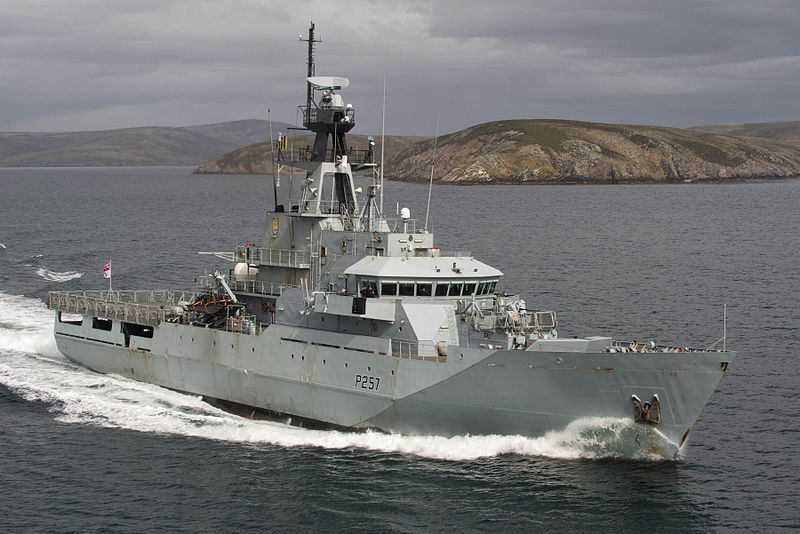
River Class Patrol Vessel HMS Clyde is pictured exercising at sea. HMS Clyde patrols the territorial seas and monitors the airspace around the Falkland Islands whilst conducting routine visits and reassurance to the many small settlements found throughout the islands.
Photo via Wikimedia Commons.
This week it was revealed that an Argentine survey vessel had been reported near the Falkland Islands, and that the local patrol ship HMS Clyde had reportedly been sent to investigate. This simple story led to a barrage of negative news suggesting that the RN had ‘confronted’ the vessel which was apparently looking for oil.
One of the greatest success stories in the last few years for British foreign policy has been the way a formerly tense and difficult relationship with Argentina has so rapidly been reset to become a genuinely productive one. Under the Kirchner regime, which used foreign policy gripes as a means of distracting attention from domestic woes, the relationship between Argentina and the UK was far less productive and strong than it could, or should, have been.
[…]
It is therefore immensely depressing to see some utter rubbish being spouted in the newspapers about what may or may not have happened off the Falkland Islands. The reality is far more simple than is being reported – the vessel in question was a scientific research ship conducting operations near the Burwood bank. Extremely bad weather forced a course change, which brought the vessel closer than planned to the Falkland Islands. (Full source can be found HERE).
The UK and Argentina operate a sensible arrangement to notify each other of movements in certain areas to reduce concerns and maintain effective communications. This agreement means that both nations provide 48hrs notice when a naval vessel will be within 15nm of the others coast line (noting territorial waters usually extend out to 12nm). Usually vessel movements and operational plans are known well in advance, and it is possible to communicate this in a timely fashion. Sometimes though, this doesn’t always go to plan – for instance when a vessel is changing course unexpectedly due to the weather.
On this occasion, it appears to have been the case that the Argentine authorities notified the UK of the vessels course and presence as soon as they were aware of its situation. The vessel herself is not one that is normally covered by these notification arrangements anyway (being a civilian research vessel).
What may have happened is that the UK may have identified an unknown vessel in the local area that they were not expecting to see (noting these waters are reasonably quiet) and began the process of sending HMS Clyde to investigate. As soon as it was clear that in fact this was an entirely legitimate presence, she returned to her normal duties. It is not even clear that HMS Clyde sailed, let alone went close to the Argentine vessel. As the Argentines themselves made clear, no overflight or challenge was made, and normal business continued as the weather improved.
August 16, 2018
August 12, 2018
QotD: Journalism
Journalism is about covering important stories. With a pillow, until they stop moving.
David Burge (@iowahawkblog), Twitter, 2013-05-09.
August 5, 2018
On The Far Side
Today I Found Out
Published on 9 Jul 2018Check out my other channel TopTenz! https://www.youtube.com/user/toptenznet
Never run out of things to say at the water cooler with TodayIFoundOut! Brand new videos 7 days a week!
More from TodayIFoundOut
What Ever Happened to the Creator of Calvin and Hobbes?
In this video:
For 15 years, Gary Larson took millions of readers over to the Far Side. Using anamorphic animals, chubby teenagers, universal emotions, a simple drawing style and a really bizarre, morbid sense of humor, The Far Side became one of the most successful – and praised – comic strips of all time.
Want the text version?: http://www.todayifoundout.com/index.p…
July 24, 2018
A Farewell to Arms – Ernest Hemingway I WHO DID WHAT IN WW1?
The Great War
Published on 23 Jul 2018He is regarded as one of the greatest writers of the 20th century, but before that, he was an ambulance driver on the Italian Front in the Great War and also took part in the Spanish Civil War and World War Two.
July 14, 2018
July 13, 2018
QotD: Decline of the mainstream media
What happened to that instinct to go find the story that the “powers that be” wanted buried? Yeah, I know how the Internet has slashed into the paid-advertising model that supported “objective” daily newspapers. But don’t you think the ongoing loss of audience and credibility of the “legacy media” might also have something to do with the fact their little drones now all recite the “Leftist line” in unison — never challenge any of the sacred cows?
That what remains of the American and European “news media” would become captive to the screeching Collectivist/Globalist Left was predictable. First our colleges and now even the government youth propaganda camps (“public high schools”) have been captive to unionized Leftists pushing a thinly disguised Marxist agenda — Franz Fanon, Noam Chomsky and the like — for 45 years now. Public schools which quite purposely turn out graduates who are just barely literate enough to follow their marching orders, by the way, with most of a troublemaker’s innate sense of curiosity long since ground out of them.
(Real research is such a grind. We SO much more prefer the classes where we get good grades for just shouting our opinions about racism and oppression and stuff. And now we even get a free field trip to the state Capitol to shout it out for gun control! … even though we wouldn’t know a muzzle brake from a stripper clip, and couldn’t tell you who wrote the Bill of Rights or why he (or they) believed a citizenry armed with military-grade weapons is somehow “necessary to the security of a free state.” … Or even where that phrase appears.)
With the exception of a few pretty network news readers with great hair, no one ever went into journalism for the money. The sense since Woodward and Bernstein took down Richard Nixon was that journalists had a mission to take down greedy white “deplorable” politicians (and if we can’t find any, we’ll invent some. “If you’re for enforcing the existing immigration laws like every other nation on earth, you’re a racist!”)
The problem is not just a political “leaning.” The problem is that today’s crop of journalists are so incurious it never occurs to them to notice that their assignment editors are taking orders from owners and publishers who are on the same globalist/mind-control team as virtually all of those bought-and-paid-for politicians they’re supposed to be “exposing.” The big corporate guys don’t really care which politicians get taken down, since they’ve bought the “D”s AND the “R”s — they own Chuck Schumer and Nancy Pelosi AND Mitch McConnell and Lindsey Graham and Trey Gowdy. It’s Kabuki, it’s a Punch-and-Judy show to make people feel they’ve got a real choice.
Vin Suprynowicz, “On Reporters Who Ask No (Unapproved) Questions”, Libertarian Enterprise, 2018-06-03.
July 12, 2018
Sometimes, the worst reporter is an eyewitness
In criminal cases — especially those dramatized for movies and TV — the strongest evidence against an accused is often an eyewitness to the crime. But as Dave Freer points out, what the person-on-the-spot saw isn’t always congruent with what objectively happened, especially when filtered through news reporting:
Back in the dark ages – 1980’s in South Africa the BBC Radio News reported on a labor dispute/picket protest led by the ANC aligned organizers in a fishing town up the West Coast of the Cape. The picket line had been savagely broken up by the police with dogs (the BBC reporter of the time was a passionate promoter of the anti-apartheid cause, and as his media was not within the country could report whatever he liked without any form of censorship.) The local Afrikaans press reported on the incident too. There wasn’t a lot to report on from one horse towns on the West Coast, and the Cape Town Riot squad dispersing a protest with dogs was news, if not big news. The one set of media carried it from their point of view as a bad thing, and the other as a good thing.
Now, as it happens I was – quite inadvertently – there, along with my pregnant wife. I wasn’t protesting, or with the police. I was just at the tail end of a long sampling trip, collecting shark vertebrae and gut contents –as well as measurements of said sharks – at various fish processing plants up the west coast. I was a very broke research scientist, and paying dog-sitters or putting our two hounds (a sloppy bull-terrier x keeshond cross and a dim-witted but loveable Old English Sheepdog) in kennels was just an expense that couldn’t be met. So they traveled with us, sleeping in the back of the truck. They loved the trips. My wife used to record for me – as it was a bloody, slimy, smelly dirty job, making writing difficult while you were doing it. Now, typically – as we were taking nothing of value, fish processors were quite obliging about us sampling the catch – as long as we didn’t get in the way. In this particular fishing town, that meant starting really early on the previous night’s landings, before work started. The track to the shark plant was a narrow alley next to and around the corner from the main only large employer in the town – they dealt with pilchards and anchovies.
We got there in the dark and had worked hard for several hours, and, tired, smelly, bloody and laden with sample buckets of vertebrae sections, (for age and grown studies) were glad to be heading for a coffee and giving the dogs a run before heading home. The dogs of course knew the pattern and were hyper with ‘walk-delight’, as always.
So: Barbara driving we headed around the corner and into the midst of a whole bunch of people. My dogs – confined to the back canopy — were barking. They were already excited for their walk and liked to tell the world… My wife, being herself, hooted and drove slowly towards the protestors –all we wanted was out of there… And, to be honest, we couldn’t actually turn around – and the sea was behind us.
Now, whether the protestors got freaked the idea that cops were somehow behind them, or just the noise of the two dogs was enough – people scattered in all directions running and screaming. We drove out, past the couple of local cops, having no idea what the hell we’d done, and wondering if we were in trouble.
A friend later told me the Cape Town Riot squad (we were about 2 hours away from the city) showed up about an hour and half after this, and were somewhat peeved at being called out for nothing.
The news media reported the event from their point of view. The essential facts were in a way true. A protest had been broken up by dogs. The riot squad had come up from Cape Town. The rest was the story that they wanted to tell their audience. They, or their sources, may have actually believed their version of events. Who knows? But I gave up on believing their reportage was overly accurate after that.
July 6, 2018
QotD: “Afflict the comfortable and comfort the afflicted”
And there we have it in a nutshell. “Afflict the comfortable and comfort the afflicted.” That phrase, it should be pointed out, is not what “they” say it’s a journalist’s duty to do. That phrase was satirical, uttered by the fictional Irish bartender “Mr. Dooley,” the 1893 creation of Chicago Evening Post humorist Finley Peter Dunne. It was not intended to be taken seriously. Here’s the phrase in its original context: “Th’ newspaper does ivrything f’r us. It runs th’ polis foorce an’ th’ banks, commands th’ milishy, controls th’ ligislachure, baptizes th’ young, marries th’ foolish, comforts th’ afflicted, afflicts th’ comfortable, buries th’ dead an’ roasts thim aftherward.”
It was a satire of newspapers, not a how-to manual for journalists. Yet that is exactly what Jackman — and, I would wager, the majority of his crusading colleagues — has turned it into. And let’s just ruminate for a moment on what that means. Afflict (“cause pain or suffering to”) the comfortable (“those who are free from worry or pain”). In other words, give pain to those who don’t have it. What a motto, what a career description. Forget the five Ws, forget just telling the truth. Journalists are here to give pain to those they feel are too pain-free. And of course the press takes it upon itself to determine just who is comfortable enough to deserve affliction. Now, make no mistake, in an active situation on the street, the police do, absolutely, wield the power. They have a license to take lives, and they have the muscle of the state behind them. That said, can we really call inner-city beat cops “the comfortable”? Are we talking the Rockefellers here? Are we claiming that your typical parking-ticket scribe is a caviar-eating, yacht-racing, Fabergé-egg-collecting one-percenter?
That’s why those who elect themselves the rainmakers and the pain bringers are so dangerous — we are at the mercy of their judgment regarding who among us needs the misery they have decided they must inflict.
David Cole, “Afflicting the Comfortable”, Taki’s Magazine, 2016-10-06.
May 11, 2018
The Ostende Raid – Peace of Bucharest I THE GREAT WAR Week 198
The Great War
Published on 10 May 2018Even though the first raid on Ostende and the Raid on Zeebrugge were not entirely successful, the Royal Navy is still determined to block access to the German submarine ports in Belgium. And this week they attack Ostende again. Meanwhile, the Germans are planning their next offensives for late May 1918 even though ten percent of the Western Front army has become a casualty in the offensives this year alone.
May 7, 2018
QotD: Running for the presidency
One of the most difficult problems for a journalist covering a presidential campaign is getting to know the candidates well enough to make confident judgments about them, because it is just about impossible for a journalist to establish a personal relationship with any candidate who has already made the big leap from “long shot” to “serious contender.” The problem becomes more and more serious as the stakes get higher, and by the time a candidate has survived enough primaries to convince himself and his staff that they will all be eating their lunches in the White House Mess for the next four years, he is long past the point of having either the time or the inclination to treat any journalist who doesn’t already know him personally as anything but just another face in the campaign “press corps.”
There are many complex theories about the progressive stages of a presidential campaign, but for the moment let’s say there are three: Stage One is the period between the decision to run for president and the morning after the New Hampshire primary when the field is still crowded, the staff organizations are still loose and relaxed, and most candidates are still hungry for all the help they can get – especially media exposure, so they can get their names in the Gallup Poll; Stage Two is the “winnowing out,” the separating of the sheep from the goats, when the two or three survivors of the early primaries begin looking like long-distance runners with a realistic shot at the party nomination; and Stage Three begins whenever the national media, the public opinion polls and Mayor Daley of Chicago decide that a candidate has picked up enough irreversible momentum to begin looking like at least a probable nominee, and a possible next president.
This three-stage breakdown is not rooted in any special wisdom or scientific analysis, but it fits both the 1972 and 1976 Democratic campaigns well enough to make the point that any journalist who doesn’t get a pretty firm personal fix on a candidate while he’s still in Stage One might just as well go with his or her instincts all the way to Election Day in November, because once a candidate gets to Stage Two his whole lifestyle changes drastically.
At that point he becomes a public figure, a serious contender, and the demands on his time and energy begin escalating to the level of madness. He wakes up every morning to face a split-second, 18-hour-a-day schedule of meetings, airports, speeches, press conferences, motorcades and handshaking. Instead of rambling, off-the-cuff talks over a drink or two with reporters from small-town newspapers, he is suddenly flying all over the country in his own chartered jet full of syndicated columnists and network TV stars……. Cameras and microphones follow him everywhere he goes, and instead of pleading long and earnestly for the support of 15 amateur political activists gathered in some English professor’s living room in Keene, New Hampshire, he is reading the same cliché-riddled speech – often three or four times in a single day – to vast auditoriums full of people who either laugh or applaud at all the wrong times and who may or may not be supporters……. And all the fat cats, labor leaders and big-time pols who couldn’t find the time to return his phone calls when he was desperately looking for help a few months ago are now ringing his phone off the hook within minutes after his arrival in whatever Boston, Miami or Milwaukee hotel his managers have booked him into that night. But they are not calling to offer their help and support, they just want to make sure he understands that they don’t plan to help or support anybody else, until they get to know him a little better.
It is a very mean game that these high-rolling, coldhearted hustlers play. The president of the United States may no longer be “the most powerful man in the world,” but he is still close enough to be sure that nobody else in the world is going to cross him by accident. And anybody who starts looking like he might get his hands on that kind of power had better get comfortable, right from the start, with the certain knowledge that he is going to have to lean on some very mean and merciless people just to get himself elected.
Hunter S. Thompson, “Fear and Loathing on the Campaign Trail ’76: Third-rate romance, low-rent rendezvous — hanging with Ted Kennedy, Jimmy Carter, and a bottle of Wild Turkey”, Rolling Stone, 1976-06-03.
April 26, 2018
Britain drops down a league table that really matters, for a change
Mick Hume on the parlous state of press freedoms in Britain:
Britain prides itself on being an historic home of freedom and the free press. So how come we are languishing in 40th place in the international press-freedom table?
Imagine the crowds singing an updated version of Rule Britannia at the Last Night of the Proms, about how Britain ‘shall flourish great and free / The dread and envy of them all / Except for the 39 freer nations, obvs’.
According to the 2018 World Press Freedom Index, published on Wednesday by Reporters Without Borders (RSF), the UK is now ‘one of the worst-ranked countries in Western Europe in terms of respect for press freedom’.
Its 40th place puts the UK one ahead of Burkina Faso and two clear of Taiwan, and suggests that journalists working in Britain have less freedom to hold the powerful to account than those in such liberal states as South Africa, Chile or Lithuania.
British observers are far more likely to bemoan how far we have fallen down the world rankings in football, another field we claim to have invented. Unlike the glorious irrelevance of football, however, freedom of the press really is a matter of life and death for a democratic society.
The UK’s 40th place is unchanged from 2017. But that is 18 lower than its ranking in the first Index, published in 2002 – and 12 places down on six years ago, before the publication of the Leveson report.
That should give a clue as to the new threats press freedom faces in the UK. Unlike in some other illiberal parts of the world, we are not confronted by old-fashioned government repression and state control of the press. Instead, and especially since the Leveson Inquiry, press freedom in the UK has been threatened by a more underhand assault from allegedly liberal political and cultural elites – backed, to their shame, by the Labour Party leadership and the Corbynite left.
April 22, 2018
The balance-of-trade hobbyhorse
Don Boudreaux doesn’t have much sympathy with people who agonize over or — worse — set their national economic policies based on the balance of trade:
No concept in economics is responsible for more confusion and policy mischief than is the so-called “balance of trade.” The many fallacious beliefs about a trade deficit include the notion that –
– aggregate demand drains from each economy that runs a trade (or current-account) deficit, thus causing overall employment to fall in each country that runs a trade deficit;
– the GDP of a country that runs a trade deficit is lowered by that trade deficit;
– the denizens of a country that runs a trade deficit spend too much on consumption and save too little;
– a trade deficit is evidence of poor policy in any country that runs such a deficit;
– a country’s trade deficit would be ‘cured’ if only the people of that country were to save more or to buy fewer imports;
– a trade deficit in the home economy is evidence of ‘unfair’ trade practices by that country’s trading partners;
– a trade deficit means that each country that runs one is “losing,” and that to “win” at trade means running a trade surplus (or, at least, to not run a trade deficit);
– a trade deficit run by the home economy means that that economy’s trading partners who have trade surpluses are being enriched at the expense of the people in the home economy;
– a trade deficit necessarily makes the citizens of any country that runs one more indebted to foreigners;
– a trade deficit involves a net transfer of capital or asset ownership from citizens of each country that runs a trade deficit to citizens of countries that run trade surpluses;
– each dollar (or each yen, or each euro, or each peso, or each pound, or each you-name-the-currency) of a country’s trade deficit today means that the people of that country must sacrifice that much consumption sometime in the future;
– bilateral trade deficits have economic meaning and relevance;
– a trade deficit is something that should be “fixed” – that is, reduced or eliminated – through government policy, including especially through trade restrictions.
None of the above-listed beliefs about trade deficits is supportable. None. Not one. Not in the least. Each and every one of these beliefs is easily refuted with either basic economics or, in many cases, with simply a clarification of the definitions of terms and concepts used in national-income accounting. And yet these – and no doubt other – false beliefs about trade deficits (and about the so-called “balance-of-payments” generally) are widespread and spill daily from the mouths and keyboards of politicians, pundits, professors, and propagandists.
The belief that trade deficits cause economic problems in countries that run them – and that trade deficits necessarily reflect poor policies or profligacy by the people of those countries – is the economic equivalent of, say, the belief that the world is ruled by sorcerers who ride fire-breathing dragons and who marry their daughters off to centaurs. Both sets of beliefs are pure madness, yet one of them serves as the basis for real-world policies.