Quotulatiousness

November 15, 2011

Idiotic British defence decision is USMC’s gain

Filed under: Britain, Military, USA — Tags: , , , — Nicholas @ 12:44

Lewis Page explains why the USMC is getting a lovely windfall from Britain’s crack-brained decision to get out of the aircraft carrier business:

Blighty’s famous force of Harrier jump-jets, controversially disposed of during last year’s defence review along with the Royal Navy’s aircraft carriers, have been reprieved: the radical vectored-thrust jets, believed by many to have been the best strike planes in Britain’s arsenal, will fly (and almost certainly, fight) again.

However they won’t do so with British roundels on their sides or British pilots in their cockpits. The mothballed fleet of 74 Harriers, plus the UK’s inventory of spare parts, is being bought up lock, stock and barrel by the US Marines.

The US Marines possess a substantial air arm of their own and operate a large fleet of Harriers, with slightly different equipment but structurally the same. They anticipate that the British planes, engines and spares, many of which are in nearly-new condition and have been recently upgraded at significant expense, will allow them to keep flying Harriers into the mid-2020s without difficulty.

“We’re taking advantage of all the money the Brits have spent on them. It’s like we’re buying a car with maybe 15,000 miles on it,” Harrier expert Lon Nordeen tells the Navy Times.

November 14, 2011

“We feel completely and utterly betrayed”

Filed under: Britain, History, Military, WW2 — Tags: , , — Nicholas @ 09:37

More on the campaign to grant a specific medal to the veterans of the WW2 Arctic convoys:

They risked their lives again and again on what Churchill described as ‘the worst journey in the world’.

The heroes of the Arctic Convoys ran the gauntlet of German warplanes and U-boats to keep the Soviet Union supplied on the Eastern Front.

Even Russia has awarded commemorative medals to acknowledge its gratitude to the surviving sailors, more than 3,000 of whose comrades were killed.

Yet David Cameron has refused to do the same. Yesterday, as the nation paid tribute to its war dead on Remembrance Sunday, disgusted veterans expressed anger that the Prime Minister had seemingly reneged on a pledge to introduce a specific Arctic Medal.

‘We feel completely and utterly betrayed,’ said Commander Eddie Grenfell, 91, the leader of the Arctic Medal campaign. ‘How can Cameron stand up and support us in public but privately say we don’t deserve a medal? It’s two-faced and wrong.’

In opposition, the Tories pledged to introduce an Arctic Medal if they won power.

Footage from a Russian TV drama series “Konvoi PQ-17”.

November 12, 2011

Renewed call for Britain to issue a medal for WWII Arctic convoy veterans

Filed under: Britain, History, Military — Tags: , , — Nicholas @ 11:36

A video report at the BBC website (no embedding allowed, unfortunately) looks at the campaign on the part of Arctic convoy veterans for a specific medal to recognize their amazing story.

There are calls for recognition for the sailors on the WWII Arctic Convoys who risked their lives to transport crucial supplies and munitions from Scotland to Russia.

Although the bravery of the crews is not disputed, the men who served on the ships have never been officially recognised with a British campaign medal.

The BBC’s Robert Hall reports.

November 11, 2011

In memorium

Filed under: Britain, History, Military, WW1, WW2 — Tags: , , — Nicholas @ 11:00

A simple recognition of some of our family members who served in the First and Second World Wars:

The Great War

  • Private William Penman, Scots Guards, died 1915 at Le Touret, age 25
    (Elizabeth’s great uncle)
  • Private David Buller, Highland Light Infantry, died 1915 at Loos, age 35
    (Elizabeth’s great grandfather)
  • Private Walter Porteous, Northumberland Fusiliers, died 1917 at Passchendaele, age 18
    (my great uncle)
  • Corporal John Mulholland, Royal Tank Corps, died 1918 at Harbonnieres, age 24
    (Elizabeth’s great uncle)

The Second World War

  • Flying Officer Richard Porteous, RAF, survived the defeat in Malaya and lived through the war
    (my uncle)
  • Able Seaman John Penman, RN, served in the Defensively Equipped Merchant fleet on the Murmansk Run (and other convoy routes), lived through the war
    (Elizabeth’s father)
  • Private Archie Black (commissioned after the war and retired as a Major), Gordon Highlanders, captured at Singapore (aged 15) and survived a Japanese POW camp
    (Elizabeth’s uncle)

In Flanders fields the poppies blow
Between the crosses row on row,
That mark our place; and in the sky
The larks, still bravely singing, fly
Scarce heard amid the guns below.

We are the Dead. Short days ago
We lived, felt dawn, saw sunset glow,
Loved and were loved, and now we lie
In Flanders fields.

Take up our quarrel with the foe:
To you from failing hands we throw
The torch; be yours to hold it high.
If ye break faith with us who die
We shall not sleep, though poppies grow
In Flanders fields.

Lieutenant Colonel John McCrae, MD (1872-1918)

November 7, 2011

The likely result of a strike against Iran’s nuclear facilities

Filed under: Middle East, Military, USA — Tags: , , , , — Nicholas @ 08:48

Ralph Peters paints a grim picture of the immediate results of any US or Israeli attack on the Iranian nuclear weapon program:

How would Iran respond to strikes on its nuke facilities? Inevitably missiles would be launched toward Israeli cities — some with chemical warheads — but these tit-for-tat attacks would be the least part of Tehran’s counterattack strategy. The Iranians would “do what’s doable,” and that means hitting Arab oil-production infrastructure on the other side of the narrow Persian Gulf. Employing it mid-range missiles, aircraft and naval forces, Tehran would launch both conventional and suicide attacks on Arab oil fields, refineries, storage areas, ports and loading facilities, on tankers in transit, and on the Straits of Hormuz, the great chokepoint for the world’s core oil supplies. The price of a barrel of crude would soar geometrically on world exchanges, paralyzing economies — exactly as Iran’s leaders intend. Ten-dollar-a-gallon gas would be a brief bargain on the way to truly prohibitive prices. And, in the way of the world, Tehran would not get the blame. We would.

And we would be in one hell of a war, with the Middle East literally aflame and our Navy able to conduct only limited operations (if any) within the Persian Gulf, given that the body of water would become a shooting gallery: Even our finest surface-warfare ships can’t fight or maneuver effectively in a bathtub. The flow of oil would not resume, and we would have no idea how to end the war (not least, since we’re unwilling to inflict serious pain on our enemies anymore).

So . . . if we are forced to attack Iran’s nuclear-weapons facilities at some point, what would it take to do it right and limit Tehran’s ability to respond with such devastating asymmetrical attacks?

H/T to Doug Mataconis for the link.

October 31, 2011

Shipwrecks: salvage or preserve?

Filed under: Environment, History, Law — Tags: , , , — Nicholas @ 08:26

An article at the BBC website looks at some of the issues involving shipwrecks in international waters:

When a ship sinks and lives are lost, it is a tragedy for the families involved.

For the relatives of the dead, the ship becomes an underwater grave but as the years pass the wreck can become a site of archaeological interest.

In recent years technological innovations have allowed commercial archaeologists, decried by some as “treasure hunters”, to reach wrecks far below the surface.

[. . .]

In November 2001, the Unesco Convention on the Protection of Underwater Cultural Heritage was finally adopted.

But 10 years on, it still has not been ratified by the UK, France, Russia, China or the US, and commercial archaeologists continue to locate wrecks, remove their cargoes and sell them off.

“The convention has not been ratified yet because of the issues it throws up about the cost of implementing and policing it,” a spokesman for the UK Department for Culture, Media and Sport, says. “Discussions continue within government, but ratification is not currently seen as a priority.”

It’s telling that the convention has not been ratified by five of the nations most likely to have both the technology and the interest to take on major underwater archaeological or salvage projects.

Robert Yorke, chairman of the Joint Nautical Archaeology Policy Committee, argues the real reason the government, and the Ministry of Defence in particular, are not ratifying the convention was becayse of a misplaced fear about the implications for British warships around the world.

The internationally recognised concept of “sovereign immunity” means nations should not interfere with foreign warships.

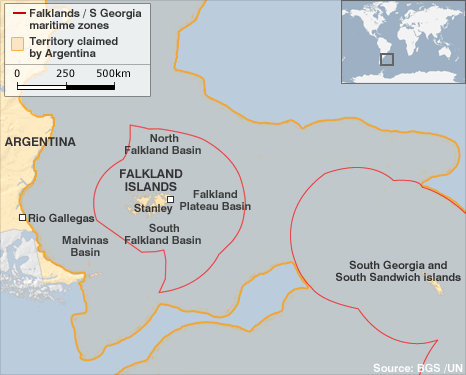
Under the Military Remains Act 1986, a number of British warships around the world are protected, including several ships sunk during the Falklands conflict. Also covered are several German U-boats in UK waters.

October 20, 2011

Timer now started for how quickly Quebec forces Harper to override shipbuilding contract awards

Filed under: Cancon, Economics, Military, Politics — Tags: , , , , , , — Nicholas @ 12:08

The National Post editorial board has lots of nice things to say about the federal government’s attempt to take politics out of the huge shipbuilding contract process:

On Wednesday, the Tory government released its Solomonic decision regarding which shipyards will build $33-billion in new military and non-military vessels over the next two decades. The evaluation of bids for the largest government procurement contract since the Second World War was handled by senior bureaucrats, rather than cabinet ministers. Even the announcement of the winning contractors was made by Francois Guimont, the top civil servant from Public Works and Government Services, rather than his minister or the minister of National Defence, as would have been the case with past contracts of this magnitude.

Of course, that’s not to say there will be no political backlash from the decision. Irving Shipbuilding of Halifax will be given $25-billion to build new joint support ships, Canadian Surface Combatants — a sort of destroyer-frigate hybrid — and offshore patrol vessels capable of sailing off all three of Canada’s coasts — east, west and Arctic. Seaspan Marine of Vancouver will build science vessels for the Coast Guard and for the Fisheries department, plus icebreakers worth a total of $8-billion. That means Davie Shipyard in Levis, Que. was left without a major shipbuilding contract (though Davie is still eligible to bid on a further $2-billion contract to provide smaller government boats, such as Fisheries patrol vessels). It must have been tempting for the Tories to intervene in the contract-award process and toss Quebec a bigger bone. Their recent decision to expand the grasp of the official languages commissioner to several airlines, and their willingness to give new seats to Quebec in the House of Commons (despite the fact Quebec was not underrepresented there), just because Ontario, B.C. and Alberta were getting more, shows the Tories have become very concerned about their appeal to Quebec voters.

You can guarantee that many Quebec politicians will benefit for having yet another stick to beat the federal government with — this would be true in all scenarios except the one where the Quebec shipyard got both contracts. It would be an even better deal for the taxpayers (and perhaps even the Royal Canadian Navy) if the contracts hadn’t been restricted to Canadian shipyards: it wouldn’t fly politically, but it would almost certainly have been better bang for the billions of bucks.

October 15, 2011

Chile upgrades their amphibious capabilities

Filed under: Americas, France, Military, Pacific — Tags: , — Nicholas @ 11:21

A brief item from the invaluable Strategy Page talks about Chile’s most recent naval acquisition:

Chile is buying the French amphibious ship Foudre, which is being replaced by a more recent design. The 12,000 ton Foudre has been in service for 21 years and could, with some refurbishment, serve another two decades or more. The 168 meter (521 feet) long ship has a crew of 160 and carries up to 70 vehicles. The well deck contains eight landing craft and there is a hangar that carries up to four helicopters. There are accommodations for 450 troops (or double that for short voyages). The Foudre can also be used as a command ship, which spaces for 150 headquarters personnel and their equipment.

Chile will use the Foudre to replace an 8,700 ton, 40 year old, American Newport class LPD. This ship was retired earlier this year, as it was considered too expensive to refurbish it. France has also offered Chile the second ship of the Foudre class, which is scheduled to retire from French service in a few years. The price of the Foudre to Chile has not been revealed. It will be cheap, and will depend on how much refurbishment French firms will undertake. Foudre undertook several long-distance operations during its career.

September 30, 2011

British defence minister tries to justify decommission of HMS Ark Royal and the Harrier

Filed under: Britain, Military, Politics — Tags: , , , , — Nicholas @ 11:19

In an update on the EMALS electro-magnetic catapult (things appear to be going well, which is good news for both the USN and the RN), Lewis Page finds the British defence minister still in full denial mode over the decision to scrap the navy’s last carrier and take the Harrier out of service:

The Royal Navy has been doing its best to overcome its current lack of carriers and Harriers in the Libyan campaign, instead inviting a group of the Army’s Apache attack choppers aboard the assault ship HMS Ocean. The Apaches have been doing useful work in the skies above Libya, which they can reach just minutes after taking off (as opposed to the hours it takes for land-based RAF jets to fly in from Italy or — as they are still routinely doing — all the way from the UK). Long haul operations by the RAF are putting its air-to-air tanker fleet under serious strain, and it will not have escaped carrier fans that the just commencing PFI tanker deal is set to cost much more than the Prince of Wales and sister ship Queen Elizabeth combined.

Defence minister Liam Fox made a bizarre statement on the question to reporters yesterday, claiming:

“Harrier could not have carried the weapons we have used to such great effect. They are too heavy. Harriers would have been no help to us at all. The critics have been silenced.”

The weapons used by the RAF so far have mainly been Paveway smartbombs and lightweight Brimstone anti-armour missiles, with a few dubious Storm Shadow air-launched cruise jobs mixed in (these latter missions are normally flown all the way from the UK).

The Harrier was the first British aircraft to be cleared for the latest Paveway IVs — the main weapon now in use by British planes over Libya — ahead of the Tornado and the Typhoon, as the RAF will tell you. It could also carry Brimstone. The Harrier GR9 could also carry Storm Shadow, supposing you actually wanted to.

September 27, 2011

Britain (finally) admits it will “never again be among the global superpowers”

Filed under: Britain, History, Military — Tags: , — Nicholas @ 08:56

For something that’s been obvious to casual observers since 1945 (1956 if you’re generous), it’s taken a while to admit:

The warning comes from the Royal United Services Institute (RUSI) thinktank in a tough report which questions whether Britain’s defence crisis is really over.

Last year’s Strategic Defence and Security Review led to sweeping redundancies across all three services, and the early mothballing of, among others, the aircraft carrier Ark Royal, and the fleet of Harrier jets.

In a brutally frank assessment of the British military, the report states: “The UK will never again be a member of the select club of global superpowers. Indeed it has not been one for decades.

“But currently planned levels of defence spending should be enough for it to maintain its position as one of the world’s five second-rank military powers (with only the US in the first rank).”

Many in the military are likely to bridle at the analysis; last week the former head of the Royal Navy, Admiral Lord West, struck a completely different tone, causing a furore when he said the UK should not consider itself a second-tier power like “bloody Belgium or Denmark”.

Except for brief wartime surges, Britain’s military strength has rarely been the army: it’s been the Royal Navy that provided Britain with both military and economic clout. Gutting the striking power of the navy (HMS Ark Royal and the Harriers) was merely the final admission that the government had higher priorities domestically than internationally. As Admiral Cunningham once said, “It takes three years to build a ship; it takes three centuries to build a tradition. It’s remarkable how quickly one can destroy a tradition.

September 19, 2011

HMS Astute seaman convicted for murder of officer

Filed under: Britain, Law, Military — Tags: , , — Nicholas @ 12:03

Able Seaman Ryan Samuel Donovan has been sentenced to life in prison for his shooting rampage on board HMS Astute earlier this year:

Able Seaman Ryan Samuel Donovan, admitted murdering Lt Cdr Ian Molyneux, 36, of Wigan, Greater Manchester, on board the nuclear submarine HMS Astute.

He also injured a second crewman, Lt Cdr Christopher Hodge, while the sub was docked in Southampton on 8 April.

Donovan, 22, of Dartford, Kent, was told he must serve at least 25 years by the judge at Winchester Crown Court.

Donavon of Hillside Road, also admitted the attempted murders of Lt Cdr Hodge, 45, Petty Officer Christopher Brown, 36, and Chief Petty Officer David McCoy, 37

Donovan, who was put on sentry duty despite being drunk, fired six shots from an SA80 rifle in the control room as local dignitaries, including Southampton City Council’s mayor, chief executive and leader, were being given a tour of HMS Astute, the court heard.

After reading about the attack, I posted an entry calling for Royston Smith’s heroism to be recognized in the next honours list.

That’s a civilian, charging a gunman armed with a battle rifle, and disarming him before the trained military personnel could intervene. There are very few people who could have reacted so quickly — and correctly — in that situation. That’s heroism.

How spendy will those whizzy F-35 aircraft end up being?

Filed under: Military, Technology — Tags: , , , — Nicholas @ 09:31

Strategy Page has a state-of-play report on the escalating cost of the F-35:

The U.S. Department of Defense and the U.S. Air Force are trying to agree on what the new F-35 fighter will cost. The air force insists that it is $65 million each, while the Department of Defense says when all costs are included; it will be more like $111 million each. Another number being debated is how many F-35s will actually be produced. The air force assumes 3,162, but the Department of Defense is not so sure that many will eventually be built. Total development cost is now put at $65 billion, which comes to over $20 million per aircraft if 3,162 are built. Development costs for the new U.S. F-35 fighter-bomber has grown by more than a third over the last few years. The additional development costs are accompanied by additional delays. Current estimates are that the F-35 will enter service in another 6-7 years. The Department of Defense believes production and development costs will continue to rise, and that the number to be built will decline. Both trends increase the average aircraft cost. Based on past experience, the higher Department of Defense estimates are more likely to be accurate.

And then there are operating costs. Earlier this year, after months of contentious disagreement, the U.S. Air Force came around to agreeing with U.S. Navy claims that the F-35 will cost much more to maintain, rather than (as the F-35 promoters assert) less. It was over a year ago that the U.S. Navy, after nervously watching as the manufacturing costs of the new F-35C and F-35B carrier aircraft increase, concluded that these aircraft would also be a lot more expensive to maintain. It comes down to this. Currently, it costs the navy, on average, $19,000 an hour to operate its AV-8 vertical takeoff or F-18C fighter aircraft. The navy calculated that it would cost 63 percent more to operate the F-35C (which will replace the F-18C) and the F-35B (which will replace the AV-8). These costs include buying the aircraft, training and maintaining the pilots, the aircraft and purchasing expendable items (fuel, spare parts, munitions.) The navy concluded that maintenance alone would be about a third more.

In a vicious circle, the higher the cost per plane, the fewer planes will be built, which increases the cost of the planes that do get built. At some point, the costs will get so high that foreign buyers (who are expected to buy more than half of the planned production) will reduce their orders or even back out altogether. The F-35 was supposed to be cheaper to operate than the aircraft it will be replacing, but that appears to be a badly mistaken estimate. That will also tend to ratchet down the foreign interest in purchasing the aircraft.

September 18, 2011

The Pentagon’s current big fear: the sequester

Filed under: Economics, Military, USA — Tags: , , , , — Nicholas @ 12:17

George F. Will explains why Leon Panetta, the secretary of defense, is very worried about the outcome of the “supercommittee” deliberations:

This would take from military budgets nearly $500 billion, in addition to a minimum of $350 billion cuts already scheduled. An almost trillion-dollar trimming, Panetta says flatly, “cannot take place.” Actually, he knows it can: “The gun to the head could really go off.” Even without a sequester, the military “is going to be a smaller force.” And with a sequester? The 1.5 million active-duty members of the armed services and 700,000 civilian employees of the Defense Department depend on an industrial base of more than 3.8 million persons. According to the Pentagon, a sequester would substantially shrink those three numbers, perhaps adding a point to the nation’s unemployment rate. The cuts would leave the smallest Army and Marine Corps in more than a decade and the smallest tactical Air Force since this service became independent of the Army in 1947. The Navy has already shrunk almost to its smallest fleet size since World War I.

Time was, when Democrats looked at the defense budget with a skeptical squint, Republicans rallied ’round it. No more. Few tea partyers remember Washington’s hawk-versus-dove dramas. They live to slow spending, period. They are constitutionalists but insufficiently attentive to the fact that defense is something the federal government does that it actually should do. And when they are told that particular military expenditures are crucial to force projection, they say: As in Libya? Been there, don’t want to do that.

Much of the defense budget is consumed by pay and health care for uniformed personnel, who have been abused enough by repeated deployments. The priciest new weapon, the stealthy F-35 Joint Strike Fighter (at least $90 million per plane), is vital for the continued salience of aircraft carriers, which are the basis of the U.S. strategic presence in the Western Pacific. Inferring China’s geopolitical intentions from its military purchases is difficult, but Panetta says guardedly that in five years China’s force projection will be “much better.” The Marines, with their smaller carriers, need a short-takeoff model F-35. Cut the number of planes built, the cost per plane rises, and the ability to recoup costs through sales to allies declines.

September 15, 2011

Is the end of the manned fighter plane at hand?

Filed under: Military, Technology — Tags: , , , , — Nicholas @ 09:08

Yes, I know we’ve gone through this discussion before (and the comment thread on that first entry is still a good summary of the counter-arguments). Air-to-air combat has become only a small part of what the air forces of the world are expected to do: ground support, while generally disdained by air force brass hats, is the most common combat task now. Here’s the state of play, according to Strategy Page, as far as the future of air combat is concerned:

The last decade has revolutionized air warfare, and air forces. This revolution was brought about by two technologies (smart bombs and UAVs) that have been around for decades but, over a decade ago, became reliable and capable enough to have a decisive effect on warfare. Now UAVs armed with smart bombs are poised to replace manned aircraft. Moreover, the proliferation of GPS guided weapons and short range guided missiles have greatly reduced the need for ground strikes by manned or unmanned aircraft. Since World War II, air forces have demanded, and obtained, a disproportionate share of military budgets. No more.

[. . .]

Underlying all of this is the appearance of so many cheaper, reliable, precision weapons in the last decade. This has changed tactics on the ground. While the air force doesn’t like to dwell on this, it’s the war on the ground that is decisive, not what’s going on in the air. This proliferation of precision has also changed the way smart bombs were designed. With the ability to put a weapon within a meter of the aiming point (using laser guidance) or 5-10 meters (using GPS), smaller is now better, at least in urban areas where there are a lot of civilians about, troops have changed the way they fight. There is more movement in urban warfare because of all this precision firepower, and fewer friendly fire casualties from bombs and artillery. But it’s not just the air force and their smart bombs that have brought this on. The army had precision missiles on the ground long before JDAM came along. Now the army has more of them. Thus, over the last five years, there has been a competition between the army and air force to develop smaller, cheaper and more precise, missiles and bombs.

[. . .]

The air force is not happy about the army having a large force of armed UAVs. Many air force generals believe the army should not have the MQ-1C, or at least not use them with weapons. That has already caused some spats in the Pentagon over the issue, but so far the army has prevailed.

The army argument is that these larger UAVs work better for them if they are under the direct control of combat brigades. The air force sees that as inefficient, and would prefer to have one large pool of larger UAVs, that could be deployed as needed. This difference of opinion reflects basic differences in how the army and air force deploy and use their combat forces. The army has found that a critical factor in battlefield success is teamwork among members of a unit, and subordinate units in a brigade. While the air force accepts this as a critical performance issue for their aircraft squadrons, they deem it irrelevant for army use of UAVs. Seeing army MQ-1Cs doing visual and electronic reconnaissance and firing missiles at ground targets, the air force sees itself losing control of missions it has dominated since its founding in 1948.

[. . .]

Meanwhile, the navy has taken the lead in developing larger, jet propelled UAVs like the 15 ton, X-47B. This UAV uses a F100-PW-220 engine, which is currently used in the F-16 and F-15. The X-47B can carry two tons of bombs or missiles and maneuver like a jet fighter. The X-47B is fast and agile enough to carry out air-to-air missions. With the right software, it can do this autonomously (without human intervention). This is being worked on, and the navy already has perfected the software that enables a UAV to land on aircraft carriers.

The coming decade will see more and more UAVs replacing manned aircraft. Thus after only a century in action, manned combat aircraft are on their way out.

September 12, 2011

Is the People’s Liberation Army a paper tiger?

Filed under: China, Economics, Military, Weapons — Tags: , , , — Nicholas @ 09:36

An interesting article at Strategy Page looks at the myth and reality of China’s army and navy:

You don’t see much in the media about the poor training of Chinese military personnel. You don’t hear much about the poor leadership and low readiness for combat. But all of this is common knowledge in China. There, the military is not walled off from everyone else. Cell phone cameras and the Internet make it easy to pass around evidence (often in the form of “hey, this one is hilarious”). The government tries to play up how modern and efficient the military is, but most Chinese know better, and don’t really care. China is winning victories on the economic front, and that what really counts to the average Chinese.

Meanwhile, U.S. military leaders and defense industries are looking for a sufficiently impressive foe to help scare more money out of Congress. The Chinese Navy (or, more correctly, the Chinese Peoples’ Liberation Army Navy) is now the favorite candidate, for navy and defense industry analysts, to become the new Big Bad. Just how dangerous are these Chinese sailors and their ships? It turns out that, on closer inspection, not very.

This is the sort of thing that what went on during the Cold War. Russian military prowess was hyped by the American military, and their defense suppliers, to justify further increases in defense spending. When the Cold War ended, it was revealed how the Russian military, and defense manufacturers, played the same game. It also revealed that Russian military capabilities were far less than the hype indicated.

The basic weapon for this sort of thing is FUD (Fear, Uncertainty and Doubt). Works every time, although it is difficult to pitch the Chinese navy as a crack force. Most of their ships are elderly, poorly designed and rarely used. Their nuclear subs are worse than the first generation of Russian nukes back in the 1960s. The most modern Chinese ships are Russian made, Cold War era models. Chinese ships don’t go to sea much, not just because it’s expensive, but because Chinese ships tend to get involved in nasty incidents. Like the submarine that killed its crew when the boat submerged (and the diesel engines did not shut down when the batteries kicked in, thus using up all the oxygen.) Breakdowns are more common, as well as a lot of accidents you don’t hear about (weapons and equipment malfunctions that kill and maim.) Nevertheless, the Chinese are working to change this. Ships are going to sea more each year, and troops are getting more training. But unless the corruption is curbed, this could all be wasted.

Of course, if China isn’t the big military threat to the rest of the world, how will the Pentagon get Congress to go along with its perpetual demands for more funding?

« Newer PostsOlder Posts »

Powered by WordPress