
It was never a practical project to silence the acting profession. These people are famous. Having acquired their fame, they then want to use their fame to do good, and in the process to become even more famous. This is only natural, especially when you consider that doing good and being heroic is what, according to the entertainments these people spend their lives making and acting in, life is all about. Trying to stop famous actors from expressing what they consider to be virtuous and heroic opinions in public is like trying to stop the wind from blowing or the sea from being wet.
Brian Micklethwait, “Minnie Driver and the changing meaning of goodness”, Samizdata, 2005-08-01.
August 31, 2024
QotD: Celebrity activism
Comments Off on QotD: Celebrity activism
August 28, 2024
Then I’ll Take Her When You’re ☠️Dead☠️!
Jill Bearup
Published May 13, 2024Ah, Captain Blood. Swords, sand, and piratical shenanigans. Let’s do this.
The Fight Master Vol 1 Issue 1: https://mds.marshall.edu/fight/1/
Buy my book: books2read.com/juststabmenow (or try your local Amazon/bookstore)
Comments Off on Then I’ll Take Her When You’re ☠️Dead☠️!
August 27, 2024
QotD: Who were the good guys?
A movie can get away with showing mostly shades of gray, but in the case of the Valkyrie plot, both shades are pretty damn close to black.
Nor was the 2008 movie, starring Tom Cruise, an isolated case. A few years earlier, Jude Law and Ed Harris squared off as dueling snipers in Enemy at the Gates … set during the Battle of Stalingrad. Who do you root for, the Nazi or the Commie? The producers opt for “commie”, obviously, but their attempts to humanize the Jude Law character are embarrassing — even if we accept Law’s character as totally apolitical, no movie featuring a political commissar in a vital supporting role, not to mention “cameos” by Khrushchev and Stalin himself, can fail to remind viewers that everyone involved was awful. Even the most gripping battle scenes (and to be fair, some of them were pretty good) can’t make up for the fact that the world would be a far, far better place if they somehow both could’ve lost.
Those are high-level failures, conceptual mistakes, the kind that professional storytellers simply shouldn’t make. Not only that, though, both movies have unforgivable mistakes in the execution, at almost every level. Tom Cruise, for instance, is comically miscast as Stauffenberg. I’ve written before about how weird it is that casting directors seem to obsess over finding actors who look like even obscure historical figures. Cruise looks a bit like Stauffenberg, I guess, but there’s simply no way a guy with his … ummm … distinctive acting style should be anywhere near a historical drama. Tom Cruise only ever really plays Tom Cruise, so “Tom Cruise dressed up as a Nazi” is really jarring.
And that’s before you consider the accents. Maybe Tom Cruise can’t do a German accent, I dunno. I seem to recall he did an Irish accent in a movie once, and that turned out ok, but again, whatever character he was playing was just “Tom Cruise with an Irish accent.” So maybe if you feel you must cast him as a German, letting him use his “natural” American accent is the way to go. But if you’re going to do that, please, for pete’s sake, make everyone else do an American accent, too. I know Kenneth Branagh can do one. So either cast guys who can do the right accent, or, failing that, who can do each other’s accent. Otherwise you get a huge, distracting mess.
Enemy at the Gates was actually worse: Law, Joseph Fiennes (the commissar), and Rachel Weisz (the love interest) all used their native British accents … but they’re different kinds of British accent, at least in Law’s case. Meanwhile, Ed Harris (the Nazi antagonist) uses the “neutral” American accent, while supporting player Ron Perlman, who is American, does a comically over-the-top Russian … as do the guys playing Khrushchev and Stalin. It’s just weird. In both movies, you’ve got supposedly tight groups of friends (or, at least, co-conspirators) talking to each other in wildly different accents. That kind of thing is bad enough in a movie like Robin Hood, Prince of Thieves, which made no pretenses to historical accuracy; it’s movie-destroying in a supposedly serious, historically-based thriller.
Severian, “Storytelling Fail”, Rotten Chestnuts, 2021-07-13.
Comments Off on QotD: Who were the good guys?
August 12, 2024
Robin Hood, But Make it ⚔️ICONIC⚔️
Jill Bearup
Published Apr 29, 2024The Adventures of Robin Hood (1938) is a classic, and I am hopefully unlikely to get in copyright trouble if I use huge chunks of it. So prepare for an exhaustive (or possibly exhausting) fight breakdown, and a few minor comments about Errol Flynn and parrying.
(more…)
Comments Off on Robin Hood, But Make it ⚔️ICONIC⚔️
August 5, 2024
QotD: George R.R. Martin’s Dothraki rank with the lazy racial sterotypes of Hollywood’s “Golden Age” westerns
The Dothraki were actually fashioned as an amalgam of a number of steppe and plains cultures … Mongols and Huns, certainly, but also Alans, Sioux, Cheyenne, and various other Amerindian tribes … seasoned with a dash of pure fantasy.
We may, I think, now safely dismiss this statement as false. What we have found is that the Dothraki do not meaningfully mirror either Steppe or Plains cultures. They do not mirror them in dress, nor in systems of subsistence, nor in diet, nor in housing, nor in music, nor in art, nor in social structures, nor in leadership structures, nor in family structures, nor in demographics, nor in economics, nor in trade practices, nor in laws, nor in marriage customs, nor in attitudes towards violence, nor in weapons, nor in armor, nor in strategic way of war, nor in battle tactics.
We might say he has added “dashes” of pure fantasy until the “dash” is the entire soup, but the truth is clearly the reverse: Martin has sprinkled a little bit of water on a barrel of salt and called it just a dash of salt. There is no historical root source here, but instead pure fantasy which – because racist stereotypes sometimes connect, in thin and useless ways, to actual history – occasionally, in broken-clock fashion, manages to resemble the real thing.
It seems as though the best we might say of what Martin has right is that these are people who are nomads that ride horses and occasionally shoot bows. The rest – which as you can see from the list above there, is the overwhelming majority – has functionally no connection to the actual historical people. And stunningly, somehow, the show – despite its absolutely massive budget, despite the legions of scrutiny and oversight such a massive venture brings – somehow is even worse, while being just as explicit in tying its bald collection of 1930s racist stereotypes to real people who really exist today.
Instead, the primary inspiration for George R.R. Martin’s Dothraki seems to come from deeply flawed Hollywood depictions of nomadic peoples, rather than any real knowledge about the peoples themselves. The Dothraki are not an amalgam of the Sioux or the Mongols, but rather an amalgam of Stagecoach (1939) and The Conqueror (1956). When it comes to the major attributes of the Dothraki – their singular focus on violent, especially sexual violence, their lack of art or expression, their position as a culture we primarily see “from the outside” as almost uniformly brutal (and in need of literally the whitest of all women to tame and reform it) – what we see is not reflected in the historical people at all but is absolutely of a piece with this Hollywood legacy.
But Martin has done more damage than simply watching The Mongols (1961) would today. He has taken those old, inaccurate, racially tinged stereotypes and repackaged them, with an extra dash of contemporary cynicism to lend them the feeling of “reality” and then used his reputation as a writer of more historically grounded fantasy (a reputation, I think we may say at this point, which ought to be discarded; Martin is an engaging writer but a poor historian) to give those old stereotypes the air of “real history” and how things “really were”. And so, just as Westeros became the vision of the Middle Ages that inhabits the mind of so many people (including quite a few of my students), the Dothraki become the mental model for the Generic Nomad: brutal, sexually violent, uncreative, unartistic, uncivilized.
And as I noted at the beginning of this series, Martin’s fans have understood that framing perfectly well. The argument given by both the creators themselves, often parroted by fans and even repeated by journalists is that A Song of Ice and Fire‘s historical basis is both a strike in favor of the book because they present a “more real” vision of the past but also a flawless defense against any qualms anyone might have over the way that the fiction presents violence (especially its voyeuristic take on sexual violence) or its cultures. No doubt part of you are tired of seeing that same “amalgam” quote over and over again at the beginning of every single one of these essays, but I did that for a reason, because it was essential to note that this assertion is not merely part of the subtext of how Martin presents his work (although it is that too), but part of the actual text of his promotion of his work.
And it is a lie. And I want to be clear here, it is not a misunderstanding. It is not a regrettable implication. It is not an unfortunate blind-spot of ignorance. It is a lie, made repeatedly, now by many people in both the promotion of the books and the show who ought to have known better. And it is a lie that has been believed by millions of fans.
One thing that I hope is clear from this treatment is just how trivial the amount of research I’ve done here was. Certainly, it helped that I was familiar with Steppe nomads already and that I knew who to ask to be pointed in the direction of information. Nevertheless, everything I’ve cited here is available in English and it is all relatively affordable (I actually own all of the books cited here; thanks to my Patrons for making that possible, especially since getting materials from the library is slower in the days of COVID-19; nevertheless, the point here is that they are not obscure tomes). Much of it – Ratchnevsky on Chinggis Khan, Secoy and McGinnis on Great Plains warfare – were already available well before the 1996 publication of A Game of Thrones. 1996 was not some wasteland of ignorance that might have made it impossible for Martin to get good information! For an easy sense of what a dedicated amateur with film connections might have learned in 1996, you could simply watch Ken Burns’ The West, which came out the same year. I am not asking Martin to become a historian (though I am asking him to stop representing himself as something like one), I am asking him to read a historian.
Instead of doing that basic amount of research, or simply saying that the peoples of Essos were made up cultures unconnected with the real thing, Martin and the vast promotional apparatus at HBO opted to lie about some real cultures and then to put hundreds of millions of dollars into promoting that lie.
And I want to be clear, these are real people! I know, depending on where you live, “Mongols” and “Sioux” and “Cheyenne” may feel as distant and fanciful as “Rohirrim” or “Hobbits” or else they may feel like “long-lost” peoples. But these were real people, whose real descendants are alive today. And almost all of them face discrimination and abuse, sometimes informally, sometimes through state action, often as a result of these very lingering racist stereotypes.
In that context, declaring that the Dothraki really do reflect the real world (I cannot stress that enough) cultures of the Plains Native Americans or Eurasian Steppe Nomads is not merely a lie, but it is an irresponsible lie that can do real harm to real people in the real world. And that irresponsible lie has been accepted by Martin’s fans; he has done a grave disservice to his own fans by lying to them in this way. And of course the worst of it is that the lie – backed by the vast apparatus that is HBO prestige television – will have more reach and more enduring influence than this or any number of historical “debunking” essays. It will befuddle the valiant efforts of teachers in their classrooms (and yes, I frequently encounter students hindered by bad pop-pseudo-history they believe to be true; it is often devilishly hard to get students to leave those preconceptions behind), it will plague efforts to educate the public about these cultures of their histories. And it will probably, in the long run, hurt the real descendants of nomads.
But this is exactly why I think it is important for historians to engage with the culture and to engage with depictions like this. Because these lies have consequences and someone ought to at least try to tell the truth. With luck, even with my only rudimentary knowledge, I have done some of that here, by presenting a bit more of the richness and variety of historical (and in some cases, present-day) horse-borne nomadic life, in both North America and Eurasia.
Because there is and was a lot more to nomads than just “that Dothraki horde”.
Bret Devereaux, “Collections: That Dothraki Horde, Part IV: Screamers and Howlers”, A Collection of Unmitigated Pedantry, 2021-01-08.
Comments Off on QotD: George R.R. Martin’s Dothraki rank with the lazy racial sterotypes of Hollywood’s “Golden Age” westerns
July 20, 2024
QotD: Comparing gun crime in Canada and the United States
Whatever, dude. Unlike Moore, I have homes on both sides of the border and it’s the Quebec one I keep locked. By the time you read this, I’ll be in New York, but my home in New Hampshire will be unlocked, and so will my car at the airport, the key in the ignition, so I’ll know where to find it. By contrast, in Quebec it’s illegal to leave your car unlocked, even if you stop for a pee on an ice floe up by Hudson’s Bay. Pace Moore, Canada has vastly lower rates of handgun ownership. Long-gun ownership is much closer, but, statistically, Canadians are slightly more murderous than Americans in this sphere: in the US, there are 1.7 homicides per 100,000 long guns; in Canada, it’s 1.9. So European visitors to North America should be aware they’re more likely to be killed by a homicidal Canadian rifleman than an American one.
On the overall murder rate, if Moore’s interested in “cultural differences”, it seems odd that he should avoid the most obvious one. Alberta Report‘s Colby Cosh, a braver man than I, points out that black Americans are 13 per cent of the US population but commit over half the murders. Once you factor those out, non-black Americans murder at about the same rate as Canadians.
Mark Steyn, “Bowling for Columbine”, Steyn Online, 2002-11-30.
Comments Off on QotD: Comparing gun crime in Canada and the United States
July 14, 2024
QotD: Method acting
Mark Steyn, “Charlie and the Chocolate Factory”, The Spectator, 2005-07-30.
Comments Off on QotD: Method acting
July 13, 2024
The real story of Henry Hook, VC – Zulu
The History Chap
Published Nov 23, 2023Henry Hook, VC, 1850-1905. Zulu — the Battle of Rorke’s Drift.
Henry Hook was one of 11 defenders at the mission station at Rorke’s Drift (battle of Rorke’s Drift, Anglo-Zulu War 1879) who were awarded the Victoria Cross. Controversially, his character was misrepresented in the 1963 film Zulu. His character, played by James Booth (1927-2005), was depicted as an insubordinate barrack-room lawyer, a drunk and a malingerer. This was far from the truth.
Hook was actually a model soldier, who was teetotal, and who would serve as a regular and volunteer for over 40 years. His family were upset by the film, although contrary to popular stories, there is no evidence that Henry Hook’s daughters walked out of the [movie’s] premiere.
Nevertheless, in this video I aim to share his real story. Not just of his service in the army (and at Rorke’s Drift) but of a humble man from Gloucestershire, who returned home to find his wife had run off with another man, who found love for a second time and who worked in the British Museum.
Where is Henry Hook buried? Henry Hook’s grave can be found at St. Andrew’s church in the hamlet of Churcham, Gloucestershire. it is about five miles west of Gloucester.
0:00 Introduction
1:26 Early Life
3:10 Rorke’s Drift
3:56 Zulu
5:00 Defending The Hospital
7:45 Assegai wound
9:47 Making Tea
10:23 Victoria Cross
11:07 After Rorke’s Drift
13:11 Failing Health
15:10 The History Chap
(more…)
Comments Off on The real story of Henry Hook, VC – Zulu
July 2, 2024
They Don’t Make Them Like ⚔️This⚔️ Any More …
Jill Bearup
Published Mar 18, 2024Ah, The Mark of Zorro. You will be endlessly told as a stage combatant that this is one to watch. There’s a reason for that, friends.
This video is sponsored by ME: https://books2read.com/juststabmenow
Comments Off on They Don’t Make Them Like ⚔️This⚔️ Any More …
June 5, 2024
Hollywood has been here before … and they learned nothing
Ted Gioia illustrates the mind-blowing dominance of westerns on TV and in the theatre in the 1950s and how quickly the boom was over and has never come close to recovering:
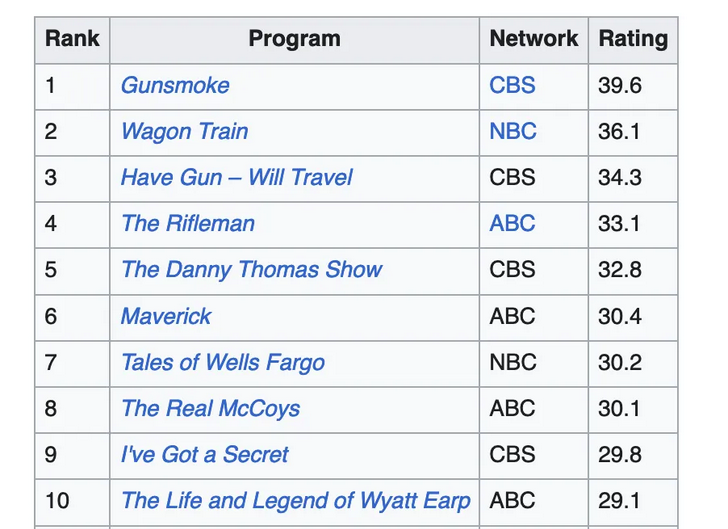
Source – https://en.wikipedia.org/wiki/Top-rated_United_States_television_programs_of_1958%E2%80%9359
Eight of the top ten shows during the 1958-59 season were westerns.
Spaceships were in the news every day back then, but on TV it was just horses — and occasionally a covered wagon. Each of the three networks was caught up in a time warp, partying like it was 1899.
Any fool could see that they were saturating the market. Yet the studios kept launching new westerns with regularity, although with less confidence, for another decade, more or less.
Back in 1955, the three US TV networks had introduced three new western-themed series — Gunsmoke, Cheyenne, and Wyatt Earp. But two years later, the networks ramped up their investment in cowboys, launching nine new westerns that fall.
And it got worse.
In 1958, these three networks introduced ten more western series. On some nights, you could watch cowboys for two hours straight on ABC. CBS and NBC also started scheduling back-to-back Wild West shows.
I need to stress that the western was already an exhausted genre long before 1960. Movie theaters had relied on cowboys as an audience draw going back at least to Broncho Billy Anderson and The Great Train Robbery (1903).
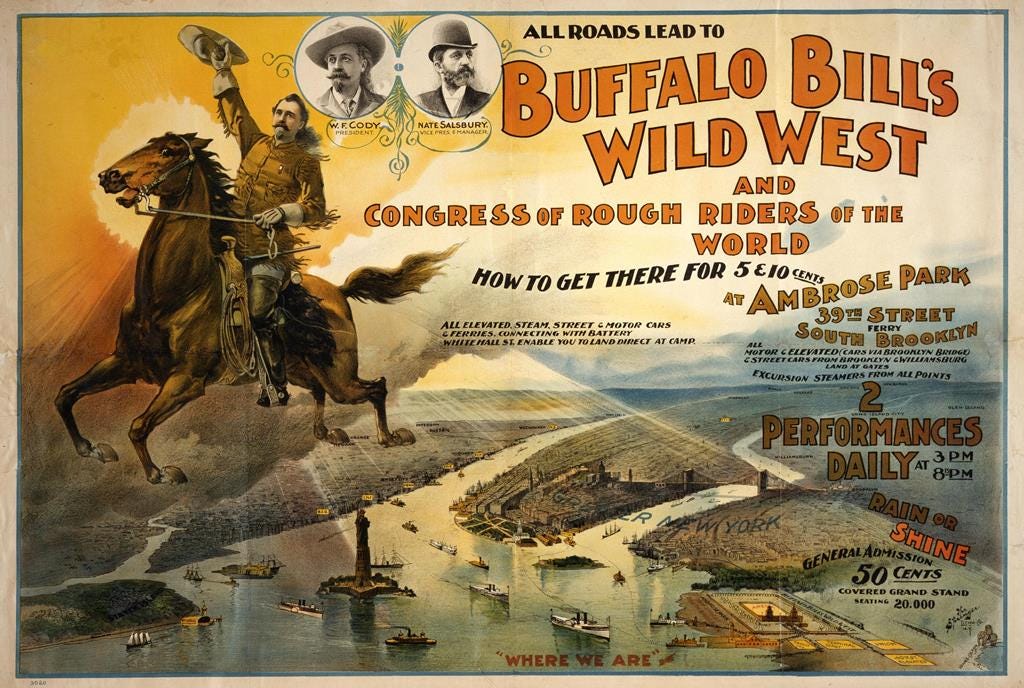
And cheap books and magazines with stories of the Wild West had already been around for decades at that point. By my measure, nostalgia for the old West dates back to the launch of Buffalo Bill’s Wild West show on May 19, 1883 in Omaha, Nebraska — four years after the invention of the gasoline engine.
Poster for Buffalo Bill’s Wild West Show — the first major cowboy nostalgia business
[…]
Younger viewers were the first to abandon the western — a telling sign, especially when you consider that, back in the 1930s, children and teens had been the core audience for the genre.
By the time Gunsmoke went off the air in 1975, the few remaining fans were old-timers — maybe the same ones who had gone to movie theaters to cheer for Roy Rogers in the 1930s. That show had been the most popular TV series in the US for four seasons in the late 1950s. But a cowboy series would never do that again.
Youngsters lost interest in westerns despite a proliferation of merchandise. During my childhood, I paid no attention to the cowboy genre — nor did any of my friends. But brand merchandise was everywhere. We could buy Gunsmoke comic books, trading cards, lunchboxes, and — of course! — toy guns, among other paraphernalia.
With the benefit of hindsight, we can see that these products did not develop the market — they merely saturated it.
Comments Off on Hollywood has been here before … and they learned nothing
June 4, 2024
J.K. Rowling’s most convincing and true-to-life villain in the Harry Potter stories
I’m with Jon Miltimore on this — J.K. Rowling’s most disturbing and best-written villain isn’t “He Who Must Not Be Named” or any of the other (frankly cardboard-y) magical villains … it’s Dolores Umbridge, a career bureaucrat who could have been drawn from any western civil service senior management position:
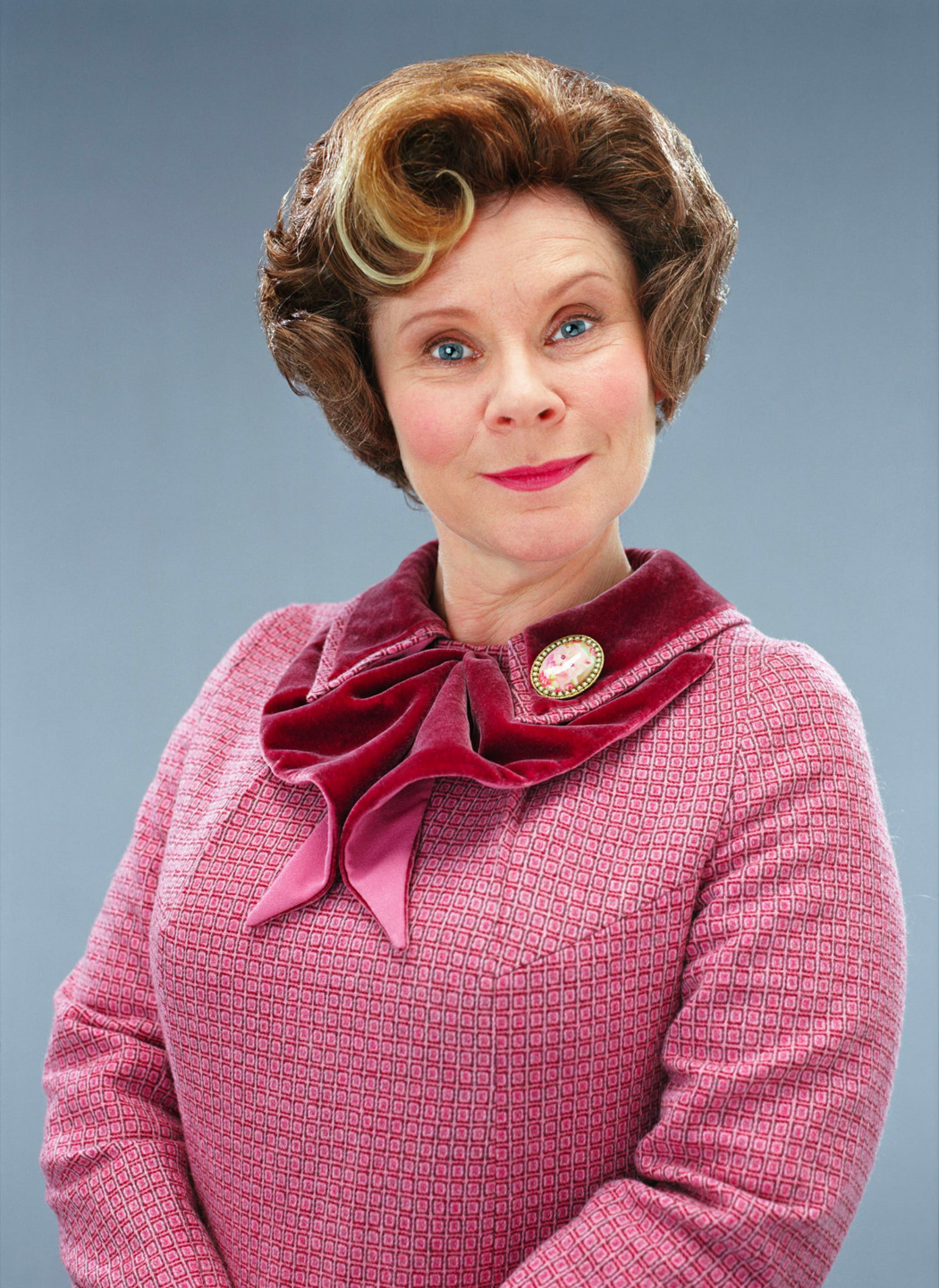
Umbridge, portrayed in the films by English actress Imelda Staunton, isn’t some apparition of the underworld or a creature of the Dark Forest. She’s the Senior Undersecretary to the Minister of Magic, the man who runs the government (the Ministry of Magic) in Rowling’s fictional world.
Umbridge wears pink, preaches about “decorum” in a saccharine voice, smiles constantly, and resembles a sweet but stern grandmother. Her intense, unblinking eyes, however, suggest something malevolent lurks beneath. And boy, does it.
“The gently smiling Dolores Umbridge, with her girlish voice, toadlike face, and clutching, stubby fingers, is the greatest make-believe villain to come along since Hannibal Lecter,” horror author Stephen King wrote in a review of Harry Potter and the Order of the Phoenix, the book in which Umbridge is introduced.
Umbridge’s “Desire to Control, to Punish”
What makes Umbridge so evil that King would compare her to Hannibal Lecter, the man widely considered the greatest villain of all time?
I asked myself this question, and I believe the answer lies in the fact that Dolores Umbridge is so real — and in more ways than one.
First, it’s noteworthy that Rowling based Umbridge on an actual person from her past, a teacher she once had “whom I disliked intensely on sight”.
In a blog post written years ago, Rowling explained that her dislike of the woman was almost irrational (and apparently mutual). Though the woman had a “pronounced taste for twee accessories” — including “a tiny little plastic bow slide” and a fondness for “pale lemon” colors which Rowling said was more “appropriate to a girl of three” — Rowling said “a lack of real warmth or charity” lurked below her sugary exterior.
The description reminded me of another detestable literary villain: Nurse Ratched, the despicable antagonist of Randle Murphy in Ken Kesey’s magnificent 1962 novel One Flew Over the Cuckoo’s Nest.
Kesey’s description of Nurse Ratched conjures to mind a character much like Umbridge.
“Her face is smooth, calculated, and precision-made, like an expensive baby doll, skin like flesh-colored enamel, blend of white and cream and baby-blue eyes, small nose, pink little nostrils — everything working together except the color on her lips and fingernails …”
While there are similarities in the appearances of Dolores Umbridge and Nurse Ratched, their true commonality is what’s underneath their saccharine exteriors.
Comments Off on J.K. Rowling’s most convincing and true-to-life villain in the Harry Potter stories
June 2, 2024
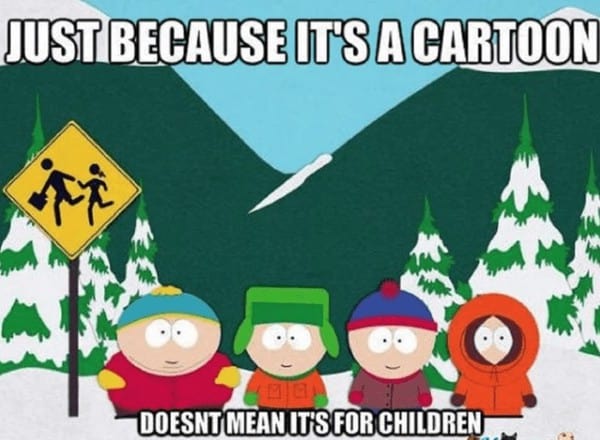
A definite sign of the end-times – “South Park is going into its 27th season”
I’d pretty much given up on watching anything on television around the time that South Park went on the air, so I never “stopped watching it” because I wasn’t watching anything on TV by that time (although I did see Team America: World Police in the theatre). Andrew Sullivan says I’ve been missing something quite worthwhile for all this time:
South Park is going into its 27th season. And it has rarely been better. (I simply can’t believe so many people I meet say they haven’t watched in years. You’ve been missing out!) The new special on obesity — a deft masterclass of social commentary — has a brutal takedown of suburban white women jonesing for doses of Ozempic like meth-heads; a definitive — and musical! — digression into the insanity of the American healthcare system; pure, character-driven humor in a figure like Randy Marsh — a far subtler parody of the average American male than Homer Simpson; and, of course, Eric Cartman — the “big-boned” fat-ass kid whose capacity for pure evil was first truly captured in the epic “Scott Tenorman Must Die“.
You can read books on Ozempic, scan op-eds, absorb TikToks, and even listen to the Dishcast! — but nothing out there captures every single possible social and medical and psychological wrinkle of this new drug than this hour of crude cartoons. Yes, there are fart jokes. There are always fart jokes. But fart jokes amid a sophisticated and deeply informed parody of insurance companies? Or, in other episodes, toilet humor guiding us through the cowardice of Disney, the dopey vanity of Kanye, the wokification of Hollywood, the exploitation of black college athletes, the evil of cable companies, the hollowness of hate-crime laws, the creepiness of Christian rock, or the money-making behind legal weed? Only South Park pulls this off. Only South Park gets away with all of it.
It’s a 1990s high-low formula at root, sophisticated cultural and political knowingness married to crude cartoons, silly accents, m’kay, and a talking Christmas turd, Mr Hankey. Generationally, it really marked a moment when merging these two worlds seemed the most creative option — not an abandonment of seriousness, but the attachment of a humane levity to it. South Park can be brutal, but it is never cruel. Unless you’re Barbra Streisand or Bono. And virtually every character (even Eric) is redeemable. Except Meghan Markle.
Yes, Matt and Trey have tried other things. To wit: just one of the best and most successful musicals of the 21st century, The Book of Mormon. They’ve pioneered deep-fakes. They also just renovated and relaunched a huge Denver restaurant they loved as kids, Casa Bonita, memorialized in a classic Cartman-is-evil episode. Twenty years ago, they actually created an entirely puppet-acted movie with epic sex and vomit scenes as a commentary on the war on terror, Team America; and are now teaming up with Kendrick Lamar to shoot a live-action comedy about a biracial couple where the black boyfriend interns as a slave re-enactor only to discover that his ancestors were owned by his girlfriend’s. No landmines there.
But they always return to South Park and evince no desire to transcend it — partly because it has become an entire world that can expand and contract at will: a world where Mel Gibson tweaks his nipples and smears his feces, Mickey Mouse acts like a mafia don, Michael Jackson’s nose falls off, Meghan Markle is a literal empty vessel, Christopher Reeve eats fetuses for their stem-cells, and Tom Cruise works in a fudge factory where, yes, he does a lot of the packing.
And in two decades of an acutely polarized and politicized culture, what team is South Park on? Precisely. You can’t tell, can you? — which is a staggering achievement in its own right. And it’s not about risk-aversion: the duo was targeted by Islamist terror and didn’t blink. They also took on the censors at the MPAA — savor this memo — and obliterated one of George Carlin’s “Seven Words You Can Never Say on TV” by saying “shit” 162 times in one episode.
They’ve shown Martha Stewart putting a whole turkey up her back-hole, Paris Hilton putting a whole pineapple up her front-hole, Caitlyn Jenner running over innocent pedestrians, and Jesse Jackson demanding that his big black ass be ceremoniously kissed. They’ve tackled Scientology and Mormonism; they’ve shown intergalactic Catholic priests astonished at the idea they have to stop raping young boys; and they beat Dave Chappelle by two decades with “Mr. Garrison’s Fancy New Vagina” — their take on sex reassignment.
They have done all this, taken no prisoners, and remain uncancellable. Why? Because their mockery is genuinely universal (including themselves), their courage is real, and because they remain humane.
By humane, I mean they show how you can skewer and yet still love. As a young gay man, I often winced at the careful, all-too-sensitive depictions of gay men in most movies and television, the elaborate ways in which the subculture was homogenized and prettified for straight audiences. But in South Park, I could see the gay reality as I had already witnessed it in all its bewildering variety: the right-wing, elementary school teacher Mr Garrison … dating Mr Slave — a leather-daddy with a gerbil called Lemmiwinks living in his upper colon; I could see Big Gay Al get expelled from the Boy Scouts — and defend their right to do so; I could see Butters’ dad on the DL at the White Swallow bathhouse; in time, I could see Satan having a gay love affair with Saddam Hussein, because his other boyfriend was so lame. They even made AIDS funny. The offense worked because it always conveyed an actual truth about gay men, while also obviously mocking us with love. (Mr Slave was portrayed as a moral paragon next to Paris Hilton, for example, and Mr Garrison eventually ends up with Rick, a total normie.) South Park‘s role in helping America grow up on the topic of homosexuality, especially the young male demographic who followed them, is deeply under-rated.
Comments Off on A definite sign of the end-times – “South Park is going into its 27th season”
QotD: The Spartans do not deserve the admiration of the modern US military
Even more concerning is the U.S. military’s love of all things Spartan. The U.S. Army, of course, has a Spartan Brigade (Motto: “Sparta Lives”) as well as a Task Force Spartan and Spartan Warrior exercises, while the Marine Corps conducts Spartan Trident littoral exercises — an odd choice given that the Spartans were famously very poor at littoral operations. Beyond this sort of official nomenclature, unofficial media regularly invites comparisons between U.S. service personnel and the Spartans as well.
Much of this tendency to imagine U.S. soldiers as Spartan warriors comes from Steven Pressfield’s historical fiction novel Gates of Fire, still regularly assigned in military reading lists. The book presents the Spartans as superior warriors from an ultra-militarized society bravely defending freedom (against an ethnically foreign “other”, a feature drawn out more explicitly in the comic and later film 300). Sparta in this vision is a radically egalitarian society predicated on the cultivation of manly martial virtues. Yet this image of Sparta is almost entirely wrong. Spartan society was singularly unworthy of emulation or praise, especially in a democratic society.
To start with, the Spartan reputation for military excellence turns out to be, on closer inspection, mostly a mirage. Despite Sparta’s reputation for superior fighting, Spartan armies were as likely to lose battles as to win them, especially against peer opponents such as other Greek city-states. Sparta defeated Athens in the Peloponnesian War — but only by accepting Persian money to do it, reopening the door to Persian influence in the Aegean, which Greek victories at Plataea and Salamis nearly a century early had closed. Famous Spartan victories at Plataea and Mantinea were matched by consequential defeats at Pylos, Arginusae, and ultimately Leuctra. That last defeat at Leuctra, delivered by Thebes a mere 33 years after Sparta’s triumph over Athens, broke the back of Spartan power permanently, reducing Sparta to the status of a second-class power from which it never recovered.
Bret Devereaux, “Spartans Were Losers”, Foreign Policy, 2023-07/22.
Comments Off on QotD: The Spartans do not deserve the admiration of the modern US military
May 15, 2024
Disintermediation Now! “Even the gatekeepers are sick of dealing with gatekeepers”
Ted Gioia on the trend for even people at the top of the distribution chain trying to find ways to get around the distribution chain they inhabit:

The Emoji Movie premiere at the Fox Theatre, Westwood Village, 23 July 2017.
Photo by Kristofer Gonzalez-DeWhitt via Wikimedia Commons.
A few weeks ago, 35 of the biggest names in Hollywood collaborated on a business venture. Can you guess what it is?
I’ll help by providing a list of the participants. Here they are in alphabetical order, to avoid wounding any of the huge egos involved:
J.J. Abrams, Judd Apatow, Damien Chazelle, Chris Columbus, Ryan Coogler, Bradley Cooper, Alfonso Cuarón, Jonathan Dayton, Guillermo del Toro, Valerie Faris, Hannah Fidell, Alejandro González Iñárritu, James Gunn, Sian Heder, Rian Johnson, Gil Kenan, Karyn Kusama, Justin Lin, Phil Lord, David Lowery, Christopher McQuarrie, Chris Miller, Christopher Nolan, Alexander Payne, Todd Phillips, Gina Prince-Bythewood, Jason Reitman, Jay Roach, Seth Rogen, Emma Seligman, Brad Silberling, Steven Spielberg, Emma Thomas, Denis Villeneuve, Lulu Wang and Chloé Zhao.
What are these movie titans up to?
Maybe they want to make a film together? Or perhaps they’re thinking bigger — planning to launch their own production company or even a movie studio?
Nope. They weren’t thinking big. They were thinking small — very small.
These heavy hitters got together to buy a 93-year-old building.
They now own the Westwood Village theater at 945 Boxton near the UCLA campus. I went there to see films when I was in high school and it was old even back then. At some point it stopped being old, and became historic and vintage. (Maybe if I live long enough this will happen to me too.)
But these 35 investors aren’t just interested in preserving a quaint old building. They want to own a place where they can show quality movies to a flesh-and-blood audience without anybody getting in their way.
We’ve reached a point where even the people in power at the top of the industry want to bypass the system. Even the gatekeepers are sick of dealing with gatekeepers.
That’s how bad it’s gotten.
Comments Off on Disintermediation Now! “Even the gatekeepers are sick of dealing with gatekeepers”
May 11, 2024
The second time as farce – “we’re living through a performative version of the seventies”
Sarah Hoyt posted this a few days back, but I only noticed it now:

A member of the CIA helps evacuees up a ladder onto an Air America helicopter on the roof of 22 Gia Long Street April 29, 1975, shortly before Saigon fell to advancing North Vietnamese troops.
Hubert van Es photo via Wikimedia Commons.
Yesterday talking to a friend, he said that it seems like we’re living through a shoddy version of the seventies.
But that’s not QUITE it. It’s more complicated. It’s more like we’re living through a performative version of the seventies.
It’s like all the recasting and re-doing of classic movies and series, at this point even those that weren’t particularly successful: it feels like Hollywood is just redoing these things out of some sort of dinosaur brain memory that they were successful. However, the people in charge no longer have any idea why these things were successful or why they resonated or achieved the results they did.
So the re-casts/re-dos sound hollow and strange, and would even if they didn’t use them to push their weird personal current obsessions. (All heroes must be women and black and increasingly of some odd sexual identity! Only villains can be white!) Because the car is there, but the engine is gone metaphorically speaking.
A Boeing CH-47 Chinook transport helicopter appears over the U.S. embassy compound in Kabul, 15 Aug 2021. Image from Twitter via libertyunyielding.com
All these redos and recastings and all are just shells of what the original was. And imbuing them with current wokeness doesn’t make them massively popular, because it doesn’t have that kind of purchase amid the public.
The left and current “Cultural gatekeeping elite” doesn’t seem to be aware of this, or aware of why they fail. In fact, each failure baffles them.
I could be snide, here, and say that it’s because this entire administration, and in fact, the entire upper-crust/controlling layer of our institutions are profoundly untalented theater kiddies, who have no creativity but love the style, and so are trying to do performance of what they think should be there, in the hopes it will work. And are forever baffled it doesn’t.
The truth is not quite that mean, but it rhymes. They are people of a certain frame of mind. In most places and most times, this would make them profoundly “conservative.” Frankly they are, because 100 years into the “progressive” project, those who support it are conservatives. But it’s a weird sort of “conservatism” because what they’re conserving is the cult that tells them if they tear Western civ apart paradise ensues. The whole just-so cult of Marx as filtered through their parents, grandparents and great grandparents.
Part of the whole Marxian philosophy is that it’s a self-contained system, congruent within itself, and with no basis in reality. This makes a certain type of mind susceptible to it. In other centuries they’d be religious fanatics, missionaries to the heathens and zeal-burned puritans.
That type of mind tends to think of things in terms of pre-ordained and fixed narrative, not wildly creative and innovative. That THEY think of themselves as creatives is the insanity of the current system and the Marxian corruption of institutions. They are not actually capable of creativity, only of passing on the received word.
And so we get to the other side of the rerun of the seventies: These kids, by and large, grew up with everything from schools, to TV to even their parents (for the children and grandchildren of boomers) being sold a version of the sixties and seventies in which protesting on the street, behaving badly and destroying property was being passionate and fighting for the voiceless and by itself meant IMPROVING SOCIETY and MAKING THE WORLD A BETTER PLACE.
So the most gullible of this generation are rebels without a clue. They must perform the hit the streets and protest, but they lack the immediacy of the draft to make it personal, and they lack anything like civil rights to make it righteous.
Instead they attach to any stupid cause they can find or which is handed to them by manipulative SOBs. So, you know, it might be saving the endangered Prebles Jumping Mouse, or perhaps saving old buildings, or even well … Lately Occupy Wall Street, BLM, antifidiots and of course pro-Hamass.

Comments Off on The second time as farce – “we’re living through a performative version of the seventies”


