
Tabloid journalism begins with W.T. Stead, who as editor of the Pall Mall Gazette in the 1880s brought news and scandal to the newly literate masses, transforming public culture and politics with it.
The son of a Congregationalist preacher, Stead grew up in a strict religious household in Northumberland, in a home where theatre was “the Devil’s chapel” and novels “the Devil’s Bible”. Taught to read by his father, the newsman’s nonconformism would inform his campaigns after he moved from the Northern Echo to the Gazette in London.
Stead was most of all famous for the first great newspaper investigation, in 1885, “The Maiden Tribute of Modern Babylon“, on the scandal of child prostitution. Stead had bought a girl called Eliza for £5, on the premise that she was to be taken to a brothel on the continent, using quite dubious methods that got him sent to jail for three months.
Despite this, the story succeeded – a national scandal which led to a change in the law, the age of consent raised from 13 to 16. The idea of English girls being trafficked into sex outraged and horrified the public, Stead’s story imprinted itself deeply into the public psyche, to the extent of influencing George Bernard Shaw’s Pygmalion — thus, Eliza Doolittle.
On the continent it helped to inspire a genre of vaguely pornographic literature about the sexual perversion rife in England, a fantasy that belied the fact that late Victorian London was not a nest of vice, relatively speaking. Most measures of squalor and child abuse had declined in the 19th century and a teenage girl by the end of the century was relatively safe, compared to a predecessor in almost any era; public moral outrage offered protection, even if it could be unforgiving for those same girls who transgressed.
Stead would become the most famous journalist of the era, so renowned that in 1912 he was invited to New York by the US President to attend a conference — and so booked a ticket on a famously unsinkable new liner. He was last seen helping women and children trying to get on to lifeboats, and, true to the chapel ethos of his parents, gave away his lifejacket. He was among the 1,500 who lost their lives on the Titanic.
Ed West, “Our Modern Babylon”, Wrong Side of History, 2023-02-11.
May 14, 2023
QotD: The original tabloid journalist
May 11, 2023
London’s return to normality after Coronation Day
In The Line, Matt Gurney recounts his third and final day in London covering the Coronation, the rather impressive clean-up efforts afterwards and the damp squib of the third day, “The Big Help Out”:

Monday was a holiday in the U.K., too, it’s important to note. A “bank holiday”, in the local jargon, which had been declared as part of the official period of celebration. There were still lots of people working, of course. Restaurant staff and taxi drivers and all the rest. But there were a lot of people who could have been volunteering. And I didn’t see any. Not a one.
I’d gone looking, too. There was a website for the so-called Big Help Out, where you could put in your address and what kind of volunteering you were interested in, and find local opportunities. I used my hotel address and selected every possible category of volunteerism, and was offered … not much. I broadened the search area and … still not much. I could download a few kits to collect some signatures for petitions. I was invited to pick up some trash in my local park, whichever park that was, and just as a solo effort. I was asked to fill out some surveys about nature and wildlife for some local conservation groups. And that all sounds … uhh … worthwhile. But this wasn’t what I had in mind, I admit. No group activities? No community activism?
It seemed odd especially because the entire point of Sunday’s events, the Big Lunches, had been bringing people together. To celebrate. It seemed fitting and appropriate for those same people to then get together the next day and contribute something. But no. No one seemed interested. I didn’t have as much time to wander the city on Monday as I’d had on Sunday, but I still had a few hours, and I didn’t see anything. It was quiet.
This had been foreseen as being a problem. Even before I’d flown over, as part of my research, I’d come across this article in The Guardian, warning three weeks ago that volunteerism was at a crisis point in the U.K., was trending further down, and had been for years. It’s not that anyone seemed to think that the idea of the Big Help Out was bad. It’s just that no one seemed to think many people would actually show up.
Some events certainly seemed to go off as planned. Mainly the ones where royals or other VIPs attended. The BBC reported that the Prince and Princess of Wales, and their children, helped improve a Scouts facility. The prime minister and his wife prepared and served food to the elderly. The BBC also reported that 55,000 events were planned across the U.K. I truly and sincerely hope they did well, and that good things were accomplished in communities and for people that needed the help. But I can only tell you what I saw, as I’ve done in my other dispatches, and I didn’t see anything in London on Monday. I asked around a bit, and people either just shrugged it off and went about their day or hadn’t heard of The Big Help Out at all. They’d sure as hell heard of The Big Lunches, though.
Again, probably not a shock that an invitation to party got a better response than an invite to help out. But still.
He also considers the monarchy as an institution from a Canadian constitutional perspective and I find I largely agree with his conclusions:
If I was starting a country from scratch, I would never decide that the logical thing to do would be to invest our notion of sovereignty and much of our government’s powers in an old man who lives in a castle on an island across the ocean. No one would. It’s absurd. But … it works? And, more to the point, I have zero faith — absolutely zero — that we’d ever be able to replace what we currently have with something that functioned at least as well. That has to be the minimum bar. And look around, at the state of things in Canada right now, and for the foreseeable future. Does anyone think we’re going to be in a place to design a new Canadian republic from scratch without just epically screwing it up? Julie Payette, President of Canada, anyone? David Johnston, Eminent President?
We all know that’s exactly who we’d end up with, right? Would we just skip a lot of fuss and bother and just make the president whomever happens to be the youngest (or oldest, or median) member of the Trudeau Foundation board of directors at any given moment? Alternate between astronauts and retired Supreme Court justices? Tack it on as a side gig for whomever happens to be hosting The National that week?
If you think I’m being unduly flippant or sarcastic, I beg you: imagine the president we’d end up with if we locked Justin Trudeau, Pierre Poilievre and Jagmeet Singh in a room together until they could sort it out. If ever. And then tell me you don’t find yourself reconsidering whatever thoughts you may have re: Charles over in Blighty.
I’m a pretty luke-warm monarchist, to be honest, but the thought of the great and the good of Canada running a republic has me singing “God Save the King” at a high volume. His Majesty King Charles III will almost certainly never achieve the personal popularity of her late Majesty Queen Elizabeth II, and that’s okay. As long as he manages to follow the model of his mother and keep his trap shut about political matters in any of his various realms, the better we’ll all feel about keeping the monarchy going a bit longer.
May 9, 2023
The Republicans’ moment in the sun rain
I joked on Coronation Day that the only people not trying to have a good experience there were the British republicans, but they did get a bit more attention due to their proximity to the Royal Procession than they normally manage:
I mentioned before that it was a happy crowd, with high spirits. The crowd didn’t strike me as remarkable, which is to say, there wasn’t anything particularly notable about it. It was mixed. You’d find every age group and colour there, as well as a smattering of obvious tourists. Lots of people had little Union Jacks they would wave or tuck into the brims of hats or under backpack straps. Some wore full-sized flags as capes. A few young men, who’d obviously been drinking either since early that morning or perhaps the night before, were there in cheap royalty costumes — robes and plastic crowns. The way they were going, I had doubts they’d last much longer. One in particular seemed a bit wobbly on his feet.
One young woman with them had somehow attached a frisbee to her head, in delightfully mockery of the absurd hats women seem to love wearing to royal events. It made me laugh. So begins and ends The Line‘s coronation-related hat commentary.
One of a collection of photos from Kim du Toit’s post-coronation post showing many (perhaps most) of the Republican protestors along the parade route.
https://www.kimdutoit.com/2023/05/08/monday-funnies-post-coronation-edition/Quite near to the front of the viewing area, just off to the left of Nelson’s Column, was a group of a few dozen republican protesters. I have to remind my North American readers — I don’t mean U.S. Republicans, the of-late MAGA-infused husk of the once Grand Old Party. These are British republicans, an arguably even more baffling breed: these are the people that want Britain to be a republic. They too were a mixed group, but as I wandered over to join them, I did note something interesting. I had expected them to be younger and more ethnically diverse than the rest of the crowd. They weren’t. I don’t know if I’d go as far as saying that they were less diverse, but my sense was that, at least in terms of the age of the crowd of protesters, maybe they were a touch older than the rest? In any case, it would have been a near-run thing, but that was one of the only things that really jumped out at me about the protest. My assumption that they’d be younger, more diverse, more obviously progressive was wrong. If they’d dropped their yellow flags and banners and quit their chanting of “NOT MY KING!”, they’d have blended in with the rest.
It started to rain around this time. It’s England, of course it was raining. I’d come prepared with a rain jacket so wasn’t deterred, but the rain did have one admittedly lousy impact. Umbrellas. I’d been gradually able to work my way up quite close to the front of the crowd — I’d stuck close to the republicans and it seems that many people tried to give them a wide berth, and I’d been able to shuffle my way gradually forward. Nelson’s Column was to the right, behind me. To my right and front was Admiralty Arch. And off in the distance, but not too far, was Westminster Abbey itself. It was a pretty perfect place to view the procession.
But for the umbrellas. Once they opened up, all one could see was umbrellas.
And that’s how it stayed, to be honest. Troops began to march past in perfect ranks. Bands struck up patriotic songs. The crowd cheered and more than a few sang. One loud female voice — a surprisingly lovely one — struck up The Star Spangled Banner — which was either some kind of deliberate prank or just a very historically confused soul getting caught up in the moment. I heard the clopping of hooves and the crowd went absolutely wild, and suddenly, thousands of arms shot up into the air holding smartphones, every person present seeking a better angle for their videos. The arms and the umbrellas made it virtually impossible to see a damn thing. (See this video by a New York Times team: they must have been standing within 50 feet of where I was, a bit off to my left. You’ll see what I mean.)
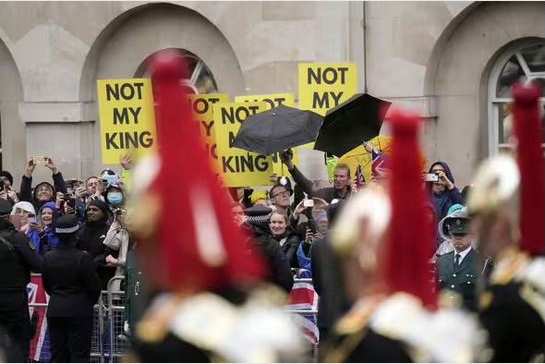
That was from Matt Gurney’s sleep-deprived view of the procession from The Line (that’s not editorializing on my part — he hadn’t slept on the plane from Toronto and got to London at 7am on Coronation Day). In what seemed like a useful break in the public celebrations, he snuck away to get some sustenance and be out of the rain for a bit. When he returned it was lowlight time for the Republicans:
After I’d polished off the pint, I headed back out, back to the square, and that’s where things got interesting. I figured I’d get back to my former spot near the chanting republicans, and did so, no problem. But I noticed there suddenly seemed to be an awful lot of cops around … all heading that way. As in: right toward me, and the chanting people I was standing near. Oops. I left, working my way around the crowd, heading back the way I came from my hotel, and found myself actually facing a rank of advancing cops. Oops again. One had a badge that said inspector, and I walked right up and told him I was a Canadian journalist just watching things. He grinned at me and said, “Alright, mate, come this way,” and had a security guard walk me through the police. I thus ended up missing what has proven to be a controversial event and perhaps the only unhappy moment I know of during the coronation, at least in my area: a bunch of the chanting republicans were arrested just moments after I got out of dodge, and then large metal screen barriers were thrown up, closing off the square due to, apparently, overcrowding. People could leave but no one new could enter.
My sense, as I walked away, was that there was no reason to arrest anyone. (And as I said, this is proving controversial.) I hadn’t seen anything getting out of hand. There had been some chanting and counter-chanting and even some heckling back and forth, but it had all seemed in good enough spirits. Even some of the boos sent at the republicans — two young men with flags had been hamming it up in the main crowd, apart from the main blob of republicans — had seemed in good humour. I don’t know what the police saw or knew. But I couldn’t tell you why they’d moved then and not before, or later. As for overcrowding, I don’t think so. The square really wasn’t all that full. It seemed less full at that moment than it had been when the procession had passed on the way to the abbey. But the barriers seemed to go up quickly, everywhere. Literally everywhere.
And though I was glad to have avoided getting caught up in the Cops vs. Chanting Republicans, I was now on the wrong side of the barriers.
In The Critic, Kittie Helmick recounts finding herself in the vicinity of the “NOT MY KING!” group:
“You seem to find this whole thing rather amusing,” snapped a short angry man with a Not My King sign, about half an hour into the Republic protest against the coronation of King Charles III. I must admit I did. Kettled into a small enclave just off Trafalgar Square, an angry swell of old school socialists, Twitter anarchists, Lib Dem mums, eccentric vicars, boomer hippies, blue haired students and Covid conspiracists had somehow found themselves part of the coronation spectacle. Before the bells of St Martin in the Fields, the full shouty brunt of British republicanism was aimed at a bewildered stream of Chinese tourists and young families out for a day in London.
The survival of the British monarchy is one of the great wonders of modern history. Spending the morning of the coronation with Republic, it began to seem less mysterious. Despite everything in recent years, the Monarchy is still liked more than most of our institutions and probably every one of our elected politicians. No one gathered there could really explain why. The arguments were articulated in between the shouty chanting: things about “modern Democracy” and a “family of Lizards”, none of which quite landed the blow as the day unfolded around us.
Somewhere beyond the crowds, towards Westminster Abbey, an ageing, eccentric dandyish farmer, who secretly wants to be King of Transylvania, was being anointed in holy oil and crowned by an Archbishop wearing hearing aids in a seven hundred year old chair vandalised by 18th century schoolboys. All the while this ceremony was being fawned over across the world by everyone from Kay Burley to one of the world’s most remote tribes. None of it made sense, and that is precisely the point.
Earlier that morning, the CEO of Republic Graham Smith, a man not even the protestors could name, achieved the greatest success of his kind since Cromwell, by being arrested at the hands of the jobsworth Met. For a brief moment, a shiver of excitement spread through the protest. Whilst the country was entranced by a fugue of sombre ritual and Zadok the Priest, Republic were experiencing their own desired reality unfold on the streets of London. Here was a police state enforcing the will of a “politically illiterate” nation brainwashed by bunting and tabloid journalism. The mask was finally off. The incoherent gaggle of shouty slogans and reddit thread arguments made sense. The fight was here and now.
Except that was all a fantasy too. As stupid as the arrests were, nothing could disguise the fact this was a fringe event for a movement that just can’t seem to take off — a Coronation curio to gawp at. “They’re a bunch of wronguns, aren’t they?” said one bored steward to me as we watched a man larping Les Miserables as he chanted Not My King at a trio of giggling Chinese students. The deeper I dug into the many arguments and protestations offered as an alternative to the “fairytale” of monarchy, the more the core transgressive energy of British republicanism revealed itself. It is itself strangely twee and fantastical. Rid us of the Royals, and everything will become better. Gone will be the “psychological baggage” of Britain’s past holding us back. Democracy will triumph. The crown jewels will be sold off and spent on food banks. The plebs will not worship hereditary blood, but NHS rainbows. Britain will become less racist, elitist and classist. The left might even win an election. We could have a poet president like Ireland, a Lineker or a Stormzy shaking hands with the American president.
May 6, 2023
Face-palm-worthy Coronations of the past
I’m sure almost everyone — except the tiny number of Republicans in England — hopes for a smooth and spectacular Coronation for His Majesty King Charles III, there are plenty of examples of past Coronations that were anything but:
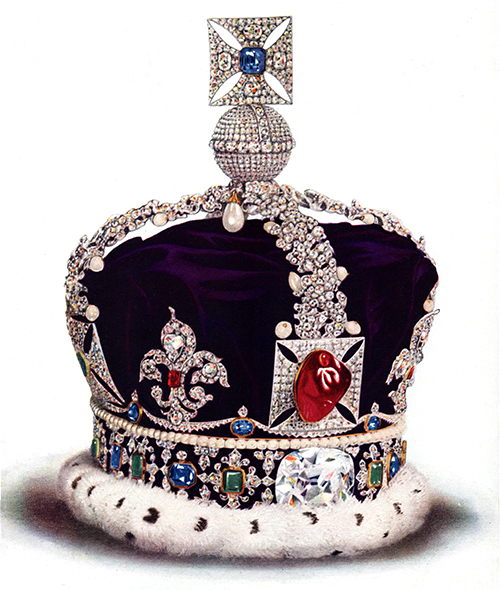
The Imperial State Crown, worn by the British monarch in the royal procession following the Coronation and at the opening of Parliament.
Wikimedia Commons.
Whereas so many traditions are 19th-century inventions, as any student of history knows, the coronation of Britain’s monarch is a rare example of a truly ancient custom, dating to the 10th century in its structure and with origins stretching back further, to the Romans and even Hebrews. As Tom Holland said on yesterday’s The Rest is History, it is like going to a zoo and seeing a woolly mammoth.
It is a sacred moment when the sovereign becomes God’s anointed, an almost unique state ceremony in a secular world. The custom originates with the late Roman emperors, associated with Constantine the Great and certainly established by the mid-fifth century in Constantinople. In the West, and following the fall of that half of the empire, barbarian leaders were eager to imitate imperial styles (a bit like today). Germanic and Celtic tribes had ceremonies for new leaders in which particular swords were displayed, a feature of later rites, but as they developed the practice of kingship, so their rituals began to imitate the Roman form.
[…]
Athelstan, the first king of England, had been crowned in 925 at Kingston, a spot where seven kings of England had been enthroned. Perhaps the most notorious was Edwig, a 16-year-old whose proto-rock star qualities were not appreciated at the time of his coronation in 955. Indeed he failed to turn up, and when Bishop Dunstan marched to the king’s nearby quarters to drag him along, he found the teenager in bed with a “strumpet” and the strumpet’s mother.
However, Edwig died four years later, and Dunstan was elevated to Canterbury, became a saint and, through chronicles recorded by churchmen, got his version of history.
This reign might seem impossibly distant and obscure, yet it was under Edwig’s brother Edgar that the current coronation format was established. Edgar was a powerful king, and the last of the Anglo-Saxon rulers to live a happily Viking-free existence. His coronation on 11 May 973 was an illustration of his strength, and also his aspirations. Held at Bath, most likely because of its association with Rome, it involved a bishop placing the crown on the king’s head, in the Carolingian style, and would become the template for the ceremony for his direct descendent Charles III.
But not all coronations would run so smoothly. After Edgar’s death his elder son Edward was killed in possibly nefarious circumstances, and his stepmother placed her son Ethelred on the throne. Ethelred’s reign was plagued by disaster, and it was later said in the chronicles — the medieval equivalent of “and then the whole bus clapped” Twitter tales — that Bishop Dunstan lambasted the boy-king for “the sin of your shameful mother and the sin of the men who shared in her wicked plot” and that it “shall not be blotted out except by the shedding of much blood of your miserable subjects”.
This would have been merely awkward, whereas many coronations ended in riot or bloodshed. The most notorious incident in English history occurred on Christmas Day 1066: Duke William got off to a bad start PR-wise when his nervous Norman guards mistook cheers for booing and began attacking the crowd, before setting fire to buildings.
[…]
Perhaps the most scandalous coronation took place at the newly completed St Paul’s Cathedral in February 1308. The young queen, Isabella, was the 12-year-old daughter of France’s King Philippe Le Bel, and had inherited her father’s good looks, with thick blonde hair and large blue, unblinking eyes. Her husband, Edward II, was a somewhat boneheaded man of 24 years whose idea of entertainment was watching court fools fall off tables.
It was a fairy tale coronation for the young girl, apart from a plaster wall collapsing, bringing down the high altar and killing a member of the audience, and the fact that her husband was gay and spent the afternoon fondling his lover Piers Gaveston, while ignoring her. Isabella’s two uncles, who had made the trip from France, were furious at the behaviour of their new English in-law, though perhaps not surprised.
[…]
One of the most disastrous coronations occurred during the Hundred Years’ War. Inspired by Joan of Arc, in 1429 the French had beaten the English at the Battle at Patay, after which their leader Charles VII entered Reims and was crowned at the spot where the kings of France had been enthroned for almost a thousand years. In response, on 26 December 1431 the English had their candidate, the 10-year-old Henry VI, crowned King of France at Notre-Dame in Paris, where one road was turned into a river of wine filled with mermaids, and Christmas plays were performed on an outdoor stage.
Unfortunately, the coronation was a complete mess. The entire service was in English, the weather was freezing, the event rushed, too packed, filled with pickpockets, and worst of all the English made such bad food that even the sick and destitute at the Hotel-Dieu complained they had never tasted anything so vile.
April 24, 2023
Even fighter pilots and gunners have love lives
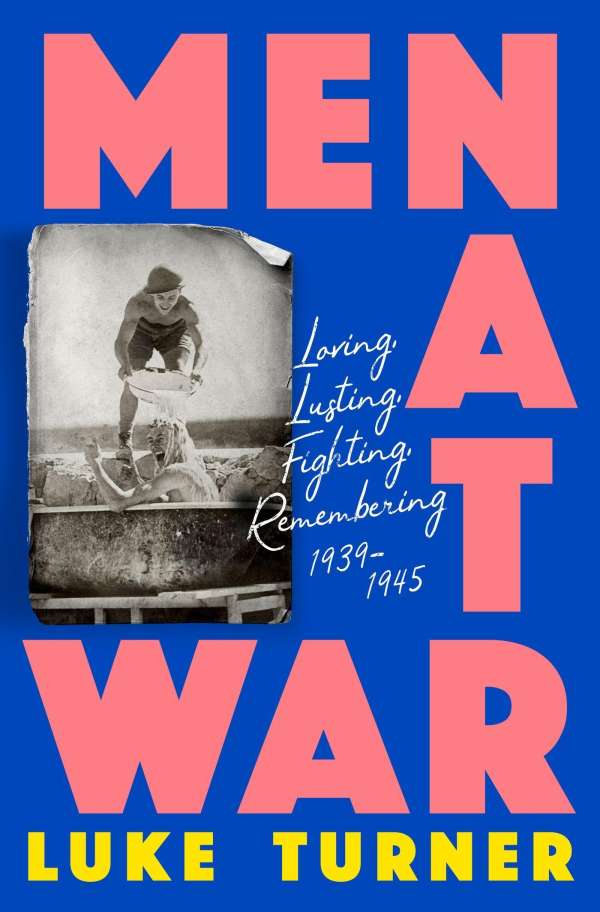
In The Critic, John Sturgis reviews a new book by Luke Turner titled Men at War: Loving, Lusting, Fighting, Remembering 1939-1945, which considers the myths and reality of wartime relationships during the Second World War:
Spitfire pilot Ian Gleed shot down five enemy aircraft in just a week in May 1940 — the fastest time in which this had ever been done, making him an official “ace” who would be quickly promoted to Wing Commander.
Gleed had become a poster boy for “the few”, the hero pilots of the Battle of Britain to whom so many would owe so much. He lived up to the popular image with his talk of “a bloody good show” and shooting down “damned Huns”, after which he’d sink a few warm beers and spend some “wizard” free time recuperating with his girlfriend Pam, whom he “loved now more than ever”.
Gleed’s luck finally ran out over Tunisia in April 1943 when his plane was hit by a German fighter and crashed into dunes. Gleed was killed. He was just 26.
It would only emerge decades later that much of the popular image he had cultivated simply wasn’t true. Gleed was gay. Pam was an imaginary character he had invented as a cover to keep his double life as a sexually active homosexual firmly secret.
Gleed’s story is one of many similar vignettes in this alternative history of the Second World War. Its author Luke Turner’s previous book was a memoir about his own grappling with issues around his identity as a bisexual. Here he takes up the question of how this would have played out for him and other sexual non-conformists in 1939–45.
Turner grew up obsessed with the war — everything from Airfix kits and Dad’s Army to Stalingrad and the Berlin bunker — and here he examines what it was to live through that period as a sexually active person of whatever hue. It proves a particularly rich subject matter as sex seems to have been everywhere in war time: everyone was sleeping with everyone else, apparently. It’s a perennial truth that you or I might be hit by a bus tomorrow — but make that bus a bomb, and suddenly this seems to create a sense of urgency which frequently manifests itself sexually, lending daily life what Turner calls “an aphrodisiac quality”. As Quentin Crisp put it when describing the shenanigans in blacked-out, Blitz London: “As soon as the bombs started to fall, the city became like a paved double bed.”
Whilst war may see an explosion of sex of all kinds, the establishment was not always comfortable with this. A Home Office report on public behaviour in London during the Blitz noted, “In several districts cases of blatant immorality in shelters are reported; this upsets other occupants of the shelters.”
One contemporary account suggests, “In wartime a uniform, whether of the Army, Navy or Air Force, to the average girl ranks as a fetish.” This had consequences in the field: Dear John letters from home could be a real problem in this regard. As an Army report in 1942 put it, morale is often damaged by “the suspicion, very frequently justified, of fickleness on behalf of wives and girls”.
Amongst all this sex was, of course, sex with Americans. Turner cites George Formby who captured this mood in the song “Our Fanny’s Gone All Yankee”: “She don’t wait for the dark when she wants to have a lark/In a bus or train she does her hanky panky.”
Then in a dark reversal of this two-nations-colliding-sexually motif, we get the horror of the Red Army’s organised rape of as many as 1.4 milllion German women during the Russian advance on Berlin, whose residents would later refer to the city’s grandiose monument to Soviet war dead as “the tomb of the unknown rapist”.
April 13, 2023
A Brief History of Gin
No Nonsense Gin Drinking
Published 21 Jul 2019Pay attention class! No running, shouting or talking at the back! It’s time to learn all about gin!
(more…)
February 4, 2023
A lobster tale (that does not involve Jordan Peterson)
In the latest Age of Invention newsletter, Anton Howes relates some of his recent research on the Parliament of 1621 (promising much more in future newsletters) and highlights one of the Royal monopolies that came under challenge in the life of that Parliament:

European lobster (Hommarus gammarus)
Photo by Bart Braun via Wikimedia Commons.
One of the great things about the 1621 Parliament, as a historian of invention, is that MPs summoned dozens of patentees before them, to examine whether their patents were “grievances” — illegal and oppressive monopolies that ought to be declared void. Because of these proceedings, along with the back-and-forth of debate between patentees and their enemies, we can learn some fascinating details about particular industries.
Like how 1610s London had a supply of fresh lobsters. The patent in question was acquired in 1616 by one Paul Bassano, who had learned of a Dutch method of keeping lobsters fresh — essentially, to use a custom-made broad-bottomed ship containing a well of seawater, in which the lobsters could be kept alive. Bassano, in his petitions to the House of Commons, made it very clear that he was not the original inventor and had imported the technique. This was exactly the sort of thing that early monopoly patents were supposed to encourage: technological transfer, and not just original invention.
The problem was that the patent didn’t just cover the use of the new technique. It gave Bassano and his partners a monopoly over all imported lobsters too. This was grounded in a kind of industrial policy, whereby blocking the Dutch-caught lobsters would allow Bassano to compete. He noted that Dutch sailors were much hardier and needed fewer provisions than the English, and that capital was available there at interest rates of just 4-5%, so that a return on sales of just 10% allowed for a healthy profit. In England, by comparison, interest rates of about 10% meant that he needed a return on sales of at least 15%, especially given the occasional loss of ships and goods to the capriciousness of the sea — he noted that he had already lost two ships to the rocks.
At the same time, patent monopolies were designed to nurture expertise. Bassano noted that he still needed to rely on the Dutch, who were forced to sell to the English market either through him or by working on his ships. But he had been paying his English sailors higher wages, so that over time the trade would come to be dominated by the English. (This training element was a key reason that most patents tended to be given for 14 or 21 years — the duration of two or three apprenticeships — though Bassano’s was somewhat unusual in that it was to last for a whopping 31.)
But the blocking of competing imports — especially foodstuffs, which were necessaries of life — could be very controversial, especially when done by patent rather than parliamentary statute. Monopolies could lawfully only be given for entirely new industries, as they otherwise infringed on people’s pre-existing practices and trades. Bassano had worked out a way to avoid complaints, however, which was essentially to make a deal with the fishmongers who had previously imported lobsters, taking them into his partnership. He offered them a win-win, which they readily accepted. In fact, the 1616 patent came with the explicit support of the Fishmongers’ Company.
It sounds like it became a large enterprise, and I suspect that it probably did lower the price of lobsters in London, bringing them in regularly and fresh. With a fleet of twenty ships, and otherwise supplementing their catch with those caught by the Dutch, Bassano boasted of how he was able to send a fully laden ship to the city every day (wind-permitting). This stood in stark contrast to the state of things before, when a Dutch ship might have arrived with a fresh catch only every few weeks or months, and when they felt that scarcity would have driven the prices high.
January 8, 2023
The (historical) lure of London
In the latest Age of Invention newsletter, Anton Howes considers the puzzle that was the phenomenol growth of London, even at a time that England had a competitive advantage in agricultural exports to the continent:
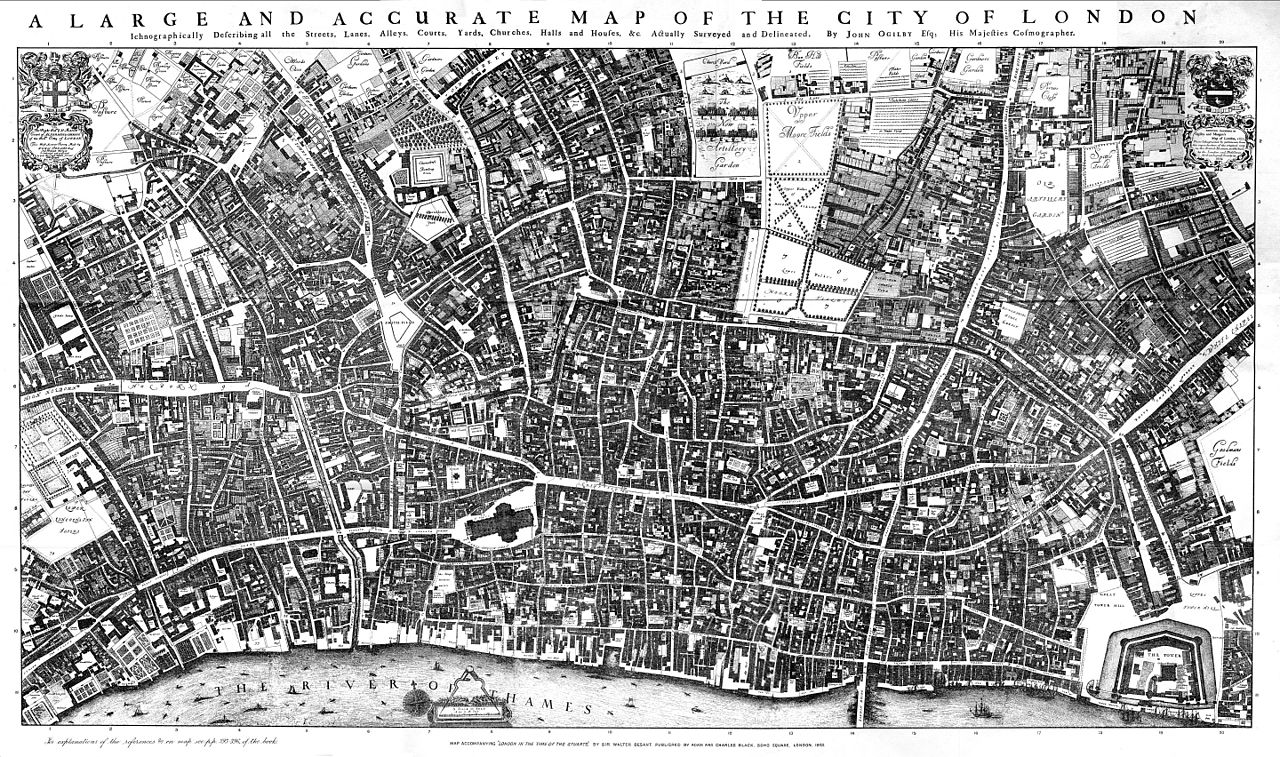
Ogilby & Morgan’s Map of London, 1677.
Scanned copy of reproduction in Maps of Old London (1908).
… the extraordinary inflow of migrants to London in the period when it grew eightfold — from an unremarkable city of a mere 50,000 souls in 1550, to one of the largest cities in Europe in 1650, boasting 400,000. I’ve written about that growth a few times before, especially here. It may not sound like much today, but it has to be one of the most important facts in British economic history. It is, in my view, the first sign of an “Industrial Revolution”, and certainly the first indication that there was something economically weird about England. It requires proper explanation.
In brief, the key question is whether the migrants to London — almost all of whom came from elsewhere in England — were pushed out of the countryside, thrown off their land thanks to things like enclosure, or pulled by London’s attractions.
I think the evidence is overwhelmingly that they were pulled and not pushed:
- The English rural population continued to grow in absolute terms, even if a larger proportion of the total population made their way to London. The population working in agriculture swelled from 2.1 million in 1550 to about 3.3 million in 1650. Hardly a sign of widespread displacement.
- As for the people outside of agriculture, many remained in or even fled to the countryside. In the 1560s, for example, York’s textile industry left for the countryside and smaller towns, pursuing lower costs of living and perhaps trying to escape the city’s guild restrictions. In 1550-1650, the population engaged in rural industry — largely spinning and weaving in their homes — swelled from about 0.7 to 1.5 million. Again, it doesn’t exactly suggest rural displacement. If anything, the opposite.
- There were in fact large economic pressures for England to stay rural. England for the entire period was a net exporter of grain, feeding the urban centres of the Netherlands and Italy. The usual pattern for already-agrarian economies, when faced with the demands of foreign cities, is to specialise further — to stay agrarian, if not agrarianise more. It’s what happened in much of the Baltic, which also fed the Dutch and Italian cities. Despite the same pressures for England to agrarianise, however, London still grew. To my mind, it suggests that London had developed an independent economic gravity of its own, helping to pull an ever larger proportion of the whole country’s population out of agriculture and into the industries needed to supply the city.
- As for the supposed push factor, enclosure, the timing just doesn’t fit. Enclosure had been happening in a piecemeal and often voluntary way since at least the fourteenth century. By 1550, before London’s growth had even begun, by one estimate almost half of the country’s total surface had already been enclosed, with a further quarter gradually enclosed over the course of the seventeenth century. A more recent estimate suggests that by 1600 already 73% of England’s land had been enclosed. As for the small remainder, this was mopped up by Parliament’s infamous enclosure acts from the 1760s onwards — much too late to explain London’s population explosion.
- Perhaps most importantly, people flocked specifically to London. In 1550 only about 3-4% of the population lived in cities. By 1650, it was 9%, a whopping 85% of whom lived in London alone. And this even understates the scale of the migration to the city, because so many Londoners were dropping dead. It was full of disease in even a good year, and in the bad it could lose tens of thousands — figures equivalent or even larger than the entire populations of the next largest cities. Waves upon waves of newcomers were needed just to keep the city’s population stable, let alone to grow it eightfold. In the seventeenth century the city absorbed an estimated half of the entire natural increase in England’s population from extra births. If England’s urbanisation had been thanks to rural displacement, you’d expect people to have flocked to the closest, and much safer, cities, rather than making the long trek to London alone.
It’s this last point that I’ve long wanted to flesh out some more. The further people were willing to trek to London, the more strongly it suggests that the city had a specific pull. I’d so far put together a few dribs and drabs of evidence for this. Whereas towns like Sheffield drew its apprentices from within a radius of about twenty miles, London attracted young people from hundreds of miles away, with especially many coming from the midlands and the north of England. Indeed, London’s radius seems to have shrunk over the course of the seventeenth century, suggested that they came from further afield during the initial stages of growth. Records of court witnesses also suggest that only a quarter of men in some of London’s eastern suburbs were born in the city or its surrounding counties.
January 6, 2023
This is the most interesting roof in London
Tom Scott
Published 5 Sep 2022The @Royal Albert Hall is 150 years old; the roof is 600 tonnes of glass and steel. And it turns out that there’s a terrifying technicians’ trampoline, acoustic-dampening mushrooms, and a complete lack of connections.
(more…)
December 15, 2022
“Intense staring” aka the “Toxic Male Gaze” on the London Underground
Jennie Cummings-Knight on a recent publicity campaign to discourage male passengers on the London Underground from “intense staring”:
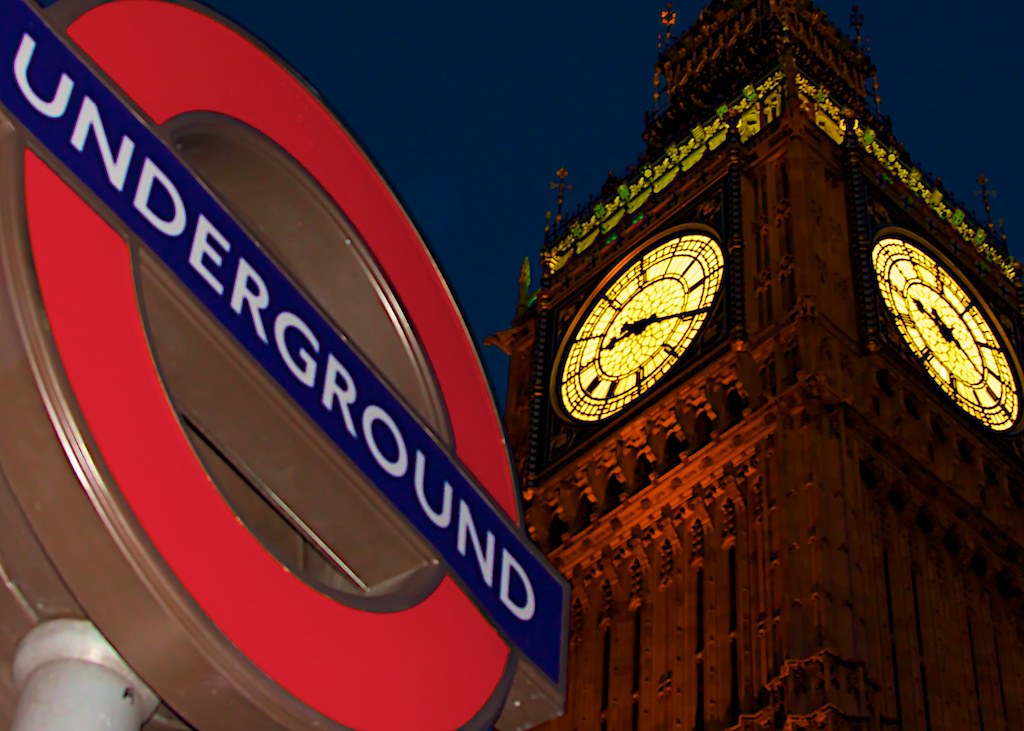
“London underground” by @Doug88888 is licensed under CC BY-NC-SA 2.0 


 .
.
… there might be reasons that a man stares intensely without sexual intent. For example, he could have autism and not really understand his behaviour might be considered as “staring”. Or he might be short sighted, or daydreaming about his holiday. Moreover, London Transport trains are used by people of all kinds from all over the world, including ordinary people from countries where staring is not seen as threatening e.g. in Spain. Indeed people in the UK are relatively comfortable with eye-contact, though those from outside London might not be aware that in the confined spaces of the London Underground “tube” trains, people tend to be unusually sensitive to eye contact. Although London Transport’s idea may be well intentioned, it doesn’t seem to take these individual and cultural differences into account. Perhaps its main effect will be to make women excessively worried about being stared at, and make men excessively worried about being jailed for accidentally looking at a woman in the “wrong” way.
But there are many layers to this issue. Speaking as a woman, I am always fascinated by the double standards exhibited by women with respect to male behaviour. We are only interested in being looked at by men if we find the said man or men to be attractive to us. This means that we can be potentially offended by the gaze of any man who falls into the following short list:
- Men we don’t know
- Men who we don’t find attractive
- Men who we feel are “punching above their weight” with regard to giving us their attention in this way
At the same time, the curious paradox is that, in spite of our assertions that we don’t need male attention (see the Toy Story 4 Bo Beep character, developed by feminist writers) and that we want to be taken seriously as we pursue our careers, we still take a lot of trouble to look attractive to men. This behaviour can start very young and persist into later adulthood. Teenage girls growing up in the 2000s are still hitching up their skirt waistbands as they come out of school on an afternoon. Teenage girls clubbing at the weekend still dress as provocatively as possible (if the ones I see on late night trains on a regular basis are anything to go by). Why dress in this way if we don’t want to be looked at?
I would suggest that the need to be seen by the male is deeply wired in the subconscious of most women. Sadly, girls as young as 9 years old are worrying about the shape of their intimate private parts. The fact is that women are having more cosmetic procedures than ever before in order to look the most attractive that they can. Men are having more cosmetic procedures too, but not to the same degree. Women who are only attracted to women seem, in my experience, to be less concerned with their physical attractiveness per se and more concerned with dressing in a way that fits in with lesbian group culture.
If we truly believe that we are liberated females, how is it that we are still so obsessed with having the perfect body/and or face? Where does this female need “to be seen” come from? On one level, what they do not realise is that they are looking for “ideal shapes” imagined at least in part, by the porn industry. On another level, if we look at evolutionary history, we see that male and female roles are rooted in survival behaviours appropriate to a hunter/gatherer society, and to the safe nurturing of children. The men were the hunters looking out for prey, and women were tied closer to the homestead because of child rearing. The more inward “yin” role for women, arising from their nurturing role and the physicality of the growth of the baby inside the woman’s body, followed by the nourishment in the early months from her body for the baby, has resulted in women being especially responsive to touch.
Men on the other hand, tend to be more visually aroused, and have an inborn, primeval need to look outwards (the outward thrusting nature of “yang”) which includes looking at the female. In the same way, the need to look around the field when hunting results in looking at whatever is in their peripheral vision. It is simply not possible for a man to stop looking at women unless he goes against this instinctive behaviour and keeps his eyes to the ground. If he does this, he may then also miss other visual cues which give him important information about dangers around and in front of him.
November 5, 2022
Repost: Remember, Remember the Fifth of November
Today is the anniversary of the Gunpowder Plot:
Everyone knows what the Gunpowder Plotters looked like. Thanks to one of the best-known etchings of the seventeenth century we see them “plotting”, broad brims of their hats over their noses, cloaks on their shoulders, mustachios and beards bristling — the archetypical band of desperados. Almost as well known are the broad outlines of the discovery of the “plot”: the mysterious warning sent to Lord Monteagle on October 26th, 1605, the investigation of the cellars under the Palace of Westminster on November 4th, the discovery of the gunpowder and Guy Fawkes, the flight of the other conspirators, the shoot-out at Holbeach in Staffordshire on November 8th in which four (Robert Catesby, Thomas Percy and the brothers Christopher and John Wright) were killed, and then the trial and execution of Fawkes and seven others in January 1606.
However, there was a more obscure sequel. Also implicated were the 9th Earl of Northumberland, three other peers (Viscount Montague and Lords Stourton and Mordaunt) and three members of the Society of Jesus. Two of the Jesuits, Fr Oswald Tesimond and Fr John Gerard, were able to escape abroad, but the third, the superior of the order in England, Fr Henry Garnet, was arrested just before the main trial. Garnet was tried separately on March 28th, 1606 and executed in May. The peers were tried in the court of Star Chamber: three were merely fined, but Northumberland was imprisoned in the Tower at pleasure and not released until 1621.
[. . .]
Thanks to the fact that nothing actually happened, it is not surprising that the plot has been the subject of running dispute since November 5th, 1605. James I’s privy council appears to have been genuinely unable to make any sense of it. The Attorney-General, Sir Edward Coke, observed at the trial that succeeding generations would wonder whether it was fact or fiction. There were claims from the start that the plot was a put-up job — if not a complete fabrication, then at least exaggerated for his own devious ends by Robert Cecil, Earl of Salisbury, James’s secretary of state. The government’s presentation of the case against the plotters had its awkward aspects, caused in part by the desire to shield Monteagle, now a national hero, from the exposure of his earlier association with them. The two official accounts published in 1606 were patently spins. One, The Discourse of the Manner, was intended to give James a more commanding role in the uncovering of the plot than he deserved. The other, A True and Perfect Relation, was intended to lay the blame on Garnet.
But Catesby had form. He and several of the plotters as well as Lord Monteagle had been implicated in the Earl of Essex’s rebellion in 1601. Subsequently he and the others (including Monteagle) had approached Philip III of Spain to support a rebellion to prevent James I’s accession. This raises the central question of what the plot was about. Was it the product of Catholic discontent with James I or was it the last episode in what the late Hugh Trevor-Roper and Professor John Bossy have termed “Elizabethan extremism”?
October 14, 2022
That time that H.G. Wells fell afoul of Muslim sentiments
In the New English Review, Esmerelda Weatherwax recounts an incident from the 1930s where Muslim protestors took to the streets of London in reaction to a recent Hindustani translation of H.G. Wells’ A Short History of the World:
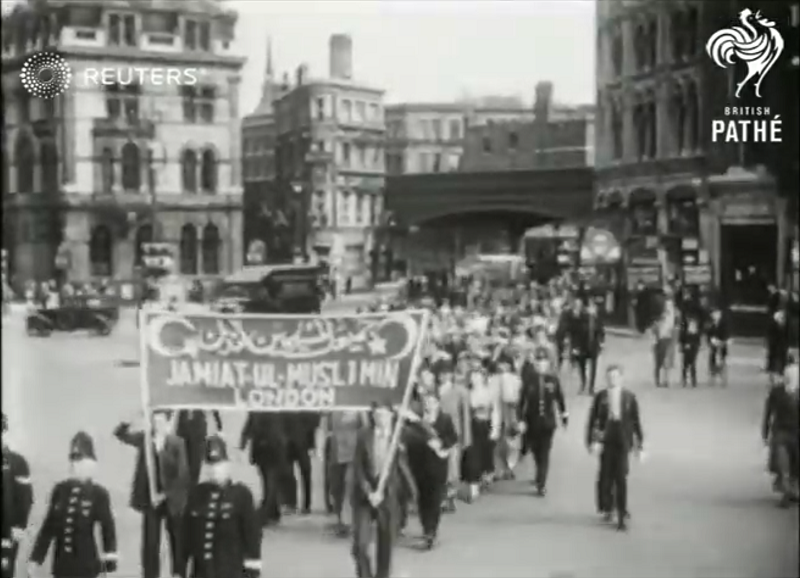
Screen capture of the 1938 Muslim protest march in London from a British Pathé newsreel – https://www.youtube.com/watch?v=ADausiEe4pM
… my husband was at the Museum of London and spotted a very brief mention of this protest in 1938 on a list of 20th century London events. I did some research.
The book they objected to was HG Wells’ A Short History of the World. This was originally published in 1922 but in 1938 an abridged version was tranlated into Hindustani and published in India. His observations about the Prophet Mohammed did not find favour with Indian Muslims (and as you know pre-partition the area called India covered what is now Pakistan and Bangladesh). There were protest meetings in Calcutta and Mumbai (then transliterated as Bombay) and the consignments of the books that WH Smith the booksellers sent to Hyderabad mysteriously never arrived. Investigation showed that the Sind government banned its import. Protests spread to east Africa and were reported in Nairobi and Mombasa.
The paragraphs concerned said “He seems to have been a man compounded of very considerable vanity, greed, cunning, self-deception, and quite sincere religious passion”. Wells concludes, not unfavourably, that “when the manifest defects of Muhammad’s life and writing have been allowed for, there remains in Islam, this faith he imposed upon the Arabs, much power and inspiration”.
There had been a number of Muslims living in east London for some years, sailors who came through the docks, retired servants, some professional men and in 1934 they formed a charitable association for the promotion of Islam called Jamiat-ul-Muslimin; they met on Fridays at a hall in Commercial Road.
On Friday 12th August 1938 a copy of A Short History of the World was, as apparently reported in the Manchester Guardian the following day “ceremoniously burned”. The main Nazi book burnings were over 5 years previously but I can’t but be reminded of them. I can’t access the Guardian on-line archive for 1938 as I don’t have a subscription, but I have no reason to doubt what they reported.
A few days later Dr Mohammed Buksh of Jamiat-ul-Muslimin attended upon Sir Feroz Khan Noon, the high commissioner for India. Sir Feroz tried to explain that in Britain we could (or could then) freely criticise Christianity, the Royal family and government as a right. He reminded Dr Buksh that Muslims were “a very small minority in England, and it would do them no good to try and be mischievous in this country, no matter how genuine their grievances were”.
October 5, 2022
The Amusing Inspiration Behind Dire Straits Classic 70s Hit | Professor of Rock
Professor of Rock
Published 16 Jun 2021The story of the 1979 classic “Sultans of Swing” by Dire Straits. Mark Knopfler was inspired to write the song after witnessing a band playing Dixieland Jazz in a dive bar.
Hey music junkies and vinyl junkies Professor of Rock always here to celebrate the greatest artists and the greatest 70s vinyl songs of all time for the music community and vinyl community.
If you’ve ever owned records, cassettes and CD’s at different times in you life or still do this is your place Subscribe below right now to be a part of our daily celebration of the rock era with exclusive stories from straight from the artists and click on our patreon link in the description to see our brand new show there.
Mark Knopfler was performing in London’s pub scene in the mid 70s, living on next to nothing in a flat with aspiring bassist John Illsley. Knopfler’s younger brother, David, introduced him to Illsley, following the dissolution of Mark’s first marriage. Mark, John, and David teamed up with “Pick” Withers, another London area musician, to form a group they aptly named Dire Straits.
The 4 members all had day jobs, but they lived a “hand to mouth” existence — struggling to pay their utilities bill. One rainy evening, Mark & a few friends decided to go to a nearby pub for a couple of pints in a dilapidated (dih-lap-ih-dated) section of South London. The pub was nearly empty, except for a couple of guys playing pool. In a corner of the bar, a band was playing — seemingly unaffected by the lack of an audience.
The band was “blowing Dixie — double-four time” as Knopfler would later transcribe. “Dixie double” is a performance style that was popularized by Django (jang-go) Reinhardt (rain-hart), and in the early days of Les Paul — where the guitar, bass, and drums are played harmoniously at a very fast pace.
If you’re playing “Dixie double-four time” as Knopfler describes in “Sultans of Swing”, you are playing twice the speed of the normal 4/4 time, and the drummer is working extra hard to keep up with the tempo. Knopfler remembered asking the hapless Dixie outfit to play “Creole Love Call” or “Muskrat Ramble”, much to the band’s delight, because they were undoubtedly shocked that someone in the pub actually knew some of the songs in their repertoire.
At the end of the band’s performance, the leader announced triumphantly to the 3-4 people in attendance … “We are the Sultans of Swing!”, as if they were playing in front of a packed house of ardent fans. Mark found the irony of the scene very amusing; a frumpy looking band playing a hole in the wall pub in a dodgy part of town, declaring themselves “the sultans of swing”.
To be a “sultan” would be to rule over a country, or hold a dynasty over people. The term originated from the Arabic language meaning to have “authority” or “rulership” over others. The true “Sultans of Swing” would’ve been the “swing” genre’s originator Fletcher “Smack” Henderson in the late 20s & 30s, or one of his revered disciples, Duke Ellington & Benny Goodman.
Babe Ruth and the Yankees legendary murderers row of the 20s if you’re talking baseball.
(more…)
September 1, 2022
QotD: The origins of the Bloody Mary
All the best bars serve Bloody Marys. But the best Bloody Mary is served in The Grenadier, the one-time officers’ mess of the Foot Guards and the long-time public house in Wilton Row, Belgravia. Pass beneath the low lintel of this tiny tavern, pick your way through the crowded tap room and press up against the burr mahogany bar to order the world’s premier pick-me-up.
[…]
The Grenadier is rightly proud of its reputation for restorative remedies and particularly this one. Into the glass go vodka, and a sizeable slug (preferably Stolichnaya), a stirrup of sherry (the secret weapon), tomato juice, then spices (Tabasco and Worcestershire sauce), citron (lemon or lime) and salt to personal taste. The addition of a celery stick is entirely superfluous but for those in search of their hair of the dog, a little light salad I suppose is a help — of sorts.
Yet this pub, though an historic watering hole, cannot claim to be the home of the Mary. That right is retained across the Channel in Paris by Harry’s New York Bar. There exactly a century ago in the City of Light, Fernand Petiot, perfected his “bucket of blood”. The name was soon changed to something a little less Madame la Guillotine and the Mary as we know it was born.
Christopher Pincher, “Hail Mary”, The Critic, 2022-05-30.
August 24, 2022
“A spectre is haunting Britain – the spectre of whingers”
A pub that was partially an inspiration for George Orwell’s description of the “perfect pub” is under threat from post-covid NIMBY complaints:
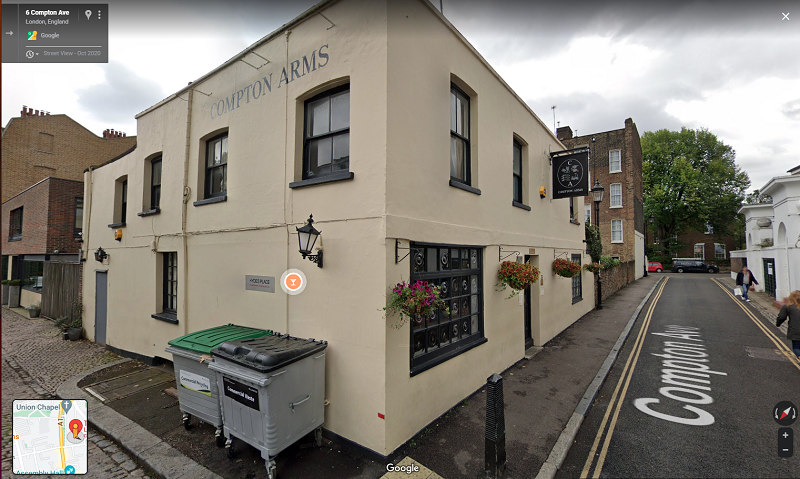
Google street view of the Compton Arms in Islington.
George Orwell’s favourite pub could be closed down because four neighbours have moaned about the noise.
A spectre is haunting Britain – the spectre of whingers. The dead hand of NIMBYism is felt on so many of our national crises, from the housing crisis to the “drought” to the energy crisis. The comfortably off classes have fought tooth and nail, all too successfully, in recent decades to block the building of anything – from houses to reservoirs – that might make life easier for everyone else. But their killjoy war on pubs might just be their most grating accomplishment.
The Compton Arms in Islington is the latest pub, still struggling in the wake of lockdown and now faced with soaring energy costs, to be threatened with closure over a handful of complaints. It’s been open since the 1800s. George Orwell drank there and it reportedly inspired his essay “The Moon Under Water”, published in the Evening Standard in 1946, which laid out his idea of the perfect pub. Now it has been slapped with a licence review by the local council after four neighbours complained that it was a “public nuisance” and posed a danger to health.
Given the Compton Arms was just voted the second-best pub in the UK by Time Out, with a review that hails its “seasonally led” “small-plates menu”, it seems unlikely to have become some den of criminal depravity. The furious explanation of Nick Stephens, the pub’s owner, seems more plausible – that some killjoys on this well-to-do Highbury side street got used to the pub being shut during lockdown and are now throwing their toys out of the pram.
“Our managers have gone to extreme lengths and worked their socks off to run the pub considerately (and exceptionally) – in spite of some more than challenging behaviour from some of the four complainants”, Stephens posted on Facebook. “A minority get used to the quiet then decide the pub that’s been there since the 1800s, that is an asset of community value, is now a nuisance.” He says that if this “minority of four” succeeds, the Compton won’t be financially viable “for us … or any other responsible operator”.
This is a story we have seen playing out time and again across the UK. An unholy alliance of whingers and council bureaucrats are shutting down and imposing punishing restrictions on much-loved pubs, stopping them from staying open later or blocking the opening of new venues over often ludicrous claims of noise and disruption. There seems to have been a particular flurry of this in recent months, following the end of lockdown and the entrenchment of working from home.


