
The Tank Museum
Published 2 Sep 2022Join Curator David Willey in his latest Tank Chat as he delves into the Springer, a German demolition vehicle.
(more…)
January 5, 2023
Tank Chats #162 | Springer | The Tank Museum
Comments Off on Tank Chats #162 | Springer | The Tank Museum
January 4, 2023
The First Modern Military Rifle: The Modele 1886 Lebel
Forgotten Weapons
Published 5 Dec 2017The Lebel was a truly groundbreaking development in military small arms, being the first rifle to use smokeless powder. This gave it — and in turn the French infantry — a massive advantage in range over everyone else in the world at the time. This advantage was short-lived, but the French did their best to exploit it.
French chemist Paul Vielle successfully developed his smokeless powder (“poudre B“) formula in 1884, and French ordnance spent 1885 experimenting with different calibers of small bore bullet to see what would work best. They also began looking at rifle actions to use, including specifically the Remington-Lee and the Mannlicher. However, a new Minister of War was appointed in January of 1886 and he demanded a completed prototype rifle and ammunition be completed by May 1886. This was a nearly impossibly short deadline to meet, and it meant that the Ordnance officers could not possibly develop a wholly new rifle, and instead would have to modify something already in the inventory.
The only suitable option was the Model 1884/5, a combination of the Gras bolt and Kropatschek tube magazine. The new smokeless cartridge was made by simply necking down the 11mm Gras round, and the 1884 rifle was given a new barrel in 8mm and a new dual-locking-lug bolt head to accommodate the high chamber pressure of the new powder. The result was the Lebel, and it was formally accepted in April 1887 after a relatively short period of testing. The weapon may not have been used the most advanced elements, but it was without any doubt the foremost military rifle in the world at the time, by a substantial margin.
The three main French state arsenals of St Etienne, Chatellerault, and Tulle would all tool up to produce the Lebel, and by the end of 1892 approximately 2.8 million had been produced, enough to equip the entire Army. The rifle would remain in service as France’s primary infantry rifle until World War One, would be declared obsolete in 1920, and remain in inventory and in use until the end of World War Two.
(more…)
Comments Off on The First Modern Military Rifle: The Modele 1886 Lebel
January 3, 2023
Debunking the Myths of Leonardo da Vinci
Tasting History with Max Miller
Published 9 Aug 2022
(more…)
Comments Off on Debunking the Myths of Leonardo da Vinci
December 20, 2022
The forgotten Thomas Savery
In the latest Age of Invention newsletter, Anton Howes remembers the work of inventor Thomas Savery:

Screenshot from “Savery’s Miners Friend – 1698”, a YouTube video by Guy Janssen (https://www.youtube.com/watch?v=Dt5VvrEIj8w)
We know surprisingly little about Thomas Savery — the inventor of the first widely-used steam engine. Unfortunately, his achievements were almost immediately overshadowed by the engine of Thomas Newcomen, and so he’s often only mentioned as a sort of afterthought — a loose and rather odd-seeming pebble before the firmer stepping stones of Newcomen, Watt, Trevithick, and other steam engine pioneers in the standard and simple narratives of technological progress that people like to tell. I’ve often seen Savery’s name omitted entirely.
He is even neglected by the experts. The Newcomen Society, of which I am a new member, has an excellent journal — it is the best place to find scholarly detail about all steam pioneers, and about the history of engineering in general. Yet even it only mentions Savery in passing. In over a century, Savery has been named in the titles of just three of its articles, and the last was published in 1986.
I think Savery is extremely under-rated, and deserves to be studied more. Fortunately, we do know quite a bit about the engine he designed, which he intended primarily for raising the water out of mines. Steam was admitted into a chamber, and then sprayed with cold water to condense it. This caused mine water to be sucked up a pipe beneath it, by creating a partial vacuum within the chamber and thus exploiting the relative pressure of the atmosphere on the surface of the mine water. Then, hot steam was readmitted to the chamber, this time pushing the raised water further up through another pipe above. Two chambers, the one sucking while the other pushed, created a continuous flow. (Video here.) We have dozens of images and technical descriptions of Savery’s engine, as it continued to be used for decades, especially in continental Europe.
But we know essentially nothing about Savery’s background, training, inspiration, or profession, and most of the supposedly known biographical details we have for him are simply wrong. There is no evidence that he was a “military engineer” or a “trenchmaster”, for example — mere speculation that has been repeated so often as to take on the appearance of fact. Savery simply appears out of nowhere in the 1690s, with his inventions almost fully formed.
Yet in Savery’s own writings we can see a few tantalising hints of how he thought, including some flashes of brilliance. I kept coming across them by chance, when investigating various energy-related themes with Carbon Upcycling. Take the following aside, from Savery’s 1702 prospectus for his steam engine: “I have only this to urge, that water in its fall from any determinate height, has simply a force answerable and equal to the force that raises it”. Savery here seems to be hinting at some idea of the conservation of energy, and perhaps of a theoretical maximum efficiency — in a phrase that is remarkably similar to that used by the pioneers of water wheel theory half a century later, and to Sadi Carnot when he applied the same ideas to early thermodynamics.
Savery, frustratingly, doesn’t expand any further on the point, except to then casually mention the notions of both mechanical work and horsepower — over eighty years before James Watt. Savery noted that when an engine will raise as much water as two horses can in the same time, “then I say, such an engine will do the work or labour of ten or twelve horses” — ten horsepower, rather than two, because you’d need a much larger team of horses from which to rotate fresh ones while the others rested, to keep raising water as continuously as the force of a stream could turn a water-wheel, or his steam engine could pump. (Incidentally, Watt wasn’t even the second person to use horsepower — the same concept was also mentioned by John Theophilus Desaguliers in the 1720s and John Smeaton in the 1770s. Watt just managed to get all the credit later on. Perhaps watts should really be called saveries, even if he was less precise.)
Comments Off on The forgotten Thomas Savery
December 18, 2022
QotD: Citation systems and why they were developed
For this week’s musing I wanted to talk a bit about citation systems. In particular, you all have no doubt noticed that I generally cite modern works by the author’s name, their title and date of publication (e.g. G. Parker, The Army of Flanders and the Spanish Road (1972)), but ancient works get these strange almost code-like citations (Xen. Lac. 5.3; Hdt. 7.234.2; Thuc. 5.68; etc.). And you may ask, “What gives? Why two systems?” So let’s talk about that.
The first thing that needs to be noted here is that systems of citation are for the most part a modern invention. Pre-modern authors will, of course, allude to or reference other works (although ancient Greek and Roman writers have a tendency to flex on the reader by omitting the name of the author, often just alluding to a quote of “the poet” where “the poet” is usually, but not always, Homer), but they did not generally have systems of citation as we do.
Instead most modern citation systems in use for modern books go back at most to the 1800s, though these are often standardizations of systems which might go back a bit further still. Still, the Chicago Manual of Style – the standard style guide and citation system for historians working in the United States – was first published only in 1906. Consequently its citation system is built for the facts of how modern publishing works. In particular, we publish books in codices (that is, books with pages) with numbered pages which are typically kept constant in multiple printings (including being kept constant between soft-cover and hardback versions). Consequently if you can give the book, the edition (where necessary), the publisher and a page number, any reader seeing your citation can notionally go get that edition of the book and open to the very page you were looking at and see exactly what you saw.
Of course this breaks down a little with mass-market fiction books that are often printed in multiple editions with inconsistent pagination (thus the endless frustration with trying to cite anything in A Song of Ice and Fire; the fan-made chapter-based citation system for a work without numbered or uniquely named chapters is, I must say, painfully inadequate.) but in a scholarly rather than wiki-context, one can just pick a specific edition, specify it with the facts of publication and use those page numbers.
However the systems for citing ancient works or medieval manuscripts are actually older than consistent page numbers, though they do not reach back into antiquity or even really much into the Middle Ages. As originally published, ancient works couldn’t have static page numbers – had they existed yet, which they didn’t – for a multitude of reasons: for one, being copied by hand, the pagination was likely to always be inconsistent. But for ancient works the broader problem was that while they were written in books (libri) they were not written in books (codices). The book as a physical object – pages, bound together at a spine – is more technically called a codex. After all, that’s not the only way to organize a book. Think of a modern ebook for instance: it is a book, but it isn’t a codex! Well, prior to codex becoming truly common in third and fourth centuries AD, books were typically written on scrolls (the literal meaning of libri, which later came to mean any sort of book), which notably lack pages – it is one continuous scroll of text.
Of course those scrolls do not survive. Rather, ancient works were copied onto codices during Late Antiquity or the Middle Ages and those survive. When we are lucky, several different “families” of manuscripts for a given work survive (this is useful because it means we can compare those manuscripts to detect transcription errors; alas in many cases we have only one manuscript or one clearly related family of manuscripts which all share the same errors, though such errors are generally rare and small).
With the emergence of the printing press, it became possible to print lots of copies of these works, but that combined with the manuscript tradition created its own problems: which manuscript should be the authoritative text and how ought it be divided? On the first point, the response was the slow and painstaking work of creating critical editions that incorporate the different manuscript traditions: a main text on the page meant to represent the scholar’s best guess at the correct original text with notes (called an apparatus criticus) marking where other manuscripts differ. On the second point it became necessary to impose some kind of organizing structure on these works.
The good news is that most longer classical works already had a system of larger divisions: books (libri). A long work would be too long for a single scroll and so would need to be broken into several; its quite clear from an early point that authors were aware of this and took advantage of that system of divisions to divide their works into “books” that had thematic or chronological significance. Where such a standard division didn’t exist, ancient libraries, particularly in Alexandria, had imposed them and the influence of those libraries as the standard sources for originals from which to make subsequent copies made those divisions “canon”. Because those book divisions were thus structurally important, they were preserved through the transition from scrolls to codices (as generally clearly marked chapter breaks), so that the various “books” served as “super-chapters”.
But sub-divisions were clearly necessary – a single librum is pretty long! The earliest system I am aware of for this was the addition of chapter divisions into the Vulgate – the Latin-language version of the Bible – in the 13th century. Versification – breaking the chapters down into verses – in the New Testament followed in the early 16th century (though it seems necessary to note that there were much older systems of text divisions for the Tanakh though these were not always standardized).
The same work of dividing up ancient texts began around the same time as versification for the Bible. One started by preserving the divisions already present – book divisions, but also for poetry line divisions (which could be detected metrically even if they were not actually written out in individual lines). For most poetic works, that was actually sufficient, though for collections of shorter poems it became necessary to put them in a standard order and then number them. For prose works, chapter and section divisions were imposed by modern editors. Because these divisions needed to be understandable to everyone, over time each work developed its standard set of divisions that everyone uses, codified by critical texts like the Oxford Classical Texts or the Bibliotheca Teubneriana (or “Teubners”).
Thus one cited these works not by the page numbers in modern editions, but rather by these early-modern systems of divisions. In particular a citation moves from the larger divisions to the smaller ones, separating each with a period. Thus Hdt. 7.234.2 is Herodotus, Book 7, chapter 234, section 2. In an odd quirk, it is worth noting classical citations are separated by periods, but Biblical citations are separated by colons. Thus John 3:16 but Liv. 3.16. I will note that for readers who cannot access these texts in the original language, these divisions can be a bit frustrating because they are often not reproduced in modern translations for the public (and sometimes don’t translate well, where they may split the meaning of a sentence), but I’d argue that this is just a reason for publishers to be sure to include the citation divisions in their translations.
That leaves the names of authors and their works. The classical corpus is a “closed” corpus – there is a limited number of works and new ones don’t enter very often (occasionally we find something on a papyrus or lost manuscript, but by “occasionally” I mean “about once in a lifetime”) so the full details of an author’s name are rarely necessary. I don’t need to say “Titus Livius of Patavium” because if I say Livy you know I mean Livy. And in citation as in all publishing, there is a desire for maximum brevity, so given a relatively small number of known authors it was perhaps inevitable that we’d end up abbreviating all of their names. Standard abbreviations are helpful here too, because the languages we use today grew up with these author’s names and so many of them have different forms in different languages. For instance, in English we call Titus Livius “Livy” but in French they say Tite-Live, Spanish says Tito Livio (as does Italian) and the Germans say Livius. These days the most common standard abbreviation set used in English are those settled on by the Oxford Classical Dictionary; I am dreadfully inconsistent on here but I try to stick to those. The OCD says “Livy”, by the by, but “Liv.” is also a very common short-form of his name you’ll see in citations, particularly because it abbreviates all of the linguistic variations on his name.
And then there is one final complication: titles. Ancient written works rarely include big obvious titles on the front of them and often were known by informal rather than formal titles. Consequently when standardized titles for these works formed (often being systematized during the printing-press era just like the section divisions) they tended to be in Latin, even when the works were in Greek. Thus most works have common abbreviations for titles too (again the OCD is the standard list) which typically abbreviate their Latin titles, even for works not originally in Latin.
And now you know! And you can use the link above to the OCD to decode classical citations you see.
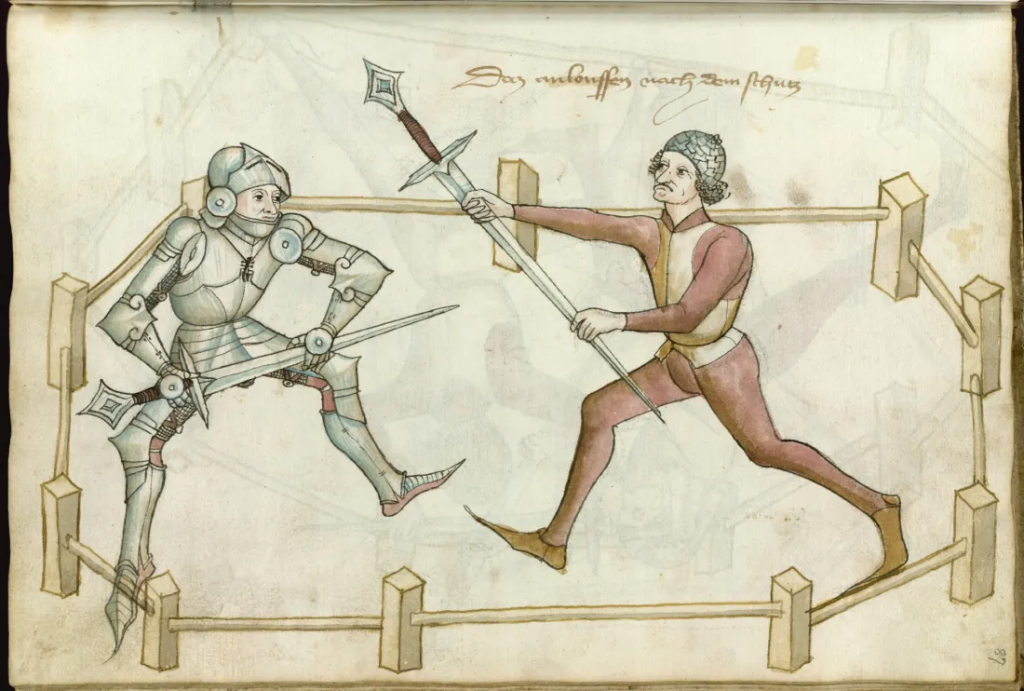
One final note here: manuscripts. Manuscripts themselves are cited by an entirely different system because providence made every part of paleography to punish paleographers for their sins. A manuscript codex consists of folia – individual leaves of parchment (so two “pages” in modern numbering on either side of the same physical page) – which are numbered. Then each folium is divided into recto and verso – front and back. Thus a manuscript is going to be cited by its catalog entry wherever it is kept (each one will have its own system, they are not standardized) followed by the folium (‘f.’) and either recto (r) or verso (v). Typically the abbreviation “MS” leads the catalog entry to indicate a manuscript. Thus this picture of two men fighting is MS Thott.290.2º f.87r (it’s in Det Kongelige Bibliotek in Copenhagen):
MS Thott.290.2º f.87r which can also be found on the inexplicably well maintained Wiktenauer; seriously every type of history should have as dedicated an enthusiast community as arms and armor history.
And there you go.
Bret Devereaux, “Fireside Friday, June 10, 2022”, A Collection of Unmitigated Pedantry, 2022-06-10.
Comments Off on QotD: Citation systems and why they were developed
December 15, 2022
Kraut Space Magic: the H&K G11
Forgotten Weapons
Published 25 Dec 2018I have been waiting for a long time to have a chance to make this video — the Heckler & Koch G11! Specifically, a G11K2, the final version approved for use by the West German Bundeswehr, before being cancelled for political and economic reasons.
The G11 was a combined effort by H&K and Dynamit Nobel to produce a new rifle for the German military with truly new technology. The core of the system was the use of a caseless cartridge developed in the late 60s and early 70s by Dynamit Nobel, which then allowed H&K to design a magnificently complex action which could fire three rounds in a hyper-fast (~2000 rpm) burst and have all three bullets leave the barrel before the weapon moved in recoil.
Remarkably, the idea went through enough development to pass German trials and actually be accepted for service in the late 1980s (after a funding shutdown when it proved incapable of winning NATO cartridge selection trials a decade earlier). However, the reunification with East Germany presented a reduced strategic threat, a new surplus of East German combat rifles (AK74s), and a huge new economic burden to the combined nations and this led to the cancellation of the program. The US Advanced Combat Rifle program gave the G11 one last grasp at a future, but it was not deemed a sufficient improvement in practical use over the M16 platform to justify a replacement of all US weapons in service.
The G11 lives on, however, as an icon of German engineering prowess often referred to as “Kraut Space Magic” (in an entirely complimentary take on the old pejorative). That it could be so complex and yet still run reliably in legitimate military trials is a tremendous feat by H&K’s design engineers, and yet one must consider that the Bundeswehr may just have dodged a bullet when it ended up not actually adopting the rifle.
Many thanks to H&K USA for giving me access to the G11 rifles in their Grey Room for this video!
(more…)
Comments Off on Kraut Space Magic: the H&K G11
November 28, 2022
Mulberry Harbours – Rhinos, Whales, Beetles, Phoenixs and Spuds against the Axis
Drachinifel
Published 13 Jul 2022Today we take a look at the artificial harbours designed, built and then installed on the Normandy beaches in 1944.
Many thanks to @Think Defence for finding and collating so many images and letting me use them! Follow them on Twitter or on their website for more interesting articles!
(more…)
Comments Off on Mulberry Harbours – Rhinos, Whales, Beetles, Phoenixs and Spuds against the Axis
November 26, 2022
The Volcanic: Smith & Wesson’s First Pistol
Forgotten Weapons
Published 18 Aug 2017The deep beginnings of the Volcanic go back to Walter Hunt’s Volitional Repeater, which became the Jennings repeating rifle, which then became the Smith-Jennings repeating rifle when Horace Smith was brought in to improve it. Smith was able to make it more commercially viable than the Jennings had been, but he recognized that the system needed significant changes to really become successful. He had met a fellow gun designer who had similar ideas, by the name of Daniel Wesson, and the two would spend a couple years developing and refining the system. In 1854 they thought it was ready for production, and formed the Smith & Wesson Company.
Included in the original company was a man named Courtland Palmer, who owned the patent rights to the Jennings system. Smith & Wesson’s system would probably have been deemed an infringement of Palmer’s patents, and by bringing him into the company they avoided legal trouble. The fact that he was a relatively wealthy financier of the new company certainly didn’t hurt!
The pistol that S&W started producing was a manually repeating one with a tubular magazine under the barrel holding either 6 or 10 rounds. It was available in the .41 caliber Navy model (note: not actually adopted by the Navy) and the .31 caliber pocket version. In this first iteration, both used iron frames, which were all engraved lightly. The prices were pretty steep, and the guns suffered from some reliability problems and a fundamental problem of underpowered ammunition (the .41 caliber had a muzzle velocity of just 260 fps / 79 m/s). However, they did offer a much greater level of rapid repeating firepower than the muzzle loading revolvers of the period, and gained some loyal fans. In total, just 1700 of the guns were produced before the company went bankrupt, about a year after forming.
To recover from that setback, they reformed the company into the new Volcanic Repeating Arms Company, and sold stock in the new company to generate a new supply of capital. This allowed them to get back into production, and the Volcanic company would make another 3000 pistols, all .41 caliber Navy types, before also running out of money 19 months later in 1856.
At this point, Smith and Wesson decide to move in another direction, and one of the main creditors of the Volcanic company was able to acquire all of its assets and put the guns into production a third time. The name of this creditor? None other than Oliver Winchester. Winchester puts a new infusion of his own money into the company under the name New Haven Arms Company. This company produces another 3300 guns, both large and small frame by 1861. The New Haven company comes very near to bankruptcy itself before finally changing the design to create the Henry repeating rifle. The Henry’s rimfire ammunition finally solved the reliability and power problems of the Volcanic, and became the starting point for Winchester to become one of the predominant American arms making companies.
(more…)
Comments Off on The Volcanic: Smith & Wesson’s First Pistol
November 25, 2022
Canada’s all-purpose VTOL transport that could have changed everything; the Canadair CL-84 Dynavert
Polyus Studios
Published 14 Jul 2018The program that developed the CL-84 lasted for almost 20 years and produced one of the most successful VTOL aircraft ever, as far as performance. Canadair produced four Dynavert’s over those 20 years and two of them crashed. In fact one crashed twice. The story of the great CL-84 is one of perseverance and missed potential.
(more…)
Comments Off on Canada’s all-purpose VTOL transport that could have changed everything; the Canadair CL-84 Dynavert
November 18, 2022
The Model SS41 – A Czech Bullpup Anti-Tank Rifle for the SS
Forgotten Weapons
Published 23 Jun 2017The SS41 was a bullpup, bolt-action antitank rifle manufactured in small numbers by CZ for the SS. Contrary to common assumption, the SS were not a part of the standard German military arms procurement system, and were forced to scrounge for their weapons from other sources. Czech factories were one of the more popular sources, as smaller production lines could escape being integrated into Wehrmacht oversight and were able to contract privately with groups like the SS (the ZK383 as used by the SS is another example of this).
The Model 41 had been in development by the Czech military when the Germans occupied, and it was adapted to the German Patrone 318 cartridge for this production run. That cartridge was also used in the PzB-39, and fired a 220 grain tungsten-cored bullet at 4000 fps — although even this extremely high velocity only allowed it to defeat 30mm of vertical armor at 100m. As with the other antitank rifles of WW2, it would obsolete almost as soon as it was introduced, although it did remain useful for attacking emplaced positions and light armored vehicles (much like the Soviet PTRD and PTRS rifles).
Only a few thousand of the SS41 were manufactured, and they served primarily on the Eastern Front. As a result very few exist in American collections, and this is a particularly excellent example. Thanks to the Institute of Military Technology for allowing me to have access to this very cool AT rifle and bring it to you! Check them out at:
Comments Off on The Model SS41 – A Czech Bullpup Anti-Tank Rifle for the SS
November 14, 2022
Two Variants of the French RSC 1917 Semiauto WW1 Rifle
Forgotten Weapons
Published 2 Apr 2017The RSC 1917, aka FSA1917, has the distinction of being the only true semiautomatic service rifle to see significant frontline infantry use during World War One. It was introduced in 1917 as a long rifle, and about 75,000 were made in that configuration. An improved carbine model was developed in in 1918 right at the end of the war, with only a few thousand of those made. However, what we are looking at today are a pair of 1917 rifles which show a couple of differences.
One of these is a standard RSC 1917 as originally produced, and the other has been updated to a 1918 standard in two ways: the bolt handle/disassembly and the bolt holdopen mechanism. I do not know if these changes were actually implemented during the war, or in the years afterward, but they make the rifles substantially easier to field strip.
If you know of details relevant to these changes, please let me know in the comments!
(more…)
Comments Off on Two Variants of the French RSC 1917 Semiauto WW1 Rifle
November 11, 2022
QotD: WW1 was the first war where the artillery was destructive enough to change the landscape
This kind of terrain – with so much of the ground-cover blasted away – would turn into mud-soaked pits the moment it rained – particularly where water collected in the shell-holes.
That also explains why these post-battle scenes often lack any kind of local terrain features. Powerful explosive shells could annihilate terrain features like forests, roads, hedgerows, fences, fields – even hills and entire villages – with extended bombardments. And without any ground-cover left, almost any rain at all will then reduce the local terrain into a mud-soaked bog, especially if the local soil drains poorly (as it did so famously in Flanders).
The problem with depicting medieval, or even early modern battlefields this way is, of course, that these armies do not possess any weapons which can deliver this kind of destruction. Even as late as the American Civil War, field artillery – even massed field artillery – was simply not that powerful (although some heavy naval and siege guns were beginning to come close). Post-battle photography of Gettysburg – even in the approaches to Cemetery Ridge and around the Wheat Field – areas of fierce fighting – shows not only trees and ground-cover, but even fences and buildings largely intact.
Field artillery firing solid shot from 6 to 20lbs to is simply not strong enough to tear apart the terrain in the way that we often see in popular depictions of historical or fantasy battlefields; as pictured above, the guns doing that in WWI were often firing 1,000+ pound shells, 100 times the weight of shot of a normal ACW cannon (lighter artillery, like the famed French 75 (Matériel de 75mm Mle 1897) still fired lighter shells – the French 75 fired a c. 12lbs shell – but still had far more explosive power due to improvements in explosives; that said, the French 75, a capable field gun, was famously too light for ideal use in the trenches). Massed musketry won’t do it either and so massed arrow or crossbow fire, catapults or whatever else certainly won’t.
(This, as a side note, may go some distance to explaining why First World War commanders were so unprepared for the challenges the new terrain they were creating in turn inflicted on them. Doctrine said that the solution to well-entrenched infantry was to mass artillery against them – blast them out of position. It had never been the case before that such massed artillery would render the ground itself impassible, because the artillery had never before been powerful enough to do so.)
Bret Devereaux, “Collection: The Battlefield After the Battle”, A Collection of Unmitigated Pedantry, 2019-10-18.
Comments Off on QotD: WW1 was the first war where the artillery was destructive enough to change the landscape
November 9, 2022
Macaroni & Cheese from 1845
Tasting History with Max Miller
Published 8 Nov 2022
(more…)
Comments Off on Macaroni & Cheese from 1845
November 5, 2022
A working flight simulator, no computers necessary
Tom Scott
Published 4 Jul 2022There are only a few working Link Trainers left in the world: but before microprocessors, before display screnes, half a million pilots learned the basics of instrument flying inside one. More: https://www.most.org/explore/link-fli…
(more…)
Comments Off on A working flight simulator, no computers necessary
November 4, 2022
“Dreadnought” – The King of the High Seas! – Sabaton History 114 [Official]
Sabaton History
Published 2 Nov 2022When the Dreadnought made its appearance in the early 20th century, it was the mightiest ship the world had ever seen, making all other gunships obsolete, including the rest of its own navy. It also sparked a naval arms race around the world, as many nations built such behemoths. But what were they actually like?
(more…)
Comments Off on “Dreadnought” – The King of the High Seas! – Sabaton History 114 [Official]


