
Although the movie [Gandhi] sneers at this reasoning as being the flimsiest of pretexts, I cannot imagine an impartial person studying the subject without concluding that concern for Indian religious minorities was one of the principal reasons Britain stayed in India as long as it did. When it finally withdrew, blood-maddened mobs surged through the streets from one end of India to the other, the majority group in each area, Hindu or Muslim, slaughtering the defenseless minority without mercy in one of the most hideous periods of carnage of modern history.
A comparison is in order. At the famous Amritsar massacre of 1919, shot in elaborate and loving detail in the present movie and treated by post-independence Indian historians as if it were Auschwitz, Gurkha troops under the command of a British officer, General Dyer, fired into an unarmed crowd of Indians defying a ban and demonstrating for Indian independence. The crowd contained women and children; 379 persons died; it was all quite horrible. Dyer was court-martialed and cashiered, but the incident lay heavily on British consciences for the next three decades, producing a severe inhibiting effect. Never again would the British empire commit another Amritsar, anywhere.
As soon as the oppressive British were gone, however, the Indians — gentle, tolerant people that they are — gave themselves over to an orgy of bloodletting. Trained troops did not pick off targets at a distance with Enfield rifles. Blood-crazed Hindus, or Muslims, ran through the streets with knives, beheading babies, stabbing women, old people. Interestingly, our movie shows none of this on camera (the oldest way of stacking the deck in Hollywood). All we see is the aged Gandhi, grieving, and of course fasting, at these terrible reports of riots. And, naturally, the film doesn’t whisper a clue as to the total number of dead, which might spoil the mood somehow. The fact is that we will never know how many Indians were murdered by other Indians during the country’s Independence Massacres, but almost all serious studies place the figure over a million, and some, such as Payne’s sources, go to 4 million. So, for those who like round numbers, the British killed some 400 seditious colonials at Amritsar and the name Amritsar lives in infamy, while Indians may have killed some 4 million of their own countrymen for no other reason than that they were of a different religious faith and people think their great leader would make an inspirational subject for a movie. Ahimsa, as can be seen, then, had an absolutely tremendous moral effect when used against Britain, but not only would it not have worked against Nazi Germany (the most obvious reproach, and of course quite true), but, the crowning irony, it had virtually no effect whatever when Gandhi tried to bring it into play against violent Indians.
Despite this at best patchy record, the film-makers have gone to great lengths to imply that this same principle of ahimsa — presented in the movie as the purest form of pacifism — is universally effective, yesterday, today, here, there, everywhere. We hear no talk from Gandhi of war sometimes being a “necessary evil,” but only him announcing — and more than once — “An eye for an eye makes the whole world blind.” In a scene very near the end of the movie, we hear Gandhi say, as if after deep reflection: “Tyrants and murderers can seem invincible at the time, but in the end they always fall. Think of it. Always.” During the last scene of the movie, following the assassination, Margaret Bourke-White is keening over the death of the Great Soul with an English admiral’s daughter named Madeleine Slade, in whose bowel movements Gandhi took the deepest interest (see their correspondence), and Miss Slade remarks incredulously that Gandhi felt that he had failed. They are then both incredulous for a moment, after which Miss Slade observes mournfully, “When we most needed it [presumably meaning during World War II], he offered the world a way out of madness. But the world didn’t see it.” Then we hear once again the assassin’s shots, Gandhi’s “Oh, God,” and last, in case we missed them the first time, Gandhi’s words (over the shimmering waters of the Ganges?): “Tyrants and murderers can seem invincible at the time, but in the end they always fall. Think of it. Always.” This is the end of the picture.
Richard Grenier, “The Gandhi Nobody Knows”, Commentary, 1983-03-01.
September 8, 2019
QotD: The Amritsar massacre and the partition of India
August 9, 2019
What’s happening in Jammu and Kashmir?
Pieter J. Friedrich reports on recent events concerning the unique constitutional status of Jammu and Kashmir within the Republic of India:
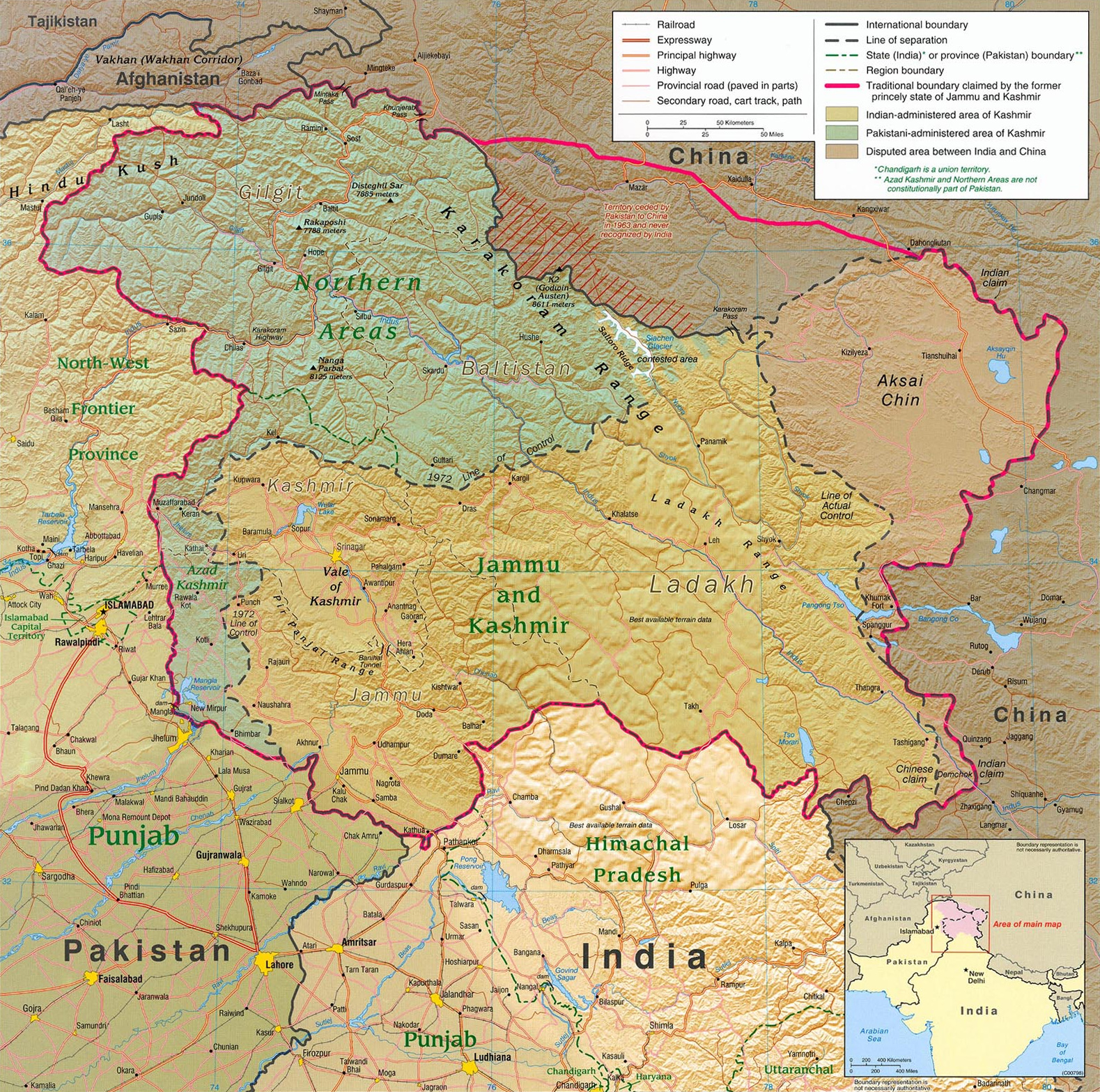
CIA map of the Kashmir Region in 2004.
Via Wikimedia Commons. Click image to see full-sized map.
Terror grips the most militarized zone in the world after India’s Central Government terminated Jammu and Kashmir’s 70-year-old “special status” as the first step towards stripping the disputed region of statehood entirely.
Internationally infamous as the world’s hottest potential nuclear flashpoint, J&K originally acceded to India in 1947 only on the condition that the newly-formed country be restricted from interfering in the domestic affairs of the mountainous northern region. The agreement was sealed between the last king of J&K, Maharaja Hari Singh Dogra, and the representative of the British crown, Governor-General Lord Mountbatten. In 1949, when passage of the constitution formed the Republic of India, the Maharaja’s conditions for accession were enshrined in Article 370.
The crux of the article – in combination with Article 35A of 1954 – was that, while J&K accepted India’s handling of issues like defense and foreign policy, the state otherwise reserved the right to autonomy in handling its domestic affairs. Kashmiris, thus, lived under their own distinct laws. Notably, citizens of other parts of India were prohibited from settling permanently or owning property in Kashmir. In the eyes of many Kashmiris, this prevented settler colonialism. On August 5, 2019, the President of India abolished this “special status” by decree.
Simultaneously, Home Minister Amit Shah – charged with India’s internal security – introduced a bill in the upper house of parliament to strip J&K of statehood, downgrade it to a “Union Territory,” and partition the region.
As Shah did this, the Central Government shut down Kashmir. It imposed a virtual curfew, banning movement of the public, shuttering educational institutions, and barring all public assemblies or meetings. It severed communications, cutting off phone and internet access. And it conducted arrests of mainstream Kashmiri political leaders – such as former chief ministers Mehbooba Mufti and Omar Abdullah – on unknown charges.
India’s ruling Bharatiya Janata Party, which was just re-elected in May, campaigned on promises to scrap J&K’s “special status.” The BJP’s manifesto alleged that it was “an obstacle in the development of the state,” while Shah insisted it stood in the way of of Kashmir becoming an “integral party of India permanently” and was necessary for “national security.” Indeed, the tumultuous region has suffered a significant influx in violence in recent years.
Since 2014, when Prime Minister Modi’s regime first came to power, terrorist incidents in J&K have nearly tripled and security forces deaths have nearly doubled. According to a July 2019 UN report, independent bodies documented 159 security forces deaths in 2018 – a figure comparable to US troop fatalities in Iraq in 2009. The latest round of escalating tensions traces back to at least 2010, when mass protests erupted over an “encounter killing” of three civilians by Indian Army troops. Protests again erupted in 2016. During suppression efforts, security forces killed hundreds of protesters.
The Central Government has responded by flooding J&K with more and more soldiers. The small region – slightly smaller than the United Kingdom – is already occupied by a bare minimum of 500,000 troops. Since late July 2019, India has deployed nearly another 50,000.
Delhi has additionally responded by repeatedly dissolving J&K’s elected state government, imposing direct rule three times since 2015. The last time was in June 2018, after India’s ruling BJP withdrew from a coalition with then J&K Chief Minister Mufti – apparently because she advocated “reconciliation” instead of a “muscular security policy” as the most effective solution to the Kashmir conflict. Elections have not been allowed since 2014.
The ongoing occupation as well as the long-term use of direct rule – imposed for approximately ten of the past 42 years – contribute to the perception of Kashmiris that they are nothing more than vassals within the Republic of India.
March 31, 2019
QotD: Gandhi’s not-so-non-violent followers
… it is not widely realized (nor will this film tell you) how much violence was associated with Gandhi’s so-called “nonviolent” movement from the very beginning. India’s Nobel Prize-winning poet, Rabindranath Tagore, had sensed a strong current of nihilism in Gandhi almost from his first days, and as early as 1920 wrote of Gandhi’s “fierce joy of annihilation,” which Tagore feared would lead India into hideous orgies of devastation — which ultimately proved to be the case. Robert Payne has said that there was unquestionably an “unhealthy atmosphere” among many of Gandhi’s fanatic followers, and that Gandhi’s habit of going to the edge of violence and then suddenly retreating was fraught with danger. “In matters of conscience I am uncompromising,” proclaimed Gandhi proudly. “Nobody can make me yield.” The judgment of Tagore was categorical. Much as he might revere Gandhi as a holy man, he quite detested him as a politician and considered that his campaigns were almost always so close to violence that it was utterly disingenuous to call them nonviolent.
For every satyagraha true believer, moreover, sworn not to harm the adversary or even to lift a finger in his own defense, there were sometimes thousands of incensed freebooters and skirmishers bound by no such vow. Gandhi, to be fair, was aware of this, and nominally deplored it — but with nothing like the consistency shown in the movie. The film leads the audience to believe that Gandhi’s first “fast unto death,” for example, was in protest against an act of barbarous violence, the slaughter by an Indian crowd of a detachment of police constables. But in actual fact Gandhi reserved this “ultimate weapon” of his to interdict a 1931 British proposal to grant Untouchables a “separate electorate” in the Indian national legislature — in effect a kind of affirmative-action program for Untouchables. For reasons I have not been able to decrypt, Gandhi was dead set against the project, but I confess it is another scene I would like to have seen in the movie: Gandhi almost starving himself to death to block affirmative action for Untouchables.
From what I have been able to decipher, Gandhi’s main preoccupation in this particular struggle was not even the British. Benefiting from the immense publicity, he wanted to induce Hindus, overnight, ecstatically, and without any of these British legalisms, to “open their hearts” to Untouchables. For a whole week Hindu India was caught up in a joyous delirium. No more would the Untouchables be scavengers and sweepers! No more would they be banned from Hindu temples! No more would they pollute at 64 feet! It lasted just a week. Then the temple doors swung shut again, and all was as before. Meanwhile, on the passionate subject of swaraj, Gandhi was crying, “I would not flinch from sacrificing a million lives for India’s liberty!” The million Indian lives were indeed sacrificed, and in full. They fell, however, not to the bullets of British soldiers but to the knives and clubs of their fellow Indians in savage butcheries when the British finally withdrew.
Richard Grenier, “The Gandhi Nobody Knows”, Commentary, 1983-03-01.
November 27, 2018
QotD: Gandhi’s view of India as a nation
No one questions that the formative period for Gandhi as a political leader was his time in South Africa. Throughout history Indians, divided into 1,500 language and dialect groups (India today has 15 official languages), had little sense of themselves as a nation. Muslim Indians and Hindu Indians felt about as close as Christians and Moors during their 700 years of cohabitation in Spain. In addition to which, the Hindus were divided into thousands of castes and sub-castes, and there were also Parsees, Sikhs, Jains. But in South Africa officials had thrown them all in together, and in the mind of Gandhi (another one of those examples of nationalism being born in exile) grew the idea of India as a nation, and Muslim-Hindu friendship became one of the few positions on which he never really reversed himself. So Gandhi — ignoring Arabs and Turks — became an adamant supporter of the Khilafat [Caliphate] movement out of strident Indian nationalism. He had become a national figure in India for having unified 13,000 Indians of all faiths in South Africa, and now he was determined to reach new heights by unifying hundreds of millions of Indians of all faiths in India itself. But this nationalism did not please everyone, particularly Tolstoy, who in his last years carried on a curious correspondence with the new Indian leader. For Tolstoy, Gandhi’s Indian nationalism “spoils everything.”
Richard Grenier, “The Gandhi Nobody Knows”, Commentary, 1983-03-01.
November 7, 2018
QotD: Gandhi and the fall of the Caliphate
… it should not be thought for one second that Gandhi’s finally full-blown desire to detach India from the British empire gave him the slightest sympathy with other colonial peoples pursuing similar objectives. Throughout his entire life Gandhi displayed the most spectacular inability to understand or even really take in people unlike himself — a trait which V.S. Naipaul considers specifically Hindu, and I am inclined to agree. Just as Gandhi had been totally unconcerned with the situation of South Africa’s blacks (he hardly noticed they were there until they rebelled), so now he was totally unconcerned with other Asians or Africans. In fact, he was adamantly opposed to certain Arab movements within the Ottoman empire for reasons of internal Indian politics.
At the close of World War I, the Muslims of India were deeply absorbed in what they called the “Khilafat” movement — “Khilafat” being their corruption of “Caliphate,” the Caliph in question being the Ottoman Sultan. In addition to his temporal powers, the Sultan of the Ottoman empire held the spiritual position of Caliph, supreme leader of the world’s Muslims and successor to the Prophet Muhammad. At the defeat of the Central Powers (Germany, Austria, Turkey), the Sultan was a prisoner in his palace in Constantinople, shorn of his religious as well as his political authority, and the Muslims of India were incensed. It so happened that the former subject peoples of the Ottoman empire, principally Arabs, were perfectly happy to be rid of this Caliph, and even the Turks were glad to be rid of him, but this made no impression at all on the Muslims of India, for whom the issue was essentially a club with which to beat the British. Until this odd historical moment, Indian Muslims had felt little real allegiance to the Ottoman Sultan either, but now that he had fallen, the British had done it! The British had taken away their Khilafat! And one of the most ardent supporters of this Indian Muslim movement was the new Hindu leader, Gandhi.
Richard Grenier, “The Gandhi Nobody Knows”, Commentary, 1983-03-01.
October 9, 2018
Kingdom of Majapahit – Changing Winds – Extra History – #5
Extra Credits
Published on 6 Oct 2018When Islam arrived in Indonesia, life changed — except within Majapahit, where court drama kept them focused on themselves and unaware of the visits and alliances between Admiral Zheng He and the Sultanate of Malacca — forming new powers in the southern seas.
Support us on Patreon! http://bit.ly/EHPatreon
As we finished this episode, an even more devastating earthquake and tsunami struck the island of Sulawesi. Once again we’ve linked two fundraising efforts—one international aid organization, and another for a local effort. Any help would be deeply appreciated.
https://secure2.oxfamamerica.org/page…
https://kopernik.info/en/donate/palu-…
October 4, 2018
QotD: Gandhi in World War One
We are therefore presented with the seeming anomaly of a Gandhi who, in Britain when war broke out in August 1914, instantly contacted the War Office, swore that he would stand by England in its hour of need, and created the Indian Volunteer Corps, which he might have commanded if he hadn’t fallen ill with pleurisy. In 1915, back in India, he made a memorable speech in Madras in which he proclaimed, “I discovered that the British empire had certain ideals with which I have fallen in love …” In early 1918, as the war in Europe entered its final crisis, he wrote to the Viceroy of India, “I have an idea that if I become your recruiting agent-in-chief, I might rain men upon you,” and he proclaimed in a speech in Kheda that the British “love justice; they have shielded men against oppression.” Again, he wrote to the Viceroy, “I would make India offer all her able-bodied sons as a sacrifice to the empire at this critical moment …” To some of his pacifist friends, who were horrified, Gandhi replied by appealing to the Bhagavad Gita and to the endless wars recounted in the Hindu epics, the Ramayana and the Mahabharata, adding further to the pacifists’ horror by declaring that Indians “have always been warlike, and the finest hymn composed by Tulsidas in praise of Rama gives the first place to his ability to strike down the enemy.”
This was in contradiction to the interpretation of sacred Hindu scriptures Gandhi had offered on earlier occasions (and would offer later), which was that they did not recount military struggles but spiritual struggles; but, unusual for him, he strove to find some kind of synthesis. “I do not say, ‘Let us go and kill the Germans,’” Gandhi explained. “I say, ‘Let us go and die for the sake of India and the empire.’” And yet within two years, the time having come for swaraj (home rule), Gandhi’s inner voice spoke again, and, the leader having found his cause, Gandhi proclaimed resoundingly: “The British empire today represents Satanism, and they who love God can afford to have no love for Satan.”
The idea of swaraj, originated by others, crept into Gandhi’s mind gradually. With a fair amount of winding about, Gandhi, roughly, passed through three phases. First, he was entirely pro-British, and merely wanted for Indians the rights of Englishmen (as he understood them). Second, he was still pro-British, but with the belief that, having proved their loyalty to the empire, Indians would be granted some degree of swaraj. Third, as the home-rule movement gathered momentum, it was the swaraj, the whole swaraj, and nothing but the swaraj, and he turned relentlessly against the crown. The movie to the contrary, he caused the British no end of trouble in their struggles during World War II.
Richard Grenier, “The Gandhi Nobody Knows”, Commentary, 1983-03-01.
October 1, 2018
Kingdom of Majapahit – The Golden Reign – Extra History – #4
Extra Credits
Published on 29 Sep 2018The new sixteen-year-old king, Hayam Wuruk, had inherited an empire. Gajah Mada acted on his behalf, reshaping the way that the throne of Majapahit would be run, but he made a big mistake with the Sundanese princess…
Support us on Patreon! http://bit.ly/EHPatreon
September 27, 2018
QotD: Gandhi’s views on Britain
… as almost always with historical films, even those more honest than Gandhi, the historical personage on which the movie is based is not only more complex but more interesting than the character shown on the screen. During his entire South African period, and for some time after, until he was about fifty, Gandhi was nothing more or less than an imperial loyalist, claiming for Indians the rights of Englishmen but unshakably loyal to the crown. He supported the empire ardently in no fewer than three wars: the Boer War, the “Kaffir War,” and, with the most extreme zeal, World War I. If Gandhi’s mind were of the modern European sort, this would seem to suggest that his later attitude toward Britain was the product of unrequited love: he had wanted to be an Englishman; Britain had rejected him and his people; very well then, they would have their own country. But this would imply a point of “agonizing reappraisal,” a moment when Gandhi’s most fundamental political beliefs were reexamined and, after the most bitter soul-searching, repudiated. But I have studied the literature and cannot find this moment of bitter soul-searching. Instead, listening to his “inner voice” (which in the case of divines of all countries often speaks in the tones of holy opportunism), Gandhi simply, tranquilly, without announcing any sharp break, set off in a new direction.
It should be understood that it is unlikely Gandhi ever truly conceived of “becoming” an Englishman, first, because he was a Hindu to the marrow of his bones, and also, perhaps, because his democratic instincts were really quite weak. He was a man of the most extreme, autocratic temperament, tyrannical, unyielding even regarding things he knew nothing about, totally intolerant of all opinions but his own. He was, furthermore, in the highest degree reactionary, permitting in India no change in the relationship between the feudal lord and his peasants or servants, the rich and the poor. In his The Life and Death of Mahatma Gandhi, the best and least hagiographic of the full-length studies, Robert Payne, although admiring Gandhi greatly, explains Gandhi’s “new direction” on his return to India from South Africa as follows:
He spoke in generalities, but he was searching for a single cause, a single hard-edged task to which he would devote the remaining years of his life. He wanted to repeat his triumph in South Africa on Indian soil. He dreamed of assembling a small army of dedicated men around him, issuing stern commands and leading them to some almost unobtainable goal.
Gandhi, in short, was a leader looking for a cause. He found it, of course, in home rule for India and, ultimately, in independence.
Richard Grenier, “The Gandhi Nobody Knows”, Commentary, 1983-03-01.
August 27, 2018
Kingdom of Majapahit – An Empire of Water – Extra History – #1
Extra Credits
Published on 25 Aug 2018In this series we will explore the history of a short-lived kingdom that united the diverse, 13,000+ islands of Indonesia: Majapahit. Before Majapahit came along, however, the Kingdom of Srivijaya and the Kingdom of Mataram laid the stepping stones.
Please note: The next episode of Majapahit will be published on September 15 and will continue every Saturday thereafter. The EC team is taking a well-deserved short upload break for a few weeks!
August 25, 2018
QotD: India’s caste system
… Gandhi, born the son of the Prime Minister of a tiny Indian principality and received as an attorney at the bar of the Middle Temple in London, [began] his climb to greatness as a member of the small Indian community in, precisely, South Africa. Natal, then a separate colony, wanted to limit Indian immigration and, as part of the government program, ordered Indians to carry identity papers (an action not without similarities to measures under consideration in the U.S. today to control illegal immigration). The film’s lengthy opening sequences are devoted to Gandhi’s leadership in the fight against Indians carrying their identity papers (burning their registration cards), with for good measure Gandhi being expelled from the first-class section of a railway train, and Gandhi being asked by whites to step off the sidewalk. This inspired young Indian leader calls, in the film, for interracial harmony, for people to “live together.”
Now the time is 1893, and Gandhi is a “caste” Hindu, and from one of the higher castes. Although, later, he was to call for improving the lot of India’s Untouchables [Dalits], he was not to have any serious misgivings about the fundamentals of the caste system for about another thirty years, and even then his doubts, to my way of thinking, were rather minor. In the India in which Gandhi grew up, and had only recently left, some castes could enter the courtyards of certain Hindu temples, while others could not. Some castes were forbidden to use the village well. Others were compelled to live outside the village, still others to leave the road at the approach of a person of higher caste and perpetually to call out, giving warning, so that no one would be polluted by their proximity. The endless intricacies of Hindu caste by-laws varied somewhat region by region, but in Madras, where most South African Indians were from, while a Nayar could pollute a man of higher caste only by touching him, Kammalans polluted at a distance of 24 feet, toddy drawers at 36 feet, Pulayans and Cherumans at 48 feet, and beef-eating Paraiyans at 64 feet. All castes and the thousands of sub-castes were forbidden, needless to say, to marry, eat, or engage in social activity with any but members of their own group. In Gandhi’s native Gujarat a caste Hindu who had been polluted by touch had to perform extensive ritual ablutions or purify himself by drinking a holy beverage composed of milk, whey, and (what else?) cow dung.
Low-caste Hindus, in short, suffered humiliations in their native India compared to which the carrying of identity cards in South Africa was almost trivial. In fact, Gandhi, to his credit, was to campaign strenuously in his later life for the reduction of caste barriers in India — a campaign almost invisible in the movie, of course, conveyed in only two glancing references, leaving the audience with the officially sponsored if historically astonishing notion that racism was introduced into India by the British. To present the Gandhi of 1893, a conventional caste Hindu, fresh from caste-ridden India where a Paraiyan could pollute at 64 feet, as the champion of interracial equalitariansim is one of the most brazen hypocrisies I have ever encountered in a serious movie.
Richard Grenier, “The Gandhi Nobody Knows”, Commentary, 1983-03-01.
June 11, 2018
QotD: Gandhi as filmic hagiography
Gandhi, therefore, the film, this paid political advertisement for the government of India, is organized around three axes: (1) Anti-racism — all men are equal regardless of race, color, creed, etc.; (2) anti-colonialism, which in present terms translates as support for the Third World, including, most eminently, India; (3) nonviolence, presented as an absolutist pacifism. There are other, secondary precepts and subheadings. Gandhi is portrayed as the quintessence of tolerance (“I am a Hindu and a Muslim and a Christian and a Jew”), of basic friendliness to Britain (“The British have been with us for a long time and when they leave we want them to leave as friends”), of devotion to his wife and family. His vow of chastity is represented as something selfless and holy, rather like the celibacy of the Catholic clergy. But, above all, Gandhi’s life and teachings are presented as having great import for us today. We must learn from Gandhi.
I propose to demonstrate that the film grotesquely distorts both Gandhi’s life and character to the point that it is nothing more than a pious fraud, and a fraud of the most egregious kind. Hackneyed Indian falsehoods such as that “the British keep trying to break India up” (as if Britain didn’t give India a unity it had never enjoyed in history), or that the British created Indian poverty (a poverty which had not only existed since time immemorial but had been considered holy), almost pass unnoticed in the tide of adulation for our fictional saint. Gandhi, admittedly, being a devout Hindu, was far more self-contradictory than most public men. Sanskrit scholars tell me that flat self-contradiction is even considered an element of “Sanskrit rhetoric.” Perhaps it is thought to show profundity.
Richard Grenier, “The Gandhi Nobody Knows”, Commentary, 1983-03-01.
April 30, 2018
QotD: Gandhi versus Gandhi
I had the singular honor of attending an early private screening of Gandhi with an audience of invited guests from the National Council of Churches. At the end of the three-hour movie there was hardly, as they say, a dry eye in the house. When the lights came up I fell into conversation with a young woman who observed, reverently, that Gandhi’s last words were “Oh, God,” causing me to remark regretfully that the real Gandhi had not spoken in English, but had cried, Hai Rama! (“Oh, Rama”). Well, Rama was just Indian for God, she replied, at which I felt compelled to explain that, alas, Rama, collectively with his three half-brothers, represented the seventh reincarnation of Vishnu. The young woman, who seemed to have been under the impression that Hinduism was Christianity under another name, sensed somehow that she had fallen on an uncongenial spirit, and the conversation ended.
At a dinner party shortly afterward, a friend of mine, who had visited India many times and even gone to the trouble of learning Hindi, objected strenuously that the picture of Gandhi that emerges in the movie is grossly inaccurate, omitting, as one of many examples, that when Gandhi’s wife lay dying of pneumonia and British doctors insisted that a shot of penicillin would save her, Gandhi refused to have this alien medicine injected in her body and simply let her die. (It must be noted that when Gandhi contracted malaria shortly afterward he accepted for himself the alien medicine quinine, and that when he had appendicitis he allowed British doctors to perform on him the alien outrage of an appendectomy.) All of this produced a wistful mooing from an editor of a major newspaper and a recalcitrant, “But still …” I would prefer to explicate things more substantial than a wistful mooing, but there is little doubt it meant the editor in question felt that even if the real Mohandas K. Gandhi had been different from the Gandhi of the movie it would have been nice if he had been like the movie-Gandhi, and that presenting him in this admittedly false manner was beautiful, stirring, and perhaps socially beneficial.
Richard Grenier, “The Gandhi Nobody Knows”, Commentary, 1983-03-01.
August 11, 2017
QotD: The plight of Hindu widows
Some of the most conservative Hindus in India believe that a woman whose husband has died should no longer live because she failed to retain his soul. Rejected by their communities and abandoned by their loved ones, thousands of destitute women make their way to Vrindavan, a pilgrimage city about 100km south of Delhi that is home to more than 20,000 widows.
These women have no choice but to live in a vidhwa ashram (ashrams for widows) run by the government, private enterprises and NGOs. Clad in white, they know they will never return home and that this is where they’ll end their days.
Pascal Mannaerts, “Nowhere to go, nowhere to hide”, BBC Travel, 2016-09-13.
February 26, 2017
British History’s Biggest Fibs with Lucy Worsley Episode 3: The Jewel in the Crown
Published on 10 Feb 2017
In the final episode, Lucy debunks the fibs that surround the ‘jewel in the crown’ of the British Empire – India. Travelling to Kolkata, she investigates how the Raj was created following a British government coup in 1858. After snatching control from the discredited East India Company, the new regime presented itself as a new kind of caring, sharing imperialism with Queen Victoria as its maternal Empress.
Tyranny, greed and exploitation were to be things of the past. From the ‘black hole of Calcutta’ to the Indian ‘mutiny’, from East India Company governance to crown rule, and from Queen Victoria to Empress of India, Lucy reveals how this chapter of British history is another carefully edited narrative that’s full of fibs.


