
All nationalists have the power of not seeing resemblances between similar sets of facts. A British Tory will defend self-determination in Europe and oppose it in India with no feeling of inconsistency. Actions are held to be good or bad, not on their own merits, but according to who does them, and there is almost no kind of outrage — torture, the use of hostages, forced labour, mass deportations, imprisonment without trial, forgery, assassination, the bombing of civilians — which does not change its moral colour when it is committed by ‘our’ side. The Liberal News Chronicle published, as an example of shocking barbarity, photographs of Russians hanged by the Germans, and then a year or two later published with warm approval almost exactly similar photographs of Germans hanged by the Russians. It is the same with historical events. History is thought of largely in nationalist terms, and such things as the Inquisition, the tortures of the Star Chamber, the exploits of the English buccaneers (Sir Francis Drake, for instance, who was given to sinking Spanish prisoners alive), the Reign of Terror, the heroes of the Mutiny blowing hundreds of Indians from the guns, or Cromwell’s soldiers slashing Irishwomen’s faces with razors, become morally neutral or even meritorious when it is felt that they were done in the ‘right’ cause. If one looks back over the past quarter of a century, one finds that there was hardly a single year when atrocity stories were not being reported from some part of the world; and yet in not one single case were these atrocities — in Spain, Russia, China, Hungary, Mexico, Amritsar, Smyrna — believed in and disapproved of by the English intelligentsia as a whole. Whether such deeds were reprehensible, or even whether they happened, was always decided according to political predilection.
George Orwell, “Notes on Nationalism”, Polemic, 1945-05.
December 31, 2018
QotD: Political convictions induce a distorted perception of reality
December 28, 2018
QotD: Celtic nationalism
Welsh, Irish and Scottish nationalism have points of difference but are alike in their anti-English orientation. Members of all three movements have opposed the war while continuing to describe themselves as pro-Russian, and the lunatic fringe has even contrived to be simultaneously pro-Russian and pro-Nazi. But Celtic nationalism is not the same thing as anglophobia. Its motive force is a belief in the past and future greatness of the Celtic peoples, and it has a strong tinge of racialism. The Celt is supposed to be spiritually superior to the Saxon — simpler, more creative, less vulgar, less snobbish, etc. — but the usual power hunger is there under the surface. One symptom of it is the delusion that Eire, Scotland or even Wales could preserve its independence unaided and owes nothing to British protection.
George Orwell, “Notes on Nationalism”, Polemic, 1945-05.
December 16, 2018
QotD: Transferring nationalist passions
The intensity with which they are held does not prevent nationalist loyalties from being transferable. To begin with, […] they can be and often are fastened up on some foreign country. One quite commonly finds that great national leaders, or the founders of nationalist movements, do not even belong to the country they have glorified. Sometimes they are outright foreigners, or more often they come from peripheral areas where nationality is doubtful. Examples are Stalin, Hitler, Napoleon, de Valera, Disraeli, Poincare, Beaverbrook. The Pan-German movement was in part the creation of an Englishman, Houston Chamberlain. For the past fifty or a hundred years, transferred nationalism has been a common phenomenon among literary intellectuals. With Lafcadio Hearne the transference was to Japan, with Carlyle and many others of his time to Germany, and in our own age it is usually to Russia. But the peculiarly interesting fact is that re-transference is also possible. A country or other unit which has been worshipped for years may suddenly become detestable, and some other object of affection may take its place with almost no interval. In the first version of H. G. Wells’s Outline of History, and others of his writings about that time, one finds the United States praised almost as extravagantly as Russia is praised by Communists today: yet within a few years this uncritical admiration had turned into hostility. The bigoted Communist who changes in a space of weeks, or even days, into an equally bigoted Trotskyist is a common spectacle. In continental Europe Fascist movements were largely recruited from among Communists, and the opposite process may well happen within the next few years. What remains constant in the nationalist is his state of mind: the object of his feelings is changeable, and may be imaginary.
But for an intellectual, transference has an important function […]. It makes it possible for him to be much more nationalistic — more vulgar, more silly, more malignant, more dishonest — that he could ever be on behalf of his native country, or any unit of which he had real knowledge. When one sees the slavish or boastful rubbish that is written about Stalin, the Red Army, etc. by fairly intelligent and sensitive people, one realises that this is only possible because some kind of dislocation has taken place. In societies such as ours, it is unusual for anyone describable as an intellectual to feel a very deep attachment to his own country. Public opinion — that is, the section of public opinion of which he as an intellectual is aware — will not allow him to do so. Most of the people surrounding him are sceptical and disaffected, and he may adopt the same attitude from imitativeness or sheer cowardice: in that case he will have abandoned the form of nationalism that lies nearest to hand without getting any closer to a genuinely internationalist outlook. He still feels the need for a Fatherland, and it is natural to look for one somewhere abroad. Having found it, he can wallow unrestrainedly in exactly those emotions from which he believes that he has emancipated himself. God, the King, the Empire, the Union Jack — all the overthrown idols can reappear under different names, and because they are not recognised for what they are they can be worshipped with a good conscience. Transferred nationalism, like the use of scapegoats, is a way of attaining salvation without altering one’s conduct.
George Orwell, “Notes on Nationalism”, Polemic, 1945-05.
December 12, 2018
QotD: G.K. Chesterton’s political Catholicism
Ten or twenty years ago, the form of nationalism most closely corresponding to Communism today was political Catholicism. Its most outstanding exponent — though he was perhaps an extreme case rather than a typical one — was G. K. Chesterton. Chesterton was a writer of considerable talent who whose to suppress both his sensibilities and his intellectual honesty in the cause of Roman Catholic propaganda. During the last twenty years or so of his life, his entire output was in reality an endless repetition of the same thing, under its laboured cleverness as simple and boring as ‘Great is Diana of the Ephesians.’ Every book that he wrote, every scrap of dialogue, had to demonstrate beyond the possibility of mistake the superiority of the Catholic over the Protestant or the pagan. But Chesterton was not content to think of this superiority as merely intellectual or spiritual: it had to be translated into terms of national prestige and military power, which entailed an ignorant idealisation of the Latin countries, especially France. Chesterton had not lived long in France, and his picture of it — as a land of Catholic peasants incessantly singing the Marseillaise over glasses of red wine — had about as much relation to reality as Chu Chin Chow has to everyday life in Baghdad. And with this went not only an enormous overestimation of French military power (both before and after 1914-18 he maintained that France, by itself, was stronger than Germany), but a silly and vulgar glorification of the actual process of war. Chesterton’s battle poems, such as Lepanto or The Ballad of Saint Barbara, make The Charge of the Light Brigade read like a pacifist tract: they are perhaps the most tawdry bits of bombast to be found in our language. The interesting thing is that had the romantic rubbish which he habitually wrote about France and the French army been written by somebody else about Britain and the British army, he would have been the first to jeer. In home politics he was a Little Englander, a true hater of jingoism and imperialism, and according to his lights a true friend of democracy. Yet when he looked outwards into the international field, he could forsake his principles without even noticing he was doing so. Thus, his almost mystical belief in the virtues of democracy did not prevent him from admiring Mussolini. Mussolini had destroyed the representative government and the freedom of the press for which Chesterton had struggled so hard at home, but Mussolini was an Italian and had made Italy strong, and that settled the matter. Nor did Chesterton ever find a word to say about imperialism and the conquest of coloured races when they were practised by Italians or Frenchmen. His hold on reality, his literary taste, and even to some extent his moral sense, were dislocated as soon as his nationalistic loyalties were involved.
Obviously there are considerable resemblances between political Catholicism, as exemplified by Chesterton, and Communism. So there are between either of these and for instance Scottish nationalism, Zionism, Antisemitism or Trotskyism. It would be an oversimplification to say that all forms of nationalism are the same, even in their mental atmosphere, but there are certain rules that hold good in all cases.
George Orwell, “Notes on Nationalism”, Polemic, 1945-05.
December 11, 2018
Criticizing the left, from the left
In Quillette, Matt Johnson discusses the phenomenon of devoted leftists being willing to criticize their own “side”, and includes a section on George Orwell’s willingness to critique leftists while still being a fully dedicated leftist himself:
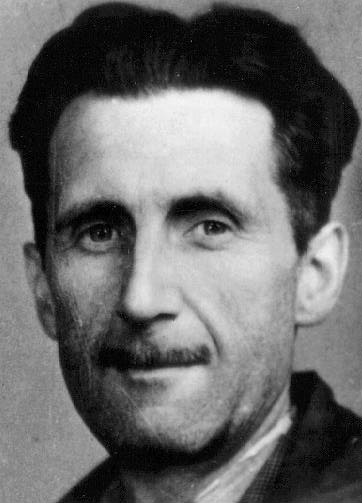
Orwell’s press card portrait, 1943
Bruckner’s remark about “Stalinist blackmail” calls to mind a writer whose commitment to both left-wing politics and anti-totalitarianism never wavered in the face of threats and coercion from the Left.
In the summer of 2003, the BBC aired George Orwell: A Life in Pictures. About halfway through the documentary, Orwell (played by Chris Langham) says, “Every line of serious work that I have written since 1936 has been written, directly or indirectly, against totalitarianism.” This is a line from one of Orwell’s best-known essays, published in 1946, “Why I Write.” But astute viewers may have noticed that something was missing from the reference — eight words that the producers decided to leave out.
Here’s the original sentence: “Every line of serious work that I have written since 1936 has been written, directly or indirectly, against totalitarianism and for democratic socialism, as I understand it.” After the sentence abruptly ends with the word “totalitarianism” in the documentary, Langham takes a long drag on his cigarette before jumping to a different passage of the essay. It was almost as if the producers wanted to accentuate the omission, taunting viewers with their own version of Orwell — one who didn’t have the courage to disclose his true beliefs.
There’s something simultaneously fitting and perverse about the manipulation of Orwell’s words more than half a century after his death (by the BBC, no less). Orwell’s anxiety about the falsification of history is one of the major themes of Nineteen Eighty-Four — as well as much of his other writing and later correspondence — and this is what the producers of the documentary were guilty of doing when they amputated one of his firmest ideological declarations and turned it into a much more palatable and anodyne comment on totalitarianism. No matter how badly some people want Orwell to be a polished and uncontroversial product for mass consumption, he was still the man who wrote these words as he speculated about the possibility of violent revolution in England: “I dare say the London gutters will have to run with blood. All right, let them, if it is necessary.”
Even when Orwell wasn’t in a mood that had him impatiently looking forward to the day “when the red militias are billeted in the Ritz,” he was always honest about his political beliefs. On November 13, 1945, Katharine Stewart-Murray, the Duchess of Atholl, wrote to Orwell asking if he would speak on behalf of an anti-communist organization called the League for European Freedom. This was a month after the publication of Animal Farm — a time when Orwell was worried that the book would be misinterpreted as a broadside against socialism instead of a narrower attack on Stalinism.
Given this context, it isn’t surprising that Orwell declined the duchess’s offer: “Certainly what is said on your platforms is more truthful than the lying propaganda to be found in most of the press, but I cannot associate myself with an essentially Conservative body which claims to defend democracy in Europe but has nothing to say about British imperialism.” Even though Orwell was a staunch anti-communist, his essential political convictions remained immovable: “I belong to the Left and must work inside it, much as I hate Russian totalitarianism and its poisonous influence in this country.”
Orwell was a socialist until the end of his life. For many people, this complicates his legacy and detracts from his pristine image as the twentieth century’s foremost foe of totalitarianism — an image that has been appropriated again and again over the past 70 years.
[…]
But as Orwell was at pains to demonstrate (especially after the publication of Animal Farm), he would have firmly rejected the Right’s attempts to appropriate his legacy. While Orwell is rightly celebrated for his refusal to accept the dogmas of the Left when he was under tremendous pressure to do so, his independence of mind is only one of the reasons why he remains so relevant today. His ability to maintain that independence without sacrificing his most fundamental principles may be even more important.
December 8, 2018
QotD: The nationalist obsession
As nearly as possible, no nationalist ever thinks, talks, or writes about anything except the superiority of his own power unit. It is difficult if not impossible for any nationalist to conceal his allegiance. The smallest slur upon his own unit, or any implied praise of a rival organization, fills him with uneasiness which he can relieve only by making some sharp retort. If the chosen unit is an actual country, such as Ireland or India, he will generally claim superiority for it not only in military power and political virtue, but in art, literature, sport, structure of the language, the physical beauty of the inhabitants, and perhaps even in climate, scenery and cooking. He will show great sensitiveness about such things as the correct display of flags, relative size of headlines and the order in which different countries are named. Nomenclature plays a very important part in nationalist thought. Countries which have won their independence or gone through a nationalist revolution usually change their names, and any country or other unit round which strong feelings revolve is likely to have several names, each of them carrying a different implication. The two sides of the Spanish Civil War had between them nine or ten names expressing different degrees of love and hatred. Some of these names (e.g. ‘Patriots’ for Franco-supporters, or ‘Loyalists’ for Government-supporters) were frankly question-begging, and there was no single one of the which the two rival factions could have agreed to use. All nationalists consider it a duty to spread their own language to the detriment of rival languages, and among English-speakers this struggle reappears in subtler forms as a struggle between dialects. Anglophobe-Americans will refuse to use a slang phrase if they know it to be of British origin, and the conflict between Latinizers and Germanizers often has nationalists motives behind it. Scottish nationalists insist on the superiority of Lowland Scots, and socialists whose nationalism takes the form of class hatred tirade against the B.B.C. accent and even the often gives the impression of being tinged by belief in sympathetic magic — a belief which probably comes out in the widespread custom of burning political enemies in effigy, or using pictures of them as targets in shooting galleries.
George Orwell, “Notes on Nationalism”, Polemic, 1945-05.
December 4, 2018
QotD: B.H. Liddell Hart and J.F.C. Fuller
The military commentators of the popular press can mostly be classified as pro-Russian or anti-Russian pro-blimp or anti-blimp. Such errors as believing the Maginot Line impregnable, or predicting that Russia would conquer Germany in three months, have failed to shake their reputation, because they were always saying what their own particular audience wanted to hear. The two military critics most favoured by the intelligentsia are Captain Liddell Hart and Major-General Fuller, the first of whom teaches that the defence is stronger that the attack, and the second that the attack is stronger that the defence. This contradiction has not prevented both of them from being accepted as authorities by the same public. The secret reason for their vogue in left-wing circles is that both of them are at odds with the War Office.
George Orwell, footnote to “Notes on Nationalism”, Polemic, 1945-05.
November 19, 2018
QotD: How nationalism distorts opinion and judgement
For those who feel deeply about contemporary politics, certain topics have become so infected by considerations of prestige that a genuinely rational approach to them is almost impossible. Out of the hundreds of examples that one might choose, take this question: Which of the three great allies, the U.S.S.R., Britain and the USA, has contributed most to the defeat of Germany? In theory, it should be possible to give a reasoned and perhaps even a conclusive answer to this question. In practice, however, the necessary calculations cannot be made, because anyone likely to bother his head about such a question would inevitably see it in terms of competitive prestige. He would therefore start by deciding in favour of Russia, Britain or America as the case might be, and only after this would begin searching for arguments that seemed to support his case. And there are whole strings of kindred questions to which you can only get an honest answer from someone who is indifferent to the whole subject involved, and whose opinion on it is probably worthless in any case. Hence, partly, the remarkable failure in our time of political and military prediction. It is curious to reflect that out of all the ‘experts’ of all the schools, there was not a single one who was able to foresee so likely an event as the Russo-German Pact of 1939. And when news of the Pact broke, the most wildly divergent explanations were of it were given, and predictions were made which were falsified almost immediately, being based in nearly every case not on a study of probabilities but on a desire to make the U.S.S.R. seem good or bad, strong or weak. Political or military commentators, like astrologers, can survive almost any mistake, because their more devoted followers do not look to them for an appraisal of the facts but for the stimulation of nationalistic loyalties. And aesthetic judgements, especially literary judgements, are often corrupted in the same way as political ones. It would be difficult for an Indian Nationalist to enjoy reading Kipling or for a Conservative to see merit in Mayakovsky, and there is always a temptation to claim that any book whose tendency one disagrees with must be a bad book from a literary point of view. People of strongly nationalistic outlook often perform this sleight of hand without being conscious of dishonesty.
George Orwell, “Notes on Nationalism”, Polemic, 1945-05.
November 17, 2018
QotD: Positive and negative nationalism
…nationalist feeling can be purely negative. There are, for example, Trotskyists who have become simply enemies of the U.S.S.R. without developing a corresponding loyalty to any other unit. When one grasps the implications of this, the nature of what I mean by nationalism becomes a good deal clearer. A nationalist is one who thinks solely, or mainly, in terms of competitive prestige. He may be a positive or a negative nationalist — that is, he may use his mental energy either in boosting or in denigrating — but at any rate his thoughts always turn on victories, defeats, triumphs and humiliations. He sees history, especially contemporary history, as the endless rise and decline of great power units, and every event that happens seems to him a demonstration that his own side is on the upgrade and some hated rival is on the downgrade. But finally, it is important not to confuse nationalism with mere worship of success. The nationalist does not go on the principle of simply ganging up with the strongest side. On the contrary, having picked his side, he persuades himself that it is the strongest, and is able to stick to his belief even when the facts are overwhelmingly against him. Nationalism is power-hunger tempered by self-deception. Every nationalist is capable of the most flagrant dishonesty, but he is also — since he is conscious of serving something bigger than himself — unshakeably certain of being in the right.
George Orwell, “Notes on Nationalism”, Polemic, 1945-05.
November 9, 2018
Sniffing out the heretics in academia
There’s apparently an easy way to figure out who the secret conservatives are in the academic world:
In Evan Maloney’s fun little campus-bashing documentary Indoctrinate U, there’s a psychology prof who’s been outed as a conservative (and, of course, harassed out of employment and blackballed from academia, because Liberals are all about the dissenting viewpoints and how dare you suggest otherwise!!!). Maloney then interviews several of her former students:
“Oh yeah,” they say, “we all knew.” He asks them just how they knew, and they all reply with a version of “because she was the only professor we had who didn’t go off on political rants all the time in class.”
Which is how all but the deepest-cover shitlords get blown. Unhinged political rants are so common in academia, in every class from the loopiest Angry Studies seminar to the hardest of STEM labs, that simply not acting like an SJW lunatic during class time is unusual enough to get you noticed. It’s like being the first guy to stop clapping for Dear Leader at a North Korean politburo meeting.*
*It’s a mark of Orwell’s genius that he even thought this through. I always wondered why the put a time limit on the Two Minutes’ Hate… until I realized that, Stalinists being Stalinists, no work would get done otherwise; they’d keep ranting until they dropped from exhaustion (and the first guy to pass out would probably still get shot).
October 7, 2018
QotD: Hitler’s over-arching “grand strategy”
… on the internal evidence of Mein Kampf, it is difficult to believe that any real change has taken place in Hitler’s aims and opinions. When one compares his utterances of a year or so ago with those made fifteen years earlier, a thing that strikes one is the rigidity of his mind, the way in which his world-view doesn’t develop. It is the fixed vision of a monomaniac and not likely to be much affected by the temporary manoeuvres of power politics. Probably, in Hitler’s own mind, the Russo-German Pact represents no more than an alteration of time-table. The plan laid down in Mein Kampf was to smash Russia first, with the implied intention of smashing England afterwards. Now, as it has turned out, England has got to be dealt with first, because Russia was the more easily bribed of the two. But Russia’s turn will come when England is out of the picture — that, no doubt, is how Hitler sees it. Whether it will turn out that way is of course a different question.
Suppose that Hitler’s programme could be put into effect. What he envisages, a hundred years hence, is a continuous state of 250 million Germans with plenty of “living room” (i.e. stretching to Afghanistan or thereabouts), a horrible brainless empire in which, essentially, nothing ever happens except the training of young men for war and the endless breeding of fresh cannon-fodder. How was it that he was able to put this monstrous vision across? It is easy to say that at one stage of his career he was financed by the heavy industrialists, who saw in him the man who would smash the Socialists and Communists. They would not have backed him, however, if he had not talked a great movement into existence already. Again, the situation in Germany, with its seven million unemployed, was obviously favourable for demagogues. But Hitler could not have succeeded against his many rivals if it had not been for the attraction of his own personality, which one can feel even in the clumsy writing of Mein Kampf, and which is no doubt overwhelming when one hears his speeches …. The fact is that there is something deeply appealing about him. One feels it again when one sees his photographs — and I recommend especially the photograph at the beginning of Hurst and Blackett’s edition, which shows Hitler in his early Brownshirt days. It is a pathetic, dog-like face, the face of a man suffering under intolerable wrongs. In a rather more manly way it reproduces the expression of innumerable pictures of Christ crucified, and there is little doubt that that is how Hitler sees himself. The initial, personal cause of his grievance against the universe can only be guessed at; but at any rate the grievance is here. He is the martyr, the victim, Prometheus chained to the rock, the self-sacrificing hero who fights single-handed against impossible odds. If he were killing a mouse he would know how to make it seem like a dragon. One feels, as with Napoleon, that he is fighting against destiny, that he can’t win, and yet that he somehow deserves to. The attraction of such a pose is of course enormous; half the films that one sees turn upon some such theme.
George Orwell, “Review of Mein Kampf” by Adolf Hitler”, 1940.
September 11, 2018
September 5, 2018
QotD: Why did appeasing the Fascist dictators seem such a sensible policy?
It is a familiar student essay question, whether the revolution could have been averted, but for the world war and resultant loss of up to three million Russian lives. It seems more useful merely to suggest that, in the political and ideological climate of the early 20th century, the collectivist experiment was bound to be attempted somewhere, and Russia or China were obvious testbeds. The consequences for millions of Russian peasants, together with the ferocity of Soviet oppression, were successfully concealed from most western eyes for half a century. The 1789 French revolution killed only a few thousand aristocrats and transferred land to peasants, who thus became ardent upholders of property rights. The Russian version required liquidation of the entire governing class and transfer of land to collective ownership, an incomparably more radical proceeding. Douglas Smith’s 2012 book Former People gives a harrowing account of the fate of the Tsarist aristocracy.
In the West, the gullibility of the Webbs, Bernard Shaw and the rest of the ‘true believers’ was fed by a desperation to suppose the Soviet example viable. ‘Looking around us at our own hells,’ wrote the historian Philip Toynbee, who became a communist at Cambridge, ‘we had to invent an earthly paradise somewhere else’. As late as 1945, the leftist publisher Victor Gollancz brought posterity’s contempt upon himself by declining to publish Animal Farm, George Orwell’s great satire on Bolshevism.
For a counter-revolutionary contemporary perspective, it is impossible to understand the 1930s appeasement of the dictators without grasping the traumatic impact of events in Russia on the propertied classes everywhere. The Winter Palace was stormed only 16 years before Hitler came to power. For at least two decades, Europe’s ‘haves’ were far more frightened of Bolshevism than of fascism.
The ‘clubland hero’ novels of John Buchan and Sapper offer embarrassing glimpses of the British bourgeois view of Lenin’s people and their followers in the decades following the revolution. A belief took hold in polite circles that the bloodiest revolutionaries were not merely communists but also Jews, which meant they were doubly damned in St James’s clubs.
Max Hastings, “The centenary of the Russian revolution should be mourned, not celebrated”, The Spectator, 2016-12-10.
May 10, 2018
QotD: Langue de bois
The attendees [of a medical leadership conference] would learn about something called “lean management,” one feebly-attempted definition of which is as follows:
If someone tells you that “lean management is this” and not something else, if someone puts it in a box and ties a bow around it and presents it in a neat package with four walls around it, then that someone knows not of what they speak. Why? Because it is in motion and not a framed picture hanging on the wall. It is a melody, a rhythm, and not a single note.
This is the mysticism of apparatchiks, the romanticism of bureaucrats, the poetry of clerks. From my limited observations of management in public hospitals and other parts of the public health care system, it seeks to be not lean, in the commonly used sense of the word, but fat, indeed as fat as possible; nor are large private institutions very much different.
It seems, then, that we have entered, gradually and without any central direction or decree, a golden age of langue de bois or even of Newspeak. Langue de bois is the pompous, vague, and abstract words that have some kind of connotation but no real denotation used by those who have to hide their real motives and activities by a smokescreen of scientific- or benevolent-sounding verbiage. Newspeak is the language in Nineteen Eighty-Four whose object is to limit human minds to a few simple politically permissible thoughts, excluding all others, and making doublethink — the frictionless assent to incompatible propositions — part of everyday mentation.
Langue de bois and Newspeak are no longer languages into which normal thought must be translated; rather they have become the languages in which thought itself, or rather cerebral activity, takes place, at least in the upper echelons of the bureaucracy that rules us. If you ask someone who speaks either of them to translate what he has said or written into normal language, it is more than likely he will be unable to do so: His translation will be indistinguishable from the words translated. It is therefore clear that, where culture is concerned, the Soviet Union scored a decisive and probably irreversible victory in the Cold War.
Theodore Dalrymple, “Life de Bois”, Taki’s Magazine, 2016-09-10.


