
Academy of Ideas
Published on 30 Dec 2017In this video we explore why Orwell believed totalitarianism was a great risk in the modern West, contrasting his ideas with those of Aldous Huxley, author of Brave New World.
===
Get the transcript ►
https://academyofideas.com/2017/12/george-orwell-1984-how-freedom-dies/
April 26, 2018
March 22, 2018
Feature History – Spanish Civil War
Feature History
Published on 12 Mar 2017Hello and welcome to Feature History, featuring The Spanish Civil War, zero mic etiquette, and a super subtle political lesson.
Comments Off on Feature History – Spanish Civil War
February 22, 2018
DicKtionary – E is for Eugenics – Otmar von Verschuer
TimeGhost
Published on 21 Feb 2018E for eugenics, pseudo science about race,
Selective breeding of humans can make the world a purer place,
When saying, “that’s scary”, those words are ne’er truer,
Then of the main man today, Otmar von Verschuer.Hosted by: Indy Neidell
Written by: Spartacus Olsson
Produced and Directed by: Astrid Deinhard
Executive Producers: Bodo Rittenauer, Astrid Deinhard, Indy Neidell, Spartacus Olsson
Camera by: Jonas Klein
Edited by: Spartacus Olsson, Jonas KleinA TimeGhost chronological documentary produced by OnLion Entertainment GmbH
Comments Off on DicKtionary – E is for Eugenics – Otmar von Verschuer
February 9, 2018
DicKtionary – C is for Car – Henry Ford
TimeGhost
Published on 8 Feb 2018C is for car – the automobiles
And nothing is cooler than a boss set of wheels,
From selling some cars, this man made a horde,
Mechanic and boss man, here’s Henry Ford.Hosted and Written by: Indy Neidell
Based on a concept by Astrid Deinhard and Indy Neidell
Produced by: Spartacus Olsson
Executive Producers: Bodo Rittenauer, Astrid Deinhard, Indy Neidell, Spartacus Olsson
Camera by: Ryan
Edited by: Bastian BeißwengerA TimeGhost documentary format produced by OnLion Entertainment GmbH
Comments Off on DicKtionary – C is for Car – Henry Ford
December 21, 2017
The bloody 20th century and the leaders who helped make it so
Walter Williams on the terrible death toll of the 20th century, both in formal war between nations and in internal conflict and repression:
The 20th century was mankind’s most brutal century. Roughly 16 million people lost their lives during World War I; about 60 million died during World War II. Wars during the 20th century cost an estimated 71 million to 116 million lives.
The number of war dead pales in comparison with the number of people who lost their lives at the hands of their own governments. The late professor Rudolph J. Rummel of the University of Hawaii documented this tragedy in his book Death by Government: Genocide and Mass Murder Since 1900. Some of the statistics found in the book have been updated here.
The People’s Republic of China tops the list, with 76 million lives lost at the hands of the government from 1949 to 1987. The Soviet Union follows, with 62 million lives lost from 1917 to 1987. Adolf Hitler’s Nazi German government killed 21 million people between 1933 and 1945. Then there are lesser murdering regimes, such as Nationalist China, Japan, Turkey, Vietnam and Mexico. According to Rummel’s research, the 20th century saw 262 million people’s lives lost at the hands of their own governments.
Hitler’s atrocities are widely recognized, publicized and condemned. World War II’s conquering nations’ condemnation included denazification and bringing Holocaust perpetrators to trial and punishing them through lengthy sentences and execution. Similar measures were taken to punish Japan’s murderers.
But what about the greatest murderers in mankind’s history — the Soviet Union’s Josef Stalin and China’s Mao Zedong? Some leftists saw these communists as heroes. W.E.B. Du Bois, writing in the National Guardian in 1953, said, “Stalin was a great man; few other men of the 20th century approach his stature. … The highest proof of his greatness (was that) he knew the common man, felt his problems, followed his fate.” Walter Duranty called Stalin “the greatest living statesman” and “a quiet, unobtrusive man.” There was even leftist admiration for Hitler and fellow fascist Benito Mussolini. When Hitler came to power in January 1933, George Bernard Shaw described him as “a very remarkable man, a very able man.” President Franklin Roosevelt called the fascist Mussolini “admirable,” and he was “deeply impressed by what he (had) accomplished.”
Comments Off on The bloody 20th century and the leaders who helped make it so
November 7, 2017
Le Corbusier
Theodore Dalrymple could never be called a fan of Le Corbusier’s architecture:
The French fascist architect Charles-Édouard Jeanneret, better known as Le Corbusier, was another of this charmless ilk, though cleaner than Brecht (a Marxist, the latter’s decision not to wash was his tribute, albeit not a very flattering one, to the proletariat). Jeanneret’s inhumanity, his rage against humans, is evident in his architecture and in his writings. He felt the level of affection and concern for them that most people feel for cockroaches.
Like Hitler, Jeanneret wanted to be an artist, and, as with Hitler, the world would have been a better place if he had achieved his ambition. Had he been merely an artist, one could have avoided his productions if one so wished; but the buildings that he and his myriad acolytes have built unavoidably scour the retina of the viewer and cause a decline in the pleasure of his existence.
One of Jeanneret’s buildings can devastate a landscape or destroy an ancient townscape once and for all, with a finality that is quite without appeal; as for his city planning, it was of a childish inhumanity and rank amateurism that would have been mildly amusing had it remained purely theoretical and had no one taken it seriously.
A book has just been published — Le Corbusier: The Dishonest Architect, by Malcolm Millais — that reads like the indictment of a serial killer who can offer no defense (except, possibly, a psychiatric one). The author shares with me an aesthetic detestation of Jeanneret, and also of his casual but deeply vicious totalitarianism; but, unlike me, the author both has a scholarly knowledge of his subject’s life and writings, of which the perusal of only a few has more than sufficed for me, and is a highly qualified structural engineer. Mr. Millais is able to prove not only that Jeanneret was a liar, cheat, thief, and plagiarist in the most literal sense of the words, a criminal as well as being personally unpleasant on many occasions, but that he was technically grossly ignorant and incompetent, indeed laughably so. His roofs leaked, his materials deteriorated. He never grasped the elementary principles of engineering. All his ideas were gimcrack at best, and often far worse than merely bad. To commission a building from Jeanneret was to tie a ball and chain around one’s own ankle, committing oneself to endless, Sisyphean bills for alteration and maintenance, as well as to a dishonest estimate of what the building would cost to build in the first place. A house by Jeanneret was not so much a machine for living in (to quote the most famous of his many fatuous dicta) as a machine for generating costs and for moving out of. In the name of functionality, Jeanneret built what did not work; in the name of mass production, everything he used had to be individually fashioned. Having no human qualities himself, and lacking all imagination, he did not even understand that shade in a hot climate was desirable, indeed essential.
Comments Off on Le Corbusier
QotD: Crony capitalism
Fascism is actually an economic system, of which “crony capitalism”, an illegitimate partnership between government and business, is an excellent example. Known otherwise as corporate socialism or simply corporatism, other eras (Adam Smith‘s for instance, in his book Wealth of Nations) have called it Mercantilism.
L. Neil Smith, “The American Zone”, The Libertarian Enterprise, 2016-03-20.
Comments Off on QotD: Crony capitalism
November 4, 2017
September 25, 2017
QotD: IKEA’s shady history
IKEA itself serves as a fitting symbol of the middle-class masquerade. The company’s well-managed brand obscures the fact that its founder, Ingvar Kamprad, at the time that he founded the store in 1943, was a member of Sweden’s pro-Nazi fascist party, in which he continued to be active at least until 1948 and which he continued to praise for decades after; or that the company used forced prison labor in East Germany until the fall of the Berlin Wall. It is fitting that IKEA’s current worth is unknown, since it is technically owned by a phony-charity shell company incorporated in the Netherlands, enabling Kamprad to evade Swedish taxes. This is not to single out IKEA for particular scorn: one could write an equally lurid laundry list about almost any large corporation; a fascist undertone usually lurks beneath the surface of mass-production and mass-marketing. Consider the fact that Apple uses what is slave labor in all but name in China yet none of their customers seem to care.
Samuel Biagetti, “The IKEA Humans: The Social Base of Contemporary Liberalism”, Jacobite, 2017-09-13.
Comments Off on QotD: IKEA’s shady history
September 19, 2017
Even in a progressive educational bubble, this isn’t correct
Holly Nicholas shared this photo, which is said to be from an Alberta school:
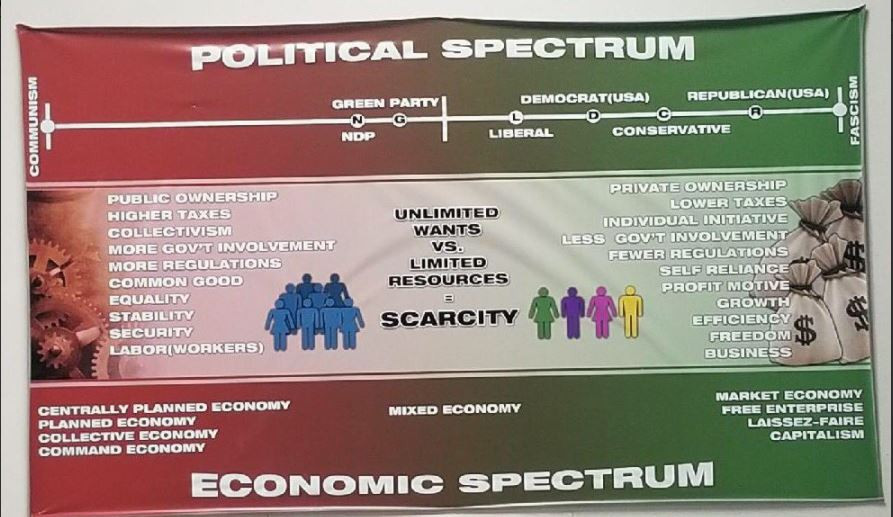
If this is indeed how public schools are presenting the political spectrum (and it’s unfortunately easy to believe that they do), the closest thing to a “centrist” party in Canada is the loony left Green Party … who somehow pip the NDP on the right. The far right end of the spectrum, Fascism, is graphically indicated to be all about “Market Economy, Free Enterprise, and Laissez-Faire Capitalism”, because as we all remember, Hitler and Mussolini were in no way fans of state intervention in the economy, right?
The graphic does, however, support certain shibboleths of the left including implying that libertarians (who are actually in favour of market economies, free enterprise, and laissez-faire capitalism) are in the same economic and political basket as actual fascists. Nice work, faceless agitprop graphic artist!
Comments Off on Even in a progressive educational bubble, this isn’t correct
September 16, 2017
Moral and philosophical conflict in Wilhelmine Germany
At Samizdata, Paul Marks looks at intra-German conflicts that were played out during and after the First World War:
The conflict between German Generals Falkenhayn and Ludendorff was over a lot more than military policy – indeed Falkenhayn made some horrible mistakes in military tactics, for example allowing himself to be pushed into continuing the Verdun offensive much longer than he intended (at least much longer than he later claimed had been his original intention), and insisting that General Fritz Von Below recapture any position he lost to the British in the Somme offensive – an order that led to terrible German casualties.
The conflict may have been presented as a military one (between the “Westerner” Falkenhayn and the “Easterner” Lundendorff ) over whether to concentrate German military resources in the West or the East – but it was really a lot more than a dispute over military policy. Nor was it really a dispute over the form of government – as neither Falkenhayn or Ludendorff was a democrat. It was fundamentally a MORAL (ethical) dispute.
General Lundendorff had absorbed (even more than Kaiser Wilhelm II had) the moral relativism and historicism that had become fashionable in the German elite in the decades running up to the First World War – ideas that can be traced all the way back to (in their different ways) such philosophers as Hegel and (far more) Fichte, whereas General Falkenhayn still clung to concepts of universal justice (morality) and rejected such things as the extermination or enslavement of whole races, and the destruction of historic civilisations such as that of Russia. Lundendorff, and those who thought like him, regarded Falkenhayn as hopelessly reactionary – for example thinking in terms of making peace with Russia on terms favourable to Germany, rather than destroying Russia and using the population as slaves. In the Middle East Falkenhayn came to hear of the Ottoman Turk plan to destroy the Jews (as the Armenian Christians had been destroyed), and he was horrified by the plan and worked to frustrate it. Advanced and Progressive thinkers, such as Ludnedorff, had great contempt for Reactionaries such as Falkenhayn who did not realise that ideas of universal justice and personal honour were “myths” only believed in by silly schoolgirls. Falkenhayn even took Christianity seriously, to Lundendorff this was clearly the mark of an inferior and uneducated mind. And Falkenhayn, for his part, came to think that his country (the Germany that he so loved) was under the influence of monsters – although while their plans to exterminate or enslave whole races and to control (in utter tyranny) every aspect of peacetime (not just wartime) life remained theoretical, he never had to make the final break.
The conflict continued into the next generation. Famously Admiral Canaris (head of German military intelligence) became an enemy of the National Socialists – not because he was a believer in a democratic form of government, but because he believed that the Nazis were a moral outrage violating the most basic principles of universal truth and justice. But the point of view in Germany opposed to men such as Admiral Canaris. the point of view that made itself felt in such things as the German Declaration of War upon France in 1914 – a pack of lies, and (perhaps more importantly) a deliberately OBVIOUS pack of lies (in order to make a philosophical point – as the President of France, a philosopher, noticed at once), had long had nothing but contempt for the very idea of universal objective truth and justice.
I’d always thought that the rise of Fascism and Communism in the 1920s was primarily due to the political chaos and material privations suffered by German citizens through the latter stages of WW1 and continuing through the Versailles Treaty negotiations. Paul shows that the groundwork for both strains of totalitarian thought were already well underway even before the catastrophe of 1914. Of course, as I think I illustrated in the origins of WW1 posts, nothing about the situation in Europe at that time was simple or straight-forward.
Comments Off on Moral and philosophical conflict in Wilhelmine Germany
September 1, 2017
“Antifa looks increasingly like the militant wing of Safe Space fanaticism”
Brendan O’Neill posting to Facebook a few days back:
People are shocked by images of antifa activists beating up normal, peaceful right-wing protesters in Berkeley or physically shoving right-wing people off Boston Common. Why? This is what happens when you tell an entire generation that other people’s ideas are dangerous, that their speech is toxic, that their words can wound you and traumatise you: you invite that generation to shut people down, to use any means necessary to ensure “dangerous” ideas are not expressed and do not cause injury to people’s self-esteem or sense of safety. We are starting to see what happens when speech is talked about as a form of violence: it green-lights actual violence against certain forms of speech. If speech is violence, shouldn’t it be met with violence? Antifa looks increasingly like the militant wing of Safe Space fanaticism, the bastard offspring of a culture that elevates mental safety over intellectual liberty, and people’s feelings over public freedom.
Comments Off on “Antifa looks increasingly like the militant wing of Safe Space fanaticism”
August 30, 2017
James May loves airships! MORE EXTRAS – James May’s Q&A – Head Squeeze
Published on 17 Mar 2013
You asked for it! In a previous episode of James May’s Q&A, James discussed the sad demise of the airship as a popular mode of transport. And during filming we literally couldn’t get him to stop talking about them! Clearly he loves airships and loves to talk about airships. A lot! Lucky for all you people we captured it all and can present it now as Exclusive Extended Extras on the rise and fall of airships.
Original clip here: http://www.youtube.com/watch?v=ug5UafJFEYc
James May’s Q&A:
With his own unique spin, James May asks and answers the oddball questions we’ve all wondered about from ‘What Exactly Is One Second?’ to ‘Is Invisibility Possible?’
Comments Off on James May loves airships! MORE EXTRAS – James May’s Q&A – Head Squeeze
August 19, 2017
How to Safely Watch The Eclipse or CNN
Published on 18 Aug 2017
Remy has a few helpful tips for safely watching large orange balls of gas.
Written by Remy. Produced by Austin Bragg
Comments Off on How to Safely Watch The Eclipse or CNN
August 18, 2017
“Rebel Commander Ezra Levant” calls retreat
In the National Post, Chris Selley recounts the sudden changes in staffing and editorial policy at Ezra Levant’s mini media empire:
If Rebel Media’s uppance was coming, if some event was finally going to wipe the smirk off its face, it could hardly have been more hideously appropriate than what happened over the weekend in Charlottesville, Va.
Live on the internet, Rebel personality Faith Goldy was blathering on about how intolerant the left is, and about left-right double standards in the media and in policing, and about all the other things that gladden the hearts of the Rebel’s grievance-based nihilist-conservative fans.
And then, right there in the frame, someone rammed his car into the crowd of counter-protesters she was mocking, killing 32-year-old Heather Heyer and injuring many others. That guy, allegedly, was 20-year-old James Alex Fields, whose high school teachers said he was obsessed with Adolf Hitler in all the wrong ways.
Fun time was over. This was, apparently, a real live neo-Nazi committing, certainly, real live murder.
At this point, Rebel Commander Ezra Levant could have steered his vessel in one of several directions. “Nothing to do with us,” he could have said, plausibly enough.
[…]
Levant could have gone there; instead, he blinked.
“When I first heard of the alt-right a year ago, I thought it simply meant the insurgent right, the politically incorrect right … the right that backed Trump and his ‘Make America Great Again’ style over Jeb Bush and the swamp,” he wrote in a purported “staff memo.”
“But the alt-right has changed into something new, especially since Trump’s election,” Levant lamented. “Now the leading figure … is Richard Spencer, and other white nationalists.” There were actual Nazi flags in Charlottesville, Levant noted, waxing appalled (while allowing they might have been carried by “agents provocateurs”). That’s “racist,” he averred, rather than “conservative,” and he would have none of it.
It is, in a word, pathetic. Spencer coined the term “alt-right,” for heaven’s sake. He has never, ever been shy about his white nationalist views. A manifesto he released before the march in Charlottesville talks of “a shared civilization” that “sprang” from the “Aryan” race, and dismisses the idea of “Judeo-Christian values” as “a distortion of the historical and metaphysical reality of both Jews and Europeans.”
I haven’t closely followed the adventures of Ezra and his Rebel Media organization, so the sudden rash of departures (Brian Lilley and Barbara Kay, in particular) caught me somewhat by surprise. I don’t use Rebel Media as a source, but I have linked to non-Rebel Media articles by Lilley and Kay, and probably other contributors outside that affiliation. I had noted the organization’s dedication to “afflicting the comfortable” — almost always those on the political left — without much corresponding “comforting the afflicted” to balance it out. Explicitly abandoning the Richard Spencer wing of the alt-right is probably a good move, but it may have come too late to prevent the alt-right taint from permanently damaging their brand.
Comments Off on “Rebel Commander Ezra Levant” calls retreat


