Quotulatiousness

May 7, 2020

Interesting change in shipping patterns … to avoid the Suez canal

Filed under: Business, Economics, Middle East — Tags: , , , , — Nicholas @ 05:00

Colby Cosh linked to this story at gcaptain.com which would have been an unbelievable one in the pre-epidemic world:

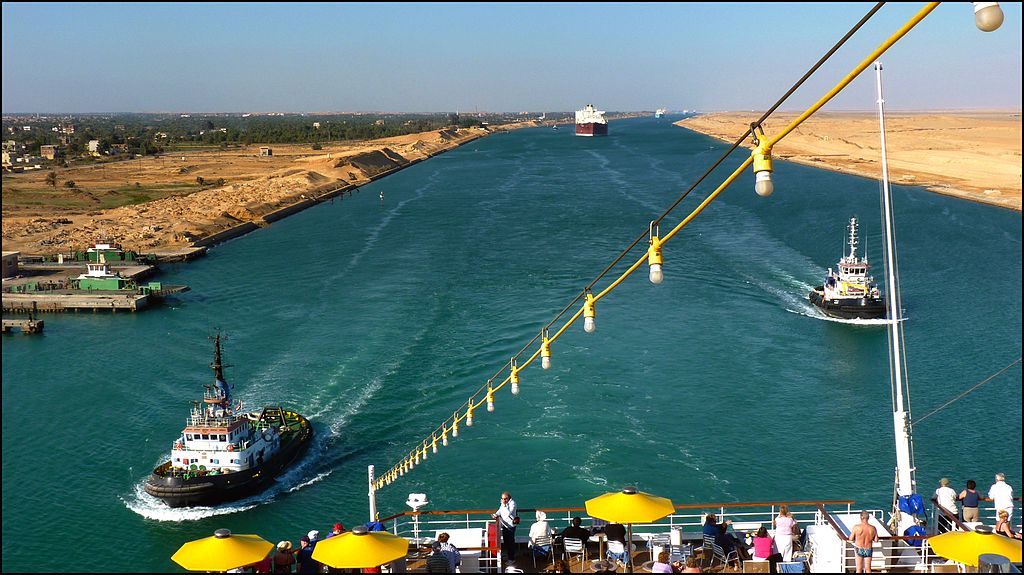
A column of ships along the Suez Canal on 3 December, 2011.
Photo by https://web.archive.org/web/20161022104657/http://www.panoramio.com/user/2433337?with_photo_id=64163879 via Wikimedia Commons.

The Suez Canal Authority (SCA) is set to lose over $10m in revenue from container lines routing vessels via the Cape of Good Hope rather than its waterway.

According to new Alphaliner research, “the number of containerships that have opted to use the Cape route and bypass the Suez Canal has risen to a historic peace-time high,” including at least 20 sailings on the Asia-Europe, Europe-Asia and North America east coast-Asia trades.

“A unique combination of a container tonnage surplus and rock-bottom bunker prices has increasingly prompted ocean carriers to avoid the canal – and thus its fees,” the analyst noted today.

“Rather unusually, even three westbound Asia-Europe headhaul sailings have opted for the Cape route, all operated by CMA CGM.

“Carriers very rarely choose this longer route for the time-sensitive headhaul, but the low bunker price and lack of demand in European markets, hit by the Covid-19 lockdowns, have suddenly made such moves viable,” it added.

April 18, 2020

Miscellaneous Myths: Typhon

Filed under: Europe, Greece, History, Religion — Tags: , , — Nicholas @ 04:00

Overly Sarcastic Productions
Published 17 Apr 2020

Are you getting sick of Zeus? Are his constant antics getting you down? Do you wanna hear about the time he got his ass kicked by Godzilla?

Our content is intended for teenage audiences and up.

PATREON: https://www.Patreon.com/OSP

MERCH LINKS: https://www.redbubble.com/people/OSPY…

OUR WEBSITE: https://www.OverlySarcasticProductions.com
Find us on Twitter https://www.Twitter.com/OSPYouTube
Find us on Reddit https://www.Reddit.com/r/OSP/
Discord: https://discord.gg/h3AqJPe

April 17, 2020

QotD: Rommel arrives in North Africa

Filed under: Africa, Britain, Germany, History, Italy, Military, Quotations, WW2 — Tags: , , , , — Nicholas @ 01:00

Rommel arrived in February 1941 with fairly mundane orders to act as a Sperrband, a “blocker” to bolster the Italians after their mauling at Beda Fomm. The force he led was appropriately tiny: the reconnaissance battalion and an antitank detachment of the 5th Light Division (soon renamed the 21st Panzer Division). The rest of the division was still en route to Africa, and a second division, the 15th Panzer, would not arrive completely until the end of May.

Rommel had his orders, but he had ignored orders in the past and been decorated for it. With British forces stripped to fight an exceedingly ill-advised campaign in Greece, he carried out a quick personal reconnaissance in his trusty little Fieseler Storch airplane, then launched an offensive in concert with his Italian partners (Ariete armored division and the infantry divisions of X Corps, Bologna and Pavia). He penetrated British defenses at El Agheila on March 24th, then drove on to Mersa el Brega on March 31st, pausing only long enough to take (and ignore) a number of radio messages from Berlin and Rome warning him not to do anything rash. Finally, he smashed the British defenders at Agedabia (elements of the green 2nd Armoured Division, equipped partially with captured Italian M13/40 tanks), pinning them in front with the infantry of 5th Light Division while dispatching his Panzers on a ride around the open desert flank to the south, the first use of a tactic that would become his signature move.

These three tiny encounters, none of them exceeding regimental strength, were enough to unhinge the entire British defensive position in Cyrenaica. Rommel now expanded his “reconnaissance in force” into a general offensive, although the forces involved were still minuscule. One column headed up the coast road towards Benghazi, while two more sliced across the Cyrenaican bulge, scooping up a mountain of British supplies at Msus and Mechili. The British rear was in chaos. On April 6th, a German motorcycle patrol actually captured the British commander in Cyrenaica, General Philip Neame, as well as General Richard O’Connor, the victor of Beda Fomm. By April 11th, the Germans had surrounded the coastal fortress of Tobruk while smaller formations pressed on to the east, taking Bardia and reaching the Egyptian border at Sollum and Ft. Capuzzo.

This was top speed maneuver, and the distances were vast, with the Afrika Korps covering over 600 miles in less than two weeks. An amazing feat, to be sure, but may we not legitimately ask, Six-hundred miles to where? Rommel had lunged from central Libya to the Egyptian border in a great bound, but now he had an unconquered fortress sitting in his rear, a serious threat to his lines of communication and supply. Two hastily marshaled attempts to storm Tobruk went badly wrong. In the “Easter battle” (April 10th-14th) and the “battle of the Salient” (April 30th-May 4th), the defenders of the 9th Australian Division hung tough. Minefields channeled the German attacks, while direct fire from artillery, antitank guns, and supporting tanks shot up the assault forces quite badly and killed General Heinrich von Prittwitz, commander of 15th Panzer Division.

The very presence of an unconquered Tobruk rendered the drive across the desert pointless. Indeed, for all the fame it had brought Rommel in the world press, this first campaign won him few friends among command echelons in Berlin. General Halder was especially unimpressed. Rommel, he wrote, “storms around all day long with formations strewn all over the place.” The man had apparently “gone insane.” There was some justice to the complaint. A German division-plus had overrun territory — a vast wasteland, to be precise — but it hadn’t really won anything. There had been no battle of annihilation, no Kesselschlacht, nor could there have been. The Afrika Korps had come a long way, but now sat precariously on the edge of nowhere. Although Rommel and his command had shown a satisfying level of aggression, something the entire officer corps understood, most of them saw his drive to the Egyptian border as a misfire.

Robert Citino, “Drive to Nowhere: The Myth of the Afrika Korps, 1941-43″, The National WWII Museum, 2012. (Originally published in MHQ, Summer 2012).

April 2, 2020

What exactly is one second? | James May’s Q&A (Ep 2) | Head Squeeze

Filed under: Greece, History, Science — Tags: , , — Nicholas @ 05:00

BBC Earth Lab
Published 10 Jan 2013

James May discusses what exactly a seconds is. He also delves into how time as we know it could have been totally different. This is because the second had many “rivals” over the years that never got their way.

Outtakes from this video: http://www.youtube.com/watch?v=kLpGHt…

James May’s Q&A:
With his own unique spin, James May asks and answers the oddball questions that we’ve all wondered about from “What exactly is one second?” to “Is invisibility possible?”

March 31, 2020

Third Crusade | 3 Minute History

Jabzy
Published 25 Jul 2015

Thanks to Xios, Alan Haskayne, Lachlan Lindenmayer, William Crabb, Derpvic, Seth Reeves and all my other Patrons. If you want to help out – https://www.patreon.com/Jabzy?ty=h

March 7, 2020

History Buffs: Lawrence of Arabia

Filed under: Britain, History, Media, Middle East, Military, WW1 — Tags: , , , , , , — Nicholas @ 02:00

History Buffs
Published 17 Apr 2016

BIG THANK YOU TO THE GREAT WAR CHANNEL FOR COLLABORATING WITH ME AND MAKING AWESOME VIDEOS!

Check out their T.E. Lawrence video here –
https://www.youtube.com/watch?v=iqvcjL6ObH0

And the rest of their awesome channel here 🙂
https://www.youtube.com/user/TheGreatWar

And thank you History Buffs so very much for being patient whilst I was in Ireland working on the Vikings podcasts for the History Channel and moving house at the same time. I sincerely hope you guys enjoy this review!

● Follow us on Twitter: https://twitter.com/HistoryBuffsNH

________________________________________­­_________________________________

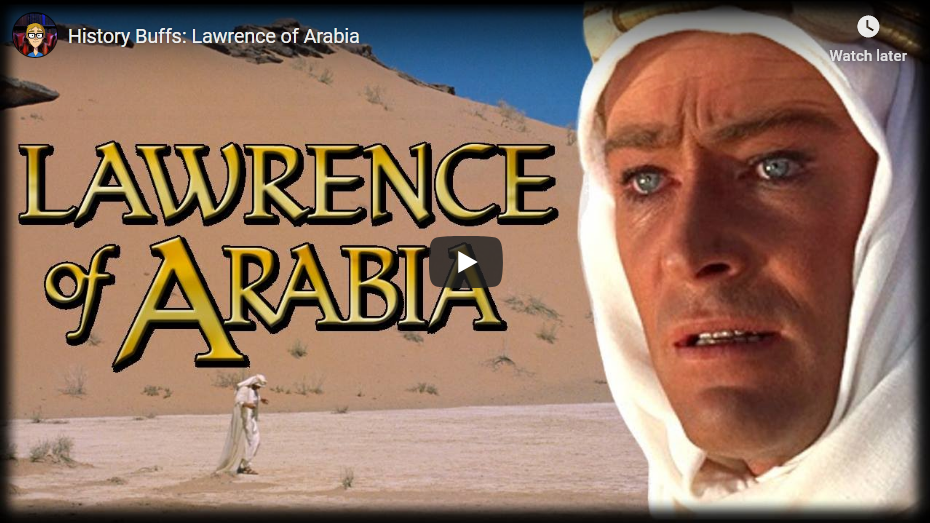
Lawrence of Arabia is a 1962 epic historical drama film based on the life of T. E. Lawrence. It was directed by David Lean and produced by Sam Spiegel through his British company Horizon Pictures, with the screenplay by Robert Bolt and Michael Wilson. The film stars Peter O’Toole in the title role. It is widely considered one of the greatest and most influential films in the history of cinema. The dramatic score by Maurice Jarre and the Super Panavision 70 cinematography by Freddie Young are also highly acclaimed. The film was nominated for ten Academy Awards and won seven in total including Best Director, Best Sound Editing, Best Film Editing, and Best Picture.

The film depicts Lawrence’s experiences in the Arabian peninsula during World War I, in particular his attacks on Aqaba and Damascus and his involvement in the Arab National Council. Its themes include Lawrence’s emotional struggles with the personal violence inherent in war, his own identity, and his divided allegiance between his native Britain and its army and his new-found comrades within the Arabian desert tribes.

In 1991, Lawrence of Arabia was deemed “culturally, historically, or aesthetically significant” and selected for preservation in the United States Library of Congress National Film Registry.

February 15, 2020

The Best Couples in History — Valentine’s Day Special

Overly Sarcastic Productions
Published 14 Feb 2020

Happy Valentine’s Day! Celebrate the history of Love with a rundown of these outstanding couples — for better and for worse.

Our content is intended for teenage audiences and up.

This video was edited by Sophia Ricciardi, AKA “Indigo”.

PATREON: https://www.Patreon.com/OSP

DISCORD: https://discord.gg/h3AqJPe
MERCH LINKS: https://www.redbubble.com/people/OSPY…

OUR WEBSITE: https://www.OverlySarcasticProductions.com
Find us on Twitter https://www.Twitter.com/OSPYouTube
Find us on Reddit https://www.Reddit.com/r/OSP/

January 25, 2020

Swedish K: The Carl Gustav m/45B and the Port Said

Forgotten Weapons
Published 24 Jan 2020

http://www.patreon.com/ForgottenWeapons

https://www.floatplane.com/channel/Fo…

Cool Forgotten Weapons merch! http://shop.bbtv.com/collections/forg…

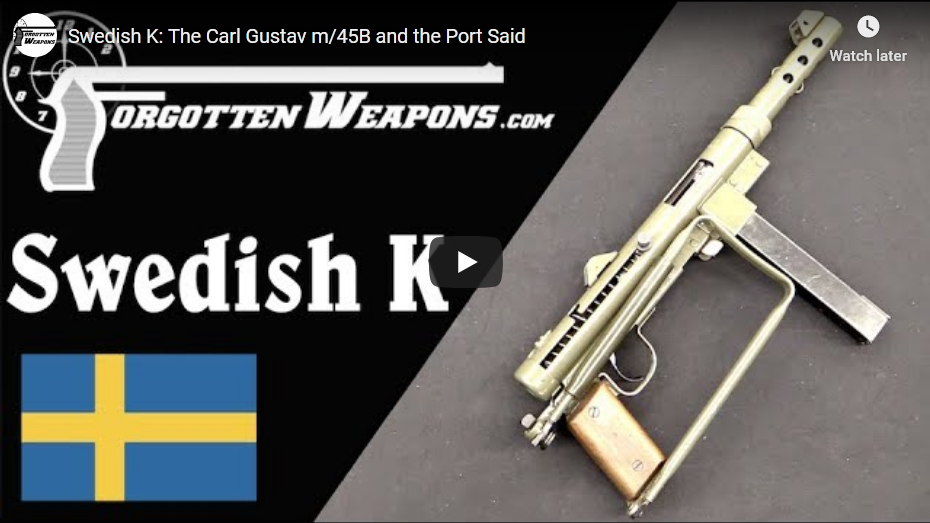
During the 1930s, Sweden acquired an assortment of different submachine guns, including Bergmanns, Thompsons, and Suomis. As World War Two progressed, they decided that they really needed to standardize on a single caliber and model of gun, and requested designs from both the Carl Gustav factory and Husqvarna. The Carl Gustav design won out, and was adopted as the m/45.

It was a very simple open-bolt, tube-receiver, fixed-firing-pin design chambered for 9x19mm Parabellum ammunition. The original guns were built around Finnish Suomi magazines, both 71-round drums and 50-round “coffin” mags. After the war these were replace by a new 36-round traditional box magazine, and magazine well adapters were fitted to the guns which precluded the use of the larger mags. The new magazines were much more convenient to carry, less expensive, and more reliable.

The name “Swedish K” comes form the full designation: Kulsprutepistol m/45. The guns were used by American special operations forces in Vietnam until the Swedish government stopped export sales to the US, at which point the Navy commissioned Smith & Wesson to produce the Model 76 submachine gun (essentially a copy of the m/45). The design was also licensed by Egypt, which also licensed the AG-42 Ljungman rifle at the same time. The Egyptian copy was called the Port Said, and shows the features fo the original Swedish m/45 pattern, where the guns in Swedish service were mostly updated to the m/45B pattern.

Photo of m/45C with bayonet from: http://www.gotavapen.se/index_eng2g.htm

Check them out for a ton of information on Swedish small arms!

Contact:
Forgotten Weapons
6281 N. Oracle #36270
Tucson, AZ 85740

January 17, 2020

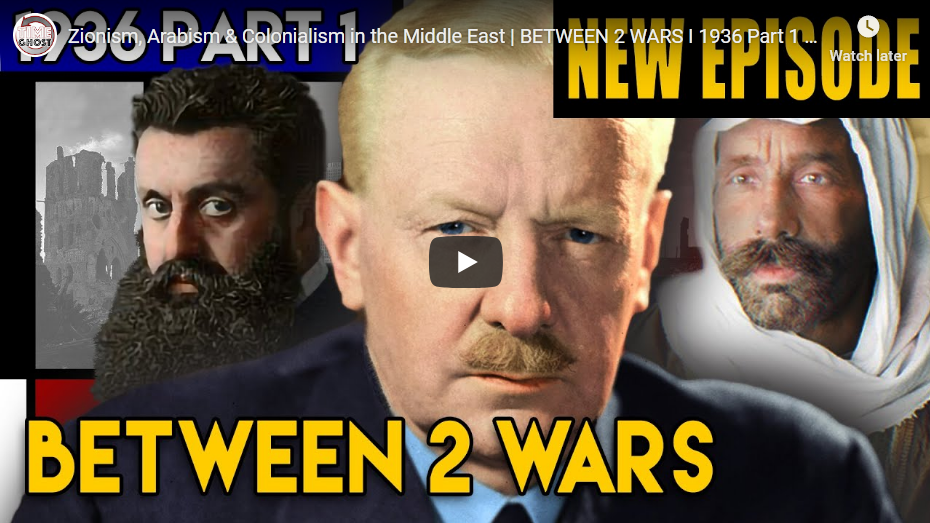
Zionism, Arabism & Colonialism in the Middle East | BETWEEN 2 WARS I 1936 Part 1 of 3

Filed under: Britain, France, History, Middle East, Military — Tags: , , , , , , — Nicholas @ 06:00

TimeGhost History
Published 16 Jan 2020

After more than twenty years of colonial management, promises made but few promises kept and ethnic & cultural clashes in the area, unrest in the Middle East erupts in violence. A series of movements originate in this time, with long lasting consequences.

Watch our episode about the Middle east in the 1920s here: https://youtu.be/y6tSvRbvh2s

Join us on Patreon: https://www.patreon.com/TimeGhostHistory

Hosted by: Indy Neidell
Written by: Joram Appel
Directed by: Spartacus Olsson and Astrid Deinhard
Executive Producers: Bodo Rittenauer, Astrid Deinhard, Indy Neidell, Spartacus Olsson
Creative Producer: Joram Appel
Post-Production Director: Wieke Kapteijns
Research by: Joram Appel
Fact-Checking by: Jonas Srouji
Edited by: Daniel Weiss
Sound design: Marek Kaminski

Sources:
Arab by LINECTOR from the Noun Project
Bomb by P Thanga Vignesh from the Noun Project

Colorizations by:
– Dememorabilia – https://www.instagram.com/dememorabilia/
– Adrien.Colorisation – https://instagram.com/adrien.colorisa…
– Norman Stewart

Soundtracks from Epidemic Sound:
– “Dawn Of Civilization” – Jo Wandrini
– “The Inspector 4” – Johannes Bornlöf
– “Easy Target” – Rannar Sillard
– “First Responders” – Skrya
– “Not Safe Yet” – Gunnar Johnsen
– “Deflection” – Reynard Seidel
– “The Charleston 3” – Håkan Eriksson

A TimeGhost chronological documentary produced by OnLion Entertainment GmbH.

From the comments:

TimeGhost History
42 minutes ago (edited)
We have already covered “Carving up the Middle East” in one of our first Between Two Wars episodes (watch here: https://youtu.be/y6tSvRbvh2s), but we felt like we had to return to the area one more time as all that carving had quite some consequences. This means that a large part of this episode is about colonialism, Zionism, Arabism, race and ethnicity. I’m also aware of the complicated modern-day conflict in the area, many of which originate in [the events covered in] this episode. However, we would like the comment section to be reserved for debating the history. We’re not going to engage with people discussing modern-day issues and politics, and we’re going to be quite strict in monitoring any racist or otherwise hateful comments.

Cheers,
Joram

January 9, 2020

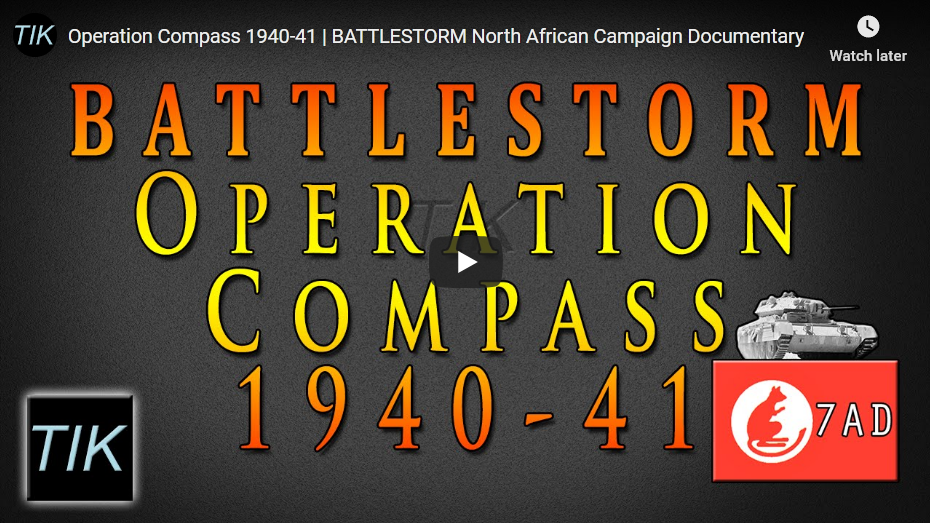
Operation Compass 1940-41 | BATTLESTORM North African Campaign Documentary

Filed under: Africa, Australia, Britain, Germany, History, Italy, Middle East, Military — Tags: , , , , — Nicholas @ 06:00

TIK
Published 21 Dec 2015

The most in-depth look at Operation Compass out there! Using animations and detailed maps, let’s find out what happened in one of the greatest British (and Commonwealth) victories of the war and who was responsible for the destruction of the Italian 10th Army. This video covers the start of the North African Campaign up to the Battle of Beda Fomm.

Sources:
Barnett, C. The Desert Generals. Weidenfeld & Nicolson, 2011.
Bierwirth, J. Beda Fomm: An Operational Analysis. Pickle Partners, 1994.
Christie H. Fallen Eagles: The Italian 10th Army in the Opening Campaign in the Western Desert, June 1940. Pickle Partners 1999.
Dimbleby, J. Destiny in the Desert. Britain 2013.
Moorehead, A. The Desert War: The Classic Trilogy on the North Africa Campaign 1940-43. Aurum Press, 2014.
Playfair, I.S.O. The Mediterranean and Middle East Volume 1: Early Successes against Italy [to May 1941]. 1954.
Wahlert, G. The Western Desert Campaign. Australia, 2011.

Music is my own!

December 15, 2019

The Empire Strikes Back – Britain’s Operation Compass – WW2 – 068 – December 14, 1940

Filed under: Africa, Britain, Germany, History, Italy, Military, WW2 — Tags: , , , , — Nicholas @ 04:00

World War Two
Published 14 Dec 2019

The First British offensive of the War begins in North Africa. Meanwhile, the German Knickebein system is designed for bombers to accurately bomb British targets at night. This is what the Brits do to stop them.

Join us on Patreon: https://www.patreon.com/TimeGhostHistory
Or join The TimeGhost Army directly at: https://timeghost.tv

Follow WW2 day by day on Instagram @World_war_two_realtime https://www.instagram.com/world_war_t…
Join our Discord Server: https://discord.gg/D6D2aYN.
Between 2 Wars: https://www.youtube.com/playlist?list…
Source list: http://bit.ly/WW2sources

Written and Hosted by: Indy Neidell
Produced and Directed by: Spartacus Olsson and Astrid Deinhard
Executive Producers: Bodo Rittenauer, Astrid Deinhard, Indy Neidell, Spartacus Olsson
Creative Producer: Joram Appel
Post-Production Director: Wieke Kapteijns
Research by: Indy Neidell
Edited by: Iryna Dulka
Map animations: Eastory (https://www.youtube.com/c/eastory)

Thumbnail Colorization (Archie Wavell) by:
– Julius Jääskeläinen – https://www.facebook.com/JJcolorization/

Colorizations by:
– Dememorabilia – https://www.instagram.com/dememorabilia/
– Adrien Fillon – https://www.instagram.com/adrien.colo…

Sources:
– IWM: F 4539, B 10600, CM 355, E 6600, E 3720E, E 1416, E 1378, E 4792
– Tropenmuseum, part of the National Museum of World Cultures

– Prison icon by FORMGUT. from the Noun Project; Compass by RULI from the Noun Project.

Archive by Screenocean/Reuters https://www.screenocean.com.

A TimeGhost chronological documentary produced by OnLion Entertainment GmbH.

December 2, 2019

QotD: Evidence of markets in classical civilizations

Filed under: Economics, Europe, Greece, History, Quotations — Tags: , , , , — Nicholas @ 01:00

If someone were to claim that market behaviour was peripheral to life in eighteenth century England, it would be easy to laugh at him. This is not to say the claim has not been or will not be made. But if it were made, it could be refuted with a mass of government and private statistics, of newspaper reports and law reports, of high literature, of sermons, speeches and letters, of descriptive and analytical surveys, of biographies and novels, and of physical remains. Ludicrous claims can always be based on selective and misread evidence. In this case, the weight of the evidence must be decisive.

If we turn, however, to the ancient world, the evidence must almost always be indecisive. Very few ancient writings have survived. Obviously, two thousand years are a long time; and ancient civilisation did collapse. Add to this that far fewer documents relating to economic matters were produced or could be preserved than has been the case with us. There was no printing: everything had to be copied by hand. The best writing material was papyrus, which was both expensive and fragile. The normal writing materials for accounts and administrative documents were waxed tablets, which were scraped and reused, and thin wooden sheets, which were thrown away once they had served their purpose.

The literary remains of Greece and Rome which have come down to us through generations of copying and recopying are the products of a rather snobbish culture, and contain little direct information about economic behaviour. The great writers, as Finley observes, do seem to have lacked the conceptual framework for intelligent discussion of finance and commerce. Even otherwise, these were matters they regarded as beneath the notice of history. Thucydides, for example, gives full discussion to the political causes of the Peloponnesian War, but says nothing of what we know from the archaeological evidence was the complete Athenian displacement of Corinth in the pottery markets of the Western Mediterranean world.

During the past century or so, the rubbish dumps of Egypt have revealed a mass of the everyday documentation we have for no other area of the ancient world. There are tax records, and commercial correspondence, and administrative commands, among much else. The problem here is that Egypt was always an exception. From its earliest history, its geography opened it to capture and exploitation by rent-seeking élites. The Pharaohs were worshipped as gods and given whatever they demanded. The Ptolemies organised the country into one gigantic state enterprise and used the proceeds for making a big noise in the Hellenistic world. The Roman Emperors kept up the monopolies and requisitions, treating Egypt as their personal property, and so far as possible isolating it from the rest of the Empire. The documentary evidence, therefore, we have from Egypt may not be representative of the ancient world as a whole.

But this, plus the material archaeology, is all we have. And if we want to know anything for economic motivations and behaviour, we must press the evidence we have as hard as we can. The history of the ancient world is, in many important respects like a mosaic that has been broken up with many of its tiles thrown away. The whole must be reconstructed from the parts remaining. It is a difficult enterprise, but it can be attempted.

If there is little direct, there is much indirect evidence. This is scattered through the surviving body of ancient literature. It consists of casual remarks, illustrations to arguments, even comments that are in themselves foolish. It is a question of looking for this evidence, and of knowing how to use it.

An interesting example of how evidence can be extracted and used comes not from our own ancient world, but from pre-Columbian South America. Deirdre McCloskey has looked at the geographical distribution of Mayan obsidian tools. She notes that, the farther from the sources of their obsidian, the smaller was the ratio of blade weight to cutting length. She comments:

    By taking more care with more costly obsidian the blade makers were earning better profits; as they did by taking less care with less costly obsidian.

What we have here, then, is evidence that illiterate, stone age toolmakers were at least as conscious of opportunity cost as any Victorian mill owner, and rather more so than the average socialist planner of the next century. So long, of course, as this is evidence — this is, so long as the tools are distributed as claimed — we have empirical reason for doubting the Polanyi claim that,

    previously to our time no economy has ever existed that, even in principle, was controlled by markets…. Gain and profit made on exchange never [before the nineteenth century] played an important part in human economy.

Sean Gabb, “Market Behaviour in the Ancient World: An Overview of the Debate”, 2008-05.

November 27, 2019

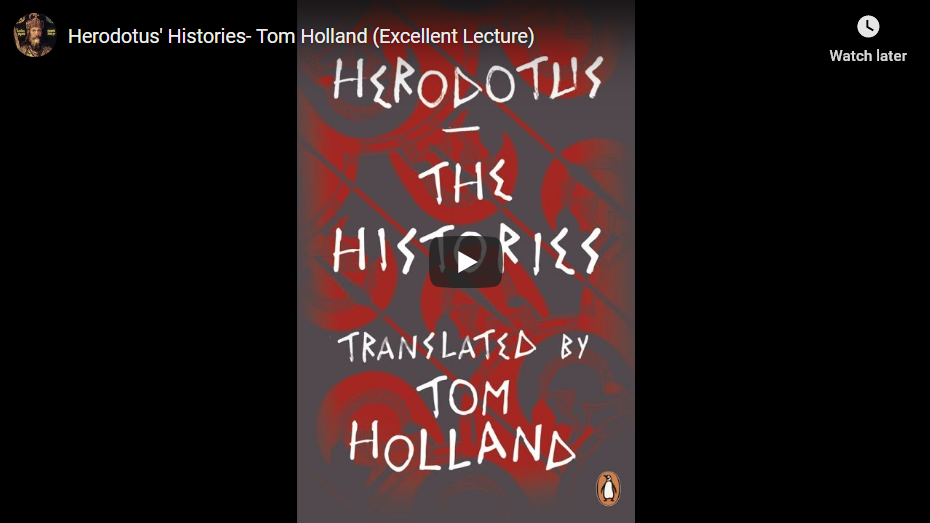
Herodotus’ Histories – Tom Holland

Filed under: Books, Europe, Greece, History, Middle East — Tags: , , , , — Nicholas @ 04:00

The Study of Antiquity and the Middle Ages
Published 24 Mar 2018

The classical scholar Tom Holland introduces his new translation of Herodotus’ masterpiece – The Histories.

The Histories (Greek: Ἱστορίαι; Ancient Greek: [his.to.rí.ai̯]; also known as The History) of Herodotus is now considered the founding work of history in Western literature.

Written in 440 BC in the Ionic dialect of classical Greek, The Histories serves as a record of the ancient traditions, politics, geography, and clashes of various cultures that were known in Western Asia, Northern Africa and Greece at that time. Although not a fully impartial record, it remains one of the West’s most important sources regarding these affairs.

Moreover, it established the genre and study of history in the Western world (despite the existence of historical records and chronicles beforehand).

The Histories also stands as one of the first accounts of the rise of the Persian Empire, as well as the events and causes of the Greco-Persian Wars between the Achaemenid Empire and the Greek city-states in the 5th century BC. Herodotus portrays the conflict as one between the forces of slavery (the Persians) on the one hand, and freedom (the Athenians and the confederacy of Greek city-states which united against the invaders) on the other.

The Histories was at some point divided into the nine books that appear in modern editions, conventionally named after the nine Muses.

November 17, 2019

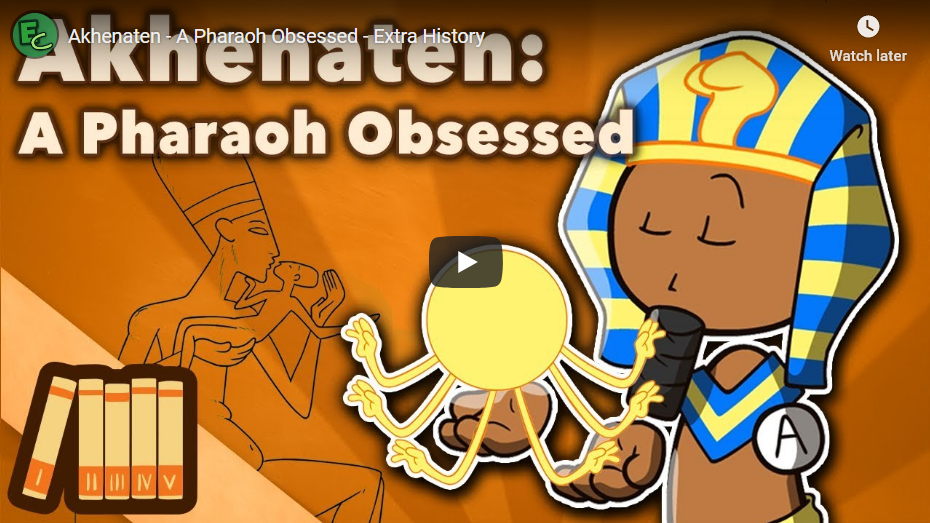
Akhenaten – A Pharaoh Obsessed – Extra History

Filed under: History, Middle East, Religion — Tags: , , — Nicholas @ 06:00

Extra Credits
Published 16 Nov 2019

Join us on Patreon! http://bit.ly/EHPatreon

A revolutionary dreamer or a tyrannical despot? That is a question at the heart of Akhenaten’s rule, a pharaoh so unusual, that his successors tried and almost successfully erased him from the historical records. You may know his more famous wife, Queen Nefertiti but Akhenaten was a fascinating ruler. He went against the grain of almost all of Egyptian traditions including trying to establish a monotheistic religion and unite the Upper and Lower Kingdoms of Egypt.

October 10, 2019

Suez Crisis Part 2 of 2

Filed under: Britain, France, History, Middle East, Military, USA — Tags: , , , , , — Nicholas @ 02:00

Epic History TV
Published on 28 Dec 2017

In 1956, an international crisis over control of the Suez Canal put Britain and France into direct conflict with President Nasser of Egypt, a proud Arab nationalist determined to stand up to foreign powers meddling in Egyptian affairs.

Part 2 explores how Britain, France and Israel cooked up a secret plan to invade Egypt, overthrow Nasser and reassert their standing as global powers. But when the international community, and in particular the United States, condemned their actions, the aggressors were forced into a humiliating climbdown. The repercussions for the Middle East and global history were long-lasting and profound.

Archive film from AP Archive http://www.aparchive.com/

Music from Filmstro https://www.filmstro.com/
Get 20% off an annual license! Use our exclusive coupon code: EPICHISTORYTV_ANN

Help me make more videos by supporting Epic History TV on Patreon https://www.patreon.com/EpicHistoryTV

Further Reading on Suez Crisis (click affiliate links to buy on Amazon & support the channel):
Blood and Sand, Alex von Tunzelmann (Simon & Schuster, 2016) http://geni.us/QyoWs
Suez: Britain’s End of Empire in the Middle East, Keith Kyle (I.B.Tauris, 2011) http://geni.us/aqn6AH
The Suez Crisis 1956, Derek Varble (Osprey, 2003) http://geni.us/ANxBQEE
“Suez 1956”, Timothy Benson in History Today (Nov 2006)
“Suez: The Canal Before the Crisis”, Steve Morewood in History Today (Nov 2006)
“Nasser, Suez and Arab Nationalism”, Michael Scott-Baumann in History Today (Mar 2010)
“The First Suez Crisis”, Christopher Danziger in History Today (Sep 1982)
The Suez Crisis, by Laurie Milner, BBC website http://www.bbc.co.uk/history/british/…
“Andrew Bacevich reviews ‘Eisenhower 1956′”, London Review of Books (Vol.33 No.12)
“Avi Shlaim reviews ‘Israel’s Border Wars, 1949-56′”, London Review of Books (Vol.16 No.16)

#EpicHistoryTV #SuezCrisis #ColdWarHistory

« Newer PostsOlder Posts »

Powered by WordPress