
Oh, so anyway, another peeve of mine is the way liberals — and many libertarians — act as if there’s a lot of common cause between liberals and libertarians. The thinking seems to be that since both liberals and libertarians are for drug legalization, gay marriage, etc., that liberals can be seduced to the libertarian cause or that libertarians and liberals should forge a new “liberaltarian” political alliance to replace the old right-leaning fusionism. This was my friend Brink Lindsey’s big cause for a while, and I never bought it. It’s also something you hear from a lot of liberal college kids who want a wee bit more plausibility when they pose as rebellious.
But the truth is that what we call liberals today — a.k.a. progressives — simply aren’t libertarian even on most of their “libertarian” issues. As I’ve written before, being a “social liberal” isn’t the same thing as being a libertarian:
Your typical liberal Democrat says she’s liberal on social issues but that doesn’t make her in any meaningful way a libertarian. For instance, the vast majority of the libertarians I know hate things like speech codes, smoking bans, racial quotas, and the vast swaths of political indoctrination that pass for “education” today. They tend to oppose gun control, think fondly of homeschooling (if not always homeschoolers) and are generally split on the question of abortion. They do not, however, think that the government should be steamrolling religious institutions with Obamacare or subsidizing birth control. Liberals tend to loathe federalism or states’ rights (though there’s been some movement there), libertarians usually love the idea. The liberals who don’t like it fear that states or local communities might use their autonomy to live in ways liberals don’t approve of. Libertarians couldn’t care less.
Sure, there’s overlap between liberalism and libertarianism on things like gay marriage. But the philosophical route libertarians and liberals take to get to that support is usually very different. Libertarians are disciples of thinkers like Hayek and von Mises. Liberals descend from thinkers like John Dewey. The former believed in negative liberty, the latter positive liberty. And therein lies all of the difference. As a gross generalization, libertarianism advocates freedom to do whatever you like (short of harming others). Liberalism supports freedom to do whatever liberals like; everything else is suspect.
[…]
That’s because libertarianism is about curbing state power to let people be and do what they want. Liberalism is about using state power to make people do and be what liberals want. And that makes all the difference in the world.
Jonah Goldberg, The Goldberg File, 2013-08-23
September 25, 2013
QotD: “Liberaltarianism”
September 15, 2013
Why “Breaking Bad: Canada” is a ludicrous meme
Megan McArdle is a fan of the TV show Breaking Bad, but she also is fairly well informed about the US healthcare system. This means that the idea that the TV show’s Canadian counterpart would look like this…
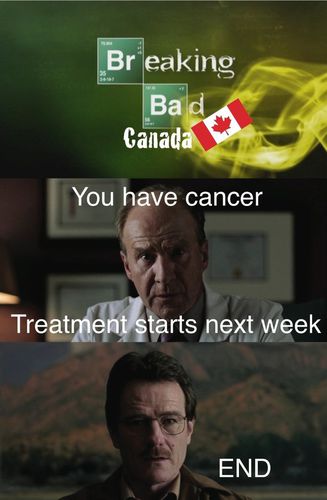
…depends on the audience for the real TV show not actually knowing much about the US system.
The series starts with Walter White, a high school chemistry teacher in Albuquerque, New Mexico, who is diagnosed with lung cancer. His lousy health maintenance organization won’t cover a decent doctor, or treatment. So Walter is forced to turn to crime just to pay his medical bills and … whoa, wait a minute. You know who has excellent benefits, compared with basically everyone else in the country? Teachers, firefighters and cops. Maybe they’re overworked and underpaid, but the one thing that you cannot say about them is that they’re forced to endure shoestring health-care plans. According to the Internet, Albuquerque school district employees are eligible for
Medical, Dental, Vision, Basic and Additional Life Insurance, Long Term Disability, Pre-tax Insurance Premium Plan (PIPP), Flexible Spending Accounts, Long Term Care Insurance, 403(b) and the 457(b) Deferred Compensation Plans.
That’s a generous package. Moreover, the Albuquerque school district self-insures, so any complaints about benefit levels should be directed at the city government, not your “lousy HMO.”
Later, after Walt’s actions accidentally result in the shooting of his brother-in-law, a Drug Enforcement Agency agent, Walt’s wife takes a bunch of the meth money to pay for Hank’s treatment. On his government salary, Hank can’t possibly afford the treatment he needs, because, of course, his lousy insurance policy won’t cover more than a few visits to the physical therapist … and whoa, we just went from “unrealistic” to “ludicrous.” You know who has even better benefits than employees enjoying a compensation package collectively bargained with a local government? Federal employees in a low-cost state such as New Mexico. Moreover, extra benefits are available to people injured in the line of duty.
In short, a number of key plot points hinge on the improbable assertion that people who actually enjoy some of the best health insurance in the country actually suffer some of the worst — so bad that we are expected to believe that Walt had no choice but to cook meth to cover the gaps. For an otherwise great show, this is incredibly silly.
September 14, 2013
QotD: Humanity and alcohol
Anthropologists assure us that wherever we find man he speaks. Chimpanzee-lovers notwithstanding, no animal other than man is capable of laughter. And, although some undiscovered tribe in the Brazilian jungle might conceivably provide an exception tomorrow, every present-day society uses alcohol, as have the majority of those of the past. I am not denying that we share other important pleasures with the brute creation, merely stating the basic fact that conversation, hilarity and drink are connected in a profoundly human, peculiarly intimate way.
There is a choice of conclusions from this. One would be that no such healthy linkage exists in the case of other drugs: a major reason for being on guard against them. More to the point, the collective social benefits of drinking altogether (on this evidence) outweigh the individual disasters it may precipitate. A team of American investigators concluded recently that, without the underpinning provided by alcohol and the relaxation it affords, Western society would have collapsed irretrievably at about the time of the First World War. Not only is drink here to stay; the moral seems to be that when it goes, we go too.
Kingsley Amis, Everyday Drinking: The Distilled Kingsley Amis, 2008.
September 3, 2013
The market for civilian armoured vehicles
Strategy Page on the growing demand in some areas of the world for protected civilian vehicles:
Since September 11, 2001 there has been a sharp increase in the use of such bullet proof automobiles. The wealthy are buying most of them, but government has become a major customer as well, accounting for about a third of sales. The biggest markets are those suffering from lots of kidnapping and seemingly random violence. Mexico, Colombia and many Middle Eastern countries are the main markets for these expensive vehicles.
[…]
Because of the cartel wars in Mexico, over 2,500 armored sedans, SUVs and light trucks are now produced each year in Mexico alone. The violence down there has been horrendous. The government believes about a thousand people a month are dying from drug cartel related violence. This puts Mexico ahead of the recently increased terrorist violence in Iraq and where Syria was earlier this year. Some 70,000 have died in the Mexican cartel war since 2007, compared to over 100,000 in two years of Syrian violence and 120,000 Iraqi dead in a decade of religious violence. Since the 1970s there have been similar internal conflicts in Algeria, Egypt, Lebanon and Turkey. Mexico is a bit of Middle East style civil violence in North America. This is not the first time the Americas have suffered this. Leftist and drug gang violence in Colombia have left over 220,000 dead in the last 60 years. That’s for a country with only about 40 percent as many people as Mexico. This war in Colombia in finally winding down, but is shows you how long and bloody such conflicts can be. Some 20,800 people have disappeared in Mexico since 2006, including 1,200 children under the age of 11. Another estimate holds that that 24,000 people were missing since 2000, and that around 16,000 bodies have been discovered but not identified.
The armored vehicles must, at a minimum, be protected against pistol bullets. But most now are resistant to sniper and assault rifles. Some manufacturers will also build vehicles that provide some protection from roadside bombs. Turning a civilian sedan or SUV into an armored vehicle is a labor-intensive job. First, you have to strip the vehicle down to the bare frame. Then you install Kevlar and steel plate armor and bullet-proof glass. The standard tires are replaced with run-flat models. The additional weight (up to a ton or more) requires the installation of enhanced shocks and a more powerful engine. It takes a few hundred pounds of armor to provide protection from pistol bullets. Protection from rifle bullets requires half a ton. For protection against heavy machine-gun (12.7mm) and bombs, you need a ton or more. The first armor kits for military vehicles, like the hummer, weighed a ton. Soon that was up to two tons. The additional load on high-end vehicles 1.5 tons, which is enough armor to stop heavy machine-gun bullets.
August 16, 2013
August 8, 2013
Medical marijuana – “We have been terribly and systematically misled for nearly 70 years”
ThinkProgress reports that CNN’s Dr. Sanjay Gupta has changed his position on the medical use of marijuana:
CNN’s Chief Medical Correspondent Dr. Sanjay Gupta reversed his position on marijuana’s health benefits and apologized for his previous stand against it in an article Thursday for CNN. In 2009, Gupta penned an op-ed advocating against marijuana, where he advised as a doctor that “marijuana isn’t really very good for you.” At the time, he was in the running for an appointment to Surgeon General.
Since then, additional research and his work on a documentary have convinced him otherwise.
“I apologize because I didn’t look hard enough, until now,” he said. “I didn’t look far enough. I didn’t review papers from smaller labs in other countries doing some remarkable research, and I was too dismissive of the loud chorus of legitimate patients whose symptoms improved on cannabis.”
[…]
“We have been terribly and systematically misled for nearly 70 years in the United States, and I apologize for my own role in that.”
August 6, 2013
Get used to seeing the term “parallel construction”
From Zero Hedge:
Undated documents discovered by Reuters show that federal agents are trained to “recreate” the investigative trail to effectively cover up where the information originated, a practice that some experts say violates a defendant’s Constitutional right to a fair trial.
“I have never heard of anything like this at all,” is one law professor’s response to the fact that a secretive DEA unit is funneling wiretap, informant, and telephone database information to authorities across the nation in order to launch investigations of Americans (targeting common criminals, primarily drug dealers), “It is one thing to create special rules for national security, ordinary crime is entirely different. It sounds like they are phonying up investigations.”
Agents are instructed to use “normal investigative techniques to recreate the information provided by [the secret DEA source],” and as the documents reveal — “remember that the utilization of [data] cannot be revealed or discussed in any investigative function.”
Stunningly, after an arrest was made, agents then created a “parallel construction” to suggest the information secretly gathered was stumbled up during the course of the investigation — “It’s just like laundering money — you work it backwards to make it clean.” One recently retired federal gent noted, “It was an amazing tool; our big fear was that it wouldn’t stay secret.”
July 11, 2013
June 25, 2013
Portugal’s experience with drug decriminalization
The Cato Institute sent out a Twitter update, reminding everyone about the 2009 White Paper by Glenn Greenwald on how the Portuguese drug experiment played out after 2001:
On July 1, 2001, a nationwide law in Portugal took effect that decriminalized all drugs, including cocaine and heroin. Under the new legal framework, all drugs were “decriminalized,” not “legalized.” Thus, drug possession for personal use and drug usage itself are still legally prohibited, but violations of those prohibitions are deemed to be exclusively administrative violations and are removed completely from the criminal realm. Drug trafficking continues to be prosecuted as a criminal offense.
While other states in the European Union have developed various forms of de facto decriminalization — whereby substances perceived to be less serious (such as cannabis) rarely lead to criminal prosecution — Portugal remains the only EU member state with a law explicitly declaring drugs to be “decriminalized.” Because more than seven years have now elapsed since enactment of Portugal’s decriminalization system, there are ample data enabling its effects to be assessed.
Notably, decriminalization has become increasingly popular in Portugal since 2001. Except for some far-right politicians, very few domestic political factions are agitating for a repeal of the 2001 law. And while there is a widespread perception that bureaucratic changes need to be made to Portugal’s decriminalization framework to make it more efficient and effective, there is no real debate about whether drugs should once again be criminalized. More significantly, none of the nightmare scenarios touted by preenactment decriminalization opponents — from rampant increases in drug usage among the young to the transformation of Lisbon into a haven for “drug tourists” — has occurred.
The political consensus in favor of decriminalization is unsurprising in light of the relevant empirical data. Those data indicate that decriminalization has had no adverse effect on drug usage rates in Portugal, which, in numerous categories, are now among the lowest in the EU, particularly when compared with states with stringent criminalization regimes. Although postdecriminalization usage rates have remained roughly the same or even decreased slightly when compared with other EU states, drug-related pathologies — such as sexually transmitted diseases and deaths due to drug usage — have decreased dramatically. Drug policy experts attribute those positive trends to the enhanced ability of the Portuguese government to offer treatment programs to its citizens — enhancements made possible, for numerous reasons, by decriminalization.
Maybe crime doesn’t pay after all…
680News reported on a Toronto Police drug investigation that ended up with 35 arrests on various charges. That sounds impressive until you get down to the summary of what contraband was confiscated in “Project Wanted”:
Thirteen grams of crack cocaine were seized, seven grams of marijuana, three grams of heroin, 34 grams of ecstasy. The total street value of the drugs was valued at $5,000. The police also seized $1,710.00.
Unless they managed to flush a huge amount of drugs before being arrested, you’d have to say that these people wouldn’t be listed as “drug kingpins”. And these are not amateurs, either:
Police also allege that the total number of convictions of those arrested is 723. The average number of convictions on each person’s criminal record is 20.
Twenty-seven of those arrested were on bail at the time the crimes were alleged to have happened. Nine were on probation.
June 24, 2013
Read an excerpt from Rise of the Warrior Cop by Radley Balko
There is an excerpt from the book Rise of the Warrior Cop in the July issue of the ABA Journal:
Are cops constitutional?
In a 2001 article for the Seton Hall Constitutional Law Journal, the legal scholar and civil liberties activist Roger Roots posed just that question. Roots, a fairly radical libertarian, believes that the U.S. Constitution doesn’t allow for police as they exist today. At the very least, he argues, police departments, powers and practices today violate the document’s spirit and intent. “Under the criminal justice model known to the framers, professional police officers were unknown,” Roots writes.
The founders and their contemporaries would probably have seen even the early-19th-century police forces as a standing army, and a particularly odious one at that. Just before the American Revolution, it wasn’t the stationing of British troops in the colonies that irked patriots in Boston and Virginia; it was England’s decision to use the troops for everyday law enforcement. This wariness of standing armies was born of experience and a study of history — early American statesmen like Madison, Washington and Adams were well-versed in the history of such armies in Europe, especially in ancient Rome.
If even the earliest attempts at centralized police forces would have alarmed the founders, today’s policing would have terrified them. Today in America SWAT teams violently smash into private homes more than 100 times per day. The vast majority of these raids are to enforce laws against consensual crimes. In many cities, police departments have given up the traditional blue uniforms for “battle dress uniforms” modeled after soldier attire.
Police departments across the country now sport armored personnel carriers designed for use on a battlefield. Some have helicopters, tanks and Humvees. They carry military-grade weapons. Most of this equipment comes from the military itself. Many SWAT teams today are trained by current and former personnel from special forces units like the Navy SEALs or Army Rangers. National Guard helicopters now routinely swoop through rural areas in search of pot plants and, when they find something, send gun-toting troops dressed for battle rappelling down to chop and confiscate the contraband. But it isn’t just drugs. Aggressive, SWAT-style tactics are now used to raid neighborhood poker games, doctors’ offices, bars and restaurants, and head shops — despite the fact that the targets of these raids pose little threat to anyone. This sort of force was once reserved as the last option to defuse a dangerous situation. It’s increasingly used as the first option to apprehend people who aren’t dangerous at all.
June 18, 2013
Radley Balko’s new book
I’m a fan of Radley Balko’s work (I quote him and hat-tip him a fair bit), so I’m looking forward to reading his new book, Rise of the Warrior Cop, The Militarization of America’s Police Forces. Here’s a glowing review from Scott Greenfield:
The book, published by Public Affairs and scheduled for release on July 9, 2013, starts at the beginning, taking us from the days when Americans policed themselves to the birth of the occupation of policing. While I was well aware of Radley’s persistence and acumen at chronicling current events, I never realized what a thorough researching her is. The history of policing is remarkably impressive.
It’s critical to appreciate the history of policing, to understand that what we now see as normal and inescapable wasn’t always the case. For most of our history, this country did not have a group of people with shields and guns who wandered the streets ordering people about. The fall from grace, If you perceive it as I do, came fast and hard.
American attitudes toward police were built on images of Andy Griffith, strolling the streets of Mayberry to save random cats and, an allusion Radley employs, serving as guest umpire in the occasional baseball game. Good. Honest, One of us. This was the police officer upon whom we relied, and the one we pictured as we told our children that they were here to help us; they were our friend.
Starting in the 1960’s, Radley takes us decade by decades down the road to perdition. As he wears his libertarian politics on his sleeve, it came as no surprise that he gave the politics of law enforcement special scrutiny. His hatred of Richard Nixon for manipulating the silent majority’s hatred of hippies and counterculture into the War on Drugs is palpable. On the other hand, there is no reluctance to blame Bill Clinton for his deceitful abuse of the COPS program, and its infusion of billions into the drug war a few decades later.
Radley is not only a surprisingly good story teller, generally low key in recounting tales of individual harm interspersed with broad influences that gave rise to putting heavy weaponry into the hands of children. There are times when the narrative gets a bit breathless, trying hard to capture the confluence of political deceit on the part of some and ignorance on the part of others. Then again, the alternative would be to simply call out the liars and morons for their contribution to a state of affairs that served to put a naïve American public at grave risk for such puny and transitory purposes as winning an election.
June 5, 2013
Latest Rob Ford video rumour
In the Toronto Sun, Jenny Yuen says the quest to track down the video that allegedly shows Toronto mayor Rob Ford smoking crack may be fruitless:
John Cook, the editor of New York-based gossip website Gawker, said Tuesday the alleged Rob Ford crack video might be “gone.”
Cook said the news came from the intermediary he had been dealing with to obtain the video.
“The intermediary called to tell me (Friday) that he had finally heard from the owner. And his message was: ‘It’s gone. Leave me alone,’” Cook said on the website. “It was, the intermediary told me, a short conversation.”
This comes just after a week Gawker, which broke the story of the alleged video, reached its $200,000 Crackstarter goal. The website has been holding on to the money in hopes of the seller will come forward.
The footage allegedly shows Mayor Rob Ford smoking what appears to be crack. Ford has denied the existence of the video and insisted he does not smoke crack.
May 26, 2013
The war on drugs is “a holocaust in slow motion”
To my surprise, the creator of the TV series The Wire has come out against legalization of marijuana:
David Simon surged into the American mainstream with a bleak vision of the devastation wrought by drugs on his home town of Baltimore — The Wire, hailed by many as the greatest television drama of all time. But what keeps him there is his apocalyptic and unrelenting heresy over the failed “war on drugs”, the multibillion-dollar worldwide crusade launched by President Richard Nixon in 1971.
When Simon brought that heresy to London last week — to take part in a debate hosted by the Observer — he was inevitably asked about what reformers celebrate as recent “successes” — votes in Colorado and Washington to legalise marijuana.
“I’m against it,” Simon told his stunned audience at the Royal Institution on Thursday night. “The last thing I want to do is rationalise the easiest, the most benign end of this. The whole concept needs to be changed, the debate reframed.
“I want the thing to fall as one complete edifice. If they manage to let a few white middle-class people off the hook, that’s very dangerous. If they can find a way for white kids in middle-class suburbia to get high without them going to jail,” he continued, “and getting them to think that what they do is a million miles away from black kids taking crack, that is what politicians would do.”
If marijuana were exempted from the war on drugs, he insisted, “it’d be another 10 or 40 years of assigning people of colour to this dystopia.”
[. . .]
Simon took no prisoners. In his vision, the war on — and the curse of — drugs are inseparable from what he called, in his book, The Death of Working Class America, the de-industrialisation and ravaging of cities that were once the engine-rooms and, in Baltimore’s case, the seaboard of an industrial superpower.
The war is about the disposal of what Simon called, in his most unforgiving but cogent term, “excess Americans”: once a labour force, but no longer of use to capitalism. He went so far as to call the war on drugs “a holocaust in slow motion”.
Simon said he “begins with the assumption that drugs are bad”, but also that the war on drugs has “always proceeded along racial lines”, since the banning of opium.
It is waged “not against dangerous substances but against the poor, the excess Americans,” he said, and with striking and subversive originality, posited the crisis in stark economic terms: “We do not need 10-12% of our population; they’ve been abandoned. They don’t have barbed wire around them, but they might as well.”


