seangabb
Published Feb 8, 2024This course provides an exploration of Rome’s formative years, its rise to power in the Mediterranean, and the exceptional challenges it faced during the wars with Carthage.
Lecture 2: Consolidation of the Republic
• The Roman Revolution against the Kings
• How Brutus put his own sons to death
• How Horatius kept the Bridge
• Scaevola and Lars Porsena
• The Roman Constitution: an Overview
(more…)
February 9, 2024
Rome: Part 2 – Consolidation of the Republic
February 5, 2024
Sitzkrieg on the southern border
Glenn “Instapundit” Reynolds on the stand-off between Texas governor Greg Abbot and President Joe Biden over the flood of illegal immigrants coming across the US-Mexican border:
So the war over the border between Texas and the Biden Administration is now in the “Sitzkrieg” stage. Texas Gov. Greg Abbott has essentially declared war on illegal immigration. He invoked Article I Section 10 of the United States Constitution, which forbids states from declaring war except when “actually invaded” (or in such imminent danger as to admit of no delay) and, by implication, allows them to declare war when that happens. He also invoked the Guarantee Clause of Article IV, which requires the federal government to protect the states against invasion.
Abbott’s legal argument is that since he’s being invaded, he’s entitled to respond, and since the federal government is defaulting on its obligations it has no business – it’s basically stopped from – complaining. There was a lot of huffing and puffing at the time, with members of Congress calling on President Biden to federalize the Texas National Guard and the like, but basically, nothing happened. The Supreme Court vacated an injunction forbidding the Border Patrol from cutting the barbed wire that Texas had installed along the border, but – contrary to many media reports – didn’t rule that what Texas had done was illegal, or order Texas to stop policing the border.
Now not much is going on. The big complaints about immigration are mostly coming from outside Texas, places like New York City where illegal immigrants beat police with impunity, being released without bail after being arrested. (The usual endgame for this sort of thing in other societies has been death squads, organized either by police or by police-adjacent groups, taking out those whom the legal system cannot or will not control; we’ll see what happens in New York City.)
But next month Texas’s law allowing the state to apprehend and effectively deport illegals will go into effect, and that’s when the sitzkrieg is likely to end. Following are my (very) preliminary thoughts.
To me what’s astonishing is how unpopular with everyone the immigration policies of the Administration – and a good chunk of the GOP – are. Open borders are unpopular with blacks, whites, rural and urban voters, and, really, just a vast bipartisan majority. But like “climate change”, another priority of the ruling class without matching popular support, the borders stay open.
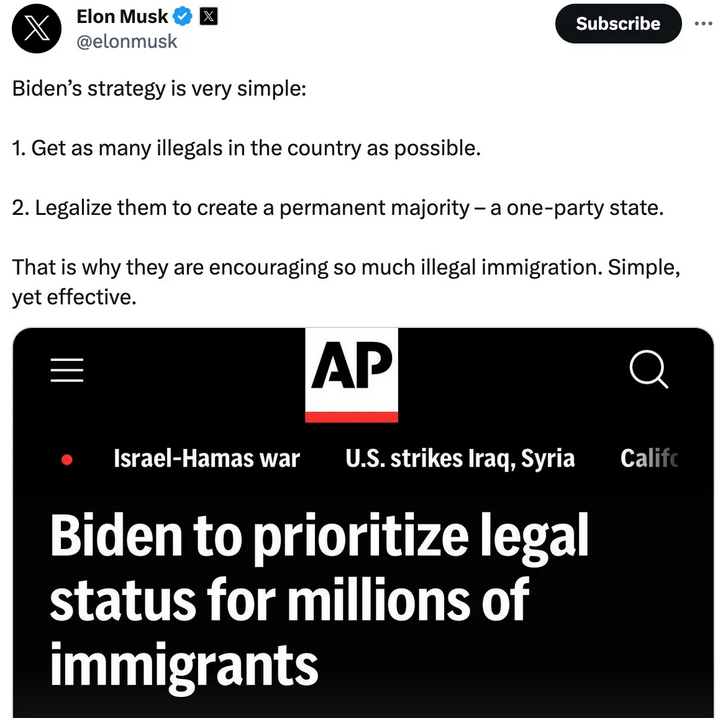
Why? Because our ruling class seeks, in Bertolt Brecht’s famous phrase, “to dissolve the populace and elect another”. As Elon Musk tweeted:
Musk’s comments met with the usual outrage, but Democrats have pretty much touted this as the plan for years. Indeed, it goes back to Ruy Teixeira’s “Emerging Democratic Majority” strategy, though it’s been accelerated in recent years. (And Teixeira himself has retreated from that plan). Sure, naturalization takes years – though they may speed that up, as it’s just a matter of statute – and there have also been some moves to allow non-citizens to vote anyway. Think that’s unlikely? Maybe, but how many things are happening these days that seemed impossibly unlikely a few years ago? And it’s a long game; a bunch of Democratic voters in 5 or 6 years will suit them fine.
January 27, 2024
Flashpoint: Texas
Theophilus Chilton wonders if you’re ready for a full-blown Constitutional crisis:
I’m sure that by now, we’re all aware of what is continuing to take place down in Texas. Far from backing down in his standoff with FedGov over the seizure of Shelby Park in Eagle Pass and subsequent expulsion of federal agents, Gov. Abbott has directed the state’s National Guard to continue interdicting illegal immigrants. Indeed, in response to the recent SCOTUS decision allowing the Feds to dismantle the razor wire Texas installed, they’ve simply installed more, in direct defiance of the wishes of the Regime. The Regime has now responded by giving Abbott and Texas an ultimatum — restore control of the park to the Federal government by the afternoon of January 26, or … well … something. Whether the governor ultimately continues to tell the Feds to get bent remains to be seen, but so far the trend is looking pretty good.
Of course, it helps that — for once — Republicans across the country have actually found a little courage to support doing what’s right. As of writing this, the Republican governors of 25 other states have all issued statements of support for Texas’ position. Hence, there are now an outright majority of states whose executives (who control their various National and State Guards) are publicly backing Texan efforts to secure our border. Many of these governors have explicitly cited the Biden administration’s continued abandonment of the federal government’s constitutional duty to protect the several states from invasion and the constitutional right of the states to act in their own defence as sovereign entities in their own right.
Needless to say, this is a constitutional crisis that would not have been conceivable even twenty years ago (well, except for this one movie that seems to have been amazingly prescient). Since 1865, the doctrine of absolute federal supremacy has been in force and the balance of power between the state and national governments has inexorably trended in Washington, DC’s favour. Occasional spurts of opposition to the contrary, most of the previous incipient talk by states about “reining in the federal government” generally proved to be all words and no action. On a few things (e.g. marijuana legalisation), the Regime allowed states to “oppose” federal policy if these were policies that the Regime wanted to change anywise but couldn’t “officially” at the federal level. But on anything that was a true Regime priority, FedGov brooked no dissent. So it is now, but the calculus has changed. What would have been impossible in 2003 is now on the verge of happening in 2023.
This all highlights the fundamental illegitimacy of our current federal government. There is no moral or legal case to be made to justify the actions of the Biden administration. The federal Constitution both enjoins the federal government to protect the states from foreign invasion (which being overrun with millions of foreigners breaking our laws most certainly counts as) and also grants the states the right to protect their own borders and sovereignty. Instead of doing this, the Biden administration has been purposefully inviting hordes of migrants to enter this country. Indeed, this is being encouraged in contravention to statutory federal law as well. Further, if Texas Attorney General Ken Paxton is correct (and he almost assuredly is), the administration has even been partnering with criminal cartels to smuggle illegals into this country. All in all, there is absolutely no justification to be credibly made for the Regime’s actions and anyone who supports them are in opposition to the Constitution, the laws, and the people of this land.
Despite the fevered ravings of various progressive “Christians” on social media, the moral argument for allowing the Regime to throw the gates open is nonsense. Indeed, the whole attempt to craft a “biblical” argument for open borders is simple-minded and ignorant of the relevant scriptural and historical context. Simply put, the Bible’s approach to “the stranger” falls into line with common ancient Near Eastern and Mediterranean modes of hospitality that were meant to “tame” the foreigner and integrate him into a society, thus preventing him from causing disruption to that society. If that couldn’t be accomplished, then the “inhospitable foreigner” was either to be expelled or eliminated. Needless to say, this applied only to individuals or small family groups — large masses of foreigners attempting to enter an ancient country would have been rightly recognised as an invasion and dealt with accordingly.
However, the illegitimacy of the current Regime and its actions alone can’t explain why the Republicans have closed ranks so precipitously. After all, Republican politicians are not exactly known for their intestinal fortitude when faced with opposition of any kind. Yet, even Northeastern moderate squishes like New Hampshire’s Chris Sununu have signed onto supporting Texas in this. Something changed that has caused the GOP, almost as a whole, to support this, either openly or tacitly.
January 25, 2024
By invoking the Emergencies Act, “the government unjustifiably violated Canadians’ constitutional rights”
Andrew Lawton reports on the Federal Court decision that ruled against Justin Trudeau’s invocation of the Emergencies Act to break up the Freedom Convoy protests in 2022:
For those whose bank accounts the government froze, those who remain on trial for trumped up charges, and those who were pepper sprayed, tear gassed, or zip tied while protesting for freedom, this week’s news might be too little to late.
Even so, the aforementioned people have all been vindicated.
The Federal Court ruled Tuesday that Justin Trudeau’s invocation of the Emergencies Act – both the decision to apply it and the measures he used it to impose – were illegal.
In other words, there was no “national emergency” rising to the wartime levels intended by the act. And even if there had been, the government unjustifiably violated Canadians’ constitutional rights.
The decision was handed down, coincidentally, on the two year anniversary of the Freedom Convoy’s launch from Delta, B.C.
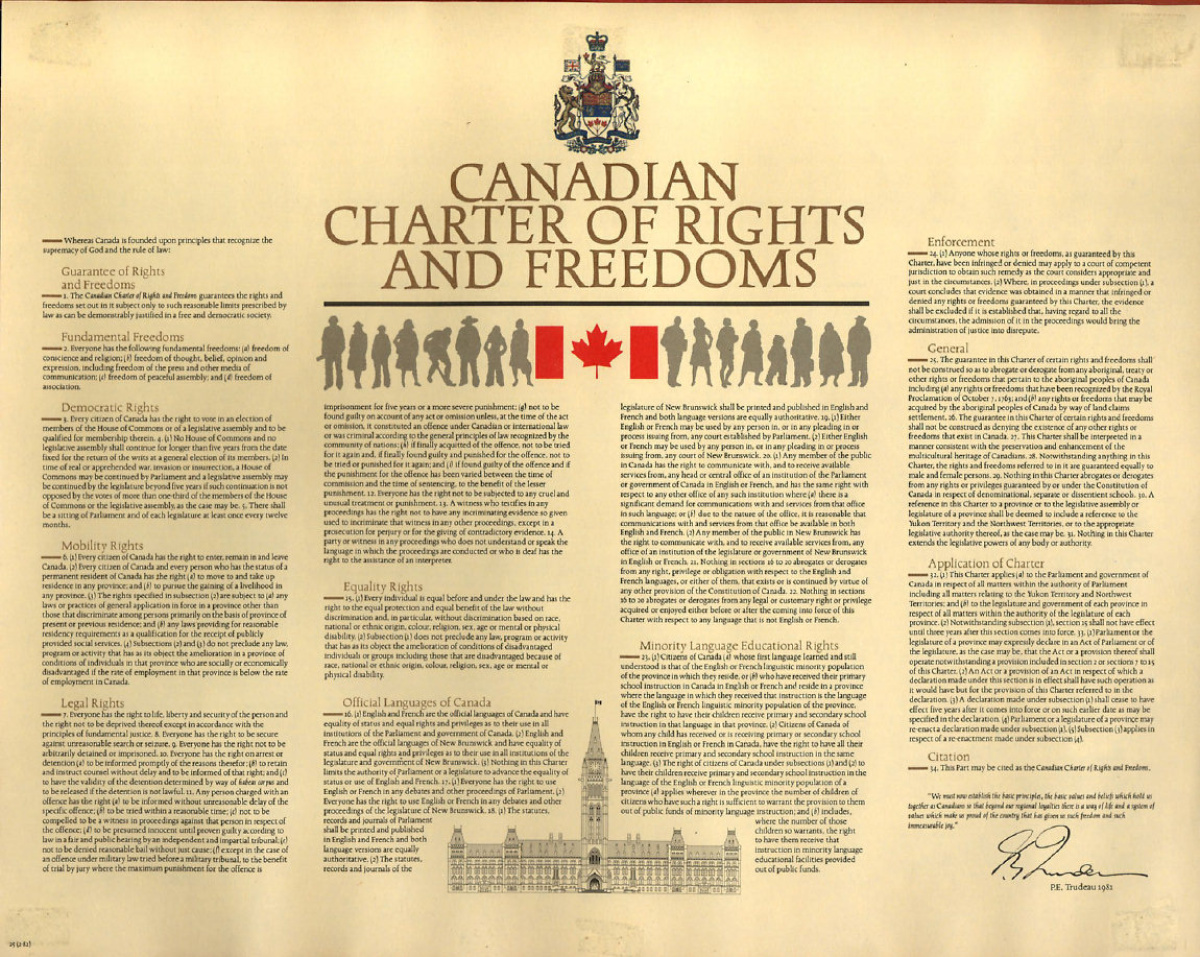
When Trudeau invoked the Emergencies Act, he assured Canadians that the Charter of Rights and Freedoms would be respected. His evidence was thin: the guarantee that Charter rights would be protected was seemingly predicated only on the fact that the law says Charter rights must be protected. I’d call it circular logic but even “logic” seems a bit of a stretch.
As I remarked then, if you have to pinky swear to Canadians that you’re upholding their rights, you aren’t. A well-respected judge on the Federal Court now agrees.
While the Freedom Convoy was an unprecedented demonstration (globally, not just by Canadian standards), Trudeau’s response put Canada on the map in all the wrong ways. It was condemned the world over, even by the Chinese Communist Party and Iran’s former president. Not that I put too much stock in what they think, but when you go too far for even the dictators, you should probably reassess.
The crackdown illuminated the authoritarian impulse in Canada’s “sunny ways” government. The convoy was a response to Covid restrictions, but also an increasingly divisive and vindictive approach to politics by Trudeau that vilified people based on their vaccine status and ultimately their political views.
Unfortunately for Trudeau, his denigration of convoy supporters as a “fringe minority” with “unacceptable views” ended up being taken up as a badge of honour and reclaimed by the very fringe he tried so hard to marginalize.
The court ruling is not a full exoneration of the Freedom Convoy. It’s still possible that Tamara Lich and Chris Barber could be found guilty on their mischief charges. It’s also possible that convoy organizers could lose the lawsuit filed on behalf of Ottawa residents. The decision isn’t a declaration that the convoy was a purely lawful protest, but it does say there was no “threat to the security of Canada” as per the CSIS Act, which Trudeau has spent nearly two years pretending there was.
January 2, 2024
Nobody will like the new rules
Chris Bray points out just how bad the “new rules” are going to be … and not just for the Bad Orange Man:
The danger is that you concede an argument about a personality or an event, then find at some future point that you’ve accepted new systems and structures that are far more broadly applicable than you noticed at the moment you accepted the new rules. Everyone of every political persuasion should see the weapon on the table, because it’s going to be pointed at you and yours: libertarians, anti-war leftists, populists, paleocons, others too weird to name. Outliers. If your votes and your views fall outside an extremely narrow band of corporate-state “centrism”, what follows is about you.
So.
Bill Mitchell, a media figure and DeSantis supporter, doesn’t see the big deal:
The problem is that Trump is “super toxic”, so whatever. Orange Man is bad, so the things you do to Orange Man are unobjectionable. Of course you can take him off the ballot — he’s a jerk. That’s, like, the Constitution.
But the constant background music for me in these discussions is that the government of Canada construed a peaceful protest against vaccine mandates as a national emergency, on par with a foreign invasion, and started freezing bank accounts and mobilizing force for mass arrests. A “Western democracy”, hearing dissent, started turning off the dissenters’ money, which means that government took away the ability of peaceful protesters to pay for things like housing and food. The patience of the global political class for disagreement is narrowing, fast and hard. (Cf. e.g. Ardern, Jacinda.)
So see what’s happening in the United States, and see where it points. On January 6, thousands of protesters turned into maybe hundreds of rioters; many people at the Capitol were peaceful and calm, while some weren’t. Almost none were armed, none used guns, and the question of law enforcement infiltration, provocation, and entrapment remains open.
But no one published a manifesto calling for the violent overthrow of the United States government, and the crowd didn’t line up at the Capitol with rifles and homemade bombs to launch waves of armed attacks on Congress. Compare: here’s Bernardine Dohrn of the Weather Underground declaring war on the United States, and announcing on the radio that “our job is to lead white kids into armed revolution”. Find me that moment on January 6, the explicit declaration of armed revolution aimed at the destruction of the federal government. No one has been charged under the Insurrection Act because no one has violated the Insurrection Act. The “insurrection” is a political construction, not a legal case.
So a riot can be an “insurrection”, in the complete absence of insurrection charges and convictions, if Maine Secretary of State Shenna Bellows (D-Longhouse) feels like an insurrection happened. She can “rule” on that.
Lone officials can unilaterally declare that American citizens are ineligible for participation in elections, because the activities of [insert name of bad people here] can be politically construed as insurrectionist — in the absence of due process and a jury trial.
December 29, 2023
QotD: The Hanoverian “reverse takeover of the British monarchy by the Germans”
Why, though, did Germans feel such a special affinity with “die Königin“? The most obvious reason is that the Royal Family is, to a great extent, of German extraction. The connections go back more than a thousand years to the Anglo-Saxons, but in modern times they begin with George I and the House of Hanover. This reverse takeover of the British monarchy by the Germans transformed the institution in countless ways. They may be summarised in four words: music, the military, the constitution and Christmas.
Music was a language that united the English and the Germans. The key figure was, of course, Handel — the first and pre-eminent but by no means the last Anglo-German composer. Born in Halle, Georg Friedrich Händel had briefly been George I’s Kapellmeister in Hanover yet had already established himself in England before the Prince Elector of Hanover inherited the British throne in 1714.
In London — then in the process of overtaking Paris and Amsterdam to become the commercial capital of Europe — he discovered hitherto undreamt-of possibilities. There he founded three opera companies, for which he supplied more than 40 operas, and adapted a baroque Italian art form, the oratorio, to suit English Protestant tastes.
His coronation music, such as the anthem, “Zadok the Priest”, imbued the Hanoverian dynasty with a new and splendid kind of sacral majesty. But he also added to its lustre by providing the musical accompaniment for new kinds of public entertainment, such as his Music for the Royal Fireworks: 12,000 people came to the first performance.
Along with music, the Germans brought a focus on military life. Whereas for the British Isles, the Civil War and the subsequent conflicts in Scotland and Ireland had been something of an aberration, war was second nature to German princes. Among them, George II was not unusual in leading his men into battle, although he was the last British monarch to do so.
Still, the legacy of such Teutonic martial prowess was visible in the late Queen’s obsequies: uniforms and decorations, pomp and circumstance, accompanied by funeral marches composed by a German, Ludwig van Beethoven. Ironically, the German state now avoids any public spectacle that could be construed as militaristic, yet most Germans harbour boundless admiration for the way that the British monarchy enlists the ceremonial genius of the armed services.
Even more important was the German contribution to the uniquely British creation of constitutional monarchy.
Each successive dynasty has left its mark on the monarchy’s evolution: from the Anglo-Saxons and Normans (the common law) to the Plantagenets (Magna Carta and Parliament) and Tudors (the Reformation). Only the Stuarts failed this test, at least until 1688. Even after the Glorious Revolution, the Bill of Rights and other laws that conferred statutory control over the royal prerogative, the constitutional settlement still hung in the balance when Queen Anne, the last Stuart ruler, died in 1714.
Coming from a region dominated by the theory and practice of absolute monarchy, the Hanoverians had no choice but to adapt immediately and seamlessly to the realities of politics in Britain, where their role was strictly limited. Robert Walpole and the long Whig ascendancy, during which the doctrine of parliamentary sovereignty embedded itself irrevocably, could not have taken place without the acquiescence and active support of the new dynasty.
George III has been accused of attempting to reverse this process. The charge is unjust. Rather, as Andrew Roberts demonstrates in his new biography, he was “a monarch who understood his extensive rights and duties under the constitution”. He still had the right to refuse royal assent to parliamentary bills, but in half a century he never once exercised his veto (the last monarch to do so was the Stuart, Queen Anne in 1708).
At a time when enlightened despotism was de rigueur on the Continent, the Hanoverians were content to participate in an unprecedented constitutional experiment in their newly acquired United Kingdom. It was neither the first Brexit, nor the last, but it happened courtesy of a Royal Family that was still very German.
Daniel Johnson, “Why Germany mourned our Queen”, The Critic, 2022-10-30.
December 10, 2023
“The peasants are revolting!”
Chris Bray says we’re back to aristocracy:
What do Americans think of vitriolic language directed at government?
Remember that Superior Court Judge William Fahey has just tentatively ruled, in a First Amendment lawsuit over the decision by the Los Angeles County Department of Public Health to forbid public comments on its social media posts, that the county has not engaged in viewpoint discrimination, because the public is yucky:
Comments were closed to the public because many were “extreme” and vitriolic; therefore, no First Amendment violation has occurred. Government cannot discriminate against your viewpoint if your viewpoint is extreme, or if it’s expressed too strongly; the First Amendment only protects inoffensive expression.
The lowest-hanging fruit for the counterargument is all in New York Times Company v. Sullivan, in which a quite liberal Supreme Court repeatedly and very clearly spelled out the American standard for the criticism of government. Justice Arthur Goldberg, in a concurring opinion: “In my view, the First and Fourteenth Amendments to the Constitution afford to the citizen and to the press an absolute, unconditional privilege to criticize official conduct despite the harm which may flow from excesses and abuses”.
This is how the Supreme Court showed up in 1964 to start thinking about a case involving the limits of speech about public officials; as Justice William Brennan, Jr. wrote in the majority opinion, “we consider this case against the background of a profound national commitment to the principle that debate on public issues should be uninhibited, robust, and wide-open, and that it may well include vehement, caustic, and sometimes unpleasantly sharp attacks on government and public officials.”
Compare that conclusion to the argument that government has not engaged in viewpoint discrimination, because it banned comments only in the context of being addressed with vitriol. We didn’t say we didn’t didn’t like their viewpoint; we just said that their opinions were too extreme.
But here’s the important thing about New York Times Company v. Sullivan: it’s a history lesson. The majority opinion quotes James Madison and John Stuart Mill, and examines debates over public speech in the early republic. Looking at the national past and its political sources, they saw only the idea that government officials may properly be addressed with whatever degree of firmness citizens choose to apply. American politics were never polite, and were never thought to be. The tumult of a democratic republic, Tocqueville wrote, “begins in the lowest ranks of the people”, storming the seats of government to shout their disapproval:
“… if he happens by chance to become heated”. That wasn’t pathology or exception; a French observer touring America thought that heated denunciations of government were signs of … a weekday. A scholar of early American politics has written colorfully about the way national officials limited the aggressiveness of attacks on their character: they shot each other, or threatened to.
November 19, 2023
“This was a law despised by almost everybody who hasn’t personally had intimate relations with an old-growth tree or an orca”
Colby Cosh meditates on the unexpectedly sensible decision by a Federal Court judge, striking down the Feral government’s virtue-signal-made-law on single-use plastic items:

“Single use plastic objects on pink background” by wuestenigel is licensed under CC BY 2.0 .
On Thursday a Federal Court judge, the Hon. Angela Furlanetto, startled the Dominion by essentially sweeping aside the Liberal government’s ban on a short list of single-use plastic items, including grocery bags, cutlery, takeout containers and drinking straws. This was a law despised by almost everybody who hasn’t personally had intimate relations with an old-growth tree or an orca. We all now live in a world where we accumulate large numbers of cloth grocery bags and eat takeout meals off of wooden disposable cutlery in the name of the environment; meanwhile, we no longer accumulate the “single-use” grocery bags that us skinflints used to hoard and reuse before consigning them harmlessly to a landfill.
All right, maybe it’s a stupid law that does more environmental harm than good. Federal governments are allowed to make those! But Justice Furlanetto, asked for judicial review by Alberta and Saskatchewan and a coalition of petrochemical processors, concluded that the actual rule was “both unreasonable and unconstitutional”.
Her judgment is a thorny 200-paragraph monster, but the innermost logic of it is simple. The federal Environmental Protection Act allows Ottawa to ban or restrict “toxic” substances that might enter the environment. In 2021 the Liberals made a cabinet order essentially saying “These here single-use plastic items are hereunto declared to be toxic. Abracadabra!” No one can show that these items are actually poisonous in the ordinary sense, and the listed items weren’t condemned as substances, i.e., for their chemical content or composition. The reasoning of the government was that if an Arctic lynx might choke on the ring from a six-pack of Labatt Blue, that kinda sorta makes the plastic in the ring “toxic”, and justifies the federal government in the use of its criminal-law power.
I don’t know if anyone at the cabinet table anticipated how this argument would fare under a “reasonableness” analysis with lawyers for two provinces, plus Dow Chemical and Imperial Oil, among others, on the opposite side. But the government almost certainly faced a piece of extra bad luck in having the case go before Justice Furlanetto, a jurist with hard-science credentials that include a master’s degree in biochemistry. She did not like the slippery game being played with the concept of “toxicity”, not one bit.
In her judgment she observes that the explicitly stated rationale for the plastics ban was that “all plastic manufactured items have the potential to become plastic pollution”. Justice Furlanetto found this reasoning to be puzzlingly ass-backward. “The basic principle of toxicity for chemicals is that all chemical substances have the potential to be toxic,” she writes. “However, for a chemical substance to be toxic it must be administered to an organism or enter the environment at a rate (or dose) that causes a high enough concentration to trigger a harmful effect. In this instance, the reverse logic appears to be applied: all PMI are identified as toxic because they are made of plastic and because all plastic is deemed to have the potential to become plastic pollution.”
November 1, 2023
QotD: The original United States government
I think governments, being human institutions, evolve as people do – and evolution, as we know, is copious, local, and recent. Put as simply as possible: If the government the Founders designed worked as intended (note: IF), it only really worked for them – that is, for Anglo-Celt misfits in a frontier society with, at best, 18th century technology and information velocity.
And in any case, that government – IF it worked as designed – lasted the span of one long-ish (then, average now) human lifetime: 1788-1861.
Most “political” problems, on this theory, can be boiled down to the attempt to retrofit old, unsuitable institutions to new creatures. To take the most basic example, that stuff about a “well-regulated militia” rests on the assumption – integral to a rough frontier society of Anglo-Celt misfits – that everyone is armed, and competent with their arms. This is simply not the case in a more settled society, with the higher information velocity that entails / requires, so we get all the endless wrangling over “gun control” (assuming anyone in that debate was ever arguing in good faith, which is also a big IF, etc.).
One obvious counter to this line of thought is to put it mostly down to technology – just as the Founders couldn’t imagine drones and ballistic missiles and “assault rifles” and the rest while they were writing the 2nd Amendment, so the problems with government can almost all be boiled down to old institutions trying to cope, not with new people, but with new technology.
Severian, “Bio-Marxism Grab Bag”, Founding Questions, 2021-01-21.
October 19, 2023
The evisceration of Bill C-69 (aka the Impact Assessment Act)
The decision of the Supreme Court of Canada to strike down large parts of the federal Impact Assessment Act caught a lot of people by surprise. The court hasn’t made much of a habit of rejecting the federal government’s ever-increasing encroachments on provincial jurisdiction, so this ruling is a bit of a black swan. It’d be nice if the Supremes were going to be more vigilant in future, but that’s unlikely. Colby Cosh explains why this is a “remarkable political moment”:
To hear the Liberals talk now, you would think that the Supreme Court’s 7–2 rebuke of C-69 was a mere bump in the road. Steven Guilbeault, the federal environment minister, appeared on CTV’s Question Period to reassure the public that the law can be “redefined” to accomplish its grandiose intentions; it’s just a matter of “course-correct(ing)” the text a smidgen in order to “comply with the spirit” of the ruling.
Here’s an idea for the minister: maybe just go ahead and comply with the ruling, period?
Comply with the spirit, he says. Having taken the trouble to decrypt the ruling, which is not exactly a masterpiece of lucid clarity, I wonder at the environment minister’s priorities. Rather than appearing on television with a bunch of happy talk, he ought to have been mopping up the seas of blood left by the court’s evisceration of his Impact Assessment Act.
In essence, the Liberals created an apparatus whereby a federal panel would perform environmental and social assessments of major infrastructure projects based on the possibility that they might “cause adverse effects within federal jurisdiction”.
The underlying pretext is that the federal government’s powers are sometimes engaged by the creation of mines, wells, roads and other such projects — even when they are confined within one province’s borders — because they can conceivably affect federal matters such as fisheries, migratory birds, Aboriginal welfare, treaty obligations and other “national concerns”.
This is true as far as it goes, but the court majority’s finding was that this constitutional pretext for creating a federal assessment scheme isn’t actually reflected in the scheme itself. The Liberals, asserting a right to investigate hypothetical infringements on the federal sphere of power, created a law that essentially allows them to veto anything that a province might want to permit.
As the law is written, the initial assessment-agency decision to “designate” a project for assessment can be based on just about anything, including “any comments received … from the public” and “any other factor the Agency considers relevant”. In the final decision-making phase, which is to be based on the “public interest”, specific federal heads of power are also cast aside: whoever makes the final call at the cabinet level is to evaluate a project for “sustainability”, for example.
October 16, 2023
In ?praise? of the “spoils system”
Glenn Reynolds on the way the US government’s structure changed from the “spoils system” of the early republic to the modern “professional” civil service of today:

Andrew Jackson sitting on a hog on top of a tomb with the inscription “To the victors belong the spoils”.
Political cartoon by Thomas Nast, Harper’s Weekly, 28 April, 1877.
America’s institutions need structural reform. We need it in academia, we need it in the corporate world, and we need it in government. In all of these fields, the structures, incentives, and institutions that have grown up over time have been destructive, and need to be fundamentally transformed.
I’ll be writing about all of these things down the line, but for now let’s start with government. Though you don’t hear a lot about it on the right, the left is all bent out of shape over the prospect that a Republican administration elected in 2024 might partially deconstruct the existing protected civil service. I, on the other hand, am excited about that prospect, and only wish they’d go farther.
Prior to the adoption of the Pendleton Act in 1883, government employment operated according to the “spoils system”, which meant that hiring in the executive branch was controlled by the Executive. When a new administration came in, everyone’s job was up for grabs, at least potentially. This “rotation in office” had several advantages, which were widely appreciated at the time, and propounded by presidents from Jefferson to Jackson to Lincoln.
Jackson argued that one serving in government for too long would inevitably lose sight of the public interest and come to use office for personal gain. He also maintained that government was or could be made simple enough for men of ordinary ability and experience, so ‘more is lost by the long continuance of men in office than is generally to be gained by their experience’.1
Contrary to popular belief, though, the arrival of a new president didn’t mean that everyone left. Even Andrew Jackson, upon taking office, replaced only about 10% of the federal work force with his own people. Every president understood the value of continuity, and hiring new people is hard work.
But under the spoils system, the fact that the president could replace anyone mean that everyone worked for him. And that meant both that everyone was responsible to the president, and that the president was responsible for everyone in the government, and everything the government did. This is consistent with the Constitution’s vesting clause, which provides that “The executive Power shall be vested in a President of the United States of America.” If the executive branch does it, it’s an executive power, and if it’s an executive power it should be controlled by the president.
Contrast this to a “professional” civil service, in which the president does neither the hiring nor the firing, except with regard to a comparatively small number of senior officials. The civil service doesn’t think of itself as working for the president, really, and will happily drag its feet when it doesn’t like the president’s priorities. And when the bureaucracy misbehaves, or fails to perform, the president can, at least to a degree, blame its recalcitrance for the trouble or lack of results that occurs.
Congress is also let off the hook, yet simultaneously weirdly empowered. Congress can blame “the bureaucracy” for bad things, even when those things result from laws that Congress has passed. Then it can turn around and “help” constituents by intervening with the bureaucracy it has rendered dysfunctional, earning gratitude that may be deserved in a narrow sense, but not in terms of the big picture.
Under a spoils system, on the other hand, nobody gets off the hook. If the bureaucracy misbehaves, the president can fire the misbehavers. If Congress is unhappy with what bureaucrats do, they can demand that the president fire them, and make an election issue out of it if they want.
So why did we wind up with a civil service? As is typical, the fantasy of a neutral, efficient, expert civil service was laid next to the reality of a messy functioning government. But, as is also typical, the fantasy in practice turned out to be considerably less appealing than as proposed.
1. Robert Maranto, Thinking the Unthinkable in Public Administration: A Case for Spoils in the Federal Bureaucracy, Administration & Society, January 1998, 623,625.
October 4, 2023
“John Adams said that a republican constitutional structure didn’t guarantee republican virtue in government”
Chris Bray reflects on the 17th amendment to the US Constitution in light of the appointment of California’s new senator:

California Governor Gavin Newsom speaking at the 2019 California Democratic Party State Convention in San Francisco, California on 1 June, 2019.
Photo by Gage Skidmore via Wikimedia Commons.
… the Senate was supposed to be the national storehouse of wisdom, restraint, discipline, and worldly experience. You may already be seeing that we wandered away from this idea at some point.
The 17th Amendment, ratified in 1913, gave voters the power to directly elect senators, reducing the influence of state legislatures and opening the upper house to mass media popularity contests. The 16th Amendment — “Congress shall have power to lay and collect taxes on incomes” — was ratified the same year, a one-two punch of Progressive centralization of power.
The democratizing and centralizing character of the 17th Amendment gave us a parade of powerful idiots that culminated in John Fetterman, passing through Mazie Hirono and the professional Ted Baxter impersonator Sheldon Whitehouse, so it looks like a failure. But we’ve just run an experiment, thanks to Dianne Feinstein’s white-knuckled grip on her personal status, and the results are … interesting.
The California legislature, in its infinite wisdom, has given the governor the unilateral authority to appoint Feinstein’s replacement, so we’re not quite seeing the exact duplicate of the original constitutional design for the Senate. But we’re seeing something like it: a senator chosen by something other than the popular vote, elevated to the Senate after selection by a longtime state official who has deep personal familiarity with the pool of people who might do the job. You know, a statesman.
Newsom’s choice for Feinstein’s seat is almost miraculous in its awfulness, an appointment distinguished by cravenness and sleazy insiderism. Naming a new senator from a state with 39 million people in it, he has chosen the Maryland resident Laphonza Butler — who has never held any elected office anywhere.
Butler is a career activist and party hack, an SEIU official who went on to run the abortion PAC EMILYs List. She is, in other words, one of the people whose function in life has been to raise money for the Democratic Party. She’s an ATM, and she’s never been anything else. She’s being appointed to the United States Senate without having ever convinced any voters anywhere to elect her to anything, and she’s rising to the upper house of the national legislature with no experience of any kind in any relevant field. Advice and consent on foreign policy? Confirmation of judicial nominees? Well, she has experience raising money for candidates, so. It’s a straight payoff: generate cash for the party for twenty years, get a free high-status ride in the Senate.
Here’s how Newsom explains the choice:
She’s a black lesbian who gives us money, end of statement. California’s idiot politicians find the choice exciting.
September 22, 2023
Political psychosis and the never-ending “narrative”
Chris Bray points out several instances of the legacy media continuing to push “the narrative” despite any inconvenient facts that cast doubt on the official story:
Every day is opposite day. Every day is a bucket of fake. The narrative is the narrative; once it’s established, nothing penetrates it. It rattles on down the road, impervious to inputs, convinced of its own truth without regard to events outside the shell. Psychologists have a term for this.
So Politico warns this week that faith in vaccines is falling, and anti-vaxxer narratives are “on the rise.” Sample paragraph, this one describing Health Secretary Xavier Becerra:
The summer of 2023, a claim made in June and credulously repeated in the bottom half of September: If you take Covid vaccines, you can’t get sick, but if you don’t take Covid vaccines, you die. Government leaders who don’t push the 7th and 8th doses of the mRNA injections “choose not to take care of their people”.
[…]
But the narrative rolls on, unperturbed. If you’re dying of Covid, it’s because you hesitated to get your 7,369th dose, anti-vaxxer! Maybe you should have stopped being such a Nazi! In the news media, it’s 2021 forever, and the virtuous science-lovers are rolling up their sleeves to rebuke the science-hating morons, who will not survive the … okay, well, who will not survive the next … okay, well, YOU’LL PROBABLY DIE AT SOME POINT because you didn’t get it. You’re facing a winter of severe illness and death by 2054, at the latest. No amount of evidence will force the storytellers to stop telling this story. It’s the story, so they tell it. The Politico thing ends by quoting Peter Hotez, by the way, as you knew it would.
Similarly, The Atlantic warns now that Donald Trump was a time bomb who kept nearly going off for four years, and only the courage of General Mark Milley kept him under control. Look at the premise at the top of the piece: Disobeying, resisting, and undermining the President of the United States, a military officer protected the Constitution.
How well does the story parse the constitutional issues at stake? This well:
The military decided to have an abortion travel policy, and to fund it. A senator is now interfering in military policy and the unilateral executive appropriations of the Department of Defense, a sign of the ongoing constitutional crisis that began with Trump. Typically, you see, in our constitutional order, the military does whatever it wants, and spends money on its own authority however it feels like spending it, but Tuberville is engaging in the “unprecedented” act of suggesting that Congress should decide how to appropriate federal funds and regulate the armed forces, which means that he hates the Constitution. Article I, Section 8 would like a word, in this obviously extremist description of the authority of Congress:
To raise and support Armies, but no Appropriation of Money to that Use shall be for a longer Term than two Years;
To provide and maintain a Navy;
To make Rules for the Government and Regulation of the land and naval Forces;
And so on. Why is Tommy Tuberville being such a Nazi?
May 9, 2023
Uncancelled History with Douglas Murray | EP. 03 Thomas Jefferson
Nebulous Media
Published 6 Dec 2022Jean Yarbrough joins Douglas Murray on this episode to discuss Thomas Jefferson’s life and legacy. They talk about the Declaration of Independence, his presidency, and the various controversies that have surrounded him. Should Thomas Jefferson stay cancelled?
(more…)
February 26, 2023
The role of Vice President of the United States is, constitutionally, pretty lightweight
For most Americans, the Vice President is seen not only as potentially the next President but also as a fairly significant official in the administration, yet this isn’t the way the job was envisioned by the Founding Fathers, as Glenn Reynolds explains:
Mike Pence is arguing that the Vice President is a legislative, not an executive, officer. Mike Luttig has a piece in the NYT calling that crazy. (Link is to Josh Blackman’s blog post on same. Luttig’s piece is here, but it’s paywalled.)
Well, as it happens, I had a piece on the topic in the NYT over a decade ago, and I’ve also authored a piece in the Northwestern University Law Review on the topic, and I say he’s not crazy.
Nowadays, we tend to think of Vice Presidents – wrongly – as a sort of junior or co-President, but that’s not actually how it works at all. As I wrote in the Northwestern Law Review piece:
The Constitution gives the Vice President no executive powers; the Vice President’s only duties are to preside over the Senate and to become President if the serving President dies or leaves office. Traditionally, what staff, office, and perquisites the Vice President enjoyed came via the Senate; it was not until Spiro Agnew mounted a legislative push that the Vice President got his own budget line. The Vice President really is not an executive official. He or she executes no laws — and is not part of the President’s administration the way that other officials are. The Vice President cannot be fired by the President; as an independently elected officeholder, he can be removed only by Congress via impeachment.
In various cases involving the Executive power, the Supreme Court has placed a lot of weight on the question of whether an official can be fired by the President or not.
Continuing:
Traditionally, Vice Presidents have not done much, which is why the position was famously characterized by Vice President John Nance Garner as “[not] worth a pitcher of warm spit”. That changed when Jimmy Carter gave Fritz Mondale an unusual degree of responsibility, a move replicated in subsequent administrations, particularly under Clinton/Gore and Bush/Cheney.
The expansion of vice presidential power, however, obscures a key point. Whatever executive power a Vice President exercises is exercised because it is delegated by the President, not because the Vice President posesses any executive power already. The Vesting Clause of Article II vests all the executive power in the President, with no residuum left over for anyone else. Constitutionally speaking, the Vice President is not a junior or co-President, but merely a President-in-waiting, notwithstanding recent political trends otherwise. To the extent the President delegates actual power and does not simply accept recommendations for action, the Vice President is exercising executive authority delegated by the President while being immune to removal from office by the President, unlike everyone else who exercises delegated power. The only recourse for the President is withdrawal of the delegation, with instruction to subordinate officials within the Executive Branch not to listen to the Vice President. However, it seems pretty clear that the President is not allowed to delegate executive power to a legislative official, as that would be a separation of powers violation.
The point of my argument there was to note that, by arguing that Vice President Cheney was not subject to the Freedom of Information Act because he was a legislative official, the White House had raised the question of whether President George W. Bush’s extensive delegation of executive powers to Cheney was unconstitutional. (Hence the title, “Is Dick Cheney Unconstitutional?”)