Matthew Lowry
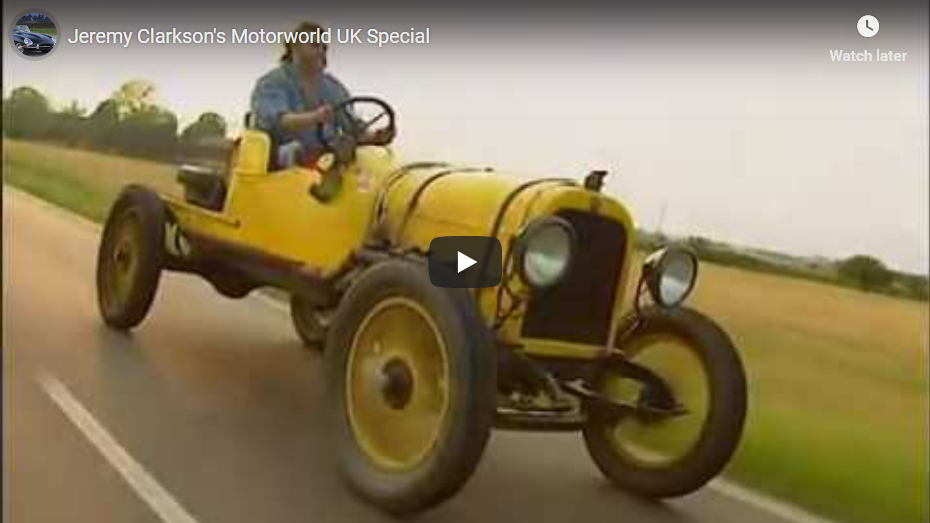
Published on 19 Nov 2016This is the last episode of Motorworld (BBC WORLDWIDE), the extremely rare UK Special. All copyrights go to their respective owners.

Matthew Lowry
Published on 19 Nov 2016This is the last episode of Motorworld (BBC WORLDWIDE), the extremely rare UK Special. All copyrights go to their respective owners.
The_Chieftain
Published on 6 Apr 2019A fun, and rather dangerous, little softskin which will easily fit in your garage.
Big Car
Published on 18 Mar 2019The MG Midget is all about fun! It’s a simple, cheap little car that promises open-top thrills which it delivers in spades. It’s a story that spans seven decades from humble roots in Oxfordshire to a world-beating car that conquered America. It was loved by weekend tinkerers, American G.I.’s coming home from the war and F1 racers. This is the MG Midget Story!
There are many reasons to become a more competent and more conscious user of the American road, but allow me to acquaint you with one reason that you’ll regret having done so: once you get to the point where every action you take behind the wheel has a defined and precise purpose, you will find the unconscious and purposeless actions of everybody on the road around you to be utterly maddening. I’m talking about the people who wander from lane to lane for no reason. The drivers who speed up to match you as you pass them on the freeway, not out of anger or machismo but simply because their subconscious herd-animal instincts tell them that it’s completely safe and comforting to be driving at 75mph next to another 4,000-pound unguided missile. Tailgaters. People who can’t merge at speed. I could go on, but I think you get the idea.
I’m not saying that road rage and aggressive driving isn’t a problem in the United States — it obviously is — but much of the bizarre behavior you see out there on the road is simply due to the fact that the average driver puts no more thought into his choices behind the wheel than I do into selecting toilet paper at the supermarket. They aren’t trying to offend you or “beat” you. They’re just kind of stroking along on instinct and the dimly remembered lessons of high-school driver’s ed. That’s why you will have somebody blow by you in a 55 zone only to hold you up in the 75 zone that follows: they aren’t even looking at the speed limit signs. Instead, they’re simply doing a speed that feels comfortable to them. It’s completely unconscious.
Jack Baruth, “How To Mentally Manipulate Your Fellow Drivers: This is not the lane you’re looking for…”, Road and Track, 2017-03-07.
At Coyote Blog, Warren Meyer climbs back onto one of his favourite hobby horses:
Yes, I am like an addict on Tesla but I find the company absolutely fascinating. Books and HBS case studies will be written on this saga some day (a couple are being written right now but seem to be headed for Musk hagiography rather than a real accounting ala business classics like Barbarians at the Gate or Bad Blood).
I still stand by my past thoughts here, where I predicted in advance of results that 3Q2018 was probably going to be Tesla’s high water mark, and explained the reasons why. I won’t go into them all. There are more than one. But I do want to give an update on one of them, which is the growth and investment story.
First, I want to explain that I have nothing against electric vehicles. I actually have solar panels on my roof and a deposit down on an EV, though it is months away from being available. What Tesla bulls don’t really understand about the short position on Tesla is that most of us don’t hate on the concept — I respect them for really bootstrapping the mass EV market into existence. If they were valued in the market at five or even ten billion dollars, you would not hear a peep out of me. But they are valued (depending on the day, it is a volatile stock) between $55 to $65 billion.
The difference in valuation is entirely due to the charisma and relentless promotion by the 21st century’s PT Barnum — Elon Musk. I used to get super excited by Musk as well, until two things happened. One, he committed what I consider outright fraud in bailing out friends and family by getting Tesla to buy out SolarCity when SolarCity was days or weeks from falling apart. And two, he started talking about things I know about and I realized he was totally full of sh*t. That is a common reaction from people I read about Musk — “I found him totally spellbinding until he was discussing something I am an expert in, and I then realized he was a fraud.”
Elon Musk spins great technology visions. Like Popular Mechanics magazine covers from the sixties and seventies (e.g. a flying RV! a mile long blimp will change logging!) he spins exciting visions that geeky males in particular resonate with. Long time readers will know I identify as one of this tribe — my most lamented two lost products in the marketplace are Omni Magazine and the Firefly TV series. So I see his appeal, but I have also seen his BS — something I think a lot more people have caught on to after his embarrassing Boring Company tunnel reveal.
Apparently the federal government believes that drinking and driving is such a huge, intractable problem that they’ve decided it’s worth sacrificing your right to privacy in order to combat this scourge:
It may sound unbelievable, but Canada’s revised laws on impaired driving could see police demand breath samples from people in bars, restaurants, or even at home. And if you say no, you could be arrested, face a criminal record, ordered to pay a fine, and subjected to a driving suspension.
You could be in violation of the impaired driving laws even two hours after you’ve been driving. Now, the onus is on drivers to prove they weren’t impaired when they were on the road.
This isn’t a simple change of rules, it’s a wholesale abandonment of common sense.
“If you start to drink after you get home, the police show up at your door, they can arrest you, detain you, take you back to the (police station) and you can be convicted because your blood alcohol concentration was over 80 milligrams (per 100 millilitres of blood) in the two hours after you drove.”
Changes to Section 253 of the Criminal Code of Canada took effect in December giving police greater powers to seek breath samples from drivers who might be driving while impaired.
Under the new law, police officers no longer need to have a “reasonable suspicion” the driver had consumed alcohol. Now, an officer can demand a sample from drivers for any reason at any time.
But there’s no possible way this could be abused, right?
“It’s a serious erosion of civil liberties,” said Toronto criminal defence lawyer Michael Engel, whose practice focuses almost exclusively on impaired driving cases.
Engel said someone could be unjustly prosecuted. If a disgruntled business associate or spouse called police with a complaint and an officer went to investigate at the persons’ home or place of business, police could demand a breath sample.
“Husbands or wives in the course of separations would drop the dime on their partner,” Engel said, describing the potential for the law’s abuse by those calling police out of spite, for example.
ReasonTV
Published on 19 Dec 2018Government plays Santa Claus with your tax money.
—–
Subscribe to our YouTube channel: http://youtube.com/reasontv
Follow us on Twitter: https://twitter.com/reason
Subscribe to our podcast at Apple Podcasts: https://goo.gl/az3a7aReason is the planet’s leading source of news, politics, and culture from a libertarian perspective. Go to reason.com for a point of view you won’t get from legacy media and old left-right opinion magazines.
—–Have a Tesla on your Christmas wish list? Don’t thank Santa — thank Tom in Ohio.
Parody written and performed by Remy. Video by Austin Bragg. Music tracks, background vocals, and mastering by Ben Karlstrom
LYRICS:
It’s beginning to look a lot like Christmas
Everywhere you go
Folks with six-figure salaries
Are shopping in galleries
With a gift card paid by Tom in OhioIt’s beginning to look a lot like Christmas
Roadsters all around
And while Tom can’t afford a car
He’ll buy part of one for John
Cuz somehow that’s allowedWell a black Model X and a tax credit check
Is the wish of Connor and Ken
And a dark Model 3 that is partially free
Is the hope of Bobby and Ben
While Tommy takes the bus and eats Vienna sausagesIt’s beginning to look a lot like Christmas
Hear those sleigh bells ring
But what else could you expect
With a tax code so complex?
Ensuring just these things?Yes a car with aplomb that’s, in part, paid by Tom
Is the wish of Victor and Von
A sedan that can drive and takes years to arrive
Is the hope of Lenny and Lon
While Tommy pinches pennies never flushing number oneIt’s beginning to look a lot like Christmas
Soon the credits end
But the funniest sight to see’s
When typical for DC
They’re renewed again
Everything’s renewed again
Quest TV
Published on 23 Oct 2018Bruce puts two iconic World War II trucks to the test: the iconic American Jeep and the German Kübelwagen. Which truck will come out on top? #CombatDealers
The TV trio of James May, Richard Hammond and Jeremy Clarkson are giving up the show after the third season, due to begin in January, and will instead move on to “Hollywood budget” specials on Amazon Prime:

An emotional Jeremy Clarkson has revealed he will walk away from the studio car shows that helped turn him into a household name following the third series of The Grand Tour.
The outspoken presenter, 58, will give up on the traditional format employed by the hugely popular Amazon show and long-running BBC flagship Top Gear after more than 17 years.
However, fans needn’t be alarmed since Clarkson – joined by co-hosts Richard Hammond and James May – has inked a new deal with Amazon Prime for a fourth series of the show in a brand new format.
[…]
‘It’s a really sad day,’ Clarkson later told The Sun. ‘I will miss the banter with each other and with the audience. But we’ve been doing that show for effectively 17 years — sitting around in studios, watching cars race around the track.’
He added: ‘We all agreed that we’ve been doing it a long time and everything eventually runs its course. Besides, I’m 58 and I’m too fat to be climbing on to the stage.’
Clarkson, Hammond and May will now focus on a series of extravagant, big-budget specials over the next two years that will take them away from their usual studio environment.
I’m far from a petrol-head, but I’ve been a fan of Clarkson/Hammond/May for several years, and I still barely know anything about cars…
Andrew Coyne tries to encapsulate the key economic concept that should be taken away from the GM Canada collapse:
Think of it this way. Governments have proven more than ready in the past to pay whatever the auto companies demanded to hold onto threatened jobs. If there were any chance whatsoever of buying the plant’s reprieve, no matter how foolishly or expensively, can there be any doubt they would have? That they did not — apparently GM waved them off — tells you how hopeless the plant’s prospects really are.
Many have recalled that the closure of the Oshawa plant comes less than a decade after the Canadian operations of GM and Chrysler were bailed out with $14 billion in federal and provincial money, $4 billion of which was never recovered. The lesson some have drawn from this is that GM is a devious ingrate, which may be fair comment but is not especially helpful. The real lesson is this: when you try to buy jobs with public money, the jobs last only as long as the money does. In the end, all you will have done is to lure people into taking or staying in jobs that were long since doomed.
Like most of economics, this is wholly alien to popular wisdom. There is a rich vein of commentary to the effect that the laws of economics are effectively optional, something we can resist by force of will: we can either bend to “market forces,” or we can “stand up” to them in some fashion. But in fact the latter option is entirely imaginary, at least in the long run. You can perhaps lure plants and jobs your way at the outset with subsidies and other goodies. But the only assurance they will stay is if it makes economic sense to the company to keep them there.
If not, then all you have won with your subsidy is the right to go on providing more subsidy, which is a fairly accurate description of Canadian automobile policy in recent decades. The workers whose jobs successive governments boasted of creating or saving were effectively hostages; as in all hostage-takings, the payment of ransom only stimulates further demands for ransom. Until one day when the money runs out, and the workers whose jobs were supposedly saved find themselves abandoned. This may be many things, but one thing it is not is compassionate.
The move by GM to close many of its remaining car manufacturing facilities in Canada and the US is a belated rational response — not to the market, but to the ways government action has distorted the market. In the Financial Post, Lawrence Solomon explains how, step-by-step, the CAFE rules have shifted drivers out of sedans and wagons and into minivans, pickup trucks, and SUVs:
Before the U.S. government introduced Corporate Average Fuel Economy (CAFE) standards to increase the distance cars could travel per gallon of gas, sedans and full-size station wagons were popular and SUVs were unknown. CAFE, which effectively governed the entire North American market thanks to the Canada-U.S. Auto Pact, incented manufacturers to artificially raise the cost of large passenger cars in order to favour smaller, more fuel-efficient vehicles. It soon claimed its first victim: the full-size station wagon, whose flexible interior accommodated both passenger and cargo needs, and which, at its peak, came in 62 models to satisfy different tastes.
But, although CAFE priced the station wagon out of the market, the market still demanded a vehicle that offered its flexibility. Enter Lee Iacocca, the chairman of Chrysler, who helped develop the minivan and convinced the U.S. government to deem it a truck rather than a passenger vehicle, thus exempting it from the strict CAFE standards that killed the station wagon. The minivan took off — the first 1984 model, built in Windsor, sold 209,000 its first year — followed by the SUV, which also was deemed a truck rather than a passenger vehicle. By 2000, the passenger car had less than half the market. Today it accounts for only about a third.
CAFE standards didn’t only claim certain car models as victims, they also made the whole industry a victim by making it dependent on government whims and then handouts. CAFE also distorted the market by creating credits for ethanol and electric vehicles and by creating a lobbyist’s dream through ever-changing regulations that led car manufacturers to continually game the system to favour their own vehicles over those of competitors.
Perversely, by improving mileage, CAFE also increased distances travelled and emissions of pollutants such as carbon monoxide and nitrogen oxides. The 2025 CAFE targets (since cancelled by President Trump) ran to almost 2,000 pages and were estimated to add an average of US$1,946 to the cost of a vehicle. Tax loopholes also helped accelerate SUV sales — like all light trucks, they were exempted from the gas-guzzler’s excise tax and also given preferential tax treatment as business vehicles.
Craig Eyermann explains why President Trump’s push to expand the use of ethanol in cars is a bad call for many reasons:
For example, because ethanol packs less energy per gallon than gasoline does, vehicle owners can expect to get even lower fuel mileage from the expansion of E15 fuel (a blend of 15% ethanol with 85% gasoline) under the new mandate to include more ethanol in automotive fuels, which would be 4% to 5% less than they would achieve if they only filled their vehicles with 100% gasoline. Today’s vehicle owners already pay a fuel efficiency penalty of 3% to 4% lower gas mileage from the E10 ethanol-gasoline fuel blend mandated under the older ethanol content rules, where the new rules will require even more fill-ups.
Beyond that, to the extent that it diverts corn from food markets to fuel production, corn-based ethanol production also jacks up the price of food—the corn itself, plus everything that eats corn, like beef cattle. One review of multiple studies found that the U.S. government’s corn-based ethanol mandates added 14% to the cost of agricultural commodity prices from 2005 through 2015.
Last summer, the Environmental Protection Agency also found that burning increasing amounts of ethanol has made America’s air dirtier because it generates more ozone pollution, which contributes to smog formation. Worse, growing the additional corn to make more ethanol has also increased agricultural fertilizer runoff pollution in the nation’s rivers and waterways.
That runoff has been linked to the increased incidence of harmful algal blooms, which have been responsible for contaminating drinking water and contributing to red tide events in coastal regions, where fish and other aquatic organisms have been killed off.
There is a solution to these federal government-generated pollution problems: stop forcing corn-based ethanol to be used in the nation’s fuel supplies. There’s even a case study from Brazil, where the city of Sao Paulo found that its air became cleaner after it switched from ethanol-based fuels to gasoline in the years from 2009 to 2011.
The Tank Museum
Published on 12 May 2017Historian David Fletcher MBE, in the 37th Tank Chat discussing the Daimler Armoured Car.
The Daimler Armoured Car proved to be a versatile and successful vehicle, serving with the British Army in all theatres of war from 1941 and remaining in service for some years after the Second World War.
Support the work of The Tank Museum on Patreon: ► https://www.patreon.com/tankmuseum
Or donate http://tankmuseum.org/support-us/donate
The Great War
Published on 6 Oct 2018Chair of Wisdom Time!
Foundation for Economic Education
Published on 11 Sep 2018Believe it or not, parallel parking is not an impossible task. Meet Blake Garrett, the entrepreneur who is using VR to teach people how to drive, without actually getting behind the wheel.
____________
Produced & Directed by Michael Angelo Zervos
Executive Produced by Sean W. Malone
Hosted by Andrew Heaton
Original Music by Ben B. Goss
Featuring Blake Garrett



Powered by WordPress