
Overly Sarcastic Productions
Published Apr 26, 2024“TOP FIVE Athenian Tyrants – #2 will surprise you and #3 will get murdered in a polycule-gone-wrong!”
-Herodotus if he had a blog.SOURCES & Further Reading:
“Revolution & Tyranny” & “The Origins of Democracy” from Ancient Greek Civilization by Jeremy McInerney
Athens: City of Wisdom by Bruce Clark, 2022
The Greeks: A Global History by Roderick Beaton, 2021
The Greeks: An Illustrated History by Diane Cline, 2016
I also have a university degree in Classical Civilization.
(more…)
August 10, 2024
History Summarized: Athens (Accidentally) Invents Democracy
Comments Off on History Summarized: Athens (Accidentally) Invents Democracy
July 23, 2024
Why Most “Ancient” Buildings are Fakes
toldinstone
Published Apr 12, 2024Almost every ancient monument has been at least partially reconstructed, for a wide range of reasons …
Chapters:
0:00 Introduction
1:06 The Forum and Colosseum
2:27 The Ara Pacis
3:24 Early restorations
4:37 Mondly
5:47 Roman forts and baths
6:42 Knossos
7:23 The Stoa of Attalus
8:59 The Acropolis
10:05 When to restore?
(more…)
Comments Off on Why Most “Ancient” Buildings are Fakes
June 30, 2024
Why Democracies Always Fail
The Why Minutes
Published Feb 21, 2024Why do democracies have a pesky habit of destroying themselves?
Comments Off on Why Democracies Always Fail
May 19, 2024
“Alcibiades … would surely have spawned numerous Hollywood movies and novelistic treatments, had his name not been so long and complicated”
In The Critic, Armand D’Angour outlines the fascinating career of one of the great “characters” of ancient Greece, Alcibiades:
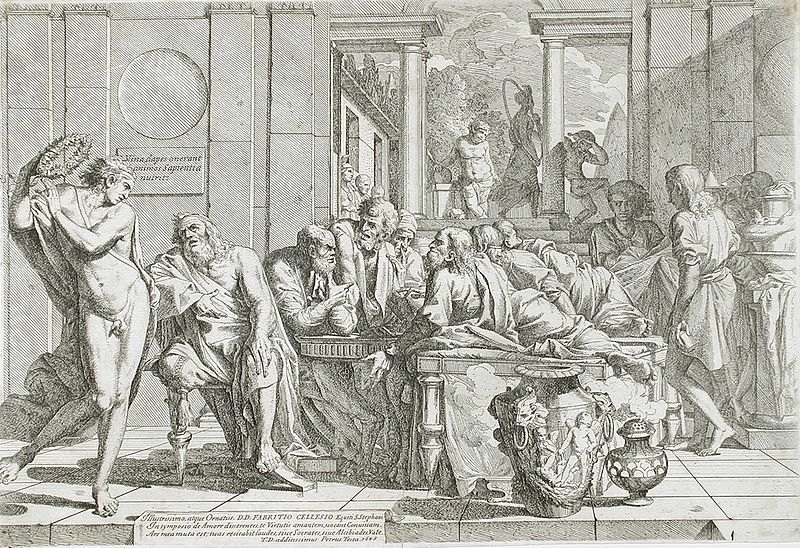
“Drunken Alcibiades interrupting the Symposium”, an engraving from 1648 by Pietro Testa (1611-1650)
Via Wikimedia Commons.
The career of the aristocratic Athenian politician, lover, general and traitor Alcibiades (c. 451–404 BC) is so well documented and colourful that it would surely have spawned numerous Hollywood movies and novelistic treatments, had his name not been so long and complicated (the standard English pronunciation is Al-si-BUY-a-deez).
His popularity, duplicity and unwavering self-regard make for ready points of comparison with modern politicians. The sheer amount of historical detail attached to his story is reflected in Aristotle’s comment in his Poetics: “Poetry is more scientific and serious than history, because it offers general truths whilst history gives particular facts … A ‘particular fact’ is what Alcibiades did or what was done to him.”
We know about “what Alcibiades did and what was done to him” from several authoritative ancient writers. The most entertaining portrayal, however, is that of the philosopher Plato (c. 425–347 BC), whose dialogue Symposium relates how Alcibiades gatecrashed a party at the home of the playwright Agathon, where several speeches had already been delivered on the theme of eros (love):
Suddenly there was a loud banging on the door, and the voices of a group of revellers could be heard outside along with that of a piper-girl. Agathon told his servants to investigate: “If they’re friends, invite them in,” he said.” If not, tell them the party’s over.” A little later they heard the voice of Alcibiades echoing in the courtyard. He was thoroughly drunk, and kept booming “Where’s Agathon? Take me to Agathon.” Eventually he appeared in the doorway, supported by a piper-girl and some servants. He was crowned by a massive garland of ivy and violets, and his head was flowing with ribbons. “Greetings, friends,” he said, “will you permit a very drunken man to join your party?”
Alcibiades proceeds to eulogise the wisdom and fortitude of his beloved mentor, the philosopher Socrates, detailing how the latter saved his life in a battle in Northern Greece in 432 BC at the start of the Peloponnesian War between Athens and Sparta, a conflict that dragged on until Athens’ defeat in 404 BC.
The prominence of Alcibiades in Platonic writings stems from his long and close relationship with Plato’s teacher Socrates. He was born in Athens to aristocratic forebears and at around the age of four lost his father Clinias, who was killed in battle in 447 BC. Along with his brother, Alcibiades entered the guardianship of Pericles, his mother’s cousin and Athens’ leading politician.
Shortly afterwards, Pericles was to take Aspasia of Miletus, a clever woman admired by Socrates, as his partner. Aspasia’s sister was married to Alcibiades the Elder, Clinias’ father, so Aspasia was Alcibiades’ great-aunt by marriage. Her acquaintance with Socrates might have been what led Pericles to appoint Socrates as a mentor for his young ward.
As a teenager Alcibiades was widely admired for his good looks and spirited personality, but he was also notorious for misdemeanours, such as when he struck a teacher for dishonouring Homer, released a bird into the Council chamber to disrupt proceedings, and paraded his dog in public with its tail docked.
Ambitious Athenians were expected to espouse a “love of honour” (philotimia), and Alcibiades displayed this to extremes. He married the daughter of a wealthy Athenian, and when she tried to divorce him because of his affairs, he lifted her bodily and carried her home through the crowded Agora.
Comments Off on “Alcibiades … would surely have spawned numerous Hollywood movies and novelistic treatments, had his name not been so long and complicated”
April 12, 2024
Greek History and Civilization, Part 6 – The Search for Stability
seangabb
Published Apr 7, 2024This sixth lecture in the course deals with the period of Greek history between the end of the Persian Wars and the assassination of Philip II of Macedon.
(more…)
Comments Off on Greek History and Civilization, Part 6 – The Search for Stability
April 2, 2024
QotD: Supersizing the Polis, Roman-style
Discussing the Roman Republic after already looking at the normal structure of a polis offers an interesting vantage point. As we’ll see, the Roman Republic has a lot of the same features as a polis: a citizen body, magistrates, a citizen assembly, all structured around a distinct urban center and so on. On the other hand, as we’re going to see, the Romans have some different ideas about the res publica (that’s their phrase which gives us our word “republic”). They imagine the republic differently than a polis and that leads to some meaningful differences in its structure and nature, even though it seems to share a lot of “DNA” with a polis and in some sense could be described as an “overgrown” city-state.
Which leads into the other major difference: size. We’re going to be taking a snapshot of the Roman Republic, necessary because the republic changed over time. In particular what we’re going to look at here is really a snapshot of the republic as it functioned in the third and second centuries, what Roman historians call the “Middle Republic” (c. 287-91BC). Harriet Flower defines this period as part of “the republic of the nobiles” which as we’ll see is an apt title as well.
But even by the beginning of this period, the Roman Republic is enormous by the standards of a polis. While a polis like Athens or Sparta with total populations in the low hundreds of thousands was already very large by Greek standards, the Roman Republic was much bigger. We know that in Italy in 225 there was something on the order of three hundred thousand Roman citizens liable for conscription, which implies a total citizen population right around a million. And that massive polity in turn governed perhaps another two million other Italians who were Rome’s “socii” (“allies”), perhaps the social category at Rome closest to “resident foreigners” (metics) in Greek poleis. This is in Italy alone, not counting Rome’s “overseas” holdings (at that point, Sicily, Corsica and Sardinia). In short, the Roman Republic may in some ways be shaped like a polis, but it was a full order of magnitude larger than the largest poleis, even before it acquired provinces outside of Italy. As you may imagine, that has implications!
Bret Devereaux, “Collections: How to Roman Republic 101, Part I: SPQR”, A Collection of Unmitigated Pedantry, 2023-07-21.
Comments Off on QotD: Supersizing the Polis, Roman-style
March 19, 2024
Greek History and Civilization, Part 5 – The Greeks Fight Back
seangabb
Published Mar 17, 2024This fifth lecture in the course deals with the defeat of Persian invasion of Greece in 480 BC, ending with the creation of the Delian League and the varying fortunes of Xerxes and Themistocles.
(more…)
Comments Off on Greek History and Civilization, Part 5 – The Greeks Fight Back
February 27, 2024
Greek History and Civilisation, Part 4 – The Ancient Greeks: The Great Invasion
seangabb
Published Feb 18, 2024This fourth lecture in the course deals with the Persian invasion of Greece in 480 BC, ending with the glory of Thermopylae and the burning of Athens.
(more…)
Comments Off on Greek History and Civilisation, Part 4 – The Ancient Greeks: The Great Invasion
February 21, 2024
Greek History and Civilisation, Part 3 – The Ancient Greeks: Rising Tensions with Persia
seangabb
Published Feb 18, 2024This third lecture in the course deals with the rise of the Persian Empire, and the growing tensions between the Persians and the Greeks, culminating in an account of the Battle of Marathon in 490 BC.
(more…)
Comments Off on Greek History and Civilisation, Part 3 – The Ancient Greeks: Rising Tensions with Persia
February 13, 2024
Greek History and Civilisation, Part 2 – Sparta and Athens: Contrasting Societies
seangabb
Published Feb 11, 2024This second lecture in the course contrasts Athens and Sparta, the two leading societies in Greece — one a commercial society with high levels of personal freedom and citizen participation, the other a militarised oligarchy.
[NR: Some additional information to supplement Dr. Gabb’s lecture:
– “Citizenship” in the ancient and clasical world
– Sparta had Lycurgus, while Athens had Solon … who at least actually existed
– The Constitution of Athens
– The Constitution of the Spartans
– The Myth of Spartan Equality
– Relative wealth among the Spartiates
– Sparta’s military reputation as “the best warriors in all of Greece”
– Sparta – the North Korea of the Classical era
– Spartan glossary]
(more…)
Comments Off on Greek History and Civilisation, Part 2 – Sparta and Athens: Contrasting Societies
February 6, 2024
Greek History and Civilisation, Part 1 – What Makes the Greeks Special?
seangabb
Published Feb 1, 2024This first lecture in the course makes a case for the Greeks as the exceptional people of the Ancient World. They were not saints: they were at least as willing as anyone else to engage in aggressive wars, enslavement, and sometimes human sacrifice. At the same time, working without any strong outside inspiration, they provided at least the foundations for the science, mathematics, philosophy, art and secular literature of later peoples.
(more…)
Comments Off on Greek History and Civilisation, Part 1 – What Makes the Greeks Special?
QotD: Sparta’s actually mediocre military performance
The Spartans were at best tactically and strategically uncreative. Tactically, Sparta employed the phalanx, a close-order shield and spear formation. But while elements of the hoplite phalanx are often presented in popular culture as uniquely Spartan, the formation and its equipment were common among the Greeks from at least the early fifth century, if not earlier. And beyond the phalanx, the Spartans were not innovators, slow to experiment with new tactics, combined arms, and naval operations. Instead, Spartan leaders consistently tried to solve their military problems with pitched hoplite battles. Spartan efforts to compel friendship by hoplite battle were particularly unsuccessful, as with the failed Spartan efforts to compel Corinth to rejoin the Spartan-led Peloponnesian League by force during the Corinthian War.
Sparta’s military mediocrity seems inexplicable given the city-state’s popular reputation as a highly militarized society, but modern scholarship has shown that this, too, is mostly a mirage. The agoge, Sparta’s rearing system for citizen boys, frequently represented in popular culture as akin to an intense military bootcamp, in fact included no arms training or military drills and was primarily designed to instill obedience and conformity rather than skill at arms or tactics. In order to instill that obedience, the older boys were encouraged to police the younger boys with violence, with the result that even in adulthood Spartan citizens were liable to settle disputes with their fists, a tendency that predictably made them poor diplomats.
Bret Devereaux, “Spartans Were Losers”, Foreign Policy, 2023-07/22.
Comments Off on QotD: Sparta’s actually mediocre military performance
December 31, 2023
Budapest Under Siege – WW2 – Week 279 – December 30, 1944
World War Two
Published 30 Dec 2023In the west, the Allies break the siege of Bastogne, but the fight for the Ardennes continues. and British commander Bernard Montgomery is maneuvering to take command of the Western Front ground forces. In Hungary Budapest is cut off by the Soviets and under siege, with hundreds of thousands of civilians still in the city. The fight in Italy is winding down for the winter, but the fight in the Philippines continues. In fact, American landings on Luzon are planned to go off soon.
00:00 INTRO
01:22 The Siege of Bastogne
03:10 The failure of 5th and 6th Panzer Armies
06:11 Montgomery wants command
09:27 Guderian appeals to Hitler, “stop the Ardennes Offensive!”
12:11 Budapest surrounded and under siege
17:04 Wrapping up the Gothic Line Campaign
19:29 Churchill in Athens
20:30 The fight in the Philippines
23:07 SUMMARY
(more…)
Comments Off on Budapest Under Siege – WW2 – Week 279 – December 30, 1944
December 24, 2023
The Siege of Bastogne Begins – WW2 – Week 278 – December 23, 1944
World War Two
Published 23 Dec 2023The German Ardennes Offensive, called by the Allies the Battle of the Bulge, is in full swing in Luxembourg and Belgium this week, and the Germans have the key junction town of Bastogne under siege. On the Allied side there comes a large American surrender, plans for counterattacks, and tension growing between British and American Commands. The fight in both Italy and the Philippines continues, and in Hungary the Soviets have nearly surrounded Budapest.
00:26 Intro
01:06 The Battle of the Bulge
03:54 The Malmedy Massacre
06:25 Bastogne
10:00 American Surrender on Schnee Eifel
12:06 Patton plans a counterattack
15:44 Bernard Montgomery and Omar Bradley
18:12 The Red Army advances around Budapest
21:39 Fighting in Italy and Greece
22:45 Leyte and Mindoro
25:07 Conclusion
(more…)
Comments Off on The Siege of Bastogne Begins – WW2 – Week 278 – December 23, 1944
December 17, 2023
The Battle of the Bulge Begins – WW2 – Week 277 – December 16, 1944
World War Two
Published 16 Dec 2023Adolf Hitler’s Ardennes counteroffensive finally goes off this week, and it does indeed catch the Allies by surprise, and they suspend other offensive operations in the west. They are still attacking in Italy, and the Soviets are still advancing in Hungary, trying to cut off Budapest. In the Far East, there are Allied landings on Mindoro, and they are also on the march in Burma, hoping to pin down the enemy.
0:00 Intro
0:55 Recap
1:22 Street fighting in Athens
04:07 Operation Queen ends
06:33 Autumn Mist Offensive plans
09:51 Allied intelligence failures
12:26 The Ardennes Offensive Begins
16:57 Allied attacks in Italy and Soviet plans to surround Budapest
20:07 The Allied offensive in Burma
22:10 Mindoro Landings
24:33 Summary
25:14 Conclusion
(more…)
Comments Off on The Battle of the Bulge Begins – WW2 – Week 277 – December 16, 1944


