
… on June 15th 1919 Captain John Alcock and Lieutenant Arthur Brown landed their Vickers Vimy airplane in a bog near Connemara, County Galway and thereby completed the first successful transatlantic flight: They had set off from St John’s, Newfoundland about fourteen hours earlier. What with having to get to the airport three hours early to shuffle through Homeland Security, we haven’t as a practical matter improved much on flight time over the last hundred years. It was also the first transatlantic air mail delivery, as, shortly before takeoff, the Royal Mail decided to give Alcock and Brown a couple of sacks of post for Britain.
A couple of weeks later, on July 6th 1919 the first east-west transatlantic flight landed at Mineola on Long Island. The RAF airship R34 had left East Fortune in Scotland four days earlier, having been hastily converted to hold passengers, and with a plate welded to an engine exhaust pipe to enable it to cook and serve hot food, which is more trouble than most airlines would go to today. A tabby kitten called Wopsie who served as the crew’s mascot stowed away on the flight, and because nobody at the Long Island end knew anything about landing large airships Major E M Pritchard parachuted out a little early, and became the first man to land on North American soil by air from Europe.
These briefly famous men did not get to savor their celebrity for long: Major Pritchard died in 1921 when the R38 airship exploded over the Humber estuary; his body was never found. Captain Alcock, just six months after his triumph and being knighted by George V, died at Rouen in Normandy in December 1919 when his new Vickers Viking crashed en route to the Paris air show.
Mark Steyn, “Come, Josephine, in My Flying Machine”, SteynOnline, 2019-07-07.
August 9, 2019
QotD: Early milestones in aviation
August 5, 2019
How Boeing lost its mojo
Rafe Champion linked to this interesting thumbnail-sketch history of the decline and fall of Boeing:
“Boeing 521 427”by pmbell64 is licensed under CC BY-SA 2.0


Let’s start by admiring the company that was Boeing, so we can know what has been lost. As one journalist put it in 2000, “Boeing has always been less a business than an association of engineers devoted to building amazing flying machines.”
For the bulk of the 20th century, Boeing made miracles. Its engineers designed the B-52 in a weekend, bet the company on the 707, and built the 747 despite deep observer skepticism. The 737 started coming off the assembly line in 1967, and it was such a good design it was still the company’s top moneymaker thirty years later.
How did Boeing make miracles in civilian aircraft? In short, the the civilian engineers were in charge. And it fell apart because the company, due to a merger, killed its engineering-first culture.
What Happened?
In 1993, Clinton’s Deputy Secretary of Defense, Bill Perry, called defense contractor CEOs to a dinner, nicknamed “the last supper.” He told them to merge with each other so as, in the classic excuse used by monopolists, to find efficiencies in their businesses. The rationale was that post-Cold War era military spending reductions demanded a leaner defense base. In reality, Perry had been a long-time mergers and acquisitions investment banker working with industry ally Norm Augustine, the eventual CEO of Lockheed Martin.
Perry was so aggressive about encouraging mergers that he put together an accounting scheme to have the Pentagon itself pay merger costs, which resulted in a bevy of consolidation among contractors and subcontractors. In 1997, Boeing, with both a commercial and military division, ended up buying McDonnell Douglas, a major aerospace company and competitor. With this purchase, the airline market radically consolidated.
Unlike Boeing, McDonnell Douglas was run by financiers rather than engineers. And though Boeing was the buyer, McDonnell Douglas executives somehow took power in what analysts started calling a “reverse takeover.” The joke in Seattle was, “McDonnell Douglas bought Boeing with Boeing’s money.”
[…]
The key corporate protection that had protected Boeing engineering culture was a wall inside the company between the civilian division and military divisions. This wall was designed to prevent the military procurement process from corrupting civilian aviation. As aerospace engineers Pierre Sprey and Chuck Spinney noted, military procurement and engineering created a corrupt design process, with unnecessary complexity, poor safety standards, “wishful thinking projections” on performance, and so forth. Military contractors subcontract based on political concerns, not engineering ones. If contractors need to influence a Senator from Montana, they will place production of a component in Montana, even if no one in the state can do the work.
July 17, 2019
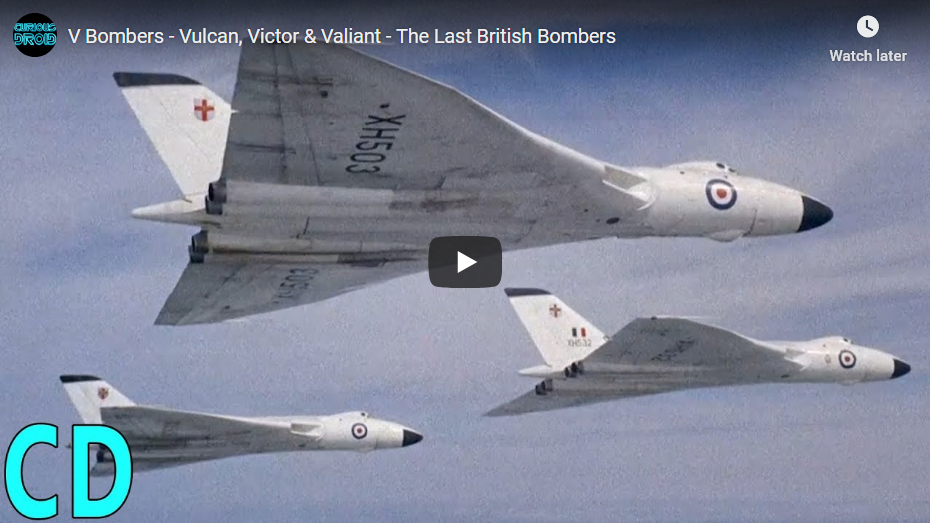
V Bombers – Vulcan, Victor & Valiant – The Last British Bombers
Curious Droid
Published on 28 Nov 2017It took just 11 years to go from the first flight of the Lancaster Bomber in 1941 to the first flight of the VX770, the prototype Vulcan bomber in 1952. Yet the difference between them could hardly be greater, the Vulcan along with the Victor and Valiant were a new generation of the new planes known as the “V” bombers, planes for a new era and a newly, nuclear-armed Britain.
Patreon : https://www.patreon.com/curiousdroid
Paypal.me : https://www.paypal.me/curiousdroidSponsers: Drew Hendrix, Symon Hamer, Florian Hesse, Lucius Kwok, Hunter Schwisow, Pyloric, Seb Stoodley, Oscar Anderson, Peter Cote, Cody Belichesky, Mogoreanu Daniel, Douglas Gustafson, Marcus Chiado, Jorn Magnus Karlsen.
This episode’s shirt was the was the Tabla Paisley by Madcap England and is available from https://www.atomretro.com/madcap_england.
Get 10% discount with the code DROID10.Presented by Paul Shillito
Written and Researched by Andy Munzer
Additional material by Paul Shillito
Images and footage: Avro, Handley-Page, Vickers-Armstrong
Jim Debinham, Pathe.Music – Machiotil by Seclorance is licensed under an Attribution License.
Source : http://freemusicarchive.org/music/Sec…
July 14, 2019
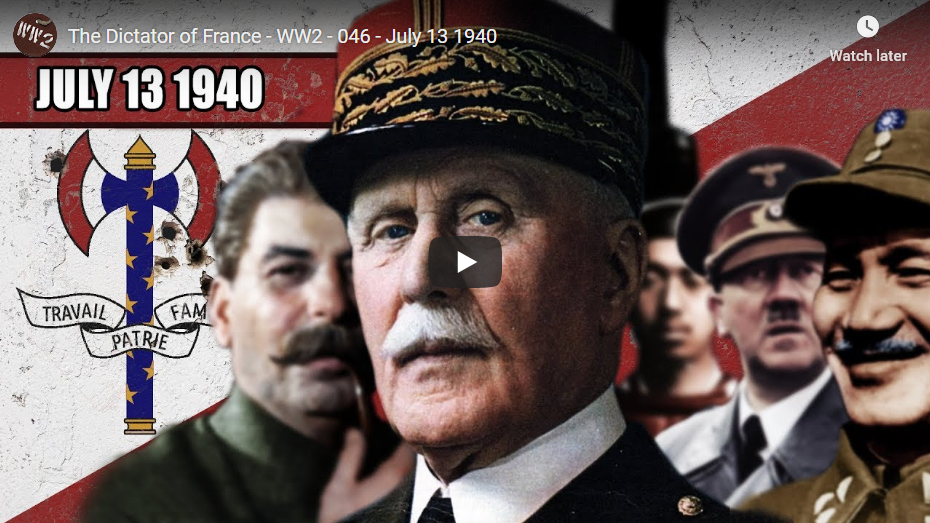
The Dictator of France – WW2 – 046 – July 13 1940
World War Two
Published on 13 Jul 2019The Germans and the French in Vichy consolidate their newly acquired power as the British deal with the remnants of the French navy. The Battle of Britain begins with fighting above the English Channel, a battle with great consequences for the future of Europe.
Join us on Patreon: https://www.patreon.com/TimeGhostHistory
Or join The TimeGhost Army directly at: https://timeghost.tvFollow WW2 day by day on Instagram @World_war_two_realtime https://www.instagram.com/world_war_t…
Join our Discord Server: https://discord.gg/D6D2aYN.
Between 2 Wars: https://www.youtube.com/playlist?list…
Source list: http://bit.ly/WW2sourcesWritten and Hosted by: Indy Neidell
Produced and Directed by: Spartacus Olsson and Astrid Deinhard
Executive Producers: Bodo Rittenauer, Astrid Deinhard, Indy Neidell, Spartacus Olsson
Creative Producer: Joram Appel
Research by: Indy Neidell
Edited by: Iryna Dulka
Map animations: EastoryColorisations by Norman Stewart and Julius Jääskeläinen https://www.facebook.com/JJcolorization/
Eastory’s channel: https://www.youtube.com/channel/UCEly…
Archive by Screenocean/Reuters https://www.screenocean.com.Sources:
– IWM: HU 25966, D 734, HU 104721, D 735,
A 18492, HU 52333, Q 69694, A 18284, AMY 450, MH 4560
– Collection of Adolph B. Miller/COLL1068, USMC Archives & Special Collections
– Lloyd W. Williams Collection (COLL/77), USMC Archives & Special CollectionsA TimeGhost chronological documentary produced by OnLion Entertainment GmbH.
From the comments:
World War Two
3 days ago (edited)
“You either die a hero or live long enough to see yourself become the villain,” could very well describe the life of Philippe Pétain. Or at least, thats what many generally agree on in hindsight. For the people living in France in 1940, it wasn’t that black or white. “Saving France” didn’t necessarily mean fighting from exile, and establishing a French state with approval of the German victors might have seemed like the best option to protect French interests, people and identity. It’s hard to place yourself in the shoes of people who lived through hard times and had to make tough decisions. Thats why we try to report and describe what happened as unbiased as we can. Keep that in mind when commenting, as well as our rules and guidelines.
July 11, 2019
From Aerobatics to Terror Bombing | Between 2 Wars | 1927 Part 2 of 2
TimeGhost History
Published on 10 Jul 2019With thousands of planes left over from World War One, hobby pilots and entrepreneurs set out to create the modern airline industry. Charles Lindbergh, Amelia Earhart, and many more set record after record, while airplane manufacturers start the creation of passenger, freight planes, and a new generation of aerial weapons.
Join us on Patreon: https://www.patreon.com/TimeGhostHistory
Hosted by: Indy Neidell
Written by: Joram Appel and Spartacus Olsson
Directed and Produced by: Astrid Deinhard and Spartacus Olsson
Executive Producers: Bodo Rittenauer, Astrid Deinhard, Indy Neidell, Spartacus Olsson
Creative Producer : Joram Appel
Post Production Director: Wieke Kapteijns
Research by: Joram Appel
Edited by: Daniel WeissArchive by Reuters/Screenocean https://www.screenocean.com
A TimeGhost chronological documentary produced by OnLion Entertainment GmbH

June 20, 2019
James Holland on the operational side of World War 2
I saved this link at the time, then life intervened and I only just re-found it now … but it’s not a time-sensitive article and the arguments he makes are still worth considering:
Studying such things in detail meant I was now looking at the operational level of war. Any conflict — or business for that matter — is understood to be conducted on three levels. The first is the strategic — that is, the overall aims and ambitions. The second is the tactical: the coal face, the actual fighting, the pilot in his Spitfire or man in his tank. And the third is the operational — the nuts and bolts, the logistics, economics and the supply of war.
Almost every narrative history of the war ever published almost entirely concentrates on the strategic and tactical levels, but gives scant regard to the operational, and the result is a skewed version of events, in which German machine guns reign supreme and Tiger tanks always come out on top.
Studying the operational level as well, however, provides a revelatory perspective. Suddenly it’s not just about tactical flair, but about so much more. Britain, for example, decided to fight a highly mechanical and technological war. “Steel not flesh” was the mantra and that’s why the British had a small army, yet still ensured it was 100-percent mechanized. They also developed a vast air force and built a staggering 132,500 aircraft during the war — and that’s 50,000 more than the Germans. Until the start of 1944, the priority for manpower in Britain was not the army or navy or even air force, but the Ministry of Aircraft Production. Well-fed men and women were kept in the factories.
Germany, on the other hand, was very under-mechanized but had a vast army, which meant it was dependent on horse-power and foot-slogging infantrymen. As a result of so many German men at the front, their factories were manned by slaves and POWs, who were underfed and treated abominably, and whose production capacity was affected as a result.
And if the ability to supply war was key, then in the war in the West, it was the Battle of the Atlantic that was the decisive theater. Yet Germany built a surface fleet before the war, which could never hope to rival Britain or France and in doing so neglected the U-boat arm. Despite sinking substantial amounts of British supplies in 1940, it was still nothing like enough to even remotely force Britain to her knees. In truth, there were never enough U-boats to more than dent the flow of shipping to Britain. In fact, out of 18,772 sailings in 1940, they sank just 127 ships, that is, 0.7 percent, and 1.4 percent in the entire war.
June 17, 2019
How does RADAR work? | James May Q&A | Head Squeeze
BBC Earth Lab
Published on 29 Nov 2013How does RADAR work? It’s a bit like shouting very loudly at a cliff and waiting for the echo to come back to you. Whether you use rude words or not is completely up to you.
RADAR is emitting a sound wave and waiting for the echo to come back to you. By timing the returning echo you can work out where exactly another object is.
The really interesting thing about radar is if you use multiple angled receivers you can work out the position and height of a target. This technology was essential in winning the Battle of Britain in 1940.
But that was 1940, what about radar now? Is it as defunct as the 3 ½ inch floppy disk? Well, no actually. Radar is still pretty important in the military but the technology is a lot more advanced. In fact each time you connect to a sat nav to figure out where you are, you are using the network of satellites that calculate your position using the same principles of radar.
Thanks to Alyssa Ann for her portrait of Jeremy Clarkson: http://alyssamenold.com/
May 17, 2019
The Red Baron – The Great War – Sabaton History 015
Sabaton History
Published on 16 May 2019The Red Baron is one of the, if not THE MOST iconic heroes of The Great War. He simultaneously embodies the mechanisation of modern war and a romanticised version of war with his individual skill and heroism. Indy goes beyond the legend to tell the history of Manfred von Richthofen, a.k.a The Red Baron, the latter of which also is the name of a Sabaton song that will feature on their upcoming album The Great War.
You can find the eight points of the Dicta Boelcke in the pinned comment.
Support Sabaton History on Patreon (and possibly get a History Channel special edition): https://www.patreon.com/sabatonhistory
Pre-order The Great War here: https://www.sabaton.net/pre-order-of-…
Check out the trailer for Sabaton’s new album ‘The Great War’ right here: https://www.youtube.com/watch?v=HCZP1…
Watch more videos on the Sabaton YouTube channel: https://www.youtube.com/user/Sabaton?…
Listen to Sabaton on Spotify: http://smarturl.it/SabatonSpotify
Official Sabaton Merchandise Shop: http://bit.ly/SabatonOfficialShopHosted by: Indy Neidell
Written by: Markus Linke and Indy Neidell
Directed by: Astrid Deinhard and Wieke Kapteijns
Produced by: Pär Sundström, Astrid Deinhard and Spartacus Olsson
Creative Producer: Joram Appel
Executive Producers: Pär Sundström, Joakim Broden, Tomas Sunmo, Indy Neidell, Astrid Deinhard, and Spartacus Olsson
Maps by: Eastory
Edited by: Iryna Dulka
Sound Editing by: Marek KaminskiEastory YouTube Channel: https://www.youtube.com/channel/UCEly…
Archive by: Reuters/Screenocean https://www.screenocean.com
Music by Sabaton.Sources:
– © IWM: Q 66959, Q 105717, Q 73533, Q 67598, Q 50329, Q 50328, Q 42284, Q 111872, Q 54397, Q 63148, Q 63122, Q 3140, Q 57513 Q 58028, Q 52781, Q 63822, Q 50673, Q 72919, Q 12044, IWM 187, EPH 9001, Q 67832, IWM 1004, Q 63162, Q 67780, Q 58034, Q 63137, Q 63160
– © IWM Art: IWM ART 517, 1488, 517, 3071, 2659, 2660, 3199, 2754, 654
– Bendigo Soldiers Memorial Institute Military Museum: 2075P
– Klimbim Colorization
– James Miller ColorizationAn OnLion Entertainment GmbH and Raging Beaver Publishing AB co-Production.
© Raging Beaver Publishing AB, 2019 – all rights reserved.
From the comments:
Sabaton History
This is the second episode of Sabaton History about one of the songs of the upcoming Sabaton album The Great War. By supporting us on Patreon, you can help us continue making these YouTube videos. You will also get some exclusive content – like a full version of Indy and Joakim talking about The Red Baron, which is live on our Patreon site right here: https://www.patreon.com/posts/full-length-red-26854763Indy mentions the Dicta Boelcke in the video. These are the eight points that Boelcke and von Richthofen used in the skies (source: Werner, Johannes von, 1932):
1. Try to secure advantages before attacking. If possible, keep the sun behind you.
2. Always carry through an attack when you have started it.
3. Fire only at close range, and only when your opponent is properly in your sights.
4. Always keep your eye on your opponent, and never let yourself be deceived by ruses.
5. In any form of attack it is essential to assail your enemy from behind.
6. If your opponent dives on you, do not try to evade his onslaught, but fly to meet it.
7. When over the enemy’s lines never forget your own line of retreat.
8. For the Staffel (squadron): Attack on principle in groups of four or six. When the fight breaks up into a series of single combats, take care that several do not go for the same opponent.
January 26, 2019
The US Army’s tank development and “The Emergency” in Eire
A discussion on the TimeGhost forums the other day included a link to this fascinating article by World of Tanks writer The Chieftain:
Wouldn’t it have been a terrible thing if, in the middle of WW2, the people responsible for training and equipping the US Army’s armored force were taken prisoner? Well, they were.
Wait, what? I’m sure we’d have heard all about this if it had really happened, and it’s certainly news to me, so he’s just pulling the long bow here, right? Well, no, he’s not. It really did happen, but there were several reasons why it didn’t become even a nine-day wonder in 1942, because it happened in what had been the Irish Free State but known after 1937 as Éire. Ireland was neutral in WW2, and had a policy of interning combatant personnel who found themselves in Ireland during the war. Keep this in mind, as it’s the key point of the story.
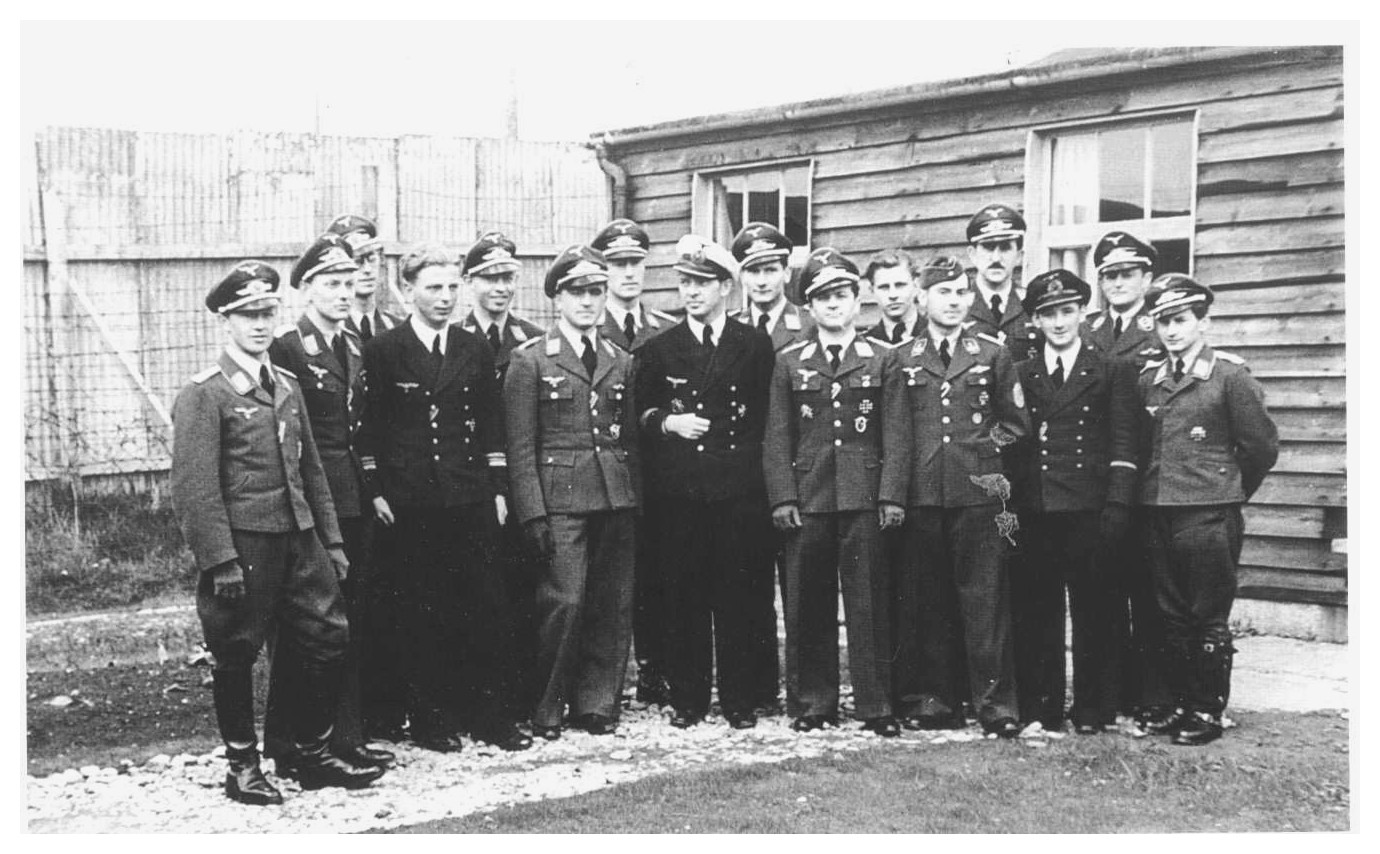
Interned German military personnel at the K-Lines Internment Camp in the Curragh.
Going on another brief tangent, you may be aware of the fact that what we know as “World War II” […] is not known by that name universally. Over on the former Soviet side of the house, it’s “The Great Patriotic War”. (Well, OK, they do distinguish between WWII and TGPW, but not in everyday conversation). The Soviet Union wasn’t the only country to give the conflict a less common name: In Eire, (Ireland), it was known as “The Emergency”
The background to this is that the Irish government wanted to enact emergency powers due to the unusual state of affairs which obtained in Europe in September 1939. The Irish Constitution granted the government such emergency powers in case of war, but it wasn’t entirely sure if the war in Europe counted. So the First Amendment to the Irish Constitution was approved, to add, in effect, that “state of war” could include “wars of which Ireland is not a part if the government thinks it’s important enough.” Once that little clarification was made, the Oireachtas (Parliament) passed its declaration of a state of emergency with the Emergency Powers Act. As a general rule, the Irish ruling bodies were not fans of the concept of acknowledging that there was a war going on which they had chosen not to be a part of. It went so far that when the son of a notable member of the Irish gentry in Malahide was killed when HMS Hood was sunk, his death was noted in the Irish Times as being due to a boating incident. As a result, the entire period 1939-1946 is known as “The Emergency.”
In this, as in so many other things, Ireland is a weird place. But we digress.
In December of 1942, Lieutenant General Jacob Devers, head of the Armored Force, decided to go on a fact-finding mission to the European Theatre of Operations to see how the tank units were holding up. Well, actually, it was mainly the North African Theatre of Operations, as European tank combat hadn’t really gotten off the ground. So he took with him a couple of colleagues, including one Major General Edward Brook, two Brigadier Generals named Gladeon Barnes and William Palmer, a Colonel William Thaddeus Sexton, and to carry the baggage, a Major Earl Hormell. They set off on December 14th, going south to Brazil, Ascension, The Gold Coast, Nigeria and Sudan, arriving Cairo five days later after a distance of 11,140 miles. After spending a little time with the British, they hopped over to Algeria, Tunisia and Morocco. At the end of trip, they went to Gibraltar for a week to consolidate their findings 7-14 January. The result of all this flying around and taking people away from their jobs for a month was one page and a quarter of conclusions, and one half-page of recommendations (the other half is six signature blocks).
[…]
Their duty from their trip being completed, they took advantage of the fact that they were already on the other side of the Atlantic to go to the UK to check in with the goings-on there.
So they boarded their aircraft, a B-17 converted to a VIP transport role, departed Gibraltar, and set off North up the Atlantic’s Eastern edge, looping around to the West of France to avoid German interception. Their B-17 was named “Stinky”.
You can probably guess where this is going.
The daily diary of the Devers mission reads as follows:
“At 2:00pm, January 15th, departed from Gibraltar, weather splendid. At approximately 10:00am, just after daylight, sighted land which navigator described as Lundy Island. From the map, this island appeared to be 100 miles north of the point at which the plane should have turned east towards Port Reath. Retracing south, the contour of the coastline did not correspond to that on available maps. Searched for approximately two hours without finding a familiar landmark. The radio operator was unable to contact any stations. The navigator admitted that he was lost. The ground consisted of small grass fields traversed by stone walls. With the gasoline supply nearly exhausted, a crash landing was made near Athenry at 11:50am. The size of the field was such that after hitting the ground, the plane crashed through a stone wall at approximately 70 miles per hour. Although the plane was wrecked, the members of the party were uninjured. The plane was immediately surrounded by Irish civilians and members of the Home Guard. The local inhabitants were very friendly, offered food and any medical assistance necessary. Shortly thereafter, representatives of the Eire Army arrived and took charge of the situation”
Er, oops? Read the whole thing for the full story.
January 6, 2019
WW2 Ball Turret with twin .50 cals at the Big Sandy Shoot
Gunscom
Published on 7 Dec 2018One of the highlights at this fall’s Big Sandy Shoot was a vintage WW2 ball turret with twin .50 cals that spectators could shoot.
Although it’s not uncommon to see unique and rare guns and military vehicles at the event, the fully functioning ball turret garnered a lot of attention.
Taigh Ramey, president of Vintage Aircraft, towed the Sperry A2 ball turret all the way from Stockton, California to the shoot, which takes place every April and October just outside of the town of Wikieup, Arizona.
Sperry A2 ball turrets were commonly mounted underneath either a Boeing B-17 Flying Fortress or the Consolidated B-24 Liberator. They were used to defend the bomber against aircraft attacking from below.
Ramey found the turret in a surplus shop many years ago. It took him 15 years to convince the owner to sell it, and he’s sure glad he did. Ramey fixes up and maintains vintage aircraft for the Stockton Field Aviation Museum. The ball turret has proven to be very popular with visitors.
The turret was new ‘old stock’ from the 1940’s, so it never saw service. Despite having sat on a storage skid for half a century, Ramey says he brought it back to his shop, put hydraulic fluid, fired it up, and the turret ran like a charm.
Rumored to have inspired the inside of the cockpit of the Millennium Falcon from the Star Wars films, the Sperry turret was operated by the gunner inside using two hand controls that operated two Vickers hydraulic units. It could rotate 360 degrees and tilt up up and down. Atop two control handles were fire buttons that engaged two .50 caliber light-barrel Browning AN/M2 machine guns. The guns fired 850 rounds per minute, and each gun was fed by a 500 round box of ammunition. The guns could not be reloaded in flight, so gunners had to be careful.
Contrary to popular myth, ball turrets were not always manned by tiny people. People up to six foot could fit inside comfortably. Gunners sat in a fetal-type position, and aimed the guns using a Reflector sight in front of a small circular window between their legs.
Statistically, the ball turret was one of the safest crew positions during WWII as ball turret gunners had the lowest loss rate.
Ramey was at the Big Sandy Shoot not only to live fire the turret, something he’d never done before, but also to promote Bomber Camp. It is a two-day event held on May 29 and 30 of every year at the Stockton Metropolitan Airport in California. Participants get a chance to step back in time to train for a bombing mission, and then to fly it for real.
Participants learn how to use original bomber sights and compensate for height, distance and wind. Gunnery classes familiarize them with the ball turret and other aircraft mounted guns, all of which can be fired in flight using airsoft propane ‘blanks’.
The grande finale is a flying mission in which dummy cement bombs are dropped from high altitudes on targets from a B-24 or B17 aircraft. Bomber Camp offers a once in a lifetime experience to gain a greater appreciation for the men and women of the “greatest generation”. Enrollment is tax deductible.
November 6, 2018
Fly the “Party Flight” with Canadian (Forces) Airways!
 In the Ottawa Citizen, David Pugliese reminds us that not all is right with the higher-ups of the Canadian military, based on what was allowed to occur — and at least partly covered-up — on a VIP flight last year:
The December 2017 “Team Canada” tour – now more popularly known in some quarters in the military as “the party flight” – has without a doubt been a major public relations black eye for the Canadian Forces.
The tour, with VIPs who were supposed to boost the morale of military personnel deployed overseas, turned into a fiasco. Some VIPs on the RCAF flight to Greece and Latvia were drunk and abusive to the crew, in particular the military flight attendants. The VIP civilian passengers, including former NHL player Dave “Tiger” Williams were exempt from security screening before the flight, and some — already drunk — walked on to the Canadian Forces aircraft with open alcoholic drinks in their hands.
Two individuals were so drunk they were reported to have urinated themselves. Video taken aboard the plane showed people — including a staff member from Chief of the Defence Staff Gen. Jon Vance’s office — dancing in the aisles of the aircraft with their drinks as a rock band played at the back of the plane. Others chewed tobacco, in violation of Canadian Forces rules, spitting the slimy juice into cups for flight attendants to clean up.
The military flight crew was prohibited from approaching the VIPs except to provide them with service. The crew felt they couldn’t do anything to put a halt to the antics as these very important people were Vance’s guests.
Williams has been charged with sex assault and assault. He denies the charges.
The $337,000 taxpayer-funded trip was planned by Vance’s office. Vance okayed the booze on the RCAF aircraft.
We know all of this now.
But almost right from the beginning, the Canadian Forces/Department of National Defence Staff Public Affairs branch appeared to try its best to mislead journalists – and ultimately the public – on what actually took place on that flight.
September 26, 2018
The last British carriers before the Queen Elizabeth class
This is a long, long thread from @EngageStrategy, so I’m putting it below the fold for those who aren’t interested and don’t want to scroll down for hours…
It covers the near-death experience of British carriers in the 1960s (the cancellation of the last fleet carriers), the odd evolution of the “through deck command cruisers” (Invincible, Illustrious, and Ark Royal), the development of the Harrier, and the very near-run thing that was the carriers’ share of combat duty during the Falklands War.
German Anti-Aircraft Gun System | Flak | US Air Force Training Film | 1944
The Best Film Archives
Published on 6 Oct 2015● Please SUPPORT my work on Patreon: https://bit.ly/2LT6opZ
✚ Watch my “Military Training Films” PLAYLIST: https://bit.ly/2G6XIrN
FLAK is German acronym of Fliegerabwehrkanone / Flugabwehrkanone (“aeroplane defence cannon”).
This US Air Force training film (1944) provides an in-depth look at the German anti-aircraft gun (Flak) system, and highlight the evasive maneuvers utilized by US pilots during their missions.
German Anti-Aircraft Gun System | Flak | US Air Force Training Film | 1944
TBFA_0019 (DM_0005)
NOTE: THE VIDEO REPRESENTS HISTORICAL EVENTS. SINCE IT WAS PRODUCED DECADES AGO, IT HAS HISTORICAL VALUES AND CAN BE CONSIDERED AS A VALUABLE HISTORICAL DOCUMENT. THE VIDEO HAS BEEN UPLOADED WITH EDUCATIONAL PURPOSES. ITS TOPIC IS REPRESENTED WITHIN HISTORICAL CONTEXT. THE VIDEO DOES NOT CONTAIN SENSITIVE SCENES AT ALL!
September 23, 2018
The Nimrod MRA4 – the world’s most expensive bad aircraft
Back in 2011, I posted an article about the retirement of the Hawker Siddeley Nimrod from the Royal Air Force inventory. I referred to the Nimrod as
… expensive to buy, eye-wateringly expensive to upgrade, but it must be cheap to operate, right? No:
[…] our new fleet of refurbished De Havilland Comet subhunters (sorry, “Nimrod MRA4s”) will cost at least £700m a year to operate. If we put the whole Nimrod force on the scrapheap for which they are so long overdue right now, by the year 2019 we will have saved […] £7bn
The Register certainly got in the right ballpark with this helpful graphic:

Earlier this month, the Nimrod saga was detailed at Naval Gazing, if only as a way to show that someone can have worse procurement experiences than the United States military. Despite being a military development of a passenger jet famous for crashes, the initial marks of the Nimrod were able to meet the RAF’s needs. The problems began when a requirement was generated for a British AWACS aircraft and the Nimrod was deemed to be the best candidate for conversion (“best” probably meaning “only British competitor”):
Things began to go wrong in the mid-70s, when the British decided to introduce an AWACS aircraft to support their air defense efforts. They had several options. The E-2 Hawkeye and E-3 Sentry were both about to enter service, and were rapidly proving themselves to have excellent radar systems during trials. The British could have had either aircraft, or bought their radar systems to integrate into an aircraft of their own. Or they could have only bought a few subcomponents, like the antenna or the radar transmitter itself, and built the rest domestically.
They decided to take none of these options. Instead, they would produce an entirely new radar system. Instead of an American-style radome, separate antennas would be installed in the nose and tail, and the system would sweep through one, and then the other. This was far more expensive and much riskier than buying from the Americans, but it did produce a lot more jobs in the British defense industry, which was apparently the government’s prime concern. In 1977, a contract was placed, making BAE and GEC-Marconi co-leads on the project to convert 11 surplus Nimrod MR1 airframes to the new configuration.
As might be expected based on that kind of decision-making, the resulting airplane had problems. The computer system chosen wasn’t powerful enough to integrate all of the data, particularly the area where the nose and tail radars overlapped. It was also horribly unreliable, with a mean time between failures of only two hours, in a system which took 2.5 hours to load the mission data from the tape. The Nimrod, considerably smaller than the American Sentry, was unable to carry more equipment to solve this problem. Different electronics racks were earthed to different points in the airframe, and the resulting potential differences caused false tracks to appear, overloading the computer even more. To make matters worse, most of the electronics units weren’t interchangeable for reasons that were never entirely clear. If one unit failed, several spares had to be tried before one that worked was found. The only system that functioned reliably was the IFF system, which could only track friendly aircraft and airliners. This was a major handicap in an aircraft intended to detect incoming Soviet bombers.
It probably isn’t a surprise to hear that the planes were delayed. A lot. And delaying military projects tends to drive the overall price higher. What was anticipated to be a £200-300 million project was over £1 billion before the government of the day came to their fiscal senses and pulled the plug (they ended up buying Boeing E-3 Sentry aircraft instead).
A few years later, the RAF ran a competition to replace the Nimrod MR2 maritime patrol aircraft. Lockheed, Dassault and Airbus entered the competition, but somehow, the RAF ended up selecting BAE’s bid which involved rebuilding 30-year-old Nimrod frames with new electronics and all the modern conveniences.
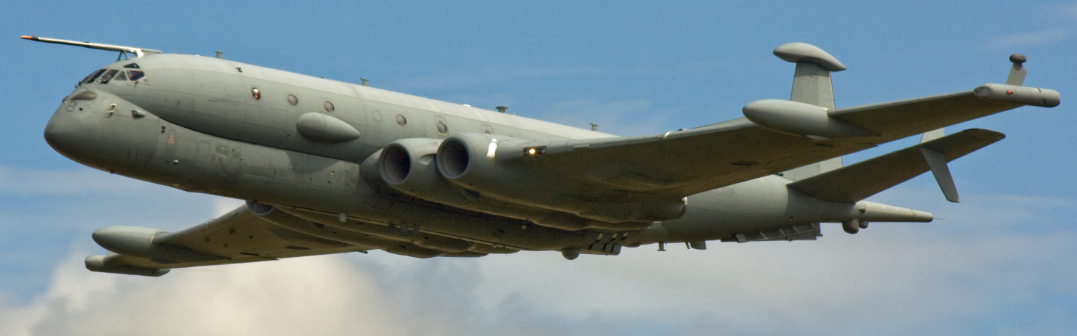
RAF Nimrod MRA4 on 18 July 2009.
Detail of original photo by Ronnie Macdonald, via Wikimedia Commons.
In 1996, a contract was issued for the new aircraft, designated Nimrod MRA4. 21 aircraft were to be produced at a cost of £2.8 billion, and they would be essentially new airplanes, with only the fuselage structure being retained. The antique Spey engines would be replaced with modern BR700s. These engines were significantly larger, and required much more air, forcing BAE to design a new, larger wing. The combined effect of these two changes was to double the Nimrod’s range and improve performance. Inside, the flight deck was replaced with one derived from the A340 airliner, and the mission systems were to be all-new.
A fuselage was sent to be reverse-engineered for the design of the new wing, and BAE designed and built it, then pulled in another aircraft to make the modification. And discovered that the wing didn’t fit. Apparently, the problem dated back to the initial construction of the aircraft. When positioning the frames, Hawker Siddeley had not done what all sensible manufacturers did, and measured from a common baseline. Instead, they had positioned each frame with a tolerance relative to the previous one, which meant that the position of the wings varied by as much as a foot across the fleet. Worse, the aircraft they had designed the wings for was one of the most extreme in wing position, so the new wings didn’t fit most of the other aircraft. This forced a redesign of the wings, further delaying the program.
Spoiler: they missed their delivery deadline. By nearly a decade. And the original plan to build 21 aircraft shrank to only 4 … but the budget continued to grow, from the original £2.8 billion to over £4.1 billion at cancellation. Each of the surviving airframes had literally cost more than £1 billion. That’s why Bean gave the Nimrod his “Naval Gazing Worst Procurement Ever” trophy, and I think it was very well-deserved.
September 22, 2018
The Distant Early Warning Line
The History Guy: History Deserves to Be Remembered
Published on 23 Apr 2018The History Guy examines how the Cold War transformed Canada with the establishment of the U.S. Air Force’s distant early warning or dew line.
The History Guy uses images that are in the Public Domain. As photographs of actual events are often not available, I will sometimes use photographs of similar events or objects for illustration.
Patreon: https://www.patreon.com/TheHistoryGuy
The History Guy: Five Minutes of History is the place to find short snippets of forgotten history from five to fifteen minutes long. If you like history too, this is the channel for you.


