Quotulatiousness

January 12, 2020

The shoot-down of Flight 752

Filed under: Government, History, Military, Politics, USA — Tags: , , — Nicholas @ 05:00

Colby Cosh discusses the destruction of Ukraine International 752 in the historical context of the Vincennes incident (later on Friday, the Iranian official position appears to have shifted to accepting responsibility for an accidental missile launch):

Some of the wreckage of Ukraine International flight 752 near Tehran, Iran.
Photo from MOJ Newsagency via Wikimedia Commons.

It has become fairly obvious, whatever the Iranian authorities may say now or later, that Ukraine International Airlines Flight 752 was shot down after departing Tehran. This was, in truth, overwhelmingly probable the moment the news broke, but there was still widespread shock and disbelief on Thursday when several Western heads of government announced signal-intelligence evidence of a missile strike. There are still “How could such a thing happen?” reactions pouring forth — mostly from people who are old enough, in theory, to recall the USS Vincennes accidentally shooting down an Iran Air Airbus A300 in 1988.

I say “in theory,” but the truth is that popular memory of the Vincennes incident has been much diminished — outside Iran — by later events in the region. This must qualify as one of the good Lord’s most sadistic jests. The United States wasn’t officially at war with anyone in the region at the moment when its best-trained sailors, equipped with scorchingly new and uncannily powerful missile and battlespace-mapping technology, blew up a commercial airliner full of religious pilgrims.

The Navy was in the Gulf not to fight or oppose anybody in particular, but to protect neutral shipping from the Iran-Iraq War. Up to the time of the accident, it was Iraq that demonstrably presented the greater danger to American warships. Ronald Reagan was still president. The First Gulf War wouldn’t kick off until 1990.

In other words: we forgot. The memory of Vincennes was overwritten by a generation of Middle East conflict, like an old computer file.

Which leaves a paradox. Liberals who regard recent U.S. history as one enormous, indistinguishable mass of bloodthirsty actions don’t seem especially aware of one of the most horrifying tactical blunders in American military history. What’s one jet plane more or less in the black ledger of imperialism? Conservatives, meanwhile, are racing to accuse Iran of “murder” in the case of Flight 752.

Blunders can be worse than crimes, according to one of the most famous of all military maxims. But if one points out that Iran’s “murder” of innocents is starting to look like a nightmarish replay of Vincennes, one risks being accused of postulating “moral equivalence” between the United States and Iran.

January 4, 2020

The Rise and Fall of the Japanese Zero

Filed under: History, Japan, Military, Pacific, Technology, USA, WW2 — Tags: , , , — Nicholas @ 06:00

Real Engineering
Published 31 Aug 2018

Patreon:
https://www.patreon.com/user?u=282505…
Instagram:
https://www.instagram.com/brianjamesm…
Twitter:
https://twitter.com/thebrianmcmanus
Discord:
https://discord.gg/s8BhkmN

Thank you to AP Archive for providing footage: https://www.youtube.com/channel/UCHTK…

Get your Real Engineering shirts at: https://standard.tv/collections/real-…

References:
[1] https://www.thoughtco.com/world-war-i…
[2] http://rwebs.net/avhistory/history/ze…
[3] http://aboutjapan.japansociety.org/im…
[4] https://www.history.com/news/the-akut…
[5] https://www.japanpowered.com/history/…
[6] https://www.warbirdforum.com/sakai.htm

Credits:
Narrator/Director: Brian McManus
Co-Director: Mike Ridolfi (https://www.moboxgraphics.com/)
3D Animations: Eli Prenten (http://eliprenten.com/)
Research: Stephanie Sammann (https://www.stephanie-sammann.com/)
Sound: Graham Haerther (https://haerther.net/)

November 30, 2019

WW1 Villar Perosa SMG at the Range

Filed under: History, Italy, Military, Weapons, WW1 — Tags: , , , — Nicholas @ 02:00

Forgotten Weapons
Published 28 Sep 2019

Courtesy of the Morphy Auction Company, I am out at the range today with a very rare Italian Villar Perosa machine gun from World War One. These are pretty unorthodox machine guns, as they were initially designed as aircraft armament and later repurposed as ground guns. The basic design is a pair of actions and barrel with a single rear trigger housing. The actions are (slightly) delayed blowback, feeding from 25-round magazines and firing at about 1500 rpm each. The grip has two separate thumb triggers, which fire the two barrels independently.

For an aircraft application, this allowed a very high volume of fire for a very short time; exactly what aerial combat called for. As an infantry gun, the design was much less practical. The bipod held the gun up, but did not have any firm stop that could be pushed into. Coupled with the lack of a buttstock, the gun was very difficult to keep on pattern with anything but the shortest burst. The small aperture sight certainly doesn’t help things either.

http://www.patreon.com/ForgottenWeapons

Cool Forgotten Weapons merch! http://shop.bbtv.com/collections/forg…

Contact:
Forgotten Weapons
6281 N. Oracle #36270
Tucson, AZ 85704

November 26, 2019

The Avro Arrow

Filed under: Britain, Cancon, History, Military, Technology, USA — Tags: , , , , — Nicholas @ 04:00

The History Guy: History Deserves to Be Remembered
Published 25 Nov 2019

In the 1950s, Canada had one of the world’s most advanced aerospace industries. But the cancellation of the Avro CF-105 “Arrow” changed everything. The History Guy remembers the Avro Arrow and forgotten aviation history. It deserves to be remembered.
(more…)

November 12, 2019

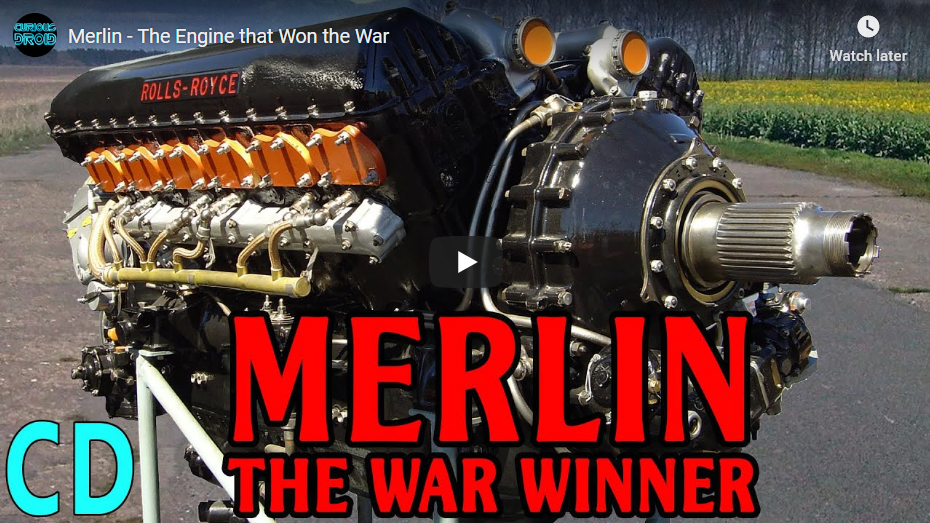
Merlin – The Engine that Won the War

Filed under: Britain, History, Military, Technology, USA — Tags: , , , — Nicholas @ 02:00

Curious Droid
Published 28 Sep 2019

Sounds like a bit of a bold claim that one engine helped change the course of WW2 but when you see the evidence it has a lot of validity but how did one little engine change the course of world events and become the engine that won the war?

I would like to thank David Irwin of Historic Aero Engines not only for the generous use of his footage but as in checking over the script and finished video for technical accuracy.

Historic Aero Engines display team :
https://www.youtube.com/channel/UCtE_…

Patreon https://www.patreon.com/curiousdroid
Paypal.me https://www.paypal.me/curiousdroid

Sponsored by
Craig Fleming, Florian Hesse, Peter Barber

Presented by Paul Shillito

Written and Researched by Paul Shillito with assistance from David Irwin.

Images and Footage:
Historic Aero Engines, Rolls Royce, USAF, RAF, Boeing, Packard,
Joel Trick

Music From the Youtube library
“Magical Gravity” by Asher Fulero
“Saving the World” by Aaron Kenny
“Adrift” by ELPHNT
“Oceans, Rivers, Canyons” by ELPHNT
“The Story Unfolds” by Jingle Punks

October 12, 2019

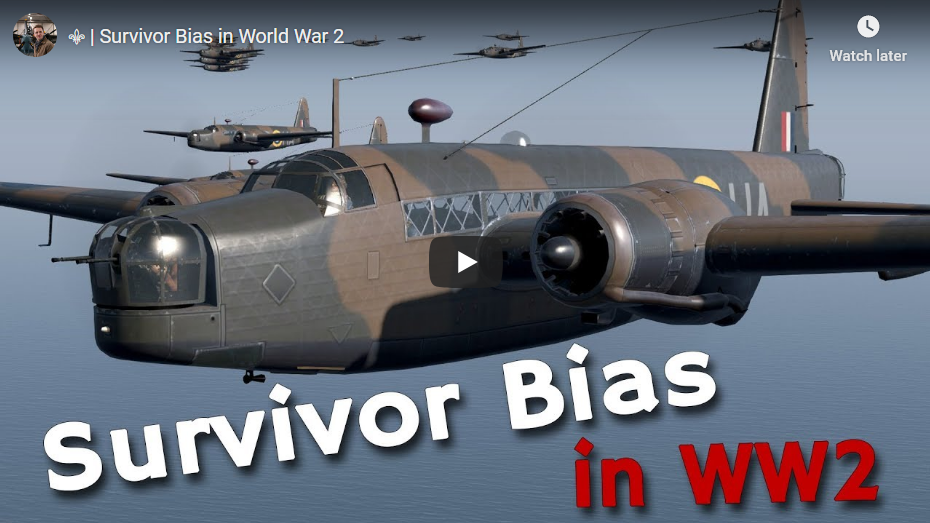
⚜ | Survivor Bias in World War 2

Filed under: History, Military, Technology, USA, WW2 — Tags: , — Nicholas @ 02:00

Military Aviation History
Published on 31 Aug 2017

Survivor Bias was a thing in World War 2. Let’s learn what happened.

– You can support my Channel with Patreon: https://www.patreon.com/Bismarck

⚜ Support My Work ⚜
– You can support my Channel with a donation [Paypal]: https://www.paypal.me/BismarckYT

⚜ Find Me On Social Media ⚜
– Twitch: http://www.twitch.tv/bis18marck70
– Twitter: https://twitter.com/Bis18marck70

⚜ Sources ⚜
M. Mangel, F. J. Samaniego, Abraham Wald’s Work on Aircraft Survivability

Abraham Wald, A Reprint of “A Method of Estimating Plane Vulnerability Based on Damage of Survivors”

From the comments:

Military Aviation History
2 years ago (edited)
Hey all, I hope that you like this video. Small correction from my side at 05:00 – It was reprinted in 1980 not 1918. I misspoke. Obviously.

This video was actually planned for the end of September but since I had the script already, I decided to publish it now. As mentioned to my Patreons some days ago, I have a few unexpected home visists to make. The first set was last week and after returning two days ago, I flew off to yesterday for another week abroad. As such it made sense to get such a familiar topic out now since otherwise, there would be nothing.

It should be mentioned that I did not find the “original” study Wald responded to. Either it got lost, or it was never published. Perhaps Wald saw them work on it, saw the errors and published his paper leading the other group to abandon their project. However, there is also a slight chance that over the years parts of the story were exaggerated. Wald certainly published his papers (you’ll easily find it on the internet) and was given the credit for helping US designers — but what of that inital research group? What were their conclusions, their recommendations beyond what is usually linked to Wald? Without their study, no one seems to know.

September 13, 2019

Why You Wouldn’t Want to Fly The First Jet Airliner: De Havilland Comet Story

Filed under: Britain, History, Technology — Tags: , , — Nicholas @ 02:00

Mustard
Published on 1 Dec 2017

Air travel before the Jet Age wasn’t always glamorous. The relentless noise and vibration from a piston powered propeller aircraft often made long flights even more exhausting. Most aircraft also couldn’t fly high enough to avoid bad weather, so air sickness was more common.

After World War Two, as part of an effort to develop its civil aviation industry, Britain stunned the world by unveiling the world’s first jet airliner. The de Havilland Comet was sleek, quiet, and flew higher and faster than any airliner of the day. As piston propeller technology was reaching its limits, the conventional thinking was that jet engines were too unreliable and produced too little power relative to their fuel consumption. But the de Havilland Comet proved that jet travel was the future. When the Comet entered service in 1952, it immediately began breaking travel time records and became a point of national pride for Britain.

The de Havilland Comet was perhaps little too ahead of its time. With such a clean sheet design, there were still lessons to learn. When early Comets suffered from catastrophic depressurization incidents, the entire fleet was grounded and their Certificate of Airworthiness was revoked. Flaws in the design of the aircraft’s fuselage were resolved in later Comet versions. However, the rest of the world was now catching up, and manufacturers including Boeing and Douglas began to offer their own jet airliners. While later version Comets served airlines reliably, they were outsold by competing aircraft. There’s no question However, that the comet paved the way. The British had taken a massive risk and brought the world into the jet age. #DeHavilland #CometAirliner #Airplane

Want to help Mustard grow? Support us on Patreon: https://www.patreon.com/MustardChannel

August 31, 2019

Young Recruits, French Planes, and Graf Spee – WW2 – OOTF 003

Filed under: Britain, France, Germany, History, Military, WW2 — Tags: , , , — Nicholas @ 06:00

World War Two
Published on 30 Aug 2019

How young were British soldiers? Could Graf Spee have gotten away? What was the French air force like? Questions, questions, questions – from you no less! With answers from us Out of the Foxholes.

Join us on Patreon: https://www.patreon.com/TimeGhostHistory
Or join The TimeGhost Army directly at: https://timeghost.tv

Follow WW2 day by day on Instagram @World_war_two_realtime https://www.instagram.com/world_war_t…
Join our Discord Server: https://discord.gg/D6D2aYN.
Between 2 Wars: https://www.youtube.com/playlist?list…
Source list: http://bit.ly/WW2sources

Image sources:
Drawing Morane-Saulnier M.S.406 C1 and Dewoitine D.520 fighters : Kaboldy

Written and Hosted by: Indy Neidell and Nicholas Moran
Produced and Directed by: Spartacus Olsson and Astrid Deinhard
Executive Producers: Bodo Rittenauer, Astrid Deinhard, Indy Neidell, Spartacus Olsson
Creative Producer: Joram Appel
Research by: Indy Neidell, Nicholas Moran, and Joram Appel
Edited by: Wieke Kapteijns

Eastory’s channel: https://www.youtube.com/channel/UCEly…
Archive by Screenocean/Reuters https://www.screenocean.com.

A TimeGhost chronological documentary produced by OnLion Entertainment GmbH.

From the comments:

World War Two
39 minutes ago
One day before the war has being going on for a whole year, we look back at some stuff from 1939 and 1940. And once again Nicholas Moran, the Chieftain https://www.youtube.com/user/TheChieftainWoT joins us to answer your questions. This time he leaves his main turf (tanks) to dive into his other area of expertise; naval battles. Please remember that we can’t field questions from the comments so if you want submit a new question do it here: https://community.timeghost.tv/c/Out-of-the-Foxholes-Qs

Coming out with Out of the Foxholes has been a bit of a challenge as we try to master the crazy amount of stuff going on in our main episodes. But thanks to the fantastic collaboration of the TimeGhost Army on https://www.patreon.com/TimeGhostHistory and https://timeghost.tv we are constantly expanding our capacity and we hope to come out with these a bit more often now! For now, enjoy and remember that tomorrow our first anniversary episode comes out!

August 16, 2019

The CO2-reduced future the elites want for the rest of us

Arthur Chrenkoff outlines the self-imposed hardship of a new Swedish MEP as he struggles to make his 24-hour weekly commute between Stockholm and Strasbourg (because he’s pretending that there are no flights between those two locations) and explains that it’s emblematic of the kind of future “our” leaders want all of us peasants to be living in the future:

Greta Thunberg at the EU Parliament, 16 April, 2019.
European Parliament photo via Wikimedia Commons.

Listen, I’m all for it; if people want to go back in time as a result of their own free choice that’s wonderful. At least these martyrs for Gaia are putting their money where their mouth is – on train as opposed to plane tickets. They are not being hypocrites, unlike the two hundred celebrities who came on 114 private jets and numerous superyachts to Google’s climate change summit in Sicily the other week. Even St Greta herself, the teenage idiot savant of the green movement, will be eschewing plane travel and going to the UN Climate Action Summit in New York in September on a zero-emission yacht. Want to suffer 24-hour Strasbourg-Stockholm regular commutes or a few weeks at sea between Europe and America so as not to sin again the planet, knock yourself out. My problem starts as soon as the environmental flagellanti decide it’s not enough that simply they care and want to start imposing their totalitarian solutions on everyone else.

[…]

This indeed seems to be the vision of an ecommunist utopia now increasingly on offer from its vocal and influential supporters:

  • As Thunberg herself declares in her musical collaboration with the Brit pop band The 1975 released last month (all proceeds to the pests of Extinction Rebellion who have a tendency to glue themselves to busy intersections): it’s “time to rebel” and for “civil disobedience” … “We have to acknowledge that the older generations have failed, all political movements in their current form have failed, but Homo sapiens have not yet failed … Now is not the time for speaking politely. Now is the time to speak clearly.”
  • David Runciman, politics professor at Cambridge University: “If electoral democracy is inadequate to the task of addressing climate change, and the task is the most urgent one humanity faces, then other kinds of politics are urgently needed … Channeling more energy into these other forms of democracy — into citizens’ assemblies and civil disobedience, rather than elections and party-building — will change our politics drastically. But it may be the only way to ensure our planet does not change beyond recognition.”
  • Greenpeace: “We’re not advocating that everyone adopt a ‘meatless’ diet tomorrow. But we all must develop “meat consciousness” and reduce the level of meat in our diets. Shifting to more plant-based foods is essential to combatting climate change, soil, air and water pollution, ocean dead zones, and myriad other problems caused by industrial livestock production.” Sentiments echoed this week by UN’s Intergovernmental Panel on Climate Change.
  • And don’t even mention Alexandria Ocasio-Cortez’s Green New Deal.

This is the future according to eco-warriors: anti-democratic, anti-growth and prosperity, with your options on everything from how (and if) you travel to what you eat restricted by your moral betters.

As my more favourite Scandinavian, Bjorn Lomborg, wrote recently:

    This year, the world will spend $US162 billion ($230bn) subsidising renewable energy, propping up inefficient industries and supporting middle-class homeowners to erect solar panels, according to the International Energy Agency. In addition, the Paris Agreement on climate change will cost the world from $US1 trillion to $US2 trillion a year by 2030. Astonishingly, neither of these hugely expensive policies will have any measurable impact on temperatures by the end of the century …

    Global warming is a real, man-made problem — but it is just one of many challenges facing humanity. We shouldn’t base our policy decisions on Hollywood movies or on scare scenarios but on the facts. According to the UN Intergovernmental Panel on Climate Change, even if we did absolutely nothing to respond to global warming, the total impact by the 2070s will be the equivalent to a 0.2 per cent to 2 per cent loss in average income. That’s a challenge that requires our attention — but it’s far from the end of the world …

    Despite costing a fortune, the Paris Agreement will have virtually no impact on global temperatures. The UN Framework Convention on Climate Change has estimated that even if every country makes every single carbon cut suggested in the Paris treaty to the fullest extent, CO2 emissions would be cut by only 1 per cent of what would be needed to keep temperature rises under 2C. Incurring an annual $US1 trillion cost while failing to rein in temperature rises is a very poor idea.

August 9, 2019

QotD: Early milestones in aviation

Filed under: Britain, History, Quotations, Technology — Tags: , , , — Nicholas @ 01:00

… on June 15th 1919 Captain John Alcock and Lieutenant Arthur Brown landed their Vickers Vimy airplane in a bog near Connemara, County Galway and thereby completed the first successful transatlantic flight: They had set off from St John’s, Newfoundland about fourteen hours earlier. What with having to get to the airport three hours early to shuffle through Homeland Security, we haven’t as a practical matter improved much on flight time over the last hundred years. It was also the first transatlantic air mail delivery, as, shortly before takeoff, the Royal Mail decided to give Alcock and Brown a couple of sacks of post for Britain.

A couple of weeks later, on July 6th 1919 the first east-west transatlantic flight landed at Mineola on Long Island. The RAF airship R34 had left East Fortune in Scotland four days earlier, having been hastily converted to hold passengers, and with a plate welded to an engine exhaust pipe to enable it to cook and serve hot food, which is more trouble than most airlines would go to today. A tabby kitten called Wopsie who served as the crew’s mascot stowed away on the flight, and because nobody at the Long Island end knew anything about landing large airships Major E M Pritchard parachuted out a little early, and became the first man to land on North American soil by air from Europe.

These briefly famous men did not get to savor their celebrity for long: Major Pritchard died in 1921 when the R38 airship exploded over the Humber estuary; his body was never found. Captain Alcock, just six months after his triumph and being knighted by George V, died at Rouen in Normandy in December 1919 when his new Vickers Viking crashed en route to the Paris air show.

Mark Steyn, “Come, Josephine, in My Flying Machine”, SteynOnline, 2019-07-07.

August 5, 2019

How Boeing lost its mojo

Rafe Champion linked to this interesting thumbnail-sketch history of the decline and fall of Boeing:

Let’s start by admiring the company that was Boeing, so we can know what has been lost. As one journalist put it in 2000, “Boeing has always been less a business than an association of engineers devoted to building amazing flying machines.”

For the bulk of the 20th century, Boeing made miracles. Its engineers designed the B-52 in a weekend, bet the company on the 707, and built the 747 despite deep observer skepticism. The 737 started coming off the assembly line in 1967, and it was such a good design it was still the company’s top moneymaker thirty years later.

How did Boeing make miracles in civilian aircraft? In short, the the civilian engineers were in charge. And it fell apart because the company, due to a merger, killed its engineering-first culture.

What Happened?

In 1993, Clinton’s Deputy Secretary of Defense, Bill Perry, called defense contractor CEOs to a dinner, nicknamed “the last supper.” He told them to merge with each other so as, in the classic excuse used by monopolists, to find efficiencies in their businesses. The rationale was that post-Cold War era military spending reductions demanded a leaner defense base. In reality, Perry had been a long-time mergers and acquisitions investment banker working with industry ally Norm Augustine, the eventual CEO of Lockheed Martin.

Perry was so aggressive about encouraging mergers that he put together an accounting scheme to have the Pentagon itself pay merger costs, which resulted in a bevy of consolidation among contractors and subcontractors. In 1997, Boeing, with both a commercial and military division, ended up buying McDonnell Douglas, a major aerospace company and competitor. With this purchase, the airline market radically consolidated.

Unlike Boeing, McDonnell Douglas was run by financiers rather than engineers. And though Boeing was the buyer, McDonnell Douglas executives somehow took power in what analysts started calling a “reverse takeover.” The joke in Seattle was, “McDonnell Douglas bought Boeing with Boeing’s money.”

[…]

The key corporate protection that had protected Boeing engineering culture was a wall inside the company between the civilian division and military divisions. This wall was designed to prevent the military procurement process from corrupting civilian aviation. As aerospace engineers Pierre Sprey and Chuck Spinney noted, military procurement and engineering created a corrupt design process, with unnecessary complexity, poor safety standards, “wishful thinking projections” on performance, and so forth. Military contractors subcontract based on political concerns, not engineering ones. If contractors need to influence a Senator from Montana, they will place production of a component in Montana, even if no one in the state can do the work.

July 17, 2019

V Bombers – Vulcan, Victor & Valiant – The Last British Bombers

Filed under: Britain, History, Military, Technology — Tags: , , , , — Nicholas @ 04:00

Curious Droid
Published on 28 Nov 2017

It took just 11 years to go from the first flight of the Lancaster Bomber in 1941 to the first flight of the VX770, the prototype Vulcan bomber in 1952. Yet the difference between them could hardly be greater, the Vulcan along with the Victor and Valiant were a new generation of the new planes known as the “V” bombers, planes for a new era and a newly, nuclear-armed Britain.

Patreon : https://www.patreon.com/curiousdroid
Paypal.me : https://www.paypal.me/curiousdroid

Sponsers: Drew Hendrix, Symon Hamer, Florian Hesse, Lucius Kwok, Hunter Schwisow, Pyloric, Seb Stoodley, Oscar Anderson, Peter Cote, Cody Belichesky, Mogoreanu Daniel, Douglas Gustafson, Marcus Chiado, Jorn Magnus Karlsen.

This episode’s shirt was the was the Tabla Paisley by Madcap England and is available from https://www.atomretro.com/madcap_england.
Get 10% discount with the code DROID10.

Presented by Paul Shillito

Written and Researched by Andy Munzer

Additional material by Paul Shillito

Images and footage: Avro, Handley-Page, Vickers-Armstrong
Jim Debinham, Pathe.

Music – Machiotil by Seclorance is licensed under an Attribution License.
Source : http://freemusicarchive.org/music/Sec…

July 14, 2019

The Dictator of France – WW2 – 046 – July 13 1940

Filed under: Britain, France, History, Military, WW2 — Tags: , , , , , , — Nicholas @ 04:00

World War Two
Published on 13 Jul 2019

The Germans and the French in Vichy consolidate their newly acquired power as the British deal with the remnants of the French navy. The Battle of Britain begins with fighting above the English Channel, a battle with great consequences for the future of Europe.

Join us on Patreon: https://www.patreon.com/TimeGhostHistory
Or join The TimeGhost Army directly at: https://timeghost.tv

Follow WW2 day by day on Instagram @World_war_two_realtime https://www.instagram.com/world_war_t…
Join our Discord Server: https://discord.gg/D6D2aYN.
Between 2 Wars: https://www.youtube.com/playlist?list…
Source list: http://bit.ly/WW2sources

Written and Hosted by: Indy Neidell
Produced and Directed by: Spartacus Olsson and Astrid Deinhard
Executive Producers: Bodo Rittenauer, Astrid Deinhard, Indy Neidell, Spartacus Olsson
Creative Producer: Joram Appel
Research by: Indy Neidell
Edited by: Iryna Dulka
Map animations: Eastory

Colorisations by Norman Stewart and Julius Jääskeläinen https://www.facebook.com/JJcolorization/

Eastory’s channel: https://www.youtube.com/channel/UCEly…
Archive by Screenocean/Reuters https://www.screenocean.com.

Sources:
– IWM: HU 25966, D 734, HU 104721, D 735,
A 18492, HU 52333, Q 69694, A 18284, AMY 450, MH 4560
– Collection of Adolph B. Miller/COLL1068, USMC Archives & Special Collections
– Lloyd W. Williams Collection (COLL/77), USMC Archives & Special Collections

A TimeGhost chronological documentary produced by OnLion Entertainment GmbH.

From the comments:

World War Two
3 days ago (edited)
“You either die a hero or live long enough to see yourself become the villain,” could very well describe the life of Philippe Pétain. Or at least, thats what many generally agree on in hindsight. For the people living in France in 1940, it wasn’t that black or white. “Saving France” didn’t necessarily mean fighting from exile, and establishing a French state with approval of the German victors might have seemed like the best option to protect French interests, people and identity. It’s hard to place yourself in the shoes of people who lived through hard times and had to make tough decisions. Thats why we try to report and describe what happened as unbiased as we can. Keep that in mind when commenting, as well as our rules and guidelines.

July 11, 2019

From Aerobatics to Terror Bombing | Between 2 Wars | 1927 Part 2 of 2

Filed under: History, Technology, USA — Tags: , , , , , , — Nicholas @ 04:00

TimeGhost History
Published on 10 Jul 2019

With thousands of planes left over from World War One, hobby pilots and entrepreneurs set out to create the modern airline industry. Charles Lindbergh, Amelia Earhart, and many more set record after record, while airplane manufacturers start the creation of passenger, freight planes, and a new generation of aerial weapons.

Join us on Patreon: https://www.patreon.com/TimeGhostHistory

Hosted by: Indy Neidell
Written by: Joram Appel and Spartacus Olsson
Directed and Produced by: Astrid Deinhard and Spartacus Olsson
Executive Producers: Bodo Rittenauer, Astrid Deinhard, Indy Neidell, Spartacus Olsson
Creative Producer : Joram Appel
Post Production Director: Wieke Kapteijns
Research by: Joram Appel
Edited by: Daniel Weiss

Archive by Reuters/Screenocean https://www.screenocean.com

A TimeGhost chronological documentary produced by OnLion Entertainment GmbH

June 20, 2019

James Holland on the operational side of World War 2

Filed under: Britain, Germany, History, Military, WW2 — Tags: , , , — Nicholas @ 03:00

I saved this link at the time, then life intervened and I only just re-found it now … but it’s not a time-sensitive article and the arguments he makes are still worth considering:

Studying such things in detail meant I was now looking at the operational level of war. Any conflict — or business for that matter — is understood to be conducted on three levels. The first is the strategic — that is, the overall aims and ambitions. The second is the tactical: the coal face, the actual fighting, the pilot in his Spitfire or man in his tank. And the third is the operational — the nuts and bolts, the logistics, economics and the supply of war.

Almost every narrative history of the war ever published almost entirely concentrates on the strategic and tactical levels, but gives scant regard to the operational, and the result is a skewed version of events, in which German machine guns reign supreme and Tiger tanks always come out on top.

Studying the operational level as well, however, provides a revelatory perspective. Suddenly it’s not just about tactical flair, but about so much more. Britain, for example, decided to fight a highly mechanical and technological war. “Steel not flesh” was the mantra and that’s why the British had a small army, yet still ensured it was 100-percent mechanized. They also developed a vast air force and built a staggering 132,500 aircraft during the war — and that’s 50,000 more than the Germans. Until the start of 1944, the priority for manpower in Britain was not the army or navy or even air force, but the Ministry of Aircraft Production. Well-fed men and women were kept in the factories.

Germany, on the other hand, was very under-mechanized but had a vast army, which meant it was dependent on horse-power and foot-slogging infantrymen. As a result of so many German men at the front, their factories were manned by slaves and POWs, who were underfed and treated abominably, and whose production capacity was affected as a result.

And if the ability to supply war was key, then in the war in the West, it was the Battle of the Atlantic that was the decisive theater. Yet Germany built a surface fleet before the war, which could never hope to rival Britain or France and in doing so neglected the U-boat arm. Despite sinking substantial amounts of British supplies in 1940, it was still nothing like enough to even remotely force Britain to her knees. In truth, there were never enough U-boats to more than dent the flow of shipping to Britain. In fact, out of 18,772 sailings in 1940, they sank just 127 ships, that is, 0.7 percent, and 1.4 percent in the entire war.

« Newer PostsOlder Posts »

Powered by WordPress