
Forgotten Weapons
Published 2 May 2017After failing to acquire a license to produce the M16 rifle, Beretta worked with SIG from 1963 through 1968 to develop 5.56mm infantry rifles. When the companies parted ways, SIG went on to produce the SIG-540 and Beretta developed the AR-70. It was introduced on the market in 1972, and was adopted by the militaries of Jordan and Malaysia, as well as Italian special forces units (the Italian Army at large would adopt the 70/90 version in 1990).
The AR-70 takes several cues from the AK series of rifles, including the rock-in magazine with large rear paddle release and a two lug rotating bolt. In a somewhat unorthodox choice, the rifle uses a coil spring in tension for its mainspring, located around the gas piston and in front of the bolt. While this would likely cause heat-related problems in a light machine gun, it appears to have been acceptable in a rifle, as the improved 70/90 version maintain the same system. It does also allow simple use of folding or collapsing stocks, as there are no working parts in the stock.
Only a relatively small number of commercial AR70/223 rifles came into the United States in the 1980s, and they are a relatively unknown member of the black rifle family.
(more…)
October 24, 2022
The Beretta AR70
October 22, 2022
Taking Out the Trash: What We Get Wrong About Recycling
Kite & Key Media
Published 24 May 2022Recycling is essential to protecting the environment, right? Well … it’s complicated. Many of our recycling practices are largely ineffective. And many of the materials it would be most beneficial to reuse barely get recycled at all.
In the 1980s, the recycling movement really took off thanks to the viral story about a trash barge called the Mobro.
In 1987, the Mobro floundered at sea for six months trying to find a port that would accept its load of garbage. The Mobro was rejected by port after port because of unsubstantiated rumors that it was carrying hazardous medical waste.
The Mobro‘s journey put the issue of waste management in the forefront of Americans’ minds. We were told recycling would solve our waste management woes — reducing trash in landfills and facilitating the reuse of plastics. Turns out, recycling isn’t the panacea we imagined it would be.
For starters, we’re not running out of landfill space. If you took just the land in the country that’s available for grazing — and then used just one-tenth of one percent of it — it could hold all the waste Americans will produce over the next 1,000 years.
As for recycling … well, it’s complicated. Take plastic, for instance. Making new plastic is actually cheaper than recycling old plastic. And the newest, high-tech methods of recycling plastic generate carbon emissions 55 times higher than just putting it in a landfill.
Many localities that used to profit from their recycling programs are losing money. Prince George’s County, Maryland, made $750,000 on its recyclables in 2017. A year later, they lost $2.7 million. Recycling has become so expensive that hundreds of local governments have stopped doing it.
Fortunately, there is one area of recycling that has potential: electronic waste. In recent years, only about 30% of e-waste — the remains of discarded computers, cell phones, TVs, etc. — has been recycled, which doesn’t make much sense. It’s packed with valuable metals and rare earths that we rely on for everything from consumer electronics to military technology.
Adding e-waste to the mix could save recycling as we know it. It could make the practice profitable again. And it could be better for the environment.
(more…)
October 18, 2022
QotD: The US media and the Democratic Party since 1968
… back in 1968 the Media convinced themselves they held the whip. Between the “Chicago Police Riot” (in reality a bunch of SDS goons finally goading the cops into cracking down) and the Tet Offensive (in reality, a communist catastrophe that all but destroyed the Viet Cong as a fighting force), the Media convinced themselves they truly were the shapers of the nation’s hearts and minds. From then on out, the Media assumed their primary job was not to report the news, but to instruct us how to feel about the news. They anointed themselves as a secular priesthood, and from that moment forward, people went into “journalism” specifically to change the world.
That suited the Democrats’ short-term interests just fine. Then as now, the Democrats were a bunch of fellow-traveling wannabe-totalitarians. The difference, though, is that in 1968 grownups were still in charge of the party. Being intimately familiar with the concept of “useful idiots”, the grownup Dems were happy to encourage the journo-kids’ delusions of grandeur. The kids might not have been able to stir up enough shit to get Hubert Humphrey elected — that would’ve been a tough sell for Josef Goebbels — but they could make life hot for Richard Nixon. In other words, the Democrats thought they held the whip.
1972 should’ve been a wakeup call, but to be fair, all the campaign wonks were still reeling from The Great Magic Party Switch of 1964. Both halves of the failed Democratic ticket from 1968 ran in the 1972 primaries, and so did George Wallace (who actually won more primaries than either Humphrey or Muskie — 6 to 5 and 4, respectively). Which left George McGovern, a goofy hippie from a nothing state who was so bad at politics that he got outflanked as a peacenik by Richard Nixon, the man who was right at that moment actually running the goddamn war. […]
[McGovern’s platform was], in short, “amnesty, abortion, and acid,” a Donald Trump-level linguistic killshot if ever there was one.
The point isn’t that McGovern was a goofy hippie. The point is that McGovern was The Media’s fair-haired boy. Hubert Humphrey was no one’s idea of a steely-eyed realist, but he was a grown-up. When he attacked McGovern as too radical during their primary debates, he was expressing America’s frustration with bratty, coddled, know-nothing college kids and their bong-addled, patchouli-soaked nonsense. But since it was the aforesaid spoiled, stoned college kids who wrote the election coverage …
Viewed from this perspective, Democratic Party politics up to now can be seen as the increasingly desperate attempts of the few remaining grownups to fend off The Media’s increasingly frantic grabs for the whip. Take a gander at these goofballs from 1976. Remember the “Scoop Jackson Democrats” all the National Review types kept gushing about when they needed some Democratic cover for W’s imperial misadventures? “Scoop” Jackson was a real guy, and probably the only adult in the room in 1976. Jimmy Carter, the eventual nominee, could at least fake being a serious, mature human being when he wasn’t being chased by enraged, swimming bunnies. The Jerry Brown of 1976 is the very same Jerry Brown who is putting the finishing touches on the shitholization of California here in 2019, and guess who The Media just loooooooved back in the ’76 primaries?
See also: Every other election through 2016. Sometimes The Media and the Party moved in tandem — e.g. Bill Clinton — but more often it played out like 1988, when the Party had to drag a bland nonentity (Mike Dukakis) over the finish line in the face of a Media darling (Jesse Jackson). This dynamic also explains the weird “enthusiasm gap” of Democratic voters starting in 2000 — nobody actually liked Al Gore or John Kerry, but since W. made The Media lose their tiny little minds, they went all-in on painting those two human toothaches as The Saviors of Mankind.
Severian, “Which Hand Holds the Whip?”, Rotten Chestnuts, 2019-07-17.
October 5, 2022
The Amusing Inspiration Behind Dire Straits Classic 70s Hit | Professor of Rock
Professor of Rock
Published 16 Jun 2021The story of the 1979 classic “Sultans of Swing” by Dire Straits. Mark Knopfler was inspired to write the song after witnessing a band playing Dixieland Jazz in a dive bar.
Hey music junkies and vinyl junkies Professor of Rock always here to celebrate the greatest artists and the greatest 70s vinyl songs of all time for the music community and vinyl community.
If you’ve ever owned records, cassettes and CD’s at different times in you life or still do this is your place Subscribe below right now to be a part of our daily celebration of the rock era with exclusive stories from straight from the artists and click on our patreon link in the description to see our brand new show there.
Mark Knopfler was performing in London’s pub scene in the mid 70s, living on next to nothing in a flat with aspiring bassist John Illsley. Knopfler’s younger brother, David, introduced him to Illsley, following the dissolution of Mark’s first marriage. Mark, John, and David teamed up with “Pick” Withers, another London area musician, to form a group they aptly named Dire Straits.
The 4 members all had day jobs, but they lived a “hand to mouth” existence — struggling to pay their utilities bill. One rainy evening, Mark & a few friends decided to go to a nearby pub for a couple of pints in a dilapidated (dih-lap-ih-dated) section of South London. The pub was nearly empty, except for a couple of guys playing pool. In a corner of the bar, a band was playing — seemingly unaffected by the lack of an audience.
The band was “blowing Dixie — double-four time” as Knopfler would later transcribe. “Dixie double” is a performance style that was popularized by Django (jang-go) Reinhardt (rain-hart), and in the early days of Les Paul — where the guitar, bass, and drums are played harmoniously at a very fast pace.
If you’re playing “Dixie double-four time” as Knopfler describes in “Sultans of Swing”, you are playing twice the speed of the normal 4/4 time, and the drummer is working extra hard to keep up with the tempo. Knopfler remembered asking the hapless Dixie outfit to play “Creole Love Call” or “Muskrat Ramble”, much to the band’s delight, because they were undoubtedly shocked that someone in the pub actually knew some of the songs in their repertoire.
At the end of the band’s performance, the leader announced triumphantly to the 3-4 people in attendance … “We are the Sultans of Swing!”, as if they were playing in front of a packed house of ardent fans. Mark found the irony of the scene very amusing; a frumpy looking band playing a hole in the wall pub in a dodgy part of town, declaring themselves “the sultans of swing”.
To be a “sultan” would be to rule over a country, or hold a dynasty over people. The term originated from the Arabic language meaning to have “authority” or “rulership” over others. The true “Sultans of Swing” would’ve been the “swing” genre’s originator Fletcher “Smack” Henderson in the late 20s & 30s, or one of his revered disciples, Duke Ellington & Benny Goodman.
Babe Ruth and the Yankees legendary murderers row of the 20s if you’re talking baseball.
(more…)
October 4, 2022
QotD: “The world bought British and British was best”
The world has never offered us an easy living. There is no reason why it should. We have always had to go out and earn our living — the hard way. In the past we did not hesitate. We had great technical skill, quality, reliability. We built well, sold well. We delivered on time. The world bought British and British was best. Not German. Not Japanese. British. It was more than that. We knew that to keep ahead we had to change. People looked to us as the front runner for the future.
Our success was not based on Government hand-outs, on protecting yesterday’s jobs and fighting off tomorrow’s. It was not based on envy or truculence or on endless battles between management and men, or between worker and fellow worker. We did not become the workshop of the world by being the nation with the most strikes.
I remember the words written on an old trade union banner: “United to support, not combined to injure”. That is the way we were. Today we still have great firms and industries. Today we still make much of value, but not enough. Industries that were once head and shoulders above their competitors have stumbled and fallen.
It is said that we were exhausted by the war. Those who were utterly defeated can hardly have been less exhausted. Yet they have done infinitely better in peace. It is said that Britain’s time is up, that we have had our finest hour and the best we can look forward to is a future fit for Mr Benn to live in. I do not accept those alibis. Of course we face great problems, problems that have fed on each other year after year, becoming harder and harder to solve. We all know them. They go to the root of the hopes and fears of ordinary people — high inflation, high unemployment, high taxation, appalling industrial relations, the lowest productivity in the Western world.
People have been led to believe that they had to choose between a capitalist wealth-creating society on the one hand and a caring and compassionate society on the other. But that is not the choice. The industrial countries that out-produce and outsell us are precisely those countries with better social services and better pensions than we have. It is because they have strong wealth-creating industries that they have better benefits than we have. Our people seem to have lost belief in the balance between production and welfare. This is the balance that we have got to find. To persuade our people that it is possible, through their own efforts, not only to halt our national decline, but to reverse it and that requires new thinking, tenacity, and a willingness to look at things in a completely different way. Is the nation ready to face reality? I believe that it is. People are tired of false dawns and facile promises. If this country’s story is to change we the Conservatives must rekindle the spirit which the socialist years have all but exhausted.
Margaret Thatcher, “Speech to Conservative Party Conference”, 1979-10-12.
August 26, 2022
Bristol/Magellan CRV7 Ground Attack Rockets; Simply The Best
Polyus
Published 19 Aug 2022Sometimes a weapon is produced that no one can ignore. Something so much better than anything else on the market that it becomes the de facto standard. Winnipeg, Manitoba’s Bristol Aerospace created such a weapon in the early 1970s. It combined high speed and long range with a powerful knockout punch. It was the CRV7 rocket and it would eventually become ubiquitous among western aligned armed forces.
(more…)
August 17, 2022
To understand Justin Trudeau, you need to look at his relationship with his mother
Janice Fiamengo on how a lot of Justin Trudeau’s personal quirks may be directly traced to his upbringing and particularly his relationship with Margaret Trudeau:

Malia and Sasha Obama talk with Prime Minister Trudeau and his mother Margaret Trudeau during a reception on the Truman Balcony, 10 March, 2016.
Official White House photo by Pete Souza via Wikimedia Commons.
Cue the popularity of Justin Trudeau, who at first seemed all sincerity, even to the point of public spectacles of tearfulness and child-like ebullience. He was the first Canadian leader to march in the Gay Pride Parade as if it were his natural milieu, not merely a vote-seeking opportunity. His enthusiasm for Bollywood-style gyving, Hindu fancy dress, and participation in Islamic prayer, though heavily criticized, seemed genuine, at least in a high-school drama teacher way.
When he refused to give a real answer to the question of why it was necessary to appoint a gender-equal cabinet as one of his first actions upon assuming office in 2015, his insouciant quip “Because it’s 2015” suggested an unstudied feminist commitment. His comments after the Boston bombings emphasized that empathy rather than harshness was the appropriate response to murderous acts of terror.
But there has always been a harsher side to Trudeau, a fondness for dictators, an attraction to brute power, and an inability (or unwillingness) to hide his contempt for political opponents. Perhaps his empathy for the Boston bombers was respect or even admiration for their willingness to use violence. Many were shocked by his open admission that one of the countries he most admired was the “basic dictatorship” of China. When churches burned across Canada in the summer of 2021 in response to the alleged discovery of “mass” graves at a residential school (a discovery that has not yet yielded a single body), Trudeau condemned the arson but hastened to say it was “understandable”. About Canadians who chose not to take the Covid-19 vaccines, he could not control his impatience, unleashing a volley of stigmatizing, scapegoating rhetoric. For the truckers who camped out in Ottawa amid a sea of Canadian flags and bouncy castles demanding vaccine mandates be revoked, he had a brutal contempt.
Which is he: the soft feminist with the fancy socks, joy in Gay Pride, and empathy for the marginalized? Or the hard, contemptuous leader who could oversee without flinching a violent RCMP crackdown on the Convoy protest that saw an Indigenous woman trampled under the hoofs of a police horse?
The answer is: both. A clue to his doubleness may be found in his relationship with his mother.
I recently watched an old interview with Margaret Trudeau that offers some illuminating glimpses into the character of the woman who mothered Justin. The interview took place in 1979, after Margaret had left Pierre Trudeau, Justin’s father, who was Prime Minister of Canada from 1968 until 1982. Pierre had primary custody of their three young children.
The interview shows a very beautiful woman whose consciousness of her attractiveness is a paramount part of her identity. She is not, as has sometimes been claimed, stupid; many of her answers to the interviewer are clever in the manner of a wayward adolescent convinced she can get away with nearly anything so long as she charms. At times she flirts openly, smiling suggestively, tongue protruding through her lips, confident in her sexual power.
The overall impact of her answers is horrifying for a viewer who fails to be enchanted. This is a woman who takes herself seriously but evidently does not take seriously her position as a mother to three young sons (all of them under 10 years old at the time) — and certainly not her position as estranged wife to the leader of the country.
She boasts girlishly about smoking marijuana, listening to psychedelic music, and giving up guilt over failing to meet others’ expectations. Spouting feminist rhetoric about being true to herself, she makes clear that she is more interested in having lovers than in looking after her children. She dismisses her husband’s shock at her unfaithfulness as owing to “old-fashioned principles of fidelity”, and indicates that Canadian society would be better off if more people heeded their “feelings” rather than stodgy moral precepts.
I cringe to think of Justin Trudeau, even today, watching this interview. The woman who presented herself therein — self-preoccupied, proudly promiscuous — must also have been evident to the son who watched her flamboyantly “find herself”, feminist-style, as his parents’ marriage crumbled.
H/T to Brian Peckford for the URL.
July 29, 2022
Nightmare Fuel For Soviet Submarines; the story of the Canadair CP-107 Argus
Polyus Studios
Published 4 Dec 2020Don’t forget to like the video and subscribe to my channel!
Support me on Patreon – https://www.patreon.com/polyusstudiosIn its day the Argus was the most formidable anti-submarine warfare platform fielded by any NATO country. Canadair adapted the Bristol Britannia into a highly effective low and slow sub hunter. This gave Maritime Air Command the edge in the North Atlantic. It served on the front-line of the Cold War and kept the Soviet submarine threat in check for almost 25 years.
(more…)
July 15, 2022
Forget George Washington, Woodrow Wilson, and FDR – studying the presidency of Jimmy Carter is suddenly more relevant
One of the readers of Scott Alexander’s Astral Codex Ten has contributed a review of The Outlier: The Unfinished Presidency of Jimmy Carter by Kai Bird. This is one of perhaps a dozen or so anonymous reviews that Scott publishes every year with the readers voting for the best review and the names of the contributors withheld until after the voting is finished:

President James Earl “Jimmy” Carter.
Official portrait via Wikimedia Commons.
Like most people under 70, I was more aware of Carter’s post-presidency role as America’s kindly old grandfather, pottering around holding his wife’s hand and building Houses for Humanity. I mostly knew that he liked to wear sweaters, that he owned a peanut farm, and that he lost to Ronald Reagan.
But I wondered what, if any, hidden depths lay within the peanut farmer. Also, I wanted to enter this contest, and I didn’t want to pick a book that I thought a bunch of other people might also review. So I turned to The Outlier: The Unfinished Presidency of Jimmy Carter, by Kai Bird. Like Carter, this book seems to have been largely forgotten. It won a Pulitzer, but I had never heard of it until I googled “best book about Jimmy Carter”. It seems to have gotten a lot less attention than similar recent biographies about Grant, Roosevelt, and Truman, and it’s hard to imagine it ever becoming a TV show or a musical.
Carter was born in 1924 in Plains, Georgia, which, as you can tell from the name “Plains”, is very dull. His father was a successful farmer, which made his family wealthy by local standards. Almost every other Plains resident during Carter’s childhood was an impoverished African-American, many of whom worked on the Carter farm, a fact that is often cited as the answer to the central mystery of Carter’s childhood: how he grew up white in the Depression-era South without becoming a huge racist. It probably doesn’t tell the whole story, though, as his siblings came out just about as racist as you’d expect.
Carter attends the Naval Academy and eventually becomes a lieutenant on a nuclear submarine. At one point, he participates in a cleanup mission in which he is lowered directly into the core of an active nuclear reactor, thus causing him to develop superpowers that he will later use to win the presidency. Perhaps because of this experience — but, more likely, because he realizes that his deep-seated religious beliefs make him a poor fit for a career in an organization designed to wage war — he quits the Navy at 29 and returns home to Plains. “God did not intend for me to kill”, he says, which would have been an awesome catchphrase had those superpowers actually been real.
Searching for a new career, Carter runs for State Senate, loses due to voter fraud, then challenges the results and wins by 15 votes in a new election. A few years later, he runs for governor, and loses for real this time, to avowed segregationist (and man with a truly awesome name) Lester Maddox. Having never experienced failure in any way before, Carter is plunged into a profound spiritual crisis by this loss. Today, we would probably just say he was depressed. But as a religious Christian in the Deep South in 1966, you don’t “get depressed”, you have a spiritual crisis.
In 1970 Carter runs for governor again. This time, however, he decides to do whatever it takes to win. He runs a sleazy campaign that flies in the face of his modern-day reputation as kindly and honest. His campaign strategy has two core planks: 1) pretend to be a racist to appeal to the masses, and 2) avoid taking a stand on any other issue. Carter describes himself nonsensically as a “conservative progressive” and avoids commenting on the Vietnam War or the civil rights movement. He’s so good at pretending to be racist that the white supremacist White Citizens Council endorses him. He even wins the endorsement of his old opponent, outgoing Governor Maddox, who’s term-limited from running again. As far as anyone can tell, Carter never expresses any second thoughts about his disingenuous behavior during the campaign. Having passed through his spiritual crisis, he’s now guided by an unshakeable faith in his own goodness — a faith that justifies a victory by any means necessary.
The “fake racist” strategy works. Carter trounces his opponent, a wealthy businessman named Carl Sanders who he caricatures as “Cuff Links Carl” — when he’s not busy falsely accusing him of corruption, or hypocritically bashing him for his support of Martin Luther King. In January 1971, Carter is sworn in as the 76th Governor of Georgia.
Just a few minutes into his inaugural speech, Carter drops the pretenses of his campaign and executes on one of the most dramatic about-faces in modern-day political history when he declares that “the era of racial discrimination in Georgia is over”. The crowd gasps audibly, and outgoing Governor Maddox denounces Carter as a liar before the inauguration is even over. But Carter doesn’t care. He’s governor now, and he’s going to do what he wants.
July 8, 2022
The Missing Rings • The Story Of The 1969 Minnesota Vikings
Randy Fast
Published 28 May 2016I know that this video has already been posted on YouTube, but for those of you that have never seen it, here’s a great documentary by NFL Films on the 1969 Minnesota Vikings season. I was only seven at the time, and professional football wasn’t quite yet on my radar, but for hardcore Vikings fans, the finale of this season must have been a pretty hard pill to swallow. Anyway, I hope YouTube/NFL Films allows me to keep this video posted, so until then…

June 18, 2022
“Fusion is 30 years away and always will be” … how much progress have we made toward practical fusion energy?
One of the readers of Scott Alexander’s Astral Codex Ten has contributed a review of The Future of Fusion Energy by Jason Parisi and Justin Ball. This is one of perhaps a dozen or so anonymous reviews that Scott publishes every year with the readers voting for the best review and the names of the contributors withheld until after the voting is finished:

Fusion is the power which lights the stars. It is the source of all elements heavier than hydrogen in the universe. Wouldn’t it be great if we could use and control this power here on Earth?
I predict that we will get fusion before 2035 (80%) or 2040 (90%). I am a professional plasma physicist, a fusioneer if you will, so I probably know more about this subject than you, but am likely to overemphasize its importance.
The Future of Fusion Energy is the best introduction to fusion that I know. I can confirm that the information it contains is common knowledge among plasma physicists. My parents, who are not physicists, can confirm that it is accessible and interesting to read.
Things are changing fast in fusion right now, and The Future of Fusion Energy is already out of date in some important ways. I will summarize our quest for fusion as it is portrayed in the book, describe what has happened in the field since 2018, and make some predictions about where we go from here. The predictions are my own and do not reflect the opinions of Parisi or Ball.
Why Don’t We Have Fusion Already?
There is an old joke:
Fusion is 30 years away and always will be.
What happened? Why has fusion failed to deliver on its promise in the past?
By the 1970s, it was apparent that making fusion power work is possible, but very hard. Fusion would require Big Science with Significant Support. The total cost would be less than the Apollo Program, similar to the International Space Station, and more than the Large Hadron Collider at CERN. The Department of Energy put together a request for funding. They proposed several different plans. Depending on how much funding was available, we could get fusion in 15-30 years.
How did that work out?
Along with the plans for fusion in 15-30 years, there was also a reference: “fusion never”. This plan would maintain America’s plasma physics facilities, but not try to build anything new.
Actual funding for fusion in the US has been less than the “fusion never” plan.
The reason we don’t have fusion already is because we, as a civilization, never decided that it was a priority. Fusion funding is literally peanuts: In 2016, the US spent twice as much on peanut subsidies as on fusion research.

May 22, 2022
HMCS Bras D’Or; The world’s fastest warship and the pinnacle of hydrofoil development in Canada
Polyus Studios
Published 3 Feb 2022Don’t forget to like the video and subscribe to my channel!
Support me on Patreon – https://www.patreon.com/polyusstudiosHMCS Bras D’Or was the pinnacle of over 100 years of hydrofoil development in Canada. Starting with Alexander Graham Bell and ending with the Proteus, hydrofoils held the promise of faster travel over the waves. Unfortunately the technology never found a comfortable fit in either military or civil fleets. It was designed to be an ASW hunter but by the time she was ready, the Navy was settled on using the now familiar Destroyer/Helicopter combos.
0:00 Introduction
0:29 Alexander Graham Bell and Casey Baldwin
2:28 The R-100 Massawippi
5:46 The R-103 Baddeck
7:15 The Rx
8:48 Anti-submarine warfare hydrofoil concept
12:24 FHE-400 Bras D’Or
17:23 Testing and refinement
19:25 Cancellation
20:18 Proteus
20:45 ConclusionMusic:
“Denmark” – Portland Cello Project
“Your Suggestions” – Unicorn Heads#BrasDor #CanadianAerospace #PolyusStudios

May 17, 2022
Mary Whitehouse, “The avenging angel of Middle England”
At First Things, Jonathon Van Maren considers the legacy of Mary Whitehouse, the often mocked champion of public decency and crusader against pornography and blasphemy in the media from the mid-60s onwards:

I was surprised to find few public domain images of Mary Whitehouse available, so here is a selection of thumbnails (hopefully this won’t violate any copyright restrictions)
We have reached the point where our post-Christian elites, having safely enshrined the sexual revolution in law, can afford the luxury of occasionally admitting that their opponents were right. Exhibit A is the new BBC documentary Banned! The Mary Whitehouse Story, which details the life of Great Britain’s most infamous morality campaigner. Beginning with a crusade to keep smut and blasphemy off TV in 1964, Whitehouse rallied hundreds of thousands of women (and ordinary Britons) to her campaigns against “the permissive society”, culminating in her war against the porn industry. Alas, she lost most of her battles — but her warnings proved prophetic.
Mary Whitehouse was born in Warwickshire in 1910. She first started organizing in the 1960s because she — and millions of other mothers — did not like what her children were seeing on TV. A committed traditional Christian, she watched with dismay as the country she loved began to change around her. The metropolitan elites she faced off with thought she was “a provincial Birmingham housewife”. They didn’t underestimate her for long. She hosted her first mass meeting in 1964, and her organizing skills soon highlighted the subterranean power of Britain’s women. Whitehouse tapped into the gardening associations, the mothers’ unions, and other grassroots community organizations filled with folks who cared deeply about their children and the moral fabric of their nation. She brought them together, and when she spoke, it was with the voices of legions of little people. Her nickname summed it up: “The avenging angel of Middle England”.
Whitehouse’s first major campaign was to “Clean Up TV”, and her parliamentary petition to that end garnered around 500,000 signatures. In 1971, Whitehouse began organizing against sex ed in schools, triggered by an “educational” video she saw that was filled with pornographic scenes. Whitehouse was accused of hysteria — but Banned! features a pornographer admitting that, by using sex ed, “we gradually pushed back the barriers”, much as Whitehouse warned they would. Now that they’ve won, they can admit they were lying.
Whitehouse and others appalled by attempts to corrupt their children were accused of being “horrified by sex”. In reality, they were horrified by the version of sex presented by sex educators — in much the same way an art lover would be appalled to see vandals approaching a great masterpiece with cans of spray-paint and lewd laughter. Progressives never understood this, and consequently Whitehouse has been almost entirely defined by what she fought against rather than what she fought for.
Whitehouse’s lobbying resulted in several pieces of legislation, including the 1981 Indecent Displays Act, which sought to restrain sex shops and the display of porn, as well as the 1984 Video Recordings Act, intended to limit the sale of extreme video content. Unfortunately, these acts were rendered moot by the internet. But her greatest achievement was the 1978 Protection of Children Act, which criminalized child pornography. It seems remarkable that such a law did not already exist, but in the ’70s the Paedophile Information Exchange (PIE) was operating openly in Britain; it was supported by some British elites who believed that sex with children was the natural next step in sexual liberation.
May 10, 2022
How did Jim Jones persuade hundreds of people to commit suicide at his command?
Chris Bray has more disturbing details drawn from Tim Reiterman’s history/biography of Reverend Jim Jones and the Peoples Temple, Raven:
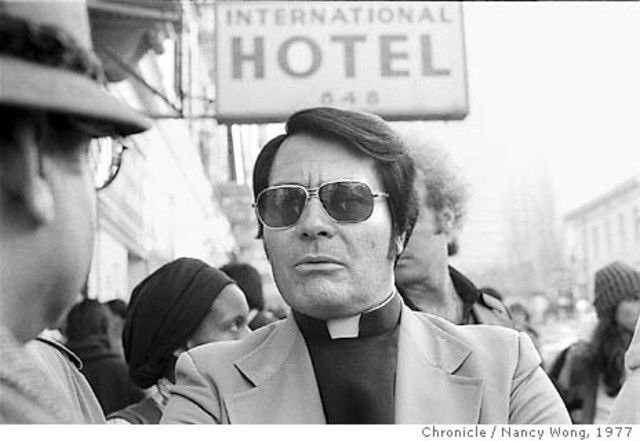
Reverend Jim Jones in front of the International Hotel in San Francisco’s Chinatown on Kearny & Jackson Streets during a rally to save the hotel.
San Francisco Chronicle photo by Nancy Wong, 1977 via Wikimedia Commons.
He broke families, he taught fear, he isolated people, he shamed and demeaned people to break their spirit, he made people dependent, he ran obedience tests with deliberate sadism to see who would take it. That’s it. Those are the tools. Again, all of this comes from Tim Reiterman’s book Raven, which I encourage you to read.
When Jonestown shows up in news stories, Peoples Temple is usually described as a 1970s-era Bay Area cult that moved to Guyana. But that’s not where Jim Jones started the church — he began in Indianapolis in the 1950s. In a moment when there were mostly black churches and white churches, Jones insisted on building a racially integrated congregation. Then he warned them, with increasing urgency, that the church would be attacked by white supremacists who were outraged by their social progress; a flood of menacing phone calls and threatening letters backed up the point. One night, as members of the church visited Jones at home, he stepped into his bedroom alone — just as a brick crashed through the window. The visitors rushed into the bedroom, where Jones told them that the white supremacists had just attacked his house. (Miraculously, the brick and the broken glass had landed outside the window.)
Over the years, the threats built to a crescendo — look, another terrifying letter! — and Jones warned his congregation that the white supremacist threat was moving toward its culmination. At the same time, he began to receive visions about the other great threat hanging over the world: nuclear war. It’s coming, he told them, over and over again, sometimes even naming likely dates for the attack.
Finally, under the increasingly terrifying dual threat of death from local attack or death from Soviet missiles, either of which could happen at any moment, Jones sent an advance party across the country to find a place where his people could survive — and then, with a secure haven located, he led his congregation to safety in a remote area of Northern California. Good thing they made it out, right?
For a congregation of Midwesterners, the journey to California meant a departure from parents, siblings, and adult children; for many, it meant a departure from their birthplace and every social connection they had made outside the church. It put them in the woods a couple thousand miles from their families, in isolation together in a new place.
Then, with church members living in church-built homes on a church-owned property, Jones helped them to see that selfishness was cruel and atavistic. People who loved, who were spiritual, shared together. So what kind of self-involved monster kept a husband or a wife trapped in a limiting one-on-one relationship? Liberating the members of his church, he helped them to start having sex with other church members outside of their marriages. In some instances, particularly close couples with especially stable relationships — like the church attorney Tim Stoen and his wife, Grace — forced Jones to issue direct orders telling them who else they would be having sex with. And yes, it did liberate them from the confinement of their close marriage, quickly and decisively.
Jones also helped by having sex with everybody, teaching them how to become free. One night, Jones had a heart attack — another maneuver he used all the time — in the presence of a church member named Larry Layton; as Layton rushed to help, Jones explained that he needed to fuck Layton’s wife, and had already started, and had brought her to orgasm “no fewer than sixteen or seventeen times” during their first encounter. But no worries, because Jones also assigned another church member, Karen Tow, to have sex with Layton to assuage his pain. After the divorce, Layton and Tow got married — but Tow let Layton know that she still preferred to have sex with Jones. See how liberating this is?

May 9, 2022
Reverend Jim Jones and the Peoples Temple
Chris Bray is reading a book by Tim Reiterman which goes into great detail about the life and career of cult leader and mass murderer Jim Jones:
Reverend Jim Jones in front of the International Hotel in San Francisco’s Chinatown on Kearny & Jackson Streets during a rally to save the hotel.
San Francisco Chronicle photo by Nancy Wong, 1977 via Wikimedia Commons.
In 1971, Jim Jones loaded up some buses in California and took members of his Peoples Temple across the country to Pennsylvania — to Woodmont, the estate of the late spiritual leader Father Divine, who had a much bigger church (and a lot more money) than Jones did.
Reaching Woodmont, Jones tried Plan A, announcing the glorious news that he was the reincarnation of Father Divine and had come to lead his church again, and we might as well just go ahead and put my name on all the bank accounts; the dead leader’s wife suggested, in fairly clear language, that Jones get back on his bus while he could still walk. The delegation from Peoples Temple took the hint. But Jones also executed Plan B, with modest success: He poached some congregants, and drove them across the country to his own church in Ukiah.
Back home, Jones worried that people who had followed Father Divine would struggle to make the transition, feeling more loyalty to their old leader than to their new one. So he showed them that he couldn’t be crossed. One day, as the refugees from Philadelphia sat eating a meal with everyone else in the communal dining room, Jones walked in and caught several of the earlier members of his church being disloyal to him — and so, pointing a finger, he ordered them to die.
They did, immediately. Bodies littered the floor. Jones let the silence linger, standing over the lifeless bodies of the people who had betrayed his trust, the power of death shooting through his fingertips. And then he showed his merciful side: He resurrected them, a choice that allowed the dead to share the horrible feeling of being struck down by the indescribably vast and awesome power of Jim Jones. Terrified, the new members of the church fell into line.
He did this shit all the time. During recruiting trips to rented churches in other cities, visitors had mid-sermon strokes and heart attacks; nurses in the congregation frantically tried to resuscitate them, but announced that it was too late. But no, the Reverend Jones wouldn’t allow death to strike in his own holy church! Rushing forward and shoving the nurses aside, he commanded the dead to ARISE, ARIIIIISSSSEEE yadda yadda whatever. In 1972, a church bulletin proudly announced that Jones had personally resurrected forty dead people so far in just that one year. And here you are feeling proud that you remembered to make the bed this morning.
I take these stories from Raven, a doorstop-thick history of Jones and Peoples Temple written by the journalist Tim Reiterman (with research assistance from a colleague, John Jacobs). Reiterman decided to write about Jones after he was shot at Jonestown, visiting the final Peoples Temple location with the congressional delegation led by Leo Ryan. The research task was made easier by the self-regard the Reverend Jones had felt, because he left behind a giant catalogue of taped sermons and lectures, and a long paper trail of church bulletins and memoranda. The resulting book is an extraordinarily detailed look at every step Jones took along the path to mass murder, starting with the sadistic hucksterism of his strange childhood.


