
Johnny Carson
Published 18 Nov 2022Original Airdate: 01/23/1974
(more…)
March 12, 2023
Jack Benny and Mel Blanc – The Man of a Thousand Voices | Carson Tonight Show
Comments Off on Jack Benny and Mel Blanc – The Man of a Thousand Voices | Carson Tonight Show
February 5, 2023
This 1970s tank simulator drives through a tiny world
Tom Scott
Published 17 Oct 2022At the Swiss Military Museum in Full, there’s the last remaining example of a 1970s tank-driving simulator. But there’s no virtual worlds here: it’s connected to a real camera and a real miniature model. ■ More about the museum: https://www.festungsmuseum.ch/
(more…)
Comments Off on This 1970s tank simulator drives through a tiny world
February 2, 2023
Gerry Rafferty’s “Baker Street” lyrics
When I first subscribed to Ted Gioia’s Honest Broker substack, I figured I’d find one or two posts a month that I found interesting enough to share on the blog … I have to be careful not to link to several of his posts every week. He writes a lot about the music industry, so when this popped up in my inbox, I assumed it was Ted and got to the point of scheduling it before I realized it was Jon Miltimore instead:

I was recently in a bar having dinner with a friend when Gerry Rafferty’s hit 1978 song “Baker Street” came on. When my friend mentioned that he loved the song, I agreed and noted the song’s powerful lyrics.
“Really?” he responded. “I never paid much attention to the lyrics.”
Most people, of course, remember “Baker Street” for its wailing saxophone, and my friend was no different. Nor was I, for many years. But at some point—I don’t know when—I began to pay attention to the song’s lyrics. They go like this:
Winding your way down on Baker Street
Light in your head and dead on your feet
Well, another crazy day
You’ll drink the night away
And forget about everythingThis city desert makes you feel so cold
It’s got so many people, but it’s got no soul
And it’s taken you so long
To find out you were wrong
When you thought it held everythingYou used to think that it was so easy
You used to say that it was so easy
But you’re trying, you’re trying now
Another year and then you’d be happy
Just one more year and then you’d be happy
But you’re crying, you’re crying nowWay down the street there’s a light in his place
He opens the door, he’s got that look on his face
And he asks you where you’ve been
You tell him who you’ve seen
And you talk about anythingHe’s got this dream about buying some land
He’s gonna give up the booze and the one-night stands
And then he’ll settle down
In some quiet little town
And forget about everythingBut you know he’ll always keep moving
You know he’s never gonna stop moving
‘Cause he’s rolling, he’s the rolling stone
And when you wake up, it’s a new morning
The sun is shining, it’s a new morning
And you’re going, you’re going homeThe lyrics — in contrast to the seductive sax and upbeat strings and keyboard — are rather dark. It’s not your typical rock/pop song about finding or losing love.
I’ve never heard “Baker Street” explained, but my take on the song is this: It’s about two lonely people in a city. They find comfort in booze, chemicals, and (occasionally) each other. The relationship is probably dysfunctional, but they are struggling to change. Struggling to grow. Struggling to find meaning.
“Baker Street” peaked at #3 in the UK and held the #2 spot in the U.S. for six consecutive weeks. I think part of the reason the song was such a success is because the lyrics touched on something a little deeper than most rock tunes, something that resonated with audiences. And though the song is 40 years old now, I have a hunch it resonates even more now than it did then.
January 24, 2023
The Vietnam War still has echoes in US politics
In UnHerd, Dominic Sandbrook outlines the end of US involvement in the Vietnam War:
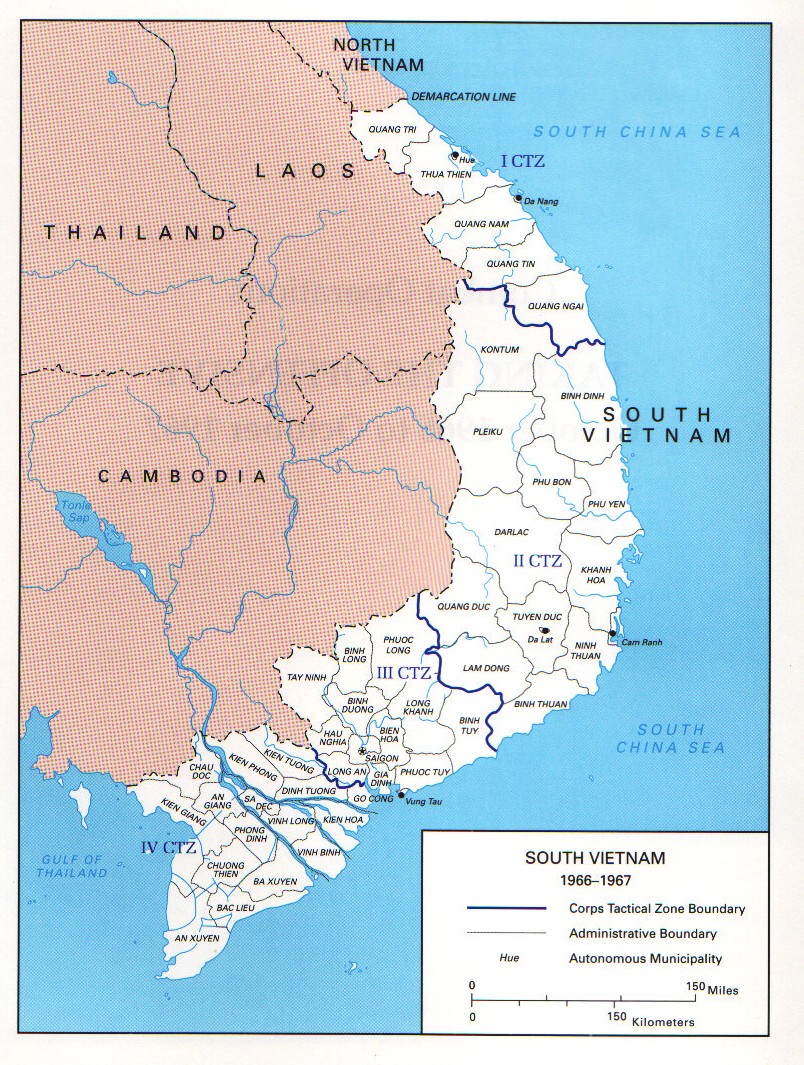
From George L. MacGarrigle, The United States Army in Vietnam: Combat Operations, Taking the Offensive, October 1966-October 1967. Washington DC: Center of Military History, 1998. (Via Wikimedia)
In the course of his troubled presidency, Richard Nixon spoke 14 times to the American people about the war in Vietnam. It was in one of those speeches that he coined the phrase “the silent majority”, while others provoked horror and outrage from those opposed to America’s longest war. But of all these televised addresses, none enjoyed a warmer reaction that the speech Nixon delivered on 23 January 1973, announcing that his Secretary of State, Henry Kissinger, had achieved a breakthrough in the Paris peace talks with the North Vietnamese.
At last, Nixon said, the war was over. At a cost of 58,000 American lives and some $140 billion, not to mention more than two million Vietnamese lives, the curtain was falling. The last US troops would be brought home. South Vietnam had won the right to determine its own future, while the Communist North had pledged to “build a peace of reconciliation”. Despite the high price, Nixon insisted Americans could be proud of “one of the most selfless enterprises in the history of nations”. He had not started the war, but it had dominated his presidency, earning him the undying enmity of those who thought the United States should just get out. But the struggle had been worth it to secure “the right kind of peace, so that those who died and those who suffered would not have died and suffered in vain”. He called it “peace with honour”.
Fifty years on, Nixon’s proclamation of peace with honour has a bitterly ironic ring. As we now know, much of what he said that night was misleading, disingenuous or simply untrue. South Vietnam was in no state to defend itself, and collapsed just two years later. The North Vietnamese had no intention of laying down their weapons, and resumed the offensive within weeks. And Nixon and Kissinger never seriously thought they had secured a lasting peace. They knew the Communists would carry on fighting, and fully intended to intervene with massive aerial power when they did. But then came Watergate. With Nixon crippled, Congress forbade further intervention and slashed funding to the government in Saigon. On 30 April 1975, North Vietnamese tanks crashed through the gates of the presidential palace, and it really was all over.
Half a century later, have the scars of Vietnam really healed? It remains not only America’s longest war but one of its most divisive, comparable only with the Civil War in its incendiary cultural and political impact. The fundamental narrative trajectory of the late Sixties — the turn from shiny space-age Technicolor optimism to strident, embittered, anti-technological gloom — would have been incomprehensible without the daily images of suffering and slaughter on the early evening news. It was Vietnam that destroyed trust in government, in institutions, in order and authority. In 1964, before Lyndon Johnson sent in combat troops after the Gulf of Tonkin incident, fully three-quarters of Americans trusted the federal government. By 1976, a year after the fall of Saigon, not even one in four did so.
It was in the crucible of Vietnam, too, that you can spot many of the tensions that now define American politics. Perhaps the most potent example came in May 1970, after Nixon invaded nominally neutral Cambodia to eliminate the North Vietnamese Army’s jungle sanctuaries. First, on 4 May, four students were shot and killed by the National Guard during a demonstration at Kent State University, Ohio. Then, on 8 May, hundreds more students picketed outside the New York Stock Exchange, only to be attacked by several hundred building workers waving American flags.
The “hard hat riot”, as it became known, was the perfect embodiment of patriotic populist outrage at what Nixon’s vice president, leading bribery enthusiast Spiro Agnew, called “the nattering nabobs of negativism … an effete corps of impudent snobs who characterise themselves as intellectuals”. Today it seems almost predictable, just another episode in the long-running culture wars. But at the time it seemed genuinely shocking. And with his brilliantly ruthless eye for a tactical advantage, Nixon saw its potential. When he invited the construction workers’ leaders to the White House two weeks later, he knew exactly what was doing. “The hard hat will stand as a symbol, along with our great flag,” he said, “for freedom and patriotism and our beloved country”.
Comments Off on The Vietnam War still has echoes in US politics
January 16, 2023
“The Commission has no power to find liability. Its report will not bind the government”
Donna Laframboise continues to cover the Emergencies Act inquiry submissions, including one from Queen’s University law professor Bruce Pardy:

A screenshot from a YouTube video showing the protest in front of Parliament in Ottawa on 30 January, 2022.
Photo via Wikimedia Commons.
Shortly after the Emergencies Act commission finished listening to witnesses, he authored a grim opinion piece in the Toronto Sun.
His expectations are exceedingly low. In his words, the commission’s
mandate is not to rule on the legality of the government’s actions but to inquire into “the circumstances that led to the declaration being issued and the measures taken for dealing with the emergency”. The Commission has no power to find liability. Its report will not bind the government. The Commission is ritual, and the purpose of ritual is performance not outcome – to make it appear that there is accountability without having to provide it. [bold added]
Let us hope he’s mistaken, and that Commissioner Paul Rouleau has a pleasant surprise in store for us. Whatever happens, Pardy’s article provides a useful history lesson. It describes the series of events that prompted the use of similar legislation the last time around:
Between 1963 and 1970, the Front de libération du Québec (FLQ) committed hundreds of bombings and several robberies, killing six people, including Quebec deputy premier Pierre Laporte. In response, Pierre Trudeau’s government invoked the War Measures Act.
Six murders – including the politically motivated kidnapping and execution of a deputy premier. Seven years of violence. Hundreds of bombings. Compare and contrast to the three-week festive, bouncy-castle, hot-tub trucker protest in which not a single person was robbed, bombed, or murdered.
Times sure have changed. Today, the same Canadian federal government that talks constantly about equity, diversity, and inclusion failed to do a single thing to make the protesting truckers feel as though their concerns, perspectives, or lives mattered. Diversity is something the government preaches, but doesn’t practice. Disagree with the Prime Minister and you’re a fringe minority with unacceptable views. Inclusion is a fancy word that makes politicians feel good about themselves, but it isn’t a principle that informs their actual behavour.
Comments Off on “The Commission has no power to find liability. Its report will not bind the government”
December 21, 2022
The rise of David Bowie
In Quillette, David Cohen outlines the career of David Bowie:

With impeccable timing, the thin white stork had dropped David Robert Jones out of London’s skies nearly three-score-and-ten years earlier. The suburban Bromley Boomer fell to Earth on January 8th, 1947, and landed smack in the middle of the bulge years, a wonderfully fertile period for anyone looking to forge a career in recorded music. His first instrument was the saxophone, which he was blowing on by the age of 14. Within a few years, the transistor radio would be ubiquitous, young people would be awash with disposable cash to buy records, and the mass adoption of international air travel would open up new vistas for fans and artists alike. Could any moment have been better suited to a rock-star-in-waiting?
But he also came of age as the youngest child in a doomy household. Three of his maternal aunts suffered from acute mental health issues — one of whom was eventually lobotomized — and the family was riven with more dark secrets than the Tolstoy home. His schizophrenic step-brother, Terry, would spend much of his adult life in psychiatric care. His beloved father dropped dead when Bowie was just 22, while his mother — a children’s home publicist with whom he was emphatically not close — lived on. “Everyone says, ‘Oh yes, my family is quite mad,'” Bowie later recalled. “Mine really is.”
The greatest dream of the era in which Bowie grew up — the promise of putting Man on the Moon — became one of his first signature artistic nightmares. Space Oddity, the most famous track from his eponymous second album, conjured one such scenario, and provided him with his first real hit after the false start of his debut. The earlier album had its moments, but it left unresolved the question of whether the singer wanted to be a fey-voiced Anthony Newley or a strange young man called Dylan.
By the time he recorded his second album — and, especially, his third — Bowie had decided he would be a bit of both. The cover art for 1970’s The Man Who Sold the World presented him elegantly reclining on a chaise longue in a dress. He smoked copious amounts of hash and assembled a crack band for 10 days of whirling Moog synthesizers and hard rock guitars. The experience was so enjoyable and creatively rewarding that bassist Trevor Bolder, guitarist Mick Ronson, and drummer Mick Woodmansey stayed on. The tracks were laid down at a London residence called Haddon Hall, in Beckenham, and it is here that he would write and rehearse the material for his next three albums that would send his career stratospheric.
Commercially, the sex, drugs, and frock ‘n’ roll of The Man Who Sold the World didn’t find much of an audience. It was too heavy, perhaps, for the folk followers he had accrued with its acoustic predecessor. And too gay for rock fans certainly, the singer’s voracious heterosexuality notwithstanding. He followed it a year later with Hunky Dory, which is generally thought to be the record on which the Bowie alchemy first cohered into something truly new. It was also the curtain-raiser for what’s generally regarded as his classic period, and it provided him with his first American hit, “Changes”. More critically, it saw him discard the claustrophobic sound of The Man Who Sold the World for textured melodies, creamy arrangements, seat-of-the-pants lyrics, and further cameos from extraterrestrials.
On Hunky Dory, Bowie also turned in tribute tracks about Lou Reed, Andy Warhol, and Bob Dylan. Warhol hated the song Bowie had written about him. Reed would eventually smack Bowie about the head during an altercation at a London restaurant in April 1979. And when Bowie finally met Dylan, he later told Playboy, they “didn’t have a lot to talk about. We’re not great friends. Actually, I think he hates me.” Small wonder that he preferred the company of spacemen. The razzle-dazzle of “Oh! You Pretty Things” conjures hordes of them. As does “Life on Mars?” which features a chord progression nicked from Frank Sinatra’s “My Way”. The album closes with “The Bewlay Brothers”, in which the 24-year-old singer paid a tribute of sorts to his own step-brother, Terry.
But it was the release of The Rise and Fall of Ziggy Stardust and the Spiders from Mars in 1972 that made David Bowie a superstar. Picking the space songs out of that record is difficult because, by that point, almost everything Bowie was writing seemed to have an explicitly alien streak. During his appearance on Top of the Pops, he draped an arm across Ronson’s shoulders, and glowered out at a world that was about to repay the attention. In the wake of the album’s release, he returned to the United States a sensation (although the stormy flight en route only confirmed his fear of flying).
A generation on, Ziggy Stardust still routinely appears at or near the top of critics’ lists of the all-time greatest rock albums. It is strange to recall then, that in 1972, while it picked up its share of warm reviews, the album was by no means universally well received (the work of a “competent plagiarist”, sniffed Sounds). Some critics never got it. “I always thought all that Ziggy Stardust homo-from-Aldebaran business was a crock of shit,” wrote Lester Bangs in Creem four years later, “especially coming from a guy who wouldn’t even get in a goddam airplane.”
Comments Off on The rise of David Bowie
December 17, 2022
The history of America’s most famous toys
J.J. McCullough
Published 20 Aug 2022The story behind some of America’s most iconic postwar toys, including GI Joe, Play-Doh, Monopoly, and Stretch Armstrong.
(more…)
Comments Off on The history of America’s most famous toys
December 15, 2022
Kraut Space Magic: the H&K G11
Forgotten Weapons
Published 25 Dec 2018I have been waiting for a long time to have a chance to make this video — the Heckler & Koch G11! Specifically, a G11K2, the final version approved for use by the West German Bundeswehr, before being cancelled for political and economic reasons.
The G11 was a combined effort by H&K and Dynamit Nobel to produce a new rifle for the German military with truly new technology. The core of the system was the use of a caseless cartridge developed in the late 60s and early 70s by Dynamit Nobel, which then allowed H&K to design a magnificently complex action which could fire three rounds in a hyper-fast (~2000 rpm) burst and have all three bullets leave the barrel before the weapon moved in recoil.
Remarkably, the idea went through enough development to pass German trials and actually be accepted for service in the late 1980s (after a funding shutdown when it proved incapable of winning NATO cartridge selection trials a decade earlier). However, the reunification with East Germany presented a reduced strategic threat, a new surplus of East German combat rifles (AK74s), and a huge new economic burden to the combined nations and this led to the cancellation of the program. The US Advanced Combat Rifle program gave the G11 one last grasp at a future, but it was not deemed a sufficient improvement in practical use over the M16 platform to justify a replacement of all US weapons in service.
The G11 lives on, however, as an icon of German engineering prowess often referred to as “Kraut Space Magic” (in an entirely complimentary take on the old pejorative). That it could be so complex and yet still run reliably in legitimate military trials is a tremendous feat by H&K’s design engineers, and yet one must consider that the Bundeswehr may just have dodged a bullet when it ended up not actually adopting the rifle.
Many thanks to H&K USA for giving me access to the G11 rifles in their Grey Room for this video!
(more…)
Comments Off on Kraut Space Magic: the H&K G11
QotD: From The Stepford Wives to The Handmaid’s Tale
Hey, did you know The Stepford Wives was published 50 years ago today? Salon does:
Why feminist horror novel The Stepford Wives is still relevant, 50 years on
But before we get to the fisking (I’m running on fumes, y’all; the end of the summer is always the worst time for me), let’s pause for a moment to consider the TV show. You’d think there’d be one, right? Either that, or this is stoyak — The Stepford Wives, coming fall 2022 to Disney Plus. But it doesn’t appear to be. I googled “stepford wives tv show” and got this, which looks trashy enough, but in no way related to the book or movie. There was a remake of the 1970s movie back in 2004, but it bombed.
Odd, no? You’d think that shit would be chick crack — all those Strongk Confidant Wahmens digging into conspiracies and Sticking it to the Man ™. At least, that’s what I thought back in 2004. I thought the casting was dodgy — Kidman was too old (and too glamorous; you really need a pretty-but-not-Hollywood-pretty type) and Matthew Broderick too nebbishy. Nonetheless, I thought the premise would be strong enough to overcome it — oh, you poor, put-upon ladies! But nope.
And then The Handmaid’s Tale happened, as my students would’ve written back in the days, and now I understand why I’m wrong. I should’ve seen it 20 years ago, but better late than never, right? Let’s all have a good laugh at the really obvious thing I missed back in 2004: Strongk, Confidant Wahmens are neither strong nor confident, nor do they want to be either. They want the thinnest veneer of the pretense of the fantasy of those things, delivered to them by a man who comes on like Chad Thundercock, but always somehow has the time to listen to her.
The Handmaid’s Tale, that’s the real chick crack. It’s highbrow bondage porn for the kind of tertiary-educated lady who thinks Fifty Shades of Gray is way too trashy to rent (except, you know, one Girls’ Night with a box of white whine, as a “guilty pleasure”). It gets her all fired up for busting balls at the next partners’ meeting down at the law firm. So empowering!
In The Stepford Wives, book and original movie, the housewives are replaced by robots. The author, Ira Levin, was a guy, and I bet you could tell that just from the one-sentence plot summary. Being replaced by a robot isn’t a “feminist” fear, it’s a male fear. The worry that you’re nothing but a wallet with a criminally underserved dick attached has been pervasive among men since probably the Puritans. It’s a neat trick on Levin’s part, racking up mucho feminist street cred by selling them the #1 male neurosis of the postwar world.
Severian, “SJWs Always Project”, Founding Questions, 2022-08-08.
Comments Off on QotD: From The Stepford Wives to The Handmaid’s Tale
December 11, 2022
Winter of Discontent 2, non-electric boogaloo?
Matt Goodwin sets the stage for Britain’s potential re-run of the “Winter of Discontent”. By chance, I happened to be in England for a few weeks smack-dab in the middle of the worst of that winter, so although I was not following the news at the time, the physical and emotional state of the country struck me very deeply. There certainly are strong similarities between late 1970s Britain and post-pandemic Britain:
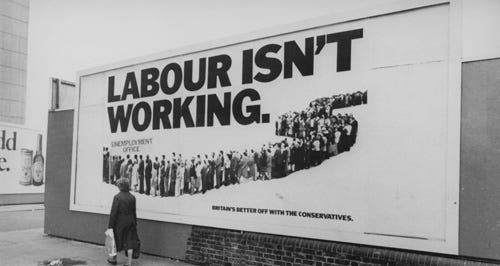
Conservative Party election poster, 1979.
Britain is entering a Winter of Discontent. If you are in the country and plan to take a train, a bus, a flight, a driving test, travel on the highway, send a letter, have a beer, go to school or university, need an ambulance to take you to hospital, need a nurse to look after you while you are in hospital or want to buy a coffin in case things do not go so well while you are in hospital then there is more than a good chance you will be caught up in a wave of strikes that are sweeping across the country.
More than one million working days are about to be lost due to strike action, the largest number since 1989. This is nowhere near the twelve million days that were lost in the original Winter of Discontent, in 1978-9, or the 126 million days lost during the general strike in 1926. But it is more than enough to cause yet another problem for Rishi Sunak and the faltering Conservative Party he is struggling to turn around.
As I pointed out in the Sunday Times last week, while Sunak has stabilised his party it remains deeply unpopular in the country. Even before this winter, voters blame the Tories far more than global events for Britain’s deteriorating economy. One legacy of Partygate and the disastrous experiment with Trussonomics is that Sunak has inherited a party that is now seen by much of the electorate as untrustworthy, serving its own interests, in the hands of a narrow elite and out of touch. Today, not even one in ten voters think the Conservatives “care about ordinary people”.
What options does Sunak have? While he and his team will be tempted to recycle the Thatcher playbook from the original Winter of Discontent, blaming the unions for the strikes and trying to appeal to national unity, this time things are more complicated. For a start, large numbers of voters actually support the strikes, which reduces Sunak’s room for manoeuvre. Second, this time it is the Conservatives not Labour who are in power, and are being blamed just as much as the unions for the unfolding chaos. Every train that is missed, every flight that is cancelled, every hospital patient that is not looked after will entrench the party’s negative image. And, third, as I said during an after dinner talk to clients of a major law firm this week, irrespective of what happens in the weeks ahead research on the impact of major strikes tells a consistent story: they hurt incumbent governments, lowering their support at the next election.
In fact, this might explain why the Rishi recovery already appears to be running out of steam. As I pointed out on Twitter this week, since taking over Sunak has certainly managed to increase his party’s average share of the vote from 23 to 27 per cent while Labour’s average lead in the polls has dropped from thirty to twenty points. And when voters are asked who would make the “best prime minister”, Sunak is much closer to Starmer, trailing him by only 5-points, than Liz Truss ever was, who trailed him by 29-points. But the Conservatives remain a long, long way behind. Just how far behind was underlined by a by-election in Chester this week which saw the party’s vote crash by sixteen points. The last time this happened at a by-election in a Labour-held seat was in the 1990s, shortly before the Blair asteroid almost rendered the Tories extinct.
At a deeper level, however, this winter also looks set to entrench a much deeper mood among the British people which will also undermine the government. The strikes, the chaos, the mounting sense of crisis are all feeding a palpable feeling among voters that nothing really works in Britain anymore, that contrary to the populist mantra of the last decade nobody is in control.
Comments Off on Winter of Discontent 2, non-electric boogaloo?
November 25, 2022
Canada’s all-purpose VTOL transport that could have changed everything; the Canadair CL-84 Dynavert
Polyus Studios
Published 14 Jul 2018The program that developed the CL-84 lasted for almost 20 years and produced one of the most successful VTOL aircraft ever, as far as performance. Canadair produced four Dynavert’s over those 20 years and two of them crashed. In fact one crashed twice. The story of the great CL-84 is one of perseverance and missed potential.
(more…)
Comments Off on Canada’s all-purpose VTOL transport that could have changed everything; the Canadair CL-84 Dynavert
November 6, 2022
QotD: Thatcher and the Falklands
And, even when Mrs Thatcher won her victory, the civilizational cringe of the west was so strong that all the experts immediately urged her to throw it away and reward the Argentine junta for its aggression. “We were prepared to negotiate before” she responded, “but not now. We have lost a lot of blood, and it’s the best blood.” Or as a British sergeant said of the Falklands: “If they’re worth fighting for, then they must be worth keeping.”
Mrs Thatcher thought Britain was worth fighting for, at a time when everyone else assumed decline was inevitable. Some years ago, I found myself standing next to her at dusk in the window of a country house in England’s East Midlands, not far from where she grew up. We stared through the lead diamond mullions at a perfect scene of ancient rural tranquility — lawns, the “ha-ha” (an English horticultural innovation), and the fields and hedgerows beyond, looking much as it would have done half a millennium earlier. Mrs T asked me about my corner of New Hampshire (90 per cent wooded and semi-wilderness) and then said that what she loved about the English countryside was that man had improved on nature: “England’s green and pleasant land” looked better because the English had been there. For anyone with a sense of history’s sweep, the strike-ridden socialist basket case of the British Seventies was not an economic downturn but a stain on national honor.
A generation on, the Thatcher era seems more and more like a magnificent but temporary interlude in a great nation’s bizarre, remorseless self-dissolution. She was right and they were wrong, and because of that they will never forgive her. “I have been waiting for that witch to die for 30 years,” said Julian Styles, 58, who was laid off from his factory job in 1984, when he was 29. “Tonight is party time. I am drinking one drink for every year I’ve been out of work.” And when they call last orders and the final chorus of “Ding Dong! The Witch Is Dead” dies away, who then will he blame?
During the Falklands War, the Prime Minister quoted Shakespeare, from the closing words of King John:
And we shall shock them: naught shall make us rue,
If England to itself do rest but true.For eleven tumultuous years, Margaret Thatcher did shock them. But the deep corrosion of a nation is hard to reverse: England to itself rests anything but true.
Mark Steyn, “The Uncowardly Lioness”, SteynOnline.com, 2019-05-05.
Comments Off on QotD: Thatcher and the Falklands
November 3, 2022
Is the AutoMag Curse Over? The New Auto Mag 180-D
Forgotten Weapons
Published 1 Jul 2022Historically speaking, the AutoMag 180 pistol has been a reaper of investors. Between 1971 and 1982, no fewer than six different companies went bankrupt trying to make a profit building Auto Mags. However, we may have finally reached the end of that streak …
In 2015, all the existing tools, parts, and IP related to the Auto Mag was sold to a new company (Auto Mag Ltd). Similar to the previous companies lured in by the glamour of this massive handgun, these new owners saw the list of existing parts (including several hundred frames) and figured they could assemble and sell a few hundred guns and make a nice return. Also similar to previous companies, they completed the deal and then discovered that those existing parts had major problems. Fundamentally, the Model 180 was simply not a mature design.
Where the new company has taken a new path is that they have spent the past 7 years reengineering the whole gun to fix its shortcomings. They have made a couple dozen design changes, although without changing anything fundamental in the appearance or operating principles of the gun. They have done things like lighten the firing pin, strengthen the locking lugs, tweak the magazine geometry, and so on — the changes that should have been make back in 1971 before the first example was ever shipped.
I came into this review with pretty low expectations — so many people have tried and failed to make a proper Automag that I really didn’t think Auto Mag Ltd would be able to pull it off. And yet to my happy surprise, it seems that they actually have. The gun ran flawlessly for me and was actually a lot of fun to shoot.
(more…)
Comments Off on Is the AutoMag Curse Over? The New Auto Mag 180-D
October 30, 2022
Jatimatic: Finland’s Least Successful PDW
Forgotten Weapons
Published 24 Jun 2022The Jatimatic was a stockless PDW designed by Jari Timari, who co-owned Tampereen Asepaja Oy, a firearms company in Tampere Finland. The firm was founded in the early 1920s, making .22 biathlon rifles, sporterizing military surplus, and other gunsmithing work. In the late 70s he got the idea for a compact 9mm PDW with some unique climb-reducing features, and in 1980 it was introduced as the Jatimatic (JAli TImari). Only about 400 were made, as it was not adopted or purchased in large quantities by anyone (although it was tested by many, including the Finnish Border Guards).
The Jatimatic was made without a stock, instead using a shooting sling for stabilization. It used standard Swedish K magazines, and has a distinctly off-angle appearance. This was done to counteract muzzle climb, as the line of the barrel points directly back into the shooter’s hand. It also has an interesting safety built into the folding front grip – if the grip is closed, the bolt is locked in place.
Production ended in the late 1980s after “permit irregularities” and a robbery of a bunch of Jatimatics from the company premises. The rights to the design were sold to a new company called Golden Gun in 1994, and they attempted to reintroduce it as the GG-95 with a few improvements, but it was a rather complete flop. Its best achievement was getting into several major movies, including Cobra and Red Dawn.
(more…)
Comments Off on Jatimatic: Finland’s Least Successful PDW
QotD: Thatcher’s legacy
Nevertheless, she won. In Britain in the Seventies, everything that could be nationalized had been nationalized, into a phalanx of lumpen government monopolies all flying the moth-eaten flag: British Steel, British Coal, British Airways, British Rail … The government owned every industry — or, if you prefer, “the British people” owned every industry. And, as a consequence, the unions owned the British people. The top income-tax rate was 83 per cent, and on investment income 98 per cent. No electorally viable politician now thinks the government should run airlines and car plants, and that workers should live their entire lives in government housing. But what seems obviously ridiculous to all in 2013 was the bipartisan consensus four decades ago, and it required extraordinary political will for one woman to drag her own party, then the nation, and subsequently much of the rest of the world back from the cliff edge.
Thatcherite denationalization was the first thing Eastern Europe did after throwing off its Communist shackles — although the fact that recovering Soviet client states found such a natural twelve-step program at Westminster testifies to how far gone Britain was. She was the most consequential woman on the world stage since Catherine the Great, and the United Kingdom’s most important peacetime prime minister. In 1979, Britain was not at war, but as much as in 1940 faced an existential threat.
Mark Steyn, “The Uncowardly Lioness”, SteynOnline.com, 2019-05-05.
Comments Off on QotD: Thatcher’s legacy


