Forgotten Weapons
Published 9 Aug 2016http://www.patreon.com/ForgottenWeapons
The French FAMAS was one of the first bullpup rifles to be adopted and built in large numbers by a military power. It was adopted by France in 1978 at right about the same time as the Steyr AUG was being adopted by the Austrian military. Bullpup rifles offered a short overall length without sacrificing barrel length, an advantage that seemed quite valuable for troops who were to spend significant amounts of time in vehicles, where space is at a premium. In French service, the FAMAS was also made the formal replacement for both the MAS-49/56 rifle and the MAT-49 submachine gun, thanks to its compact nature.
The FAMAS is interesting mechanically, as it is one of very few production delayed-blowback rifle designs (the other common one being the CETME/HK series). The FAMAS uses a lever-delaying system, which allows a very simple bolt and action mechanism. The F1 model (adopted by the French Army and still in use today, making up the bulk of FAMAS production) has a 1:12″ twist to its rifling, effectively limiting it to 55 grain projectiles — and it also requires steel-cased ammunition to run reliably. The G2 variant (adopted in 1995 by the French Navy) changed to a 1:9″ twist, introduced a full-hand trigger guard, and also uses NATO standard AR15 magazines instead of the proprietary 25-round magazine of the F1.
In the late 1980s a small number of semiauto FAMAS rifles were made by St Etienne and imported into the US by Century. Most people say 100-125 rifles, although serial number suggest this may have actually been 225-250 rifles. Regardless, they are quite scarce and expensive today.
October 19, 2021
Semiauto FAMAS F1 Rifle
October 3, 2021
The Triumph Spitfire Story
Big Car old account
Published 8 Mar 2019To help me continue producing great content, please consider supporting me: https://www.patreon.com/bigcar
Help support my channel through these Amazon US affiliate links:
Triumph Spitfire t-shirt: https://amzn.to/2KdY33m
Triumph Spitfire baseball cap: https://amzn.to/2U1SrZF
Triumph sweatshirt: https://amzn.to/2KgGIXq
Triumph Spitfire model car: https://amzn.to/2U4gnvo
Triumph keyfob: https://amzn.to/2YTeKV4
Triumph Spitfire metal sign: https://amzn.to/2U2u4ejThe Spitfire is a beautiful automobile, a thing of wonder penned by an Italian genius, but it almost never happened. If not for a chance find in the dusty corner of a factory it would have remained merely a “could have been”. But Triumph produced a car that still inspires new creations today and has a strong and loyal fan base around the world, nearly sixty years since it burst on the scene.
#TriumphSpitfire
August 25, 2021
Tanks Chats #121 | The Cascavel | The Tank Museum
The Tank Museum
Published 2 Apr 2021The Tank Museum’s Curator David Willey presents a Tank Chat on the EE-9 Cascavel, a Brazilian Armoured Car developed during the 1970s, primarily for reconnaissance. David also touches upon the EE-11 Urutu, which shares many of the Cascavel’s components. Join him to find out more.
(more…)
August 5, 2021
Gordon Ingram’s Westarm .308 Battle Rifle
Forgotten Weapons
Published 2 Apr 2021http://www.patreon.com/ForgottenWeapons
https://www.floatplane.com/channel/Fo…
Cool Forgotten Weapons merch! http://shop.bbtv.com/collections/forg…
In the late 1970s and early 80s, Gordon Ingram came close to producing a military rifle in one of the most convoluted international arrangements I’ve yet heard of. Prototypes were made in Italy using British raw castings, to be tested in Somalia as part of a project to build a rifle factory there with Dominican Republic expertise from the San Cristobal armory. Somalia actually ordered a large quantity of rifles in 7.62x39mm, but Ingram prototyped the design in .223 and .308 as well.
Mechanically, the rifle was essentially a scaled-up M1 Carbine with a long stroke gas piston instead of a gas tappet. The production guns were select-fire, but the handful or prototypes brought into the US were semi-automatic only, to meet import requirements. In .308, the rifle used FAL magazines, while the .223 ones used AR magazines and the 7.62x39mm ones AK magazines.
Unfortunately for Ingram (but predictably), the project fell apart as the result of financial corruption among the many interested parties. The Somali government ended up paying out something like $5 million US and all they got for it were 10 unreliable prototype rifles.
Contact:
Forgotten Weapons
6281 N. Oracle 36270
Tucson, AZ 85740
July 29, 2021
QotD: An opera called Margaret
Margaret Thatcher had a great deal of time for Andrew Lloyd Webber. In August 1978, while she was still Leader of the Opposition, her speechwriter Ronnie Millar took her to see Evita. “It was a strangely wondrous evening yesterday leaving so much to think about,” she wrote to Millar the next day. “I still find myself rather disturbed by it. But if they [the Peronists] can do that without any ideals, then if we apply the same perfection and creativeness to our message, we should provide quite good historic material for an opera called Margaret in thirty years’ time!”
Dominic Sandbrook, The Great British Dream Factory, 2015.
July 6, 2021
QotD: Generational dislocation
The first generation to experience a cultural innovation, and almost every generation is the first to experience something, usually takes it hard. There is no parental wisdom on offer. There is no “oral culture” that records the misadventures of the previous generation. There is only a new imperative that has to be satisfied. (Personally, I believe this is the only way to explain the disco clothing innovations of the 1970s.)
Grant McCracken, “Gender Watch”, This Blog Sits at the, 2005-03-24.
Update: Link had rotted since I first posted this on the old blog. The link has been updated to the current location. H/T to WarEagle82 for calling this to my attention.
June 18, 2021
Feeding “the masses”
Sarah Hoyt looked at the perennial question “Dude, where’s my (flying) car?” and the even more relevant to most women “Where’s my automated house?”:
The cry of my generation, for years now, has been: “Dude, where’s my flying car?”
My friend Jeff Greason is fond of explaining that as an engineering problem, a flying car is no issue at all. It is as a legal problem that flying cars get interesting, because of course the FAA won’t let such a thing exist without clutching it madly and distorting it with its hands made of bureaucracy and crazy. (Okay, he doesn’t put it that way, but I do.)
[…]
But in all this, I have to say: Dude, where’s my automated house?
It was fifteen years ago or so, while out at lunch with an older writer friend, that she said “We always thought that when it came to this time, there would be communal lunch rooms and cafeterias that would do all the cooking so women would be free to work.”
I didn’t say anything. I knew our politics weren’t congruent, but really the only societies that managed that “Cafeterias, where everyone eats” were the most totalitarian ones, and that food was nothing you wanted to eat. If there was food. Because the only way to feed everyone industrial style is to take away their right to choose how to feed themselves and what to eat. And that, over an entire nation, would be a nightmare. Consider the eighties, when the funny critters decided that we should all live on a Russian Peasant diet of carbs, carbs and more carbs. Potatoes were healthy and good for you, and you should live on them.
It will surprise you to know – not — that just as with the mask idiocy, no study of any kind supports feeding the population on mostly vegetables, much less starches. What those whole “recommendations” were based on was “diet for a small planet” and the bureaucrats invincible ignorance, stupidity and assumption of their own intelligence and superiority. I.e. most of what they knew — that population was exploding, that people would soon be starving, that growing vegetables is less taxing on the environment and produces more calories than growing animals to eat — just wasn’t so. But they “knew” and by gum were going to force everyone to follow “the plan”. (BTW one of the ways you know that Q-Anon is in fact a black ops operation from the other side; no one on the right in this country trusts a plan, much less one that can’t be shared or discussed.) Then the complete idiots were shocked, surprised, nay, astonished when their proposed diet led to an “epidemic of obesity” and diabetes. Even though anyone who suffered through the peasant diet in communist countries, could have told the that’s where it would lead, and to both obesity and Mal-nutrition at once.
So, yeah, communal cafeterias are not a solution to anything.
My concern about the “automated house of the future” is nicely prefigured by the “wonders” of Big Tech surveillance devices we’ve voluntarily imported into our homes for the convenience, while awarding untold volumes of free data for the tech firms to market. Plus, the mindset that “you must be online at all times” that many/most of these devices require means you’re out of luck if your internet connection is a bit wobbly (looking at you, Rogers).
June 16, 2021
QotD: The Shah of Iran
The Shah that emerges from these pages would be almost a tragic figure, if they gave us a better feel for him as a person, that is to say as a living being rather than a mere policy-maker. He was by nature a vacillator, thrust by inheritance and a destiny beyond his control into a position in which vacillation would eventually prove fatal. In addition to self-doubt, however, he was also inclined to vainglory, oscillating between the two, retreating from crises and ostentatiously parading himself, and boasting, when things seemed to be going well. He thought that he had both the right and the duty, genuinely for the sake of his country, to rule rather than reign, but while he had the ideas of an autocrat, he also had those of an ordinary decent person who baulked at the shedding of much blood, the only way, in the end, that he could have preserved his throne (and possibly not even then).
He was intelligent and wily, and his achievements were not negligible. He managed to wrest control of Iran’s oil first from the British and then from the international oil consortium that succeeded them. He played the oil market with great skill. He instituted an important land reform that genuinely benefitted the peasantry, expanded education, and had a full understanding of the importance of technology in the modernization of Iran necessary if it were to be anything other than a dependent state. His foreign policy was flexible, pragmatic, and shrewd. He needed the Americans but did not trust them (or anybody else, for that matter), realising that in politics there were no friendships, only common interests. This was to be borne out in the most terrible and tragic way during his last few years of exile, with which this book does not deal. Where there is no friendship, there is no gratitude for services rendered.
His failures were at least as great as his successes, and in the end more important from the point of view of his personal destiny. He so hollowed out political life in Iran, in order to exercise power as a true autocrat, that it came to have two poles: sycophancy and plotting against him. Sycophancy is a terribly addictive drug, no doubt a permanent temptation of the powerful (and therefore a good reason to restrict political terms of office); you can never have enough of it, nor can it ever be outrageous enough.
Unfortunately for the Shah, no one is sycophantic from principle, indeed sycophants tend (rightly) to despise themselves, fully aware that they are acting from the most naked of self-interest. There is no rat that leaves a sinking ship faster than a sycophant deserting a lost cause. A sycophant will take a risk to preserve his skin, but not to preserve his master.
Theodore Dalrymple, “Downfall of the House of Pahlavi”, The Iconoclast, 2021-03-03.
June 10, 2021
The odd history of Irish Cream as we make Irish Cream hard candy at Lofty Pursuits
Lofty Pursuits
Published 25 Feb 2021Jake makes Irish Cream green shamrock hard candy for St. Patrick’s day. We discuss the history of the weird flavor and how it has become a tradition even though it was invented in the 1970’s
A great article about the history of Irish Cream
https://www.irishtimes.com/culture/bo…Buy our candy: http://www.pd.net
Listen to our podcast: http://loftypursuits.libsyn.com/website
Join our Patreon at https://www.patreon.com/LoftyPursuits
June 7, 2021
Dude, where’s my (flying) car?
The latest of the reader-contributed book reviews at Scott Alexander’s Astral Codex Ten looks at Where is my Flying Car? by J. Storrs Hall:
What went wrong in the 1970s? Since then, growth and productivity have slowed, average wages are stagnant, visible progress in the world of “atoms” has practically stopped — the Great Stagnation. About the only thing that has gone well are computers. How is it that we went from the typewriter to the smartphone, but we’re still using practically the same cars and airplanes?
Where is my Flying Car? by J. Storrs Hall, is an attempt to answer that question. His answer is: the Great Stagnation was caused by energy usage flatlining, which was caused by our failure to switch to nuclear energy, which was caused by excessive regulation, which was caused by “green fundamentalism”.
Three hundred years ago, we burned wood for energy. Then there was coal and the steam engine, which gave us the Industrial Revolution. Then there was oil and gas, giving us cars and airplanes. Then there should have been nuclear fission and nanotech, letting you fit a lifetime’s worth of energy in your pocket. Instead, we still drive much the same cars and airplanes, and climate change threatens to boil the Earth.
I initially thought the title was a metaphor — the “flying car” as a standin for all the missing technological progress in the world of “atoms” — but in fact much of the book is devoted to the particular question of flying cars. So look at the issue from the lens of transportation:
Hans Rosling was a world health economist and an indefatigable campaigner for a deeper understanding of the world’s state of development. He is famous for his TED talks and the Gapminder web site. He classifies the wealthiness of the world’s population into four levels:
1. Barefoot. Unable even to afford shoes, they must walk everywhere they go. Income $1 per day. One billion people are at Level 1.
2. Bicycle (and shoes). The $4 per day they make doesn’t sound like much to you and me but it is a huge step up from Level 1. There are three billion people at level 2.
3. The two billion people at Level 3 make $16 a day; a motorbike is within their reach.
4. At $64 per day, the one billion people at Level 4 own a car.
The miracle of the Industrial Revolution is now easily stated: In 1800, 85% of the world’s population was at Level 1. Today, only 9% is. Over the past half century, the bulk of humanity moved up out of Level 1 to erase the rich-poor gap and make the world wealth distribution roughly bell-shaped. The average American moved from Level 2 in 1800, to level 3 in 1900, to Level 4 in 2000. We can state the Great Stagnation story nearly as simply: There is no level 5.
Level 5, in transportation, is a flying car. Flying cars are to airplanes as cars are to trains. Airplanes are fast, but getting to the airport, waiting for your flight, and getting to your final destination is a big hassle. Imagine if you had to bike to a train station to get anywhere (not such a leap of imagination for me in New York City! But it wouldn’t work in the suburbs). What if you had one vehicle that could drive on the road and fly in the sky at hundreds of miles an hour?
Before reading this book, I thought flying cars were just technologically infeasible, because flying takes too much energy. But Hall says we can and have built them ever since the 1930s. They got interrupted by the Great Depression (people were too poor to buy private airplanes), then WWII (airplanes were directed towards the war effort, not the market), then regulation mostly killed the private aviation industry. But technical feasibility was never the problem.
Hall spends a huge fraction of the book on pretty detailed technical discussion of flying cars. For example: the key technical issue is takeoff and landing, and there is a tough tradeoff between convenient takeoff/landing and airspeed (and cost, and ease of operation). It’s interesting reading. But let’s return to the larger issue of nuclear power.
May 31, 2021
The History of HSTs in the West
Ruairidh MacVeigh
Published 29 May 2021Hello again! 😀
With the recent withdrawal of the last HST operations into London, I wanted to make a series of videos chronicling the history of these mighty trains in terms of their years of each region they were assigned to, the Great Western, East Coast, Midland, West Coast and Cross Country Routes.
With that in mind, we start with the first of the BR Regions to employ the venerable HST, but also the first to withdraw them from long distance services, the Great Western, a line that, since its inception under the auspices of Brunel, has played host to many different types of trains, but none have had greater impact that the superb HSTs.
All video content and images in this production have been provided with permission wherever possible. While I endeavour to ensure that all accreditations properly name the original creator, some of my sources do not list them as they are usually provided by other, unrelated YouTubers. Therefore, if I have mistakenly put the accreditation of “Unknown”, and you are aware of the original creator, please send me a personal message at my Gmail (this is more effective than comments as I am often unable to read all of them): rorymacveigh@gmail.com
The views and opinions expressed in this video are my personal appraisal and are not the views and opinions of any of these individuals or bodies who have kindly supplied me with footage and images.
If you enjoyed this video, why not leave a like, and consider subscribing for more great content coming soon.
Thanks again, everyone, and enjoy! 😀
References:
– 125Group (and their respective sources)
– Wikipedia (and its respective references)
May 20, 2021
Men Will Be Boys (1970)
British Pathé
Published 13 Apr 2014Men will be boys. Various locations.
M/S men round lake with boats. C/U man in lake with waders with model boat. C/U another man with model boat. Man lighting boiler. C/U engine working. M/S as model of paddle boat moves through water. M/S paddle boat on water. In foreground a swan. C/U another model boat going through water. M/S pan scale model of Hitler’s yacht. M/S men playing with model cars on race track. C/U cars going round race track. C/U men’s hands on controls. C/U men looking at cars go past. L/S of cars going round race track.
L/S men playing war games with model soldiers. on large table. C/U as man moves soldiers out of line laying them on ground. M/S man moves horses forward. C/U hand placing cannon into position. C/U hand places horse troops in position. M/S lines of soldier. Hand places another in position. M/S of troops being moved.
M/S Mr Victor Martin and wife go through gate by railway crossing dressed up in their uniforms, carrying lamps etc. M/S as they make their way to their signal boxes. C/U railway notice ‘By Midland Railway’. Pa off notice to show Mr Martin approaching his signal box. M/S Martin going into signal box. M/S Mrs Martin going into signal box. C/U Mrs Martin going into signal box. C/U interior. Mr Martin hanging up his jacket inside signal box. He then sits at the controls. C/U signal controls working. C/U of Mr Martin operating signals. Camera zooms back and we see train going past him along track. C/U model train over track. C/U Mrs Martin working in her signal box.
M/S Mrs Martin working signal controls. C/U Mrs Martin. M/S showing trains going over track. C/U trains moving. Camera zooms out to show tracks . C/U trains moving. C/U looking along tunnel showing trains moving. C/U exterior. Signals working. Then camera pans to show where the trains run on an enclosed section out in the open. C/U goods train and passenger train moving. M/S Interior. Trains going over track and Mr Martin at controls.
FILM ID:2241.18A VIDEO FROM BRITISH PATHÉ. EXPLORE OUR ONLINE CHANNEL, BRITISH PATHÉ TV. IT’S FULL OF GREAT DOCUMENTARIES, FASCINATING INTERVIEWS, AND CLASSIC MOVIES. http://www.britishpathe.tv/
FOR LICENSING ENQUIRIES VISIT http://www.britishpathe.com/
British Pathé also represents the Reuters historical collection, which includes more than 136,000 items from the news agencies Gaumont Graphic (1910-1932), Empire News Bulletin (1926-1930), British Paramount (1931-1957), and Gaumont British (1934-1959), as well as Visnews content from 1957 to the end of 1984. All footage can be viewed on the British Pathé website. https://www.britishpathe.com/
May 17, 2021
An older BBC dramatization on the slave trade that seems to have gone down the memory hole
At Samizdata, Niall Kilmartin wondered why the BBC hadn’t gotten around to showing a 1970s historical series through the year-and-more of the pandemic lockdowns. He doesn’t mention the name of the series, and an unusually unhelpful BBC site search didn’t turn up a name but IMDB suggests it was 1975 and the series was called The Fight Against Slavery:
Fifty years ago, the BBC screened a dramatised documentary series about the fight to abolish the slave trade. Even a year of the virus limiting new series, at a time of great BBC eagerness to talk about racism, has not made them screen it again.
– I see one reason why they have not: the series displayed sleazy white slave traders and abusive white slave owners prominently, but it also showed white people eager to end the slave trade and (much worse) black people eager to continue it. It included the king of Dahomey’s threat: “if you do not allow me to sell you my slaves, their fate will be a great deal worse” (a very brief scene of the Dahomey murder spectacle lent meaning to his remark). After abolition was voted, it showed a white slave trader assuring the Dahomans, as a drug dealer might his suppliers, “It is one thing for parliament to pass a law …”, hinting at the Royal Navy’s long and hard campaign to enforce it.
– Only recently did I spot another reason why they would not want to show it again – the scene in which a corrupt old white slave trader warns his young colleague that “it’s more than your life’s worth” to doubt the ability of their slave-selling hosts to count very accurately the quantity of trade goods being handed over in exchange, and to assess their quality knowledgeably. The traders well knew that Africans counted two plus two as four, just as they did. Any trader who imagined that black ability to add diverged enough from white to enable an attempt to short-change them had learned otherwise long before the 1780s.
– The southern Confederacy thought the same. Until its death throes, it forbade enlisting a southern black as a Confederate soldier because, as one Confederate senator put it, “If blacks can make good soldiers then our whole theory of slavery is wrong.” (Perhaps also because even southern white Democrats realised that southern black desire to fight against blacks being freed was likely to be a very minority taste.) But there was one exception. Every regiment had its regimental band, which played to set the pace at the start and end of marches, used trumpets to signal commands in battle – and fought when other duties did not supervene. From its start to its end, Confederate law said any black could enlist as bandsman, with the same pay and perquisites as a white – a very rare example of formal legal equality. (Playing music requires the ability to count time. For the woke, “dismantling the legacy of the Confederacy” apparently includes dismantling its realisation – shared by the Victorian composer Dvorak – that blacks often excelled in music so much as to overcome prejudice against black ability. Today, it’s “racist” to value instrumental skill.)
“Politically correct” has meant “actually wrong” ever since the first commissar explained to the first party comrade that it was neither socialist nor prudent to notice a factual error in the party line. “Structurally racist” is PC’s modern companion. No longer are the woke content merely to imply (“mathematics is racist”, “punctuality is racist”, “politeness is racist”) that blacks can’t count, can’t tell the time and can only behave crudely. They’re starting to say it in words of fewer syllables.
If I’d scrolled down to the comments, I’d have discovered that Natalie Solent had also dug up the name of the series:
Natalie Solent (Essex)
May 10, 2021 at 4:30 pm
Outstanding post, Niall. Was the BBC series you mentioned “The Fight Against Slavery“, written and narrated by Evan Jones? I have not seen it – given that I was ten or eleven in 1975 my parents probably thought I was too young too see it.However someone called “InternetPilgrim” has put up three videos of the series on YouTube. There is a link to Part I here, Part II here and Part III here, so I will try to remedy that lack soon.
April 14, 2021
Tank Chat #103 | Laird Centaur | The Tank Museum
The Tank Museum
Published 15 May 2020David Fletcher looks at this curiosity from the 1970’s, a Land Rover with tracks. Currently housed in The Tank Museum’s Vehicle Conservation Centre.
Support the work of The Tank Museum on Patreon: ► https://www.patreon.com/tankmuseum
Visit The Tank Museum SHOP & become a Friend: ► tankmuseumshop.orgTwitter: ► https://twitter.com/TankMuseum
Instagram: ► https://www.instagram.com/tankmuseum/
Tiger Tank Blog: ► http://blog.tiger-tank.com/
Tank 100 First World War Centenary Blog: ► http://tank100.com/
#tankmuseum #tanks
March 25, 2021
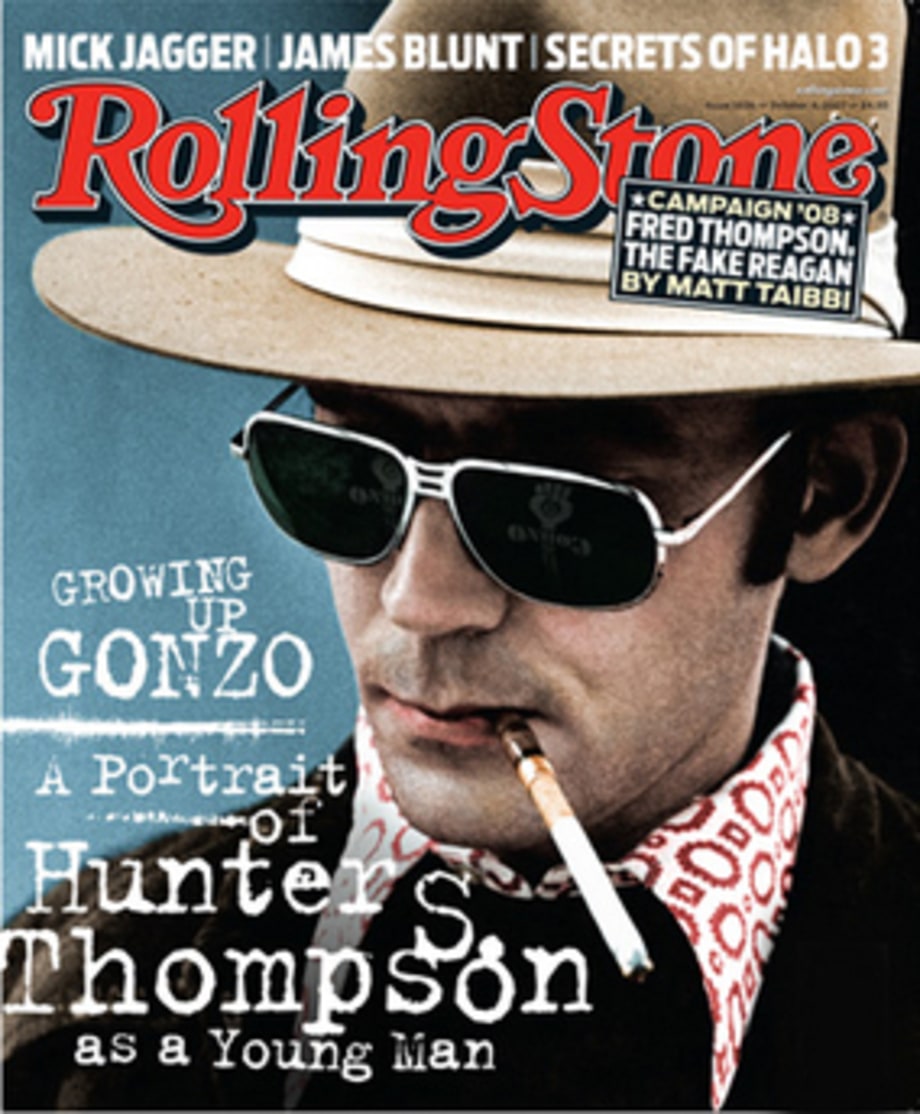
Hunter S. Thompson’s Fear and Loathing in Las Vegas
I first read Thompson’s Fear and Loathing in the late 1970s and being as callow and inexperienced as most teenagers, I took it for a mostly factual exploit (along with many older readers who didn’t have my excuse for gullibility). I passed the book on to one of my friends who became mildly obsessed with “Raoul Duke” and the adventures recounted in the book. I’ve long since lost touch with him, but I’m sure he’d be horribly disappointed to discover that Thompson probably imagined 90% of it:
We were somewhere around Barstow on the edge of the desert when the drugs began to take hold. I remember saying something like “I feel a bit lightheaded; maybe you should drive …” And suddenly there was a terrible roar all around us and the sky was full of what looked like huge bats, all swooping and screeching and diving around the car, which was going about a hundred miles an hour with the top down to Las Vegas.
From the outset, Fear and Loathing in Las Vegas is an outrageous and darkly amusing tale of two crazed men turned loose in the world’s capital of decadence. Raoul Duke and Doctor Gonzo, clearly based upon Thompson and Acosta, are carrying a veritable pharmacopoeia in the trunk of their rented car, and throughout the novel they abuse a litany of substances as they stumble through casinos, bars, and hotels terrorising staff and patrons alike. Though Duke and Gonzo are, like the real Thompson and Acosta, tasked with covering the Mint 400, their assignment is quickly lost in the carnage. Near the end of the book, Duke admits he “didn’t even know who’d won the race.”
If you are unfamiliar with Thompson’s work, you may wonder why it matters that their efforts to complete a minor assignment ended in failure. Authors like Ernest Hemingway had mined their journalistic experience for material to incorporate into their fiction, so it is hardly unusual that Thompson would find inspiration for a novel whilst covering the Mint 400. But his approach with this book went beyond mere inspiration. Throughout Fear and Loathing, reality and imagination are blurred to the extent that no one really has much idea of what really happened on their trip.
[…]
In this letter, he made the startling confession that Fear and Loathing had not merely exaggerated the debauchery that took place in Vegas, but that there had in fact been no drugs at all. Could this really be true? Was the most notorious drug book of its era really inspired by a drug-free journey?
Before we can answer that, it is important to note the chronology of events on which the book was based. Whilst the book portrays the two men tearing apart hotels and casinos over a period of several days, there were in fact two distinct trips. First, they went to cover the Mint 400 on Mach 21st–23rd, then they returned for the National District Attorneys’ Conference on Narcotics and Dangerous Drugs on April 25th–29th. Thompson simply rolled the two events together into a single narrative. The evidence suggests that, during the first trip, Thompson and Acosta drank heavily and perhaps smoked a little pot, but certainly did no serious drug-taking. The famed pharmacopeia in the trunk of their convertible was fictitious:
The trunk of the car looked like a mobile police narcotics lab. We had two bags of grass, seventy-five pellets of mescaline, five sheets of high-powered blotter acid, a salt shaker half full of cocaine, and a whole galaxy of multi-colored uppers, downers, screamers, laughers … and also a quart of tequila, a quart of rum, a case of Budweiser, a pint of raw ether and two dozen amyls.
As tempting as it is to believe that this existed, it was a product of Thompson’s prodigious imagination. He was, however, keen to keep his readers in the dark, hence his letter to Silberman and the inclusion of his photo on the back cover. Since childhood, he had been obsessed with appearing as an outlaw, yet real outlaws never explicitly said that’s what they were. They merely hinted at it.
Of course, Thompson’s “drug-diet” did consist of various illegal substances, which made his descriptions of their effects rather convincing, but not only did he remain mostly drug-free in Vegas, he also wrote the novel with little more than beer and tobacco in his system. Back home in Colorado, he polished his story carefully through many drafts. The result was a far more intelligent and coherent work than almost anything else he published.
It was only during the second of the two trips that they began to consume drugs, but even then their indulgence was mild when compared with Duke and Gonzo’s extravagant excesses. They had marijuana, a few pills, and possibly some mescaline, but nothing else. His descriptions of LSD came from experiments several years earlier, the parts about adrenochrome were entirely fabricated, and — surprisingly — Thompson had not yet tried cocaine by 1971.