
Officer Frenly (High IQ) @FrenlyOfficer
The most hated character from Harry Potter is not Voldemort. It’s not Bellatrix. Not even Draco.It’s Umbridge.
Ask yourself why.

Simple.
Umbridge does one thing the main villain doesn’t do, that none of the other villains do.
She pretends to be on the heroes’ side. And prevents them from defending themselves.
This is how the human mind evolved. Foemen, tribal enemies who oppose us on the field of battle, provoke our fear, anger, even hatred. But traitors provoke our contempt and disgust.
We instinctively know that a disloyal friend is worse than an enemy.
Against an enemy, we can defend ourselves, and our tribe will support us. Oppose the traitor, and she will cry that she is an innocent victim, and we are the evil ones.
The traitor not only betrays her own tribe, she turns her tribe against each other.
But it’s worse than that. The enmity between this tribe and that, between lion and zebra, between farmer and rat, is dictated by opposing interests, by incompatible needs.
Our cruelty to the foe is forced upon us. It is the indifference of the universe, manifesting its conclusion through us. It’s adaptation, not sadism.
The traitor isn’t like that. She didn’t have to do it. She could have supported the tribe, and everyone, including her, would have been fine.
The traitor didn’t have her path forced on her. She chose it out of spite, or for gain.
Traitors are worse. So we hate them more.
Devon Eriksen, The social media site formerly known as Twitter, 2025-11-28.
March 11, 2026
QotD: Traitors are worse than open enemies so we hate them more

March 10, 2026
Rolling toward disaster – North America’s trucking industry
Donna Laframboise reviews a new memoir by Gord Magill, recounting his career in trucking in Canada, the United States, Australia and New Zealand:
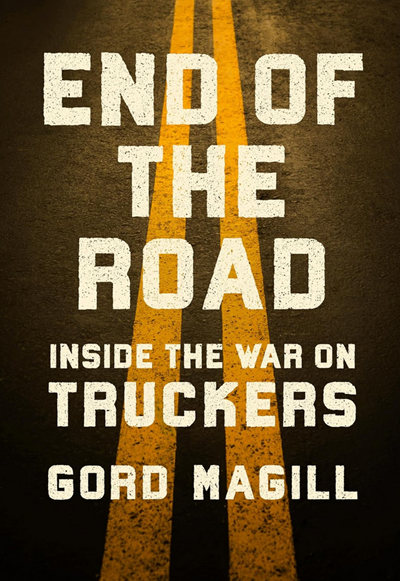
… Gord has written a splendid book that belongs on Economics 101 reading lists everywhere. End of the Road: Inside the War on Truckers is chock-a-block with firsthand anecdotes. He tells us, for example, about traveling north into Canada from New York state during the 2022 Freedom Convoy protest, and feeling “drunk with patriotism, in love with every person I met, and they were in love with me”. After returning to his wife and daughters south of the border, he says he’d “never seen so many Canadian flags flying in the United States. It was unbelievable.” For a short time, “I was a minor celebrity simply for being from Canada”.
But this book is more than a collection of quirky tales about life behind the wheel. It’s a deep dive into shark-infested waters. For decades, but especially in recent years, experienced truckers have been treated like disposable widgets rather than skilled professionals. An industry upon which much of the North American economy depends has been undermined and hollowed out by perverse economic incentives, widespread fraud, and foolish policy. All of this makes our highways dangerous.
Gord explains that members of the public are three times more likely to be killed in a truck crash in America than down under partly because Australia has a graduated, quasi-apprentice licensing system. After driving smaller trucks for a year, people apply for the next level of trucking license, and then the next level, and then the next.
In North America these days, licenses seem to be given out like breath mints. The driver who blew through a stop sign in rural Saskatchewan in 2018, killing sixteen people associated with the Humboldt Broncos junior hockey team and injuring 13 others had less than one month of trucking experience. Yet he was behind the wheel of one of the largest configurations on the road (two interconnected trailers, known in the industry as a Super B-train). In Australia, that same driver would have needed a minimum of four years of experience and would have completed multiple courses and passed multiple tests before being entrusted with such a load.
Gord reminds us about the Ethiopian driver (on a work visa) who plowed into traffic that had slowed to a halt in a Texas construction zone last March. Five people — including a family of two parents and two young children — were killed, eleven others were sent to hospital, and seventeen vehicles were damaged. In that case, the driver reportedly had only four months of trucking experience.
Shortly afterward, in August 2025, three people died in Florida when, as Gord writes, “a tractor trailer attempted to pull an illegal U-turn through a small access point in the median … As the driver of the truck executed the turn, he pulled in front of a minivan, which ran into his trailer at high speed.”
The trucker in that case, an illegal immigrant from India, had somehow acquired commercial driver’s licenses in two US states. But when an English proficiency test was administered a few days after the accident, he answered only 2 of 12 verbal questions correctly and could identify only 1 of 4 traffic signs. It was later reported he’d failed his commercial trucking exam ten times during a two-month period.
Then there’s the trucker who drove an 18-wheeler weighing forty tons across a bridge with a clearly posted weight limit of six tons in rural Arkansas in 2018. The bridge collapsed and the truck sank into the river. It took seven months to extract it, while the bridge remained out-of-service for years.

Iran in the news
As I mentioned last time, as I don’t try to stay on top of the “breaking news” cycle, I’m not feverishly refreshing all my social media feeds to get the latest dope about the latest confict with the Islamic State. It’s not that I don’t care, but that as with all modern wars the ratio of signal to noise renders almost all of it worthless for finding out what’s actually happening. At Postcards from Barsoom, John Carter tries to gather his thoughts on the issue, subject to the same kind of informational constraints:
When I sit down to write, I usually have some idea of what I want to say – not only a topic I want to address, but a specific message I want to communicate. This is not going to be one of those essays. My feelings on the war on Iran are conflicted, to say the least. Nor do I feel that I understand enough about what’s happening to say much of substance. Nevertheless, on a matter that is of such potentially world-shaking import, I owe it to you not to be silent. So I’m setting out here to try and organize my thoughts on the matter. Whether they come to some conclusion or not, I have no idea. If nothing else, perhaps this will serve as a jumping off point for further discussion in the comments. Many of you, I’m sure, will have strong opinions on the subject, and many will also possess insights that I do not.
Will this war be of world-shaking import? That is perhaps the core of the matter. If it is not, and the principle of Nothing Ever Happens holds, then bombing Iran will not actually matter that much. A month from now, or even a couple weeks, the bombardment will fade back into the news cycle, the storm and fury of a million passionately articulated hot takes fading back into the warm, frothing ocean of discourse.
Certainly this has happened before. Trump has bombed Iran’s nuclear research facilities a few months ago, and assassinated the Iranian Revolutionary Guard Commander Qasem Soleimani a few years ago. Every time this kind of thing happens there are panicked shouts that thermonuclear Ragnarok is imminent, alongside outraged cries that Zion Don has betrayed MAGA by engaging in precisely the foreign interventionism that he repudiated, that he has been captured by the Neocohens, and that We Will Not Die For Israel. In each case, nothing much happened. Iran raised the red flag of revenge, or the gold flag of implacable annihilation, or the black flag of this time we really mean it, all of which amounted in practice to a few rockets being fired ineffectually in Israel’s general direction, to be absorbed by an Iron Dome that really seems to work quite well. There was no World War III. There were no boots on the ground. As I saw someone observe recently, We Will Not Die For Israel has become the groyper version of the Handmaid’s Tale: no one is actually asking anyone to die for Israel; there are no imminent plans for mass conscription; therefore protestations that one will resist a non-existent draft amount to the same kind of lurid masturbatory fantasy as declarations that one would never, pant, allow oneself to be confined in a harem, pant pant, and turned into, pant pant pant, breeding stock.
Brief pause for meme:

And back to John Carter:
Maybe that will change. Maybe a year from now I’ll be ruefully eating those words, as American boys are being shipped off by their hundreds of thousands to run around blinded by Russian electronic countermeasures in the cold mountain passes of the Zagros, getting picked off by snipers and shredded by Chinese drones.
But I doubt it.
Modern warfare doesn’t have much use for conscript armies. That lesson was learned in Vietnam: conscripts generally have poor morale, they aren’t highly motivated, they aren’t usually of the highest quality, and so they are of limited usefulness on the battlefield. Soldiers are highly trained professionals who have chosen the military as a career. That makes them much less likely to mutiny. Moreover, modern warfare is highly technical: soldiers have to be extremely well trained to be any use at all. The young men who volunteer for military service usually do so with some hope of adventure and even danger. As such, they often positively look forward to war.
None of this should be taken to imply that Israel hasn’t played a massive role in orchestrating and precipitating this war. They clearly have. Marco Rubio let this slip when he admitted that part of the reason the US attacked when they did was that Israel had signalled that they were going to attack with or without America’s blessing or assistance; since Iran would certainly direct some of its retaliation against the Little Satan towards the regional assets of the Great Satan, America’s hand was forced. This is a bit like when your shithead friend has had one Jameson’s too many and you sit down next to him at the bar only to find that he’s about to throw hands at some asshole you’ve never met: you’re liable to take a punch to the nose no matter what you do, so you might as well have your friend’s back. You can call him a shithead later.
Israel’s involvement goes much deeper than this, of course. Zionism’s penetration of American conservatism is hardly a secret. There are Dispensationalists all over the Republican party, including the Secretary of War Peter Hegseth, and probably Marco Rubio (though technically he’s a Catholic). Republicans who shrug off open anti-white bigotry systematically directed against America’s core population in essentially all of its universities react with fury to campus anti-Semitism, threatening to withhold funding from any institutions that tolerate hurt Jewish feelings. Then of course there’s the big guy himself. Trump has never been much of a Christian, still less an evangelical ZioChristian, but he seems to have undergone something of a religious awakening after divine intervention saved his life in Butler, Pennsylvania. And who can blame him? It certainly doesn’t seem implausible that since then, Trump has been influenced by Zionists who have convinced him that G-d saved him so that he could save America and, more importantly, G-d’s Chosen People. “You are the second coming of Cyrus the Great” would be an appealing narrative to a man with a vast ego. It would be even more appealing given the political and economic support it would come with. Certainly there would be no shortage of avenues for approach: Trump’s daughter is married into the tribe, after all.
There’s ordinary virtue signalling, then there’s virtue costuming
On the social media site formerly known as Twitter, L. Wayne Mathison describes what happens when virtue signalling becomes someone’s entire persona:
When Virtue Becomes a Costume
Here’s an old village joke: if a man walks around telling everyone how humble he is, check his pockets. He’s usually carrying a mirror.
That’s roughly how the modern “woke” phenomenon works. It presents itself as moral enlightenment, but most of the time it behaves like a status game, who can signal the most compassion, the loudest outrage, and the strongest allegiance to the fashionable cause of the week.
My definition is blunt: woke politics is moral signalling replacing moral responsibility.
It’s not about solving problems. It’s about performing concern.
And once you start looking at it that way, the pattern shows up everywhere.
The Performance Economy of Virtue
Rob Henderson calls these “luxury beliefs”.
Luxury beliefs are ideas held mostly by wealthy or highly educated people that signal status but impose real costs on everyone else. The people promoting them rarely suffer the consequences.
Think about it.
Defund the police.
Abolish prisons.
Decriminalize hard drugs.
Romanticize homelessness as a “lifestyle choice”.Who pushes these ideas hardest?
Not the working-class neighbourhood dealing with break-ins. Not the single mother living beside a drug market. It’s usually professors, activists, and celebrities living in safe neighbourhoods with security cameras and gated buildings.
The belief becomes a badge of moral sophistication.
The consequences fall somewhere else.
This is the luxury belief machine.
The Five Laws of Stupidity at Work
Carlo Cipolla’s Five Laws of Human Stupidity explains the rest.
His argument was beautifully cynical: stupidity is not about intelligence. It’s about behaviour.
A stupid person, he wrote, is someone who causes harm to others while gaining nothing themselves.
Sound familiar?
Look around at some modern activism and you’ll see Cipolla’s laws running like background software.
Law #1: Always underestimate the number of stupid people.
Every generation believes it has escaped mass foolishness. Every generation is wrong.
Law #2: Stupidity is independent of education.
A PhD does not vaccinate someone against bad thinking. Sometimes it just gives them fancier vocabulary.
Law #3: A stupid person harms others without benefit.
Policies driven by emotional slogans often damage the very communities they claim to protect.
Law #4: Non-stupid people underestimate stupidity’s power.
This is why sensible people are constantly surprised when destructive ideas gain traction.
Law #5: A stupid person is the most dangerous type of person.
Unlike criminals, they don’t know what they’re doing. And unlike the selfish, they aren’t pursuing rational gain.
They simply push the lever harder.
The Hollywood Example
Even entertainment hasn’t escaped the pattern.
Hollywood increasingly behaves less like a storytelling industry and more like a political signalling club. The pressure to conform is real: careers depend on being publicly aligned with the dominant ideology, and dissent can carry professional consequences.
The incentives are obvious.
Actors gain admiration by championing fashionable causes. They receive praise, awards, and moral approval, often without sacrificing anything material in their own lives.
It’s “virtue” at almost zero cost.
The Moral Time Machine
Then there’s what Bill Maher once joked about: the moral time machine.
Modern activists judge people from centuries ago as if those individuals possessed today’s cultural knowledge and moral vocabulary. It’s a kind of historical self-congratulation, imagining how virtuous we would have been in 1066 if only we had been there.
But that trick isn’t really about history.
It’s about status.
If you can condemn the past loudly enough, you look enlightened in the present.
The Incentive Problem
Here’s the uncomfortable truth.
Most systems don’t run on morality. They run on incentives.
Corporations chase profit.
Media chase attention.
Algorithms chase engagement.
Political activists chase moral prestige.If the reward structure encourages outrage and virtue signalling, that’s exactly what people will produce.
Not because they’re evil.
Because incentives work.
The Reframe
The real divide in modern politics isn’t left versus right.
It’s performance versus results.
One side asks:
“Does this policy sound compassionate?”
The other asks:
“Did it actually improve people’s lives?”
That’s the question that cuts through the noise.
Because compassion measured by intentions is theatre.
Compassion measured by outcomes is responsibility.
Here’s the test I use now.
When someone proposes a moral crusade, ask three questions:
Who pays the cost?
Who receives the applause?
What happens if the policy fails?
Luxury beliefs collapse under those questions almost instantly.
And the moment the performance stops, something interesting happens.
We can finally start solving the problem.
[NR – emphasis added]
Update, 11 March: Welcome, Instapundit readers! Have a look around at some of my other posts you may find of interest. I send out a daily summary of posts here through my Substack – https://substack.com/@nicholasrusson that you can subscribe to if you’d like to be informed of new posts in the future.
Austria’s Inbred Emperor who Demanded Dumplings – Marillenknödel
Tasting History with Max Miller
Published 9 Sept 2025Apricots wrapped in a soft dough with a crunchy exterior and sprinkled with powdered sugar
City/Region: Austria
Time Period: 1858Ferdinand I of Austria was emperor in name only. Incredibly inbred, Ferdinand had various disabilities and ailments that affected his ability to rule, though it’s said that he spoke five languages and was very witty. As the empire was run by others, not much is written about Ferdinand’s rule, but one thing that he did do as emperor was to demand dumplings at every meal.
And I can see why; they’re absolutely delicious. The apricots are sweet and juicy, the dough is soft, and the crunchy exterior of breadcrumbs, butter, sugar, and cinnamon is wonderful.
Apricot and Plum Dumplings With quark dough.
You mix 4 deciliters flour and 20 decagrams quark with 3 yolks to make a soft dough. Roll out fairly thick, cut into large pieces, enough to wrap a plum [or apricot], then seal them well … Boil the dumplings in salted water. Lift them out carefully with a spoon so they don’t stick to the bottom, then transfer with a slotted spoon into hot butter in a dish. Let them brown on one side. In the butter, you can first brown some sugar and breadcrumbs…coat with sugar, cinnamon, and brown breadcrumbs.
— Die Süddeutsche Küche by Katharina Prato, 1858
QotD: The slave trade
Brett Pike @ClassicLearner
The Ottoman slave trade, the trans Saharan slave trade, the trans Indian slave trade, lasted for thousands of years and enslaved millions of people … Yet school children are led to believe that slavery was a uniquely European activity.Now why do you think that is?
The Arabs, Turks, and Indians collectively enslaved three times as many people as Europeans, their slave trades lasted three times as long, and the only reason they ended was that Europeans — in particular the British — used military power to force them to stop.
Yet we get the exclusive blame for slavery.
Why?
Simple.
We’re the only ones who felt bad about slavery.
Even at the height of the slave trade it was morally controversial. It never sat right with us. We’re genuinely ashamed of it.
No one else feels bad about it. At all.
And they know this. They know that the European soul is profoundly empathetic in a way that their own petty, clannish chauvinism is not. And in that universalizing empathic conscience they smell weakness, and in weakness, opportunity.
They remind us endlessly of the role we played in continuing slavery, knowing full well that we will be either too courteous, or too distracted by guilt, to point to the much larger role that they played.
By pressing on that sore nerve they sustain a moral assault on our conscience that they then exploit for financial benefits: welfare parasitism, preferment in admissions and hiring, open borders.
The slave societies have found a way to take their revenge for the end slavery, enslaving us with our own conscience.
And they don’t feel the slightest twinge of guilt about that, either.
John Carter, The social media site formerly known as Twitter, 2025-12-08.

March 9, 2026
Political and philosophical illusions, left and right
Tom Kratman discusses how illusions distort how people on the left and on the right view reality:
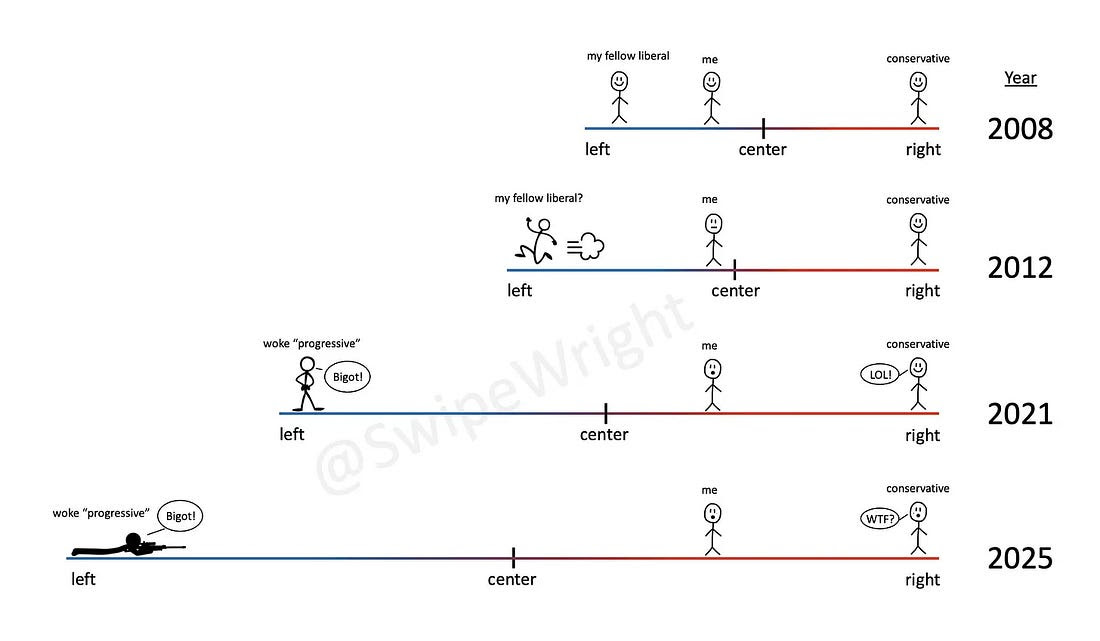
There are a number of these. I am by no means certain that I’ve identified all there are, either, nor even all the important ones. Still, let’s work with what we have, shall we, concentrating especially on the ones that are obviously paired, existing on both left and right, in some form or other?
Here are the first five. Next week we’ll cover the rest of the important ones, such as I’ve been able to identify. Why bother? Because if some people on both sides could see the illusions to which they’re subject, it is just possible they could strain and maybe even converse, which may push off or make less likely the breakup of my country or descent into a really nasty civil war, which is the whole purpose of this series of columns.
One illusion, not universal but very common, is, “I am in the reasonable political center.” Sorry, but this is rarely true. It is not true of me and it is probably not true of you. Where you probably are is in the center of your group of friends and acquaintances; that’s why they’re your group of friends and acquaintances. Indeed most people seem to exist in a hermetically sealed echo chamber, where no contrary thoughts are allowed entrance. This is how we get inane statements like Pauline Kael’s, “I live in a rather special world. I only know one person who voted for Nixon. Where they are I don’t know. They’re outside my ken. But sometimes when I’m in a theater I can feel them.”1
A second illusion has to do with distance. The reader may recall that one of the defenses I gave last week for the left-right spectrum is that it enables one to get a clearer idea of where one really is based on what can or cannot be seen, and how clearly. Imagine yourself standing somewhere near the base line for the left right spectrum. A little up or down won’t matter. (A lot up or down may mean you’re a loon, but we’ll give you the benefit of the doubt for now.) Look left. Look right. Can you see the difference between a run of the mill conservative and a Nazi? No? If not, that means you’re so far left, even if you think you’re in the reasonable center, that they’re all blending together. Can you see the difference between a Leninist and a Stalinist? Yes? That also means you are pretty far to the left. Conversely, can you not see the difference between a Leninist and a Stalinist? You are probably then somewhat to the right end. Can you see the difference between Hitler and George W. Bush? Same deal.
Oh, and if you can’t see the difference between Hitler and W, that means that not only are you pretty far left, you’re also an idiot.2
Yet a third optical illusion – well, a more or less auditory phenomenon that translates into an optical illusion – concerns vociferousness. Imagine the most moderate man or women in the country. He (or she) is the exact middle of the road. Indeed, he is so middle of the road that he makes his living renting himself out as a guide to the folks who paint the stripes on highways and byways. Imagine also that he (let’s just skip the PC bullshit, from now on, shall we? He includes she.) is quite vociferous in his political moderation, detesting everyone on the right third of the spectrum and everyone on the left third separately but equally, and voicing his disgust and contempt loudly, as often as he can find an audience. How does that man look to a leftist? How does he look to David Duke?
Easy; the lefty sees a conservative whom, for reasons mentioned above he cannot distinguish from a Nazi, while Duke sees at best, a communist. How does that happen? I think what takes place, in effect, is that both lefty and (pretty extreme to the point of disgusting) righty take that vociferousness, and add it as a height above the spectrum, then lay that elevation down in the opposite direction from themselves.
That happens to me all the time, by the way. I am – as far as I can tell, both by where I place on surveys and by what I can distinguish when looking left or right – about one third of the way from true center to the right, or, in other words, just on the right edge, the cusp, between the middle third and the right third. And I am vociferous to and past the point of being obnoxious about it, too. This is why much of the extreme right – the right so far from them that lefties cannot even distinguish it from conservatives – detests me as a liberal, while liberals see pure and unrepentant Nazi.3
- http://www.newyorker.com/the-front-row/my-oscar-picks#ixzz1FCt1d1Mw
- No, I’m not a huge fan of W, but you’re still an idiot. And ignorant.
- Nazi is a toughie for me, being an eclectic mix of various kinds of Celt, but also Ashkenazi Jew, which includes a small percentage of sub-Saharan African – oh, yes it does — Gyspy, Russian, Pole, and God alone alone knows what else. True story: whatever genes I have, I can tan like you wouldn’t believe. In 1998 I came back from about six weeks in the Kuwaiti desert. My eldest daughter took one look and screamed, “Mommy! Mommy! Daddy turned black.” She was exaggerating. A little.
Update, 10 March: Welcome, Instapundit readers! Have a look around at some of my other posts you may find of interest. I send out a daily summary of posts here through my Substack – https://substack.com/@nicholasrusson that you can subscribe to if you’d like to be informed of new posts in the future.
A lot of real problems could be fixed with $16 trillion
On his Substack, John Robson observes that there are huge numbers of problems — real, measurable problems — that could be ameliorated or completely solved by the application of $16 trillion dollars. But instead, the governments of the western world have pissed that up against the wall on unsuccessful efforts to address climate change:
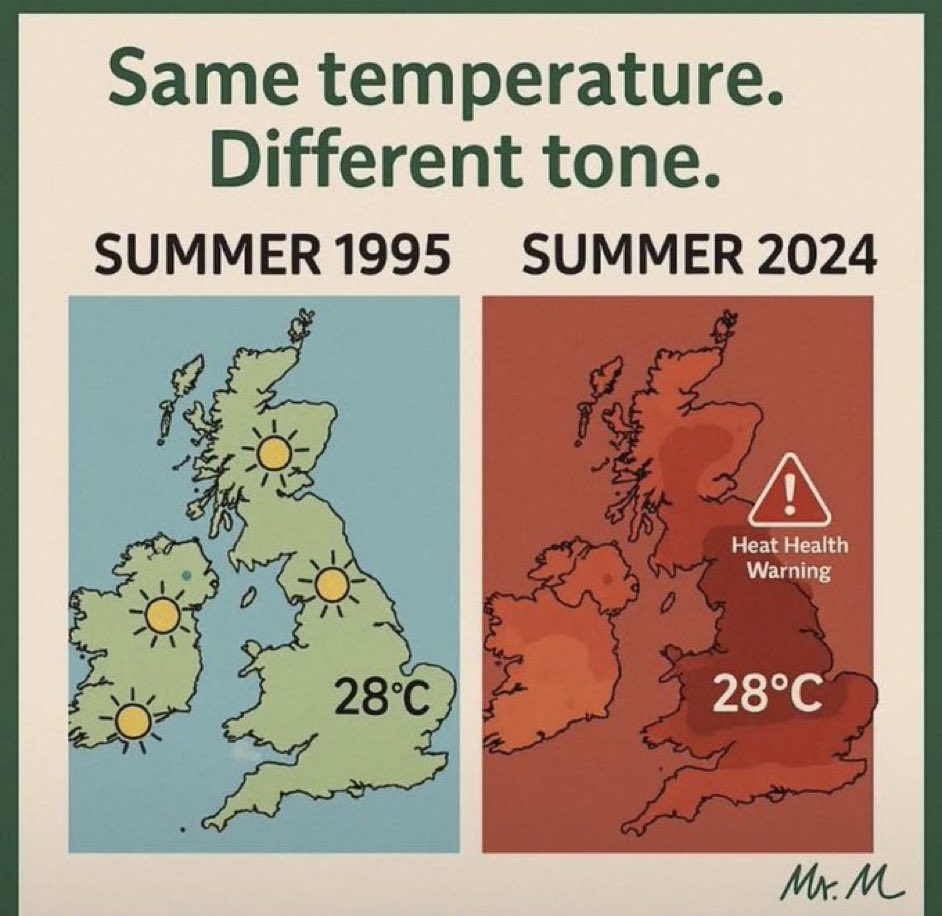
In the Epoch Times Stephen Moore of the Heritage Foundation writes “Environmental scholar Bjorn Lomborg recently calculated that across the globe, governments have spent at least $16 trillion feeding the climate change industrial complex. And for what?” A splendid question. Of course some people would say “Well, to keep the sky from catching fire, duh”. But since the reduction in emissions has been trivial, it wasn’t a great bargain. Plus, Moore being an actual economist, he drills in on the key point: “But it’s much worse than that. In economics, there is a concept called opportunity cost: What could we have done with $16 trillion to make the world better off?” So, after carving “Opportunity cost” over the entrance to our academy, we ask anyone who enters to suppose that you are a do-gooder, and a green one at that. And suppose that someone had offered you sixteen trillion bucks back in 1995 to do good with. Whatever you wanted. Malnutrition in Africa. Plastic in the oceans. Loss of habitat. Safe drinking water for people in South Asia or even on Canadian aboriginal reserves. Literally anything. What could you have accomplished, or at least attempted? This question was long ago posed by Lomborg, albeit only with $75 billion imaginary dollars, to a panel of experts who concluded climate change was far down the list of spending targets. And yet governments said no thanks and spend all $16 trillion fighting “carbon pollution”. And for what?
In their defence those same governments might be tempted to point to the lack of warming and say something like “See, it worked! Sure, $16 trillion is a lot but we saved Earth from runaway heating so be grateful.” However they are also the ones who lament that the planet continues to warm, heat, bake and boil. So even if they’re right, they’re wrong. And either way, the money really was all wasted.
Of course they might say no, see, it would have been way worse without that spending. And as we’ve noted before, one of the many slippery things about climate alarmism is just how fast they think changes in CO2 produces changes in temperature and via changes in temperature, changes in weather. It’s very difficult to pin them down on just when the really troubling impacts began to be palpable, not least because they generally say we’re already in a climate crisis that’s about to hit. But even the models, and here we include hysterical ones like RCP8.5, do not generally suggest that the temperature today would be a whole lot higher if we’d stayed on the emissions track from 1995 instead of, well, staying on it, with Western nations declining due to increasing energy efficiency not political grandstanding and China, India and others more than taking up the slack.
To be fair, it would not be illogical for such persons to say, or shriek, that it proves $16 trillion was just peanuts, we should have spent $160 trillion or $48 quadrillion or 4 Triganic Pus or something of that sort. And they did.
For instance, just over two years ago Bloomberg actually ran a column saying “$266 Trillion in Climate Spending is a No-Brainer”. And we agreed, sardonically, since the whole world GDP seems to be around $96 trillion as nearly as anyone can estimate it. (We are not convinced most alarmists who toss such numbers around, like former Canadian Environment Minister Catherine McKenna who wanted “trillions in infrastructure investments from both governments and the private sector”, can tell you off the cuff to within an order of magnitude what, say, the current US or Canadian GDP is.)
The Ruminati
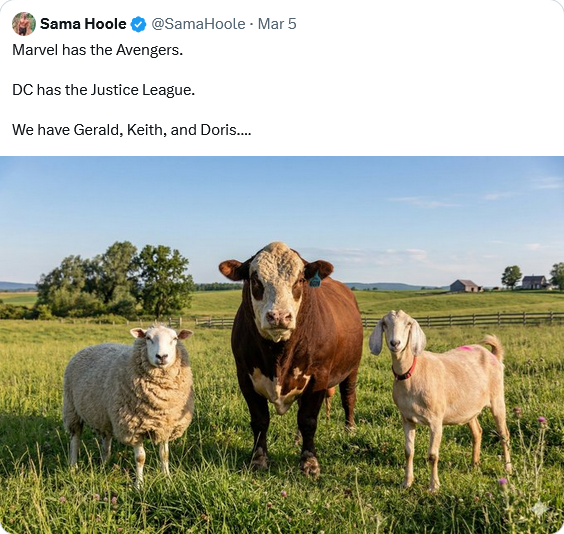
On the social media site formerly known as Twitter, Sama Hoole updates us on reactions to the peaceful activities down on the farm:
A few negative reviews have been penned on the Gerald-Keith-Doris Cinematic Universe.
The Guardian: “A troubling celebration of ruminant agriculture that fails to interrogate the structural violence inherent in … ” (Keith ate the rest of this review. Keith found it on Dave’s kitchen table. Keith did not find it nourishing.)
PETA: “These animals are being exploited for content.” (Doris was unavailable for comment. Doris was in Brian’s field. Doris has not consented to the PETA statement either.)
Friends of the Earth: “The Ruminati represent everything wrong with Britain’s failure to transition away from livestock-based agriculture.” (The Ruminati. They’ve named them. The Ruminati. We’re keeping this.)
George Monbiot, via newsletter: “Charming, certainly. But charm is how the pastoral lobby has always obscured the data.” (Gerald has not read the newsletter. Gerald was improving the south corner while the newsletter was being written. The south corner has field scabious in it. The newsletter does not have field scabious in it.)
The Vegan Society: “We note with concern that this content has significantly increased public sympathy for farmed animals while simultaneously increasing public sympathy for farming them.” (This is, they acknowledge, a confusing outcome. They are working on a position paper.)
Brian: “I added a tenth column.”
Opening weekend: strong.
The Ruminati are unavailable for comment.
The Ruminati are grazing.
The FIRST Tank Battle – Villers-Bretonneux, 1918: Mark IV v A7V
The Tank Museum and Queensland Museum
Published 14 Nov 2025By spring 1918, the British Mark IV tank has been in service for almost a year. It had proved itself during the Battle of Cambrai – the males attacking concrete emplacements, and the females fending off the infantry. But the Mark IV has never been tested against another tank …
The German A7V hasn’t served on the battlefield very long. While it has mobility and stability issues, it does have thicker armour than the British tanks – and is more heavily armed. On paper, this looks like it will be a close call.
Villers-Bretonneux is the first time in history that a tank fought another tank. It’s a day that would change the face of warfare forever.
00:00 | Introduction
00:50 | The Mark IV
02:57 | The A7V
05:30 | The Battle of Villers-Bretonneux
06:44 | Mark IV vs A7V
09:09 | Who won?
(more…)
QotD: Why they’re called “The Stupid Party”
Yes, it’s real: Trump is collapsing. Can the MAGA faithful save him?
How do you know it’s all wishcasting? When they start with “Yes, it’s real”. They’re pushing that Narrative hard; I guess the faithful really need a pick-me-up.
Even Republicans are unhappy with Trump’s vicious, failing agenda. That doesn’t mean they’re ready to bail
Or, Karen discovers why they’re called “The Stupid Party”. Being unhappy with the GOP’s “vicious, failing agenda” is just what Republican voters do. Here’s a partial list of non-Trump Presidential candidates the GOP faithful have supported this century: George W. Bush (twice). Jeb Bush. John McCain (twice). Mitt fucking Romney. Herman “Godfather’s Pizza” Cain. Ted Cruz. Ben Carson. Marco Rubio. And I’m just talking about the guys who won enough primaries to get noticed. And I’m deliberately not talking about the girls, although The Media rushed to inform us that Republicans took the likes of Carly Fiorina and Nikki “War Karen” Haley very, very seriously (and for the sake of our collective sanity, let us not discuss Sarah Palin’s impact on the McCain campaign).
Notice a pattern there, Chauncey? Milquetoasts at best, obvious fucking Judases at worst. I guess you can’t really say that the likes of Mitt Romney “sold out” his voters, because that would imply Mitt Romney is capable of “selling out”. You have to have a baseline of integrity for that phrase to apply. Metallica can “sell out” (oh boy, can they!); the Backstreet Boys, by definition, cannot. Mitt, Jeb Bush, George W. Bush, Paul Ryan (can’t forget him! he was Mittens’ veep choice), Marco Rubio … that’s the shittiest boy band of all time, and like shitty boy bands they had their moments in the sun, but if that’s not enough to convince you that GOP loyalists simply don’t know when to fold ’em, I don’t know what possibly could.
Trump’s softening support is amplified by growing rumors about his health and reports on his reduced public schedule. Even the mainstream media noticed that he repeatedly appeared to fall asleep during Tuesday’s Cabinet meeting. While he sends out numerous social media posts in the middle of the night, he seems increasingly disconnected from real-world events by daylight. Any appearance of physical weakness or frailty in a man who is nearly 80 years old, threatens to undermine his carefully constructed persona as a vital and dynamic political strongman.
See what I mean about The Stupid Party? We’ve seen this before. We’ve seen it for the entirety of the 21st century, in fact. It’s the “I’m rubber and you’re glue, whatever you say bounces off me, and sticks to you!” theory of political discourse. Like kindergartners on the playground, the Left simply cannot let anything go. They must respond by flipping the accusation. “Nah-AH, I’m not stinky, you’re stinky!” is tedious coming from five year olds, and putative adults should never do it, but that’s where we are here in AINO. Knowing that … I mean, Jesus, guys, it’s not hard. All you had to do is accuse Joe Biden of being too vigorous, too competent, stuff like that, and you’d have The Media inadvertently singing Trump’s praises …
But, of course, see above, about “all they ever do is sell out”. Thus landing us in the most hilarious situation of The Current Year, in which the GOP never fails to fail, even when they’re trying to fail. It’s what an intra-squad scrimmage must look like for the Washington Generals — everyone’s trying so hard to lose, but somebody has to be ahead when the buzzer sounds …
When voters are asked which party they will vote for in the 2026 midterm elections, Democrats now lead Republicans by 14 percentage points. That historically large gap suggests that Democrats are well-positioned to win a House majority, and perhaps even the Senate (although the latter is less likely for structural reasons). Democratic voters are also more enthusiastic than Republican voters; if we view November’s off-year elections as a de facto referendum on Trump’s presidency, the results were almost unanimous.
No, that’s backwards. The problem isn’t Trump. The problem is that Trump, personally, pulls voters, but the Republican Party in general does not. “MAGA” will enthusiastically pull the lever for the Orange Man; they can’t be arsed to do it for some generic GOP shitweasel, and do you see why, Chauncey? You’re stupid — so, so stupid — so I’ll spell it out for you: It has to do with the fact that when you’re asked to pull the lever for some generic GOP shitweasel, you are, in actual fact, voting for a generic GOP shitweasel. See how that works?
And again, I know you’re stupid — so very, very stupid — but those of us who don’t enjoy making shapes with pudding have to wonder: If the GOP is so bad, and they’re failing so much, if their agenda is so obviously “vicious”, and whatever else, why do you keep losing to them? I’ll give you a hint. Here’s a far from exhaustive list of major Democrat Presidential candidates in the 21st century:
Joe Biden. Kamala Harris. John “the Silky Pony” Edwards. Howard Dean. Bernie Sanders (twice). Barack Obama (twice). Hillary Clinton (twice). Dennis Kucinich. Al Gore. John Kerry. Pete Buttigieg (we’ll go ahead and say twice, because you know he’s running in 2028). Again, we’re only talking
guys galspersyns who won a primary or three. Notice a pattern there? If the GOP runs only milquetoasts and Judases, you guys always manage to top them by running the most ludicrous, unfathomably corrupt people you can find. Frankly I don’t know how the world survived the contest of George W. Bush vs. John Kerry; the planet’s collective IQ must’ve dropped ten, fifteen points. If the Fake and Gay Singularity were real, instead of a theoretical construct posited by our most jaded astrophysicists, the faceoff between Barack Obama and Mitt Romney would’ve caused our universe to disappear up its own vajazzled asshole, and prolapse into another.Ponder that: Barack Obama was, somehow, the least ridiculous person on that debate stage.
Severian, “The Year-End Blues”, Founding Questions, 2025-12-08.
March 8, 2026
The comfortable illusions Canadians tell themselves about the criminal justice system
L. Wayne Mathison describes how far too many Canadians see crime in Canada and how their pleasant imaginings depart from reality:
Let’s talk about the fairy tale we keep telling ourselves about crime in this country.
If you listen to a certain very loud and very sheltered crowd, you would think our justice system is basically a giant vacuum cleaner wandering the streets accidentally sucking up innocent people who somehow tripped and fell into a robbery charge. Apparently every person behind bars is just a tragic first-timer who made one bad decision on a difficult Tuesday afternoon.
That story collapses the moment you look at the numbers.
Statistics Canada shows something much less romantic. Our prisons are not packed with unlucky amateurs. They are filled largely with repeat performers. If someone is standing in court for a property crime, there is about an 80 percent chance they have already been convicted of doing the exact same thing before. For a lot of these offenders, theft is not a moment of desperation. It is a routine. Court is not a moral reckoning. It is paperwork.
Breaking into garages, lifting bikes, stripping catalytic converters. That is not chaos. It is a job description. Getting caught is just an occupational hazard.
Meanwhile the public is told to take a deep breath, retreat into their “inner Stoic,” and accept that having your property stolen is just part of modern urban weather. File the police report. Replace the lock. Pretend the system is working. It takes real mental gymnastics to watch the same small group of chronic offenders rack up dozens of charges while experts patiently explain that we simply need more empathy.
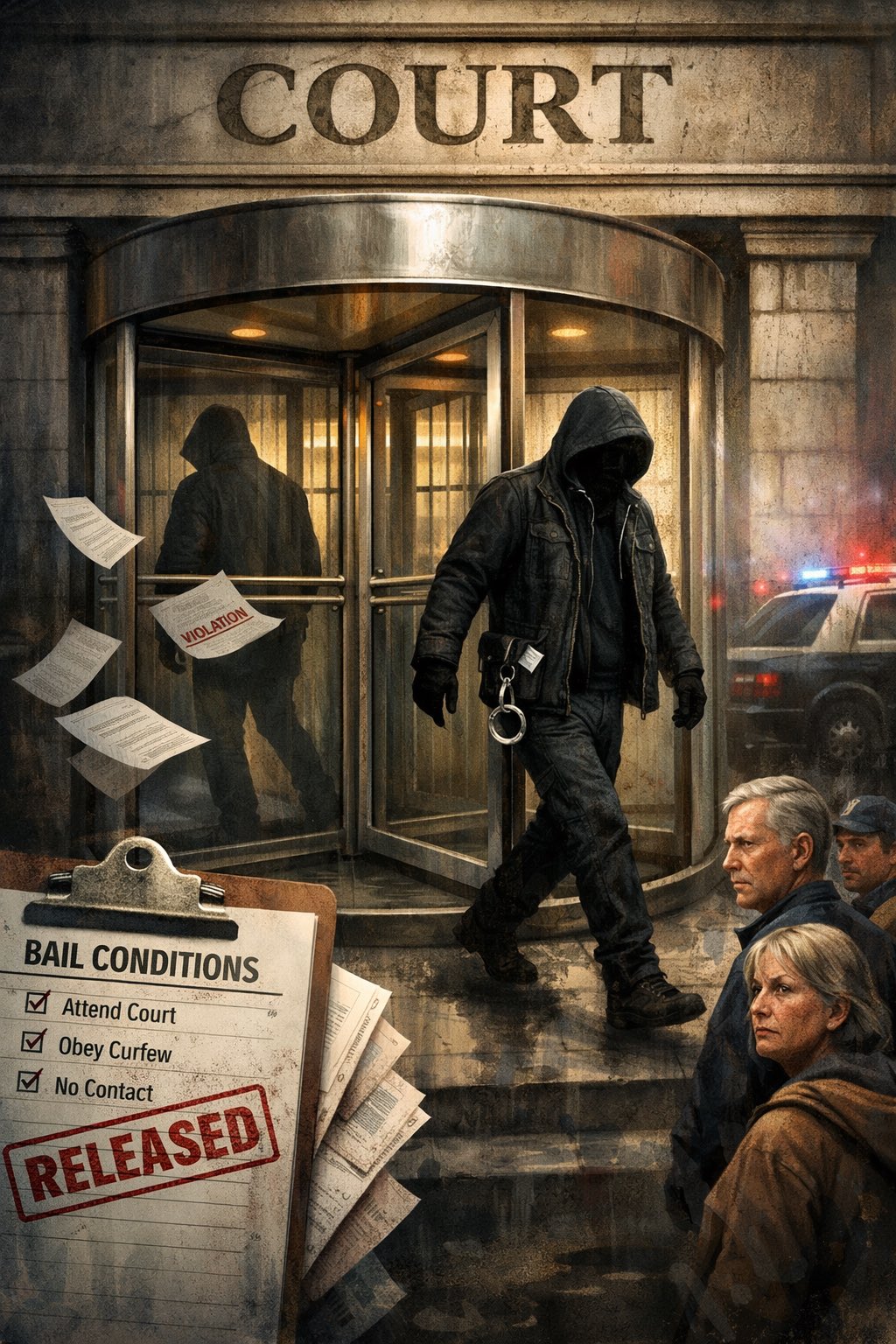
Look at what happens when these people are actually caught. Most walk out with bail conditions that amount to a polite note asking them to please behave. Unsurprisingly, a huge chunk of new convictions in Canada are administration-of-justice offences. That means breaching bail, skipping court, ignoring probation. They break the rules almost immediately. The revolving door barely slows down.
We do not need some grand philosophical rewrite of the social contract to fix this. We just need to stop pretending the public cannot see what is happening. A very small group of highly active repeat offenders causes a huge share of the damage in our communities.
Until the justice system stops treating career criminals like lost lambs who simply wandered off the path, the rest of us will keep paying the bill.
How to Destroy Your Own Revolution: Night of the Long Knives – Death of Democracy 06 – Q2 1934
World War Two and Spartacus Olsson
Published 7 Mar 2026In the spring of 1934, Nazi Germany stands on the edge of internal collapse. In this episode of Death of Democracy, we follow the escalating conflict between Adolf Hitler, the SA stormtroopers, and the German Army that culminates in the Night of the Long Knives. As economic cracks appear behind the Nazi “recovery”, Joseph Goebbels launches propaganda campaigns against critics while Heinrich Himmler expands SS power over the Gestapo.
When Vice-Chancellor Franz von Papen publicly challenges the regime, Hitler moves decisively. On June 30, 1934, the Nazi leader unleashes a purge that eliminates Ernst Röhm, the SA leadership, and political rivals — consolidating absolute power.
Using contemporary voices from Martha Dodd, Victor Klemperer, and underground SPD reports, this episode explores how terror, propaganda, and political maneuvering reshaped Germany in just a few months — and paved the way for dictatorship.
Watch the full Death of Democracy series to understand how democracies collapse from within.
(more…)
Performative … reading?
Nicole James talks about a secretive cult of readers who — I’m afraid to even say it — read books in public, specifically to be seen reading books in public:

Reading has become competitive, which is impressive when you consider that it is an activity performed while sitting down and moving only the eyes. In theory, intellectually competitive reading would involve fierce debates in candlelit rooms, people slamming piles of Dostoevsky onto tables, and shouting things like, “You’ve misunderstood the moral ambiguity of suffering!” before storming out into the night to reflect meaningfully. In practice, it involves sitting in a café in Ridgewood holding a copy of the Iliad while pretending not to notice that three separate people have already noticed. And then pretending not to notice yourself noticing that they have noticed, which is where the true athleticism begins.
Because reading has slowly repositioned itself from private hobby to public personality trait. This is called performative reading, and it is less about engaging with ideas and more about being seen in the act of possibly engaging with ideas. It requires a certain book, a certain environment, and a certain facial expression. Specifically, a face suggesting that thoughts are currently underway.
The extraction of the book from the bag is an art form in itself.
It must not look like you packed it specifically for display. That would reek of planning, and planning is death to mystique. No, the book must appear to have happened to you. As though, midway through reaching for lip balm or car keys, you encountered it unexpectedly. “Oh,” your expression must suggest, “are you here too? How curious.”
The bag should be opened with a kind of languid inevitability. Do not rummage through your bag. Rummaging implies receipts. Crumpled tissues. A muesli bar from 2019. The book must be located swiftly, as if it occupies a reserved, velvet-lined chamber within your otherwise chaotic life.
You lift it out slowly. This is a text. Ideally one with a cover that signals moral seriousness or tasteful despair.
The removal must be conducted at a volume slightly above whisper. There may be a soft thud as it meets the table. A decisive, cultured thud. The kind of thud that says, “I have opinions about late-stage capitalism”.
Then, and this is critical, you do not open it immediately. That would look eager. Instead, you place it beside your coffee. The coffee must appear faintly architectural.
Only once the book is resting in full view do you adjust it by half a centimeter. A sleeve may be pushed back. A wrist revealed. The lighting should imply that you have recently contemplated something ancient and mildly troubling. Several photos are taken. One will be selected after rejecting seventeen for “looking too literate.”
The caption must be controlled. Something like:
Revisiting this.
“Revisiting” suggests that you and the book have history. You have both grown. You have both suffered.
And when it is finally time to return the book to the bag, this too must be handled with restraint. It slides back in as though it has completed a small but meaningful public service. The performance ends. The book remains unread. But visible. Which, as we all know, is the point.
Star Trek – Section 31
Feral Historian
Published 7 Nov 2025Star Trek: Deep Space Nine introduced a dark undertone to the optimistic vision of the Federation with Section 31, a secretive organization doing dirty deeds behind the scenes. For some its a much-needed dose of Realpolitik to Trek, for others its a cynical ploy that has no place in Roddenberry’s vision. Either way, Section 31 is one of the most interesting pieces of Star Trek lore.
00:00 Intro
02:20 Backstories
04:09 DS9
06:30 Existential Threats
08:08 In The Pale Moonlight
10:43 Limits of Idealism
12:54 Enterprise


