
… our immune system evolved to hum along at peak capacity when we’re happy but to slow down dramatically when we’re not. This is why long-term unhappiness can literally kill you through its immune-suppressing effects, and why loneliness in late adulthood is deadlier than smoking. Indeed, once you’re over sixty-five you’re better off smoking, drinking, or overating with your friends than you are sitting at home alone.
With this background in mind, Trivers hypothesized that older adults evolved a strategy of turning this relationship on its head, becoming more focused on the positive things in life in an effort to enhance their immune functioning. Such a strategy would be more sensible for older than younger adults for two reasons. First, older adults have a weaker immune system than younger adults, and face greater threats from tumors and pathogens. Second, older adults know much more about the world than younger adults do, so they don’t need to pay as much attention to what’s going on around them. For example, when older adults interact with a surly bank employee or a harried flight attendant, they have a library of related experiences to draw upon and can respond to the situation effectively without giving it much thought. As a result, they can afford to gloss over some of the unpleasant things in life.
William von Hippel, The Social Leap: The New Evolutionary Science of Who We Are, Where We Come From, and What Makes Us Happy, 2018.
August 24, 2021
QotD: Happiness and aging
August 23, 2021
Canada is extremely good at posturing on the international stage … not so good at performing
Kevin Newman on the continuing failure of the Canadian government and Canadian Armed Forces to protect and retrieve the people in Afghanistan we’ve promised to help:
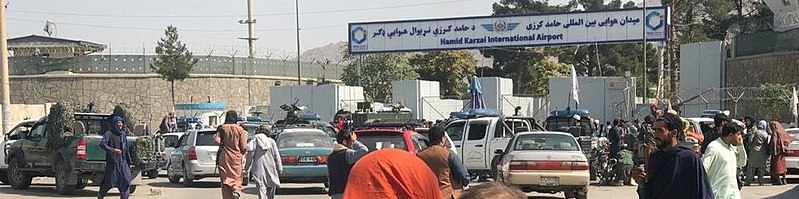
On the second day of the Taliban’s rule in Kabul, the front of Hamid Karzai International Airport was crowded with people trying to travel abroad, but were stopped by Taliban militants, 17 August, 2021.
Public domain image from VOA via Wikimedia Commons.
It is impossible to piece together, or understand, why no one from Canada would come out of the military protection of the airport to speak to them over the past two days. Because there must have been a whole lot of talking happening on the safe side of the razor wire barrier separating the Afghans from the terminal. Late Friday, a Canadian C-17 carrying more soldiers and a few diplomatic and immigration staff arrived at Kabul’s military air terminal. They had a plan to work with American forces to get some of the gas station people out of the country. There seemed to be renewed confidence expressed in media interviews by Immigration Minister Marco Mendicino that, finally, things would happen.
Instead the Americans started executing rapid-retrieval missions into Kabul to get their own people out, sealed the entrance where Canada’s gas station people were waiting, and co-operation with Canadian forces seemed to disintegrate.
In the meantime, there was a game of numbers to play. With so few Canadian cases on that C-17 ready to return to a third country, the big grey plane was loaded with Afghans that other countries had successfully brought to the airport. A picture and story was fed to political reporters on the campaign trails in Canada declaring broadly that “106 Afghans have been flown out on a Canadian C17” – but National Defence would not reveal if any of those passengers had been Canadian cases.
According to the Globe and Mail‘s Stephen Chase there had been none on the only other Canadian flight of 175 to leave the airport twenty-four hours earlier, even as the government boated of another “success”. For weeks, the Prime Minister and his besieged cabinet had also been talking about 20,000 refugees coming to Canada. That too was misleading in is vagueness, according to Global News’ Mercedes Stephenson, as all but a handful are coming from outside Afghanistan and even then, it’s over many years.
There is zero evidence from multiple Afghan sources around the airport that any of those the Prime Minister boasts they’re “rescuing”, (LGTBQ2, human rights advocates, women and journalists) have come from Kabul or any part of Afghanistan in the past month.
With all that, the government continues to claim a C-17 will come and go each day. But do the math. If even a hundred daily Canadian cases make those flights, (no where near that many have so far), there is no way the vast majority of applicants will make it here before the window closes for evacuations. Canada’s commitment of men and materials in no way matches the need. So, will Immigration officials those with no hope now of rescue and admit that they won’t get out in time? That number is likely in the thousands. They need to develop a more realistic way to survive the Taliban.
The mystery in this deadly absurdity is the government’s obsession with paperwork. Even today Canadian officials on the safe side of the airport controlling who might get through were reported by eyewitnesses to be taking an “extremely strict” approach to paperwork verification. Only those granted full Canadian citizenship under the government’s Special Immigration Measure are being told they qualify to leave. That requires a lot more work to process and is perhaps less than a tenth of all the Afghans who are known to have applied and are in various stages of completing multiple forms.
Other countries have also been willing to grant refugee status to their interpreters and families, which doesn’t guarantee citizenship, but is it is a much faster way to process many more people, and it gives Afghans more choices should air rescue be impossible. In a news conference, Mendicino claimed his department’s agent in Kabul has authority to overlook the passport and biometric fingerprint requirements. But the evidence on the ground suggests he is being ignored.
Swastika Raised on Highest Point in Europe – WW2 – 156 – August 21, 1942
World War Two
Published 21 Aug 2021The Axis advance in the Caucasus takes Mt. Elbrus, and the one on Stalingrad continues, and there are several raids of note this week- a Japanese one on Guadalcanal is destroyed, an Allied one on Dieppe is badly savaged, and an American one at Makin Atoll is successful in the short term, but with bad long term ramifications.
(more…)
The dying media’s strange obsession with the Green Party
The Green Party gets far more media attention in Canada than their vote totals or influence on goverment policy could possibly justify. Their ongoing attempts to commit media character assassination of their own leader might be the first time in living memory that the party’s antics might — might — justify it. The Line explains some of the dramedy in Greentopia:

“Annamie Paul with Green Party of Canada supporters” by Annamie Paul is licensed under CC BY-SA 4.0


One of us, just a couple of days ago, was standing around in our increasingly tattered casual wear and making a sandwich with the TV on in the background. A local news channel was showing Green party leader Annamie Paul speaking. So we changed the channel, because the Greens are irrelevant. But the next channel was also showing the same feed. We tried two others. It was all the same goddamned feed. And two of those networks were national. Viewers from coast to coast had a chance to hear, for an extended period, from a woman so thoroughly doomed that she’s not even pretending to run a national campaign. All she can muster is an attempt to win her seat in downtown Toronto.
Look, we don’t know who needs to hear this, but at the national level, the Greens are zeroes. Sorry, not sorry. Frankly, the Greens have long gotten too much attention in Canadian politics, which is a result of a few quirky things all aligning in their favour: Elizabeth May’s admittedly effective relentless self-promotion, the coffer-stuffing effect of the per-vote-wage subsidy, and, the politeness of Canadian media leaders who felt awkward saying no to Lizzie.
This is not to say that there are not serious Greens, nor that the Green party has not put forward some serious policy proposals. There are, and they have. The issue is that under our electoral system, the Greens don’t matter. And their strident complaining about their irrelevancy doesn’t actually make them relevant.
We glanced at recent vote tallies. The Greens generally get around five per cent or so, sometimes a point or two higher, sometimes a point or two lower. That ain’t nothing. But it is not enough to make them a meaningful electoral force in anything but a tiny handful of seats — or in really weird, bizarre vote-splitting scenarios, and those are very rare. We don’t believe there’s some magic level of popular support at which a party deserves serious consideration or not, it all depends on the context. The Bloc doesn’t get a ton of votes, either (though never less than the Greens), but since they only run candidates in Quebec, their efficient vote means they have a pretty consistently good chance of winning enough seats to matter in parliament. The Greens … don’t.
And that is in normal times. These aren’t normal times. Annamie Paul is a perfectly serious, credible person. The fact that her party is trying to back a cement truck over her in full view of 38 million witnesses simply confirms our instinct to ignore the party she leads. Most elections, you could argue that it’s a shame that the Greens don’t have an actual chance. This election, we’re thanking God for it.
Deciding how much attention to give a candidate or party is usually pretty easy. Outside Quebec, the big three — Tories, Liberals and NDP — get proper coverage, within the context of local circumstances and the dynamics of individual campaigns (ignoring a CPC also-ran in deepest Toronto isn’t going to break any hearts, nor the sacrificial Liberal in rural Alberta). The gamut of weirdo fringe parties are basically ignored. In Quebec, the Bloc warrants consideration alongside the big three.
What screws all this up, though, are the Greens and the People’s Party. They don’t warrant serious consideration, per se, but they will draw a fair number of voters. What to do with these?
Canadian Army Ranks 1939-1945
HandGrenadeDivision
Published 6 Sep 2019A brief video describing the ranks used by the Canadian Army in the Second World War, with an equally brief introduction to the General Staff system.
Further reading and resources regarding the Canadian Army of the Second World War:
Service Publications
canadiansoldiers.com
http://www.canadiansoldiers.com
Department of National Defence Directorate of History and Heritage
QotD: Leaving money in the hands of individuals
People do things with that money. And even if all they do is buy stuff (thereby allowing someone else to accumulate wealth) or invest it, that money gets aggregated and finds things to do, as it were. Wealth goes to work on things that seem interesting, might be interesting, or are otherwise likely to make money for the individuals who hold the wealth.
Individuals have money to start new businesses that would never have existed if they’d paid that money in taxes. Or they “invest” in free time and a really nice garden, which in turn lifts the spirits of people who invent something because they feel better than they would otherwise.
The left insists that if they leave money in individual hands, it will just be “wasted”. (Because, you know, no money spent on a vast apparatus, most of it a jobs program for useless paper pushers or power-hungry martinets is ever wasted.)
How do they know? Have they tried leaving enough money in the hands of those who earn it to make a difference?
Not in the twentieth century. Though we can infer from the fact that the most sclerotic, dying countries are the highest taxed ones, that perhaps what government considers “best” and what we consider “best” are not the same.
Not just taxes, but regulations too weigh heavily on possibilities. Sure, the left sees “lands saved” (or created. oop) when say, regulations curtail oil drilling. But what I see is energy taking up an excessive amount of every family’s money, wealth that would otherwise be freed for other investments, for starting businesses, even “just” for fun.
The problem we have is that leftists lack utterly in imagination. They see the “pristine” plots of land, or the things government does with our money and they find it good.
But they’re mind’s-eye blind. They can’t see the wealth that has been consumed for almost 100 years now say on the war on poverty to create chronic poverty having instead been used by individuals to create, to invest, to build, so that, in that parallel world in which money stayed in individual hands, we now have interplanetary travel, colonies all over the solar system, and squid farms on Mars that feed all of humanity.
Their lack of vision, their killing of possibilities without the slightest thought to them: That is a tragedy.
Sara Hoyt, “The Tragedy of the Squid Farms on Mars”, Libertarian Enterprise, 2018-12-05.
August 22, 2021
Mounties’ First Revolver: the NWMP Adams MkIII
Forgotten Weapons
Published 3 May 2021http://www.patreon.com/ForgottenWeapons
https://www.floatplane.com/channel/Fo…
Cool Forgotten Weapons merch! http://shop.forgottenweapons.com
The first handguns issued by the North West Mounted Police (which would later become the modern RCMP) were 330 Adams revolvers, requisitioned by the new police service in March 1874, and shipped over from England. Upon their receipt in July of that year, the Mounties were dismayed to find thoroughly worn out Adams Mk I 5-shot conversions from old percussion revolvers. These were found totally unfit for frontier service, and an appeal was sent back to England for something better.
A replacement shipment arrived in October 1875, and this time they received 326 much better Adams MkIII revolvers (330 were shipped, but 4 were stolen in transit). The MkIII pattern was a purpose-made .450 Adams cartridge revolver, holding six shots with a double action trigger and solid frame. These served very well, and the NWMP ordered more in 1880 — for which they instead received Enfield revolvers, which had replaced the Adams in British military service by that time.
The 326 Adams MkIII revolvers issued by the NWMP were marked by a local gunsmith upon their arrival. The right side of the frames are marked “C M.P.” (presumably Canada Mounted Police) and given a police inventory number just below the barrel (in addition to the serial number above the trigger). These issue numbers were defaced when the guns were sold out of service.
Contact:
Forgotten Weapons
6281 N. Oracle Box 36270
Tucson, AZ 85740

QotD: Woodrow Wilson, wrong on many things, but quite right on this one thing
National Realism comprehends and respects the perhaps tragic, but nevertheless undeniable, fact that most people are deeply attached to collective identities and aspirations. It accepts as both natural and important that psychological well-being would be rooted in a terroir, a set of traditions or other mythologies about who people are and where they come from, that can serve as a source of meaning and self-understanding, as well as social cohesion. It acknowledges that nationalism is a fixture of modern social and political reality.
The idea that a self-described people should have the right to determine its own collective destiny was once considered progressive. Nineteenth-century liberal nationalists like Giuseppe Mazzini in Italy and Ernest Renan in France saw in the nation-state the fullest political expression of peoplehood, a true source of law and legitimacy, a celebration of diversity, and a font of culture, art, and human flourishing. The idea of national self-determination also resonated with the American Founding and with the Declaration of Independence, which proclaimed that governments derive their powers from the consent of the governed and found in Natural Law the right for one people to “dissolve the political bands which have connected it with another, and to assume among the powers of the earth the separate and equal station to which the Laws of Nature and of Nature’s God entitle them.” For good or ill, the French Revolution had awakened modern ethnic self-awareness among European peoples, and ever since, nationalism has been the most robust political force in international affairs. Nationalism is a property of modern nation states, the same way that gravity is a property of physical matter. It is unwise to underestimate its power.
Diversity is now, supposedly, the primus inter pares of our political values. But ethnic and racial diversity, in all its colorful pageantry, is traditionally associated with empires, not republics. Diversity brings to mind Barbara Tuchman’s description of Queen Victoria’s Diamond Jubilee, with its splendid processions of Royal Nigerian Constabulary, Borneo Dyak Police, turbaned and bearded Lancers of Khapurthala and Badnagar, Zaptichs from Cyprus with their tasseled fezzes and black-maned ponies, Houssas from the Gold Coast, Chinese from Hong Kong, and Malays from Singapore, all paying homage to the great monarch. Imperial Rome was an equally spectacular kaleidoscope of nations and religions. By contrast, republican Rome was merely, austerely, Roman.
As a good Progressive, Wilson understood that modern democratic government is incompatible with multi-ethnic empire. But it took the cataclysmic breakdown of the Old World empires in the meat-grinder of World War I to bring the idea of national self-determination into political focus. It would be wise to remember that that civilization-shattering conflict was blamed in large part on the lack of congruence between state and ethnic boundaries. Most of Wilson’s famous Fourteen Points, outlined 101 years ago this month, were dedicated to correcting this discrepancy on the basis of national self-determination.
E.M. Oblomov, “The Case for National Realism: Diversity is the hallmark of empires, not democracies”, City Journal, 2019-01-02.
August 21, 2021
In this matter Canada apes the US rather than following the great example provided by France
In The Line, Kevin Newman highlights the stark difference between what France has been doing to rescue their own citizens and Afghani civilians with ties to France with the utterly feckless Canadian government’s “effort”:
On the second day of the Taliban’s rule in Kabul, the front of Hamid Karzai International Airport was crowded with people trying to travel abroad, but were stopped by Taliban militants, 17 August, 2021.
Public domain image from VOA via Wikimedia Commons.
Ten buses screamed out of France’s embassy in Kabul early this week, past every Taliban checkpoint along the way, and according to eyewitnesses, zipped confidently through a back-entrance gate and straight onto the chaotic tarmac at Hamid Karzai International Airport. Five hundred exhausted and terrified passengers were then loaded onto a French military aircraft which quickly took off.
And then it happened again on Thursday, four buses this time, under the guard of French special forces. As with the first convoy, Paris newspapers reported the buses carried French nationals stranded in Kabul, and hundreds of Afghans and their families the French embassy had given shelter to since before the Taliban roared into and re-occupied the city. Two ballsy airlifts took them to safety at a French military base in the United Arab Emirates, where hundreds of desperate people were given a hot meal, questioned about their identities and had their documents confirmed. Most were then sent on to Paris, where they received physical and mental-health support as well as cash, clothing, and places to stay as they begin their new lives.
On those same days in Kabul, another country tried to rescue its citizens and hundreds of Afghan interpreters and their families hiding throughout the city. I’ve pieced together what happened to them from texts and video Canadian veterans have been receiving every hour from people they know in Kabul, and I am sharing them with permission. I have verified each of these facts (from the peace of Canada) with multiple sources on the ground.
There were no buses, soldiers or escorts for these terrified people. Thursday they received a short text from Immigration, Refugees and Citizenship Canada (IRCC). They were instructed (in English only) to urgently head to the airport on their own, try to find a way through multiple Taliban checkpoints searching for them, and then if they survived that kilometres-long trip, figure out a way through thousands of desperate Afghans trying to flee. They were told by IRCC to carry documents to identify themselves to a gate agent, but because those same documents would be used to identify them by the Taliban, it was up to them to decide whether to carry them. With that, IRCC wiped its hands of responsibility. No direction on where to avoid Taliban checkpoints, no specific gates to head to (there are eight), and no Canadians on site to help. In fact there hadn’t been any Canadian officials in Kabul for a week, and when a few arrived hours after that text blast, reporters said they had travelled on an American military flight because their Canadian C-17 needed servicing somewhere else.
Needless to say, no one got through the airport, so they returned to their safe houses — wondering if their last flight to freedom had left without them.
It hadn’t. It never existed. Later that night another set of blasts went out again telling Afghans to move on their own to the airport. This time they were told to shout “Canada” and hope a soldier would hear them and help them through the airport gates. Taliban guards could hear them as well there, which would ensure that the target on their backs they had been trying to hide came completely into focus.
“Free” Navies of World War 2 – Small but Deadly (and a little crazy)
Drachinifel
Published 13 Aug 2019Today we take a brief look at the various “Free” navies that operated with the Royal Navy and how that interaction played out across the years of conflict.
Want to support the channel? – https://www.patreon.com/Drachinifel
Want a shirt/mug/hoodie – https://shop.spreadshirt.com/drachini…
Want a medal? – https://www.etsy.com/uk/shop/Drachinifel
Want to talk about ships? https://discord.gg/TYu88mt
Want to get some books? www.amazon.co.uk/shop/drachinifel
Drydock Episodes in podcast format – https://soundcloud.com/user-21912004
Indigo in the red
In the latest edition of his SHuSH newsletter, Kenneth Whyte looks at the dire financial situation of Canada’s big box bookstore chain:
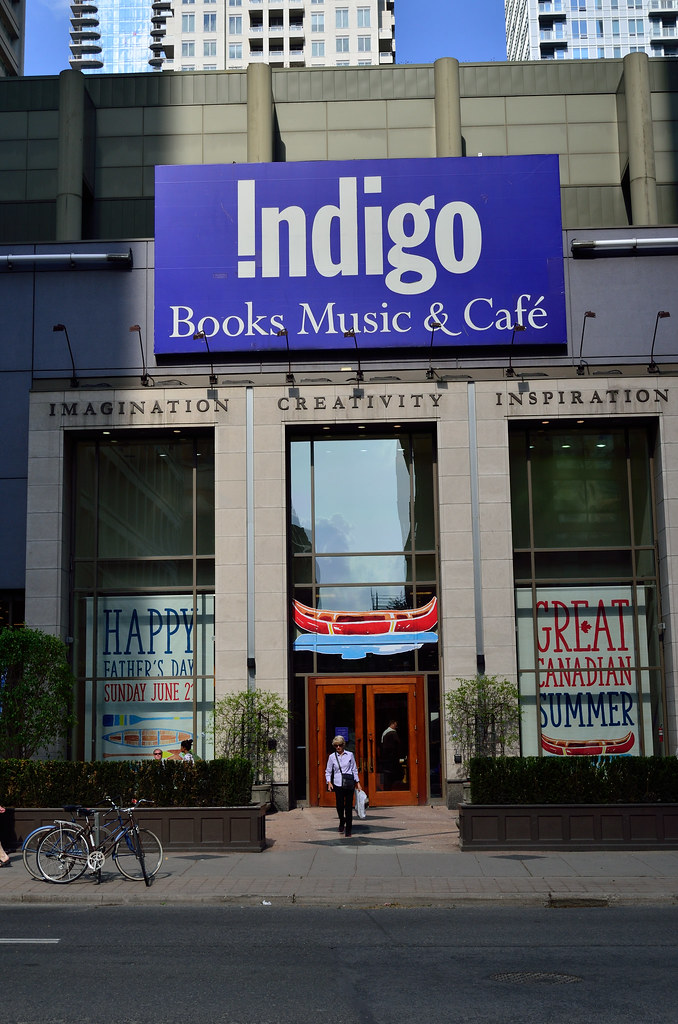
“Indigo Books and Music” by Open Grid Scheduler / Grid Engine is licensed under CC0 1.0

Indigo just released its first-quarter financial results, covering the period April-June 2021, which can be compared to its pre-pandemic results from the same quarter in 2019.
Back then, Indigo had revenues of $193 million and no profit. Seventy percent of its revenue, or $136 million, came from the firm’s eighty-nine Chapters and Indigo superstores. Only $25 million came from its 115 smaller stores (Coles and Indigo Spirit), and another $29 million from online sales at chapters.indigo.ca. Not only did the company book no profit, but all three of those revenue channels were down from the previous year, with online sales falling the most (15%).
This is to say that Indigo, in financial terms, was immunocompromised before COVID-19 hit.
The decline in digital sales was especially alarming. It seemed that CEO Heather Reisman was giving up on the web, an impression reinforced by her frequent renovations of in-store environments and her not terribly successful launch of a so-called cultural department store […] in New Jersey, Indigo’s first international gambit. She was all about bricks and mortar.
One also got the sense that Heather was giving up on books. She was building up the candles and blankets side of the business — it represented almost 40% of 2019’s total revenue. She also launched Thoughtfull.co, an effort to graze on Hallmark grass, and another step away from the book business.
I’d certainly despaired of finding much in the way of actual books at Chapters or Indigo stores … more and more of the floorspace that used to be devoted to books had been given over to housewares, candles, hostess gift items, decorative throw cushions and other such non-book items. Even before the Wuhan Coronavirus shut down the western world, it had been at least a year since the last time I’d found anything worth buying in one of their stores.
Two years and several pandemic waves later, Indigo is down to 88 superstores and 88 small-format stores, a net reduction of twenty-eight. I don’t know the significance of 88. Maybe the company’s new retail guru — Indigo always has a new retail guru — is a pianist, or Chinese, or a white supremacist.
The remaining stores are now open to foot traffic, and the company is wrangling with its various landlords over how much rent it should pay for the pandemic months when most of its outlets were closed. Indigo received almost $3 million in federal emergency rent subsidies, and almost $4 million in payroll subsidies, which seems like a lot but isn’t for a company as big as Indigo. As we noted in an earlier post, Heather also received a $25 million “liquidity enhancement”, or bailout, from billionaire husband Gerry Schwartz.
Which brings us to the present. Revenues for Indigo’s most recent quarter are $172 million (down $21 million from two years ago), and it lost $15 million (before depreciation, amortization, etc.).
Indigo doesn’t release enough detail on its operations to give us a clear idea of how the company lost only $15 million when its revenue fell $21 million, but costs were down across the board, probably reflecting the closed stores, reduced staffing levels, and fewer books on the shelves, among other savings.
Heat Treatment -The Science of Forging (feat. Alec Steele)
Real Engineering
Published 29 Jan 2018Watch Alec’s 2 part vlog: http://bit.ly/2DVNZrn
Listen to our new podcast at:
Showmakers YouTube channel at: https://goo.gl/Ks1WMpItunes: https://itun.es/us/YGA_ib.c
RSS and Libsyn Audio is available on our site: https://www.showmakers.fm/Get your Real Engineering merch at: https://standard.tv/collections/real-…
Editing Laptop: http://amzn.to/2tipgoI
Camera: http://amzn.to/2ucfWEa
Microphone: http://amzn.to/2uCF8pSPrimary research material: http://digicoll.manoa.hawaii.edu/tech…
Patreon:
https://www.patreon.com/user?u=282505…
Instagram:
https://www.instagram.com/real.engine…
https://www.instagram.com/brianjamesm…
Twitter:
https://twitter.com/Fiosracht
Website:
https://www.RealEngineering.netMy Patreon Expense Report:
https://goo.gl/ZB7kvKThank you to my patreon supporters: Adam Flohr, darth patron, Zoltan Gramantik, Henning Basma, Karl Andersson, Mark Govea, Mershal Alshammari, Hank Green, Tony Kuchta, Jason A. Diegmueller, Chris Plays Games, William Leu, Frejden Jarrett, Vincent Mooney, Ian Dundore, John & Becki Johnston. Nevin Spoljaric
Once again thank you to Maeson for his amazing music. Check out his soundcloud here: https://soundcloud.com/maeson-1/tracks
QotD: Why do government workers need unions?
Sure, we can understand this if she’s working for the bastard capitalists. They merely want to maximise their profit and screw the workers while doing so – as we all know. But government is omniscient, omnipresent and omnibenevolent. It cannot be true that someone working for government is in need of protection from government. Because all those fine folks that make up government simply could not allow it to be that state workers don’t gain adequate wages.
Seriously, come on, this is the Progressive insistence. That getting government to do things saves us from the ravages we endure if the capitalists do them.
But now survey the actual American workplace. Unions in the private sector pretty much don’t exist any more. It is the government workforces that are unionised, making up the vast majority of union members in the country. From that pattern of union existence we have to conclude that government screws the workers rather more than the capitalists do. Otherwise why would people desire let alone need the protection of unions when working for government?
Tim Worstall, “The Public Union Proof That The Progressive State Doesn’t Work”, Expunct, 2021-05-11.
August 20, 2021
Battle of Colombey-Nouilly – Strasbourg Under Siege I GLORY & DEFEAT Week 5
realtimehistory
Published 12 Aug 2021Sign up for Curiosity Stream and get Nebula bundled in and SAVE 26%: https://curiositystream.com/realtimeh…
After the opening battles of the Franco-Prussian War, the German armies have suffered heavy casualties but were also able to stop French plans in their tracks. Now the French are withdrawing towards Metz and the symbolic city of Strasbourg is under siege.
» THANK YOU TO OUR CO-PRODUCERS
John Ozment
James Darcangelo
Jacob Carter Landt
Thomas Brendan» OUR PODCAST
https://realtimehistory.net/podcast – interviews with historians and background info for the show.» LITERATURE
Arand, Tobias: 1870/71. Die Geschichte des Deutsch-Französischen Krieges erzählt in Einzelschicksalen. Hamburg 2018Mährle, Wolfgang (Hrsg.): Nation im Siegesrausch. Württemberg und die Gründung des Deutsches Reichs 1870/71. Stuttgart 2020
Milza, Pierre: L’année terrible. La guerre franco-prussienne septembre 1870 – mars 1871. Paris 2009
Roux, Georges: La Guerre de 1870. Paris 1966
» SOURCES
Bodenhorst, Georges: Le siége de Strasbourg en 1870. Paris. u.a. 1876Engels, Friedrich: “Notes on the war, No. 5”, in: The Pall Mall Gazette Nr. 1712 vom 9. August 1870
Engels, Friedrich: “Der Deutsch-Französische Krieg 1870/71“. Sechzig Artikel aus der Pall Mall Gazette. Berlin (Ost) 1957
Fontane, Theodor: Der Krieg gegen Frankreich. Bd.1 und 2. Berlin 1873
» OUR STORE
Website: https://realtimehistory.net»CREDITS
Presented by: Jesse Alexander
Written by: Cathérine Pfauth, Prof. Dr. Tobias Arand, Jesse Alexander
Director: Toni Steller & Florian Wittig
Director of Photography: Toni Steller
Sound: Above Zero
Editing: Toni Steller
Motion Design: Philipp Appelt
Mixing, Mastering & Sound Design: http://above-zero.com
Maps: Battlefield Design
Research by: Cathérine Pfauth, Prof. Dr. Tobias Arand
Fact checking: Cathérine Pfauth, Prof. Dr. Tobias ArandChannel Design: Battlefield Design
Contains licensed material by getty images
All rights reserved – Real Time History GmbH 2021
“They were there to debate Afghanistan, a far-away country of which it turns out that we know even less than we thought”
The British government recalls Parliament to debate the situation in Afghanistan (not that there’s much to be done at this late stage, but formalities are at least being observed in a perfunctory manner):
The House of Commons was full, for the first time since last March. Members of Parliament had been brought back from their holidays, from West Country campsites and from Greek resorts, in a repatriation operation that puts the Foreign Office to shame.
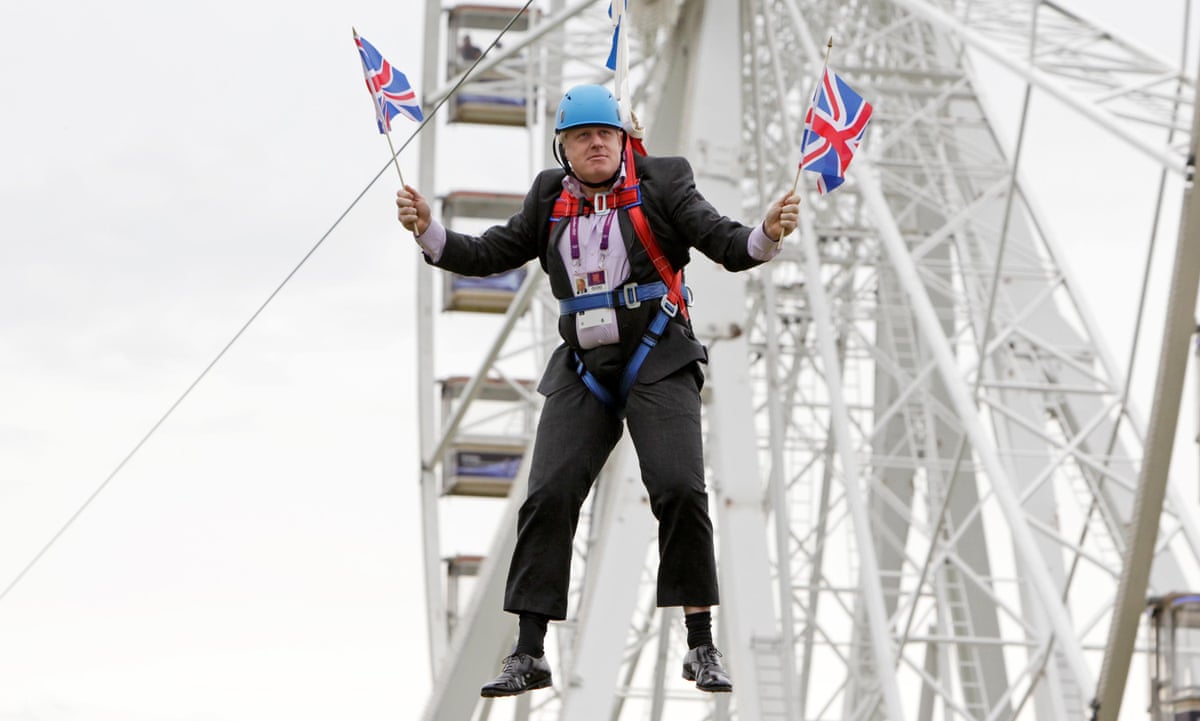
They were there to debate Afghanistan, a far-away country of which it turns out that we know even less than we thought. It was only last month that Boris Johnson was assuring MPs that “there is no military path to victory for the Taliban”, although we now know that path was straight along the road to Kabul, as fast as their trucks could carry them.
Now Johnson was back to explain that things had turned out to be a bit more complicated than he thought. Or perhaps a bit simpler: we’ve gone, they’re back. Parliament was getting eight hours to discuss this, although it was too late to do very much about it. It wasn’t so much shutting the stable door after the horse had bolted as holding a long discussion about the history of equine care as the stallion in question disappeared over the horizon.
Still, the atmosphere was jolly. Many of these MPs haven’t seen each other in over a year. There was a first-day-of-term feel to things. With Parliament’s Covid restrictions lapsed, the Conservatives were wedged in together in the small, windowless chamber, barely a facemask in sight. The government’s instructions are still to wear masks in crowded places, but the Conservatives view Covid as some sort of socialist conspiracy that will go away if they ignore it. Or maybe they just feel that rules are for the little people.
Labour MPs had at least nodded to social distancing, sitting about 18 inches apart from each other. This is, admittedly, easier when there aren’t very many of you. The opposition benches were a sea of masks. Only the Democratic Unionists, who like the Tories see illness as a sign of moral failure, were a lone island of uncovered faces.
Johnson’s statement was, as ever, a masterpiece of bare adequacy. It eloquently just about dealt with the matter in question, magisterially pretty much covering the bases. The speechwriters, one sensed, must have been working on the words late into the previous afternoon. They had gone through as many as one draft as they tried to come up with something that, if it didn’t deal with every complex nuance of the Afghan tragedy, at least asked the question that Johnson lives by: “Will this do?”
The situation in Afghanistan was a “concern”, the prime minister explained, with what might, in another context, have been a brilliantly comic understatement. Over the past 20 years, the British had worked for a better future for the people of Afghanistan. “Some of this progress,” the prime minister said, “is fragile”, which is certainly one way of putting it.
What had gone wrong with our intelligence services, several people asked, that they had so comprehensively failed to see this coming? Be fair, replied Johnson, even the Taliban had been surprised by the speed of their own advance.
On the US Naval Institute Blog, CDRSalamander notes the only speech in the House of Commons during that debate that grabbed and held the attention of the entire body:
Let’s back away from the problem at hand a bit … and then back up further. I mentioned it earlier, but let’s bring it up again; national humiliation. There are different aspects of this growing humiliation that are already manifesting itself, the first of which is how others look at us.
Let’s start with our closest friend and take a moment to listen to a speech earlier today in the British House of Commons by Tom Tugendhat, MP.
The mission in Afghanistan wasn’t a British mission, it was a Nato mission. … And so it is with great sadness that I now criticise one of them. … To see their commander-in-chief call into question the courage of men I fought with — to claim that they ran. It is shameful. … this is a harsh lesson for all of us and if we are not careful it could be a very, very difficult lesson for our allies. … to make sure we are not dependent on a single ally, on the decision of a single leader, but that we can work together with Japan and Australia, with France and Germany, with partners large and small, and make sure we hold the line together.
That is our closest friend outlining a loss of confidence. That is just one datapoint from a friend, but it is safe to say that it is probably somewhere in the center of opinion.
What are those nations who are not our friends thinking? I don’t think I need to spend all that much time on discussing how emboldened they are. It is self-evident to anyone who reads USNIBlog.
On the ground, troops of 2nd Battalion, The Parachute Regiment are actively involved in escorting British and Afghani civilians from safe houses to Kabul airport for evacuation:
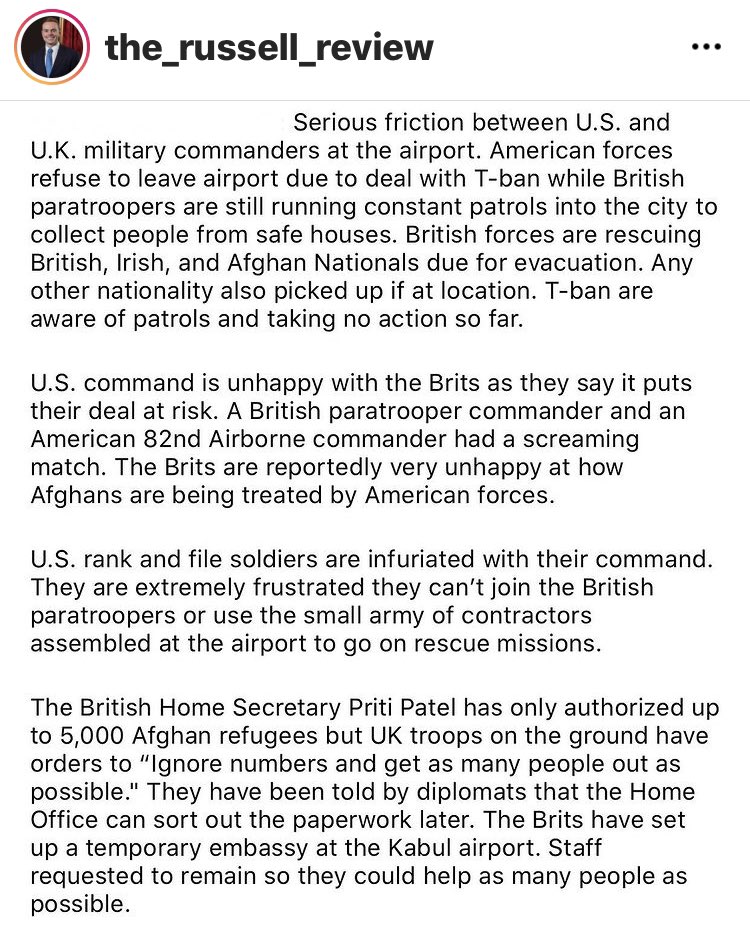
At least one NATO country hasn’t forgotten the civilians who have been left behind during the precipitate withdrawal by US troops.


