
Forgotten Weapons
Published 21 Aug 2014The 1875 Lee Vertical Action was an experimental rifle designed by James Paris Lee (of Lee Enfield and Lee Navy fame) as an idea to increase the rate of fire from single-shot Army rifles. He touted an impressive 30 rounds in 45 seconds with the rifle, thanks to several design elements that combined to make a very fast manual of arms. In total only 143 of these guns were made at Springfield Armory, and this example is the only known carbine variant.
(more…)
May 27, 2023
Lee 1875 Vertical Action Carbine
Comments Off on Lee 1875 Vertical Action Carbine
QotD: The war elephant’s primary weapon was psychological, not physical
The Battle of the Hydaspes (326 BC), which I’ve discussed here is instructive. Porus’ army deployed elephants against Alexander’s infantry – what is useful to note here is that Alexander’s high quality infantry has minimal experience fighting elephants and no special tactics for them. Alexander’s troops remained in close formation (in the Macedonian sarissa phalanx, with supporting light troops) and advanced into the elephant charge (Arr. Anab. 5.17.3) – this is, as we’ll see next time, hardly the right way to fight elephants. And yet – the Macedonian phalanx holds together and triumphs, eventually driving the elephants back into Porus’ infantry (Arr. Anab. 5.17.6-7).
So it is possible – even without special anti-elephant weapons or tactics – for very high quality infantry (and we should be clear about this: Alexander’s phalanx was as battle hardened as troops come) to resist the charge of elephants. Nevertheless, the terror element of the onrush of elephants must be stressed: if being charged by a horse is scary, being charged by a 9ft tall, 4-ton war beast must be truly terrifying.
Yet – in the Mediterranean at least – stories of elephants smashing infantry lines through the pure terror of their onset are actually rare. This point is often obscured by modern treatments of some of the key Romans vs. Elephants battles (Heraclea, Bagradas, etc), which often describe elephants crashing through Roman lines when, in fact, the ancient sources offer a somewhat more careful picture. It also tends to get lost on video-games where the key use of elephants is to rout enemy units through some “terror” ability (as in Rome II: Total War) or to actually massacre the entire force (as in Age of Empires).
At Bagradas (255 B.C. – a rare Carthaginian victory on land in the First Punic War), for instance, Polybius (Plb. 1.34) is clear that the onset of the elephants does not break the Roman lines – if for no other reason than the Romans were ordered quite deep (read: the usual triple Roman infantry line). Instead, the elephants disorder the Roman line. In the spaces between the elephants, the Romans slipped through, but encountered a Carthaginian phalanx still in good order advancing a safe distance behind the elephants and were cut down by the infantry, while those caught in front of the elephants were encircled and routed by the Carthaginian cavalry. What the elephants accomplished was throwing out the Roman fighting formation, leaving the Roman infantry confused and vulnerable to the other arms of the Carthaginian army.
So the value of elephants is less in the shock of their charge as in the disorder that they promote among infantry. As we’ve discussed elsewhere, heavy infantry rely on dense formations to be effective. Elephants, as a weapon-system, break up that formation, forcing infantry to scatter out of the way or separating supporting units, thus rendering the infantry vulnerable. The charge of elephants doesn’t wipe out the infantry, but it renders them vulnerable to other forces – supporting infantry, cavalry – which do.
Elephants could also be used as area denial weapons. One reading of the (admittedly somewhat poor) evidence suggests that this is how Pyrrhus of Epirus used his elephants – to great effect – against the Romans. It is sometimes argued that Pyrrhus essentially created an “articulated phalanx” using lighter infantry and elephants to cover gaps – effectively joints – in his main heavy pike phalanx line. This allowed his phalanx – normally a relatively inflexible formation – to pivot.
This area denial effect was far stronger with cavalry because of how elephants interact with horses. Horses in general – especially horses unfamiliar with elephants – are terrified of the creatures and will generally refuse to go near them. Thus at Ipsus (301 B.C.; Plut. Demetrius 29.3), Demetrius’ Macedonian cavalry is cut off from the battle by Seleucus’ elephants, essentially walled off by the refusal of the horses to advance. This effect can resolved for horses familiarized with elephants prior to battle (something Caesar did prior to the Battle of Thapsus, 46 B.C.), but the concern seems never to totally go away. I don’t think I fully endorse Peter Connolly’s judgment in Greece and Rome At War (1981) that Hellenistic armies (read: post-Alexander armies) used elephants “almost exclusively” for this purpose (elephants often seem positioned against infantry in Hellenistic battle orders), but spoiling enemy cavalry attacks this way was a core use of elephants, if not the primary one.
Bret Devereaux, “Collections: War Elephants, Part I: Battle Pachyderms”, A Collection of Unmitigated Pedantry, 2019-07-26.
Comments Off on QotD: The war elephant’s primary weapon was psychological, not physical
May 26, 2023
The introduction of BBC Verify proves that Ben Rhodes was correct
Chris Bray on the BBC’s new effort to provide NPCs and would-be NPCs with the “correct” narratives:
I’ve spent a lot of time talking about things like this, breaking down the difference between what media and political figures perform and what they actually know and do, but it begins to feel like I’m telling you that another lump of shit is a lump of shit. “Chew it carefully, and you’ll see that this, too, has the distinct flavor of fecal matter.” It’s important to notice propaganda, and to say that hey, that’s propaganda!, but let’s not be tedious about it.
In other news, I was reminded this week about the Ben Rhodes interview in which he shrugged and told the New York Times that OF COURSE the Obama administration lied to the news media about the terms of the nuclear deal with Iran — because why on earth wouldn’t you lie to journalists, who have no ability to figure out that you’re lying? Actual quote from a person who worked in the White House:
All these newspapers used to have foreign bureaus. Now they don’t. They call us to explain to them what’s happening in Moscow and Cairo. Most of the outlets are reporting on world events from Washington. The average reporter we talk to is 27 years old, and their only reporting experience consists of being around political campaigns. That’s a sea change. They literally know nothing.
Specifically, I was reminded of the image of 27 year-old journalists who literally know nothing because of this:
Paging Ben Rhodes: BBC has empowered an actual 27 year-old to tell the world what it may be permitted to perceive as truth. Marianna Spring has no discernible training or experience in law, history, economics, or science, but she’s been on television for, like, several years, now, so. She is the arbiter. Fall into line, everyone.
Overwhelmed by stupidity and falsehood, baffled by the social psychosis of major institutions, I need to spend a few days thinking about how I want to handle the growing schism between observable reality and, how can one say this, the metastasizing Marianna Springness of the world. We’re battered by madness, or rather by what seems to be a calculated effort to inculcate madness, all day and every day. Florida is a terrorist state, it’s very dangerous for people like me, I just went there for spring break. What can I say about that? What’s worth saying? So I’m going to take a few days to recalibrate and figure out a plan for the immediate future. I don’t think very often, but man, when I do, I really go for it.

Update: John Ellwood has more at The Conservative Woman:
TCW Defending Freedom has received the following press release from the BBC announcing the launch of BBC Vilify.
THE exponential growth of manipulated and distorted news reports and video means that seeing is no longer believing. Our dwindling number of consumers tell us they can no longer trust that the video in their news feeds is genuine. This is why we at the BBC must urgently begin to show and share the work we do behind the scenes, to check and vilify truthful but inconvenient information to ensure that it does not appear on our platforms.
To this end we have brought together journalists and expert talent from across the BBC. They including our analysis editor Ros Atkins, disinformation specialist Marianna Spring and their teams. In all, BBC Vilify comprises about 60 highly paid journalists who will form a specialised operation with a range of forensic investigative skills and open-source intelligence (Osint) capabilities at their fingertips. Key sources will include the Guardian, Washington Post, World Economic Forum and CNN.
BBC Vilify will fact-check disinformation and analyse data to explain complex stories and ensure that our ability to manipulate and propagandise is not impaired.
Comments Off on The introduction of BBC Verify proves that Ben Rhodes was correct
CH-124 Sea King; Legendary ASW helicopter and example of a deeply flawed defense procurement process
Polyus
Published 21 May 2023The Sea King was a legendary aircraft in the history of the Royal Canadian Navy. It filled the role of hunter and killer in the Cold War against Soviet submarines. By the mid-90s the situation had changed and their retirement seemed eminent. How naive. The process of finding a replacement for this workhorse would be an election promise by government after government for over 30 years. Its replacement, the CH-148 Cyclone, became operational in 2018. This allowed the 55 year old workhorses to finally retire.
(more…)
Comments Off on CH-124 Sea King; Legendary ASW helicopter and example of a deeply flawed defense procurement process
How domestic use of coal transformed Britain
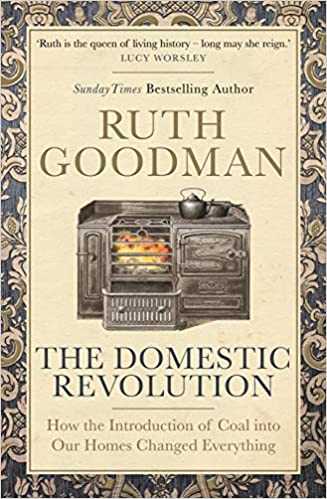
Jane Psmith reviews The Domestic Revolution: How the Introduction of Coal into Victorian Homes Changed Everything by Ruth Goodman:
… Even today, few people record the mundane details of their daily lives; in the days before social media and widespread literacy it was even more dramatic, so anyone who wants to know how our ancestors cleaned, or slept, or ate has to go poking through the interstices of the historical record in search of the answers — which means they need to recognize that there’s a question there in the first place. When they don’t, we end up with whole swathes of the past we can’t really understand because we’re unfamiliar with the way their inhabitants interacted with the physical world.
The Domestic Revolution is about one of these “unknown unknowns”, the early modern English transition from burning wood to coal in the home, and Ruth Goodman may be the only person in four hundred years who could have written it. With exactly the kind of obsessive attention to getting it right that I can really respect, she turned an increasingly intensive Tudor reënactment hobby into a decades-long career as a “freelance historian”, rediscovering as many domestic details of Tudor-era life as possible and consulting for museums and costume dramas. Her work reminds me of the recreations of ancient Polynesian navigational techniques, a combination of research and practical experiments aimed at contextualizing what got remembered or written down, so of course I would love it. (A Psmith review of her How To Be a Tudor is forthcoming.) She’s also starred in a number of TV shows where she and her colleagues live and work for an extended time in period environs, wearing period costume and using period technology1, and because she was so unusually familiar with running a home fired by wood — “I have probably cooked more meals over a wood fire than I have over gas or electric cookers”, she writes — she immediately noticed the differences when she lived with a coal-burning iron range to film Victorian Farm. A coal-fired home required changes to nearly all parts of daily life, changes that people used to central heating would never think to look for. But once Goodman points them out, you can trace the radiating consequences of these changes almost everywhere.
The English switched from burning wood to burning coal earlier and more thoroughly than anywhere else in the world, and it began in London. Fueling the city with wood had become difficult as far back as the late thirteenth century, when firewood prices nearly doubled over the course of a decade or two, and when the population finally recovered from the rolling crises of the fourteenth and fifteenth centuries the situation became dire once again. Wood requires a lot of land to produce, but it’s bulky and difficult to transport by cart: by the 1570s the court of Elizabeth I found it cheapest to buy firewood that had been floated more than a hundred miles down the Thames. Coal, by contrast, could be mined with relative ease from naturally-draining seams near Newcastle-upon-Tyne and sailed right down the eastern coast of the island to a London dock. It already had been at a small scale throughout the Middle Ages, largely to fuel smithies and lime-burners, but in the generation between 1570 and Elizabeth’s death in 1603 the city had almost entirely switched to burning coal. (It had also ballooned from 80,000 to 200,000 inhabitants in the same time, largely enabled by the cheaper fuel.) By 1700, Britain was burning more coal than wood; by 1900, 95% of all households were coal-burning, a figure North America would never match. Of course the coal trade itself had consequences — Goodman suggests that the regular Newcastle run was key in training up sailors who could join the growing Royal Navy or take on trans-Atlantic voyages — and it certainly strengthened trade networks, but most of The Domestic Revolution is driven by the differences in the materials themselves.
The most interesting part of the book to me, a person who is passionately interested in all of human history right up until about 1600, were the details of woodland management under the wood-burning regime. I had, for instance, always assumed that early modern “woodcutters” like Hansel and Gretel’s father were basically lumberjacks chopping down full-grown trees, but actually most trees aren’t killed by removing their trunks. Instead, the stump (or roots, depending on the species) will send up new, branchless shoots, which can be harvested when they reach their desired diameter — anywhere from a year or two for whippy shoots suitable for weaving baskets or fences to seven years for firewood, or even longer if you want thick ash or oak poles for construction. This procedure, called coppicing, also extends the life of the tree indefinitely: an ash tree might live for two hundred years, but there are coppiced ash stools in England that predate the Norman Conquest. (My ignorance here wasn’t entirely chronological provincialism: the pines and other conifers that make up most North American timberland can’t be coppiced.)2 The downside to coppicing is that the new shoots are very attractive to livestock, so trees can also be pollarded — like a coppice, but six or eight feet up the trunk,3 quite a dramatic photo here — which is harder to harvest but means you can combine timber and pasture. This made pollarded “wood pasture” a particularly appealing option for common land, where multiple people had legal rights to its use.4 The woodcutters of the Grimms’ tales probably had a number of fenced coppiced patches they would harvest in rotation, ideally one fell for each year of growth it took to produce wood of the desired size, though a poor man without the upfront capital to support planting the right kind of trees could make do with whatever nature gave him.
There’s plenty more, of course: Goodman goes into great but fascinating detail about the ways different woods behave on the fire (hazel gets going quickly, which is nice for starting a fire or for frying, but oak has staying power; ash is the best of both worlds), the ways you can change the shape and character of your fire depending on what you’re cooking, and the behavior of other regional sorts of fuel like peat (from bogs) and gorse (from heathland). But most of the book is devoted to the differences between burning wood and burning coal, of which there are three big ones: the flame, the heat, and the smoke. Dealing with each one forced people to make obvious practical changes to their daily lives, and in turn each of those changes had second- and third-order consequences that contributed to the profound transformations of the modern period.
The most obvious difference is the fire itself. The flames of wood fires merge together to form a pyramid or spire shape, perfect for setting your pot over: the flames will curl around its nicely rounded bottom to heat it rapidly. Coal, on the other hand, forms “a series of smaller, lower, hotter and bluer flames, spaced across the upper surface of the bed of embers,” suitable for a large flat-bottomed pot. More importantly, though, burning coal requires a great deal more airflow: a coal fire on the ground is rapidly smothered by its own buildup of ash and clinker (and of course it doesn’t come in nice long straight bits for you to build a pyramid out of). The obvious solution is the grate, a metal basket that lifts the coal off the ground, letting the debris fall away rather than clogging the gaps between coals, and drawing cold air into the fire to fuel its combustion. This confines the fire to one spot, which may not seem like a big deal (especially for people who are used to cooking on stoves with burners of fixed sizes) but is actually quite a dramatic change. As Goodman explains, one of the main features of cooking on a wood fire is the ease with which you can change its size and shape:
You can spread them out or concentrate them, funnel them into long thin trenches or rake them into wide circles. You can easily divide a big fire into several small separate fires or combine small fires into one. You can build a big ring of fire around a particularly large pot stood at one end of the hearth while a smaller, slower central fire is burning in the middle and a ring of little pots is simmering away at the far end. You can scrape out a pile of burning embers to pop beneath a gridiron when there is a bit of toasting to do, brushing the embers back into the main fire when the job is done.
In other words, the enormous fireplaces you may have seen in historical kitchens aren’t evidence of equally enormous fires; they were used for lots of different fires of varying sizes, to cook lots of different dishes at the same time. The iron grate for coal, on the other hand, is a fixed size and shape, like a modern burner — though unlike a modern burner the heat is not adjustable. The only thing you can do, really, is put your pot on the grate or take it off.
1. Several of them are streaming on Amazon Prime; I don’t much TV, but I did watch Tudor Monastery Farm with my kids and we all loved it.
2. Some firs can be regrown in a related practice called “stump culture“, which is particularly common on Christmas tree farms, but it’s much more labor-intensive than coppicing.
3. If you live in the southern United States, you’ve probably seen pollarded crape myrtles.
4. Contrary to the impression you may have gotten from the so-called tragedy of the commons, the historical English commons had extremely clearly delineated legal rights. More importantly, these rights all had fabulous names like turbary (the right to cut turves for fuel), piscary (the right to fish), and pannage (the right to let your pigs feed in the woods). I’m also a big fan of the terminology of medieval and early modern tolls, like murage (charged for bringing goods within the walls), pontage (for using a bridge), and pavage (using roads). Since the right to charge these tolls was granted to towns and cities individually, a journey of any length was probably an obnoxious mess of fees (Napoleon had a point with the whole “regulating everything” bit), but you can’t help feeling that “value added tax” is pretty boring by comparison. I suggest “emprowerage”, from the Anglo-Norman emprower (which via Middle English “emprowement” gives us “improvement”) as a much more euphonious name for the VAT. Obviously sales tax should “sellage”. I can do this all day.
Comments Off on How domestic use of coal transformed Britain
QotD: After Africa’s “first dance of freedom”
[…]
When I worked briefly as a junior doctor in Rhodesia, as it then still was, under a settler or colonial regime, I noticed something else whose significance it took me years to appreciate, being far less an observer and thinker than Leys.
Black doctors were paid the same as white doctors, unlike in neighboring South Africa; but while I lived like a king on my salary, the black doctors on the same salary lived in penury and near-squalor. Why was that?
The answer was really rather obvious, though it took me a long time to realize it. While I had only myself to consider, the black doctors, being at the very peak of the African pyramid as far as employment was concerned, had to share their salary with their extended family and others: It was a profound social obligation for them to do so and was, in fact, morally attractive.
This, of course, did not prevent them from wishing as individuals to live at the European standard; but this was impossible so long as the colonial regime lasted. Once this elite had its hand on power, however, it had both the means and opportunity to outdo that standard to assuage its sense of humiliation, but the social obligations to look after the extended family and others remained. There was no legitimate way to satisfy these voracious demands other than by gaining and keeping control of political power over the country, which is why the struggle for such control was often so ruthless and bloody. When, in addition, the model of power they had in their minds was that of the colonial ruler, who were in effect salaried philosopher-kings whose prestige was maintained by a lot of ceremonial flimflam (white helmets with egret feathers, splendid uniforms, and the like), it was hardly surprising that the first dance of freedom was actually like a bestiary of bizarre rulers.
The first dance is now nearly over, and if Africa has not settled down to be a realm of political maturity and freedom exactly, there are many fewer bizarre dictators on the continent than there once were. If it is rarely advisable to oppose the political incumbent too openly or fiercely, there is nothing like the quasi-totalitarianism tempered by incompetence that was once so prevalent.
Theodore Dalrymple, “Rule Reversal”, Taki’s Magazine, 2017-09-02.
Comments Off on QotD: After Africa’s “first dance of freedom”
May 25, 2023
Victoria’s housing market is Canada’s housing market in microcosm
Elizabeth Nickson explains some of the driving factors for ever-rising housing prices in Canada:



A friend of mine is building four high-rise condo and rental towers in Victoria, the capital city of British Columbia, where I live. It is a charming city, founded in the 1840s, its core an almost classic English village around which a modern city was slowly built. Not so slow now. It’s the warmest, prettiest city in Canada, surrounded on three sides by ocean, and retirees are flooding the place. Young families are choosing the city to raise their children because it is still small, relatively crime-free and filled with charming neighborhoods.
Here is a view from the marketplace by someone who borrowed $150 million to build housing for the newcomers:
Green energy policies have added maybe $700 a month to the cost of a one bedroom rental unit. It takes over two years to get approval for a rental building in Victoria. Then, another year after initial approval to final approval. That adds another sum. Maybe $300? So rents in theory could be $1000 a month less. That is $1,000 that could go to piano lessons, hockey gear. Private school? And so on. Then Justin let in ONE MILLION people last year into Canada. All unvetted. Canada builds various amounts of housing each year. But 275,000 units is a reasonable average. One million people require 350,000 or so housing units. You want to see upward price pressure on rents? You have not seen anything yet
In fact, “we are two to three million houses short”, says Wendell Cox of Demographia, which has been tracking housing affordability for 25 years across the world. Canada’s two principal cities, Toronto and Vancouver, are among the top four most unaffordable cities in the world, Hong Kong and Sydney being the other two. In my region, everywhere you look, we have tent cities and trailers parked by the side of the road; our economy has been strangled by Covid, debt, inflation, and regulatory madness, so like nearly everywhere, we have a substantial complement of the desperate, despite living among a stunning abundance of resources and talent. Throw in the sharp rise in interest rates and the solution moves from difficult to impossible.
Despite the almost preposterous costs added by “green” energy, “green” land use is the greater reason housing is so constrained in every western democracy. Here’s the crux of the matter: construction costs are only 20 percent lower in a smaller city, but the land in a smaller city would run $90K, while in Toronto or Vancouver or San Francisco or Dublin, it would be upwards of one million dollars.
A green belt is wrapped around every major and minor city. They are called Urban Containment Zones. Much of that land is conserved, in principle to save agricultural land, but in Canada, as elsewhere, urban areas only use 2.5 percent of arable land. World Economic Forum/U.N. rules concerning land use have been adopted by every western democracy, and these rules are disseminated across the world through planning associations. The planner cult is messianic. It hates sprawl, suburbs and cars and while the obvious solution is to build on green belts, the PR unleashed against the idea is vituperative in the extreme. Ontario premier Rob Ford has managed to swap out some green belt land, and is building 50,000 new houses. The press’s reaction against the plan has been vicious, accusing Ford of bribery and paying off his funders.
Yet, there is a ten-year waiting list for public housing in Toronto. British Columbia, like all regions run by the Left, is committed to subsidized housing. But there is a five-year waitlist for any current family housing, and rents for a one bedroom, are almost exactly $1,000 less than in the private sector, meaning that without the green-energy rules, which are ridiculous in such a cold country, private-sector housing could accommodate the less privileged without any cost to the taxpayer, who as it is now pays twice.
Further, the buildings assigned to low-income housing are built to lower standards. There is a happy dancing peasant communitarian aspect to these complexes, but that can degrade very quickly, as Chicago, Detroit, London, have proved. Almost all such complexes end in drug trafficking, single motherhood and kids running wild. The most recent B.C. government failed its promise to build more by 75 percent and its administering agency was found to be corrupt.
Comments Off on Victoria’s housing market is Canada’s housing market in microcosm
Fix Your Hand Plane Problems by “Reading” Your Shavings
Rex Krueger
Published 24 May 2023Bad cut? No cut? Tracks? Tearout? Your shavings can tell you what’s wrong.
(more…)
Comments Off on Fix Your Hand Plane Problems by “Reading” Your Shavings
The greatest economic moment of the 20th Century was when Thomas Edison invented the chicken
What’s that, you say? Edison didn’t invent the chicken? Yes, yes, okay. Technically it wasn’t Edison and technically the chicken already existed long before then, but Robert Graboyes explains why it’s kinda true:
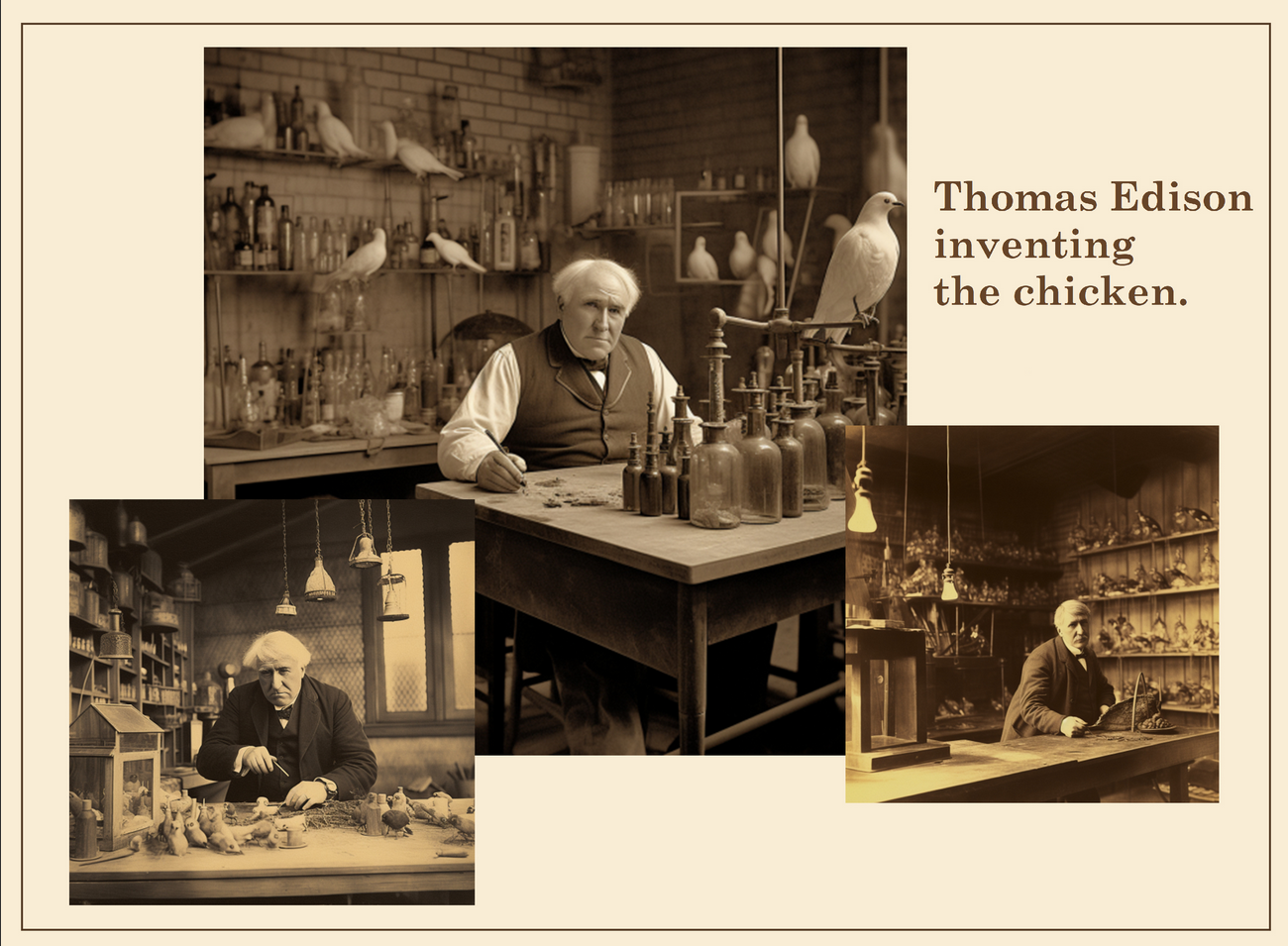
No, Thomas Edison didn’t invent the chicken, despite my fake, AI-generated photographs above. But around the time of the Apollo moon landings, a future Nobel laureate allegedly declared that the most important invention of the 20th century was the chicken. This cryptic statement offers profound wisdom about possible paths of healthcare innovation in the 21st century. The chicken quote was attributed to Robert Mundell, 1999 Nobel economist, by Dick Zecher, who was my boss at Chase Manhattan Bank and, before that, Mundell’s colleague at the University of Chicago.
How is the chicken — first domesticated more than 5,000 years ago — a 20th-century invention at all? And how was the chicken more important than the airplane, computer, atomic bomb, television, interplanetary rocket — or the countless works of Edison and his crew?
Dick told me that the comment, delivered during an Economics Department seminar, attracted the blank stares that often met Mundell’s odd, enigmatic, and always-profound observations. After a prolonged silence, the befuddled seminar speaker asked what Mundell meant.
His insight was that in the 20th century, modern production methods so drastically reduced the price of chicken that the bird became, for all practical purposes, an entirely new good. According to W. Michael Cox and Richard Alm (“Myths Of Rich And Poor: Why We’re Better Off Than We Think“), a typical American in 1900 worked 160 minutes to earn enough money for a 3-pound chicken. An equivalent worker in 2000 needed only 14 minutes of wages to buy that chicken. Pre-1950s, consumers generally had to eviscerate a commercially bought bird or have a butcher do it. (My mother used to shudder when she recalled the itinerant butcher who would slaughter chickens for my grandmother in their kitchen sink.) Herbert Hoover’s promise of “a chicken in every pot” rings dull to our ears, but in 1928, the phrase sounded like “a flying car in every garage” sounds to ours.
Revolutionary production, distribution and storage methods changed chicken from a Sunday luxury item to the everyman’s protein. Our concept of chicken bears little resemblance to our great-grandparents’ image. Massive reductions in food prices explain why rates of malnutrition and starvation have plummeted worldwide since the mid-20th century.
Comments Off on The greatest economic moment of the 20th Century was when Thomas Edison invented the chicken
The Hoplite Heresy: Why We Don’t Know How the Ancient Greeks Waged War
The Historian’s Craft
Published 9 Feb 2023Hoplites are probably one of the first things that come to mind when one thinks of “Ancient Greece”. Equipped with a bronze spear and wearing bronze armor or a linothorax, and hefting the aspis — the hoplite‘s bronze shield — they fought in phalanxes. The classic mode of fighting in this formation was the “othismos“, the push, with the aim being to disrupt the enemy phalanx and break their formation. But, over the past few decades, views on hoplite warfare have been called into question and seriously revised, because there are problems in the source material. So, what are these problems, and how do historians of Ancient Greece understand hoplite warfare?
Comments Off on The Hoplite Heresy: Why We Don’t Know How the Ancient Greeks Waged War
QotD: How long does “celebrity” last?
Back in the 1940s, Bob Hope was the most popular comedian in the world. He was a radio star. He was a movie star. He would later become a TV star at NBC.
When Hope died in 2003, it made perfect sense to name the Burbank airport after him. After all, his longtime employer NBC was the best known company in Burbank, and Bob Hope had spent a half-century on the network — usually at the top of the ratings.
So the local airport got renamed.
But the only thing that lasts forever in pop culture is the fact that nothing last forever. By 2017, Bob Hope was only a dim memory at NBC, and young passengers flying to SoCal had no idea who he was. So they changed the name to the Hollywood Burbank Airport.
By coincidence this happened almost exactly 80 years after Hope rose to fame — when Paramount signed him to star in the film The Big Broadcast of 1938. In that hit movie, he sang his charming theme song “Thanks for the Memories” — which he kept singing until the end of the 20th century. Not long ago, everybody knew that song.
But then the memories ran dry.
I’ve long believed that 80 years is a typical span of pop culture fame for superstars. I’m referring to the biggest names — the lesser stars burn out in 80 months or 80 weeks or 80 days. But the top draws retain their fame for the entire lifetime of their youngest fans — and given current life expectancies of the US audience, that can’t be much more than 80 years.
We already see the price of Elvis Presley memorabilia starting to drop. The recent Elvis biopic might slow the erosion, but will never bring back the King’s red hot fame of the 1950s. By my measure, Elvismania will be officially dead in the year 2034. That will be the 80th anniversary of his first hit single “That’s All Right”. Almost none of his original audience will still be around to celebrate the anniversary, and that can’t bode well, even for the nostalgia crowd.
Some reputations do flourish after 80 years, but only because the entertainers somehow found an audience outside of pop culture. Louis Armstrong was famous as an entertainer during his lifetime, but enjoys posthumous renown as an artistic and cultural figure. Back in the 1920s, Rudy Vallée sold more records than Armstrong, but never made the transition outside of pop culture.
Ted Gioia, “How Long Does Pop Culture Stardom Last?”, The Honest Broker, 2023-02-23.
Comments Off on QotD: How long does “celebrity” last?
May 24, 2023
The Original PB&J from 1901
Tasting History with Max Miller
Published 23 May 2023
(more…)
Comments Off on The Original PB&J from 1901
The American flagship of Standing NATO Maritime Group 2 (SNMG2)
CDR Salamander has thoughts on the state of the current flagship of Standing NATO Maritime Group 2 (SNMG2), USS James E. Williams … unhappy thoughts:

One of the most high profile alliance units is Standing NATO Maritime Group 2 (SNMG2).
Consisting of a half dozen or so destroyers and frigates from assorted alliance members, it cruises about refining how we work together, conducting exercises, and showing the flag around the Mediterranean and Atlantic as time and livers allow. It is also an opportunity for nations to show their allies their professionalism.
Really, for a Sailor of any nation, it is some of the best duty you can find this side of BALTOPS … but I digress. We’ll return to BALTOPS at the bottom of the post.
Because of its high profile and extended operations with alliance nations, the ships we assign to SNMG2 don’t just represent the USA as any warship that “shows the flag” does, but it imprints on the mind of military and civilian leaders in Europe the quality of the US Navy and by extension, the nation it serves.
Our opponents in the world will also see it as an indication of our general health, morale, and the respect we show our friends.
I had an interesting seat as a junior officer. A little more than a month after reporting to my first sea duty command, I found myself with a front row seat to not just Desert Shield/Storm, but to the last year or so of the Soviet Union. I then watched from the Mediterranean and Atlantic the slow decay of the now Russian naval forces through the 1990s. A common refrain was as we got a close look at them was, “Did you see the condition they’re in?”
Looks matter. With ships, even more than people, the external manifestations of poor condition are a warning of significant problems inside the skin of the ship

The Arleigh Burke-class Flight IIA guided missile destroyer USS James E. Williams (DDG 95) as it was leaving Toulon, France, May 22, 2023. Yes, the ship named after a Boatswain’s Mate First Class looks like that. I am sorry BM1, we tried.
Photo from https://twitter.com/WarshipCam/status/1660740976942501893.
SNMG2 decided to honor the United States Navy by having one of its destroyers be its flagship. That’s right kiddies; that rusting eyesore is the flagship of SNMG2.
The US Navy decided that this was the warship they wanted to represent the US Navy and the nation it serves. This was an act of commission – of intent – as conscious of an act as that which ensured that in the last few years that warship was not manned, trained, equipped, or maintained at a level which would allow for basic maintenance. Even as she got ready to get underway, no one stopped her. No one tried a last minute fix. The whole evolution has an ambiance of, “Who cares. Send her.”
Don’t think the insult isn’t properly understood, if not to Congress and the American people, but to our friends and competitors. Don’t think this isn’t the talk of allied wardrooms.
Comments Off on The American flagship of Standing NATO Maritime Group 2 (SNMG2)
Darne Model 1933: An Economic & Modular Interwar MG
Forgotten Weapons
Published 15 Feb 2023The Darne company was one of relatively few private arms manufacturers in France, best known for shotguns. During World War One they got into the machine gun trade, making licensed Lewis guns for the French air service. After making a few thousand of those, Regis Darne designed his own belt-fed machine gun in 1917. A large order was placed by the French military, but it was cancelled before production began because of the end of the war.
Darne continued to develop this design in the 1920s, while also producing sporting arms to keep the business running. The gun was intended mostly as an aircraft gun, but designed in a rather modular fashion, easily made into both magazine-fed and belt-fed infantry versions as well as downing, wing, and observer aerial models. It was actually bought by the French Air Force, as well as several other countries during the inter-war period.
The example we are looking at today is an infantry configuration, with a bipod and light-profile barrel. It is chambered for the French 7.5x54mm cartridge, and is officially the Model 1933 (one of the last iterations made).
(more…)
Comments Off on Darne Model 1933: An Economic & Modular Interwar MG


