
Forgotten Weapons
Published 20 Feb 2023During World War Two, both German and Russian soldiers often thought that the other side’s weapons were better than their own. In particular, both sides often preferred their opponents’ SMGs. In late 1941, a group of German officers formally requested that Germany simply copy and produce the PPSh-41. This led to the HWA formally studying the question of PPSh-41 vs MP-40 … and they found that the German gun was better, but the Russian magazine was better.
Naturally, as a result of this finding, the German military chose to convert captured Russian PPSh-41s to use MP-40 magazines. The conversion used standard MP40 magazines, and required magazine well adapters and new 9mm barrels. Some 10,000 such conversions were made in total. Some used cast magwell adapters and some were stamped, and the barrels were made from standard MP40 barrels turned down to fit PPSh trunnions.
The standard 7.62mm PPSh-41 in German service was designated MP-717(r), while the ones changed to 9x19mm like this were designated MP-41(r). Many thanks to Limex for giving me access to film this one for you!
(more…)
June 2, 2023
Germany Adopts the PPSh in 9mm: the MP-41(r)
QotD: The four types of college papers for English Majors – 1. The Reliable C&C
This is the “compare and contrast” paper, and is about as simple as they come. You take two things that aren’t exactly like each other. It’s just like Sesame Street, but with books.
Then you list 5 ways they are similar and 5 ways they are different. Voilá — you’ve written a college paper!
Ernest Hemingway and Jane Austen are both writers who share the same language: English. But Hemingway is an American who liked bullfighting and drinking martinis. Jane Austen is English and never fought a bull. She probably drank tea, because the martini wasn’t invented until 1863, some 47 years after her death …
You can write this stuff in your sleep, provided you dream about Wikipedia entries. But be forewarned: the reliable C&C probably only gets you a reliable C grade.
Ted Gioia, “The 4 Types of College papers for English Majors”, The Honest Broker, 2023-02-27.
June 1, 2023
Recent discoveries in ancient DNA
The Psmiths, John and Jane, decided to jointly review a book by David Reich called Who We Are and How We Got Here: Ancient DNA and the New Science of the Human Past. This is Jane’s first contribution to an extended email thread between the Psmiths:

The problem with history is that there just isn’t enough of it. We’ve been around for, what, fifty thousand years? Conservatively.1 And we’ve barely written things down for a tenth of that. Archaeological excavation can take you a little farther back, but as the archaeologists always like to remind us, pots are not people. If you get lucky with a society that made things out of durable materials in a cold and/or dry environment (or you get very lucky with anaerobic preservation of organic materials, like in ice or bogs), maybe you can trace a material culture’s expansion and contraction across time and space. But that won’t tell you whether it’s a function of people moving and taking their stuff with them, or people’s neighbors going “ooh, using string to make patterns on your pots, that’s cool” and copying it. It certainly doesn’t tell you what their descendants were doing several thousand years later, potentially in an entirely different place and probably using an entirely different suite of technologies. Trying to understand what happened in the human past based on the historical and archaeological records is like walking into a room where a bomb has gone off and trying to reconstruct the locations of all the objects before the explosion. You can get some idea, but it’s all very broad strokes. And actually it’s worse than that, because it wasn’t just one explosion, it was lots, and we wouldn’t even know how many if we didn’t have a way of winding the clock back. But these days we do, and it’s ancient DNA.
Sometime between when my grandfather gave me a copy of Luca Cavalli-Sforza’s Genes, Peoples, and Languages for my birthday and when you and I decided to read Reich’s book together, two big things happened: humans got really, really good at sequencing and reading genomes, and Svante Pääbo’s lab in Leipzig got really, really good at extracting DNA from ancient bones. (How they developed their procedures is actually a really interesting story, which Pääbo retells in his book, but Reich — whose lab uses the same techniques on an industrial scale — gives a good, brief summary of how it works.) Together, these two advances unlocked … well, not quite everything about the deep past, but an absolutely enormous amount. Suddenly we can track the people, not just the pots, and the story is more complicated and fascinating than anything we might have expected. I’ve written elsewhere about some of the aDNA discoveries about human evolution (Neanderthal admixture, the Denisovans, etc.), but I’m even more excited about what ancient DNA reveals about our more recent past. Luckily, that’s what Reich spends most of the book on, with discussion of ancient ghost populations who now exist only in admixture and then chapters on the specific population genetic histories of Europe, India, North America, East Asia, and Africa, each of which contains some discoveries that would make (at least the more sensible) archaeologists and historical linguists go “well, duh” and others that are real surprises.
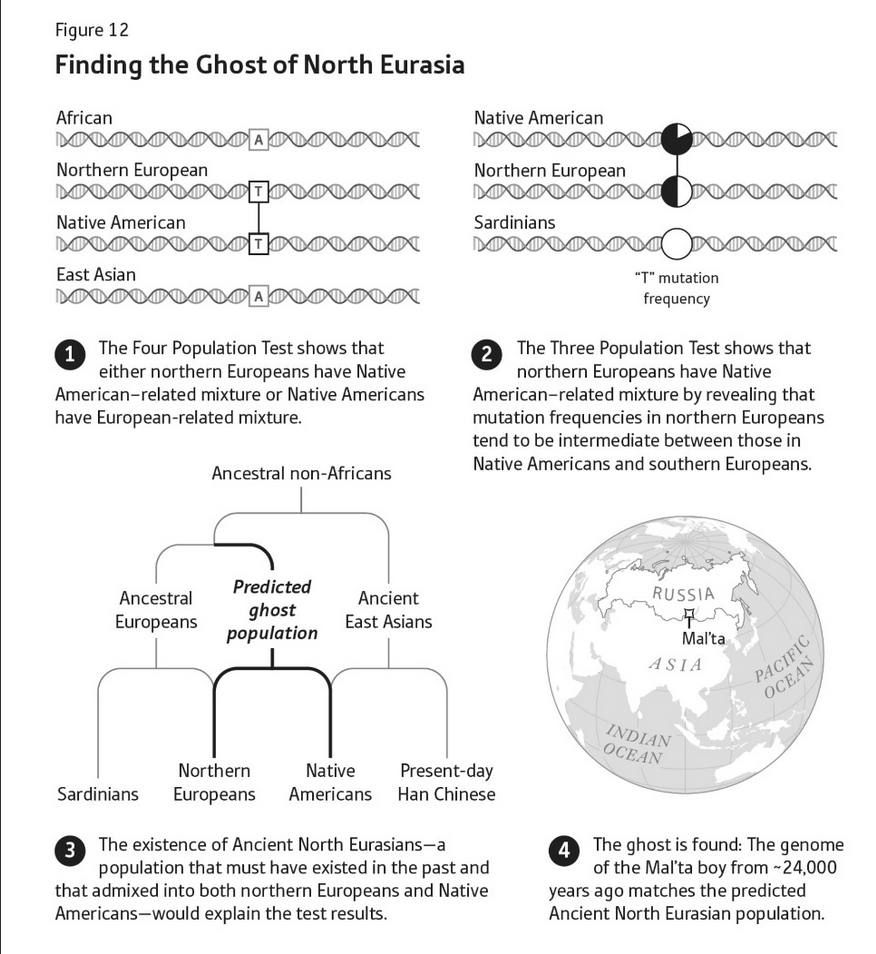
One of the “duh” stories is the final, conclusive identification of the people who brought horses, wagons, and Indo-European languages to Europe with the Yamnaya culture of the Pontic Steppe and their descendants. (David Anthony gives a very good overview of the archaeological case for this in The Wheel, the Horse, and Language, including some very cool experimental archaeology about horse teeth; you have my permission to skim the sections on pots.) My favorite surprising result, though, comes from a little farther north. People usually assume that Native Americans and East Asians share a common ancestor who split from the ancestors of Europeans and Africans before dividing into those two populations, but when Reich’s lab was trying to test the idea they found, to their surprise, that in places where Northern European genomes differ from Africans’, they are closer to Native Americans than to East Asians. Then, using a different set of statistical techniques, they found that Northern European populations were the product of mixture between two groups, one very similar to Sardinians (who are themselves almost-unmixed descendants of the first European farmers) and one that is most similar to Native Americans. They theorized a “ghost” population, which they called the “Ancient North Eurasians”, who had contributed DNA both to the population that would eventually cross the Bering land bridge and to the non-Early European Farmer ancestors of modern Northern Europeans. Several years later, another team sequenced the genome of a boy who died in Siberia 24kya and who was a perfect match for that theorized ghost ANE population.
But we’ve already established that I’m the prehistory nerd in this family; were you as jazzed as I was to read about the discovery of the Ancient North Eurasians?
1. That’s the latest plausible date for the arrival of full “behavioral modernity” in Africa, though our genus goes back about two million years, tool use probably three million, and I think there’s a good case that Homo was meaningfully “us” by 500kya. (That’s “thousand years ago” in “I talk about deep history so much I need an acronym”, fyi.)
Banning Roger Waters would be playing his game
In Spiked, Daniel Ben-Ami explains why we should reject the arguments about banning Roger Waters, formerly the frontman for Pink Floyd, and lately a pretty out-there antisemite:

Screencapture from a YouTube video.
Pressure is mounting to ban Roger Waters from performing in Britain. The former Pink Floyd frontman and veteran anti-Israel activist stands accused of anti-Semitism. But whatever one makes of Waters’s antics, his performances should not be cancelled.
Waters is set to perform his first UK show tonight in Birmingham, with further concerts scheduled for Glasgow, London and Manchester. These are part of his controversial “This Is Not a Drill” tour, which began its European leg a few months ago. The show contains a number of controversial elements, such as Waters dressing up in a Nazi-style uniform and brandishing a gun, while Anne Frank’s name is projected above the stage. In past tours, he has floated an inflatable pig with a Star of David on it above the stage.
The Waters row came to a head earlier this month, when local authorities in Frankfurt attempted to ban his concert. The ban was successfully challenged by Waters in court and the concert went ahead, despite protests. Waters is now being investigated by the German police for wearing a Nazi-style uniform on stage at his Berlin gig (the display of Nazi symbols is illegal in Germany, except for educational or artistic purposes). According to Waters, he donned the uniform not to endorse Nazism, but in order to make a “scathing critique” of it.
Jewish community organisations in the UK have condemned Waters, with some calling for him to be censored. The Board of Deputies of British Jews has argued that his concerts are probably better described as political rallies. The National Jewish Assembly has called on the UK government to condemn Waters. The Campaign Against Antisemitism, a volunteer-led charity, has not only launched a petition to stop venues hosting him – it has also written to cinema chains demanding they cancel film screenings of his concerts.
[…]
There are also more practical reasons to challenge these attempts to cancel Waters. The campaign against him, first in Germany and now in Britain, has allowed Waters to present himself as a free-speech martyr. To some, this will lend credence to his dubious claim that he is the victim of shadowy, covert forces determined to silence his advocacy for the oppressed.
Besides, banning displays of anti-Semitism does not make the problem go away. On the contrary, it only encourages anti-Semitism to take on more disguised forms. This often includes the demonisation of Israel or of Zionism, rather than Jews as such. Even those who do genuinely hate Jews will rarely admit to it openly. Instead, they typically use coded language, which is harder to challenge and confront.
By all means, protest outside Waters’s concerts and challenge his outrageous antics. But the attempts to ban his concerts are an affront to freedom. And they will do nothing to help the struggle against anti-Semitism. Roger Waters must have the right to perform.
How to Make a Wall Shelf | Episode 2
Paul Sellers
Published 20 Jan 2023With all the housing dadoes completed and the main body together, we must cut the middle shelf to length and determine the shoulder lines for the stepped part of the stepped housing dado joint.
The practicalities ensure that all of the shoulder lines close up perfectly. The patterns we use are important to a wide range of other projects, so learning them now aids us in establishing patterns of construction.
These joints are used in a wide range of shelving units, ranging from bookshelves to toy storage and many other projects. The unit we build here has three types of commonly used housing dado, and the joints we consider mostly as the bookshelf joints.
That said, it can be used for toy boxes and firewood boxes, but we also use it in drawer making too.
——————–
(more…)
QotD: “The Puritans were the SJWs of their day”
The Puritans, as English Calvinists were called, wrote difficult prose, but in translation it sounds shockingly modern. The Puritans were the SJWs of their day, obsessed with their own pwecious widdle selves. They didn’t get around to making up xzheyr own pronouns, but they did give themselves self-righteous new names — when Ben Johnson called his caricature Puritan Zeal-of-the-Land Busy he got big laughs, but he wasn’t really joking, they really did stuff like that. To be a Puritan requires two things: An obsessive focus on the tiniest micro-movements of your own soul …
… and an equally obsessive focus on forcing other people to disclose the tiniest micro-movements of their souls. There’s nothing anyone could ever do, so trivial that a Puritan could in good conscience overlook it. Calvin’s Geneva was the closest thing to a police state 16th century technology allowed, and when their turn came, Oliver Cromwell and the boys gave importing it to England the old college try. And, of course, Plymouth Bay Colony started as a Puritan police state …
Ideology, then, removes the distinction between public and private. You can’t simply say you’re a Puritan, you really have to BE one — constantly, perfectly, since there’s nothing that Puritanism doesn’t touch. And the only way to do that, of course, is to do everything in full public view at all times. Calvin did — as Walzer remarks, John Calvin, the man, is almost completely absent from Calvin’s writings. (Unlike Luther, whose idiosyncratic, not to say lunatic, personality comes through in practically every sentence). Calvin achieved that clear windowpane prose Orwell claimed was the mark of a great writer — nothing between audience and subject at all. Calvin would, indeed, take the remark that he’s almost a complete cipher, personally, as a very high compliment.
Severian, “Ideology II”, Rotten Chestnuts, 2020-11-09.
May 31, 2023
The War Against The Patriarchy, updated
Janice Fiamengo responds to a recent Joel Kotkin op-ed in the National Post discussing the “war of the sexes” and the long, long string of victories chalked up by the “weaker sex”:

The war between the sexes has ended, and rather than a co-operative future that could benefit all, it has turned out to be more like a lopsided win for the female side.
So begins Joel Kotkin’s National Post op/ed “Women have won the ‘war between the sexes’, but at what cost?” It is a welcome but disappointing analysis that starts with a show of defiance and ends in quiet desperation. Of course, it’s good to find anyone in a major newspaper willing to cast a less-than-adulatory eye on “The Future [that] is Female” or to write sympathetically about men, and Kotkin, a prolific author on cities and technocracy, proves his good faith on the strength of that opening statement alone. Aside from the wishful thinking of believing feminism to be winding down (was #MeToo a prelude to ceasefire?) or ever having envisioned a co-operative future (he should take a look at Kate Millett’s incendiary “Theory of Sexual Politics“), Kotkin is to be commended for daring to name as a war the decades of post-1960s activism, in which all the decisive victories have been claimed by feminists against men.
Kotkin, however, isn’t able to continue in the take-no-prisoners style he chose for his opening salvo. He is prevented, either by his own prudence, his lack of deep knowledge, or the paper’s editorial insistence, from targeting feminist ideology and policies in the rest of the article. In fact, the article doesn’t name a single piece of debilitating feminist legislation or even make one reference to the many expressions of anti-male contempt that are now deeply embedded in our public culture. The result is a curiously disembodied discussion in which serious social problems linked to male decline are pointed to without any attempt made to say exactly how they came about or how they might be reversed.
“The crux of the problem,” Kotkin tells us to start off, “lies in the fact that as women rise, men seem to be falling.” Here we see him start to draw back from the attack, as if afraid to say what he really thinks. His phrasing makes male decline sound like a natural phenomenon, an illustration of the primordial principle of Yin and Yang. Or perhaps it is simply that men, with their allegedly fragile egos and hegemonic masculinity, haven’t been able to compete against all that female ability, once dammed up by the patriarchy, now finally being let loose on the world (though always with calls for more to be done to assist women).
[…]
Kotkin refers to men “left behind” in the economy, but he keeps mum about the decades of affirmative action in higher education and hiring (detailed by Paul Nathanson and Katherine Young in Legalizing Misandry, pp. 81-124) as well as draconian sexual harassment legislation that have made work life unrewarding and often punitive for men.
He stresses the loss of sexual amity and of willingness to marry, but avoids discussing the nightmare of family law that has made marriage or even cohabitation perilous for many men.
The sins of omission do not end there. Perhaps working on the assumption — not without basis — that any discussion of social problems will need to focus on women at least as much as on men, Kotkin proceeds to backtrack on his earlier claim about women’s victory in the sex war, outlining instead a downbeat portrait of women’s troubles. Citing research by Jonathan Haidt, he tells us that adolescent girls have been severely affected by depression and self-harm, that many young women, without reliable men to support them, have had to fend for themselves in a difficult economic climate, and that single mothers, left with few options, are unable to offer stability to their children. It looks as if the decline of men mentioned early in the article has mainly hurt women and their children.
What Kotkin neglects to mention — surely deliberately — is that adolescent boys commit suicide at 4 X the rate of girls, resolving their depression decisively enough that Haidt seems not to have felt the need to account for them; that women are the ones who choose divorce in approximately 70% of cases; and that divorced fathers are too often denied a real role in their children’s lives while being burdened past endurance by exorbitant support payments. In other words, for every sad woman held up for our concern, there is a plurality of equally sad men rendered invisible in the conventional reporting. The staggering statistics on male suicide provide a stark illustration of Kotkin’s initial contention about the casualties of the sex war — yet he leaves these aside, choosing instead to voice the now-obligatory concern about the trans threat to women’s sports.
Perhaps most importantly, Kotkin suggests through his word choice that the data he cites are simply “trends”, occurrences that came about through economic and demographic factors independent of the sex war initially evoked. But they aren’t. They flow directly from a feminist vision in which the family — explicitly understood by feminist leaders to be a source of abuse and oppression — must be transformed and women liberated from reliance on the fathers of their children. Under this vision, a more just and equitable world will be ushered in by women’s superior leadership once they are freed from their unpaid labor in the home and the many sexist barriers that hold them back. That freedom must be aided, according to conventional wisdom, through abundant contraception, unfettered abortion, collectivized child care, no-fault divorce, programs and propaganda to urge men to do more housework, and non-stop encouragement to women — in movies, sit-coms, advertising, articles, and government equity programs — to give up on their men.
The Original Mai Tai from 1944
Tasting History with Max Miller
Published 30 May 2023
(more…)
Alvin Toffler may have been utterly wrong in Future Shock, but I suspect his huge royalty cheques helped soften the pain
Ted Gioia on the huge bestseller by Alvin Toffler that got its predictions backwards:
Back in 1970, Alvin Toffler predicted the future. It was a disturbing forecast, and everybody paid attention.
People saw his book Future Shock everywhere. I was just a freshman in high school, but even I bought a copy (the purple version). And clearly I wasn’t alone — Clark Drugstore in my hometown had them piled high in the front of the store.
The book sold at least six million copies and maybe a lot more (Toffler’s website claims 15 million). It was reviewed, translated, and discussed endlessly. Future Shock turned Toffler — previously a freelance writer with an English degree from NYU — into a tech guru applauded by a devoted global audience.
Toffler showed up on the couch next to Johnny Carson on The Tonight Show. Other talk show hosts (Dick Cavett, Mike Douglas, etc.) invited him to their couches too. CBS featured Toffler alongside Arthur C. Clarke and Buckminster Fuller as trusted guides to the future. Playboy magazine gave him a thousand dollar award just for being so smart.
Toffler parlayed this pop culture stardom into a wide range of follow-up projects and businesses, from consulting to professorships. When he died in 2016, at age 87, obituaries praised Alvin Toffler as “the most influential futurist of the 20th century”.
But did he deserve this notoriety and praise?
Future Shock is a 500 page book, but the premise is simple: Things are changing too damn fast.
Toffler opens an early chapter by telling the story of Ricky Gallant, a youngster in Eastern Canada who died of old age at just eleven. He was only a kid, but already suffered from “senility, hardened arteries, baldness, slack, and wrinkled skin. In effect, Ricky was an old man when he died.”
Toffler didn’t actually say that this was going to happen to all of us. But I’m sure more than a few readers of Future Shock ran to the mirror, trying to assess the tech-driven damage in their own faces.
“The future invades our lives”, he claims on page one. Our bodies and minds can’t cope with this. Future shock is a “real sickness”, he insists. “It is the disease of change.”
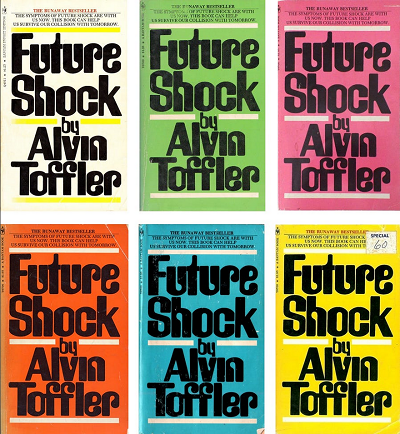
As if to prove this, Toffler’s publisher released the paperback edition of Future Shock with six different covers — each one a different color. The concept was brilliant. Not only did Future Shock say that things were constantly changing, but every time you saw somebody reading it, the book itself had changed.
Of course, if you really believed Future Shock was a disease, why would you aggravate it with a stunt like this? But nobody asked questions like that. Maybe they were too busy looking in the mirror for “baldness, slack, and wrinkled skin”.
Toffler worried about all kinds of change, but technological change was the main focus of his musings. When the New York Times reviewed his book, it announced in the opening sentence that “Technology is both hero and villain of Future Shock“.
During his brief stint at Fortune magazine, Toffler often wrote about tech, and warned about “information overload”. The implication was that human beings are a kind of data storage medium — and they’re running out of disk space.
Improvised Weapons of WW2 | Anti-Tank Chats #8 | The Tank Museum
The Tank Museum
Published 10 Feb 2023Historian Stuart Wheeler is back with another Anti-Tank Chat. In this episode, he looks at the development and use of improvised, thrown and placed infantry anti-tank weapons, available to British and Commonwealth forces in World War II.
(more…)
QotD: The second system of war
In such war, the goal was to deliver the siege. But delivery of the siege meant a large army which might now be confronted in the field (for it was unlikely to move by stealth, being that it has to be large enough to take the town). And so to prohibit the siege from being delivered, defenders might march out and meet the attackers in the field for that pitched battle. In certain periods, siegecraft or army size had so outpaced fortress design that everyone rather understood that after the outcome of the pitched battle, the siege would be a forgone conclusion – it is that unusual state of affairs which gives us the “decisive battle” where a war might potentially be ended in a stoke (though they rarely were).
We may term this the second system of war. It is the system that most modern industrial and post-industrial cultures are focused on. Our cultural products are filled with such pitched battles, placed in every sort of era of our past or speculative future. It is how we imagine war. Except that it isn’t the sort of war we wage, is it?
Because in the early 1900s, the industrial revolution resulted in armies possessing both amounts of resources and levels of industrial firepower which precluded open pitched battles. All of those staples of our cultural fiction of battles, developed from the second system – surveying the enemy army drawn up in battle array, the tense wait, then the furious charge, coming to grips with the enemy in masses close up – none of that could survive modern machine guns and artillery.
Bret Devereaux, “Collections: The Universal Warrior, Part IIa: The Many Faces of Battle”, A Collection of Unmitigated Pedantry, 2021-02-05.
May 30, 2023
Australia’s … deranged … attitudes to vaping
Christopher Snowden describes — because it’s impossible to actually explain — the Australian government’s hysterial and illogical attitude toward vaping:
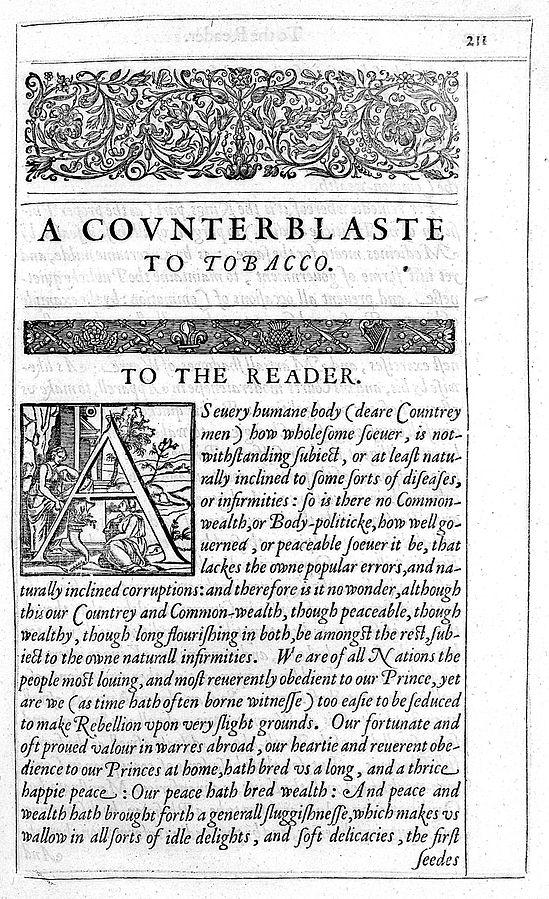
King James I would recognize and approve of Australia’s anti-vaping stance, probably. It would certainly be in the same territory as His Majesty’s pamphlet A Counterblaste to Tobacco where he let his strong feelings be known about “so vile and stinking a custom”.
For the past decade, Australian newspaper articles about e-cigarettes have seemed like communiqués from another dimension. The term “moral panic” is over-used, but how else can you describe a situation in which people are so terrified of safer nicotine delivery devices that doctors give their children cigarettes to stop them vaping?
The sale of nicotine e-cigarettes has always been banned in Australia. Prohibition is the default and, along with the highest cigarette taxes in the world, it has led to a huge black market in vapes (and, indeed, in tobacco). It appears that many teenagers are vaping there and what they are vaping is unregulated.
The Aussies could have done what New Zealand did and legalise e-cigarettes. Instead, they doubled down and banned the importation of nicotine vapes for personal use. That didn’t work so they are now banning the sale of all the remaining (i.e. non-nicotine) disposable vapes. Something tells me that won’t work either, but the government is so far down the rabbit hole it can only keep digging.
Their politicians have convinced themselves that “Big Tobacco” is getting a new generation of Aussies hooked on killer vapes with aggressive marketing. It’s a paranoid delusion. There is no e-cigarette marketing in Australia. The products flooding the black market are coming straight from China, not from “Big Tobacco”. And insofar as the products are dangerous it is because they are totally unregulated.
Down this road lies madness but if the Australians want to go down it, that’s up to them. I have no plans to go back there. As an Australian reader said to me recently, “Go and see a Kangaroo at a zoo. Don’t even waste a single dollar on ‘tourism’ of the doomed failed state of what’s become of Australia.”
But while the Aussies can go to Hell in whatever handcart they like, I don’t appreciate them pushing their nonsense on the rest of us, as the BBC’s recently appointed Sydney correspondent has done today with an article titled “Why Australia decided to quit its vaping habit“.
From the outset, it is clear that the author has spent too long Down Under.
Despite vapes already being illegal for many, under new legislation they will become available by prescription only.
The number of vaping teenagers in Australia has soared in recent years and authorities say it is the “number one behavioural issue” in schools across the country.
And they blame disposable vapes — which some experts say could be more addictive than heroin and cocaine — but for now are available in Australia in every convenience store, next to the chocolate bars at the counter.
Some experts? Do they have names? People say a lot of things. The job of a journalist is to find out which ones are telling the truth.
And if e-cigarettes are illegal, why are they available “in every convenience store”? This sounds like an enforcement issue that isn’t going to be solved by more prohibition.
Ban all the words!
Chris Bray reflects on the historical context of literature bans:
Before the Civil War, Southern states banned abolitionist literature. That ban meant that postmasters (illegally!) searched the mail, seized anti-slavery tracts, and burned them. And it meant that people caught with abolitionist pamphlets faced the likelihood of arrest. The District of Columbia considered a ban, then didn’t pass the thing, but Reuben Crandall was still arrested and tried for seditious libel in 1833 when he was caught with abolitionist literature. He was acquitted, then died of illness from a brutal pre-trial detention. Seizure, destruction, arrest: abolitionist literature was banned.
The Soviet writer Yevgeny Zamyatin wrote a 1924 novel, We, depicting a world in which an all-powerful government minutely controlled every aspect of life for an enervated population, finding as an endpoint for their ideological project a surgery that destroyed the centers of the brain that allowed ordinary people to have will and imagination. The Soviet government banned Zamyatin’s work: They seized and destroyed all known copies, told editors and publishers the author was no longer to allowed to publish, and sent Zamyatin into exile, where he died without ever seeing his own country again. Seizure, destruction, exile: Yevgeny Zamyatin’s work was banned.
During World War I, the federal government banned literature that discouraged military service, including tracts that criticized conscription. Subsequently, “socialists Charles Schenck and Elizabeth Baer distributed leaflets declaring that the draft violated the Thirteenth Amendment prohibition against involuntary servitude”. They were arrested, convicted, and imprisoned. The Supreme Court upheld the conviction. Anti-conscription literature was banned: It was seized and destroyed, and people caught distributing it were sent to prison.
In 2023, the tedious midwit poet Amanda Gorman posted on Twitter that she was “gutted” — the standard emotion for tedious midwits — to discover that one of her poems had been “banned” by a school in Florida. The news media raced to proclaim that Florida schools are banning books, the leading edge of the Ron DeSantis fascist wave.
As others have already said, Gorman’s boring poem was moved from an elementary school library shelf to a middle school library shelf, without leaving the library

It might be time to consider getting a home generator … while you still can
J.D. Tuccille in today’s The Rattler newsletter suggests that if you’ve been considering getting a generator to power your house in case of blackouts, now might be a good time:

The regulatory body that oversees the nation’s power grid cast a bit of a chill over the coming warm months when, in mid-May, it cautioned that the country might not generate enough electric power to meet demand. Coming after multiple warnings from regulators, grid operators, and industry experts that enthusiasm for retiring old-school “dirty” generating capacity is outstripping the ability of renewable sources to fill the gap, the announcement is a heads-up to Americans that they may want to make back-up plans for a power grid growing increasingly unreliable. It’s also a reminder that green ideology is no substitute for the ability to flip a switch and have the lights come on.
Unreliable Energy
“NERC’s 2023 Summer Reliability Assessment warns that two-thirds of North America is at risk of energy shortfalls this summer during periods of extreme demand,” the North American Electric Reliability Corporation, a nominally non-governmental organization with statutory regulatory powers, noted May 17. “‘Increased, rapid deployment of wind, solar and batteries have made a positive impact,’ said Mark Olson, NERC’s manager of Reliability Assessments. ‘However, generator retirements continue to increase the risks associated with extreme summer temperatures, which factors into potential supply shortages in the western two-thirds of North America if summer temperatures spike.'”
This is not the first time we’re hearing that the power grid isn’t up to meeting demand for electricity. Nor is it the first time we’re told that renewable sources such as wind and solar are coming online more slowly than power-generation capacity based on fossil fuels is being retired.
Dwindling Power Plants
“The United States is heading for a reliability crisis,” Commissioner Mark C. Christie of the Federal Energy Regulatory Commission (FERC) told the Senate Committee on Energy & Natural Resources during a May 4 hearing. “I do not use the term ‘crisis’ for melodrama, but because it is an accurate description of what we are facing. I think anyone would regard an increasing threat of system-wide, extensive power outages as a crisis. In summary, the core problem is this: Dispatchable generating resources are retiring far too quickly and in quantities that threaten our ability to keep the lights on. The problem generally is not the addition of intermittent resources, primarily wind and solar, but the far too rapid subtraction of dispatchable resources, especially coal and gas.”
The federal Energy Information Administration foresees almost a quarter of coal generating capacity being retired by the end of the decade — a process already in progress. Just this month it announced “the United States will generate less electricity from coal this year than in any year this century.” Non-hydropower renewables are the only generating capacity sources really seen growing in the short-term.
In February of this year, PJM Interconnection, which manages grid operations in much of the eastern United States, warned of “increasing reliability risks … due to a potential timing mismatch between resource retirements, load growth and the pace of new generation entry.”
M1886 Lebel Rifle at the Range
Forgotten Weapons
Published 17 Mar 2013The French M1886 Lebel was the first smallbore smokeless powder rifle adopted by a major military, and was a game changer in the European arms race in the 1880s. It wasn’t an outstanding design in many ways (like the slow-loading tube magazine and requirement to use a screwdriver to remove the bolt), but its 8mm smokeless cartridge jumped France to the front of the technological race regardless. Today, we’re taking one out to the range to see how it shoots.


