Quotulatiousness

July 13, 2023

Bill Slim’s plan for the Battle of Meiktila in March 1945

Filed under: Asia, Books, Britain, History, India, Japan, Military, WW2 — Tags: , — Nicholas @ 05:00

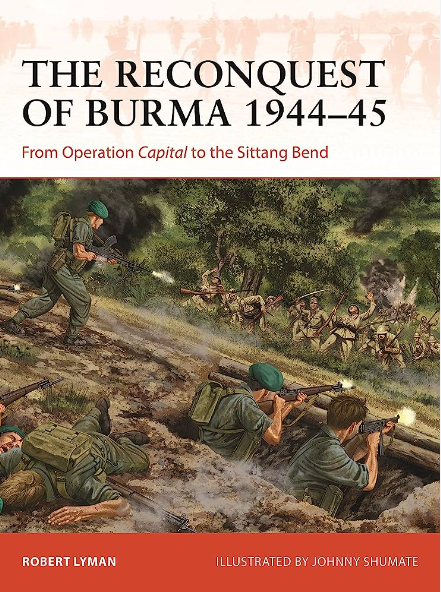
Dr. Robert Lyman on the subject of his most recent book, The Reconquest of Burma 1944-45: From Operation Capital to the Sittang Bend:

When I was writing my latest book with General Lord Dannatt he said to me, “Rob, if I’ve got one criticism of A War of Empires it’s that you don’t emphasise enough the role of Bill Slim in coming up with the plan for victory in 1945, and executing it perfectly.” Fair. As Slim’s military biographer, I told Richard that I didn’t want to be accused of rewriting that book again. I was conscious of this problem as I was writing A War of Empires.

But it is fair criticism. It may be that I underplayed Slim’s role when I was considering all the other critical features in this great campaign. The idea behind the dramatic victory by 14th Army in Burma in 1945 was Slim’s and Slim’s alone. He pursued his own plan through to its remarkable conclusion.

[…]

Slim’s original plan was to fight the main strength of the Japanese army on the Shwebo Plain, a dry, flat plain between the loops of the Chindwin and Irrawaddy. Not only would the terrain be well suited to the deployment of armour, for which the Japanese had little effective reply, but the Japanese would be trapped with the river-line at their back. Slim had assumed that the Japanese would be unprepared to make a voluntary withdrawal. The scene was set for Slim to be able to deploy his superior mobility and firepower to destroy the main Japanese army in Burma.

By the end of the year, however, it became apparent that the Japanese were not going to conform to Slim’s plan for the battle, and General Kimura had seen the trap which his forces would be caught in if they attempted to stand and fight in the Shwebo Plain. Showing unusual flexibility and moral courage Kimura promptly withdrew his reconstituted 15th Army behind the Irrawaddy. Kimura hoped, not without reason, to be able to smash Slim’s army as it attempted to cross the river, which in itself presented an immense obstacle to the British. He would then counter-attack and destroy Slim as the British withdrew during the monsoon to the Chindwin.

Kimura’s move behind the Irrawaddy destroyed at a stroke Slim’s plan. Undaunted, and recognising the supreme importance of destroying Kimura’s army rather than taking ground for its own sake, Slim came up with another plan. In basic outline, his new plan (Operation Extended Capital) entailed crossing the Irrawaddy and fighting the decisive battle in February in the plain around Mandalay and the low hills around Meiktila, the key enemy air and supply base in Central Burma. Both the road and rail links between Mandalay and Rangoon ran through Meiktila. If Meiktila fell, the whole structure of the Japanese defence of Central Burma would collapse.

This “simple” bench made me humble when I tried to build it

Filed under: Tools, Woodworking — Tags: , , — Nicholas @ 04:00

Rex Krueger
Published 12 Jul 2023

It’s just nails and pine, but this piece was full of tricks.
(more…)

“… if Ukraine were to join NATO in the middle of a war, then congrats – most of Europe and North America are at war”

Filed under: Government, Military, Russia — Tags: , , , , , — Nicholas @ 03:00

As I’ve said several times, I have great sympathy for ordinary Ukrainians caught up in a war not of their making, but I’m not a fan of the awesomely corrupt Ukrainian government. NATO nations providing weapons, ammunition, and training is fine, but in no way is Ukraine ready to become a member of the alliance and will not be until after this war is over and they conduct a very significant set of anti-corruption reforms in their national government. CDR Salamander points out the insanity of western pundits demanding that NATO add Ukraine to the alliance in the middle of a major war:

I understand the desire for Ukraine — and others for that matter — to be part of NATO. I also understand why the frontline states in Central Europe such as the Baltics republics and Visegrad Group would like Ukraine in as well. Defense in depth and long fronts are a thing.

As much as I can sympathize with the above, I also understand the reasons that Ukraine and other nations may never be right for NATO membership, or at best be a decade or two out. Single points of failure triggers to another world war — where every new member state increases the aggregate risk to all members — is not a minor thing to consider.

There is also the very real fact that Ukraine is in a war right now, for her an existential war with Russia. This CNN article is a perfect example of some of the absolutely foolish questions people are even considering right now. I’m not even going to quote from it as there are dozens like it out as the NATO summit is going on. It is a waste of your time.

You don’t need to be an international lawyer to understand that if Ukraine were to join NATO in the middle of a war, then congrats — most of Europe and North America are at war. As history tells us, when Europe and North America goes to war, eventually the world joins in.

For today’s post, I’d like to pull some quotes from a superb Financial Times article, NATO’s dilemma: what to do about Ukraine’s bid to join?

    Membership represents the long-term security that Kyiv wants and was promised 15 years ago. But Russia’s war has complicated things

    When Ukrainian President Volodymyr Zelenskyy strides into Nato’s annual summit in Vilnius on Wednesday, his country will have been fighting a full-scale war of survival against Russia for 503 days.

2008, in the last year of the Bush-43 administration. The year it looked like we had Iraq stabilized yet were already planning to take the keys in Afghanistan back from NATO after the alliance culminated in the summer of 2007.

The year of imperial overreach in denial;

    It was over breakfast in Bucharest in 2008 that the seeds of Nato’s current dilemma were sown.

    At an early morning meeting on the second day of the alliance’s summit that year, then secretary-general Jaap de Hoop Scheffer met with US president George W Bush and his French and German counterparts Nicolas Sarkozy and Angela Merkel.

    The outcome of that breakfast, and a result of Merkel softening her opposition to Bush’s proposal to offer membership to Ukraine and Georgia, was a statement by the entire Nato alliance.

    Both countries “will become members of Nato”, it said, without providing a timeline. That declaration, at the same time both unequivocal and non-committal, was hailed as a major achievement. It has since sunk into infamy.

Amazing how people forget that other nations get a vote. Your actions will cause reactions by those who either think they will benefit from or be endangered by them. Roll that simple context in to the 1,000 year record of people west of the Vistula misreading Russia and you have this;

    Four months later Putin’s tanks rolled into northern Georgia. In 2014 his special forces annexed Ukraine’s Crimean peninsula. Nato, as Putin knew well, refuses to accept new members with “frozen conflict” on their territory. Aside from condemnatory rhetoric, Nato did little to punish Moscow. Putin, who had been present at the Bucharest summit as a guest, had called Nato’s bluff.

Putin was right. No one will join NATO who has border disputes or are best known for their globe-spanning corruption.

NATO and the USA’s natsec “blob” was, again, wrong. Being wrong isn’t the problem. It is an imperfect business where mistakes are going to be made. The important thing is to learn from them and if the same people and institutions are perpetually wrong, you get new people and institutions to help you make decisions. That is the danger. It isn’t that we “remember everything but learn nothing” it is more that we “remember only what confirms our priors and only learn to try harder next time.”

Praise for the #151 Flat-Bottomed Spokeshave | Paul Sellers

Filed under: Tools, Woodworking — Tags: , , — Nicholas @ 02:00

Paul Sellers
Published 10 Feb 2023

It’s easy to underestimate the value of the #151 spokeshave, no matter the maker. But these simple tools work amazingly for a wide range of woodworking tasks, and you only need the flat-bottomed version as it will work equally well for both convex and concave surfaces.

With this video, see just how versatile the flat-bottomed spokeshave is and why you should own one for your woodworking tasks that need shaping.
(more…)

QotD: The Annales school of history

The Annales school is a style of historical thinking that emerged in France in the early 1900s; at least for pre-modernists, the dominating figures here tend to be Marc Bloch and Fernand Braudel. It got its name because of its close association with Annales d’Historie Economique et Sociale. Fundamentally, what sets the Annales approach apart is first its focus and then the methods that focus demands.

The big shift in focus for the Annales school was an interest in charting the experience of society below the level of elites (though the elites are not abandoned either), what is sometimes termed “history from below”, as distinct from traditional elite-centered “great man” history or the more deterministic Marxist models of history at the time. You can see the political implications, of course, in the very early 1900s, of declaring the common man worthy of study; this is generally a history from the left but not the extreme left. That focus in turn demanded new approaches because it turned the focus of social history towards people who by and large do not write to us.

In reaching for that experience, Annales scholars tended to frame their thinking in terms of la longue durée (“the long run”); history was composed of three parts: événements (“events”), conjonctures (“circumstances”) and finally la longue durée itself. Often in English this gets rendered as a distinction between “events” (kings, wars, politics, crises) and “structures” (economics, social thought and at a deeper level climate, ecology, and geography). What Annales scholars tended to argue was that those structures were often more important than the events that traditional historians studied: the farmer’s life was far more shaped by very long-term factors like the local ecology, the organization of his farming village, the economic structure of the region and so on. And then the idea goes, that by charting those structures, you can figure things out about the lives of those farmers even if you don’t have many – or any – of those farmers writing to you.

Important to this was the idea of enduring patterns of thought within a society, what Bloch termed mentalités (“mentalities”, like longue durée, this is a technical term usually used in French to make that fact clear). Mentalités – Bloch’s original example was the idea that kings had a holy healing touch, but this could be almost any kind of social construct or pattern of ideas (indeed, one critique of it is that the notion of mentalités is broad and ill-defined) – can last a long time and can inform or constrain the actions of many actors within a society; think of how successive generations of kings can have their decisions shaped or constrained by their societies view – their own view – of kingship. That view of kingship might be more impactful than any one king and so pervasive that even a king would struggle to change it.

So how does this influence my work? I tend to be very much a “history from below” kind of historian, interested in charting the experience of regular farmers, soldiers, weavers and so on. The distinction between the long-term structures that shape life and the short-term events that populate our history is very valuable to think with, especially for identifying when an event alters a structure, because those tend to be very important events indeed. And I think a keen attention to the way people thought about things in the past and how those mentalités can be different than ours is very important.

That said, the Annales stress on mentalités has in some ways been overtaken by more data-driven historical methods on the one hand or a strong emphasis on local or individual experience (“microhistory”) on the other. Mentalités tend to be very big picture, asking how, say, “the French” thought about something over a period of decades or centuries and seeking to know how that shaped their experience. But archaeology, demographics or economic data can reveal patterns of behavior which might not correspond to the mentalités that show up in written texts; this is fundamentally the interaction that informs the “revenge of the archaeologists” in the study of the ancient economy, for instance. On the other hand, not everyone in that big group thinks the same and a microhistory of an individual or a single village might reveal telling local variations not captured in massive-scale structures.

Fortunately, historians do not need to be doctrinaire in our use of theory, we don’t have to pick one and stick to it. Different projects also lend themselves to different approaches. I think the Annales school offers a lot of really useful tools to have my historian’s toolbox, but they sit alongside military theory, archaeological material culture studies methods, philological approaches, a smattering of economic and demographic tools, etc.

Bret Devereaux, Referenda ad Senatum: January 13, 2023: Roman Traditionalism, Ancient Dates and Imperial Spies”, A Collection of Unmitigated Pedantry, 2023-01-13.

July 12, 2023

“[E]lite colleges are machines for laundering privilege”

Scott Alexander ponders the reasons our elite universities operate as they do:

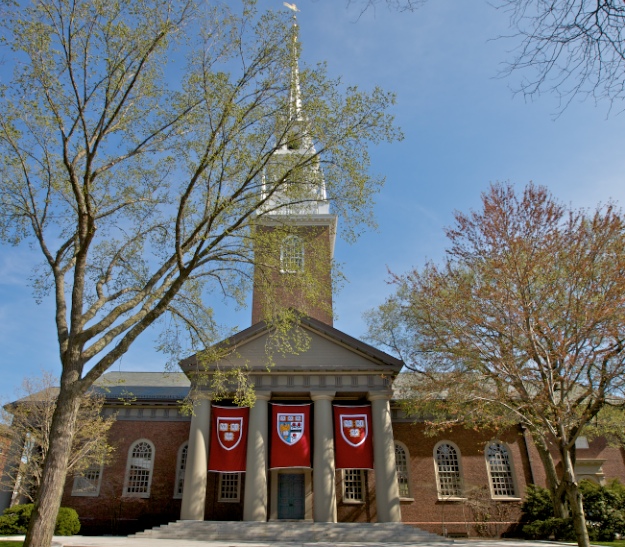
Harvard University Memorial Church.
Photo by Crimson400 via Wikimedia Commons.

We could think of “the best college” as a self-fulfilling prophecy; for whatever reason, one college has gotten a reputation as the one whose signal is most valuable. Everyone naturally tries to get in there; if they fail, they go to the college with the next-best reputation, and so on. The system is stable; the “best” college will keep its reputation (since it gets the best students) and the best students will always want to go to the best college. If, as Matt’s son suggests, all the Ivies started accepting the worst students instead, an Ivy degree would soon become a signal that you’re bad, and employers would stop respecting it.

I heard a fascinating variation of this hypothesis from Matt Christman of Chapo Trap House: elite colleges are machines for laundering privilege.

That is: Harvard accepts (let’s say) 75% smart/talented people, and 25% rich/powerful people. This is a good deal for both sides. The smart people get to network with elites, which is the first step to becoming elite themselves. And the rich people get mixed in so thoroughly with a pool of smart/talented people that everyone assumes they must be smart/talented themselves. After all, they have a degree from Harvard!

The most blatant form of this obfuscation: suppose you own a very successful family business. You can leave your son your fortune, you can leave him the business, you can leave him your mansion, but you can’t (directly) leave him an aura of having deserved all these things. What you can do is make a $10 million donation to Harvard in exchange for them accepting your son. Your son gets a Harvard degree, a universally-recognized sign of being a highly meritorious person. Then when you leave him the business, everyone will agree he deserves it. Who said anything about nepotism? Leaving a Harvard graduate in control of your business is an excellent decision!

This happens a little, but I think it mostly isn’t this obvious. More often the transactions are for abstract goods: prestige, associations, favors. The Maharaja of Whereverstan sends his daughter to Harvard so that she appears meritorious. In exchange, Harvard gets the credibility boost of being the place the Maharaja of Whereverstan sent his daughter. And Harvard’s other students get the advantage of networking with the Princess Of Whereverstan. Twenty years later, when one of them is an oil executive and Whereverstan is handing out oil contracts, she puts in a word with her old college buddy the Princess and gets the deal. It’s obvious what the oil executive has gotten out of this, but what does the Princess get? I think she gets the right to say she went to Harvard, an honor which is known to go mostly to the meritorious.

People ask why Harvard admissions can still be bribed or influenced by the rich or well-connected. This is the wrong question: the right question is why they ever give spots based on merit at all. The answer is: otherwise the scheme wouldn’t work. The point of a money-laundering operation is to take in both fairly-earned and dirty money, then mix them together so thoroughly that nobody can tell which is which. Likewise, the point of a privilege-laundering operation is to take in both fairly-earned and dirty privilege, then stamp both with a Harvard degree. “Fairly-earned privilege” means all the brilliant talented ambitious youngsters admitted on the basis of their SAT scores and grades and impressive accomplishments; “dirty privilege” means the kids of various old-money aristocrats, foreign potentates, and ordinary super-rich people. Colleges mix them together, with advantages for both groups.

Is this good or bad? It’s good insofar as it provides a justification for making some elite positions dependent on merit and accessible to anyone, but bad insofar as it helps defend and obfuscate the ones that aren’t. It’s good if you think it’s good for all the elites (meritocratic and otherwise) to know each other and be on the same page; it’s bad if you don’t want them to be (maybe because it helps them oppress people more efficiently).

I expect that without such a system the elites would do their own thing without any concession to merit whatsoever – so maybe it beats the alternative.

Nazi drone war begins – War Against Humanity 103

Filed under: Britain, Europe, Germany, History, Military, Weapons, WW2 — Tags: , , , , , — Nicholas @ 04:00

World War Two
Published 11 Jul 2023

Bombing enemy civilians does nothing to advance a nation’s war effort. But now, Adolf Hitler believes that the V-1 flying bomb, the first of the Vengeance Weapons, will bring London to its knees and unite the German population behind the war effort as never before. The missiles are ready for launch and thousands more civilians will die to satisfy the Führer’s
delusions.
(more…)

“Folksy” Joe Biden has always been a nasty piece of work

Filed under: Media, Politics, USA — Tags: , , , , — Nicholas @ 03:00

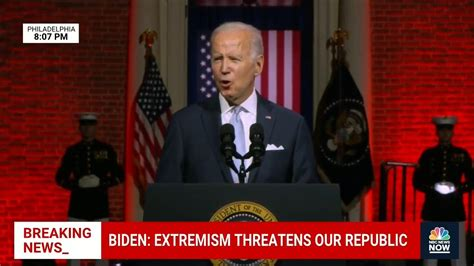
One of the most puzzling things about how Joe Biden has been represented in the legacy media is that — despite mountains of evidence that he’s a hot-tempered bully who has always been eager to belittle and demean other people — he still gets fawning coverage of his supposed kindly personality:

Joe Biden likes to present himself as a folksy type, the kind you’d think of as a kindly old uncle or something. He tells stories about Corn Pop and virtually anything else and the press eats it up.

But it’s a veneer, a mask Biden wears so the public will like him.

We’ve seen it slip a time or two, but Axios has a story that hints that what we’ve seen is just the tip of the iceberg.

    In public, President Biden likes to whisper to make a point. In private, he’s prone to yelling.

    Behind closed doors, Biden has such a quick-trigger temper that some aides try to avoid meeting alone with him. Some take a colleague, almost as a shield against a solo blast.

    The president’s admonitions include: “God dammit, how the f**k don’t you know this?!,” “Don’t f**king bullsh*t me!” and “Get the f**k out of here!” — according to current and former Biden aides who have witnessed and been on the receiving end of such outbursts.

    There’s no question that the Biden temper is for real. It may not be as volcanic as Bill Clinton’s, but it’s definitely there,” said Chris Whipple, author of The Fight of His Life: Inside Joe Biden’s White House.

    Whipple’s book quotes former White House press secretary Jen Psaki as saying: “I said to [Biden] multiple times, ‘I’ll know we have a really good, trusting relationship when you yell at me the first time.'”

    Whipple notes: “Psaki wouldn’t have to wait long.”

    Zoom out: Biden’s temper comes in the form of angry interrogations rather than erratic tantrums.

    He’ll grill aides on topics until it’s clear they don’t know the answer to a question — a routine that some see as meticulous and others call “stump the chump” or “stump the dummy”.

    Being yelled at by the president has become an internal initiation ceremony in this White House, aides say — if Biden doesn’t yell at you, it could be a sign he doesn’t respect you.

Go and read the whole thing, because this is troubling, and not just because I dislike Biden.

While Axios goes out of its way to paint this as just an impassioned politician who demands much of his staff, that’s not what I’m seeing here.

Instead, I’m seeing an abusive man who is taking advantage of his powerful position to bully his subordinates.

I won’t pretend I’ve never lost my temper before. Doing so would be a lie. However, my yelling at someone has never been a sign of respect. It’s been a sign that I lost control.

And if Biden is doing it this often, there’s not much chance the man has any control over much of anything.

Of course, this is a report from Axios. Maybe it’s not really a thing. Maybe I’m just reading too much into it because I can’t stand Biden.

DOES YOUR FLAG FAIL? Grey Grades The State Flags!

Filed under: History, Humour, USA — Tags: , — Nicholas @ 02:00

CGP Grey
Published 2 Apr 2023
(more…)

QotD: Media gullibility on military issues

Filed under: Media, Military, Quotations, Russia, USA, Weapons — Tags: , , , , , — Nicholas @ 01:00

One reason I don’t say much about the Ukraine war, for instance, is that I’m out of my depth, and simply don’t want to put in the necessary work to get up to speed. I don’t know a thing about contemporary Russian equipment (or NATO equipment for that matter). My grasp of strategy begins and ends with “playing Risk! against drunk frat boys”. If I went out there, I’d be a babe in the woods. “What was that bang?” “Oh, that’s the Q-35 matter modulator.” “What was that bang?” “That’s the Lepage glue gun. It glues a whole formation of bombers together in midair.”

The Media, of course, does not do this. They’d be happy to write up a whole big feature story about how the Russians’ Q-35 matter modulator wasn’t nearly what Vlad Putin, that lying bastard, bragged it up to be. And with the new Lepage gun gluing all those Russian planes together, the brave Ukrainians will be in Moscow for Easter!

Are they lying? Not really. Some very serious-looking persyn in a snazzy uniform with a lot of very colorful ribbons told them that the Q-35 matter modulator isn’t all that, and why would some brave freedom fighter lie to them? And besides — this is crucial — “fact checking” the stats on the Q-35 matter modulator would entail that you’ve never heard of it before …

… which is anathema to our intrepid reporterette’s sense of xzhyrself as a hard-hitting newshound who is very very Smart. After all, she scored a 35,000 on her SATs and graduated from the Assjammer School of Journalism with a 9.98 GPA. She’s got fellowships and awards and whatnot out the yingyang, plus 1.2 million Twitter followers. And it says “war correspondent” right there on her Facebook page. If the Q-35 matter modulator weren’t actually a thing, surely she would know.

Severian, “The Becky Cycle”, Founding Questions, 2023-02-27.

July 11, 2023

“Howard hit upon an ingenious solution: take the coolest parts of history, file off the serial numbers, and do with them as you will”

Filed under: Books — Tags: , — Nicholas @ 05:00

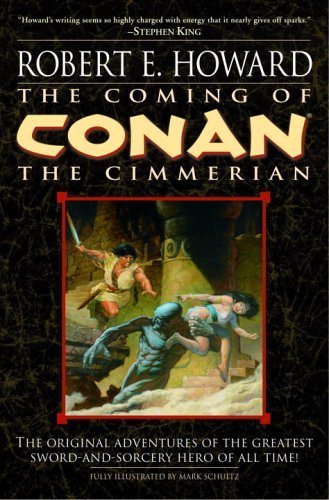
Jane Psmith reviews Robert E. Howard’s The Coming of Conan the Cimmerian:

    Know, oh prince, that between the years when the oceans drank Atlantis and the gleaming cities, and the years of the rise of the Sons of Aryas, there was an Age undreamed of, when shining kingdoms lay spread across the world like blue mantles beneath the stars — Nemedia, Ophir, Brythunia, Hyperborea, Zamora with its dark-haired women and towers of spider-haunted mystery, Zingara with its chivalry, Koth that bordered on the pastoral lands of Shem, Stygia with its shadow-guarded tombs, Hyrkania whose riders wore steel and silk and gold. But the proudest kingdom of the world was Aquilonia, reigning supreme in the dreaming west. Hither came Conan, the Cimmerian, black-haired, sullen-eyed, sword in hand, a thief, a reaver, a slayer, with gigantic melancholies and gigantic mirth, to tread the jeweled thrones of the Earth under his sandalled feet.

Robert E. Howard’s Conan stories are everything I have ever wanted in fantasy literature — decadent cities bowed under the weight of the ages, wicked sorcerers, gushing arterial blood, lurking antediluvian horrors, red-handed buccaneers, strange magics that have slumbered beneath the sands for untold centuries, glorious cavalry charges into the teeth of death, arcane jewels the size of ostrich eggs, monstrous ape-like demons with slavering jaws, captive princesses, steely thews — and this is the way to read them. For years they were only available in heavily-edited versions, interspersed with “posthumous collaborations”,1 and, worst of all, presented in chronological order (has Narnia taught us nothing?). These editions, though — there are two more volumes — give us Howard’s texts, in the order Howard wrote them, and beautifully illustrated.2 They’re a great pleasure to read, and you should, so I promise not to spoil any major plot points.

Howard got his professional start with boxing stories, but his great authorial love was historical fiction. “There is no literary work, to me, half as zestful as rewriting history in the guise of fiction,” he wrote in 1933. “I wish was I able to devote the rest of my life to that kind of work.” He published stories set during the Crusades (see, for example, Hawks of Outremer, which has some notable similarities to his later work on Conan) and the eras of Mongol and Islamic conquest, and failed to sell tales of ancient Irish warriors. Unfortunately, the markets were slim (more or less only Oriental Stories, which only ran for four years) and the demands of research high: “I could never make a living writing such things, though,” he went on. “[I]t takes me so long to complete one. I try to write as true to the actual facts as possible, at least, I try to commit as few errors as possible. I like to have my background and setting as accurate and realistic as I can …” In his Hyborian Age, the setting for his Conan stories, Howard hit upon an ingenious solution: take the coolest parts of history, file off the serial numbers, and do with them as you will. As a bonus, it means you can combine eras and civilizations that could never have coexisted (or, indeed, existed at all) in real history: the Hyborian Age has 13th century France (or its imagined version of Charlemagne and his Paladins) in the streaming banners of Aquilonia, the Old Kingdom of Egypt in the necromantic rituals of Stygia, warring Assyrian city-states in the lands of Koth, the hill tribesmen of Afghulistan and the tent-dwelling Shemite nomads and the wild pillaging Picts, all immediately recognizable. Howard paints in broadest of strokes, with none of the specifics that would obsess, say, me — there’s no fussing about why classical Greece is next door to the Timurids or why you have the Bronze Age one place and the Middle Ages elsewhere — but it works. Here’s a sweeping picture of rumor spreading across his world in Black Colossus:

    Rumors drifted up through the meadowlands, into the cities of the Hyborians. The word ran along the caravans, the long camel-trains plodding through the sands, herded by lean hawk-eyed men in white kaftans. It was passed on by the hook-nosed herdsmen of the grasslands, from the dwellers in tents to the dwellers in the squat stone cities where kings with curled blue-black beards worshipped round-bellied gods with curious rites. The word passed up through the fringe of hills where gaunt tribesmen took toll of the caravans. The rumors came into the fertile uplands where stately cities rose above blue lakes and rivers: the rumors marched along the broad white roads thronged with ox-wains, with lowing herds, with rich merchants, knights in steel, archers and priests.

You know immediately what he’s gesturing at with all these peoples and places. H.P. Lovecraft, Howard’s friend and frequent correspondent, complained about his “incurable tendancy to devise names too closely resembling actual names,” but that was precisely the point. Why waste pages establishing the culture and character of an imaginary people with no emotional valence to anyone but the author when you can simply call a real people to mind in a few choice words? We already have a wealth of associations and baggage with the real world; it just makes sense to use them when you can. This is true on the small scale — as game designer and writer Kenneth Hite points out, your reader will have a much more powerful reaction to the shocking revelation that the queen is a vampire if it’s Elizabeth I rather than Lots’apostrae’fiis VII, to whom they were introduced three pages ago3 — but it’s even more useful when your fictional world has a wide scope. And indeed, Howard’s strategy works so well that it’s been copied by a great deal of subsequent fantasy literature: A Song of Ice and Fire is full of it, as is the world of Warhammer Fantasy. Even Tolkien, widely considered the master of secondary world fiction, works best for me when he draws most directly on the real world: on a recent re-read of Lord of the Rings, I cheered for the Rohirrim but had trouble caring about the Dúnedain and the line of Elendil until I started mentally substituting “Atlantis” for Númenor.

    1. This is what they call it when you’re dead and someone else writes a story based on your notes, because they think “raping a corpse” isn’t very catchy.

    2. They make wonderful audiobooks, too, if that’s your jam, but do take a peek at the illustrations if you can.

    3. Actually, Elizabeth II would be even more fun.

Western legacy media is suffering from an overdose of Professionally Correct speech

Filed under: Environment, Health, Media, Politics, USA — Tags: , , , , — Nicholas @ 04:00

David Friedman can’t help but notice this phenomenon:

When the question of alcohol and health came up on “Doctor Radio”, a satellite radio program, all of the participants agreed that evidence showed that consuming a moderate level of alcohol, something like one beer a day for a woman, one or two for a man, or the equivalent in other drinks, was good for you, better than no alcohol at all. All of them also agreed that they would not advise their patients to do so.

Why? They mentioned that there were problems with prescribing something that depended on the exact dosage and that a higher level of consumption was likely to lead to auto accidents, but distinguishing one beer a day from three is not a difficult problem even for those who are not doctors. My conjecture was that the real explanation was the reluctance of doctors to appear to be on the wrong side. Everyone knew that alcohol was a bad thing, a source of auto accidents and various medical (and other) problems. By giving a truthful account of the medical evidence the doctors on the program might appear to be pro-alcohol; all good people are anti. Hence they had to qualify their conclusion as a purely theoretical matter, not something that would affect what they told their patients. Think of it as a different version of PC — Professionally Correct speech.

A similar pattern exists for ice cream. Multiple independent studies have found evidence that consuming ice cream reduces the chance of getting diabetes — and found ways of explaining the evidence away. In several cases they have gone so far, in public statements, as to report that yogurt is protective against diabetes, other dairy products are not, when ice cream in their study showed as strong, in some studies a stronger, effect than yogurt.

Yogurt, as everyone knows, is a healthy food. Ice cream, as everyone knows, is bad for you.

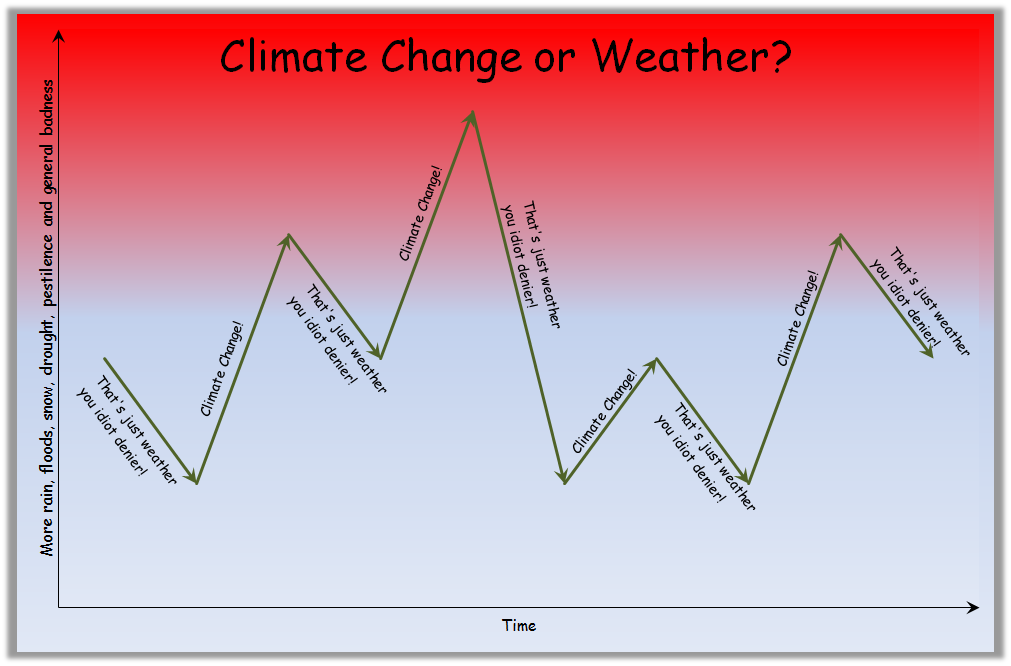
From time to time I see a news story on some piece of scientific research that somewhat weakens the case for taking strong action against global warming. I believe that every time I have seen such a report it was accompanied by a quote from the researchers to the effect that global warming was a serious problem and their work should not be taken as a reason to be less worried about it. They almost certainly believed the first half of that, but their work was a reason to be less worried even if not to stop worrying.

Good people are on the side that believes that warming is happening, is anthropogenic, is a serious problem that needs to be dealt with immediately. Bad people deny one or more of those claims. If that is what all the people who matter to you, such as the fellow members of your profession, believe, and you are so unfortunate as to produce results that strengthen the bad people’s case, it is prudent to make it clear that you are still on the side of the angels. Just as, if you are so unfortunate as to be an honest doctor aware of the evidence in favor of alcohol, it is prudent to make it clear that you have not transferred your allegiance to demon rum.

The obesity crisis … fuelled by iatrogenic public health warnings about certain food groups

Filed under: Bureaucracy, Food, Government, Health, Media — Tags: , , — Nicholas @ 03:00

Here’s The Armchair General with another example of what he calls COGOs – Crisis of Government Origin:

So, after the decades-long crusade against saturated fats, we have a population that has been repeatedly told that fat will kill us. So, many people eschewed fats in favour of salt and sugar. Which, apparently, are also bad for us.

But without saturated fats, remember, people are not going to feel sated. So, what is likely to happen? Well, just what did happen — never feeling full, people feel hungry throughout the day so eat continually through the day: a behaviour known as “snacking”

    Nutritionists believe many people are obese not because they binge on fatty main meals but because they indulge in constant grazing throughout the day without even realising it.

    This pattern, dubbed “auto-eating”, involves resorting to snacks and treats at the slightest indication of hunger.

Or, rather, people always feel hungry because they have been told to avoid saturated fats. And they snack on chocolate bars and biscuits and small things that provide a pleasant sugary boost.

Combine this with an increasingly sedentary population — both at home and at work — and other comforts (such as central heating which leads to fewer calories being expended on maintaining body temperature), and…

BOOM! You have an obesity problem.

And now — nearly seventy years after some arrogant doctors used some extremely dodgy studies to enhance their reputations, we now know that what we were told about the harms associated with saturated fats was all absolute bollocks.

And so, once again, we can demonstrate another Crisis of Government Origin (COGO), ably assisted by the arrogant fuckers of the medical profession.

Unfortunately, the government legislation is already in place, and it will take at least three years for the fuck-nuggets in politics to catch up — if they ever do. After all, they are going to have to undo decades of medical advice, government food advice, leaflets, bus adverts, nutritionist training, and social conditioning.

Just another reason why governments should stay the hell out of our private lives. Such up — and fuck off.

What is a HUMP Yard?

Filed under: Business, History, Railways, USA — Tags: , — Nicholas @ 02:00

V12 Productions
Published 24 Oct 2022

Hump yards are amazing pieces of engineering that allow railroads to use gravity to sort cars and build trains. Of course, not all railroad equipment can be humped.
(more…)

QotD: The Calgary Stampede

Filed under: Cancon, Government, Quotations — Tags: , , , — Nicholas @ 01:00

… there are those in Calgary who, in their most secret of hearts, would love to abolish the Stampede and wipe out its memory. The Stampede, to the Calgarian, is both curse and blessing, and when all the curses are thrown into the balance, you cannot help being impressed by their weight. For starters, the Stampede kills. And we’re not just talking about the chuckwagon races. There’s a scholarly paper from 2006 in which statisticians from Montreal and Edmonton wrote about their efforts to develop forecasting models for EMS demand in Calgary. They found the numbers don’t quite work unless the Stampede is included as a variable: ambulance and rescue services become so busy during the 10-day party that it throws all the equations off-kilter.

The Stampede itself is very solvent, earning an operating surplus of $3.1 million in 2011, but if the costs and benefits to the city were all counted up, the former would have to include the salaries of the thousands of high-paid Calgary professionals who see major parts of their calendar devoured by Stampede preparations and aftermath. It would include the tacit outright cancellation of nine-to-five work for the duration of the Stampede at key Calgary oil patch companies and law firms. And it would include the arms race of conspicuous consumption that sees expensive entertainers like Cirque du Soleil and the Tragically Hip brought into town for exclusive corporate affairs at Stampede time.

Meanwhile, the perceived importance of the Stampede has led to the entrenchment of a shadowy, at least slightly sinister relationship between the city’s government and the Stampede board. It took a long skein of bailouts, sweetheart deals and low-interest loans from Calgary’s city government to make the show what it is today. Over the decades, Calgary has repeatedly used its power to borrow cheaply to fund Stampede expansions, and even expropriated land outright in the Victoria Park neighbourhood in the late 1960s when some homeowners were reluctant to sell. Because the city technically owns the Stampede grounds, the Stampede pays no property tax on them. Conflicts of interest are rampant and ignored, except on those occasions when the Stampede tries to pull off some particularly ambitious business or real estate deal. Local media know they must tread carefully before broadcasting or printing anything even slightly negative about the various entities that sustain the city’s totemistic event.

Of course the Stampede has made the name of Calgary world-famous. Calgarians abroad are as sure to be asked about their Stampede as Edmontonians are to be asked about their big mall. But the marketing effect is double-edged. Andy Sayers, a communications specialist for a mid-sized Calgary oil-patch-service company, says he and others in his field “struggle with themselves” every year as the bacchanal he compares to “the last days of Rome” approaches. “I spend most of my time trying to inculcate the image of our firm as ultra-modern thought leaders”, he says. “Then I have to create the invitations to our Stampede event. It’s tricky to wrap yourself in the blanket of the Stampede — to offer a down-home feeling to visitors without making yourselves look small-time.”

Colby Cosh, “The Calgary Stampede at 100: It may be over-the-top and at times dangerous, but Calgary’s Wild West show is the best party in Canada”, Maclean’s, 2012-07-06.

« Newer PostsOlder Posts »

Powered by WordPress