
I see that Prince Abdul-Rahman bin Abdulaziz al Saud died the other day. If you’re having trouble keeping track of your Saudi princes, well, I don’t blame you. Unlike the closely held princely titles of the House of Windsor, the House of Saud is somewhat promiscuous with the designation: there are (at the time of writing) over 10,000 Saudi “princes” running around the country — and, in fact, at this time of year, more likely running around Mayfair and the French Riviera, exhausting the poor old blondes from the escort agencies. I believe that’s Abdul-Rahman at right, although to be honest all Saudi princes look alike to me, except that some wear white and others look very fetching in gingham. As I once remarked to Sheikh Ghazi al-Ghosaibi, the late cabinet minister, he was the only Saudi I knew who wasn’t a prince.
Abdul-Rahman was a longtime Deputy Defense Minister, whose catering company, by happy coincidence, held the catering contract for the Defense Ministry. The first Saudi prince to be educated in the west, he was a bit of a cranky curmudgeon in later years, mainly because of changes to the Saudi succession that eliminated any possibility of him taking the throne. But he nevertheless held a privileged place as the son of Ibn Saud, the man who founded the “nation” and stapled his name to it. When I say “the son”, I mean a son: Ibn Saud had approximately 100 kids, the first born in 1900, the last over half-a-century later, in 1952, a few months before ol’ Poppa Saud traded in siring for expiring.
Abdul-Rahman’s mother was said to be Ibn Saud’s favorite among his 22 wives — or, at any rate, one of the favorites. Top Five certainly. She also had the highest status, because she bore him more boys — seven — than any other other missus. They’re known as the Sudairi Seven or, alternatively, the Magnificent Seven. She also gave him seven daughters. They’re known as the seven blackout curtains standing over in the corner. This splendidly fertile lady’s name was Hussa bint Ahmed, and she was Ibn Saud’s cousin once removed and then, if I’m counting correctly, his eighth wife. But she’s a bit like the Grover Cleveland of the House of Saud — in that he’s counted as the 22nd and 24th President of the United States, and she’s the eighth wife and also either the tenth or eleventh. He first married her when he was 38 and she was 13. But he divorced her and then remarried her. In between their marriages she was married to his brother, but Ibn Saud was a sentimental lad and never got over his child-bride-turned-sister-in-law, so he ordered his brother to divorce her.
Don’t worry, though: In the House of Saud, it’s happy endings all round. Two of their daughters wound up marrying two of the sons of another brother of Ibn Saud. The Saudi version of Genealogy.com must be a hoot: “Hey, thanks for the DNA sample. You’re 53.8 per cent first cousin, and 46.2 per cent uncle.”
Mark Steyn, “The Son of the Man who Put the Saud in Saudi Arabia: Prince Abdul-Rahman bin Abdulaziz al Saud, 1931-2017”, Steyn Online, 2017-07-18.
October 7, 2023
QotD: Saudi princes
October 6, 2023
Farnborough Airshow – 1959 (in colour)
spottydog4477
Published 28 Dec 2009Farnborough Airshow – 1959 (in colour)
QotD: The “Marian Reforms” to Roman legions
In short, the things that are supposed to have happened here are:
- (Tactical-Organizational) A shift in battle tactics from the two-century maniple (c. 120 men) to the six-century cohort (c. 480 men) as the primary tactical unit on the battlefield,1 as well as the primary organizational unit of the Roman army. Elements of the older Polybian legion persist in names and titles.
- (Organizational) A shift from poorly paid conscript soldiers drawn from Rome’s propertied class (the assidui) drawn up through the dilectus to the use of volunteers drawn from Rome’s property-less poor (the proletarii or capite censi) who served as effectively professional soldiers, lacking any other means of subsistence.
- (Organizational) The practice of granting land and/or citizenship to Roman soldiers on discharge as a regular feature of Roman service.
- (Organizational) The end of the light infantry velites and Roman citizen cavalry (the equites) as part of the legion, as a product of the next point making such wealth distinctions unimportant.
- (Logistical) The introduction of state-supplied equipment (in place of self-supplied equipment) which enabled the mass-recruitment of the proletarii, as they no longer needed to be able to afford their own equipment, as part of a reform ascribed by some scholars to Gaius Gracchus (trib. 123-2).
- (Equipment) The introduction of a new design of pilum with a wooden rivet designed to break on impact with enemy shields (Plut. Mar. 25).
- (Equipment) The prioritization of the aquila, the eagle standard, over other standards in the legion (Plin. NH 10.16), often framed as the aquila fully replacing these other standards.
- (Equipment) The introduction of the furca, a Y-shaped pole for carrying the soldier’s pack (the sarcina), leading to better legionary logistics.
As we’re going to discuss, some of these things happened – but not because of Marius – and some of them didn’t happen at all. So how on earth did this idea of a big “Marian Reform” end up so pervasive in how we (used to) understand the Roman army of this period? The answer really has a lot to do with gaps (lacunae) in our sources. For the early second century, we have two really quite good sources on Roman military activity, Livy and Polybius. But both give out by mid-century,2 leaving us relatively blind until Julius Caesar‘s comentarii (de Bello Gallico and de Bello Civili) suddenly give us a massive infusion of information as we can see Caesar’s army functioning often in quite minute detail.
And we see what seem to be quite different armies! Caesar is using cohorts as tactical and operational units, rather than maniples. His armies don’t seem to have any citizen cavalry in them and they seem to be very loyal to him; he’s using a lot of non-citizens in auxiliary roles in a way that we know will become very standard in the imperial period (eventually making up half the army by Tiberius‘ reign). And indeed, moving forward, the legions of the early empire end up a lot more visible to us, both because of the literary evidence (Tacitus!) and also because, as they become more stationary on fixed frontiers, they leave forts and inscriptions and other evidence we can see far more clearly than the ever-moving armies of the Roman Republic.
And then into that there is Gaius Marius. Remember that our sources in this period are a bit patchier, without a strong continuous narrative (but with a lot of sources so we generally have someone for most of it). But Marius gets a lot of focus because of his roles in the civil wars and his spectacular seven consulships, and the one thing we are told quite clearly about him is that in 107 when he raised his first consular army he broke tradition by accepting volunteers from the proletarii (Sall. Iug. 86.1; Plut. Mar. 9.1). The temptation then to see that substantial change (which, to be clear, our sources are exaggerating for reasons I’ll discuss in a moment) as connected to all the other changes from the “Polybian” legion to the “Caesarian” legion and thus to assume that Marius is doing all of them, reading far too deeply into a few lines of Sallust and Plutarch (the latter not generally a particularly good guide on military affairs).
And I should note finally at the outset that this all also plays into a tendency in our sources generally: ancient authors really like narratives where one particular aristocrat can be credited with making major reforms or innovations as an expression of their particular virtue. We’ve talked about this with Lycurgus, but it shows up consistently with rulers supposedly introducing new weapons and new practices as big, top-down reforms that, on closer inspection, turn out to be gradual changes we can see signs of happening over quite some time. It’s an understandable if irritating bias of habit for authors whose purpose in writing is the education of aristocrats on how to be leaders – every big change has to be a product of the character and leadership of aristocrats (even when it wasn’t). Plutarch, especially, of all ancient authors, loves these sorts of just-so stories and guess who we are heavily reliant on for the life of Gaius Marius? But until relatively recently, historians were often far more willing to accept these sorts of just-so stories than they should have been (in part because late 19th and early 20th century historians shared some of those same assumptions about elite leadership and in part because singular reforms make for compelling stories).
Bret Devereaux, “Collections: The Marian Reforms Weren’t a Thing”, A Collection of Unmitigated Pedantry, 2023-06-30.
1. Note that the size of the century has changed, from 60 to 80 as well.
2. Polybius’ history, already incomplete as we have it, ends, while Livy’s continuous narrative which originally went through the first century cuts out almost completely in 167, leaving us with just summaries of his work.
October 5, 2023
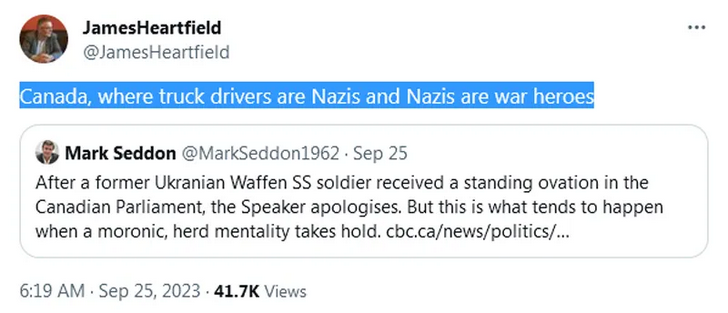
“Canada, where truck drivers are Nazis and Nazis are war heroes”
Donna LaFramboise on the “Coutts Four” — bona fide political prisoners of the Canadian state:

Gord Magill has a lengthy article over at Newsweek titled Meet the Four Men Being Held as Political Prisoners in Canada. These individuals are jointly accused of conspiring to murder police officers during a protest in Coutts, Alberta around the same time that the Freedom Convoy truckers were in Ottawa.
That’s a very serious charge, of course, but evidence appears scarce. I’ve not personally investigated this matter, but a former Toronto police detective named Donald Best has. In July, he outlined a long list of concerns, in addition to pointing out that “Everybody makes bail in Canada” — including the man “currently accused of the first degree murder of Toronto Police officer Jeffrey Northrup”.
Yet the Coutts men — three of whom have no criminal record — have been held without bail for nearly 600 days. Since they are legally innocent until proven guilty, this is horrifying.
As Gord writes in Newsweek, we are a country in which hard-working Canadians are called Nazis by the same Prime Minister whose government recently recognized an actual Nazi with a standing ovation in the House of Commons. What a strange state of affairs.
After speaking to each of the Coutts four, Gord provides a wealth of new info about them. These are working class guys — a power lineman, the owner of a small construction company, a master electrician, and a contractor. Three of them have children as young as 9, 10, and 11. Gord says only two of them “knew each other prior to their arrest”. It’s difficult to imagine a more unlikely group of cop-murder conspiracists.
The Soviet Spies who Kickstarted the Nuclear Arms Race
World War Two
Published 4 Oct 2023Last episode we saw Klaus Fuchs steal details of the American atomic bomb for the Soviet Union. But he’s only one component of a much bigger conspiracy. Today, Astrid introduces you to the mysterious web of Soviet atomic spies. Their work changed our world forever.
(more…)
From Hilaire Belloc’s sailboat to your nearest international airport terminal
The most recent review at Mr. and Mrs. Psmith’s Bookshelf considers Hilaire Belloc’s The Cruise of the “Nona”:
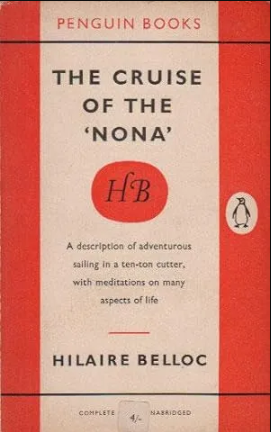
Late in the May of 1925, around midnight, Hilaire Belloc climbed into a tiny boat and put out to sea so that he would have some time to think. The sea gives ample time to think, especially if like Belloc you disdain the use of a motor. Some wag once jested that sailing is like being at war: long stretches of boredom punctuated by moments of abject terror. I suppose in some sense that’s correct, but give me the boredom of the sailboat any day over the boredom of the trench, the boredom of the cubicle, the boredom of endless doomscrolling.
Sailing is productive boredom, and seems unusually well calibrated for causing the mind to wander in interesting or delightful or just plain ridiculous directions. Maybe it’s the stimulating effects of the wind in your face and the smell of salt in the air, or maybe it’s the weird altered state of consciousness that comes from staring at the ocean. I think it’s because sailing is the human condition in miniature. It places you perfectly-balanced on a knife’s edge between agency and helplessness, and in so doing it both spurs the mind to activity and gives it space to relax and reflect.1
[…]
Anybody who’s travelled extensively in the third world has seen the modern version of this. There’s nothing intrinsic to being a reformer or a liberalizer that makes you an agent of American power, and yet … there’s a better than even chance that you are. After a while these people all blend together — the idealistic students, the LGBT activists, the NGO staffers, the embassy employees recruited from amongst the locals. They come from a hundred nations, from every conceivable race and religion, and yet something invisibly and inexorably molds them all into the same shape, like iron filings lining themselves up in the presence of a powerful magnet.
Soon they have American souls, and divided loyalties to match. The local regime panics and views them as an internal enemy, which only furthers their alienation from their motherland and their flight into the bosom of Global America. Most empires rule primarily though influence, not coercion, and this class of people is one of America’s most powerful weapons for maintaining and extending its hegemony.
A related phenomenon is the awful sameness that is slowly taking over the whole world. Perhaps your cruise ship docks at a dozen ports over the course of its journey, and every one of them looks exactly the same — the same tiki bar with the same sign, the same shops selling the same ornamental kitsch probably all made in the same factory. You aren’t visiting a place, you’re visiting a psychic manifestation of the Buffetverse, another outpost of Margaritaville, a Potemkin seaport with frozen daiquiris. You all know what I’m talking about. We make fun of it all the time, because cruise ships are for chuds. But it doesn’t just happen with cruise ships.
The cancer usually starts in an international airport. Form follows function, so it’s superficially reasonable that every airport on earth should look and feel exactly the same. But the real reason is that it follows in the wake of the kinds of people who fly into those airports, praising the broadening effects of foreign travel whilst terraforming everything they touch until it resembles the “arts district” of a midsize American city, replete with distressed wood finishes, gravid with craft beers. Real foreignness would cause these people to recoil in shock, or to demand a peacekeeping intervention. It’s not unusual for the imperial functionary class to be parochial, but what’s surreal about ours is how they combine the blinkered innocence of a farm boy with an ideology of weary cosmopolitanism.
None of this was as far along when Belloc took his little cruise, but the seeds had been planted, and he could feel in his bones that something horrible lay across the horizon. So he fights it the only way he knows how — by noticing and celebrating everything distinctive and local and weird about every place he visits. No island is too small for him to mention by name and recall a ghost story or two associated with it. No village is too commonplace for him to remark on the habits, physiognomy, and vices of the people who live in it. It’s the same spirit as that which animates Chesterton’s essay on cheese, but applied to a hundred hamlets and fishing ports, a paean to the regional diversity and distinctiveness that was already slipping away.
1. Oh hey, it’s the focused-mode and diffuse-mode of cognition! The best way to think deeply about anything is to toggle between them.
The Great War: Its End and Effects, Lecture by Prof Margaret MacMillan
McDonald Centre
Published 25 Jan 201922 January 2019, “How far did the Versailles Treaty make Peace?”, Professor Margaret MacMillan, Warden of St Antony’s College, Oxford. The lecture was sponsored by Christ Church Cathedral and the McDonald Centre for Theology, Ethics, and Public Life, Oxford.
QotD: The Wuhan Coronavirus pandemic was a “propaganda masterpiece”
Dr. Miller goes on to say, “I know a lot about propaganda, and this is unprecedented in the history of mass persuasion. There has never been anything like this because this is global. This has never happened before. We had Stalin’s crimes … We had Hitler’s aggression and the Holocaust. We had 911 and the ‘War on Terror’. None of those actually begin to compare to what we have now because what we have now is planetary. It’s worldwide.”
Dr. Miller does not call the CV19 bioweapon/vax a genocide. He says it is really a global democide. Meaning everyone and anyone is being murdered with the CV19 bioweapon/vax. Dr. Miller says, “My Substack is called ‘Died Suddenly’. I started it in February of 2022 when I noticed many, many people were dying suddenly for no given reason. In the history of obituaries, certainly in the United States, that is unprecedented. Obituaries always tell you why somebody died. Even if the person is very, very old, you have a cause of death. Now, all kinds of people are dropping dead for no reason and often very young … We do a weekly overview with as many pictures of these people as possible. This is the point. There are many statistical claims of the numbers of people who are dying … But as Stalin said, ‘One death is a tragedy, a million deaths is a statistic’. This is brutal, cynical wisdom, and he was absolutely right. If you read 1 million people starved in Ukraine, you say that’s too bad. If you look at page after page after page of people’s faces and names with the names of their survivors, it’s not so easy to shrug off.”
Greg Hunter, “CV19 – A Propaganda Masterpiece – Mark Crispin Miller”, USAWatchdog, 2023-06-10.
October 4, 2023
“John Adams said that a republican constitutional structure didn’t guarantee republican virtue in government”
Chris Bray reflects on the 17th amendment to the US Constitution in light of the appointment of California’s new senator:

California Governor Gavin Newsom speaking at the 2019 California Democratic Party State Convention in San Francisco, California on 1 June, 2019.
Photo by Gage Skidmore via Wikimedia Commons.
… the Senate was supposed to be the national storehouse of wisdom, restraint, discipline, and worldly experience. You may already be seeing that we wandered away from this idea at some point.
The 17th Amendment, ratified in 1913, gave voters the power to directly elect senators, reducing the influence of state legislatures and opening the upper house to mass media popularity contests. The 16th Amendment — “Congress shall have power to lay and collect taxes on incomes” — was ratified the same year, a one-two punch of Progressive centralization of power.
The democratizing and centralizing character of the 17th Amendment gave us a parade of powerful idiots that culminated in John Fetterman, passing through Mazie Hirono and the professional Ted Baxter impersonator Sheldon Whitehouse, so it looks like a failure. But we’ve just run an experiment, thanks to Dianne Feinstein’s white-knuckled grip on her personal status, and the results are … interesting.
The California legislature, in its infinite wisdom, has given the governor the unilateral authority to appoint Feinstein’s replacement, so we’re not quite seeing the exact duplicate of the original constitutional design for the Senate. But we’re seeing something like it: a senator chosen by something other than the popular vote, elevated to the Senate after selection by a longtime state official who has deep personal familiarity with the pool of people who might do the job. You know, a statesman.
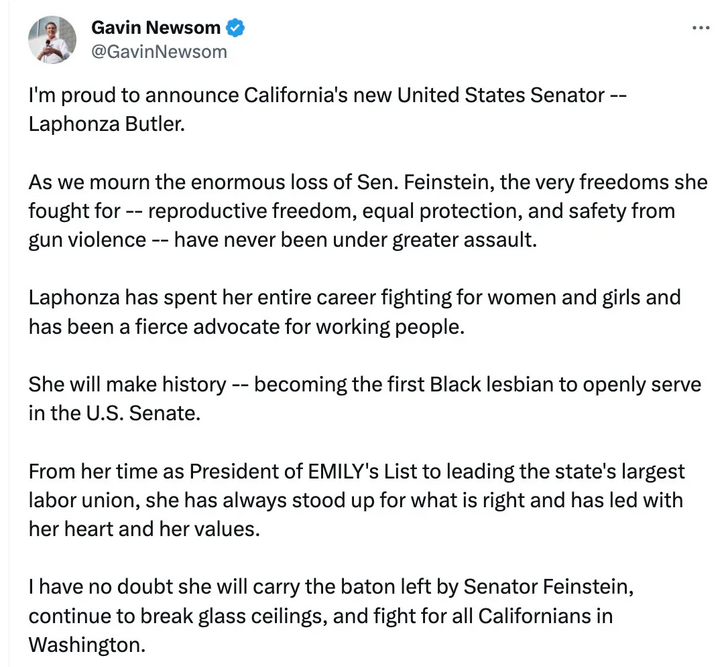
Newsom’s choice for Feinstein’s seat is almost miraculous in its awfulness, an appointment distinguished by cravenness and sleazy insiderism. Naming a new senator from a state with 39 million people in it, he has chosen the Maryland resident Laphonza Butler — who has never held any elected office anywhere.
Butler is a career activist and party hack, an SEIU official who went on to run the abortion PAC EMILYs List. She is, in other words, one of the people whose function in life has been to raise money for the Democratic Party. She’s an ATM, and she’s never been anything else. She’s being appointed to the United States Senate without having ever convinced any voters anywhere to elect her to anything, and she’s rising to the upper house of the national legislature with no experience of any kind in any relevant field. Advice and consent on foreign policy? Confirmation of judicial nominees? Well, she has experience raising money for candidates, so. It’s a straight payoff: generate cash for the party for twenty years, get a free high-status ride in the Senate.
Here’s how Newsom explains the choice:
She’s a black lesbian who gives us money, end of statement. California’s idiot politicians find the choice exciting.
Paris under the Swastika – Collaboration and Resistance – On the Homefront 019
World War Two
Published 3 Oct 2023Occupied Paris, a paradoxical city of banality and brutality, of resistance and collaboration. Join Anna as she takes you on a tour of the city from occupation, the establishment of the Pétain regime and collaboration, the growth of resistance, and finally liberation. But the story doesn’t end there and into the 21st century, the city of lights is haunted by its occupation.
(more…)
Douglas Murray – “Canada today looks like a nation of ignoramuses”
Writing in the National Post, Douglas Murray flays the Canadian Parliament for their shameful ignorance put on display by publicly honouring a former Waffen SS officer:
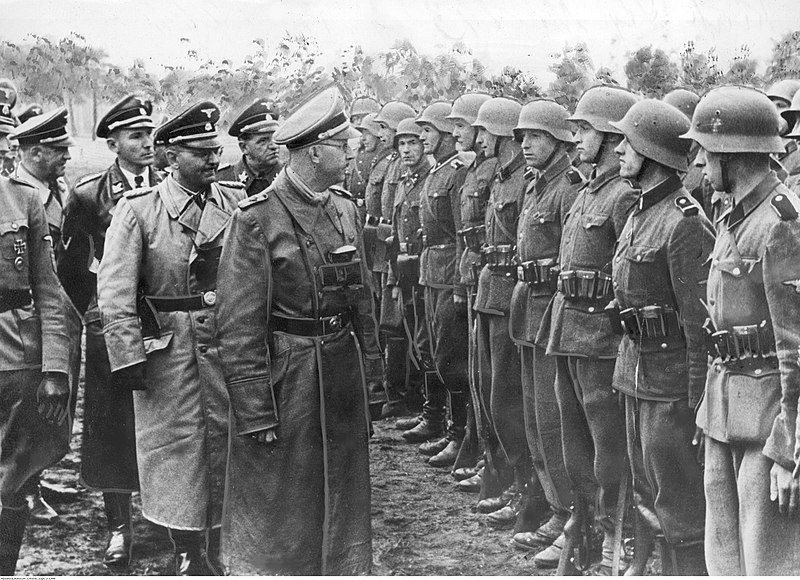
Reichsführer Heinrich Himmler (in the foreground) visiting the 14th Grenadier Division of the Waffen SS “Galizien” in May 1943.
Narodowe Archiwum Cyfrowe photo via Wikimedia Commons.
Perhaps I should say straight away that I love Canada. Some of my best friends are Canadian. That minimal throat-clearing aside, let me say — as a friendly outsider — that Canada today looks like a nation of ignoramuses.
The incident in Parliament the other week is just one case in point. Standing ovations are very rare things. They should be very special things. When a whole House stands to applaud someone they had better be very sure who they are applauding.
I know that Speaker Anthony Rota has now resigned. But here is the thing. Anybody who knows anything about the Second World War knows that if you were fighting the Soviets in Ukraine in the 1940s you were most likely fighting with the Nazis. It does not require a fine-tuned expert in the era to know this. Almost anybody could have guessed this. If almost anyone knew anything.
It seemed to be the assumption not just of Speaker Rota but of the whole Canadian Parliament that there existed in the 1940s some proto-anti-Putin fighting force and that the great cause of this moment has some direct lineage back to the fight of the 1940s. Ukrainian President Volodymyr Zelenskyy almost certainly guessed this. But it was the Canadian Parliament who was hosting him, the Canadian Parliament who embarrassed him and the Canadian Parliament who have handed the most magnificent propaganda victory to the Kremlin. In a war which Putin pretended to start in order to “de-Nazify” Ukraine, how much help has Canada given by your entire Parliament standing to applaud an actual Nazi?
What makes this worse is that this all comes after a period in which Prime Minister Justin Trudeau has been perfectly happy to call decent, ordinary Canadians Nazis. To use measures like the de-banking of his critics in moves that have horrified most of the other democracies in the West. When a bank in my country of birth — Britain — was recently found to have de-banked a politician (Nigel Farage) for what turned out to be political reasons not only did the head of the bank resign, but politicians in Britain from across the political system condemned the bank. Such moves are unlikely to be taken by another bank in Britain again. But in Canada it seems to be perfectly acceptable, because at any time the Canadian prime minister and deputy prime minister can claim that their critics are homophobes, xenophobes, racists, Nazis, misogynists and all of the rest.
The world — especially America — has looked on in horror as the Canadian government has tried to curtail speech in the country, and looked on with ever-more horror as Canadians seem willing to go along with this. It seems to be the view of the Canadian authorities that they are capable of deciding at the merest glance who is and is not allowed to speak, what is and is not acceptable speech, what any Canadians can and cannot read and who is and who is not a “Nazi”. These being the same authorities who apparently cannot even perform the most basic Google searches on their guests.
I know that Canadians often like to look down on Americans. But as someone who spends most of his time in America I can tell you that it is the American public who now wonder at what on earth is happening with our neighbour in the north.
Last Gasp of the German Maxim: the Air-Cooled MG 08/18
Forgotten Weapons
Published 7 Jun 2023The MG 08/18 was developed at the very end of World War One as a lighter alternative to the MG 08/15. It used an air-cooled barrel, and between not needing water and having lighter parts it managed to weigh about 6 pounds less than the 08/15. Only a few hundred appear to have been produced before the end of the war, and they were not used by the German military during the Weimar era (the Mg 08/15 was). The 08/18 barrel jacket served as the basis for the MG34 barrel shroud, interestingly.
Thanks to Limex for giving me access to this very rare gun to film for you!
(more…)
QotD: The Witchburning and the “Mandate of Heaven”
So they burned witches. The “European Witch Craze” of the 15th century has been a feminist bugbear for a long time, and one must naturally assume that pretty much all modern scholarship on it is uber-politicized hooey1, but it’s clear that there really were a lot of witch burnings in Germany in the 1400s. All that free-floating anxiety has to land somewhere, and since it’s pointless to blame the Margrave — he of the one decrepit castle and three square miles of territory — “witches” are a prime target. See also “the Period of the Wars of Religion” — is it any surprise that the most famous witchcraft stuff came from Germany just before the Reformation, or France in the depths of the religious wars, or England around the Civil War?
Clearly something is wrong with the universe – the Mandate of Heaven has been lost, not by any individual ruler necessarily, but by society. “Purity spirals” are also characteristic of these periods, and they quickly spiral out of control — see e.g. the Anabaptist Commune at Munster, or of course the Puritans.
Speaking of, the most famous-to-Americans example is the Salem Trials, and here we see all the trends converge. Not that the Puritans of Plymouth Bay would be so hubristic as to claim the Mantle of Heaven for themselves — Puritans were nothing if not ostentatiously self-effacing — but claim it they did, in deed if not in word, since Plymouth Bay was the closest thing one will ever get to a theocracy this side of Calvin’s Geneva (they burned their “witches”, too). And they just as clearly lost the Mandate — economic dislocations, a devastating Indian war brought about largely by their own hubristic incompetence, even a plague.
The aftermath of all this is fascinating. COVID, of course, is our new witch panic, and feel free to prognosticate on our current situation based on the life of Cotton Mather. The colony’s hottest young intellectual superstar in 1693, he went all-in on “spectral evidence” and the like, and by 1700 he was a joke on both sides of the Atlantic. So, too, with “critical race theory” and all the rest. There’s a racial awakening happening, kameraden, no doubt about that, but it has nothing to do with the eggheads’ fantasies. Those are just witch panics, and while witch panics are devastating to those caught in them, the wheel always turns sooner than later …
Severian, “Witch Trial Syndrome”, Rotten Chestnuts, 2021-01-27.
1. Which was also true of earlier scholarship, most famously Miss Murray’s The Witch-Cult in Western Europe, which is Marxist economics-level disproven, but still fervently believed by “Wiccans” everywhere.
October 3, 2023
“Just play safe” is difficult when the definition of “safe” is uncertain
David Friedman on the difficulty of “playing safe”:
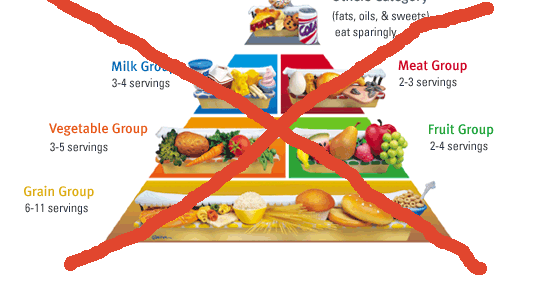
It’s a no brainer. Just play safe
It is a common argument in many different contexts. In its strongest form, the claim is that the choice being argued for is unambiguously right, eliminates the possibility of a bad outcome at no cost. More plausibly, the claim is that one can trade the risk of something very bad for a certainty of something only a little bad. By agreeing to pay the insurance company a hundred dollars a year now you can make sure that if your house burns down you will have the money to replace it.
Doing that is sometimes is possible but, in an uncertain world, often not; you do not, cannot, know all the consequences of what you are doing. You may be exchanging the known risk of one bad outcome for the unknown risk of another.
Some examples:
Erythritol
Erythritol was the best of the sugar alcohols, substitutes tolerably well for sugar in cooking, has almost zero calories or glycemic load. For anyone worried about diabetes or obesity, using it instead of sugar is an obvious win. Diabetes and obesity are dangerous, sometimes life threatening.
Just play safe.
I did. Until an research came out offering evidence that it was not the best sugar alcohol but the worst:
People with the highest erythritol levels (top 25%) were about twice as likely to have cardiovascular events over three years of follow-up as those with the lowest (bottom 25%). (Erythritol and cardiovascular events, NIH)
A single article might turn out to be wrong, of course; to be confident that erythritol is dangerous requires more research. But a single article was enough to tell me that using erythritol was not playing safe. I threw out the erythritol I had, then discovered that all the brands of “keto ice cream” — I was on a low glycemic diet and foods low in carbohydrates are also low in glycemic load — used erythritol as their sugar substitute.
Frozen bananas, put through a food processor or super blender along with a couple of ice cubes and some milk, cream, or yogurt, make a pretty good ice cream substitute.1 Or eat ice cream and keep down your weight or glycemic load by eating less of something else.
It’s safer.
Lethal Caution: The Butter/Margarine Story
For quite a long time the standard nutritional advice was to replace butter with margarine, eliminating the saturated fat that caused high cholesterol and hence heart attacks. It turned out to be very bad advice. Saturated fats may be bad for you — the jury is still out on that, with one recent survey of the evidence concluding that they have no effect on overall mortality — but transfats are much worse. The margarine we were told to switch to was largely transfats.2
“Consumption of trans unsaturated fatty acids, however, was associated with a 34% increase in all cause mortality”3
If that figure is correct, the nutritional advice we were given for decades killed several million people.
1. Bananas get sweeter as they get riper so for either a keto or low glycemic diet, freeze them before they get too ripe.
2. Some more recent margarines contain neither saturated fats nor transfats.
3. “Intake of saturated and trans unsaturated fatty acids and risk of all cause mortality, cardiovascular disease, and type 2 diabetes: systematic review and meta-analysis of observational studies”, BMJ 2015; 351 doi: https://doi.org/10.1136/bmj.h3978 (Published 12 August 2015)
Narcissism
Rob Henderson discusses the psychology of narcissistic individuals:
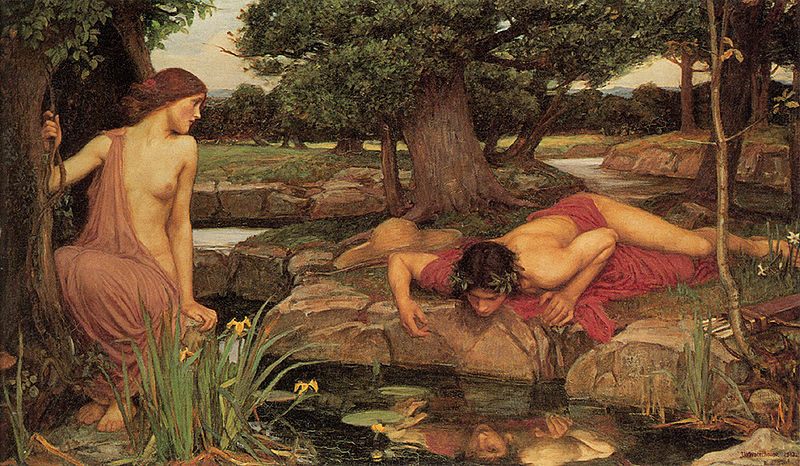
“Echo and Narcissus” by John William Waterhouse, 1903.
Oil painting from the Walker Art Gallery via Wikimedia Commons.
One of my favorite blogs from the Before Times was The Last Psychiatrist. He is most known for his writings on narcissism. When I discovered him in 2015, I read through most of his archive over the course of a few weeks. You can read my review of his book here.
On narcissistic injury and narcissistic rage:
A narcissistic injury occurs when the narcissist is confronted with the reality that he is not the main character in his movie … The worst thing that could happen to a narcissist is not that his wife cheats on him and leaves him for another man … He’s still the main character in his movie; it was a romantic comedy but now it’s a break-up film … The worst thing that could happen to a narcissist is that his wife cheats on him secretly and never tells him, and she doesn’t act any differently towards him, so that he couldn’t even tell. If she can do all that, that means she exists independently of him. He is not the main character in the movie. She has her own movie and he’s not even in it. That’s a narcissistic injury … But all narcissistic injuries lead to rage … The violence serves two necessary psychological functions: first, it’s the natural byproduct of rage. Second, the violence perpetuates the link, the relationship, keeps him in the lead role. “That slut may have had a whole life outside me, but I will make her forever afraid of me.” Or he kills himself — not because he can’t live without her, but because from now on she won’t be able to live without thinking about him. See? Now it’s a drama, but the movie goes on. So if you cause a narcissist to have a narcissistic injury, get ready for a fight.
Psychological researchers have found that there are two categories of narcissist:
- Grandiose narcissists: Dominant, extraverted, overconfident, exploitative, egotistical, low emotional distress. This is the version of narcissism people tend to be most familiar with.
- Vulnerable narcissists: Self-centered, introverted, defensive, resentful, high emotional distress. Psychologists sometimes refer to them “hidden” or “shy” or “covert” narcissists because they don’t self-promote the way the grandiose types do.
Grandiose narcissists enjoy seeking any kind of attention. Their positive self-image is resistant to criticism. They always think they’re amazing no matter what people say.
In contrast, vulnerable narcissists have mixed feelings about seeking attention. They are overly excited at the prospect of positive feedback but excessively sensitive to negative feedback. They have a high opinion of themselves but this high opinion can be thwarted if the external world does not validate it.
Both types tend to be exploitative, hold high opinions of themselves, and see themselves as deserving of special treatment.
Compared to grandiose narcissists, vulnerable narcissists are more sensitive to insults, ruminate more about perceived unfairness, and report more anger when they do not receive what they think they deserve. Although vulnerable narcissists require external feedback to maintain their sense of self, they are often dissatisfied with the feedback they receive.


