
Real Time History
Published May 17, 2024Only five years after the end of WW2, the major nations of the world are once again up in arms. A global UN coalition and an emerging Chinese juggernaut are fighting it out in a war that will see both sides approach the brink of victory — and defeat.
(more…)
September 16, 2024
Who Really Won The Korean War?
Comments Off on Who Really Won The Korean War?
QotD: The origins of Marmite
The story of Marmite begins in the late 19th century when a German scientist, Justus Freiherr von Liebig, discovered that the waste product from yeast used in brewing beer could be made into a meaty-flavoured paste which was completely vegetarian. He also produced bouillon, a meat extract which kept well in jars without needing refrigeration. This eventually became the product known as Oxo.
In 1902 the Marmite Food Extract Company was formed in Burton upon Trent, two miles from the Bass brewery which had been there since 1777. Yeast is a single-cell fungus originally isolated from the skin of grapes, used in brewing, winemaking and baking since ancient times. I have read somewhere that the yeast Bass used was descended from the original batch employed since its inception, endlessly reproducing itself right up to the present time.
The waste product from brewing was transported to the Marmite factory, where salt, enzymes and water were added to the slurry before it was simmered for several hours then poured into vats ready for bottling.
The product was an instant hit and within five years a second factory had to be built in Camberwell Green, south London. Marmite was given a huge boost with the discovery of vitamins. It was found to be a rich source of vitamin B, deficiency of which was responsible for the condition beriberi which afflicted British troops during the Great War. They were subsequently issued with Marmite as part of their rations. In the 1930s the folic-acid-rich product was used to treat anaemia in Bombay mill workers, and malnutrition during a malaria epidemic in Ceylon, now Sri Lanka.
Alan Ashworth, “That Reminds Me: My mate Marmite”, The Conservative Woman, 2024-06-05.
Comments Off on QotD: The origins of Marmite
September 15, 2024
The Occupation of Japan Begins – a WW2 Epilogue Special
World War Two
Published 14 Sep 2024The war is over and the occupation of Japan has begun. The country has largely been destroyed by Allied bombs, and shall be rebuilt, physically, economically, and even governmentally. But what will the new government be? What shall become of the Emperor? Who is to actually do the occupation? Today we look at all this and more.
(more…)
Comments Off on The Occupation of Japan Begins – a WW2 Epilogue Special
My Man Godfrey (1936) with William Powell and Carole Lombard
The Film Detective
Published Nov 15, 2018During the height of the Great Depression, a scavenger hunt party game brings a pair of spoiled sisters, Irene and Cornelia Bullock (Carole Lombard and Gail Patrick) to a city dump looking for a “forgotten man”. They find down-and-out hobo Godfrey Parks (William Powell), who accompanies one of the sisters back to the party to be presented as a scavenger hunt find, and ends up warily accepting her offer to become the family butler. Irene falls for Godfrey, but is unaware of his mysterious past. Nominated for six Academy Awards, My Man Godfrey might be the screwiest of all screwball comedies.
Director: Gregory La Cava
Writers: Morrie Ryskind, Eric Hatch
Starring: William Powell, Carole Lombard, Alice Brady, Gail Patrick, Eugene Pallette, Jean Dixon
Comments Off on My Man Godfrey (1936) with William Powell and Carole Lombard
QotD: “Primordial” Marxism
Inconveniently, the only place this ever actually happened was in a Communist country – Poland – in 1981. I’m not going to get into the complicated historiography of how the Soviet Revolution itself failed to fit the causal sequence Marx expected; consult any decent history. What’s interesting for our purposes is that capitalism accidentally solved the immiseration problem well before then, by abolishing Marx’s proletariat through rising standards of living – reverse immiseration.
The most forward-thinking Marxists had already figured out this was going to be a problem by around 1910. This began a century-long struggle to find a theoretical basis for socialism decoupled from Marxian class analysis.
Early on, Lenin developed the theory of the revolutionary vanguard. In this telling, the proletariat was incapable of spontaneously respond to immiseration with socialist revolution but needed to be led to it by a vanguard of intellectuals and men of action which would, naturally, take a leading role in crafting the post-revolutionary paradise.
Only a few years later came one of the most virulent discoveries in this quest – Fascism. It is not simplifying much to say that Communists invented Fascism as an escape from the failure of class-warfare theory, then had to both fight their malignant offspring to death and gaslight everyone else into thinking that the second word in “National Socialism” meant anything but what it said.
During its short lifetime, Fascism did exert quite a fascination on the emerging managerial-statist elite. Before WWII much of that elite viewed Mussolini and Hitler as super-managers who Got Things Done, models to be emulated rather than blood-soaked tyrants. But Fascism’s appeal did not long survive its defeat.
Marxists had more success through replacing the Marxian economic class hierarchy with other ontologies of power in which some new victim group could be substituted for the vanished proletariat and plugged into the same drama of immiseration leading to inevitable revolution.
Most importantly, each of these mutations offered the international managerial elite a privileged role as the vanguard of the new revolution – a way to justify its supremacy and its embrace of managerial state socialism. This is how we got the Great Inversion – Marxists in the middle and upper classes, anti-Marxists in the working class being dismissed as gammons and deplorables.
Leaving out some failed experiments, we can distinguish three major categories of substitution. One, “world systems theory”, is no longer of more than historical interest. In this story, the role of the proletariat is taken by oppressed Third-World nations being raped of resources by capitalist oppressors.
Though world systems theory still gets some worship in academia, it succumbed to the inconvenient fact that the areas of the Third World most penetrated by capitalist “exploitation” tended to be those where living standards rose the fastest. The few really serious hellholes left are places (like, e.g. the Congo) where capitalism has been thwarted or co-opted by local bandits. But in general, Frantz Fanon’s wretched of the Earth are now being bourgeoisified as fast as the old proletariat was during and after WWII.
The other two mutations of Marxian vanguard theory were much more successful. One replaced the Marxian class hierarchy with a racialized hierarchy of victim groups. The other simply replaced “the proletariat” with “the environment”.
Eric S. Raymond, “The Great Inversion”, Armed and Dangerous, 2019-12-23.
Comments Off on QotD: “Primordial” Marxism
September 14, 2024
Sten MkIII: A Children’s Toy Company Makes SMGs
Forgotten Weapons
Published Jun 5, 2024Lines Brothers was a company in the UK that made sheet metal childrens’ toys prior to the war. When production of the Sten guns began, Lines Bros was a parts subcontractor. Their engineers analyzed the design alongside the machinery the company had available and redesigned a version of the Sten that they could make very quickly and cheaply in-house, by replacing the tube receiver with a rolled and spot-welded piece of sheet steel. Their first order came in January 1942, to a whopping 500,000 guns, which were designated the MkIII.
The Sten MkII and MkIII were produced simultaneously, and Lines Brothers was the only producer of the MkIII. Ultimately they got three contracts, although the second one was cancelled before it was completed and the third was never begun. A total of 876,794 MkIII Stens were made by September 1943. Once submachine gun production caught up with British needs, the MkII was found to be the superior of the two designs and only it remained in production.
(more…)
Comments Off on Sten MkIII: A Children’s Toy Company Makes SMGs
QotD: Academia
Severian, “Storytelling Fail”, Rotten Chestnuts, 2021-07-13.
Comments Off on QotD: Academia
September 13, 2024
“The problem [with America] is and has always been the people and their beliefs”
Chris Bray puts on the old biohazard suit and goes wading into the political book section, this time looking at two recent tomes by NeverTrumpers Robert Kagan and Tom Nichols:

Robert Kagan speaking in Warsaw, 2008-04-17.
Photo by Mariusz Kubik via Wikimedia Commons.
If you want to know where we are as a country, get your hands on a copy of Robert Kagan’s new book, Rebellion. Don’t worry, you won’t even need to crack the spine and open it. Kagan, who married the Queen of Eternal War Victoria Nuland and helped found the now defunct neoconservative Project for a New American Century, has written a warning about the dangerous renascence of antiliberalism in American political life: intolerance, a rejection of minority rights, hatred of progress. America is in deep trouble, Kagan warns. We’re close to losing our democracy! You can already see the freshness and originality of his thought.
Flip it. Take the book, turn it around, and look at that back cover, which carries an excerpt from inside, getting right to the meat of the thing. The problem isn’t the media, Kagan concludes. And it isn’t government. It isn’t a problem with institutions at all: “The problem is and has always been the people and their beliefs”. The thing that’s wrong with America is Americans, full stop. The country works brilliantly, except for the existence of the population. Imagine how healthy we would become if we could just get rid of them.
Should you make the mistake of opening the book, your experience will get worse in a hurry. The intellectual muddle is fatal. Here’s Kagan’s summary of the one big problem that runs through all of American history: “A straight line runs from the slaveholding South in the early to mid-nineteenth century to the post-Reconstruction South of the late nineteenth and early twentieth centuries, to the second Ku Klux Klan of the 1920s, to the Dixiecrats of the 1940s and 1950s, to Joseph McCarthy and the John Birch Society of the 1950s and 60s, to the burgeoning Christian nationalist movement of recent decades, to the New Right of the Reagan Era, to the Republican Party of today.”
All of those movements are precisely the same, you see. Ronald Reagan was a latter-day Ben Tillman, the Birchers merely a rebrand for the 1940s Southern Democrats, and Barry Goldwater was a fitting heir to Nathan Bedford Forrest. A shrewd mind is at work here. All, Kagan concludes, were figures representing “antiliberal groups”: “All have sought to ‘make America great again,’ by defending and restoring the old hierarchies and traditions that predated the Revolution.” The American Revolution, he means. The Dixiecrats and the Birchers and Reagan and Trump all want to restore Parliamentary supremacy and the landed aristocracy, or … something.
But pretend, for a moment, that Kagan has made some form of coherent statement about American history. He is arguing for the protection of the liberal order, the dignity of the common man and the premise that we’re all created equal. At the same time, he says, the biggest problem with America is … the American people themselves. How do those two claims fit together? What kind of politics can we frame around the dignity and inherent worth of the common man, who is stupid and worthless?
See also, on this theme, anything the former U.S. Naval War College professor Tom Nichols has written in the last decade, such as his warning in Our Own Worst Enemy: The Assault from Within on Modern Democracy that “our fellow citizens are an intolerable threat to our own safety” — a claim that closely mirrors Kagan’s warning about America being plagued by Americans. Consider this framing very carefully: if a threat is intolerable, what do you have to do about it?
Kagan’s base argument sounded better in the original German.
Comments Off on “The problem [with America] is and has always been the people and their beliefs”
Fiction should have heroes, not merely the morally ambivalent “heroes” modern writers prefer
Tom Knighton is nostalgic for some of the books and movies of his youth, which often had an actual hero you could root for:
Somewhere along the way, fiction started changing.
In my childhood, the nihilism that seems to be so common today wasn’t really a thing. We had grand adventures with heroes who might not have been perfect but were still heroes.
Today, we have a lot of fiction where no one is really the good guy. Rings of Power has been trying to humanize the orcs, making all the good races of Middle Earth darker than they were. Game of Thrones saw just about every truly heroic character killed while so many of the despicable characters lasted until the end.
And that’s a problem. Why?
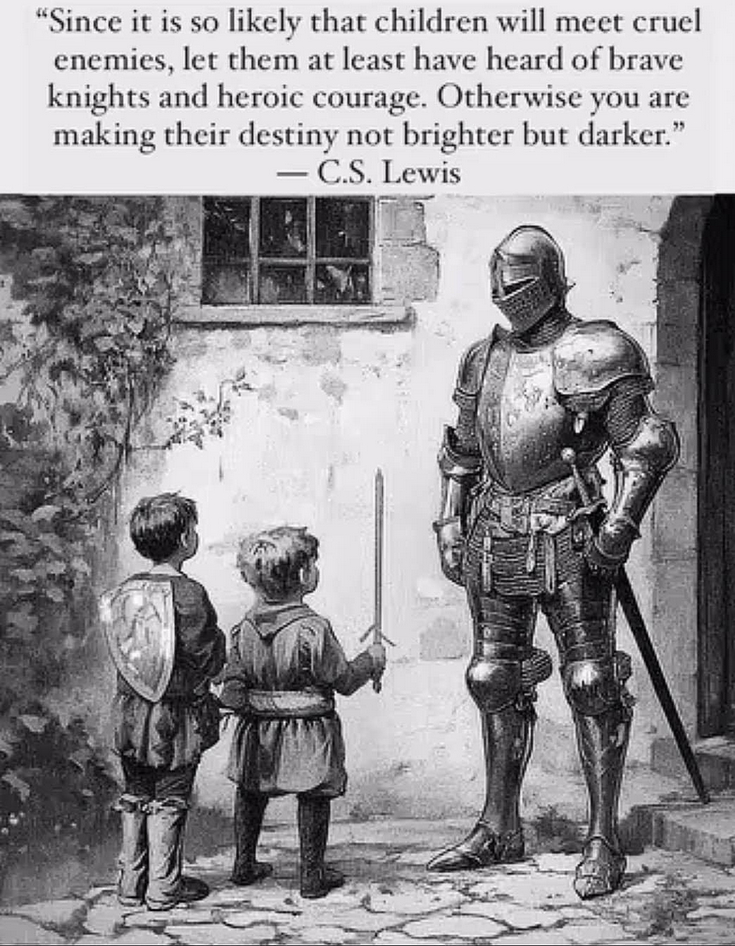
Well, let’s start with this bit from C.S. Lewis:
Now, I grew up in the era of Rambo and John McClain. I had tough-guy heroes and I also had those that were just regular folks thrust into bad situations.
But there were always good guys and there were always dark forces at work.
The world is more muddied than that, sure, but entertainment doesn’t have to reflect reality perfectly. I mean if that were true, how did Lord of the Rings do so well? Elves and orcs and uruk-hai aren’t exactly real, now are they? Neither are hobbits, Jedi, terminators, or any of a million other fictional creations.
Yet what existed in all of those stories were good guys fighting to put down the evil that arose.
As Lewis argues, it taught my generation and those before and right after mine that cruel enemies can be defeated.
Today, though, we see all too many stories where the enemies prevail, where good fails to triumph over evil, and evil is allowed to remain.
For a while, there was a certain amount of shock value to that. This was when this was the exception rather than a normal thing you would see. It was that moment at the end when you realize the good guy lost despite their best efforts, that revealed at the end that the hero who sacrificed himself to kill the bad guy failed to actually kill him.
Comments Off on Fiction should have heroes, not merely the morally ambivalent “heroes” modern writers prefer
Recreating the Last Meal of Ötzi the Iceman
Tasting History with Max Miller
Published Jun 4, 2024City/Region: Ötztal Alps
Time Period: c. 3230 B.C.Over 5,000 years ago, before the pyramids and Stonehenge, Ötzi the Iceman was killed in the Ötztal Alps near the border between modern day Austria and Italy. His body was soon covered with snow and ice, which helped preserve it for thousands of years until it was discovered in 1991.
There is a lot of speculation about what Ötzi’s life was like and what the circumstances surrounding his death were, but one thing that is known for sure is what his last meal was.
Researchers found red deer and ibex meat, einkorn, and ferns in Ötzi’s mummified stomach. This is just one version of what his last meal might have been, and while it’s plain compared to modern tastes, there’s a surprising amount of flavor in the meat and einkorn cakes, though I wouldn’t judge you if you added a bit of salt or seasoning.
(more…)
Comments Off on Recreating the Last Meal of Ötzi the Iceman
QotD: Cargo cult thinking and status seeking
Flashing actual stacks of money is the crudest possible status display, and I can 99.9% guarantee you that anyone who does something like this on social media is engaged in some kind of criminal behavior. People who obtain wealth by honest means are not prone to such shameless ostentation, and this kind of cargo-cult behavior exhibits a level of stupidity that is not usually compatible with economic success.
Robert Stacy McCain, “The Cargo Cult Mentality”, The Other McCain, 2019-12-20.
Comments Off on QotD: Cargo cult thinking and status seeking
September 12, 2024
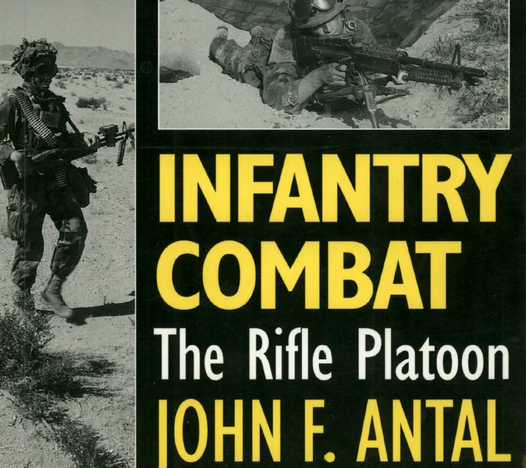
Infantry Combat: The Rifle Platoon by Col. John F. Antal
At anarchonomicon, kulak reviews Antal’s book from the 1990s:
There are a lot of weird experimental products in the world of Military Publishing … there’s no other subject for adults where professional volumes are published in the same format as children’s picture books where every other page is a full page image so that when you hold it in your hands you always have 50% picture/50% text, and yet that’s exactly how military atlases are formatted. They’re amazing!
Likewise military identification/vehicle guides, book length manuals or ship tours, or regimental campaign histories and memorabilia … These push the limits of the publishing medium, because they have to. The subject matter is complex, technical, tactile, risky, and multifaceted enough that aside from experimental horror novels or the vanishingly rare graphic novel … Nothing pushes the limits of paper so completely … indeed there are almost certainly some military history books that rival the experimental horror novel House of Leaves in terms of sheer medium breaking complexity.
And while Colonel John F. Antal hasn’t produced the most complex example of this… He may have produced one of the most experimental.
Infantry Combat: The Rifle Platoon is a simultaneous Military Tactics and Leadership crash course and semi-political argument about the wrong lessons that were learned from Operation Desert Storm (it was first published in 1995) in the format of a “Choose your own Adventure” novel.
And my god does it work. Its argument is incredibly well presented, its intangible concepts and ethos is really strongly conveyed, it teaches an impressive amount of theory and application despite NOT being a textbook of theory or doctrine …
And It just has no conceivable right to work as well as it works.
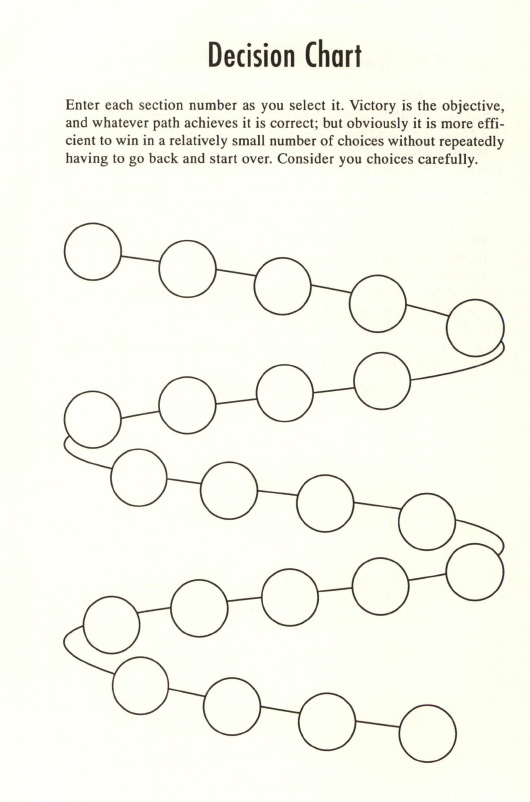
It actually does push the format of the “Choose your own adventure novel” incredibly far in terms of complexity. I’ve never seen one before that included several pages of charts just to track your decisions down the matrix.
The setup is primally simple.
You are US Army 2nd Lieutenant Davis. While it isn’t your first-First day, it is nearly your first after getting to the unit, and a very unlucky one at that.
You graduated West Point, attended ranger school, and this is day 2-3 of your first command.
America’s army is in an unnamed country and temporarily outnumbered as it is invaded, however they’re just dumb Arabs … its fine. Will probably get settled at the negotiating, and beside you have air dominance and the technological marvel of the US Military behind you.
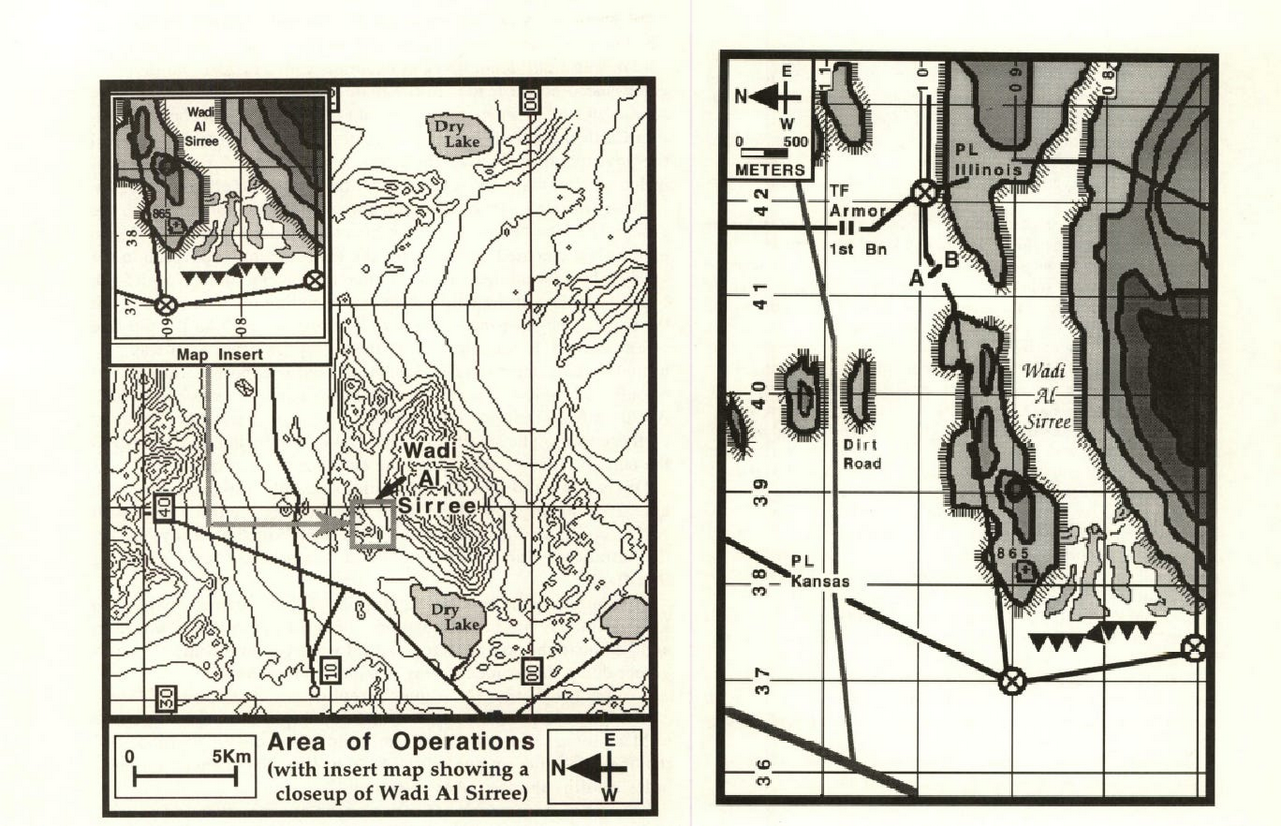
Note this map is oriented 90 degrees off. North is on the left, east at the top. The triangles are a tank ditch meant to stop armoured vehicles (like a massive dry moat)
The main force isn’t going to be attacking you.
Your lone platoon of just 38 will be defending Wadi Al Sirree, a narrow mountain pass separate and a little ahead of your main force.
You might think this is a little exposed but they’re almost certainly going to exploit the open country with their armor and proceed up the dirt road to hit the 1st armoured battalion and the rest of your company. This is the fastest way they can proceed and exploit their momentary numbers in the theater before the rest of the US military arrives. Your pass isn’t valuable much at all for a ground invasion, and besides there’s a massive tank ditch and other obstacles that will deter the enemy. Your troops are really just there as an auxiliary to the land and the ditch. Maybe spot some artillery fire.
But hey! This is a great opportunity to see what war in the late 20th/early 21st century is about up close and personal. Just keep your head down, let your NCOs who have the experience do their jobs, and you’ll get a nice combat medal on your second day on the job. Just try not to get in people’s way.
As you can guess, the job of a Infantry commander is probably a bit more complex than that …
Comments Off on Infantry Combat: The Rifle Platoon by Col. John F. Antal
PIAT: The weapon that could punch through steel but needed nerves to match
Forces News
Published Jun 3, 2024Tanks, soft-skin vehicles, bunkers and buildings — the PIAT could deal with them all.
The PIAT — Projector, Infantry, Anti-Tank — was a British weapon that proved its worth during the Normandy Landings.
It was introduced in 1943, first seeing action in Tunisia, but was used to good effect in France, and despite its name it was a true multi-purpose weapon.
(more…)
Comments Off on PIAT: The weapon that could punch through steel but needed nerves to match
QotD: The collapse of early civilizations in Mesopotamia
Robert Adams, whose knowledge of the early Mesopotamian states is unsurpassed, expresses some astonishment at the Third Dynasty of Ur (Ur III), in which five kings succeeded one another over a hundred-year period. Though it too collapsed afterward, it represented something of a record of stability.
Scott thinks of these collapses not as disasters or mysteries but as the expected order of things. It is a minor miracle that some guy in a palace can get everyone to stay on his fields and work for him and pay him taxes, and no surprise when this situation stops holding. These collapses rarely involved great loss of life. They could just be a simple transition from “a bunch of farming towns pay taxes to the state center” to “a bunch of farming towns are no longer paying taxes to the state center”. The great world cultures of the time – Egypt, Sumeria, China, whereever – kept chugging along whether or not there was a king in the middle collecting taxes from them. Scott warns against the bias of archaeologists who – deprived of the great monuments and libraries of cuneiform tablets that only a powerful king could produce – curse the resulting interregnum as a dark age or disaster. Probably most people were better off during these times.
Scott Alexander, “Book Review: Against The Grain“, Slate Star Codex, 2019-10-15.
Comments Off on QotD: The collapse of early civilizations in Mesopotamia
September 11, 2024
The Korean War Week 012 – Green Light for Incheon – September 10, 1950
The Korean War by Indy Neidell
Published 10 Sep 2024Douglas MacArthur’s brazen plan to land two full divisions far behind enemy lines and sabotage the North Korean logistics finally gets the green light from the President and the Joint Chiefs of Staff, despite the myriad difficulties everyone knows the operation will face. It is to go off next week. In the field, the North Korean offensive against the Naktong Bulge continues, though it seems to be running out of steam, and the UN forces get beefed up as the first British troops to arrive in Korea join the battle line.
Chapters
01:03 Recap
01:23 KPA Offensive and Counterattacks
07:31 JCS Approve Incheon
10:33 Eugene Clark Investigates
13:32 More UN Forces for the fight
15:00 Summary
15:24 Conclusion
18:14 Call to Action
(more…)
Comments Off on The Korean War Week 012 – Green Light for Incheon – September 10, 1950


